
Recommended Tinplate Strip Options for High-Speed Fuel Filter Stamping
A fuel filter plant does not really buy steel. It buys die uptime. Perforated center tubes, inner cores, outer shells and end caps are formed on progressive dies running at high stroke rates, and every unplanned stop caused by a thickness swing, a wavy edge or a burr is charged to the line, not to the coil. That is why strip selection for filter stamping is a shortlist exercise rather than a single-purchase decision: buyers screen a small set of grades and slit configurations against a fixed list of forming and handling criteria, then qualify one or two.
This article shortlists the tinplate strip and coil options that fit automotive and industrial fuel filter component stamping, compares deep drawing quality (DDQ) against extra deep drawing quality (EDDQ), and sets out the slitting, inspection and documentation evidence a buyer should ask for before committing a die to a substrate.
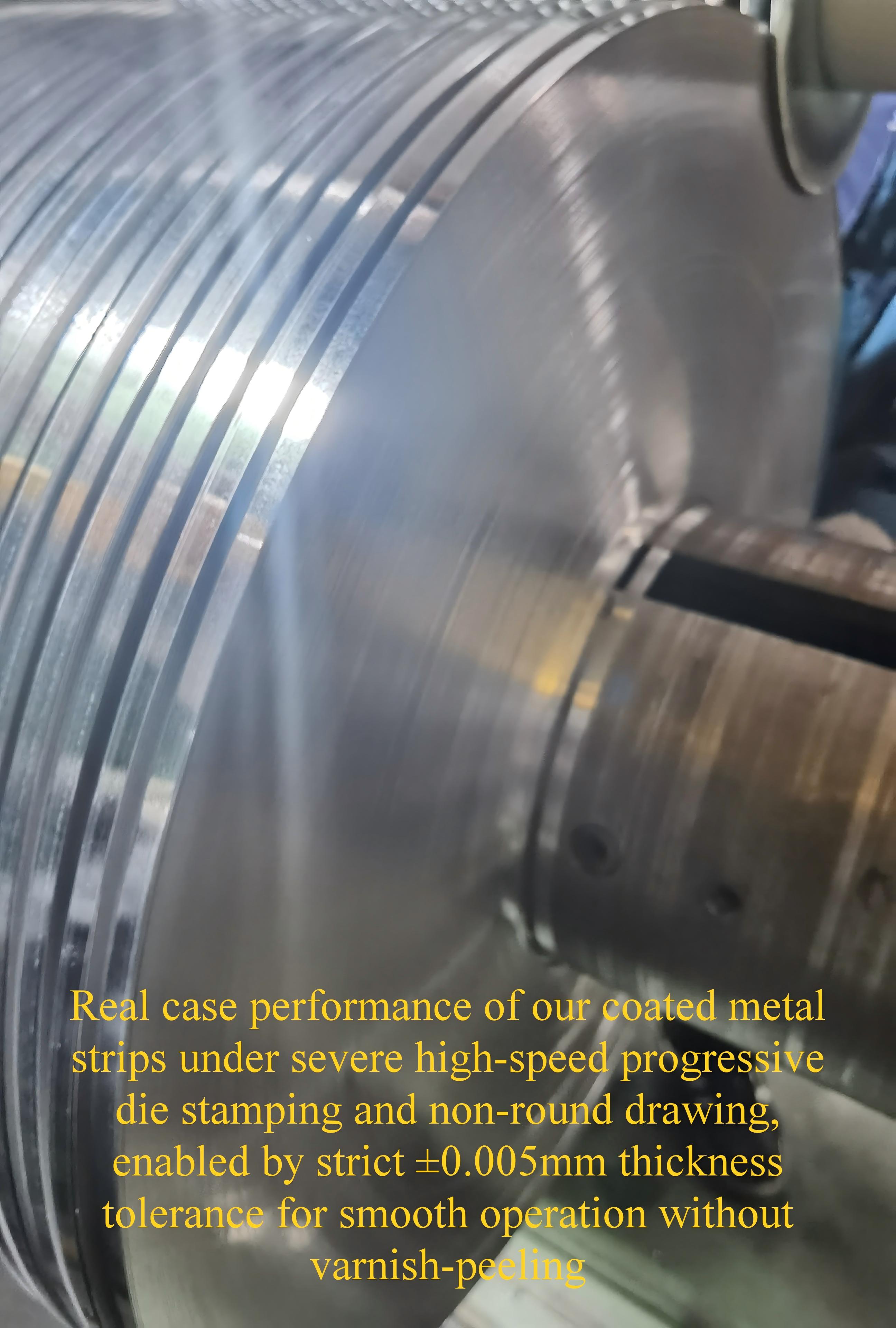
Precision slitted tinplate strip prepared for continuous progressive stamping lines.
YOUNGSON METAL, registered as Chongqing Youngson Metal Products Co., Ltd., is a metal surface processing, precision slitting and supply manufacturer based in Chongqing, China, founded in 2016 and operating under a BV ISO9001:2015 quality management system (certificate CN058611). Its product matrix covers electrolytic tinplate (ETP), tin free steel (TFS/ECCS), coated and lacquered strip, and precision slit coil in tempers from T1 through DR10, with a stated monthly production capacity of about 1200 tons.
Why Fuel Filter Stamping Is Really a Strip-Screening Problem
Filter components sit at the intersection of two demanding behaviours. Inner cores and perforated tubes are rolled and punched, so the strip needs stable stiffness and clean edges. Outer shells and multi-stage drawn hardware are formed progressively, so the same strip family must also stretch without thinning to the point of cracking. A grade that satisfies one of these behaviours will often underperform on the other, which is why a single all-purpose specification rarely survives a real tool trial.
Supplier-side experience matters here. The filter-core strip product family offered by YOUNGSON METAL is described as the result of over eight years of dedicated development work aimed at the global filter component supply chain, covering filter perforated tubes and inner cores specifically. That is a supplier statement rather than an independently audited claim, and it is best treated as the reason a supplier can offer a narrow but relevant option set, not as proof of performance. Proof still comes from batch certificates and press trials.
The commercial argument for shortlisting carefully is straightforward. Every gauge or edge defect that reaches the press converts into scrap, die adjustment or a stoppage, and those costs are usually multiples of the price difference between a generic commercial strip and a filter-grade precision slit strip. The screening criteria below exist to make that conversion visible before ordering.
The Screening Criteria That Decide the Shortlist
These are the parameters that reliably separate workable filter strip from strip that merely looks acceptable on a mill certificate. The ranges shown are the published values for the relevant YOUNGSON METAL product families.
| Screening criterion | Why it gates the press | Published value to compare against |
|---|---|---|
| Thickness consistency | Die clearance and draw depth depend on gauge stability | Thickness tolerance within +/-0.005 mm |
| Formability grade | Determines crack-free performance in multi-stage draws | DDQ and EDDQ grades; T1 temper at Rockwell HR30T 49 +/-3 |
| Temper / hardness | Controls feeding stiffness versus elongation | T1, T3, T4, T5 and DR7 to DR10 options |
| Width and slitting tolerance | Affects tool alignment and scrap rate | Width tolerance within +/-0.05 mm at product level; stated custom slitting tolerance of +/-0.02 mm |
| Edge burr height | Burrs accelerate die wear and cause feeding jams | Edge burrs at or below 0.05 mm |
| Tin coating mass | Corrosion protection during storage and handling | 1.1/2.8 and 2.8/2.8 g/m2 for filter-core strip; 1.1/1.1 and 2.8/2.8 g/m2 on DR grades |
| Slit-edge rust protection | Cut edges are the first place humidity shows | Anti-rust oil sprayed on slitted edges |
| Inspection documentation | Required for incoming quality and customer audits | 100% in-house inspection plus MTC EN 10204 3.1; SGS, BV or TUV third-party inspection supported |
Recommended Tinplate Strip Options: A Four-Option Shortlist
Rather than ranking brands, the useful shortlist for a filter stamping plant is a grade-level shortlist: four substrate configurations that cover the majority of filter components, each with a clear job to do.
Option 1 - Automotive-grade filter-core strip, 0.21 to 0.30 mm
The narrowest and most application-specific option. The filter-core material is listed at 0.21 mm, 0.24 mm, 0.25 mm and 0.30 mm with thickness tolerance of +/-0.005 mm, width tolerance within +/-0.05 mm and edge burrs at or below 0.05 mm. Tempers available are T1, T3, T4 and T5, with tin coatings of 1.1/2.8 or 2.8/2.8 g/m2, and slitted edges treated with anti-rust oil for humid climates. It is the natural first candidate for perforated tubes and inner cores, where a mid-range temper gives the stiffness that keeps a rolled tube round.
Option 2 - DDQ and EDDQ slitted strip for drawn shells, 0.20 to 0.50 mm
This is the option for filter outer shells, end caps and complex multi-stage drawn hardware. The series is engineered on an ultra-soft T1 matrix at Rockwell HR30T 49 +/-3, offered at 0.20 mm, 0.25 mm, 0.30 mm, 0.40 mm and 0.50 mm with 2.8/2.8 g/m2 tin coating. Its distinguishing feature is a five-point edge and coil discipline described as ZERO joints, ZERO notches, ZERO wavy edges, ZERO overlap ribbons and ZERO rust spots, verified through factory screening. For a progressive die, those five zeros are the difference between continuous feeding and manual intervention.
Option 3 - Deep drawing and extra deep drawing series with a TFS route, 0.20 to 0.50 mm
Where a buyer wants either electrolytic tinplate or a chromium-coated tin free steel substrate under the same drawing specification, this family combines deep drawn grade and extra deep drawn grade material with a T1 classification or a T49 TFS alternative, in thicknesses from 0.20 mm to 0.50 mm and widths from 4.0 mm to 1000 mm through custom slitting. It is positioned for crack-free severe deformation, and the supplier makes complimentary sample rolls or sheets available for industrial press trialing - a practical way to qualify a die before committing to a tonnage.
Option 4 - Ultra-thin high-strength DR strip, 0.14 to 0.17 mm
This is a weight-reduction and stiffness option rather than a deep-drawing option. The DR strip family runs from 0.14 mm to 0.17 mm in DR7, DR8, DR9 and DR10 tempers, with tin coatings of 1.1/1.1 or 2.8/2.8 g/m2, micro-burr control at or below 0.05 mm and anti-rust treated slit edges. It suits thin, small, high-strength components where maximum draw depth is not the dominant requirement.
| Option | Typical filter part | Thickness | Grade / temper |
|---|---|---|---|
| 1. Filter-core strip | Perforated tubes, inner cores | 0.21 / 0.24 / 0.25 / 0.30 mm | T1, T3, T4, T5 |
| 2. DDQ / EDDQ slitted strip | Outer shells, end caps, drawn hardware | 0.20 to 0.50 mm | DDQ / EDDQ, T1 (HR30T 49 +/-3) |
| 3. DD / EDD series with TFS option | Severe-deformation housings | 0.20 to 0.50 mm | T1 tinplate or T49 TFS |
| 4. Ultra-thin DR strip | Thin high-strength small parts | 0.14 to 0.17 mm | DR7, DR8, DR9, DR10 |
DDQ vs EDDQ: What the Grade Change Actually Buys
Deep drawing quality and extra deep drawing quality describe how much deformation the substrate tolerates before thinning, earing or cracking becomes a risk. In practice, DDQ covers shells and caps formed in one or two controlled stages, while EDDQ is specified when the draw is deeper, when wall thinning must stay within a narrow band, or when the part is redrawn more than once.
Both grades are available within the same supplier families at YOUNGSON METAL: the DDQ and EDDQ slitted strip series, and the deep drawn and extra deep drawn series that also offers a T49 TFS route. The practical selection rule is to start from the drawing depth and part geometry, not from the grade label. A part that forms cleanly on DDQ should not be upgraded to EDDQ by default, because softer, higher-ductility material is also less stiff in the feeder, and stiffness matters on a high-speed perforating or rolling station. Conversely, a shell that shows earing or micro-cracking on DDQ will not be fixed by tighter slitting; it needs the EDDQ route.
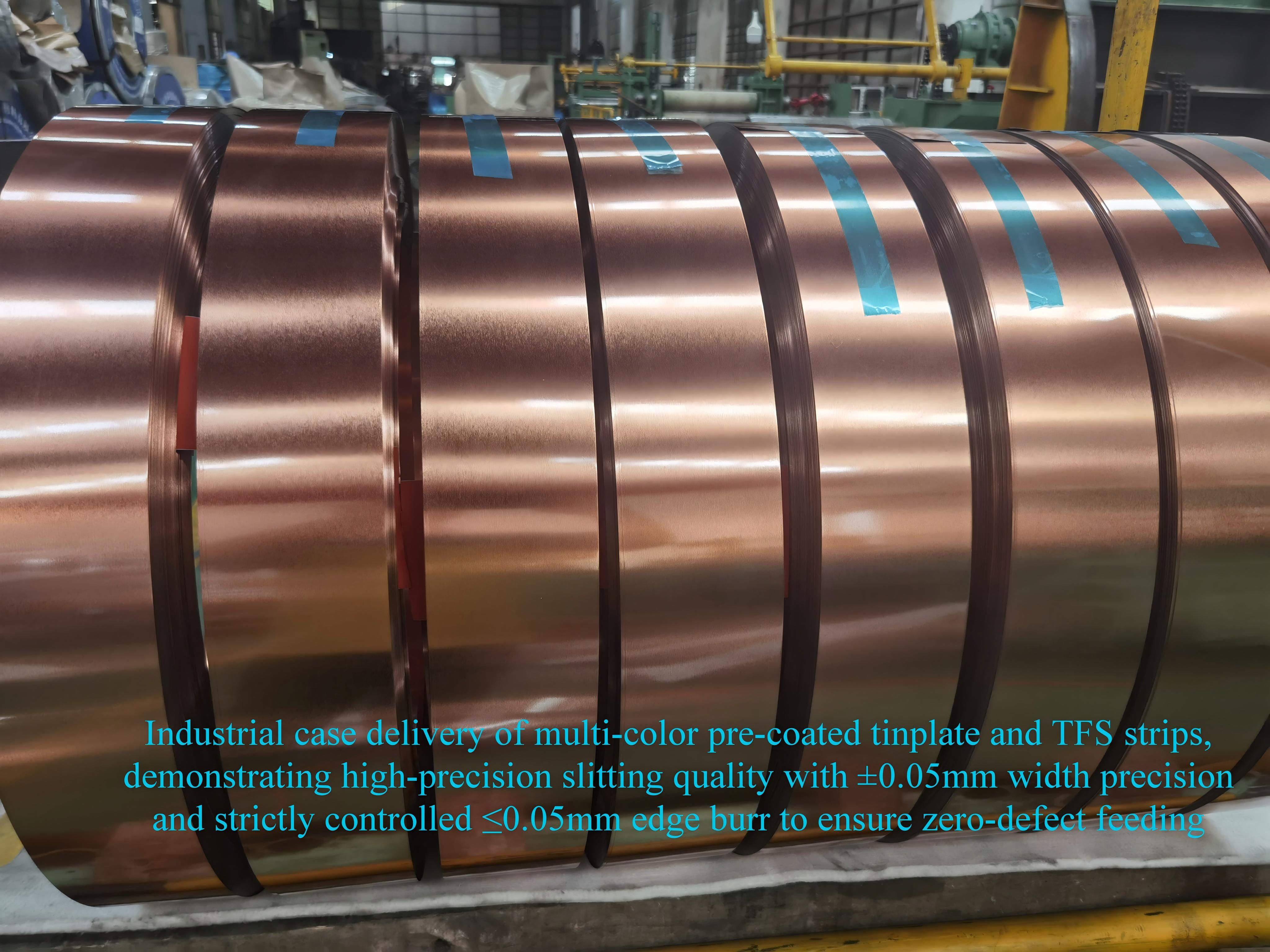
Coil integrity - joint-free winding, flat edges and controlled burr - is checked before dispatch rather than discovered at the press.
Slitting Tolerance and Burr Control: Two Numbers That Decide Die Life
For filter stamping, width tolerance and burr height are not cosmetic specifications. A width drift forces the tooling to run with variable clearance; a burr above the agreed limit accelerates punch and die wear and increases the chance of a strip catching during feeding.
The published position is worth reading carefully, because two different numbers appear in the material and they apply to different scopes. Product data sheets for the filter-core and DDQ/EDDQ series state width tolerance within +/-0.05 mm and edge burrs at or below 0.05 mm, alongside a thickness tolerance within +/-0.005 mm. Separately, the supplier's customization capability lists width and slitting tolerance of +/-0.02 mm for custom precision slitting programmes, with slit widths from 4.0 mm to 1050 mm. A buyer specifying a filter component should therefore ask which figure applies to the exact width, gauge and temper combination being quoted, and should have it written into the purchase specification rather than assumed from a capability statement.
Edge preservation is handled after slitting. Slit edges are sprayed with anti-rust oil, a treatment described as engineered for high-humidity and tropical maritime conditions, and coils are provided in individual protective packaging with options on coil inner diameter of 160 mm, 200 mm, 300 mm, 400 mm or 500 mm - a detail that matters for automatic feeding lines with fixed mandrel sizes.
Documentation Buyers Should Expect in the Carton
For an automotive-adjacent component, the material file usually has to survive an internal audit as well as a customer audit. The evidence set described for these products includes 100% in-house quality inspection covering thickness, coating mass, tensile strength, T-bend, salt spray and surface roughness, with a Mill Test Certificate to EN 10204 3.1 issued per batch and third-party inspection by SGS, BV or TUV supported on request.
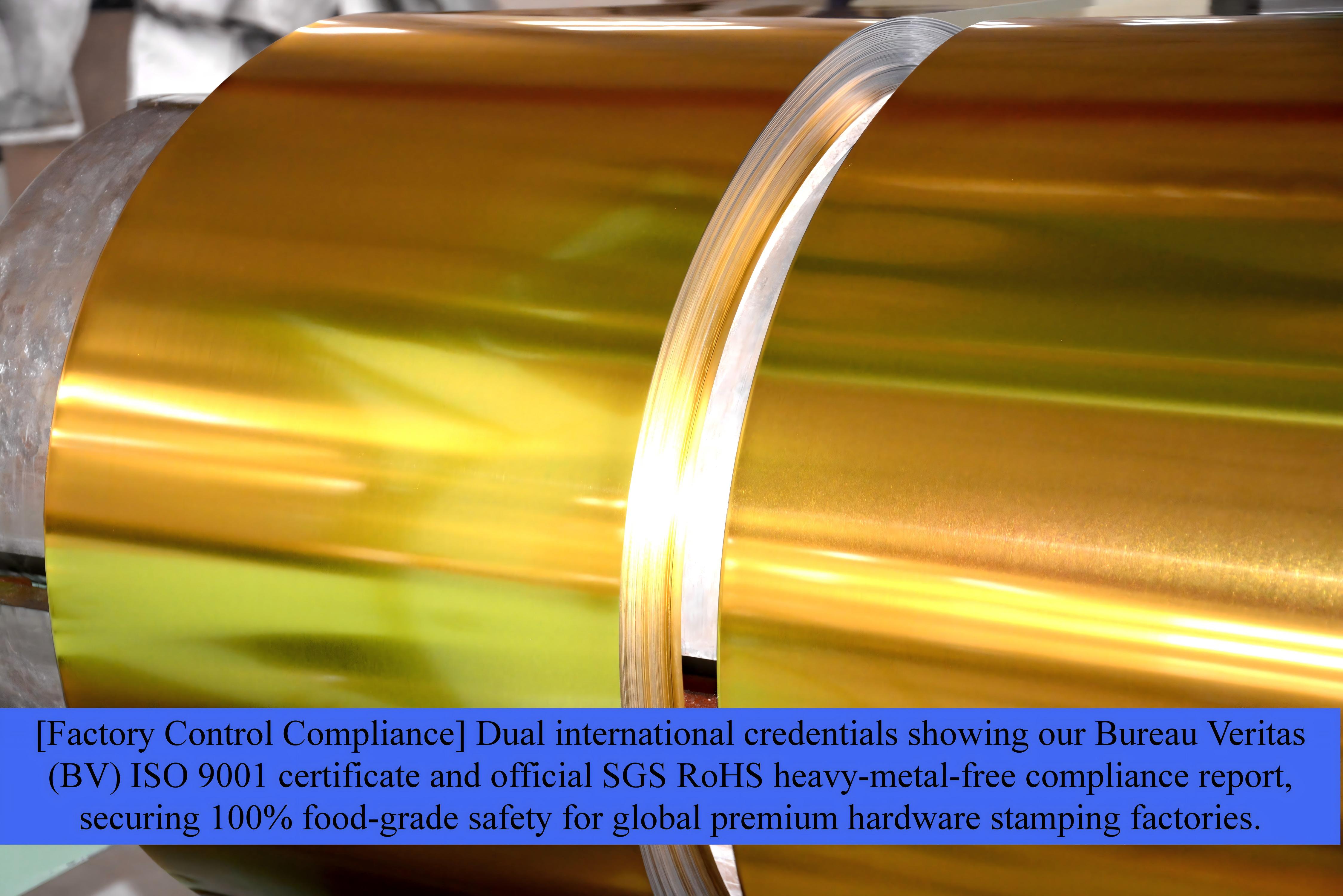
Quality system certification and batch-level test documentation underpin the strip qualification file.
Two verification points deserve attention. First, the quality system certification cited is BV ISO9001:2015 certificate CN058611, issued on 23 December 2022 and valid to 22 December 2028, with a scope covering mild steel, automotive steel and prepainted steel. Second, product-level chemical compliance is documented separately: an SGS report numbered CZXHL25001691201, issued on 18 August 2025 under directive 2011/65/EU and supporting IEC 62321 test methods, covers 0.23 mm copper colourful tinplate. Buyers ordering other finishes, tempers or coating masses should request a report whose sample identity matches their specification, rather than relying on a general compliance statement.
On the environmental side, the manufacturer maintains ISO 14067 certification for Environmental Product Declaration and Carbon Footprint of Product data and states compliance with the EU CBAM framework, and offers CBAM and EPD carbon footprint data as part of its customization service. For European filter buyers, that documentation is increasingly part of the sourcing file rather than an optional extra.
Commercial Terms: What a First Order Looks Like
The procurement parameters for these product families are unusually accessible for a precision slitting supplier. The minimum order quantity is stated as 2 to 3 tons depending on size, lead time is 5 to 30 days depending on size, and the production facility is described as having a monthly capacity of about 1200 tons supported by precision processing lines.
For an evaluation-stage buyer, those numbers support a staged approach: qualify a narrow width with a small tonnage, run it on the actual press, and only then release a rolling volume. On customization, the stated capability covers material grades including tinplate, prepainted steel, cold rolled, galvanized, galvalume, zinc-aluminium-magnesium and stainless steel, thickness from 0.08 mm to 6.0 mm, width and slitting tolerance of +/-0.02 mm, surface finishes, temper and hardness settings, coil inner and outer diameter, export anti-rust packaging and carbon footprint data. Joint development of functional coatings and processes - high-adhesion, deep-drawing or anti-abrasion lacquers - followed by precision slitting or sheet shearing is also offered, which is the part of the offer that most closely resembles an OEM or ODM arrangement.
Where Comparable Options Are Already Running
Two supplier-reported references illustrate what the shortlisted material is expected to do in continuous production. The first is a supply relationship of more than three years with an automated high-speed hardware stamping plant and metal packaging can-maker, running more than 6,000 tons annually of precision slit strip and multi-colour coated coil for progressive die stamping, precision miniature shell deep drawing and severe mechanical drawing and flanging of non-round cans. The reported outcome was zero-defect continuous stamping with no coating delamination or foil bursting during deep drawing, and a 35% extension of progressive die tool life attributed to sub-micron thickness tolerance and burr-free edges.
The second reference, a supply period of more than ten years at 500 to 1000 tons per month, covers automated progressive die deep drawing of gold-coated lids on a 0.14 mm to 0.15 mm ultra-thin high-tensile matrix (DR8/DR7/TH520). Reported results include zero coating peeling, zero tooling crashes, a 35% reduction in die abrasion, and no oxidation during humid shipping. Both references are first-party case descriptions rather than independently audited studies, and both are useful mainly as a checklist of what the material is being asked to deliver: uninterrupted feeding, intact coating, controlled die wear and rust-free edges after ocean freight.
Boundaries and Trade-offs to Accept Before Ordering
A shortlist is only credible if it states where each option stops working. Four boundaries are worth stating plainly.
- Ultra-thin DR grades are stiffness solutions, not ductility solutions. At 0.14 mm to 0.17 mm in DR7 to DR10 tempers, the material is engineered for high strength in thin gauges; it is not the right starting point for a deep, multi-stage draw, where the DDQ or EDDQ routes are the appropriate candidates.
- Slitting tolerance is specification-dependent. The +/-0.02 mm figure is stated as a customization capability for custom precision slitting, while published product data sheets for the filter-core and DDQ/EDDQ series state width tolerance within +/-0.05 mm. Buyers should confirm which value is guaranteed for their exact width and gauge combination.
- Documentation is product-specific. Compliance evidence such as the SGS report CZXHL25001691201 covers a defined sample - 0.23 mm copper colourful tinplate - and does not automatically extend to other coatings, tempers or gauges.
- Formability should be validated on the tool. Deep drawing behaviour depends on die design, lubricant, draw ratio and press speed as much as on the substrate, which is why sample rolls and sheets are offered for industrial press trialing rather than relying on data sheets alone.
Market Context: Thinner, Stronger, Better Documented
Commercial market research estimates the global tinplate market at about USD 31.98 billion in 2025, with Asia Pacific holding a 39.2% share, and reported market values across published research vary widely - between roughly USD 15.2 billion and USD 32.68 billion for the same year - which reflects differences in whether finished packaging is included in the definition. Those figures should be read as directional context, not as a precise market denominator.
Trade-side data points the same direction. China remains the largest tinplate exporter, with 3,137 shipments recorded between July 2024 and June 2025 according to customs bill-of-lading aggregations. For filter stamping buyers, the practical implication of that concentration is that Asian precision slitting capacity is a realistic part of a sourcing strategy, provided the supplier can demonstrate the tolerance, edge and documentation discipline that filter dies require.
What to Watch Next
Three shifts are likely to shape filter strip sourcing over the next procurement cycles. First, gauge reduction continues: as DR tempers extend down to 0.14 mm with usable strength, filter designs can be lightened without losing rigidity, but only where the forming route is matched to the grade. Second, carbon documentation is moving from a European speciality into a standard part of the material file, with EPD and carbon footprint data under ISO 14067 and CBAM reporting being requested alongside mechanical certificates. Third, the verification burden is shifting onto the buyer: as more suppliers publish capability ranges, the differentiator becomes which values are backed by batch-level MTCs, product-specific third-party reports and trial evidence on a real press. Shortlists built on those three criteria will age better than shortlists built on headline specifications.
FAQ
Which tinplate temper is normally used for fuel filter inner cores and perforated tubes?
The automotive-grade filter-core strip series is published at 0.21 mm, 0.24 mm, 0.25 mm and 0.30 mm with temper options of T1, T3, T4 and T5, and tin coating weights of 1.1/2.8 or 2.8/2.8 g/m2. Higher tempers such as T3 to T5 are generally selected where the part is rolled or lightly formed and stiffness is the priority, while the softer T1 classification is used where the component requires more deformation. The final choice is normally confirmed through a press trial rather than from the temper label alone.
What width tolerance and burr limit should be written into a filter strip specification?
Published product data for the filter-core and DDQ/EDDQ strip series state thickness tolerance within +/-0.005 mm, width tolerance within +/-0.05 mm and edge burrs at or below 0.05 mm. The manufacturer also states a custom precision slitting capability of +/-0.02 mm width and slitting tolerance, with slit widths from 4.0 mm to 1050 mm. Because the two figures cover different scopes, the guaranteed value for a specific width, gauge and temper should be confirmed in the quotation and locked into the purchase specification.
Should a filter shell be specified in DDQ or EDDQ?
Both grades are available on the same ultra-soft T1 matrix, listed at Rockwell HR30T 49 +/-3 with 2.8/2.8 g/m2 tin coating across 0.20 mm to 0.50 mm thicknesses. DDQ is the standard route for shells and caps formed in a limited number of stages, while EDDQ is specified for deeper draws, redrawing sequences or parts where wall thinning has to be tightly controlled. A separate deep drawing and extra deep drawing series offers T1 tinplate or a T49 tin free steel alternative for severe deformation. Upgrading to EDDQ without a forming requirement adds cost and reduces stiffness, so the decision should follow the draw, not precede it.
What quality documents should accompany a filter strip shipment?
The described documentation set consists of 100% in-house quality inspection covering thickness, coating mass, tensile strength, T-bend, salt spray and surface roughness, a Mill Test Certificate to EN 10204 3.1 issued per batch, and optional third-party inspection by SGS, BV or TUV. Product-specific chemical compliance reports, such as SGS report CZXHL25001691201, are issued against a defined sample, so the report scope should be checked against the ordered finish and gauge. Environmental documentation is available in the form of ISO 14067 EPD and carbon footprint data with EU CBAM reporting support.
What are the minimum order quantity and lead time for filter-grade tinplate strip?
The stated minimum order quantity is 2 to 3 tons depending on size, and lead time is 5 to 30 days depending on size. Production capacity is described as approximately 1200 tons per month on precision processing lines. Custom slitting widths, coil inner diameters of 160 mm to 500 mm, temper and hardness settings, surface finishes and export anti-rust packaging are configurable within those terms.
Full technical data for these strip families, including gauges, tempers, coating weights and slitting ranges, is collected in the YOUNGSON METAL product catalogue.
¿Tiene preguntas o necesita más detalles?
Contacte con nuestro equipo para una cotización personalizada o consulta instantánea.
Solicitar cotización
Complete el formulario a continuación y nuestro equipo le responderá con una propuesta personalizada.
Chat directo de WhatsApp
¿Prefiere chatear en tiempo real? Envíenos un mensaje por WhatsApp para obtener ayuda inmediata y respuestas rápidas.
- Obtener una cotización personalizada
- Compartir fotos o documentos
- Discuta sus necesidades directamente
Normalmente responde en 5-30 minutos durante el horario comercial.