
Recommended Shortlist: Special-Shaped Seamless Pipe Profiles for Automotive Parts
A practical shortlist of seamless pipe profiles for automotive parts sourcing comes down to five non-round cross-sections — triangle, hexagon, lemon-shaped, octagon and oval — together with the cold-drawn round tube they are drawn from. All of them sit inside a documented supply envelope of 1–100 mm outer diameter, 1–20 mm wall thickness and ±0.1 mm tolerance, and all of them are formed by cold drawing rather than hot rolling. Buyers shortlist these profiles for functional reasons: a non-round section can transmit torque, locate against a mating feature, or replace a machined flat, which removes secondary operations from the finished component.
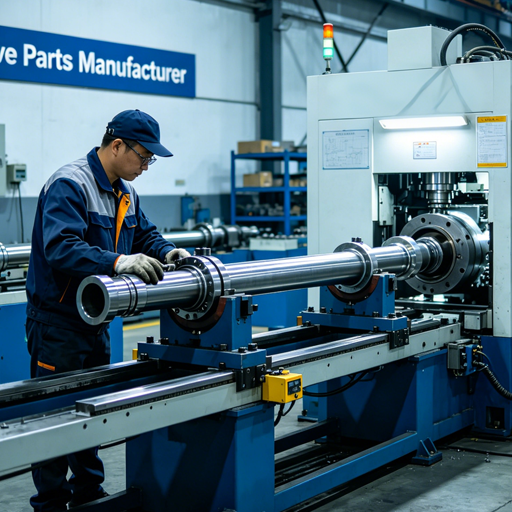
Automotive parts manufacturing is a documented application area for precision cold-drawn seamless tube. Image: FAKESI.
Why Profile Geometry Enters an Automotive Bill of Materials
Round seamless tube remains the default section in automotive machining because it is the most economical to draw and the simplest to inspect: one diameter and one wall thickness largely define the part. The difficulty appears at the interface. Where a component has to resist rotation, engage a keyed or wrench-flat feature, or seat into a shaped housing, a circular section cannot supply that geometry on its own. Engineers then either create the feature afterwards — milling a flat, broaching a spline, turning a stepped profile — or specify a tube whose cross-section already contains it.
Drawing the profile puts the geometry in the mill rather than in the machining centre. That can remove an operation, its fixturing and its handling steps, and it keeps wall thickness distribution consistent around a section that is no longer symmetrical. The trade-off is equally concrete. A profiled section is tied to shaped tooling, it rewards order quantities that justify that tooling, and the geometry has to remain stable through drawing, annealing, straightening and cutting. That is why profile selection is usually settled at sample stage rather than at the purchase-order stage.
Three buyer profiles tend to work through this shortlist: procurement engineers replacing a machined flat on a drive shaft or drive-line tube, product developers looking for a housing or lock component with an anti-rotation feature, and importers building a special-profile line alongside standard round tube. The evaluation question is the same in each case — does the drawn geometry hold, and can the supplier document that it holds?
The Shortlist at a Glance
The profiles below are the special-shaped seamless tubes listed in the FAKESI product range, which also covers standard round, thick-wall, thin-wall, large-diameter, small-diameter, high-pressure and machining grades of seamless tube. The order reflects a sourcing sequence rather than a quality ranking: each section answers a different locating or torque problem, and the correct choice is whichever geometry the mating part drawing already implies.
| Profile family | Section geometry | Typical design intent (verify against part drawing) | Documented supply envelope |
|---|---|---|---|
| Seamless Triangle Pipe | Three flats, constant wall | Anti-rotation location; lightweight shaft sections | OD 1–100 mm; WT 1–20 mm; ±0.1 mm |
| Seamless Hexagon Pipe (external hexagonal, internal round) | Six flats outside, round bore | Gripped or indexed sections; tool and fitting interfaces | OD 1–100 mm; WT 1–20 mm; ±0.1 mm |
| Seamless Lemon-shaped Tube | Lobed section between round and oval | Drive-shaft and PTO shaft tubing; torque transmission | OD 1–100 mm; WT 1–20 mm; ±0.1 mm |
| Seamless Octagon Pipe | Eight flats | Multiple index positions on one tube | OD 1–100 mm; WT 1–20 mm; ±0.1 mm |
| Seamless Oval Steel Pipe | Flattened elliptical section | Shallow envelopes with a continuous outer surface | OD 1–100 mm; WT 1–20 mm; ±0.1 mm |
| Cold Drawn Seamless Pipe (round baseline) | Circular | Turned, ground or machined parts | OD 1–100 mm; WT 1–20 mm; ±0.1 mm |
1. Seamless Triangle Pipe
Seamless Triangle Pipe is a three-flat section drawn with a constant wall. It is normally considered where an anti-rotation location is needed along a shaft, or where a three-point contact section can replace a machined flat. For a buyer, the measurements that matter are flat-to-flat dimension, corner radii and wall thickness at the corners, because the corners are where a drawing operation is hardest to control. Triangle sections are specified inside the same 1–100 mm outer diameter and 1–20 mm wall thickness envelope as the rest of the family, and geometry should be confirmed against the mating drawing rather than against a nominal size alone.
2. Seamless Hexagon Pipe (External Hexagonal, Internal Round)
Seamless Hexagon Pipe — the profile commonly specified as an external hexagonal, internal round tube — places six flats on the outside while leaving a round bore for a shaft, a fastener or a fluid path. The combination is what makes the geometry useful: the outer flats can be gripped, keyed or indexed, while the bore stays round for standard mating components. A hexagonal outer profile cannot simply be ordered by across-flats size. Buyers should state across-flats, across-corners and the bore diameter together, because the relationship between the outer flats and the inner bore is what the forming operation has to hold.
3. Seamless Lemon-shaped Tube
Seamless Lemon-shaped Tube is a lobed profile that sits between a round and an oval section. Lobed sections are widely associated with drive-shaft and power take-off tubing, where torque has to be transmitted through the tube rather than through a keyway, and the documented Italian programme discussed later in this article concerns an agricultural drive shaft application of the same precision tube family. For sourcing, the controlling dimensions are the major and minor section widths and the wall thickness at the lobes, since those are the features that carry the engagement with the mating part.
4. Seamless Octagon Pipe
Seamless Octagon Pipe offers eight flats and therefore more locating positions than a hexagon, with a smaller flat width for the same overall section size. It is usually evaluated where several index positions are needed on the same tube, or where a smoother transition between flats suits the mating part. As with hexagon tube, the across-flats dimension is only one of the numbers a supplier needs; across-corners, corner radii and the tolerance band on each flat determine whether the section will assemble without rework.
5. Seamless Oval Steel Pipe
Seamless Oval Steel Pipe is a flattened elliptical section. It is typically shortlisted where the available envelope is restricted in one direction, because an oval section can carry wall thickness in a shallow space while keeping a continuous outer surface with no sharp corners. For procurement purposes the section is defined by major and minor axis dimensions plus wall thickness, and the tolerance on the minor axis normally governs assembly, since that is the dimension that has to fit inside the mating feature.
Baseline: Cold Drawn Seamless Round Pipe
Cold Drawn Seamless Pipe remains the reference point for every profile above. It is the section that most machining processes are already set up for, it is available across the widest set of listed material grades, and it is the version most often already approved in an existing part programme. A profile shortlist is usually the second step in a sourcing project rather than the first: it makes commercial sense once the round-tube baseline has been established and a specific interface problem remains unsolved.
How Cold Drawing Sets the Profile
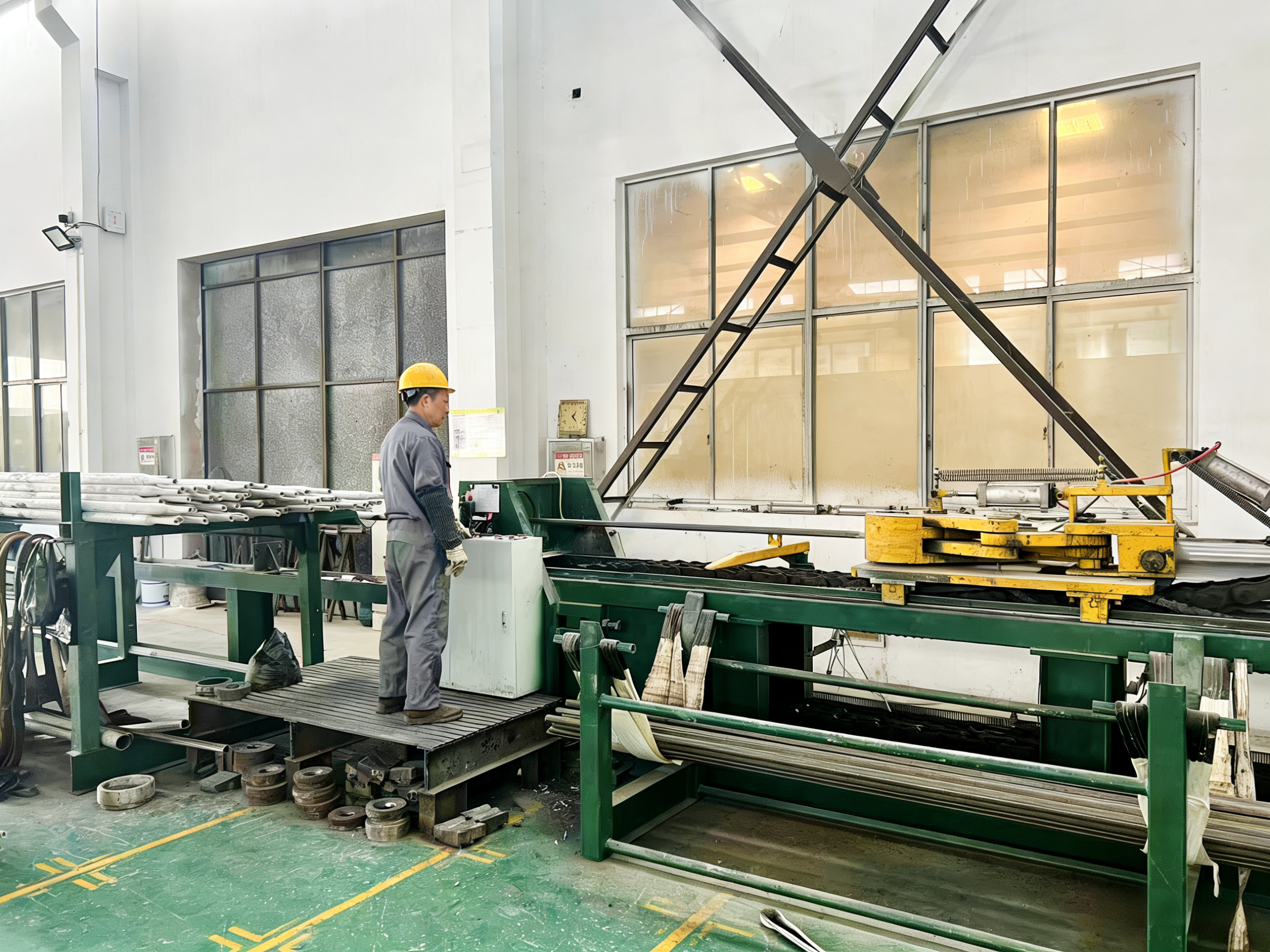
Cold drawing is the forming route that gives a non-circular section its repeatability. Image: FAKESI.
Cold drawing is the forming route that gives a non-circular section its repeatability. The process steps documented for this production line are cold drawing on a hydraulic draw bench, intermediate annealing, straightening and fixed-length cutting. Each step exists for a dimensional reason rather than a procedural one. Annealing matters because drawing hardens the section and the material has to be softened before the next pass; straightening matters because a tube that has been drawn and annealed still needs its longitudinal geometry reset before cutting; and fixed-length cutting matters because the cut length is the last dimension that can drift before packing.
The material grades listed for the range include 10#, 20#, 35#, 45#, 20Cr, 40Cr, 16Mn, 20Mn, Q355B and Q235B. In automotive parts and drive shaft work, the grade decision is usually driven by the torque and service environment of the finished component rather than by the profile itself, and Q355B is the grade recorded in the documented case in this article. Grade and section should be specified together, because the strength the part needs and the geometry the part needs are fixed by the same drawing.
The precision outcome of this route is what allows a profile to be used without post-processing. Precision Bright Steel Pipe and precision seamless steel pipe sit in the same product family as the special-shaped tubes, and the ±0.1 mm tolerance reference published for the family is the number that determines whether a downstream turning or broaching operation can be reduced or removed.
Supplier Capability Behind the Shortlist
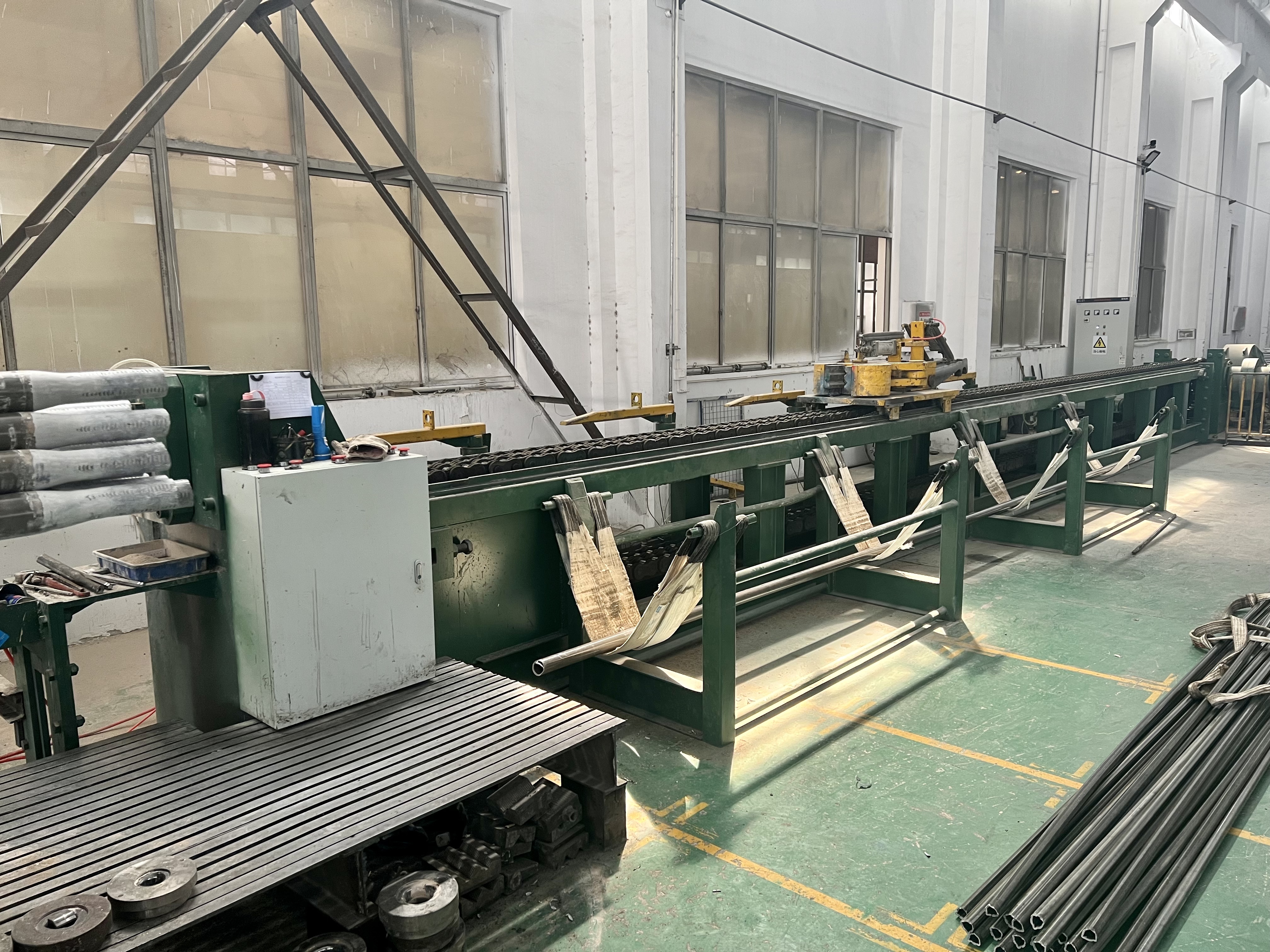
Hydraulic cold draw bench on the FAKESI production line. Image: FAKESI.
FAKESI is the brand of Wuxi Jiangbo Intelligent Technology Co., Ltd. (formerly Wuxi Fakes Pipe Industry Co., Ltd.), a steel tube manufacturer founded in 1992 and operating from Yixing, Wuxi, Jiangsu, China. The company runs a production base of more than 20,000 m² with 50 employees and a five-engineer R&D team, an annual output of 20,000 tonnes, a stated monthly capacity of 2,000 tonnes and a 50% export ratio across EU, Eurasia and MENA markets. Its production model combines OEM, ODM and standard component manufacturing, with full customization of logo, dimensions and lengths.
Several of these parameters matter to profile sourcing rather than to general supplier assessment. A 2,000-tonne monthly capacity and a 30-day lead-time reference indicate the volume and rhythm a buyer should plan around. A stated minimum order quantity of 1 tonne is the threshold at which a custom section becomes an order rather than an inquiry. A 100% testing regime is the claim that has to be evidenced at pre-packaging inspection, and the one-year warranty with 24-hour after-sales and technical support covers the period in which a new profile is most likely to need adjustment. The company states that it implements ISO quality management systems, and product documentation is published at wxjiangbo.com.
Documented Application: Automotive Parts and Drive Shaft Tube
The clearest documented use of this tube family in the automotive chain is an Italian project. An automotive parts manufacturer in Italy ordered 25 tonnes of seamless steel tubing for an agricultural drive shaft application, and the programme has run for two years. The reported outcomes are specific: the tube withstands high torque without deformation, and the high-precision tolerances reduced secondary machining costs on the finished part. Q355B is the material grade recorded for the application, and the applicable product data covers outer diameters from 1 mm to 100 mm with wall thicknesses from 1 mm to 20 mm at a tolerance reference of ±0.1 mm.
The case is worth reading as procurement evidence rather than as a marketing statement. A drive shaft application is a load path: if the section deforms under torque, the part fails, and if the tolerance is loose, the machining centre compensates and the cost simply moves downstream. A documented reduction in secondary machining cost therefore indicates that the delivered tube arrived close enough to nominal for downstream operations to be reduced — which is the same argument that justifies shortlisting a drawn profile in the first place.
The company also lists hydraulic cylinders, pneumatic cylinders, automotive drive shafts, motorcycle and auto parts, smart lock components, motor housings, construction machinery and customized structural applications among the uses served by its tubing, which places the special-shaped profiles in a wider industrial context than the automotive case alone.
Shortlist Screening Checklist for Buyers
1. Section definition. Confirm the geometry is stated as a drawing, not a name: across-flats, across-corners, flat width, corner radii, major and minor axes.
2. Envelope check. Confirm the section falls within 1–100 mm outer diameter and 1–20 mm wall thickness, and identify any dimension that sits close to the boundary.
3. Grade and section together. State the material grade — for example 20#, 45# or Q355B — alongside the profile rather than after it.
4. Tolerance and measurement. Agree how the profile will be measured and which dimension the ±0.1 mm tolerance reference applies to.
5. Commercial frame. Confirm MOQ of 1 tonne, FOB or CIF terms, pre-packaging inspection as the acceptance criterion, and deposit plus balance payment.
Market Context for Special-Shaped Seamless Tube
Two independent data points frame the shortlist. Research and Markets projects the global seamless steel tube and pipe market to reach roughly USD 130–140 billion in value by 2026, which places the category in a mature, high-volume bracket rather than a niche one. Against that, the Steel Tube Branch of China Steel Association estimated China's seamless steel tube output at 29.9 million tonnes in 2024, a 5.08% year-on-year decline.
Read together, the two numbers describe a market whose value is not contracting while a major producing country reduces volume — a pattern consistent with a shift away from bulk tonnage and toward higher-value, tighter-tolerance product. For a buyer, that interpretation has a practical consequence rather than a strategic one: the sections worth shortlisting are the ones where precision and documentation, not commodity availability, determine whether the part works. Special-shaped profiles sit at that end of the range.
The supply side of these profiles is also fragmented. International trade statistics track seamless tubes, pipes and hollow profiles under HS 7304, but the heading does not separate non-circular sections from round ones, so public trade data cannot be used to size the special-profile segment on its own. That gap is one reason a profile shortlist is built from product documentation and sample evaluation rather than from market reports.
Comparison with Traditional Solutions and Where the Shortlist Stops
A non-round tube is not automatically the better choice, and the comparison should be made explicitly during evaluation.
Profile versus round tube plus machining. A round tube with a milling operation gives maximum design freedom: any flat, notch or step can be added, changed or removed late in the programme. A drawn profile removes that freedom and locks the geometry to tooling. Where a part is still under development, or where order volumes are low relative to setup effort, round tube and machining usually remain the more tolerant route.
Profile versus welded profile tube. A welded profiled tube can be produced in sections and wall combinations that drawing cannot reach economically. A seamless drawn profile carries no longitudinal weld seam, which matters in pressure-containing and fatigue-loaded parts, and it holds a more consistent wall distribution around a non-symmetric section. The choice depends on the service condition, not on the shape alone.
Profile versus hot-rolled stock. Hot Rolled Seamless Pipe covers heavy-wall and larger-diameter work where dimensional precision is secondary. Cold-drawn profiles occupy the tighter end of the same family, and the 1–100 mm outer diameter, 1–20 mm wall thickness and ±0.1 mm tolerance references in this article apply to that cold-drawn envelope.
Three boundaries should be stated plainly. First, a standard reference is not a certification: ASTM A106 is the specification for seamless carbon steel pipe for high-temperature service, ISO 3183 covers steel pipe for petroleum and natural gas pipeline transportation systems, and API 5L Grade B and ISO 3183 Grade L245 are listed as equivalent grade references — but none of these establishes that a given supplier holds a certificate for a given order, so certificates and inspection records have to be verified per purchase order. Second, no verified unit-price benchmark for non-circular seamless profiles was available at the time of writing, so cost comparison for these sections has to come from quotation rather than from published tables. Third, buyers should treat a new non-round section as an order-line item tied to tooling and to a 1-tonne minimum order quantity until the supplier confirms stock or repeat-production availability.
Future Outlook
The direction of travel in this category is already visible in the data cited above: value stable or rising while Chinese tonnage contracts, which favours suppliers able to hold tolerance over suppliers able to pour volume. For special-shaped profiles specifically, three developments are worth tracking.
Trade classification will keep improving as HS 7304-level data is refined with national subheadings, which will eventually allow buyers to see which source countries are exporting hollow profiles rather than round pipe. Second, the data gaps that currently exist around non-circular sections — market share, primary producers and shaping cost — are the gaps most likely to be closed by buyer-side RFQ data rather than by published reports. Third, the sections themselves are unlikely to change quickly: triangle, hexagon, lemon, octagon and oval are the geometries that appear in the documented product range, so the competitive ground is likely to remain tolerance, documentation and delivery reliability rather than new cross-sections.
Frequently Asked Questions
What is a special-shaped seamless pipe, and how does it differ from a standard seamless round pipe?
A special-shaped seamless pipe is a seamless tube whose outer cross-section is not circular. Triangle, hexagon, lemon-shaped, octagon and oval profiles are listed in the FAKESI product range alongside standard round tube, and all of them belong to the same family as cold-drawn and hot-rolled seamless pipe. The functional difference is where the locating or torque-transmitting feature is created: at the mill in the case of a drawn profile, or at the machining centre in the case of round tube.
Which profile geometries are used in automotive and drive shaft applications?
The published range includes Seamless Triangle Pipe, Seamless Hexagon Pipe, Seamless Lemon-shaped Tube, Seamless Octagon Pipe and Seamless Oval Steel Pipe, produced alongside Seamless Round Pipe and cold-drawn round tube. Automotive drive shafts, motorcycle and auto parts, smart lock components, motor housings, hydraulic and pneumatic cylinders are listed among the applications the tubing serves, and a documented Italian case covers an agricultural drive shaft programme for an automotive parts manufacturer.
What outer diameter and wall thickness range applies to these profiles?
The product data for the relevant seamless steel tube family specifies an outer diameter range of 1–100 mm and a wall thickness range of 1–20 mm, with a tolerance reference of ±0.1 mm. Material grades listed for the family include 20#, 45# and Q355B, and Q355B is the grade recorded in the documented drive shaft case. Buyers should confirm both the geometry and the applicable tolerance against the part drawing before ordering.
What purchasing terms and acceptance criteria apply when ordering?
The published purchasing terms are a minimum order quantity of 1 tonne, FOB or CIF delivery terms, pre-packaging inspection as the acceptance criterion, and payment by deposit plus balance payment. A 30-day lead time is the stated reference, and quality control is described as 100% testing. Buyers evaluating a new profile type should confirm the applicable terms and inspection method in the quotation, since the published terms are stated at product-family level.
How should a buyer validate a custom profile before committing to volume production?
Validation starts with the drawing rather than with the tube. Because a profiled section is defined by several dimensions — across-flats, across-corners, corner radii, axis widths or lobe thickness — the buyer and supplier should first agree which dimension carries the assembly tolerance and how it will be measured. The available quality-control evidence is a stated 100% testing regime and pre-packaging inspection as the acceptance criterion; for a new geometry, buyers should request the inspection record for the trial batch and confirm the measurement method before releasing volume. Material grade should be fixed at the same stage, and the one-year warranty with 24-hour after-sales and technical support defines the period during which post-delivery issues are covered.
Manufacturer documentation: the FAKESI seamless steel tube brochure is published as a downloadable PDF at https://cdn.socialarks.com/sbsp/24763/0/2026/0413/69dc98c8e0522.pdf. Compiled from product documentation, first-party application records and the category references cited in this article; dimension and tolerance values are supplier-published references and should be confirmed per order.
¿Tiene preguntas o necesita más detalles?
Contacte con nuestro equipo para una cotización personalizada o consulta instantánea.
Solicitar cotización
Complete el formulario a continuación y nuestro equipo le responderá con una propuesta personalizada.
Chat directo de WhatsApp
¿Prefiere chatear en tiempo real? Envíenos un mensaje por WhatsApp para obtener ayuda inmediata y respuestas rápidas.
- Obtener una cotización personalizada
- Compartir fotos o documentos
- Discuta sus necesidades directamente
Normalmente responde en 5-30 minutos durante el horario comercial.