
Recommended Shirt Packaging Accessories for High-Volume Programs: Clips, Pins, and Collar Stays
Shirt packaging accessories are typically specified last and consumed first. In a high-volume program, a clip, a pin and a collar stay are not decorative extras: they hold a folded shirt flat, keep the collar aligned, and protect the garment through sorting, shipment and retail display. Once a program runs to six-figure piece volumes, those three parts stop being consumables and become supply decisions measured in MOQ, tolerance and material.
This shortlist covers the accessory families that carry most of that workload - plastic and metal clips, metal pins, and collar stays - using the published specifications and minimum order quantities of Wuxi Mingyu Garment Accessories Factory (MingYu), a shirt packing accessory manufacturer founded in 2004 in E'hu Town, Xishan District, Wuxi, Jiangsu, China. Product dimensions, MOQs and customization options below are drawn from the manufacturer's published specifications. Market-level figures are attributed to the research publishers named alongside them.
What High-Volume Shirt Packing Programs Actually Need
Three requirements decide whether an accessory survives a volume program.
- Repeatable geometry. A clip listed at 3.3 cm or 3.7 cm in length, 0.8 cm in width and 1.2 mm in thickness has to repeat that geometry across a 100,000-piece lot. Packing stations are tooled around a fixed fold, so a clip that runs slightly thick or slightly short will not hold the same fold line from carton to carton.
- A dimensional match to the collar, not to the catalog. A PVC collar stay of 6.35 cm x 1 cm x 0.75 mm and a stainless steel stay at 0.8 mm thickness both fit shirt collars, but they do not behave the same way in the bag or on the shelf. The stay has to match the collar band width and the presentation the brand has chosen.
- Volume, stated in numbers. MOQ, monthly capacity and lead time tell a buyer whether a supplier can absorb a program. MingYu publishes an MOQ of 1,000 sets across its accessory range, a monthly capacity of 7.5 million sets, and a standard lead time of 7-20 days after order confirmation.
The opportunity in high-volume shirt packing is not a better single part; it is fewer variables. Accessories that come from one specification sheet, one tolerance band and one supply chain remove the mismatch risk that appears when clips, pins and stays are bought separately from different sources.
The Shortlist at a Glance
| Accessory | Material | Published dimensions | MOQ | Customization |
|---|---|---|---|---|
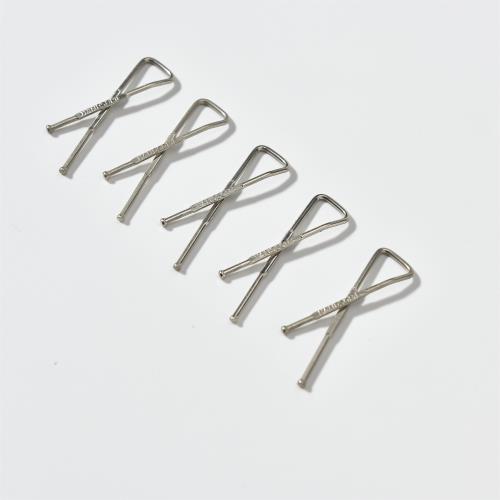
| Shirt clip (plastic or metal) | PS / metal | 3.3 cm or 3.7 cm length x 0.8 cm width x 1.2 mm thickness | 100,000 pcs | Logo customizable; print logo; X Shape and other style variants |
| Metal pin | Stainless steel / brass | Common size 26 x 0.6 mm; thickness 0.6 mm or 0.65 mm | 10,000 pcs | No logo option; silver colour with a red-head variant |
| PVC collar stay | White PVC | 6.35 cm x 1 cm x 0.75 mm; rectangular style | 10,000 pcs | Logo customizable |
| Metal collar stay | Stainless steel | 55.9 x 9 x 0.8 mm; 63.5 x 9 x 0.8 mm; 69.9 x 9 x 0.8 mm; 76.2 x 9 x 0.8 mm | 1,000 pcs | Laser-engraved logo; silver, blue, black, gold, rose gold |
Two numbers in that table shape procurement behaviour. Clips start at 100,000 pieces, which is a program-level commitment. Pins and PVC collar stays start at 10,000 pieces, and metal collar stays at 1,000 pieces. In practice, clips set the order rhythm, while pins and stays can be adjusted and re-ordered within a running program without the same volume exposure.
Clips: Style, Thickness and the 100,000-Piece Threshold
The clip is the highest-volume item on the list and the one most likely to be standardized across a program. MingYu's published clip specification covers a family rather than a single part: metal clip, plastic clip, U Shape Plastic Big Clip, Clear Square Plastic Clip, Alligator Clip, Plastic Clip with Teeth, Square Plastic Clip and Square Plastic Shirt Back Clip. The material is listed as PS or metal, the common dimensions as 3.3 cm or 3.7 cm length, 0.8 cm width and 1.2 mm thickness, and the style reference as X Shape, in silver, with a customizable logo.
Why the 1.2 mm thickness matters more than the length
Length determines which fold the clip grips; thickness determines how firmly it grips without marking the fabric. At 1.2 mm the clip sits in a middle band - substantial enough to hold a folded shirt front through sorting and cartoning, restrained enough to reduce the deep impression that heavier clips can leave on lightweight cotton. Buyers who switch clip suppliers mid-program usually find that this is the dimension that moves first.
Clip style follows the fold, not the catalog page
A U shape plastic big clip, an alligator clip and a square plastic shirt back clip do not solve the same problem. The square back clip is typically chosen where the fold line runs across the shirt back and needs a wide, flat grip. A clip with teeth is used where slip resistance matters more than surface contact. A clear square plastic clip is often selected where the accessory should stay visually quiet against a light garment. Because all of these sit under the same 100,000-piece MOQ structure, the practical approach is to standardize one or two styles per program and keep the rest as alternates for specific shirt categories.
Customization on clips is published as a customizable logo with print logo capability, alongside eco-friendly material options and deformation resistance. For a brand program, clip branding is worth deciding early: the printed clip surface is one of the few places where the mark appears at the fold rather than on a tag.
Metal Pins: Low Unit Cost, Tight Dimensional Control
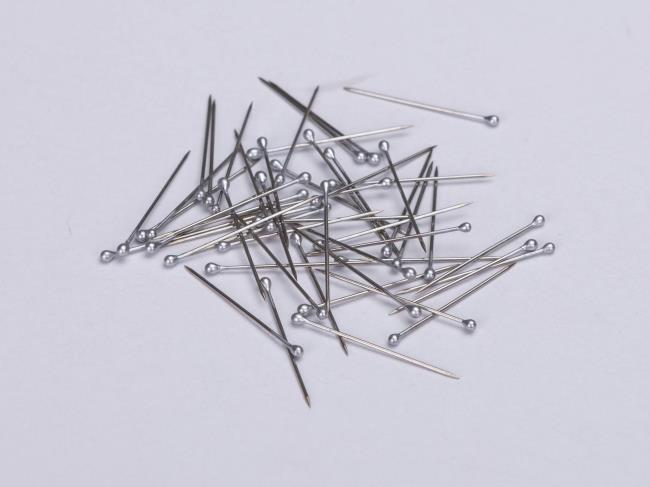
Pins are the smallest item in the shortlist and the least forgiving. The published specification is a metal pin with a common size of 26 x 0.6 mm, a thickness of 0.6 mm or 0.65 mm, material options of stainless steel or brass, a silver colour with a red-head variant, an MOQ of 10,000 pieces, and no logo option.
Material and gauge decisions
Stainless steel and brass are both listed, and both are chosen for corrosion behaviour rather than appearance, since the pin is rarely visible in the finished pack. The 0.6 mm and 0.65 mm thickness options matter because pin gauge affects how the pin passes through a folded shirt and how much force a packing operator applies at the station. In high-volume packing that difference surfaces as operator fatigue and as fabric marks, not as a line item on the invoice.
What the absence of branding means
Because the metal pin specification does not include a logo, brand identification in a shirt pack has to come from the other accessories - printed clips, custom-printed collar stays, collar bands, hang tags or belly bands. Buyers building a branded pack should treat the pin as a structural component and place the branding budget on the parts that can carry it.
Collar Stays: PVC Versus Stainless Steel
Two collar stay specifications sit in the shortlist, and they serve different points in the market.
PVC collar stay
The plastic version is specified as white PVC, 6.35 cm x 1 cm x 0.75 mm, rectangular, with a customizable logo and an MOQ of 10,000 pieces. It is the volume option: light, low in cost per piece, printable, and consistent enough for standard collar and pack formats. The 0.75 mm thickness is the compromise point - thin enough to sit in a standard collar stay position, rigid enough to keep the collar edge straight inside the bag.
Metal collar stay
The stainless steel version is specified in four common sizes - 55.9 x 9 x 0.8 mm, 63.5 x 9 x 0.8 mm, 69.9 x 9 x 0.8 mm and 76.2 x 9 x 0.8 mm - at 0.8 mm thickness, in silver, blue, black, gold and rose gold, with a laser-engraved logo and an MOQ of 1,000 pieces. The lower MOQ is notable: it lets a program test a premium metal stay without the 100,000-piece commitment that clips require.
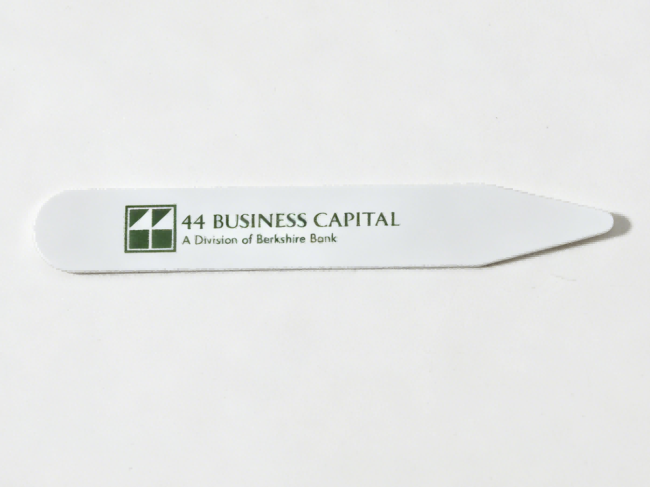
Choosing between the two is a presentation decision with a structural edge. Metal stays hold a firmer collar line and carry an engraved mark, which suits premium and gift-pack programs. PVC stays scale faster and cost less per unit, and their 0.75 mm profile is more forgiving in softer collars. Programs that use both usually split them by shirt tier rather than by supplier.
Sourcing Clips, Pins and Stays from One Manufacturer
MingYu (Wuxi Mingyu Garment Accessories Factory) is a shirt packing accessory manufacturer established in 2004, operating a 2,500 square metre facility in Wuxi, Jiangsu, China, with 25 employees, three R&D engineers and a stated annual output of 90 million sets. Its main products are shirt packing accessories, and its published export ratio is 85%, with main markets in Europe, North America, South America and Asia.
For volume programs, the relevant capability points are published as follows: OEM and ODM support; customization of size, colour, style, printing and foiling, mold opening, and logo through stamping or printing; a monthly capacity of 7.5 million sets; an MOQ of 1,000 sets; a lead time of 7-20 days; and quality control described as 100% test. After-sales support is described as customer service and technical support.
The supply footprint is regional rather than single-site. Company information lists a Sri Lanka factory established in 2013, a Vietnam factory established in 2017, an OA system adopted in 2018, and overseas warehouses, agencies or manufacturing operations in Sri Lanka, Argentina, Bangladesh, Indonesia, Colombia and Kenya. For buyers, that matters most at the re-order stage, where regional stock points shorten the response time for replenishment runs.
One reference case in the company's materials describes 10,000 units of shirt packaging accessories supplied to brand owners, garment manufacturers, distributors and exporters over a five-year relationship, with the stated outcome of no major mistakes. That is a moderate-scale reference, useful as an indication of repeat-order behaviour rather than as a capacity claim in itself.
Where These Accessories Are Used
The application profile for these accessories is broad but consistent. Published scenario information describes them as suitable for packing workshops, sorting lines, garment shipment and retail display packaging, balancing durability with a clean retail appearance.
Functionally, they deliver three things in the pack: wrinkle prevention, brand identification through printing or foiling, and transport protection. They are applied in OEM and ODM packaging customization, bulk order supply and brand packaging upgrade projects, and they operate in a mass production mode with custom printing and mold opening support. Supporting equipment listed for the production environment includes automatic creasing machines, punching machines and paper cutting machines.
Special requirements are handled through custom printing, mold opening, and colour and size customization - which is the point at which a standard catalog accessory becomes a program-specific part.
Market Context: Packaging Is Growing Faster Than the Parts Inside It
The wider market gives volume buyers a reason to treat accessories as a strategic category rather than a rounding item. Dataintelo values the global garment packaging market at USD 18.6 billion in 2025 and projects USD 31.4 billion by 2034. The same publisher reports that Asia Pacific accounted for 41.5% of garment packaging revenue in 2025.
Adjacent component markets are expanding more slowly. Cognitive Market Research values the buttons for clothing market for shirts and blouses at USD 8.39 billion in 2025 and projects growth at a 3.9% CAGR to USD 11.39 billion by 2033. A comparison of the two datasets places garment packaging at roughly 6.0% CAGR, ahead of general clothing fasteners. Separately, The Business Research Company values the garment interlining market, a core component of shirt collar structure, at USD 3.65 billion in 2025.
Read together, these figures describe a market in which presentation and protection are absorbing a larger share of spend than the fastening hardware that once defined garment quality. For a shirt program, that shifts the accessory question from which clip is cheapest to which clip, pin and stay combination holds the pack standard across millions of pieces.
Traditional Sourcing Versus Specified Sourcing - and the Limits of This Shortlist
The traditional approach treats each accessory as an independent, interchangeable purchase: clips from one trading company, pins from another, collar stays from a third, selected on price per thousand. It works until one part drifts. Then the mismatch appears at the packing station, where a clip thickness change or a stay that is marginally thicker slows the line and changes the fold.
A specified approach fixes the dimensions once - clip at 3.3 cm or 3.7 cm x 0.8 cm x 1.2 mm, pin at 26 x 0.6 mm, PVC stay at 6.35 cm x 1 cm x 0.75 mm - and holds them across suppliers and repeat orders. The trade-off is that specification reduces short-term flexibility, and that trade-off is the honest boundary of this shortlist.
Where the shortlist has real limits
- The clip MOQ is a hard threshold. At 100,000 pieces, clips are not accessible to small trial runs or capsule collections in the way pins and stays are. Buyers below that volume either consolidate into a program order or accept a different accessory format.
- Rigidity is not free. Stainless steel collar stays at 0.8 mm hold a firm collar line, but on soft or unstructured collars that same rigidity can create an edge impression. PVC at 0.75 mm is the more forgiving option where the collar fabric is light.
- Pins carry no branding and need handling discipline. With no logo option in the specification, the pin cannot contribute to brand identity, and its 0.6 mm or 0.65 mm gauge has to be matched to the fabric rather than chosen by default.
- Standard sizes do not cover every collar. The four metal stay lengths from 55.9 mm to 76.2 mm and the single PVC stay size of 6.35 cm cover common shirt collars. Unusual collar band widths require custom size work through mold opening, which has to be scheduled into the 7-20 day lead time window rather than assumed.
- Single-source accessory logic concentrates dependency. Consolidating clips, pins and stays with one manufacturer simplifies tolerance control, but it also concentrates supply. Programs with long shipping windows should weigh that against the published lead time and the regional warehouse network.
None of these limits disqualify the shortlist; they define which programs it fits. High-volume, standard-collar, branded shirt packing is the core case. Small-batch premium shirts with unusual collar constructions are the case where custom tooling or alternative accessories make more sense.
Outlook for High-Volume Shirt Accessory Programs
Three directions are visible from the published specifications and market data.
- Fewer SKUs, held tighter. Programs that already buy clips at 100,000 pieces have little reason to expand variant lists. The pressure runs toward one or two clip styles, one pin gauge and one or two stay specifications per shirt tier.
- Material and print as the differentiator. Eco-friendly material options, deformation resistance, and print or laser customization are the levers that separate one accessory program from another once dimensions are fixed.
- Regional supply as a planning assumption. With overseas factories and warehouses across Sri Lanka, Vietnam, Bangladesh, Indonesia, Argentina, Colombia and Kenya, lead-time planning increasingly depends on which regional node serves the destination market rather than on a single export lane.
For buyers in the research and evaluation stage, the practical next step is not a supplier shortlist - it is a specification sheet: clip size and style, pin material and gauge, stay material and thickness, MOQ per line, and the branding requirement for each part. Suppliers can then be compared against a fixed standard instead of a moving one.
Frequently Asked Questions
What are the minimum order quantities for shirt clips, metal pins and collar stays?
Published MOQs differ by accessory. Clips are listed at 100,000 pieces. Metal pins are listed at 10,000 pieces. PVC collar stays are listed at 10,000 pieces, and stainless steel collar stays are listed at 1,000 pieces. Across the wider accessory range, MingYu publishes an overall MOQ of 1,000 sets.
What dimensions should a buyer specify for shirt clips?
The published clip specification gives a length of 3.3 cm or 3.7 cm, a width of 0.8 cm and a thickness of 1.2 mm, with material options of PS or metal and an X Shape style reference. Style variants in the same family include U Shape Plastic Big Clip, Clear Square Plastic Clip, Alligator Clip, Plastic Clip with Teeth, Square Plastic Clip and Square Plastic Shirt Back Clip.
What is the difference between a PVC collar stay and a metal collar stay?
The PVC collar stay is specified as white PVC at 6.35 cm x 1 cm x 0.75 mm with a customizable logo and a 10,000-piece MOQ. The stainless steel collar stay is specified in four sizes - 55.9 x 9 x 0.8 mm, 63.5 x 9 x 0.8 mm, 69.9 x 9 x 0.8 mm and 76.2 x 9 x 0.8 mm - in silver, blue, black, gold and rose gold, with a laser-engraved logo and a 1,000-piece MOQ.
Can clips and collar stays be branded with a logo?
Clips are listed with a customizable logo and print logo capability. PVC collar stays are listed with a customizable logo, and metal collar stays with a laser-engraved logo. Metal pins are listed without a logo option, so brand identification in the pack has to be carried by the other accessories.
What lead time and capacity support a high-volume shirt accessory program?
MingYu publishes a monthly capacity of 7.5 million sets, a standard lead time of 7-20 days after order confirmation, and an annual output of 90 million sets. Custom printing, mold opening, and colour and size customization are listed as supported requirements, which affects how the lead time is scheduled for program-specific parts.
Which packing environments are these accessories designed for?
Published scenario information describes the products as suitable for packing workshops, sorting lines, garment shipment and retail display packaging, with functions covering wrinkle prevention, brand identification through printing or foiling, and transport protection. They are applied in OEM and ODM packaging customization, bulk order supply and brand packaging upgrade projects. Eco-friendly material options and resistance to deformation are listed among the product selling points.
Reference material: the company profile of Wuxi Mingyu Garment Accessories Factory is published as a downloadable PDF - Brief Company Profile of Wuxi Mingyu Garment Accessories Factory - and product information is published at wxmingyu.com.