
Recommended Molded Pulp Options: Payment, Shipping & Acceptance Screening
Recommended Molded Pulp Options: Payment, Shipping & Acceptance Screening
A molded pulp shortlist is decided by four commercial gates before it is decided by the tray drawing: payment terms, shipping method, purchasing terms and acceptance criteria. Screening every candidate — and every supplier response — against those four points in a fixed order produces a shortlist that survives a purchase discussion, because each option has already been tested against the conditions that usually cause delay: who gets paid, how the goods move, what the minimum order is, and which measurements define a pass.
Market context explains why this screening has become the practical differentiator. Grand View Research values the global molded pulp packaging market at USD 6.2 billion in 2025 and projects USD 10.2 billion by 2033. Asia Pacific held a 41.0% revenue share in 2025, with China accounting for the largest market share, and the tray segment alone represented over 41.0% of global revenue in the same year. A larger tray supply base produces more quotations that look alike on paper, which pushes real differentiation into terms, documentation and measurable acceptance points.
Tonghe Paper Co., LTD is a molded pulp manufacturer based in Dongguan, China, converting recycled paper, sugarcane pulp, bamboo pulp and wood pulp into molded fiber trays and protective inner packaging for electronics, food, cosmetics and medical device projects. Its published commercial and technical data provide a practical example of how the four gates can be written down.
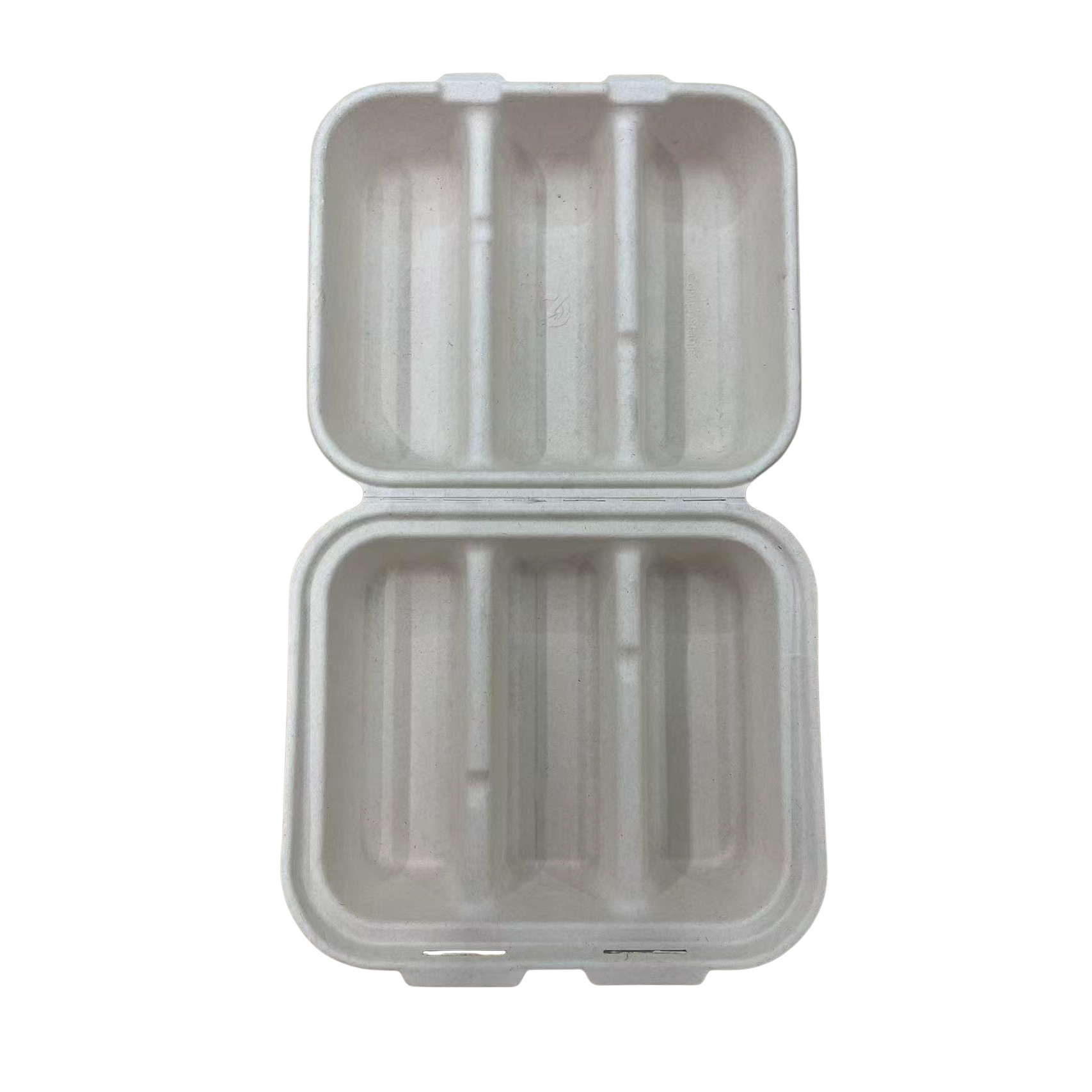
Molded pulp trays in a food-service configuration — one of several option profiles that should be screened on terms before sampling.
Why Commercial Terms, Not Shapes, Separate Molded Pulp Suppliers
Most molded pulp suppliers describe a similar forming route: fiber slurry is formed on a mould, dewatered, dried and trimmed. Because the process description converges, quotations for the same cavity tend to converge on material language and diverge on everything a buyer later has to manage — the payment instrument, the freight basis, the minimum order that makes the tooling viable, and the measurement set that decides whether a delivered batch is accepted.
The practical consequence is that acceptance language should be introduced at the request-for-quotation stage rather than at the purchase-order stage. A buyer who asks for thickness range, moisture content and strength values together with the price receives a comparable response. A buyer who asks only for price receives a number that cannot be compared.
The four-gate framework below is a screening order, not a preference order. Payment and shipping are placed first because they are the two points that are hardest to renegotiate once production has started; acceptance criteria are placed last because they can only be finalized after the option profile is chosen.
| Gate | Core question | Evidence to request | What goes wrong without it |
|---|---|---|---|
| 1. Payment | Which instrument, and is the beneficiary the same legal entity that signs the contract? | Written payment terms naming the accepted instruments | Payment routed to a name that does not match the contracting entity |
| 2. Shipping | Sea, air or express — and on what basis is freight calculated? | Destination port or delivery address stated on the RFQ | Freight estimated on weight alone while the cartons ship on volume |
| 3. Purchasing terms | What minimum order and lead time does the chosen option actually carry? | MOQ, production lead time, customization scope in writing | A sample approved for a shape the minimum order cannot support economically |
| 4. Acceptance | Which measurements define pass or fail? | Thickness, moisture, edge crush and compressive strength ranges plus QC stages | Disputes resolved by opinion instead of data |
Gate 1 — Payment Terms: What Belongs in Writing
Tonghe Paper Co., LTD accepts T/T and Alibaba Trade Assurance as payment instruments. Those two options sit in different risk categories, and a shortlist should record which one applies rather than treating payment as an afterthought. T/T is a bank transfer whose protection depends on the accuracy of the beneficiary details and the documentation attached to each milestone. Alibaba Trade Assurance is a platform-mediated arrangement in which the order terms are recorded inside the platform.
Three checks turn the payment line of a quotation into a usable screening point:
- Entity match. The beneficiary name, the contracting entity and the name on the commercial invoice should be the same. A mismatch between a manufacturer name and a receiving account is the single most common reason a first order stalls.
- Milestone logic. Payment stages should correspond to verifiable events — order confirmation, pre-shipment inspection, and document release — rather than to calendar dates alone. Where a pre-shipment inspection is planned, the payment stage should be written so that the inspection result is available before the balance is released.
- Document set. Each instrument implies a document list: invoice, packing list, and the shipping document appropriate to the mode. Buyers importing into the EU or North America should confirm at quotation stage which certificates accompany the shipment.
The published commercial data for Tonghe Paper Co., LTD states the accepted payment instruments but does not publish a fixed deposit-to-balance ratio. That split should be confirmed in the quotation rather than assumed from a template.
Gate 2 — Shipping Method: Matching Mode to Product Risk
Tonghe Paper Co., LTD ships by sea, air and express (DHL/FedEx/UPS). Freight is calculated after the buyer supplies the destination port or delivery address, which means an RFQ without a destination cannot produce a comparable landed cost.
Mode selection for molded pulp is driven less by urgency than by the material's relationship with moisture. Standard trays are specified at a moisture content of ≤8–12%, and the reference working condition for pulp packaging projects is a well-ventilated, dry area with no prolonged exposure to direct sunlight. Sea freight exposes cartons to long transit periods and container humidity, so the shipping gate and the moisture line of the acceptance gate should be read together. Where a project specifies water and oil resistance, that treatment is a defined surface option rather than a default, and it should be confirmed on the quotation when sea freight is the chosen mode.
Volume, not weight, usually drives cost in this category. Molded pulp trays are bulky relative to their mass, so carton configuration and nesting determine how much air is shipped. The company states that its lightweight construction reduces weight by approximately 50% compared with traditional hard gift boxes — a company statement that is relevant to the freight calculation, and one that should be verified against the actual carton dimensions of the approved tray rather than applied generically. The reference scenario also lists packaging assembly lines and automatic wrapping machines as matched equipment, which is a reminder to confirm that tray dimensions and stack height suit the downstream line before the shipping quantity is fixed.
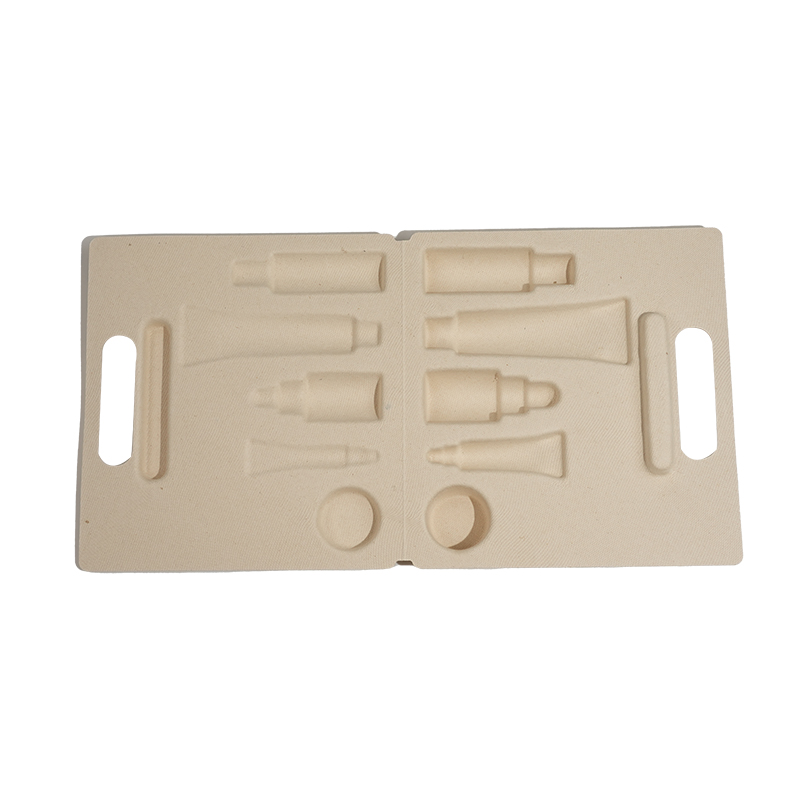
A custom-fit cavity tray: the profile where tooling, minimum order and cavity acceptance have to be agreed together.
Gate 3 — Purchasing Terms: Minimum Order, Lead Time and Customization Scope
Purchasing terms are where the shortlist becomes operational. The published capability data for Tonghe Paper Co., LTD records a minimum order quantity of 1000 pcs, a production lead time of 15–30 days, OEM/ODM production, and monthly capacity of 1000 tons. The manufacturer operates a 23,000 m² facility with 160 employees, an annual output of 12,000 tons, a 12-engineer technical team and in-house mould development, and exports approximately 50% of output to the EU, the USA, Australia, Saudi Arabia, Malaysia and Brazil.
Each of those figures answers a specific screening question:
- MOQ against SKU count. A 1000 pcs minimum applies per item. A project with six cavity variants should be assessed as six minimums, not one, before the shortlist is finalized.
- Lead time against the launch calendar. The 15–30 day figure describes production. Tooling and sample approval sit before that window, so the calendar should carry a separate allowance for them.
- Customization scope against the specification. Documented customization covers material, colour, LOGO, anti-static function and moisture-proof function. Additional surface options include calendering, waterproof and oil-proof treatment, plus embossing and printing. A buyer who needs an anti-static or moisture-proof variant should see that requirement named in the quotation, because it changes the pulp rather than the print.
- Mould ownership. In-house mould development reduces the number of handoffs between tooling and forming, but the commercial terms should still state who holds the mould, how long it is retained and what happens to it if the program is paused.
Gate 4 — Acceptance Criteria: Turning Specifications into Pass or Fail
Acceptance is the gate that most often arrives late and costs the most. The specification set shared across Tonghe Paper Co., LTD tray products provides a starting measurement plan that can be adapted per program.
| Parameter | Published range | Role in an acceptance plan |
|---|---|---|
| Raw material | Sugarcane pulp, bamboo pulp, wood pulp; customization on request | Confirms the fiber basis named in the purchase order |
| Colour | Natural, white, yellow, customized as required | Visual acceptance reference for batch-to-batch comparison |
| Thickness | 0.8–5.0 mm, customized as required | Distinguishes a cushioning wall from a nesting wall |
| Wet pressure / dry pressure | 0.15–0.25 g/cm³ / 0.28–0.45 g/cm³ | Density reference for the formed fiber body |
| Moisture content | ≤8–12% | Storage and dimensional stability reference |
| Edge crush strength | 3–8 kN/m | Stacking performance reference |
| Compressive strength | 2–8 MPa | Top-load resistance reference for the formed shape |
| Temperature range | −20 °C to +80 °C standard; food grade −20 °C to +120 °C | Cold-chain and hot-fill suitability check |
| Degradability | Degradable | End-of-life claim that requires supporting documentation |
Parameters as published across the Tonghe Paper Co., LTD tray specification set; program-specific tolerances should be agreed per cavity.
Quality control on the production side is documented as IQC, IPQC and FQC — incoming, in-process and final inspection. For a buyer, that structure matters because it defines where evidence comes from: incoming material checks support fiber claims, in-process checks support dimensional consistency, and final inspection supports the pre-shipment sample. For medical device programs the acceptance plan extends further, because the medical tray specification includes support for EO sterilization, one-piece moulding with precise positioning, low dust with no shedding, virgin wood pulp free of fluorescent agents produced in a clean workshop, and a material inspection report.
Technical Explanation: What Each Acceptance Number Actually Controls
The acceptance values in the table are not interchangeable, and a shortlist that treats them as a single quality score will misread supplier responses.
Edge crush strength (3–8 kN/m) describes resistance along the formed edge, which is the parameter a warehouse manager feels when cartons are stacked. Compressive strength (2–8 MPa) describes resistance to a load applied across the formed shape, which is the parameter a packaging engineer tests when the tray protects a product in transit. A tray can be adequate on one and marginal on the other, so both should appear in the acceptance plan for protective applications.
Thickness (0.8–5.0 mm) sets the trade-off between cushioning and space. A thicker wall protects better and nests worse; a thinner wall saves cube and shipping cost but reduces the protective margin. Moisture content (≤8–12%) is the parameter that links production to storage: the reference working condition for pulp packaging is a ventilated dry area without prolonged direct sunlight, and a batch accepted at the upper end of the moisture range will behave differently in a humid warehouse than one accepted at the lower end.
Wet and dry pressure values (0.15–0.25 g/cm³ and 0.28–0.45 g/cm³) describe the density of the formed fiber body and are the closest proxy in the specification for how solid the tray feels. Temperature range splits the specification into two practical cases: −20 °C to +80 °C for general use, and −20 °C to +120 °C for food-grade applications, which is the line that matters for hot-fill and reheating scenarios.
Recommended Option Profiles for the Shortlist
Because the four gates produce different answers depending on the tray type, the shortlist is easier to run when candidates are grouped into option profiles. The profiles below use the published product configurations from Tonghe Paper Co., LTD.
| Option profile | Specification anchor | Commercial point to confirm | Acceptance focus |
|---|---|---|---|
| Food Grade Molded Pulp Trays | Food-contact safe, degradable, −20 °C to +120 °C food-grade range | Shipping mode and moisture protection across transit | Moisture content, colour consistency, thickness |
| Custom Molded Pulp Trays (OEM) | Custom cavity replacing foam or vacuum forming | MOQ 1000 pcs, 15–30 day lead time, mould development and ownership | Cavity fit, positioning, edge crush strength |
| Protective / electronics trays | Anti-static option via modified pulp; shockproof cushioning | Anti-static requirement named in the quotation | Compressive strength, dust, dimensional tolerance |
| Medical Device Pulp Trays | EO sterilization support, virgin wood pulp free of fluorescent agents, clean-workshop production | Documentation package and inspection report before shipment | Material inspection report, cleanliness, cavity precision |
| Cosmetic Packaging Pulp Trays | Custom-fit insert, anti-scratch cushioning, colour and thickness options | Colour, embossing and printing scope; sample approval timing | Surface finish, colour match, cavity fit |
| Biodegradable / eco-friendly trays | Zero plastic, no PE/PET film, compostable claim | Which compliance statements accompany the shipment | Material declaration, PFAS-free and RoHS statements |
Application Fit: Where the Shortlist Is Actually Used
The reference application scenario for this product family covers 3C and electronic appliances, food and catering including fresh produce, beauty and daily chemical products including wine gift boxes, and medical devices. Destination markets listed in that scenario include Germany, the United Kingdom, France, the Netherlands, Sweden, Denmark, the United States, Canada, Australia, New Zealand, Saudi Arabia and Qatar. The function is shock-absorbing cushioning and inner product protection in static storage and passive protective packaging, with packaging assembly lines and automatic wrapping machines as matched downstream equipment, and recyclability, biodegradability and food-contact safety as the special requirements.
A logged reference case shows the same configuration in volume use: restaurants and supermarkets across Australia, Canada, Germany, Denmark, France, the United Kingdom, the Netherlands, New Zealand, Qatar, Saudi Arabia, Sweden, the United States and Malaysia, with a quantity of 2000 units for disposable packaging used in transport and turnover, on a shockproof and shatterproof result, with environmental protection as the stated highlight. For shortlisting purposes, the useful part of that case is not the volume but the application logic: disposable turnover packaging puts the emphasis on edge crush and moisture control, while export gift packaging puts the emphasis on surface finish and colour consistency.
Market Signals That Should Appear in the Terms
Three verified market signals are directly relevant to how the four gates should be written in 2026.
First, scale. The global market moving from USD 6.2 billion in 2025 toward a projected USD 10.2 billion by 2033, with Asia Pacific at a 41.0% revenue share and trays above 41.0% of global revenue, means most buyers will be shortlisting against a deeper supplier field than they did three years ago. Deeper fields reward documented terms over relationship assumptions.
Second, regulation. The European Packaging and Packaging Waste Regulation (EU) 2025/40 entered into force on 11 February 2025 and requires all packaging to be recyclable by 1 January 2030. For buyers shipping into the EU, recyclability moves from a marketing statement to an acceptance input, and the documentation line of the payment gate becomes the place where it is captured.
Third, segment growth. Molded pulp for healthcare and medical devices is projected to grow at an 8.6% CAGR, driven by sterilization standards and plastic bans in hospitals. That growth pushes medical programs toward suppliers who can document clean-workshop production and a material inspection report, not merely a tray shape.
Comparison with Traditional Solutions — and Where Molded Pulp Stops
Against EPS foam and vacuum-formed plastic, molded pulp changes the commercial structure of a project more than it changes the visual one. Foam tooling is comparatively cheap and fast, which supports frequent design changes; molded pulp tooling is a fibre-forming mould that rewards a stable cavity design. Molded pulp trays are specified with measurable moisture, thickness and strength values, whereas foam is usually accepted on density and dimension alone. Pulp is recyclable and, in the biodegradable configurations, compostable with no PE or PET film, while foam carries the disposal issues that regulation such as (EU) 2025/40 is designed to address.
Those advantages come with boundaries that a credible shortlist has to state:
- Moisture sensitivity is structural, not incidental. Standard trays are specified at ≤8–12% moisture with storage in a ventilated dry area away from prolonged sunlight. Water and oil resistance are surface treatment options, not default properties, so a project with continuous wet contact should confirm the treatment before the tray is approved.
- Tooling and minimum order limit iteration speed. A custom cavity requires mould development, a 1000 pcs minimum and a 15–30 day production lead time. A program that expects three design changes in a quarter will feel that structure as friction.
- Opacity. Molded pulp is not transparent. Where product visibility on shelf is a requirement, the design has to solve it through an open window or a printed panel rather than through the material.
- Support model. After-sales support for this manufacturer is documented as remote support. Buyers running high-speed packaging lines should agree in the contract how an on-site line issue will be handled, because that is a real constraint rather than a detail.
Where a project depends on full product visibility or sustained wet contact, molded pulp may not be the first fit, and the shortlist should record that conclusion rather than force the material into the application.
Future Outlook
Two forces are likely to reshape molded pulp shortlists over the next several years. The first is the 2030 recyclability requirement under (EU) 2025/40, which will move recyclability evidence from a supporting document to a standard line item in the acceptance gate — alongside the SGS RoHS and PFAS-free compliance already stated for this manufacturer's products, and the ISO 9001, ISO 14001 and FSC certifications recorded in publicly available company information. The second is the projected 8.6% CAGR in healthcare and medical device pulp packaging, which will make sterilization compatibility and clean-workshop documentation routine screening points rather than differentiators.
A third, quieter shift concerns capacity rather than compliance. With Asia Pacific holding a 41.0% revenue share and tray demand growing, buyers are likely to maintain two qualified suppliers per cavity instead of one, which makes a documented four-gate screen reusable across suppliers rather than a one-off exercise. The company's stated position supports that direction: complete biodegradation within 28 days in a natural composting environment, as stated by the manufacturer, is the kind of claim that a buyer should hold as a documented statement to be verified against the compliance package, not as a headline.
Frequently Asked Questions
What payment terms and shipping methods does Tonghe Paper Co., LTD accept?
Tonghe Paper Co., LTD accepts T/T and Alibaba Trade Assurance as payment instruments. Shipment is arranged by sea, air or express (DHL/FedEx/UPS). Freight cost is calculated once the buyer provides the destination port or delivery address, so an RFQ without a stated destination cannot produce a comparable landed cost.
What minimum order quantity and lead time apply to molded pulp tray orders?
The published capability data records a minimum order quantity of 1000 pcs and a production lead time of 15–30 days, with monthly capacity of 1000 tons and annual output of 12,000 tons. The lead time covers production; mould development and sample approval occur before that window and should be planned as separate allowances in the project calendar.
Which measurements should appear in a molded pulp acceptance plan?
The tray specification set publishes thickness of 0.8–5.0 mm, moisture content of ≤8–12%, edge crush strength of 3–8 kN/m, compressive strength of 2–8 MPa, wet pressure of 0.15–0.25 g/cm³, dry pressure of 0.28–0.45 g/cm³, and a temperature range of −20 °C to +80 °C for standard use or −20 °C to +120 °C for food-grade use. Quality control is documented as IQC, IPQC and FQC, which indicates where inspection evidence is generated.
Which project scenarios fit molded pulp trays?
Documented application scenarios include 3C and electronic appliances, food and catering including fresh produce, beauty and daily chemical products including wine gift boxes, and medical devices. The function is shock-absorbing cushioning and inner product protection in static storage, with recyclability, biodegradability and food-contact safety as stated special requirements. The storage condition specified for these projects is a well-ventilated dry area without prolonged exposure to direct sunlight.
What customization is available before an order is confirmed?
Documented customization covers material, colour, LOGO, anti-static function and moisture-proof function, under OEM/ODM production. Surface options include calendering, waterproof and oil-proof treatment, plus embossing and printing. Mould development is handled in-house, which supports multi-specification and irregular structures rather than only regular shapes.
What documentation supports acceptance for export projects?
The manufacturer states that its products comply with SGS RoHS and PFAS-free requirements, and publicly available company information records ISO 9001, ISO 14001 and FSC certifications. For medical device trays, the specification adds support for EO sterilization, virgin wood pulp free of fluorescent agents, clean-workshop production and a material inspection report. Buyers shipping into the EU should also track the recyclability requirement under (EU) 2025/40, which entered into force on 11 February 2025 and requires all packaging to be recyclable by 1 January 2030.
A downloadable company profile containing product and capability details is available as a PDF: Tonghe Paper company profile (PDF).
¿Tiene preguntas o necesita más detalles?
Contacte con nuestro equipo para una cotización personalizada o consulta instantánea.
Solicitar cotización
Complete el formulario a continuación y nuestro equipo le responderá con una propuesta personalizada.
Chat directo de WhatsApp
¿Prefiere chatear en tiempo real? Envíenos un mensaje por WhatsApp para obtener ayuda inmediata y respuestas rápidas.
- Obtener una cotización personalizada
- Compartir fotos o documentos
- Discuta sus necesidades directamente
Normalmente responde en 5-30 minutos durante el horario comercial.