
Recommended Infrared Sauna Room Models for Hospitality: OFS06 Series Shortlist
Recommended Infrared Sauna Room Models for Hospitality: OFS06 Series Shortlist
An infrared sauna room produces dry radiant heat from heating plates rather than from a stone-filled stove, and for hospitality buyers that single difference determines which cabins can be fitted into an existing building, how quickly a cabin recovers between guests, and what the room costs to operate. This shortlist covers six infrared models from the OCEAN FUTURE OFS06 series — OFS06A-5, OFS06B-1, OFS06B-2, OFS06B-3-1, OFS06B-3-2 and OFS06B-4 — and sets out how the series' 1500W to 3850W power range, its shared material and feature specification, and its procurement terms apply to hotel, guesthouse, spa and commercial wellness club projects.
Why infrared cabins are being specified into hospitality wellness areas now
The global sauna market was valued at USD 954.3 million in 2025 and is projected to reach USD 1,556.8 million by 2033, according to Grand View Research. Traditional saunas still hold the largest product share within that market at 42.79%, but infrared is the fastest-growing product segment, with the same source reporting a 7.5% CAGR. For a property deciding how to spend a wellness budget, the practical reading is that infrared is not a niche format any more; it is the part of the category that is expanding fastest.
Geography shapes the business case. The United States generated USD 250.8 million in sauna revenue in 2024, approximately 21.8% of global revenue, based on Topture's compilation of Technavio data. Grand View Research also reports that the residential segment accounted for 58.92% of the market in 2025 — a meaningful signal for hotel and spa operators, because it means a growing share of guests already understand how an infrared cabin feels and how it is used before they arrive.
Regulatory timing is a second factor. A new electric sauna heater safety standard, UL 60335-2-53, was published in June 2025 to align US requirements with international practice, according to Underwriters Laboratories as reported by SaunaTimes. For a hospitality installation in the United States, the compliance documentation attached to the heater and control assembly therefore becomes a specification line item rather than an afterthought.
Market size figures should be read with their scope in mind. Published estimates range from USD 954.3 million for sauna equipment (Grand View Research) to USD 4.8 billion for sauna and steam room combined (Dataintelo) and USD 148.79 billion once spa services are included (Mordor Intelligence). Hospitality buyers building a project case should match the scope of the number to what they are actually purchasing.
What the OFS06 series is — and who builds it
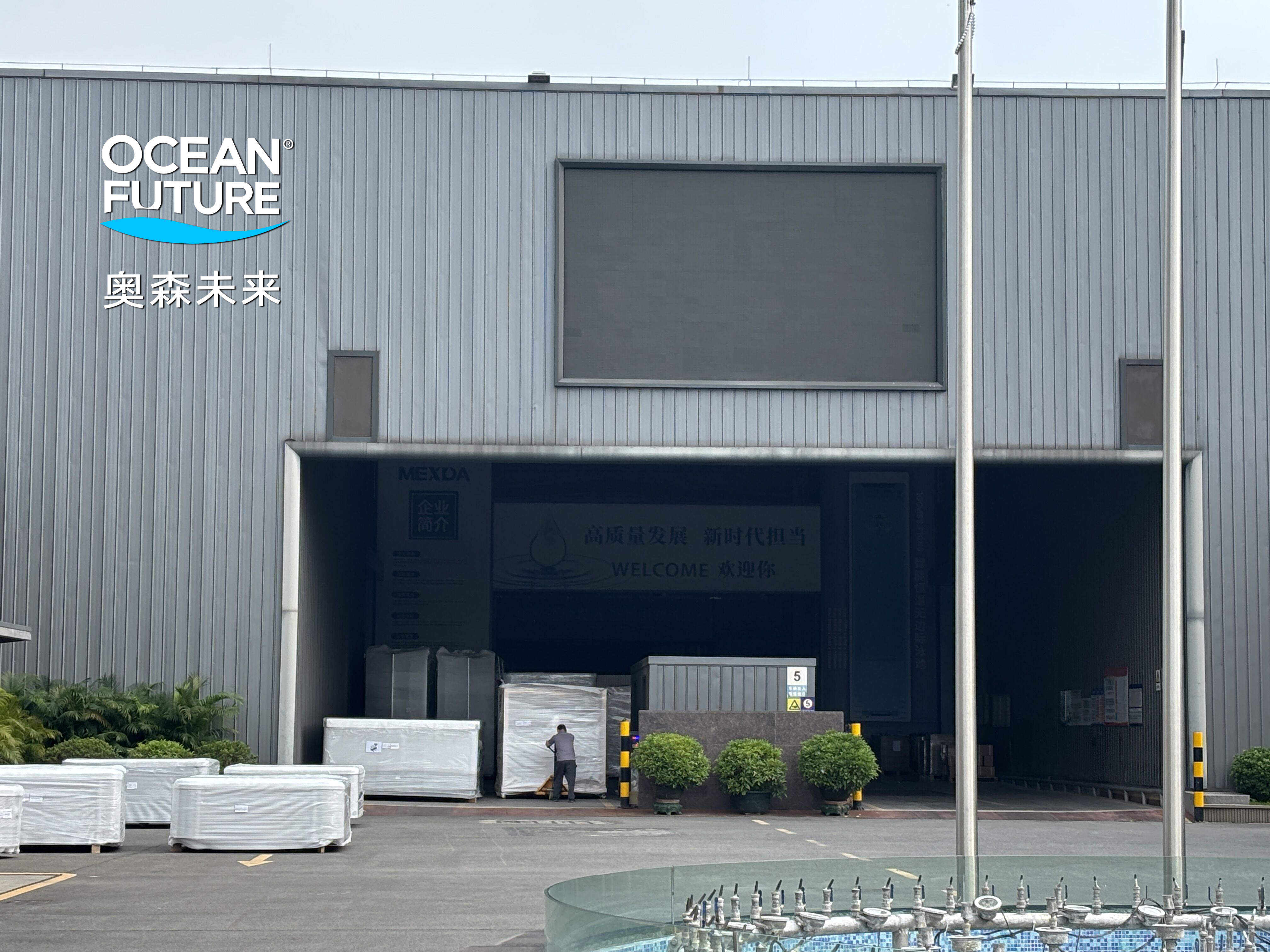
OCEAN FUTURE is the sauna and spa brand of FOSHAN GAOMING MUHE JINGCHENG SANITARY WARE CO., LTD., a manufacturer based in Foshan, Guangdong, China, whose range covers sauna rooms, hot tubs, swim spas and cold plunge products. The company was established in 2023 and operates a 50,000 m² factory with more than 200 employees and a nine-engineer R&D team.
Production scale is a supply-planning input, not a marketing detail. Annual output is 5,000 sets, with a monthly production capacity of 400 sets, and roughly 85% of output is exported, with the USA, Australia, Germany and the wider EU listed as main markets. For a multi-property rollout, monthly capacity is the figure that decides whether a delivery schedule is realistic or optimistic.
The OFS06 series is the infrared group within that sauna room range. It is offered in six models — OFS06A-5, OFS06B-1, OFS06B-2, OFS06B-3-1, OFS06B-3-2 and OFS06B-4 — and spans a total power range of 1500W to 3850W.
Shared build specification across the shortlist
The most useful starting point for a hospitality specification is what the six models have in common, because that common set defines the maintenance, cleaning and guest-experience baseline for the whole shortlist. All six OFS06 models are published with the build and feature set below.
| Parameter | Specification (OFS06 series) |
|---|---|
| Wood options | Hemlock, aspen, red cedar |
| Surface finish | Painted surfaces |
| Fittings | Wood handles |
| Glazing | Tempered glass windows |
| Heating | Far infrared heating plates |
| Control | AV1 control |
| Lighting | Colorful lighting |
| Audio and connectivity | FM radio, Bluetooth, USB, two speakers |
| Series power range | 1500W – 3850W |
Two details deserve attention in a commercial specification. First, the material options — hemlock, aspen and red cedar — let a buyer align a cabin with an existing interior palette while keeping to a single build platform, so a Canadian red cedar sauna room look does not require switching suppliers. Second, AV1 control gives the operator one control platform across multiple cabins, which simplifies staff training and spare-part planning when a spa area or wellness floor runs several units at once.
The feature list also answers a question that hotel operators ask early: whether a cabin will feel like a stripped-down version of a spa product. Colorful lighting, an FM radio, Bluetooth and USB input, and two speakers are all part of the standard published configuration, which means a guest-facing smart sauna room experience can be delivered without a separate fit-out package.
Matching total power (1500W–3850W) to a hospitality space
Total power is the main variable that separates the six models in this shortlist, and it is the number that should drive model selection rather than appearance. Higher wattage within the series generally means a larger room can be brought to temperature and a shorter warm-up interval, but it also raises the electrical demand on the circuit serving the cabin. The two constraints have to be resolved together, in this order:
- Measure the space before choosing a model. Floor area, ceiling height, wall material, glazing area, insulation and ambient temperature all change how much power a room needs.
- Decide the experience first. An infrared cabin is a dry-heat radiant product, which is a different guest experience from a traditional Finnish sauna room, a steam sauna room, or a hybrid infrared and traditional sauna room.
- Shortlist inside the 1500W–3850W band. The lower end suits compact, well-insulated spaces; the upper end suits larger or less insulated rooms and venues that need faster turnaround between guests.
- Confirm the electrical supply with the site's electrical contractor before committing to a model. The cabin is only one part of the circuit that serves it.
- Confirm the specific wattage for each model number against the current datasheet or quotation, because a series-level range does not by itself state which rating an individual model carries.
This shortlist deliberately does not assign a wattage to each individual model number. The 1500W to 3850W range is the published series figure; the rating belonging to a specific model should be confirmed in writing before a purchase order is issued.
The shortlist at a glance: six OFS06 infrared models
Because the material, heating, control, lighting and audio specification is common to the series, the practical selection question is which power rating each model carries and how that rating matches the rooms on a given site. The table below lists the six models against the shared specification.
| Model | Wood options | Heating | Control | Lighting | Audio & connectivity | Power |
|---|---|---|---|---|---|---|
| OFS06A-5 | Hemlock / aspen / red cedar | Far infrared heating plates | AV1 | Colorful lighting | FM radio, Bluetooth, USB, two speakers | Within series range 1500W–3850W — confirm model rating |
| OFS06B-1 | Hemlock / aspen / red cedar | Far infrared heating plates | AV1 | Colorful lighting | FM radio, Bluetooth, USB, two speakers | Within series range 1500W–3850W — confirm model rating |
| OFS06B-2 | Hemlock / aspen / red cedar | Far infrared heating plates | AV1 | Colorful lighting | FM radio, Bluetooth, USB, two speakers | Within series range 1500W–3850W — confirm model rating |
| OFS06B-3-1 | Hemlock / aspen / red cedar | Far infrared heating plates | AV1 | Colorful lighting | FM radio, Bluetooth, USB, two speakers | Within series range 1500W–3850W — confirm model rating |
| OFS06B-3-2 | Hemlock / aspen / red cedar | Far infrared heating plates | AV1 | Colorful lighting | FM radio, Bluetooth, USB, two speakers | Within series range 1500W–3850W — confirm model rating |
| OFS06B-4 | Hemlock / aspen / red cedar | Far infrared heating plates | AV1 | Colorful lighting | FM radio, Bluetooth, USB, two speakers | Within series range 1500W–3850W — confirm model rating |
For a hotel with several room categories, this is the stage at which the shortlist should be narrowed to one or two model numbers and then repeated across the property, so that housekeeping routines, maintenance procedures and guest instructions stay identical. On multi-cabin projects, specification consistency is usually worth more than a marginal difference in features.
Application fit: hotels, guesthouses, spas and wellness clubs
Hotels and resorts
Hotel buyers normally work with an existing building rather than a purpose-built wet area. An infrared cabin delivered as a prefabricated unit — with tempered glass windows and a painted wood finish — can typically be positioned on a spa floor, in a fitness area or in a suite with less structural intervention than a wet sauna build requires. Power selection is then driven by room size and by how quickly the cabin has to recover between guests during peak occupancy.
Guesthouses and boutique accommodation
Smaller operators prioritize a cabin that fits a modest footprint without overloading the building's electrical supply. Inside a 1500W–3850W range, the lower end of the band is the natural starting point, with the caveat that insulation and glazing still determine the final figure. Material choice is a commercial decision here as well: hemlock and aspen read as lighter and more contemporary, while red cedar carries the warmer tone associated with a Canadian red cedar sauna room.
Day spas and wellness clubs
Multi-cabin operators should standardize rather than mix. One control platform across the series (AV1), with the same lighting, audio and connectivity feature set, keeps the guest experience consistent and the spare-part inventory simple. Where a venue operates both dry-heat and wet-heat areas, infrared cabins can sit alongside a commercial sauna room or a steam sauna room instead of replacing it.
Commercial and private wellness clubs
Clubs with high footfall should weigh durability and cleaning routines as heavily as guest features. Wood handles, painted surfaces and tempered glass windows are the surfaces that take daily handling. The manufacturer's published control measures address the two most common failure modes for cabins in continuous commercial use — heat and moisture exposure — through overheat protection and a sealed structure, supported by pre-delivery environmental safety testing, corrosion-resistant hardware and quality inspection.
Where the OFS06 series has limits
An honest shortlist has to state where a product family stops being the right answer, and for the OFS06 series there are four boundaries worth flagging before a specification is signed.
- Power ceiling. The series tops out at 3850W. Very large commercial sauna suites, or rooms with extensive glazing and weak insulation, may exceed what a single cabin in this range can heat effectively. Those projects may need a different model family, more than one unit, or a different heating format.
- It is not a traditional Finnish sauna. Guests who expect a stove, stones and ladled water — or a true steam sauna room — will not get that experience from a far infrared cabin. If sauna culture is central to a venue's positioning, a traditional or hybrid infrared and traditional sauna room is the more appropriate specification.
- Certification is order-specific. The series is offered in hemlock, aspen and red cedar. Buyers who need FSC-certified wood should request chain-of-custody documentation for the specific order rather than assume it from the material name. The underlying market trend is real — Topture's 2024 industry report indicates that European commercial developers prioritized FSC-certified sustainably sourced wood in 36% of new sauna installations — but the documentation has to match the shipment.
- Site work stays with the buyer. Electrical supply confirmation, room preparation and local acceptance requirements remain the purchaser's responsibility, even when the cabin itself is delivered pre-tested.
Comparison with traditional fixed sauna rooms
OCEAN FUTURE publishes a comparison between its modular sauna rooms and traditional fixed installations. The company's figures state assembly time reduced by 70% and heating speed up by 40% relative to traditional fixed sauna rooms and single-mode cabins, an initial cost approximately 10% lower than custom-built saunas, and a total cost of ownership close to 30% lower over five years, with simple cleaning as the maintenance profile. These are supplier-published numbers and should be treated as indicative rather than independently audited.
Even allowing for that caveat, the underlying logic is directly relevant to a hospitality shortlist: a prefabricated cabin reduces on-site construction time, which shortens the gap between capital spend and the first paying guest. The trade-off runs the other way as well. A fixed custom build can be shaped around an irregular room, whereas a prefabricated indoor sauna room or prefabricated outdoor sauna cabin has to fit the space it is delivered into — which is why site measurement should precede model selection, not follow it.
Procurement and long-term supply terms
Purchase mechanics matter as much as the model number when a property runs a staged rollout, and the terms below are the published baseline for this supplier.
- Minimum order quantity: 1 set
- Delivery terms: EXW / FOB / CFR / CIF / DAP / DDP
- Acceptance criteria: pre-shipment test
- Payment terms: T/T, 30% deposit, 70% balance before shipment
On the manufacturing side, monthly capacity of 400 sets and annual output of 5,000 sets frame what a buyer can realistically schedule, and a nine-engineer R&D team supports customization requests — from finish selection to private label sauna room programs — when a project needs a configuration outside the standard build. Published quality controls include overheat protection, a sealed structure, pre-delivery environmental safety testing, corrosion-resistant hardware and quality inspection.
For a long-term program spanning several properties, the reliable approach is to fix the model and the specification early, agree the acceptance test expectations in the contract, and phase deliveries against verified capacity rather than against a single ideal delivery date. A one-set minimum order quantity makes a pilot unit straightforward; the same published capacity is what makes a multi-property rollout plannable rather than speculative.
A specification checklist for hospitality buyers
Before issuing an order for any model in this shortlist, confirm the following items in writing. Each one corresponds to a decision that is expensive to reverse later.
- Room volume, wall material, glazing area and insulation level.
- The specific power rating of the chosen model number, and the corresponding circuit requirement.
- The selected wood — hemlock, aspen or red cedar — and the painted finish.
- Control specification (AV1) and whether the venue standardizes on one control platform across cabins.
- Lighting, audio and connectivity requirements, including FM radio, Bluetooth, USB and two-speaker configuration.
- Compliance documentation for the destination market and the applicable heater and control standard.
- Pre-shipment test scope and the acceptance criteria that will be used on delivery.
- Delivery term (EXW, FOB, CFR, CIF, DAP or DDP) and the phasing of deliveries against monthly capacity.
Future outlook
Three directions look durable for hospitality infrared buyers. The first is growth: infrared remains the fastest-growing sauna product segment at a 7.5% CAGR, while traditional saunas hold the largest product share at 42.79%. Both formats will keep appearing in commercial wellness projects rather than one displacing the other, which is why hybrid and dual-format specifications are likely to remain part of hotel briefs.
The second is regulation. The publication of UL 60335-2-53 in June 2025 to align US requirements with international practice raises the value of suppliers who already document heater and control assemblies for export markets, rather than treating compliance paperwork as a post-order task.
The third is material sourcing. If European commercial developers are prioritizing FSC-certified wood in roughly a third of new installations, documentation discipline becomes part of the commercial conversation rather than a back-office detail. The scale of the established players reinforces the same point: Harvia Oyj, the leading traditional sauna and spa company, reported 2024 revenue estimated at approximately EUR 175 million, according to Dataintelo and Harvia investor relations — a reminder that hospitality buyers are choosing inside a maturing, compliance-driven industry where verifiable specifications matter more than catalogue adjectives.
FAQ
Which OFS06 model should a hotel specify for a guest suite versus a shared spa area?
The six models in the shortlist — OFS06A-5, OFS06B-1, OFS06B-2, OFS06B-3-1, OFS06B-3-2 and OFS06B-4 — share the same published material, heating, control, lighting and audio specification, and span a total power range of 1500W to 3850W. Selection therefore turns on room volume, insulation and the required recovery speed rather than on features. A compact, well-insulated suite and a larger shared spa area are matched from opposite ends of that power range, and the specific rating carried by each model number should be confirmed from the current datasheet before specifying.
How much power does a commercial infrared sauna room need?
Required power depends on room volume, ceiling height, wall material, glazing area, insulation and ambient temperature, so there is no single figure that applies to every commercial space. The OFS06 series covers 1500W to 3850W in total power; the lower end suits smaller, better-insulated rooms and the upper end suits larger or less insulated rooms and faster guest turnaround. Because additional power increases electrical demand, the circuit serving the cabin should be confirmed with a qualified electrical contractor as part of the same decision.
Can the wood finish and appearance be specified to match an existing interior?
The OFS06 series is offered in hemlock, aspen and red cedar, with painted surfaces and wood handles, which allows a cabin to be aligned with an existing interior palette while keeping one build platform. Buyers who require FSC-certified wood should request chain-of-custody documentation for the specific order, since material name alone does not confirm certification status. Tempered glass windows are part of the standard configuration.
What control and connectivity features come with the OFS06 series?
The series uses AV1 control. Standard published features include colorful lighting, FM radio, Bluetooth, USB input and two speakers. For venues operating several cabins, a common control platform simplifies staff training and spare-part planning, and the lighting and audio features are part of the standard configuration rather than a separate fit-out package.
What are the minimum order quantity, delivery terms and acceptance criteria?
The published terms are a minimum order quantity of 1 set; delivery terms of EXW, FOB, CFR, CIF, DAP or DDP; acceptance criteria based on a pre-shipment test; and payment terms of T/T with a 30% deposit and 70% balance before shipment. These terms apply to the sauna room range and are the reference point for a first order or a pilot unit.
How does production capacity affect a multi-property rollout schedule?
Monthly production capacity is 400 sets, and annual output is 5,000 sets, with approximately 85% of production exported to markets including the USA, Australia, Germany and the wider EU. For a rollout across several properties, delivery phasing should be planned against that verified monthly capacity rather than against a single ideal completion date, and acceptance testing expectations should be agreed in the contract before the first shipment.
The current OCEAN FUTURE sauna room brochure, including model and specification detail, is available for download: OCEAN FUTURE SAUNA ROOM (PDF). Company information: oceanfuturespas.com.