
Recommended Focuses USB Cables 2026: Five Builds Compared
USB cable sourcing in 2026 is standardized at the connector and unstandardized everywhere else. The European Union requires handheld mobile phones, tablets, and cameras sold after 28 December 2024 to charge through a USB Type-C port and to comply with EN IEC 62680-1-3:2022, and USB Type-C accounted for 41.2% of USB cable sales in 2025 according to Dataintelo. The plug question is largely settled. The cable behind the plug is not.
Jacket polymer, braid construction, strain relief, conductor build, and waterproofing still differ between products that look identical on a shelf. Those differences decide where a cable fails first — at the connector head after repeated bending, in cold weather when the jacket stiffens, or in humid outdoor conditions where moisture reaches the contacts.
This article shortlists five USB cable builds from Dongguan Focuses Electronics Technology Co., Ltd., sold under the brand Focuses: CB-PVC, CB-Nylon, CB-TPE, CB-SILICONE, and CB-Waterproof. Focuses is a USB cable manufacturer established in 2006 and relocated to Tangxia Town, Dongguan in 2018; it designs, produces, and exports data cables and charging cables, with approximately 90% of output shipped to the EU, North America, the Middle East, and Asia.
Each build below is assessed by jacket material, interface options, charging and data ratings, and the applications where it is the defensible choice — and the applications where it is not.
Why the Cable Body, Not the Connector, Drives 2026 Sourcing
Three market forces moved the cable body to the center of procurement conversations.
- Regulated connectors reduce differentiation at the plug. With EU common charger rules in force for devices sold after 28 December 2024 under EN IEC 62680-1-3:2022, buyers can no longer compete on connector type in that market. What remains to differentiate is the build.
- Power delivery keeps climbing. Fast-charging devices in the EU market that support USB Power Delivery must comply with EN IEC 62680-1-2:2022. Higher negotiated power means conductor cross-section, insulation, and heat management matter more than they did when 5W charging set the ceiling.
- Marketplaces now enforce cable safety. Amazon US requires USB Type-C cables to meet the UL 9990 safety standard for ICT power cables to avoid listing removal — a rule that shifts part of the electrical-safety burden onto the supplier and its test records.
Counter-pressure comes from the installed device base. Even as USB-C expands, Lightning and Micro USB devices remain in service, and distributors still need multi-interface coverage inside a single purchase order. That combination — fewer connectors, more power, mixed legacy devices — is why a material-based shortlist is more useful to a buyer than another "best cable" list.
The Five Focuses Builds at a Glance
| Model | Jacket / build | Interface options | Length | Charging | Data | Best-fit use |
|---|---|---|---|---|---|---|
| CB-PVC | PVC jacket | USB-A / USB-C to Type-C, Lightning, Micro USB | 0.3–2 m | 1A–2.4A | Up to 480 Mbps | Everyday home and office charging; cost-driven retail bundles |
| CB-Nylon | Braided nylon | USB-A / USB-C to Type-C, Lightning, Micro USB | 0.3–2 m | 1A–2.4A, up to 6A / 240W in fast-charging configurations | Up to 480 Mbps | Daily charging and travel; cables that are repeatedly coiled |
| CB-TPE | TPE jacket | USB-A / USB-C to Type-C, Lightning, Micro USB | 0.3–2 m | 1A–2.4A | Up to 480 Mbps | In-car and desktop use; soft-touch feel and cold-weather flexibility |
| CB-SILICONE | Silicone jacket | USB-A / USB-C to Type-C, Lightning, Micro USB | 0.3–2 m | Up to 6A / 240W in fast-charging configurations | Up to 480 Mbps | Working range of -20°C to 70°C; field charging |
| CB-Waterproof | IPX7 waterproof build | USB-A / USB-C to Type-C, Lightning, Micro USB | 0.3–2 m | Up to 6A / 240W in fast-charging configurations | Up to 480 Mbps | Outdoor, sweaty, and rainy environments; wet handling |
Two specifications run across the entire shortlist. Data transfer is rated at up to 480 Mbps, and the interface matrix pairs a USB-A or USB-C host connector with Type-C, Lightning, or Micro USB on the device side. The silicone and waterproof builds are specified for a working temperature range of -20°C to 70°C, with a maximum charging current of 6A and supported power of up to 240W in their fast-charging configurations.
The Manufacturer Behind the Shortlist
Dongguan Focuses Electronics Technology Co., Ltd. (brand: Focuses) manufactures USB cables from 8F HuiQing Industrial Park, TangXia Avenue South, Tangxia Town, Dongguan, Guangdong, China. The company was established in 2006 and relocated to its current site in 2018.
Manufacturing and commercial parameters that matter at the decision stage:
- Capacity: a 6,000 m² facility, 150 employees, and a stated annual output of 25,000,000 units.
- Engineering: an R&D team of 6 engineers.
- Export orientation: approximately 90% of output is exported, with shipments to the EU, North America, the Middle East, and Asia.
- Minimum order quantity: 2,000 units.
- Lead time: 25–35 days.
- Warranty: 12 months.
- Quality control: 100% electrical testing before shipment, supported by short circuit tests, swing tests, tensile tests, high and low temperature tests, power tests, and plug-in tests.
For a buyer, these figures translate into three practical consequences. A 2,000-unit minimum order quantity positions the range for distributor, OEM, and private-label programs rather than one-off retail purchasing. A 25–35 day lead time has to be built into seasonal planning rather than treated as a buffer. And 100% electrical testing plus a 12-month warranty shifts part of the field-failure risk toward the supplier's process control instead of the buyer's returns budget.
What Each Jacket Material Actually Does
PVC: the cost baseline
PVC is the lowest-cost jacket material in the shortlist, and it is the reason CB-PVC can serve high-volume, price-sensitive programs. It is flexible, easy to extrude in custom colours, and adequate for cables that stay largely stationary — a desk, a bedside table, a bundled retail kit. Its limits appear under repeated flexing and in cold conditions, where PVC stiffens and becomes less forgiving at the connector head.
Nylon braid: abrasion resistance
Braided nylon in CB-Nylon adds a textile layer over the inner jacket. The braid resists abrasion from bags, pockets, and vehicle interiors, and it reduces the tangling that shortens a cable's usable life in practice. The trade-off is manufacturing complexity and a slightly higher unit cost than a plain PVC build; braid also shows dust more visibly over time, which is a packaging consideration for light-coloured retail SKUs.
TPE: soft touch and cold flexibility
TPE sits between PVC and silicone. CB-TPE targets in-car and desktop use, where a cable must feel pliable and stay flexible at lower temperatures without the cost of a silicone jacket. TPE does not match the abrasion resistance of a braided nylon outer layer, so it is a comfort-and-flexibility specification rather than a ruggedized one.
Silicone: temperature range as a specification
Silicone is specified where temperature is the binding constraint. The Focuses silicone and waterproof builds carry a working temperature range of -20°C to 70°C, with a maximum charging current of 6A and supported power of up to 240W in fast-charging configurations. Silicone retains flexibility when cold and resists heat-related softening better than PVC. The costs are material price — silicone is the most expensive jacket polymer in this shortlist — and surface behaviour, since silicone surfaces tend to attract dust and lint.
IPX7 waterproof builds: sealing is the engineering problem
CB-Waterproof is built to IPX7 waterproof performance for outdoor, sweaty, and rainy conditions. The engineering challenge is not the jacket itself but the transition points: the connector head, the strain relief, and the moulded junctions where water can enter. Buyers should treat IPX7 as a build-level rating tied to the tested configuration — repeated plug and unplug cycles, worn connectors, or jacket damage reduce water resistance over the life of the cable.
Where cables actually fail: the head, not the middle
Most consumer cable failures occur at the cable head, where bending stress concentrates. Focuses applies an anti-broken structure at the cable head position on its durable builds. Compared with common market USB cables, that design provides 3–5 times longer service life and reduces the joint fracture failure rate by over 80%. Maintenance requirements are almost zero because the failure rate is low and replacement is seldom needed. The trade-off is stated in the company's own comparison data rather than hidden: raw material cost is slightly higher, while the long-term failure rate is much lower.
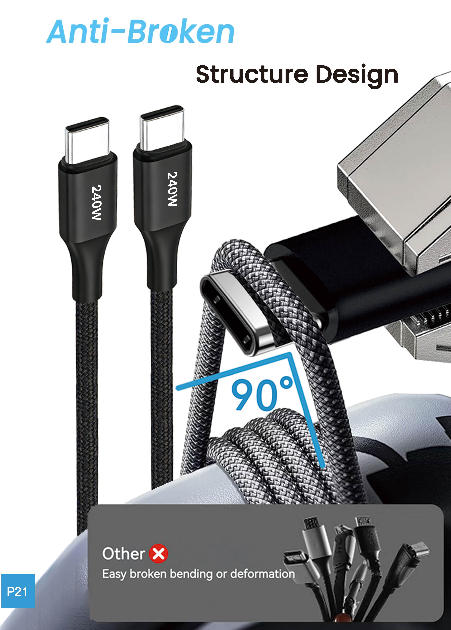
Anti-broken design at the cable head position — the structural difference behind the 3–5× service-life figure and the over-80% reduction in joint fracture failure rate.
Matching Each Build to an Application
Daily home and office charging — CB-PVC
CB-PVC is the volume option. Where a cable is charged overnight, rarely coiled, and bundled with a device or sold as an entry-level accessory, the PVC jacket delivers the required 1A–2.4A charging and 480 Mbps sync at the lowest material cost. Buying logic: match the cheapest jacket to the least demanding handling profile, and reserve the durability spend for cables that travel.
Fast charging and travel — CB-Nylon
CB-Nylon suits cables that live in a bag or a pocket. The braid handles abrasion, the anti-broken head addresses the dominant failure mode, and fast-charging configurations in the range reach up to 6A and 240W. For distributors, this is the build that covers both daily phone charging and laptop-class power delivery from a single SKU family — while remaining a 480 Mbps data cable.
Vehicles and temperature swings — CB-TPE and CB-SILICONE
Car interiors expose cables to heat build-up on the dashboard and cold starts in winter. CB-TPE is the softer-feeling option for regular in-car use at 1A–2.4A. Where the duty cycle includes long charging sessions at higher current, CB-SILICONE is the specification to choose: its -20°C to 70°C working range and up to 6A / 240W configuration are aimed at exactly that combination of heat, cold, and sustained load.
Outdoor, sweaty, and wet use — CB-Waterproof
CB-Waterproof is intended for field service, logistics, marine, and outdoor-sports environments. The IPX7 build adds sealing at the points where water normally enters, and the waterproof construction pairs with the same 0.3–2 m length range and Type-C, Lightning, or Micro USB interface options as the rest of the shortlist. Where a program is entirely indoor, the PVC, nylon, and TPE builds deliver the same charging function at lower cost, since waterproofing is unnecessary spend for a controlled environment.
OEM and ODM programs — custom logo, packaging, and interface mix
All five builds sit inside a customization framework supported by a 6-engineer R&D team: custom logo USB cables, custom packaging, and mixed interface combinations across USB-A, USB-C, Type-C, Lightning, and Micro USB. The governing constraint is commercial rather than technical — a 2,000-unit minimum order quantity and a 25–35 day lead time — so OEM buyers should plan pilot volumes and launch dates around those thresholds rather than around sample turnaround.
Market Trends Shaping Cable Selection in 2026
- Type-C is now the default interface. The USB Type-C segment held a 41.2% share of the USB cable sales market in 2025, according to Dataintelo, which is why USB-C-to-Type-C configurations dominate new programs while Lightning and Micro USB persist as legacy coverage.
- Demand is concentrated in Asia Pacific. Dataintelo reports Asia Pacific leading global USB cable revenue in 2025 at USD 12.3 billion, roughly 43% of the total market share — the region where most cable manufacturing capacity, including Focuses' Dongguan facility, is located.
- Growth is projected to stay double-digit. KBV Research projects a 17.3% CAGR for the USB cable market through 2031, while DataHorizzon Research estimates the market at USD 21.2 billion in 2024 and projects approximately USD 88.6 billion by 2033.
- Market size estimates diverge by scope. Published figures range from USD 19.2 billion to USD 28.6 billion for overlapping years depending on whether the report counts USB cable assemblies alone or a broader cable scope. Buyers should treat any single number as an order-of-magnitude indicator rather than a precise figure.
The strategic reading matters more than the totals. Growth of this scale is accompanied by regulation on two ends — the EU common charger rules on the connector side and marketplace safety requirements such as UL 9990 on the electrical side — which pushes differentiation toward build quality, test evidence, and application fit rather than connector availability.
Comparison with Common USB Cables — and the Limits of This Shortlist
| Dimension | Common market USB cable | Focuses anti-broken builds |
|---|---|---|
| Cable head construction | Standard moulded head | Anti-broken design at the cable head position |
| Service life | Baseline reference | 3–5 times longer service life |
| Joint fracture failure rate | Baseline reference | Reduced by over 80% |
| Maintenance | Replacement once the head fails | Almost zero; low failure rate, seldom replacement needed |
| Raw material cost | Lower | Slightly higher |
| Long-term failure rate | Higher | Much lower |
| Typical application fit | Occasional, light use | Daily home use, mobile matching, car charging |
Field evidence supports the durability argument beyond the laboratory comparison. In one Focuses USB cable program covering order quantities of 5,000 to 30,000 pieces per order, the product delivered stable fast charging, durable braided wire, low heating during prolonged charging, and zero quality complaints; normal service life exceeded two years against a 12-month warranty period. Globally recognized cable manufacturers such as Anker Innovations, Belkin International, Ugreen, and Baseus set the reliability benchmark that buyers typically use for comparison, and the practical question for any sourcing decision is whether a supplier's test evidence and warranty terms are strong enough to be measured against that benchmark.
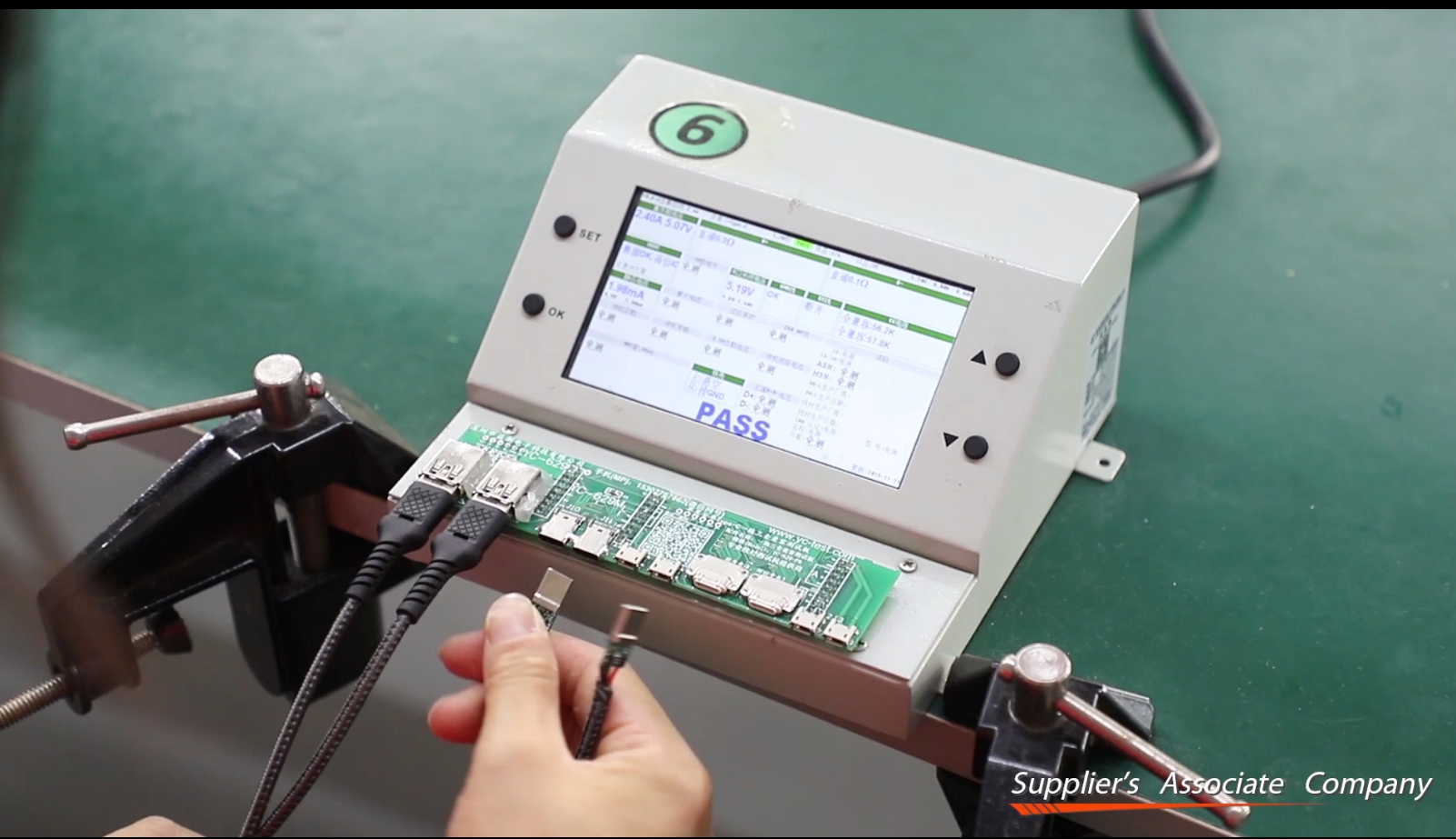
Electrical and mechanical test equipment: 100% electrical testing is applied before shipment, with short circuit, swing, tensile, high and low temperature, power, and plug-in tests supporting it.
Where this shortlist does not fit
- The data ceiling is 480 Mbps. Every build in the range is a charging and sync cable. Buyers whose programs require 5 Gbps or 10 Gbps transfers between drives, docks, or displays should treat data rate as the primary selection criterion and look outside this shortlist rather than assume the jacket determines performance.
- The durable builds cost slightly more in raw material. Focuses states this directly: raw material cost is slightly higher than common market cables, while the long-term failure rate is much lower. The waterproof and silicone builds sit at the top of that band because both sealing and silicone compound add cost. The justification is total cost of ownership across a replacement cycle, not unit price at the purchase order.
- A 2,000-unit minimum order quantity excludes very small trials. Buyers who need a few hundred units for field validation cannot place that order as a standard production run; they must plan pilot quantities around the MOQ and the 25–35 day lead time.
- IPX7 performance is configuration-dependent. Water resistance is achieved at the tested build level. Repeated plug cycles, worn connectors, or jacket damage degrade it, so the waterproof build should be treated as protection for wet handling rather than as a permanent guarantee for submerged use.
- 6A and 240W require a matched charging chain. The 6A rating is realized only when the charger and the device both support USB Power Delivery and negotiate that level. Connected to a non-PD charger, a fast-charging build falls back to the lower rate — a specification issue buyers frequently overlook when comparing cables on headline wattage alone.
What to Expect After 2026
Three trajectories look durable. First, connector consolidation continues: with the EU mandate applying to devices sold after 28 December 2024 under EN IEC 62680-1-3:2022 and USB Type-C holding 41.2% of 2025 cable sales, USB-C-to-Type-C will keep taking share from the Lightning and Micro USB configurations that remain in this shortlist for legacy coverage.
Second, power and temperature specifications will keep moving upward. The 6A / 240W configurations and the -20°C to 70°C working range already applied to the silicone and waterproof builds point toward cable selection being driven by thermal and current headroom rather than by connector type.
Third, material choices will be scrutinized on more than cost. PVC remains the volume baseline, but the premium builds in this range — braided nylon, TPE, silicone, and IPX7 waterproofing — exist because the market is paying for service life, handling feel, and environmental tolerance. For distributors and OEM buyers, the practical planning implication is a shorter SKU list with clearer application mapping: one cost-optimized build, one travel-grade braided build, one temperature-rated build, and one sealed build, rather than a long tail of near-identical cables.
Frequently Asked Questions
What is the difference between PVC, nylon braided, TPE, and silicone USB cable jackets?
The jacket material controls flexibility, abrasion resistance, and temperature behaviour. PVC is the lowest-cost option and is used in CB-PVC for everyday charging. Braided nylon in CB-Nylon adds an abrasion-resistant outer layer over the inner jacket, which helps on cables that are repeatedly pulled and coiled. TPE in CB-TPE is a soft-touch polymer with good low-temperature flexibility for in-car and desktop use. Silicone in CB-SILICONE retains flexibility across a -20°C to 70°C working range, which suits vehicles and outdoor equipment. All five builds are available with USB-A or USB-C host connectors to Type-C, Lightning, or Micro USB device connectors.
Which Focuses build fits everyday charging best?
For cost-driven daily charging, CB-PVC covers 1A–2.4A charging and up to 480 Mbps data in lengths from 0.3 m to 2 m, which is sufficient for desks, bedside tables, and bundled retail kits. Where a cable is handled and coiled frequently, CB-Nylon is the better fit because the braid resists abrasion and tangling. Where the priority is feel and cold-weather flexibility rather than abrasion, CB-TPE is the relevant specification. The decision rule is simple: match the jacket to the handling profile, not to the device brand.
Do these cables support fast charging?
Fast-charging configurations within the range support up to 6A and up to 240W, with a -20°C to 70°C working temperature range. The rating is conditional: 6A is delivered only when both the charger and the device support USB Power Delivery and negotiate that level. The EU additionally requires fast-charging devices in its market that support USB Power Delivery to comply with EN IEC 62680-1-2:2022. A fast-charging cable connected to a non-PD charger will fall back to the lower charging rate.
When is the IPX7 waterproof build worth the additional cost?
CB-Waterproof is intended for outdoor, sweaty, and rainy conditions such as field service, logistics, and outdoor sports, where moisture reaches the connector head during normal use. Where a cable is used exclusively indoors, the PVC, nylon, and TPE builds provide the same charging function without the waterproof construction, since sealing adds material and process cost. Water resistance is a build-level property: repeated plug cycles, worn connectors, or jacket damage reduce it over the life of the cable.
What are the order requirements for Focuses USB cables?
The minimum order quantity is 2,000 units and the lead time is 25–35 days. The warranty period is 12 months. Quality control includes 100% electrical testing before shipment, supported by short circuit tests, swing tests, tensile tests, high and low temperature tests, power tests, and plug-in tests. These thresholds apply across the five builds and should be planned into pilot and launch schedules.
Are these builds suitable for high-speed data transfer?
No. The range is rated at up to 480 Mbps, which is USB 2.0-class throughput. These builds are charging and sync cables suited to phone synchronisation, device pairing, and general data exchange, not to 5 Gbps or 10 Gbps transfers between external drives, docks, or displays. Buyers whose programs depend on high-speed data should select on data rate first and treat jacket material as a secondary criterion.
Further reference: the 2026 Focuses product catalogue is available for download at 2026 Focuses Catalogue (PDF). Company information is published at focusestech.com.