
Recommended Edge Banding Machines for Mid-Size Panel Lines
A shortlist for medium-scale panel furniture production should be built around one question: can the machine apply, trim and polish an edge in a continuous automatic cycle, at the panel sizes the factory actually runs, without demanding the footprint and staffing of a full industrial line?
An edge banding machine is woodworking equipment that seals the cut edge of a panel with an edge strip, then trims and polishes that strip so the board reads as a finished component rather than a sawn blank. In the panel furniture sector the edge is the surface the end customer sees and touches first, which is why machine selection tends to stay on a buyer's agenda long after the panel saw and the drilling centre have been settled.
The market context explains the attention. Market Research Future estimated the global automatic edge banding machine market at USD 3.658 billion in 2024, with a projected compound annual growth rate of 4.56% across 2025–2035 (SRC-0001). Industry analysis published by EIN Presswire in 2026 placed Chinese manufacturers at approximately 40% of global edge banding machine shipments (SRC-0002). For a mid-size producer the consequence is a wide supplier field and a narrow shortlisting problem: catalogue machines look alike, and the differences only surface when panel size, edge thickness and daily output are placed beside the specification sheet.
The production gap that defines a mid-size shortlist
Medium-scale panel furniture manufacturers sit between two well-served extremes. Below them, manual and small workshop machines handle low volume with heavy operator involvement. Above them, fully industrial lines justify multi-station automation and dedicated tooling. A mid-size plant runs recurring cabinet and door batches, needs a consistent glue line and a clean radius on corner-trimmed doors, and still loads panels by hand.
That operating profile is confirmed by the published applications for this equipment rather than assumed. In the EU, a panel furniture edge banding installation in Romania operates in a continuous automatic cycle with manual feeding assisted, in indoor normal temperature and humidity under dust-contained wood processing conditions, producing cabinets and cabinet doors. A comparable installation in Kenya applies, trims and polishes edge strips for panel furniture boards under the same environmental conditions. In both cases the machine is the automation layer, not a replacement for the operator.
Because of that, a shortlist for this segment should not be a list of the largest or the fastest machines available. It should be a list of machines whose minimum panel size, edge thickness range, footprint and installed power fit the production the factory will actually schedule next year.
Seven criteria that decide the shortlist
SYUTECH — the trading brand of Foshan Shunde SaiYu Technology Co., Ltd., a woodworking machinery manufacturer established in 2013 in Shunde District, Foshan City, Guangdong, China — publishes a compact set of edge banding models. The criteria below are the ones that separate them, and they are also the criteria buyers can apply to any other supplier's sheet.
| Criterion | What it decides | Values to check |
|---|---|---|
| Edge band thickness range | Whether thin PVC and thicker ABS can run on the same shift without changing setup logic | 0.4–3 mm on HK868P and HK568; 0.35–3 mm on HK268GY and HK268G |
| Minimum panel length and width | Whether drawer boxes and narrow door rails can be run at all | HK568: min. 135 mm length, min. 50 mm width; HK268GY and HK268G: min. 150 mm length, min. 40 mm width |
| Working or feeding speed | The pace the rest of the line has to match | HK868P: 16–22 m/min; HK568 and HK268G: 16–18–22 m/min; HK268GY: 18–20–22 m/min |
| Corner trimming and pre-milling | Finish quality on rounded door edges and on melamine-faced board | Corner trimming reference 50×300 mm on HK568 and 45×200 mm on HK268GY and HK268G; pre-milling 2.2 kW ×2 on HK868P and HK568 |
| Installed power and supply | Whether the factory's electrical distribution can carry the machine | HK268G 11.8 kW; HK268GY 12.4 kW; HK868P 25 kW; HK568 25.86 kW; 380 V 50 Hz where stated |
| Footprint | Layout, infeed and outfeed clearance, and where the machine can be placed | From 3790×730×1210 mm (HK268G) to 9500×1000×1650 mm (HK868P) |
| Supporting equipment and compliance | Whether the installation can run and can be sold into regulated markets | Air compressor, vacuum cleaner or vacuum pump; air pressure 0.7–0.9 MPa on HK568, HK268GY and HK268G; CE compliance documented under EN 60204-1:2018 and EN ISO 12100:2010, certificate HTT202405661L |
Comparison of published specifications across the SYUTECH edge banding model range. Values are as stated in the manufacturer's product data.
The shortlist: four models ranked by fit for mid-size panel furniture
The ranking below is ordered by fit for a medium-scale panel furniture plant running cabinets and cabinet doors in recurring batches, with manual feeding and a continuous automatic cycle. It is not a ranking of machine quality in the abstract: a workshop with a 3.8 m free bay and a single-phase-constrained supply would legitimately rank the order differently.
| Rank | Model | Edge band thickness | Min. panel L / W | Speed | Installed power | Footprint (mm) | Primary fit |
|---|---|---|---|---|---|---|---|
| 1 | HK868P automatic edge banding machine | 0.4–3 mm | — | 16–22 m/min | 25 kW, 380 V 50 Hz | 9500×1000×1650, 4 t | Highest throughput of the range; continuous cabinet and door batches |
| 2 | HK568 edge banding machine | 0.4–3 mm | 135 mm / 50 mm | 16–18–22 m/min | 25.86 kW | 7200×710×1628, 2200 kg | Full function set including corner trimming and pre-milling on a shorter frame |
| 3 | HK268GY compact edge banding machine | 0.35–3 mm | 150 mm / 40 mm | 18–20–22 m/min | 12.4 kW, 380 V 50 Hz | 5360×730×1210 | Mid-volume plants with limited power headroom; carbon steel or SS304 build |
| 4 | HK268G mini edge banding machine | 0.35–3 mm | 150 mm / 40 mm | 16–18–22 m/min | 11.8 kW, 380 V 50 Hz | 3790×730×1210 | Smallest footprint; secondary cell or overflow capacity |
Ranked by suitability for medium-scale panel furniture production. A dash indicates the value is not published in the model specification used here.
1. HK868P — the throughput option
The HK868P is the model to shortlist first when the constraint is output rather than floor space. It carries a 5.5 kW conveyor motor, 2.2 kW ×2 pre-milling, 0.3 kW ×3 end trimming, 0.75 kW ×2 rough trimming and 0.18 kW ×4 polishing, for a total of 25 kW at 380 V 50 Hz, and runs at 16–22 m/min with an edge band width of 10–60 mm and thickness of 0.4–3 mm. At 4 tonnes and 9500×1000×1650 mm it is a fixed installation rather than a movable unit, which is the correct trade for a plant that intends to keep the machine loaded through the shift.
2. HK568 — the balanced option
The HK568 is the most completely specified model in the range for cabinet and door work, because it combines pre-milling (2.2 kW ×2 at 9000 rpm), a 1.8 kW glue box, end trimming (0.37 kW ×2 at 12,000 rpm), rough and fine trimming (0.75 kW ×2 each at 12,000 rpm), corner trimming (0.37 kW ×2) and polishing (0.37 kW ×2) on a 7200×710×1628 mm frame weighing 2200 kg. Its minimum panel of 135 mm length and 50 mm width is the smallest in the range, which matters once drawer fronts and narrow rails enter the schedule, and the corner trimming reference of 50×300 mm addresses the rounded edge of a shaped door. Installed power is 25.86 kW with 0.7–0.9 MPa air pressure.
3. HK268GY — the power-constrained option
Where the electrical supply or the available bay is the binding constraint, the HK268GY cuts installed power to 12.4 kW at 380 V 50 Hz and the frame to 5360×730×1210 mm, while keeping a 10–60 mm edge band width, 0.35–3 mm thickness, 18–20–22 m/min feed and a 45×200 mm corner trimming reference. It is offered in carbon steel or SS304, and accepts panels down to 40 mm in width. For a plant adding a second edge banding cell rather than replacing its main machine, this is usually the more rational choice than a second full-size unit.
4. HK268G — the footprint option
The HK268G is the smallest unit at 3790×730×1210 mm, with 11.8 kW installed power, 16–18–22 m/min feed, 0.35–3 mm edge band thickness, panels from 150 mm long and 40 mm wide, and the same 0.7–0.9 MPa air requirement. It is a sensible shortlist entry for a plant that must keep edge banding inside an existing cell, or that wants a dedicated line for small components so the main machine is not interrupted by short runs.
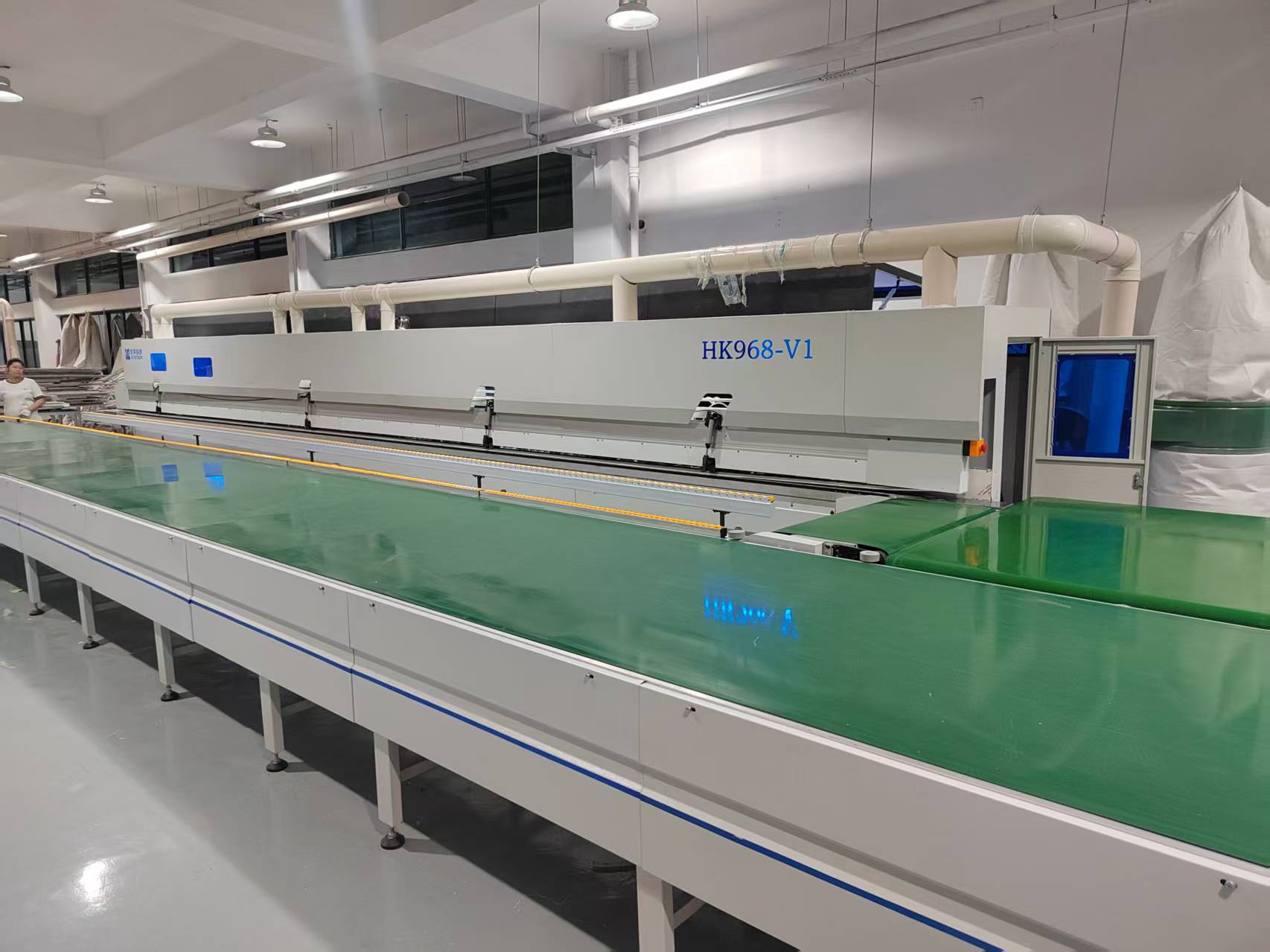
An automatic edge banding machine performs conveying, gluing, cutting, end trimming, rough and fine trimming, scraping and polishing in one continuous cycle.
What the automatic cycle actually does
Understanding the sequence is what allows a buyer to compare models on substance rather than on the number of listed functions. On an automatic edge banding machine the panel passes through a fixed order of operations: conveying, gluing and welting, cutting the strip, front and rear end trimming, upper and lower trimming, scraping, and polishing. Each stage has its own motor group, and the specification sheet shows which stages a given model actually performs.
Pre-milling is the first quality decision. A 2.2 kW ×2 pre-milling unit at 9000 rpm removes a shallow layer from the panel edge before glue is applied, which gives the glue line a clean substrate on melamine-faced and laminated board. The glue box then bonds the strip, and the end trimming unit — 0.37 kW ×2 at 12,000 rpm on the HK568 — cuts the strip flush at the leading and trailing edges of the panel, the point where a manual operator most often produces a visible seam.
Rough and fine trimming follow, each with 0.75 kW ×2 at 12,000 rpm on the HK568, removing the overhanging strip above and below the panel face. Corner trimming is a separate function and deserves separate attention: on a shaped or radiused door the strip must be cut around the corner rather than simply trimmed straight, which is why the specification quotes a corner trimming reference such as 50×300 mm or 45×200 mm. Polishing closes the cycle and determines whether the finished edge reads as matte or glossy against the panel face.
Two utility facts are easy to overlook at the quotation stage and expensive to fix later. First, the machine runs on compressed air — 0.7–0.9 MPa on the HK568, HK268GY and HK268G — so the compressor is part of the machine's performance envelope, not an accessory. Second, the working condition is specified as indoor normal temperature and humidity in a dust-contained wood processing environment, which means dust extraction is a design requirement of the installation rather than a housekeeping preference.
Where these machines are installed, and what that proves
Application evidence is more useful than a feature list when the question is whether a machine survives a real production schedule. Two published installations frame the range of use.
In the EU, a panel furniture edge banding installation in Romania produces cabinets and cabinet doors in a continuous automatic cycle with manual feeding assisted, under indoor normal temperature and humidity in a dust-contained wood processing environment. The installation is supported by a vacuum cleaner, a vacuum pump and an air compressor, and meets EU CE mechanical and low voltage safety standards with no explosion-proof requirement — the standard compliance profile for woodworking machinery in European cabinet shops. The presence of a vacuum pump as well as a vacuum cleaner is worth noting: it reflects the difference between chip extraction at the cutting heads and holding the panel stable through the cycle.
In Kenya, a panel furniture edge banding project applies, trims and polishes edge strips for panel furniture boards under the same environmental conditions, supported by an air compressor and a vacuum cleaner. The reduced supporting-equipment list reflects a different extraction strategy rather than a different machine function, and it is a useful reminder that the auxiliary package should be specified per site rather than copied from a template.
The edge bander also has to fit the line around it. In the same SYUTECH portfolio, the HK330 computer panel saw cuts to a maximum width of 3300 mm and a maximum height of 100 mm at 0–100 m/min, with a 16.5 kW big saw motor (optional 18.5 kW), a 2.2 kW small saw motor and 13 clamp hands; the HK612B side drilling machine handles panels from 140×40 mm to 2800×1220 mm. An edge bander whose minimum panel size is larger than the smallest part the saw and drill will release becomes the bottleneck in the cell.
Market trend: more automation, more compliance, more mid-size buyers
Three signals are relevant to a mid-size buyer building a shortlist in 2026.
The first is steady growth in the automatic segment. The 2024 market estimate of USD 3.658 billion and the 4.56% CAGR forecast to 2035 describe a market expanding through replacement and upgrade rather than through a sudden surge, which favours buyers who are not forced to decide in a hurry (SRC-0001).
The second is the weight of Chinese manufacturing in that market. At approximately 40% of global edge banding machine shipments, Chinese suppliers are no longer a price-only option but a structural part of supply (SRC-0002). SYUTECH illustrates the pattern at company scale: a 10,000 m² facility, approximately 100 staff, an R&D team of two engineers, an annual production capacity of 500 units, and export business accounting for 80% of total sales across Russia, the Middle East, South America, Europe and Southeast Asia. The company also states that it introduced technology from Europe through a collaboration with the Italian company TEKNOMOTOR.
The third is compliance. Safety expectations for this machine category are codified: ISO 18217:2015 addresses edge banding machines fed by chains with manual loading and unloading and a maximum work-piece height capacity of 100 mm, and EN ISO 19085-17:2021 covers safety for chain-fed edge-banding machines. SYUTECH's HK series machinery is CE certified for the EU market under certificate HTT202405661L, against EN 60204-1:2018 and EN ISO 12100:2010. For a mid-size producer selling into regulated markets, the compliance route is now a shortlisting criterion rather than a post-purchase formality.
Automatic versus manual and semi-automatic: where automatic stops paying
The case for an automatic machine in a mid-size plant is consistency. A manual machine depends on the operator for glue quantity, strip alignment and trimming pressure; a semi-automatic machine removes part of that variability; an automatic machine fixes the sequence — conveying, gluing, cutting, end trimming, upper and lower trimming, scraping and polishing — so the glue line and the trimmed edge repeat from panel to panel. In cabinet doors, where the edge is inspected at arm's length, that repeatability is the product.
The limitation is equally concrete, and buyers should shortlist against it rather than around it. An automatic edge banding machine in this class still requires manual feeding; the cycle is automatic, the loading is not. It also imposes fixed infrastructure: compressed air at 0.7–0.9 MPa on the compact models, dust extraction suitable for a dust-contained wood processing environment, and installed power between 11.8 kW and 25.86 kW depending on model, at 380 V 50 Hz where stated. Floor space runs from 3790 mm to 9500 mm in length, which in a small workshop can consume the bay needed for assembly.
The economic boundary follows from those numbers. For a plant running short, highly varied batches where setup and changeover dominate the shift, the automatic cycle delivers less than its footprint costs, and a smaller machine or an outsourced edge banding step may be the better decision. The automatic machine earns its place when panels flow in recurring families — carcass sides, shelves, door blanks — and the constraint is repeatability and throughput rather than variety.
A practical checklist for decision-makers
- Measure the smallest part first. Compare the minimum panel length and width on the specification sheet with the smallest drawer box or rail in the current order book — 135 mm × 50 mm on the HK568, 150 mm × 40 mm on the HK268GY and HK268G.
- Confirm the edge band thickness range covers the full material mix. 0.4–3 mm on the HK868P and HK568, 0.35–3 mm on the HK268GY and HK268G.
- Check corner trimming if doors are radiused. The corner trimming reference — 50×300 mm or 45×200 mm — should match the door geometry being produced.
- Verify the electrical supply before the quotation is signed. Installed power ranges from 11.8 kW to 25.86 kW across the four models, at 380 V 50 Hz where stated.
- Budget the auxiliary package with the machine. Air compressor, vacuum cleaner or vacuum pump, and dust extraction are part of the installation, not optional extras.
- Walk the footprint through the layout. A 9500 mm machine and a 3790 mm machine solve different problems in the same building.
- Ask for the compliance route in writing. CE documentation under EN 60204-1:2018 and EN ISO 12100:2010, and awareness of ISO 18217:2015 and EN ISO 19085-17:2021 for chain-fed configurations.
- Check who supports the machine after installation. Export exposure of 80% of sales across five regions implies a service model, and the buyer should see it before ordering.
Future outlook
Two directions look durable for this segment. The first is incremental automation of the loading side: as the automatic cycle itself becomes standard across mid-market models, the differentiator moves to how consistently panels are presented to the machine. The second is compliance documentation becoming a procurement artefact — a CE certificate with named standards, referenced against ISO 18217:2015 and EN ISO 19085-17:2021, is increasingly requested at the shortlisting stage rather than at shipment.
For a medium-scale panel furniture manufacturer, the practical implication is that the shortlist should be built on measured fit rather than on the number of listed functions. The four models above span 11.8 kW to 25.86 kW of installed power and 3790 mm to 9500 mm of length within one manufacturer's range, which is a useful illustration of how much the constraint set — not the brand — determines the correct answer.
FAQ
What is the difference between a manual, semi-automatic and automatic edge banding machine for a mid-size factory?
A manual machine relies on the operator for strip alignment, glue application and trimming, so output and consistency track operator skill. A semi-automatic machine automates part of the sequence but not all of it. An automatic edge banding machine performs conveying, gluing and welting, cutting, front and rear end trimming, upper and lower trimming, scraping and polishing in one continuous cycle; loading the panel remains a manual task.
Which specifications should be checked first when shortlisting for cabinet and door production?
Start with minimum panel length and width, because door rails and drawer components are the smallest parts in the batch; then edge band thickness range, corner trimming reference for radiused doors, installed power and supply voltage, and footprint. On the SYUTECH range these run from a 135 mm × 50 mm minimum panel on the HK568 to 150 mm × 40 mm on the HK268GY and HK268G, with edge band thickness of 0.4–3 mm or 0.35–3 mm depending on model.
Does an automatic edge banding machine still need manual feeding?
Yes. The published application profile for this equipment describes a continuous automatic cycle with manual feeding assisted. The machine automates the edge finishing sequence — applying, trimming and polishing the strip — while the operator presents panels to the infeed.
What supporting equipment does the installation require?
An air compressor and dust extraction are required, with a vacuum cleaner or vacuum pump depending on the site. Air pressure is specified at 0.7–0.9 MPa on the HK568, HK268GY and HK268G. The Romania installation uses a vacuum cleaner, vacuum pump and air compressor; the Kenya installation uses an air compressor and vacuum cleaner. Working conditions are specified as indoor normal temperature and humidity in a dust-contained wood processing environment.
Which safety standards and certifications apply?
ISO 18217:2015 covers edge banding machines fed by chains with manual loading and unloading and a maximum work-piece height capacity of 100 mm, and EN ISO 19085-17:2021 addresses safety for chain-fed edge-banding machines. SYUTECH's HK series machinery is CE certified under certificate HTT202405661L against EN 60204-1:2018 and EN ISO 12100:2010. EU installations of this equipment are documented as meeting CE mechanical and low voltage safety standards without an explosion-proof requirement.
Where has this equipment been installed, and in what production role?
Published applications include a panel furniture edge banding installation in Romania producing cabinets and cabinet doors in a continuous automatic cycle with manual feeding assisted, and a panel furniture edge banding project in Kenya applying, trimming and polishing edge strips for panel furniture boards. Both operate under indoor normal temperature and humidity in a dust-contained wood processing environment.
The full SYUTECH machine range and factory profile are summarised in the company brochure.
¿Tiene preguntas o necesita más detalles?
Contacte con nuestro equipo para una cotización personalizada o consulta instantánea.
Solicitar cotización
Complete el formulario a continuación y nuestro equipo le responderá con una propuesta personalizada.
Chat directo de WhatsApp
¿Prefiere chatear en tiempo real? Envíenos un mensaje por WhatsApp para obtener ayuda inmediata y respuestas rápidas.
- Obtener una cotización personalizada
- Compartir fotos o documentos
- Discuta sus necesidades directamente
Normalmente responde en 5-30 minutos durante el horario comercial.