
Recommended Bulk Bags Shortlist: FIBC, Ton Bag and Reusable Logistics Options
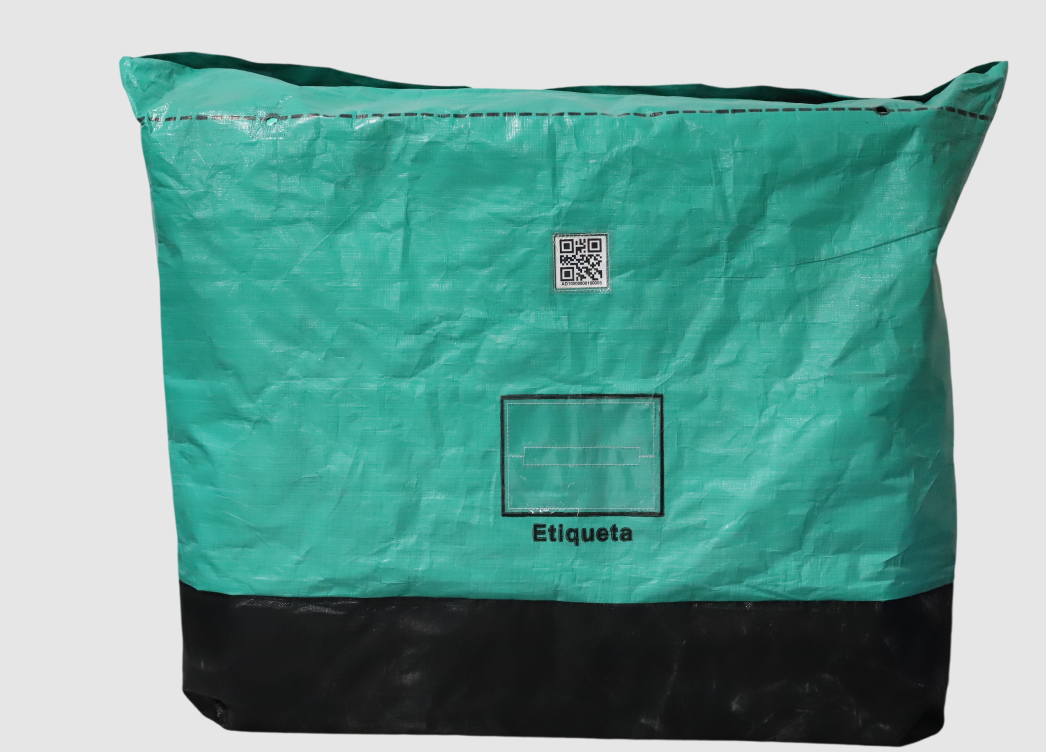
Reusable logistics bags with zipper or round openings are the returnable side of a bulk-packaging shortlist. Image: Yide Packaging.
A bulk bag shortlist for industrial loads between 500 kg and 2,000 kg is a structural decision before it is a purchasing decision. Fill interface, discharge method, fabric construction and whether the container travels once or many times determine handling effort, contamination and moisture risk, and whether a returnable loop is even possible.
Bulk bags — also written as FIBC (Flexible Intermediate Bulk Containers), ton bags or jumbo bags — are large flexible industrial containers designed to store and transport bulk materials. In the working band most industrial buyers actually use, three option families cover the majority of requirements: FIBC / ton bags for 500–2,000 kg dry powder, granule and pellet loads; industrial bulk bags for heavy-duty, frequently laminated general industrial cargo; and reusable logistics bags for repeated parcel and goods transit rather than powder containment.
Yancheng Yide Packaging Technology Co., Ltd. (Yide Packaging) is a manufacturer and customized packaging solution provider based in Yancheng, Jiangsu, China, producing FIBC bags, PP woven bags, valve bags, paper-plastic composite bags and reusable logistics packaging for industrial, chemical, agricultural and logistics customers. Its FIBC and woven-bag production is certified under ISO 9001, ISO 14001 and ISO 45001, with the ISO 45001 scope explicitly covering the production of postal bags including FIBC / bulk bags, transfer bags and woven bags.
The shortlist below is built from verifiable structure and specification facts — not from brand positioning.
Why the 500–2,000 kg band frames every choice
Load range is the first filter because it defines which structures are even available, and which standards apply. A ton bag, also called a bulk bag, FIBC or jumbo bag, is typically rated for a Safe Working Load (SWL) of 500–2,000 kg, depending on design, material, dimensions and safety requirements. A standard ton bag commonly holds around 1,000 kg, and heavy-duty FIBC construction can be specified above that standard when required.
For the FIBC family, the relevant specification is custom sizing rather than a fixed catalogue size: FIBC bag sizes are customized on demand, with the load rating, fabric and safety factor matched to the intended duty.
Two standards developments matter for buyers signing off a shortlist today:
- ISO 21898:2024 specifies materials, construction and design requirements, type test and marking requirements for FIBCs intended to contain non-dangerous solid materials in powder, granular or paste form, designed to be lifted from above by integral or detachable devices.
- EN ISO 21898:2024 was approved by CEN on 12 August 2024, covering the same requirement set for the European market.
- GB/T 10454-2025, the Chinese national standard for packaging FIBCs for non-dangerous goods, was released on 29 August 2025 and takes effect on 1 March 2026, replacing GB/T 10454-2000 and GB/T 37425-2019.
The practical implication is that the earlier ISO 21898:2004 edition is now superseded, and a specification written against it may need re-mapping. This is a documentation question, not a product question — but it is exactly the kind of detail that changes a shortlist decision.
Shortlist structure 1: top filling options
FIBC / ton bag construction supports three documented top configurations: fill spout, full open top and top cover. They are not interchangeable, because they assume different filling equipment and different degrees of product containment during filling.
| Top structure | Fits when | What to verify before ordering |
|---|---|---|
| Fill spout | Filling is carried out through enclosed filling equipment and the priority is controlled product entry with reduced dust during the fill cycle | Spout dimensions against the filler outlet; fabric specification and SWL for the target load |
| Full open top | The product is loaded manually or in a way that cannot pass through a spout, or the load is bulky rather than free-flowing | Whether closing after filling is required, and whether a separate cover is needed |
| Top cover | An open-top bag needs to be closed after filling to limit spillage, contamination or weather exposure during storage | Whether the cover closure method suits the handling process |
Top configuration options for FIBC / ton bags, based on documented construction options.
A shortlist mistake appears here more often than anywhere else: buyers specify the SWL correctly and then select a top structure that their existing filling line cannot serve. The fill interface should be matched to the filler first, and to the product second.
Shortlist structure 2: bottom discharge options
Bottom construction resolves into two documented choices: discharge spout and flat bottom. Both are used across the same documented industry set — chemical, new energy, mining, agriculture, food, logistics and warehousing, and trading operations — so the decision is driven by how the material leaves the bag, not by industry.
| Bottom structure | Fits when | What to verify |
|---|---|---|
| Discharge spout | The material is emptied in a controlled flow into a hopper, process line or receiving vessel | Spout opening against downstream equipment; whether the receiving point can be sealed during discharge |
| Flat bottom | Discharge happens by other handling means, or the bag is used for storage and transport rather than controlled emptying | Reuse intent — whether the bag will be emptied and refilled or discarded |
Bottom discharge options for FIBC / ton bags, based on documented construction options.
All structures in this family share a common build baseline: virgin PP woven polypropylene fabric or reinforced thickened anti-static fabric, four lifting belts, and high-strength polyester thread sewing. Industrial bulk bags follow the same sewing logic with high-tensile polyester thread and are additionally offered with custom logo printing and waterproof lamination.
Shortlist category 3: reusable logistics bags with zipper or round openings
Reusable logistics bags belong on the same shortlist table but serve a different job. They are not designed for 500–2,000 kg of powder; they are designed for repeated transit of parcels, goods and mixed loads, where the constraint is closing speed, reuse cycles and weather resistance rather than SWL.
Documented construction options include two opening types:
- Zipper style, supplied with a zipper protector, a lockable buckle and zipper-tooth protection — relevant where loads must be secured and the closure must survive repeated opening.
- Round opening style, where a simpler loading aperture suits the handling process.
The standard size is 100×100 cm with customizable sizes available. The material is PE woven fabric with lamination optional, and the bags are documented as waterproof and stain-resistant, wear-resistant and high load-bearing. Standard color options include blue, white, light-green, green, yellow, red and orange-red, with custom printing available.
Documented applications for this family include logistics circulation, moving and storage, luggage transit, warehouse handling, express sorting and goods storage — and by industry, apparel and e-commerce, automotive and industrial, pharma and healthcare, and electronics and high-value goods.
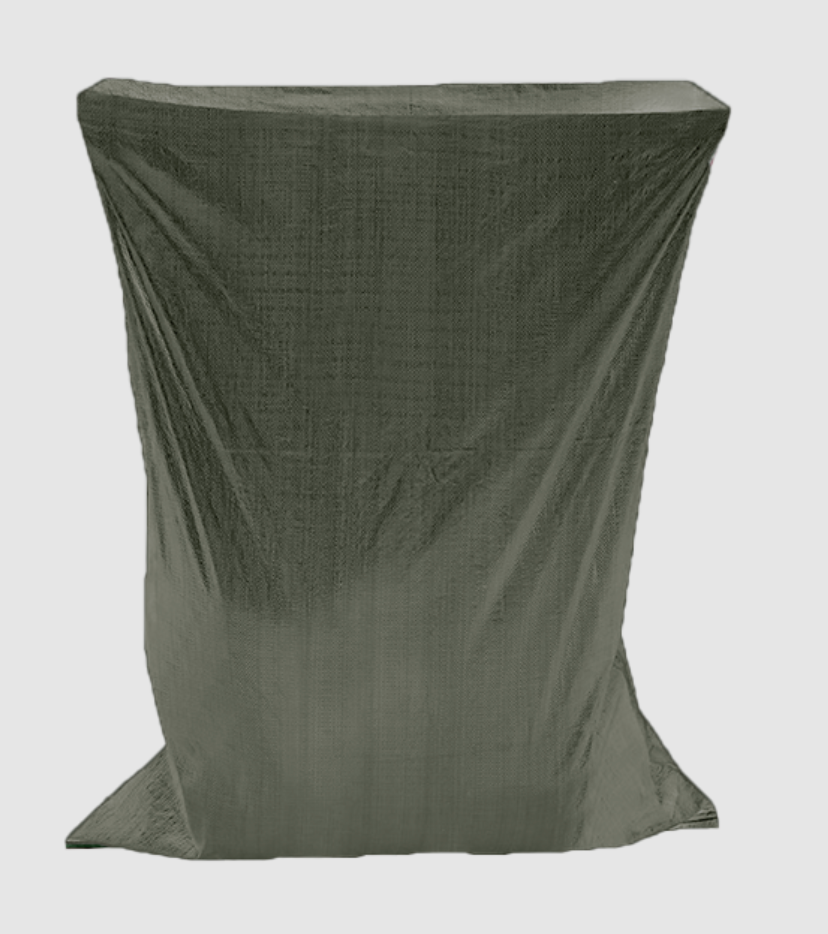
Virgin PP woven fabric is the common base material across FIBC, industrial bulk bags and PP woven packaging. Image: Yide Packaging.
Lamination: the waterproof decision, and its boundary
Waterproof handling is usually the second question after load. The shortlist answer depends on which family is chosen, because lamination behaves differently across them.
| Product family | Lamination status | Waterproof consequence |
|---|---|---|
| FIBC / ton bag | Laminated or non-laminated optional | Specify lamination where moisture exposure during storage or transit is a risk |
| Industrial bulk bags | PP woven material with waterproof lamination | Waterproof performance applies to the laminated version |
| Reusable logistics bag / express transfer bag | PE woven fabric, lamination optional | Waterproof and stain-resistant performance documented for the bag construction |
| Paper-plastic composite bag | Optional lamination | Laminated version is waterproof; non-laminated version is non-waterproof |
| Valve bag | Film-lined and non-film configurations | Film-lined version offers water and moisture resistance; non-film version is breathable but not waterproof |
Lamination options and their documented waterproof behaviour by product family.
The honest boundary here is that lamination is not automatically the better choice. In valve-bag construction, the film-lined version delivers water and moisture resistance while the non-film version is breathable but not waterproof — breathability matters for products that need to release moisture or gas. A buyer who specifies lamination across every line removes that option without necessarily needing to.
What evidence should accompany the shortlist
A structural shortlist is only as good as the documentation behind it. Yide Packaging's certification set includes:
- ISO 9001 (certificate 12426Q00719R001, issued 2026-08-05, valid to 2029-08-04) covering manufacturing of mail bags including FIBC, transit bags and woven bags.
- ISO 14001 (12426E00299R001, issued 2026-08-05, valid to 2029-08-04) for associated environmental management activities.
- ISO 45001 (12426S00261R001, issued 2026-05-08, valid to 2029-04-08) covering occupational health and safety management activities related to the production of postal bags, including FIBC / bulk bags, transfer bags and woven bags.
- REACH SVHC screening (DGC260127018YD03, issued 2026-07-31) covering 251 SVHC items for white woven bag packaging under REACH Regulation (EC) No 1907/2006.
- RoHS 2.0 (A2260656737101001C, issued 2026-08-05) for lead, cadmium, mercury, hexavalent chromium, PBBs, PBDEs, DBP, BBP, DEHP and DIBP, tested by CTI.
- Halogen content test (DGC260127018YD02, issued 2026-02-03) to BS EN 14582:2016.
- UN Packaging Test Report (2513230601001079, issued 2025-09-23 by the Nanjing Customs Dangerous Goods and Packaging Testing Center): a 600×1050 mm paper-plastic woven bag passed UN dangerous goods packaging drop performance testing to SN/T 0510.2-2021 with no leakage or safety-relevant damage after drop.
The UN report is where many buyers over-read evidence. It applies to a specific 600×1050 mm paper-plastic woven bag tested under a specific drop procedure — it is not a blanket certification for every FIBC size or structure a supplier makes. The correct use of a certificate file is to confirm that a comparable construction has been tested, then confirm the specific configuration being purchased.
Manufacturing evidence also matters: Yide Packaging operates 5G-connected production systems with robotic material handling, visual recognition and intelligent production management, supported by professional quality inspection teams and advanced testing equipment. The FIBC production base covers approximately 80 mu with around 80,000 square meters of standardized factory facilities, including a 5,000-square-meter food-grade clean workshop, and annual production capacity of 500,000 to 1 million tonnes. For customized projects the documented commercial parameters are a 45-day lead time excluding delivery, a 5,000-piece MOQ for customized products, and single samples available for delivery, with unprinted samples provided for customer confirmation.
Where each option has already been used
Documented deployment cases provide the closest thing to a fit test:
- Chemical plant, Japan: 6,000 industrial bulk bags applied on pallets, with documented reuse of 10 to 30 times, large loading capacity, reduced overall cost, and continued consumable procurement.
- Logistics and transportation, Saudi Arabia: 50,000 units for logistics transit use, in continuous use over a 1-year period, with reusable and lightweight construction as the stated highlight.
- Logistics and transportation, Malaysia: 3,000 reusable logistics bags deployed in a single logistics transit operation, remaining in service over a 1-year period.
- Large-scale e-commerce logistics group, Brazil: 50,000 units in a returnable transit loop for a high-volume distribution network, in continuous use for 1 year.
- Large e-commerce logistics group, the Philippines: 50,000 units for logistics transit use over a 1-year project duration.
Read together, these cases separate the two shortlist categories cleanly: the 500–2,000 kg FIBC route appears in chemical and palletised industrial duty with 10–30 reuse cycles, while the reusable logistics bag route appears in high-unit-count parcel transit loops with one-year continuous service.
Standards movement: what changed between 2024 and 2026
Three regulatory signals are reshaping FIBC specification conversations:
Edition turnover. ISO 21898:2004 has been superseded by ISO 21898:2024, with the European adoption EN ISO 21898:2024 approved by CEN on 12 August 2024 and the Chinese national standard GB/T 10454-2025 taking effect on 1 March 2026, replacing GB/T 10454-2000 and GB/T 37425-2019. For buyers, the practical effect is that supplier test documentation should reference the current edition.
Electrostatic classification. IEC 61340-4-4:2018 specifies requirements for FIBCs between 0.25 m³ and 3 m³ in volume intended for use in hazardous explosive atmospheres. This is a narrower scope than the general FIBC standard, and it is the reference point for chemical, new-energy and other dust-hazard applications where conductive or anti-static fabric enters the specification.
Reuse orientation. Alongside conventional PP and PE packaging, manufacturers are developing biodegradable woven sacks, biodegradable poly mailers, recyclable packaging, high-strength reusable logistics bags and bio-based packaging to support customers reducing packaging waste and improving reuse. This shifts part of the shortlist logic from unit price toward cycles per unit.
Bulk bags versus traditional packaging — and where this shortlist stops
Against traditional small-unit packaging such as 25–50 kg woven sacks, the FIBC route reduces the number of handling units per tonne, which reduces labour touches, stretch-wrapping and pallet count. Against rigid containers, flexible bulk bags are lighter and collapse when empty, which simplifies return and storage logistics. That is the general case; the specific arithmetic depends on product density, existing filling equipment and transport mode.
The limits of this shortlist should be stated plainly:
- The 500–2,000 kg figure is a design envelope, not a promise. Actual rating depends on fabric specification, dimensions, construction and the required safety factor for the application. Sizes are customized on demand, so the rating must be confirmed for the specific build.
- Non-laminated construction is not waterproof. If moisture protection is required, lamination has to be specified explicitly — and for some products the breathable non-laminated version is the correct choice instead.
- Test reports have a defined subject. The UN drop test cited here applies to a 600×1050 mm paper-plastic woven bag, not to every FIBC configuration.
- Reusable logistics bags are not ton bags. They are PE woven transit containers at 100×100 cm standard size; placing a 1,000 kg powder load in one is a mismatch of category, not a specification upgrade.
- Customization has commercial preconditions. A 5,000-piece MOQ and 45-day lead time apply to customized products, with single samples available for delivery.
Future outlook
The direction of the shortlist is toward fewer, better-evidenced SKUs rather than longer catalogues. Standards consolidation — ISO 21898:2024, EN ISO 21898:2024 and GB/T 10454-2025 all describing the same non-dangerous-goods FIBC class — makes cross-border specification comparison easier than it was under the 2004 edition. Electrostatic classification under IEC 61340-4-4:2018 will continue to pull chemical and new-energy buyers toward conductive and anti-static fabric options.
On the returnable side, the reuse economics documented in logistics cases — 50,000-unit loops running continuously for a year, and indoor industrial bags reused 10 to 30 times — point toward procurement models that evaluate cost per cycle rather than cost per bag. The materials question runs in parallel: biodegradable woven sacks, biodegradable poly mailers and recyclable constructions are moving from development into product lines, which will add sustainability criteria to a shortlist that has traditionally been decided on load, structure and price.
FAQ
What is a ton bag, and how does it relate to FIBC, bulk bag and jumbo bag?
Ton bag, bulk bag, FIBC (Flexible Intermediate Bulk Container) and jumbo bag describe the same product class: a large flexible industrial bag used to store and transport bulk materials. In the FIBC family, specifications are customized on demand rather than fixed, with a documented Safe Working Load range of 500–2,000 kg and a standard ton bag commonly holding around 1,000 kg. Documented industry applications include chemical, new energy, mining, agriculture, food, logistics and warehousing, and trading operations.
How much weight can a ton bag hold?
A ton bag typically has a working load capacity of 500 kg to 2,000 kg, depending on design, material, dimensions and safety requirements. A standard ton bag commonly holds around 1,000 kg of bulk material, and heavy-duty FIBC construction can be manufactured to carry higher loads when required. Because sizes are customized on demand, the load rating should be confirmed against the product's density and the fabric specification for that specific order rather than assumed from the family range.
How do I choose the right top and bottom structure for my product?
Start from the process, not the product. For the top, a fill spout suits filling through enclosed filling equipment; a full open top suits manual or non-spout loading; a top cover is added where an open-top bag must be closed after filling. For the bottom, a discharge spout suits controlled emptying into a hopper or process line, while a flat bottom suits storage and transport duty or emptying by other handling means. Documented build options across the FIBC family also include four lifting belts, high-strength polyester thread sewing, and laminated or non-laminated fabric.
What is an express transfer bag or reusable logistics bag used for?
An express transfer bag is a durable, reusable logistics bag designed for the collection, storage, sorting and transportation of parcels, documents and other items within express delivery and logistics operations. It is commonly used by courier companies, postal services, e-commerce logistics providers, distribution centres and warehouse operators. Documented applications include logistics circulation, moving and storage, luggage transit, warehouse handling, express sorting and goods storage.
Can reusable logistics bags be specified for repeated transit cycles, and what openings are available?
Reusable logistics bags use PE woven fabric with lamination optional, in a 100×100 cm standard size with customizable sizes available, and are documented as waterproof and stain-resistant, wear-resistant and high load-bearing. Two opening types are available: a zipper style supplied with a zipper protector, lockable buckle and zipper-tooth protection, and a round opening style. Documented deployment cases include a 50,000-unit returnable transit loop for an e-commerce logistics group in Brazil and 50,000 units in Saudi Arabia, both in continuous use over a one-year period.
Does a supplier's certificate file prove performance for my specific application?
No. A certificate file confirms that a defined construction has been tested or audited, and it should be read against its stated scope. Yide Packaging's ISO 9001 (12426Q00719R001), ISO 14001 (12426E00299R001) and ISO 45001 (12426S00261R001) certificates cover mail bag manufacturing including FIBC, transit bags and woven bags, with documented validity to 2029. The UN Packaging Test Report (2513230601001079) applies specifically to a 600×1050 mm paper-plastic woven bag tested to SN/T 0510.2-2021 with no leakage or safety-relevant damage after drop. Buyers should match the tested construction and scope to the configuration being purchased rather than treating any single report as global approval.
Reference document: Yide Packaging company profile (PDF) — https://cdn.socialarks.com/sbsp/25217/common/2026/0904/亿德集团介绍2026-快递袋版.pdf
¿Tiene preguntas o necesita más detalles?
Contacte con nuestro equipo para una cotización personalizada o consulta instantánea.
Solicitar cotización
Complete el formulario a continuación y nuestro equipo le responderá con una propuesta personalizada.
Chat directo de WhatsApp
¿Prefiere chatear en tiempo real? Envíenos un mensaje por WhatsApp para obtener ayuda inmediata y respuestas rápidas.
- Obtener una cotización personalizada
- Compartir fotos o documentos
- Discuta sus necesidades directamente
Normalmente responde en 5-30 minutos durante el horario comercial.