
Recessed Downlights vs Recessed Spotlights: Beam and Buyer Fit
Two luminaires can share the same Ø55mm ceiling cut-out, the same aluminum alloy housing and the same wattage class, and still perform opposite jobs. Recessed downlights and recessed spotlights are frequently treated as interchangeable items during early specification. They are not. The variable that decides whether a finished ceiling reads as deliberate or unresolved is beam direction: where the light is aimed, and whether the fitting is allowed to move once the ceiling is closed.
This is an independent buyer comparison for ceiling, bathroom and accent lighting packages. It works only from published ALPHALUCE model data for recessed downlights, recessed spotlights and recessed adjustable downlights, and it separates what the product data supports from what it does not.
Why the Downlight / Spotlight Distinction Is a Procurement Decision
The global recessed lighting market was valued at USD 78.32 billion in 2024 and is projected to reach USD 104.79 billion by 2034, growing at a CAGR of 11.05% from 2026, according to Market Research Future and Straits Research respectively. North America held the largest regional share in 2025 at 34.7% (Straits Research). Hospitality lighting, one of the largest application pools for recessed fixtures, was valued at USD 14.2 billion in 2025, with LED lighting accounting for 58.4% of that figure (Dataintelo).
Volume of that scale means the downlight-versus-spotlight decision is being taken thousands of times per week, usually by someone working from a lighting layout rather than from a photometric plan. When the choice is wrong, the failure is rarely dramatic. It looks like a retail display lit by a wide fixed downlight that spreads light across the floor instead of the product, or a corridor fitted with narrow accent optics on a wall that has nothing to accent.
Because the substitution is usually invisible on a drawing — same symbol, same cut-out, similar wattage — the error is discovered after handover, when the cost of correction includes ceiling repair, not just a different luminaire.
What Each Term Actually Means in Product Data
Recessed downlight
A recessed downlight is a ceiling-recessed luminaire engineered to project light downward into the volume below, distributing illumination across a horizontal plane. ALPHALUCE Recessed Downlights, model ALDL1851, is rated 7W with 630 lumens, a CRI of at least 97, an IP20 rating and beam angle options of 15°, 24°, 36° and 55°. It uses a Ø55mm cut-out with CCT options of 2700K, 3000K and 4000K in an aluminum alloy housing, and its listed applications are hospitality, residential and commercial interiors.
Recessed spotlight
A recessed spotlight is a ceiling-recessed luminaire designed to concentrate output on a defined target rather than flood the plane beneath it. ALPHALUCE recessed spotlights, model ALDL1702, is rated 5W with 450 lumens, CRI ≥92, IP20, with beam angle options of 15°, 24°, 36° and 50°, and the same Ø55mm cut-out. Its listed applications are residential, hospitality, commercial and office interiors.
Beam Direction: The Specification Most Buyers Under-Read
The table below consolidates the beam and aiming data published for the recessed families. It is the single most useful comparison in this article, because it shows that narrow beam width and aimability are two separate attributes.
| Family | Model | Beam angles | Aiming | Cut-out |
|---|---|---|---|---|
| Recessed Downlights | ALDL1851 | 15° / 24° / 36° / 55° | Fixed | Ø55mm |
| recessed spotlights | ALDL1702 | 15° / 24° / 36° / 50° | Fixed | Ø55mm |
| Recessed Spotlights | ALDL1590 | 15° / 24° / 36° / 60° | 0–90° tilt, 355° rotation | Ø35mm |
| trim Spotlights | ALDL1712 | 15° / 24° / 36° / 50° | 0–45° tilt, 355° rotation | Ø90mm |
| trimless spotlight | ALDL1598 | 15° / 24° / 35° / 60° | 0–50° tilt, 355° rotation | Ø95mm |
| bathroom spotlights | ALDL1191 | 15° / 24° / 36° / 50° | 0–25° tilt, 350° rotation | Ø83mm |
| dimmable spotlights | ALDL1608 | 15° / 24° / 36° / 55° | 0–25° tilt, 350° rotation | Ø70mm |
| waterproof spotlights | ALDL1188 | 15° / 24° / 36° / 50° | 0–25° tilt, 350° rotation | Ø90mm |
| directional downlights | ALDL1754 | 15° / 24° / 36° / 50° | Adjustable angle | Ø90mm |
| dimmable downlights | ALDL1405 | 70° | Fixed | Ø150mm |
Beam and aiming data as published for ALPHALUCE recessed families. Where no tilt is listed, the fixture should be treated as fixed.
Three conclusions follow directly from that data.
First, a narrow beam is not the same thing as a spotlight. The 15° option appears across nearly every family, including the downlight family. A 15° fixed downlight is still fixed; it cannot be aimed at a wall unless the ceiling position was chosen for that purpose at design stage.
Second, aiming range is not uniform. Tilt capability in the published data spans 0–25° on ALDL1191, ALDL1608 and ALDL1188; 0–45° on ALDL1712; 0–50° on ALDL1598; and 0–90° on ALDL1590. A 25° tilt is an adjustment allowance for minor aiming correction. A 45° or 50° tilt is a wall-washing allowance. A 90° tilt supports steep accent aiming onto objects.
Third, the widest optic in the range is a general-lighting optic. The dimmable downlight ALDL1405 lists a single 70° beam, which is designed for broad coverage of a plane, not for accent. Specifying it against a display wall would be a category error.
Ceiling Format: Trim, Trimless, Square and Mini as Procurement Variables
Format is often treated as an aesthetic choice made late in the process. In recessed lighting it is a dimensional commitment made early, because every format carries its own cut-out.
| Format | Model | Cut-out | IP | Key data |
|---|---|---|---|---|
| trim downlight | ALDL1552 | Ø35mm | IP20 | 5W, 450lm, CRI≥97 |
| trimless downlights | ALDL1609 | Ø76–80mm | IP20 | 7W, 630lm, CRI≥92 |
| square downlights | ALDL1517 | 80×80mm | IP54 | 7W/10W, 630lm/960lm, CRI≥92 |
| trimless spotlight | ALDL1598 | Ø95mm | IP20 | 10W, 886lm, adjustable |
| trim Spotlights | ALDL1712 | Ø90mm | IP20 | 10W, 753lm, adjustable |
| small recessed lights | ALDL1409 | Ø22mm | IP65 | 2W, 70lm, CRI≥90 |
| waterproof downlights | ALDL1232 | Ø60mm | IP65 | 7W, 508lm, fixed, trimless design |
| dimmable downlights | ALDL1405 | Ø150mm | IP44 | 15–30W, 1300–3200lm, CRI≥92 |
The boundary condition buyers should price in: cut-outs in this range span Ø22mm to Ø150mm, plus an 80×80mm square. These openings are not interchangeable on a finished ceiling. Moving from a Ø55mm downlight to a Ø90mm trim spotlight requires patching, refilling and repainting — and in a tiled bathroom, tile replacement. In fitted-out hospitality and retail environments, this is usually the most expensive late-stage change in an entire recessed lighting package, and it is caused by a decision that appeared cosmetic on paper.
Dimming and Control: Where the Data Is Incomplete
Only one model in the published recessed data states a control protocol. The dimmable downlights family, model ALDL1405, lists optional DALI or 1–10V dimming alongside 15–30W output, 1300–3200 lumens, CRI ≥92, IP44, a single 70° beam, a Ø150mm cut-out and CCT options of 3000K, 3500K and 4000K.
The dimmable spotlights family, model ALDL1608, is named as dimmable and lists 7W, 482 lumens, CRI ≥92, IP20, beam angles of 15°/24°/36°/55°, a Ø70mm cut-out and 0–25° tilt with 350° rotation — but the published parameters do not name a dimming protocol.
Wet Areas: IP Rating Decides the Family, Not the Format
Bathroom and wet-zone specification is governed by the installation zone, not by aesthetics. Under UK BS 7671, Zone 1 — the area above a bath or shower up to 2.25m — requires a minimum IP65 rating for recessed downlights.
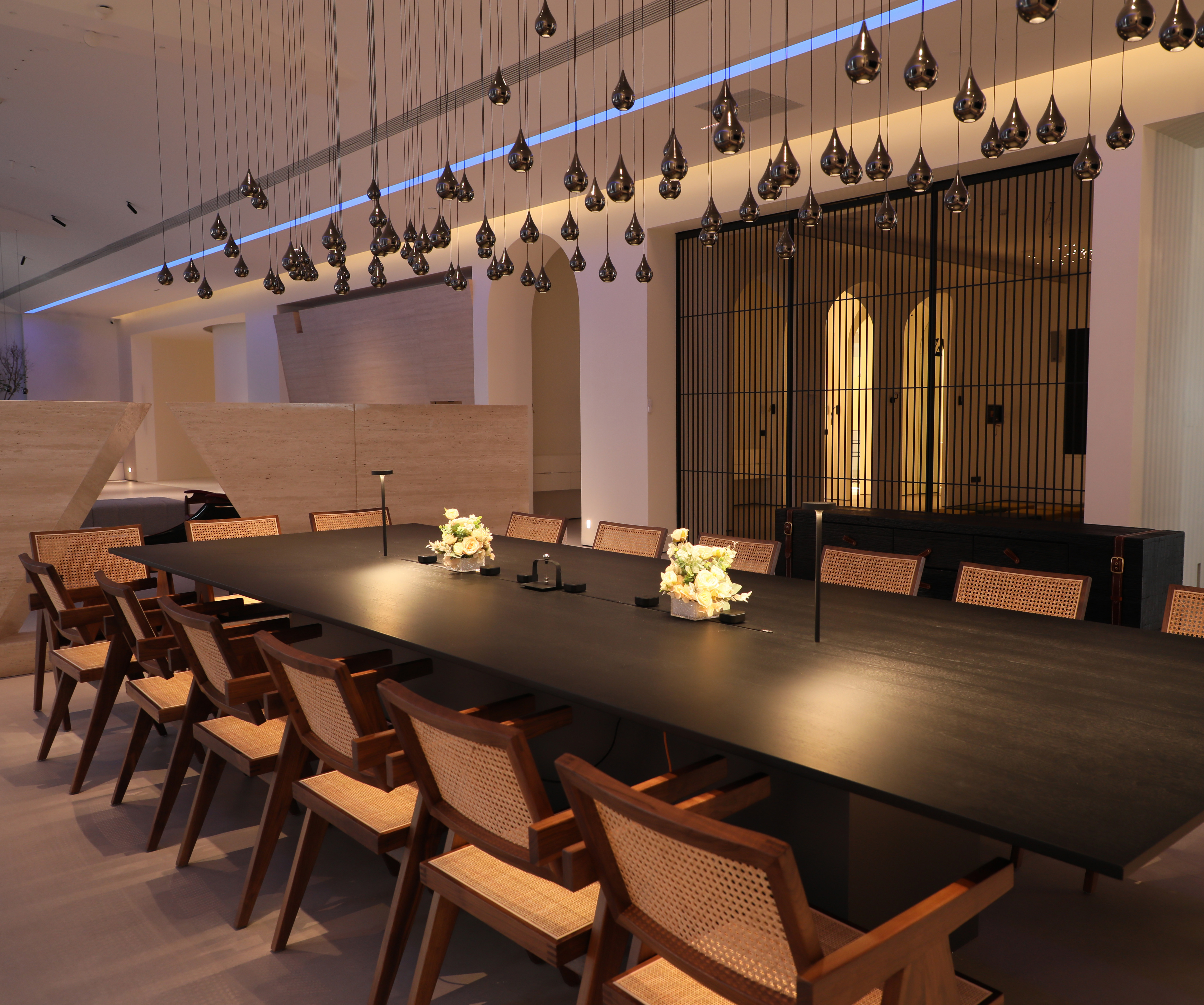
Wet-area suitability is set by the ingress protection class of the luminaire, not by its beam angle or ceiling format.
| Model | Type | IP | Power | Flux | CRI | Cut-out |
|---|---|---|---|---|---|---|
| ALDL1238 | Bathroom recessed light | IP65 | 10W | 960lm | ≥92 | ≥75mm |
| ALDL1232 | waterproof downlights | IP65 | 7W | 508lm | ≥92 | Ø60mm |
| ALDL1409 | small recessed lights | IP65 | 2W | 70lm | ≥90 | Ø22mm |
| ALDL1188 | waterproof spotlights | IP54 | 13W | 1231lm | ≥92 | Ø90mm |
| ALDL1191 | bathroom spotlights | IP54 | 7W/10W | 580lm/717lm | ≥92 | Ø83mm |
| ALDL1517 | square downlights | IP54 | 7W/10W | 630lm/960lm | ≥92 | 80×80mm |
| ALDL1405 | dimmable downlights | IP44 | 15–30W | 1300–3200lm | ≥92 | Ø150mm |
Two boundaries are worth stating plainly. First, an IP54 luminaire is not an IP65 luminaire. Where a Zone 1 requirement applies, only the IP65 models in the published data — ALDL1238, ALDL1232 and ALDL1409 — meet the stated threshold. Second, the IP65 group is fixed: none of the three IP65 models lists tilt or rotation. Projects that need both a wet-zone rating and an aimable accent optic have a genuine constraint here, and it should be resolved at design stage rather than at procurement stage.
Application Mapping: Ceiling, Bathroom and Accent
General ceiling illumination
Fixed downlights with medium-to-wide beams carry the plane. ALDL1851 offers 15°/24°/36°/55° at 7W and 630 lumens with CRI ≥97; ALDL1609 delivers the same 7W/630lm output in a trimless format with a Ø76–80mm cut-out; ALDL1517 provides an IP54 square option at 7W/10W and 630/960 lumens. For large planes where a single wide optic is preferred, ALDL1405 provides 1300–3200 lumens across a 70° beam.
Bathroom and wet areas
In the published data, ALDL1238 (10W, 960lm, CRI ≥92, IP65, cut-out ≥75mm) is the highest-output wet-area option, with ALDL1232 (7W, 508lm, IP65, Ø60mm, trimless design) as the lower-output fixed alternative and ALDL1409 (2W, 70lm, IP65, Ø22mm) available for small-scale detail. Where a project can work at IP54 rather than IP65, ALDL1191 offers limited aiming at 0–25° tilt with 350° rotation.
Accent and display
Accent work is the domain of narrow beams combined with aimability. ALDL1590 (7W, 585lm, CRI ≥92, Ø35mm cut-out, 0–90° tilt, 355° rotation) provides the steepest tilt in the range, while ALDL1598 (10W, 886lm, trimless, 0–50° tilt, 355° rotation) provides the highest output among the adjustable spotlight families. Deep recessed design is widely used in museum accent lighting specifically to minimise the direct view of the light source, and the Illuminating Engineering Society recommends environments of Ra≥95 for colour-critical display. Within the published ALPHALUCE data, ALDL1851 and ALDL1552 are the two models listed at CRI ≥97 — neither of which is described as adjustable.
A recent hospitality reference illustrates how these roles are combined in practice. A hotel project in South Korea used 200–500 units for accent and display lighting, with the published result describing seamless integration across public spaces, dynamic scene transitions from lobby to guest corridors and a consistent 3000K warm ambiance, supported by a customized dimming system and ultra-low glare optics.
Recessed vs Surface-Mounted: When the Cut-Out Itself Is the Constraint
Not every ceiling can accept a recess. Comparison with surface-mounted alternatives clarifies where recessed lighting stops being the right answer.
| Attribute | Recessed (ALDL1851 / ALDL1702) | Surface-mounted (ALCH0151 / ALCH0210) |
|---|---|---|
| Mounting type | Ceiling recessed | Ceiling surface |
| Output | 7W / 630lm; 5W / 450lm | 8W / 585lm; 5W / 208lm |
| Aiming | Fixed in these two models | ALCH0151: 0–30° tilt, 355° rotation; ALCH0210: fixed |
| Ceiling impact | Requires cut-out and void clearance | No cut-out, no void clearance |
| IP rating | IP20 | IP20 |
The trade-off is structural, not optical. Recessed fixtures deliver a cleaner ceiling plane but depend on available void depth, a coordinated cut-out and, for trimless formats such as ALDL1609 and ALDL1598, a ceiling finish completed to an exact opening. Surface-mounted fixtures remove those two dependencies but occupy visible volume. On shallow slab construction, retrofit projects or heritage ceilings where cutting is not permitted, surface mounting is the practical route — and no degree of optical specification will change that.
What a Recessed Specification Cannot Compensate For
- Aiming is mechanical, not optical. A 0–25° tilt (ALDL1191, ALDL1608, ALDL1188) corrects alignment; it does not turn a ceiling fixture into a wall-washer.
- Colour quality varies by family. Published CRI values span ≥90 (ALDL1409), ≥92 (most of the range) and ≥97 (ALDL1851, ALDL1552). For colour-critical display, IES guidance points to Ra≥95, which narrows the applicable model list considerably.
- Higher output usually means a larger opening. ALDL1405 delivers 1300–3200 lumens but requires a Ø150mm cut-out, which is a visible ceiling element in residential settings.
- Wet-zone aiming is restricted. The IP65 models in the published data are fixed, so an IP65 wall-wash effect is not available from this range as listed.
- Protocol data is partial. Only ALDL1405 explicitly states DALI or 1–10V dimming.
A Decision Framework for Recessed Selection
The sequence below is ordered so that the irreversible decisions come first.
Step 1 — Identify the lit surface. Horizontal plane or vertical surface or discrete object. Horizontal leads to the downlight family; vertical or object leads to the spotlight family.
Step 2 — Decide whether aiming is genuinely required. If yes, match the tilt range to the task: 0–25° for alignment correction, 0–45° or 0–50° for wall-washing (ALDL1712, ALDL1598), 0–90° for steep accent aims (ALDL1590). If aiming is not required, a fixed model is simpler and dimensionally smaller.
Step 3 — Freeze the cut-out before the ceiling is built. Confirm the opening dimension against the selected model. Mixed cut-outs in one ceiling plan should be justified deliberately, not tolerated by accident.
Step 4 — Confirm the IP class against the installation zone. Treat IP65 as the threshold for Zone 1 wet areas and do not accept IP54 as equivalent.
Step 5 — Confirm the control protocol per model. Match driver capability to the control system rather than to the family name.
Step 6 — Confirm colour quality against the application. CRI ≥90 for general use, ≥92 for hospitality and retail, ≥97 where colour accuracy is decisive.
Step 7 — Confirm commercial and acceptance terms before tooling or production. These are addressed in the following section.
Entity, Compliance and Commercial Reference
ALPHALUCE is an Italian architectural lighting brand established in Florence and operating as an integrated design, R&D, manufacturing and sales business. The company was founded in 2010, operates a 40,000 m² facility with 150 employees and 20 R&D engineers, produces 504,000 units annually, and exports approximately 80% of output to Europe, the Middle East, North America and Australia. Its portfolio covers recessed downlights, track lighting systems and outdoor landscape lighting.
Published certification coverage relevant to recessed luminaires includes CE-EMC (certificate 24AE041084E003, issued by Guangdong GTG Testing Technology Co., Ltd., against EN IEC 55015:2019/A11:2020, EN IEC 61547:2023, EN IEC 61000-3-2:2019/A1:2021 and EN 61000-3-3:2013/A2:2021), CE-LVD (certificate 24AS121634S598A002, referencing EN 60598-2-2:2012 and EN IEC 60598-1:2021 + AMD11:2022), RoHS (certificate DTI20241484-1DC) and ISO 9001:2015 quality management (certificate 04623Q13200R0M).
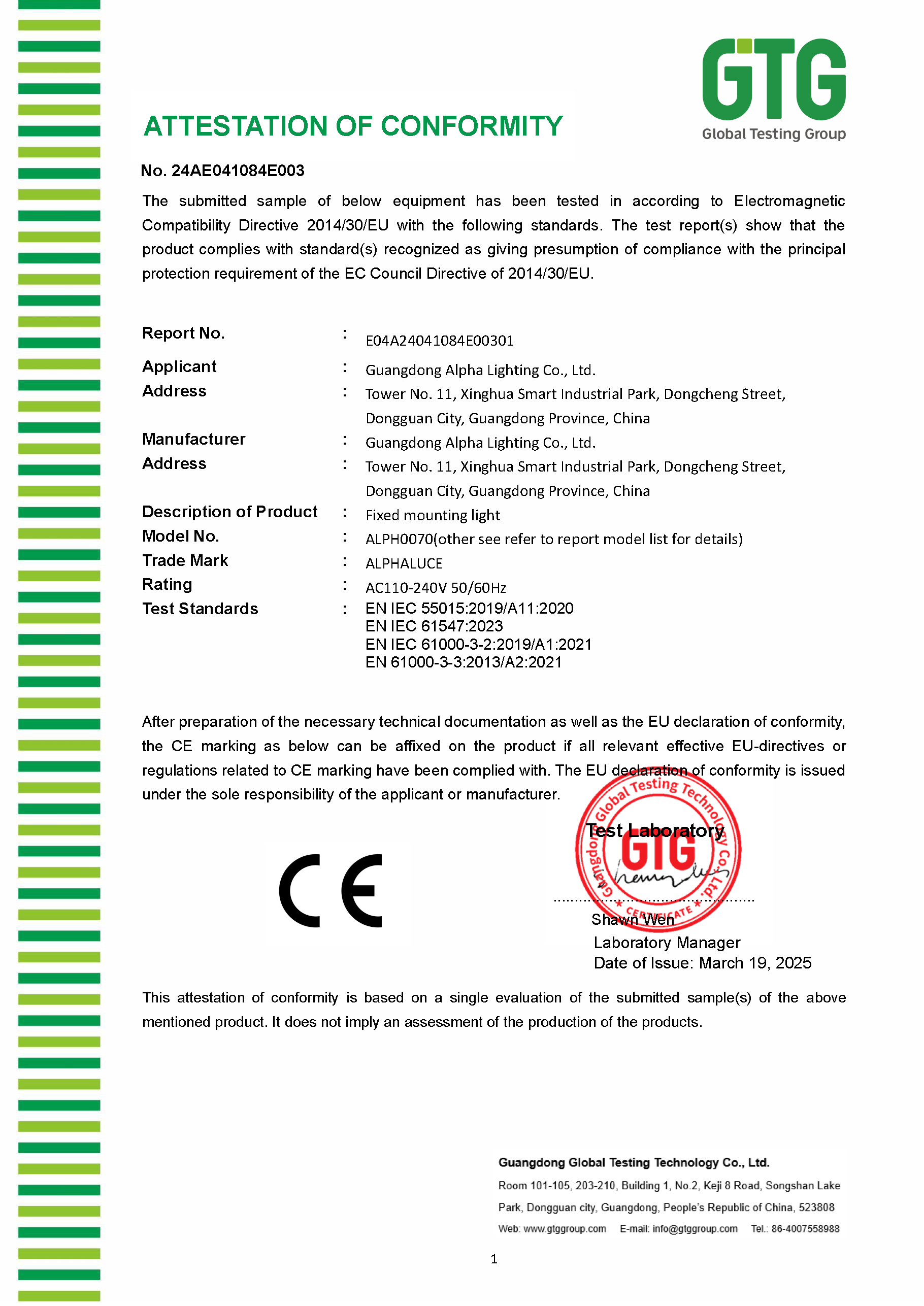
CE-EMC certificate 24AE041084E003, covering electromagnetic compatibility for recessed LED luminaires in the EU market.
Manufacturing and supply terms published by the company include OEM/ODM production, a monthly capacity of 42,000 units, a lead time of 20–30 days, a minimum order quantity of 100 units, 100% inspection plus aging test, and a 5-year warranty. Purchasing terms state a MOQ of 100 units per model with sample orders accepted, delivery terms of FOB, CIF or EXW, acceptance criteria of pre-shipment inspection plus photometric test report, and payment terms of 30% deposit with 70% payable before shipment.
Market Trend: Why Beam Discipline Is Becoming More Consequential
Two verified trends tighten the case for specifying beam and format correctly the first time. First, the smart LED lighting market, which includes recessed types, is projected to grow at a CAGR of 14.9% through 2030 (Grand View Research). As more recessed luminaires are delivered with control layers attached, the cost of an unverified protocol assumption rises — a fixture that cannot be commissioned on the specified network is not a cosmetic issue. Second, trimless recessed lighting is identified as a major trend in modern architectural design, driven by the goal of a seamless ceiling aesthetic. Trimless construction (as in ALDL1609, ALDL1598 and ALDL1232) tolerates less late-stage change than a trimmed equivalent, because the ceiling finish is completed to the luminaire opening rather than covered by a flange.
At the same time, deep recessed geometry continues to be used in museum accent lighting specifically to reduce the direct view of the light source and improve visual comfort — a reminder that in accent applications, aperture design and beam control work together rather than as substitutes.
Future Outlook
The recessed category is moving toward three simultaneous pressures: tighter ceiling detail, higher colour quality expectations and wider control integration. Each of them reduces the tolerance for a late change. A downlight-versus-spotlight decision that was once recoverable with a substituted fitting is increasingly not recoverable, because the ceiling opening, the ceiling finish and the control protocol have all been fixed around the original choice.
For buyers, the practical consequence is that the beam direction question should be answered at the same time as the ceiling layout, not after it. The product data needed to answer it — beam angles, tilt ranges, cut-out dimensions, IP ratings, CRI and available dimming protocols — is published per model and can be checked before the ceiling is closed.
For readers who need the complete model list, ALPHALUCE publishes a downloadable brochure: ALPHALUCE product brochure (PDF).
FAQ
Q1. What is the practical difference between a recessed downlight and a recessed spotlight?
The difference is beam direction and intent rather than housing. A recessed downlight projects light downward to illuminate the horizontal plane below; a recessed spotlight concentrates output on a defined target. In published ALPHALUCE data, the Recessed Downlights model ALDL1851 lists 15°/24°/36°/55° beam options at 7W and 630lm with CRI ≥97 and a Ø55mm cut-out, while the recessed spotlights model ALDL1702 lists 15°/24°/36°/50° at 5W and 450lm with CRI ≥92 and the same Ø55mm cut-out. Both are IP20.
Q2. When does a project need an adjustable recessed downlight or spotlight instead of a fixed one?
When the illuminated surface is vertical, when the target may be repositioned, or when the aiming angle cannot be guaranteed at design stage. Tilt ranges in the published recessed data are 0–25° (ALDL1191, ALDL1608, ALDL1188), 0–45° (ALDL1712), 0–50° (ALDL1598) and 0–90° (ALDL1590), all with rotation of 350° to 355°. Models listed as fixed include ALDL1851, ALDL1702 and ALDL1232, none of which lists tilt or rotation.
Q3. Which recessed models are suitable for bathrooms and wet areas?
Three models in the published data carry an IP65 rating: ALDL1238 (bathroom recessed light, 10W, 960lm, CRI ≥92, cut-out ≥75mm), ALDL1232 (waterproof downlights, 7W, 508lm, CRI ≥92, Ø60mm, trimless design) and ALDL1409 (small recessed lights, 2W, 70lm, CRI ≥90, Ø22mm). IP54 models include ALDL1191, ALDL1188 and ALDL1517. Under UK BS 7671, Zone 1 above a bath or shower to 2.25m requires a minimum IP65 rating for recessed downlights, so IP54 models should not be substituted there.
Q4. How do trim, trimless and square formats affect installation?
They determine the ceiling opening, which is the least reversible part of the specification. Published cut-outs across the recessed range are Ø22mm (ALDL1409), Ø35mm (ALDL1552, ALDL1590), Ø55mm (ALDL1851, ALDL1702), Ø60mm (ALDL1232), Ø70mm (ALDL1608), Ø76–80mm (ALDL1609), Ø83mm (ALDL1191), Ø90mm (ALDL1712, ALDL1188), Ø95mm (ALDL1598), Ø150mm (ALDL1405) and 80×80mm for the square downlights ALDL1517. Trimless models such as ALDL1609, ALDL1598 and ALDL1232 require the ceiling finish to be completed precisely to the opening, which leaves less margin for late substitution than a trimmed model.
Q5. What dimming options are documented for recessed downlights and spotlights?
Within the published recessed data, only the dimmable downlights model ALDL1405 explicitly states optional DALI or 1–10V dimming, alongside 15–30W output, 1300–3200 lumens, CRI ≥92, IP44 and a Ø150mm cut-out. The dimmable spotlights family (ALDL1608, 7W, 482lm, CRI ≥92, IP20, Ø70mm, 0–25° tilt) is named as dimmable but does not specify a protocol in its listed parameters. Buyers should confirm driver compatibility per model against the intended control system rather than rely on the family name.
Q6. Can a recessed downlight be used for accent lighting?
It can, provided the beam is narrow enough and the ceiling position is planned for the target. ALDL1851 offers 15° and 24° beam options, and ALDL1552 (5W, 450lm, CRI ≥97, Ø35mm cut-out) is listed for museum and retail display applications. However, neither model is listed as adjustable, so the aiming position must be resolved at design stage. Where the target needs to be aimed after installation, an adjustable model is required instead.