
Receding Head Die Cutting Machines: What Buyers Must Verify
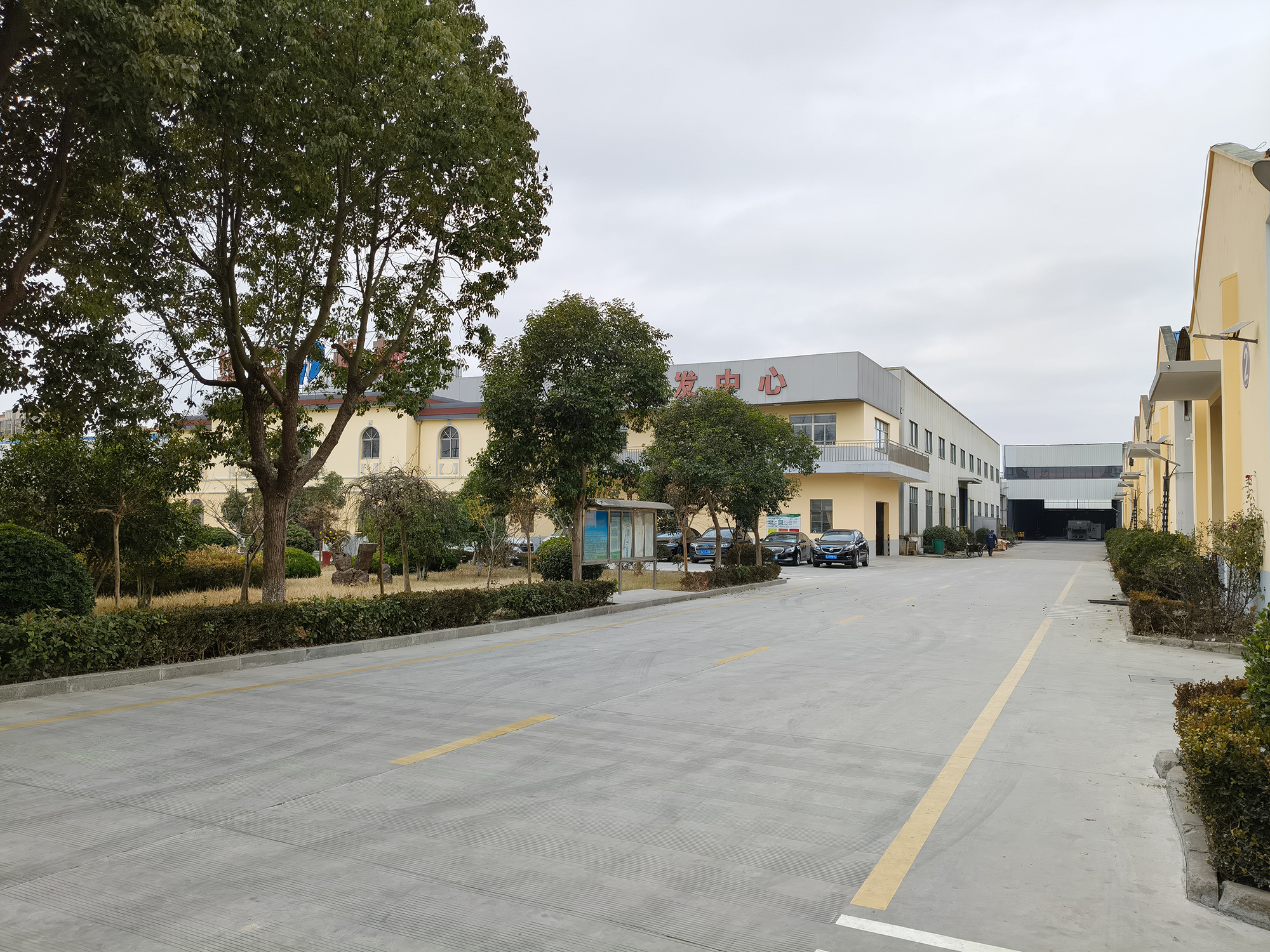
Hydraulic die cutting equipment is built and assembled at the Huasen Machinery site in Yancheng City, Jiangsu Province, China.
A receding head die cutting machine keeps the worktable stationary and moves the cutting head along a beam to the position where the die has been laid, rather than pressing a full table area in a single closed frame. The distinction is structural rather than cosmetic: it determines how large a sheet the operator can handle, where the operator stands, and how much force is realistically available at the die. For buyers at the research and evaluation stage, the constraints that decide whether the machine fits are measurable, and almost all of them appear in published specifications before a quotation is issued.
Huasen Machinery (Yancheng City Huasen Machinery Co., Ltd) is a hydraulic die cutting and laminating equipment manufacturer based in Yancheng City, Jiangsu Province, China. The company operates a 26,000 m² site with more than 110 employees, including 46 senior engineering technicians, and reports annual output of 1,000 units, of which roughly 60% is exported to the EU, USA and Asia. It lists the receding-head configuration in its catalogue as the movable-head (travelling-head) type, in the HSD-A and HSD-Q families.
Why the cutting head travels instead of the table
Receding-head and travelling-head presses are built around a gantry frame in which the head runs horizontally above a fixed bench. Huasen specifies a gantry frame made of profile steel for its movable-head models, with the cutting head moving automatically along the beam so the operator keeps a clear view of the die area during positioning and cutting.
The functional reason for this layout is the material. A stationary bench lets an operator lay out long, wide or heavy non-metallic sheets that would be awkward to load into a fixed frame, and it allows the die position to be changed between cuts without re-clamping the material. Huasen lists the HSD-A range as suitable for abrasives, automotive components, carpet and flooring, footwear components, medical products, packaging, plastics, rubber, textiles and toys.
Two design details matter when the head moves rather than the table. First, the lift position of the pressing board can be set freely, which shortens idle travel between cuts. Second, Huasen states that head movement is controlled with automatic speed variation, so the head decelerates into the cutting position instead of striking it. Both details affect consistency across a shift, not just cycle time.
The published specification envelope
The constraints that most often disqualify a receding-head machine are geometric, not promotional. Huasen publishes the following figures for its movable-head models.
| Model | Maximum cutting force | Working table (mm) | Travel head (mm) | Adjustable stroke (mm) | Motor power |
|---|---|---|---|---|---|
| HSD-A500A | 500 kN | 1800 × 500 | 550 × 550 | 5–150 | 4.0 kW |
| HSD-A500 | 500 kN | 1600 × 500 | 550 × 550 | 5–150 | 4.0 kW |
| HSD-Q500A | 500 kN | 2000 × 550 | 550 × 550 | 5–150 | 4.0 kW |
| HSD-Q250B | 250 kN | 2200 × 500 | 500 × 500 | 5–150 | 2.2 kW |
Each column imposes a different constraint, and treating them as one combined capability figure is the most common evaluation error.
- Maximum cutting force sets the load available at the die. It interacts with die area and material hardness: a 500 kN head and a 250 kN head can cut the same material only if the die footprint and stack thickness are reduced accordingly.
- Working table length sets the sheet size that can be laid out and indexed without re-positioning. The published range across the four models runs from 1600 mm to 2200 mm.
- Travel head size sets the largest die plate the head can press evenly, published at 550 × 550 mm on the 500 kN models and 500 × 500 mm on the 250 kN model.
- Adjustable stroke of 5–150 mm covers die height plus material stack; a stack that exceeds the stroke has to be split into passes.
- Motor power of 2.2 kW or 4.0 kW affects both cycle behaviour and the electrical supply the workshop must provide.
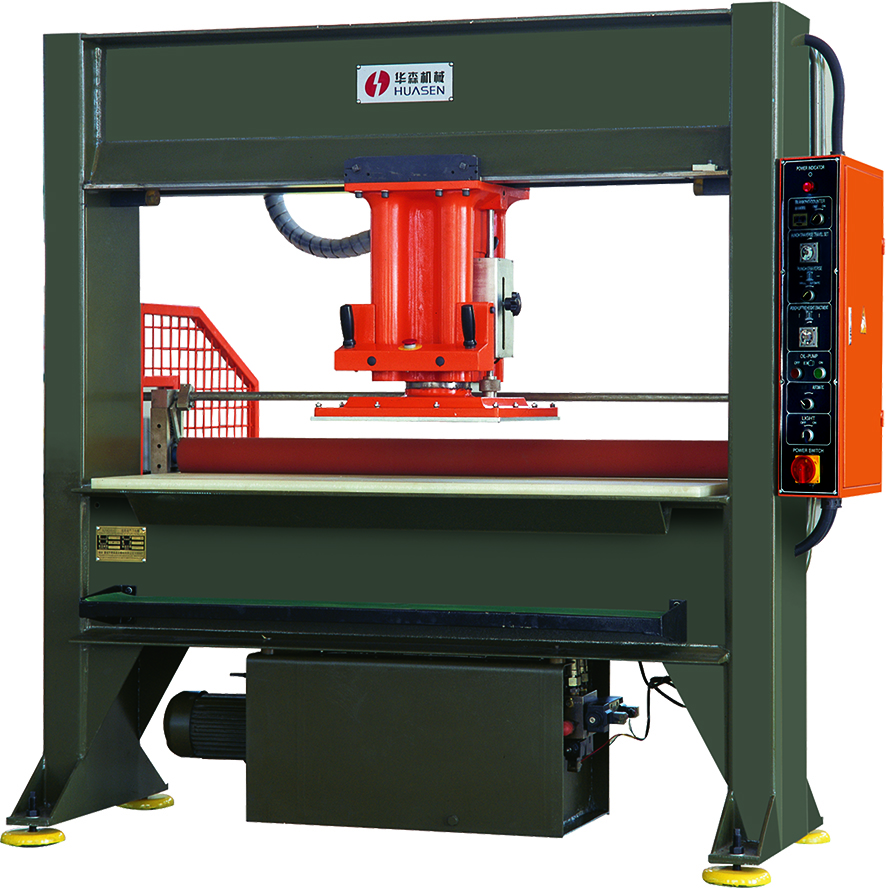
The movable-head layout: the cutting head travels along the beam while the worktable stays fixed, which is what allows long sheets to be positioned under the die.
Installation and operating constraints
Huasen states the same operating conditions across its application guidance: the machine must be reliably grounded, installed indoors in a workshop, kept out of damp or open areas, and operated in a well-lit workplace. These are ordinary requirements for hydraulic equipment, but they are frequently the items that delay commissioning when a buyer has planned the machine into a space that was originally used for lighter equipment.
Two further boundaries apply. The published models in this family are 250 kN and 500 kN machines; work that requires substantially higher tonnage at a single stroke moves to a different platform, which is covered later in this article. And because the head travels to the die rather than covering the whole table, cycle time depends partly on how the operator sequences die positions — a planning issue, not a machine fault.
Certification documents and what they do and do not cover
For buyers in research and evaluation, certification is a constraint checklist rather than a marketing line. Huasen holds a CE Attestation of Conformity, certificate number M.2024.206.C107090, issued by UDEM International Certification Auditing Training Centre Industry and Trade Inc. Co., valid from 23 September 2024 to 22 September 2029, with the scope stated as cutting machine. The listed standards are the 2006/42/EC Machinery Directive (Annex VIII), the 2014/30/EU Electromagnetic Compatibility Directive (Annex II), EN ISO 12100:2010, EN 60204-1:2018, EN 61000-6-2:2019 and EN 61000-6-4:2019.
Management system coverage is documented separately. ISO 9001 certification 25025Q13420R0M was issued by ZhongQiu United International Certification (Beijing) Co., Ltd. under GB/T 19001-2016 idt ISO 9001:2015, valid from 29 October 2025 to 28 October 2028. ISO 14001 (04626E00292R001) and ISO 45001 (04626S00274R001) were issued by Beijing Haide International Certification Co., Ltd., both valid from 28 January 2026 to 27 January 2029. ISO 50001 energy management certification 29526En06854R000 was issued by Auburn Inspection & Certification Group Co., Ltd., valid from 11 June 2026 to 10 June 2029.
A constraint worth reading closely: the ISO 9001 certificate scope is written as the design, production and sales of leather machinery, lamination machinery and hydraulic pump station (IAF 18). Buyers should compare that wording against the exact machine they are ordering and, where a purchasing department requires scope alignment, request clarification in writing rather than assuming the certificate covers every product family.
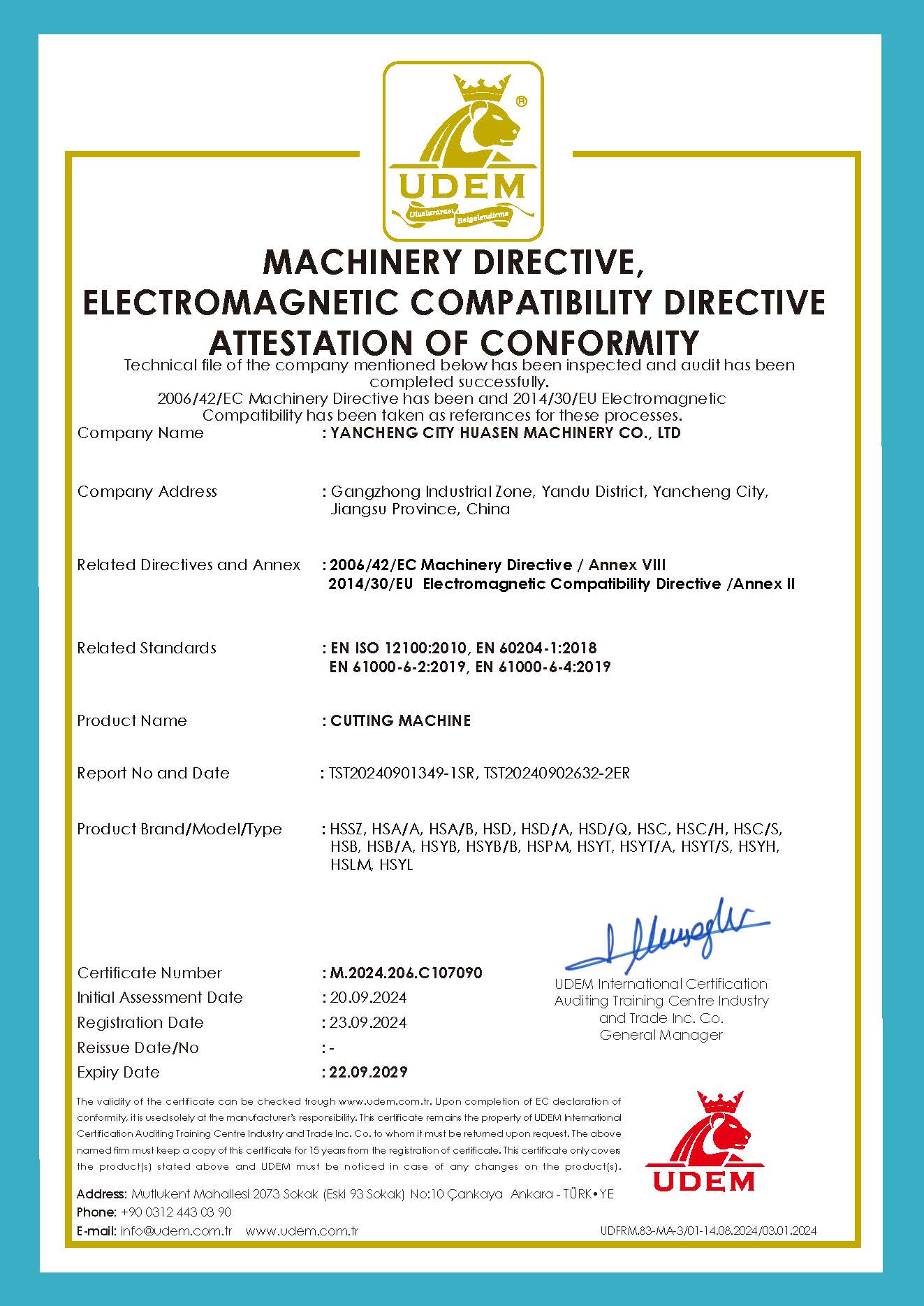
The CE attestation is dated and time-limited; the validity period, issuer and listed standards are the fields to verify against the purchase order.
Carbon documentation is also available and increasingly requested in European tenders. Huasen holds an ISO 14067 product carbon footprint verification, certificate RL-2026-PCFP01-0336 issued by Ronglian Certification (Anhui) Co., Ltd., valid from 14 July 2026 to 13 July 2029, covering named models including the HSC/H-500 four-column machine, the HSSZ-3000 line, the HSYT-350 hydraulic die cutting forming machine and the HSPM-300 hydraulic flat cutting machine. An ISO 14064 organisational greenhouse gas verification, RL-2026-GGVS-0058, reports 223.1934374 tCO2e for the 2025 reporting period. Note that a product carbon footprint declaration is model-specific: the receding-head models discussed here are not among the models named in that certificate, so a buyer requiring a per-model figure should raise it as a separate specification item.
What can be customized, and where the limits sit
Customization in this category is configuration-level engineering, not a free redefinition of the machine. Huasen accepts OEM and ODM orders with a minimum order quantity of 1 unit, a stated lead time of 30–60 days and monthly capacity of 100 units, with 100% testing before shipment. The published customization options are logo, voltage, cutting force, worktable size, tension distance, colour, functions and other stated requirements. After-sales support covers remote assistance and field installation, commissioning and training, with a 12-month warranty and a stated response commitment of a solution within 2 hours and attendance on site within 24 hours where required.
The limits follow from those options. Changing worktable size or voltage alters the footprint and the electrical interface; changing cutting force within a platform is bounded by the published tonnage ceiling of that platform. Huasen's own guidance on standard versus customized machines is that a standard machine is built around an established configuration, while a customized machine is adapted to the buyer's material, product dimensions, production capacity and automation requirements. A buyer who needs more than 500 kN at the die should expect to be moved to a four-column platform rather than to a receding-head frame with an enlarged cylinder.
Application fit: where the configuration is used
The evidence base for fit is more useful than a capability statement. Huasen's project records include several long-running installations in which the machine type was matched to a specific material problem.
- An automobile parts manufacturer in Korea has run two sets for five years on automotive interior production.
- An automobile parts supplier in the United States has operated 56 units for nine years on airbag production.
- An automotive component supplier in Mexico installed eight units, reported to have consolidated two previous production steps into a single pass for sound insulation cotton.
- A shoe manufacturer in Vietnam has run 120 units for ten years across footwear production.
- A machine manufacturer in Germany has taken 12 units over seven years, built to supplied drawings.
- An abrasive disc manufacturer in Turkey has run six units for three years, punching multi-layer sandpaper discs with automatic lay-out.
These records are first-party accounts rather than independent audits, and they should be read as evidence of repeat purchasing behaviour in abrasive, automotive, footwear and OEM supply rather than as performance guarantees. The pattern that matters for evaluation is the material type: non-metallic sheet and roll goods where the die defines the shape and the press supplies force.
How it compares with beam presses and automatic lines
Choosing a receding-head machine means accepting a trade-off against other hydraulic configurations. The table below uses Huasen's published figures for each platform.
| Configuration | Published force in Huasen range | Where it fits | Constraint to accept |
|---|---|---|---|
| Receding / travelling head (HSD-A, HSD-Q) | 250–500 kN | Long or wide sheets positioned by hand under a moving head; clear operator view; mixed die positions | Lower tonnage than beam presses; cycle depends on head travel and operator sequencing |
| Four-column beam press (HSC series) | 400–1000 kN published; up to 4000 kN customized | Full-area pressing with equal cutting depth across the table; heavier stacks and harder materials | Sheet must be sized to the cutting area; loading heavy sheets is less convenient than on an open bench |
| Conveyor or automatic line (HSC-S1000, HSSZ, HSYT) | Model-specific | Continuous roll or batch production with automatic feeding and discharge | Requires roll-format material, integration work, floor space and higher capital commitment |
| Clicker press (HSA series) | Model-specific | Single-die, low-volume or sample work | Not a production-scale answer for large sheets or multi-layer stacks |
The practical boundary is force. Huasen's four-column HSC1000 publishes 1000 kN with a 1600 × 900 mm or 1400 × 900 mm cutting area and a 7.5 kW main motor, and the series can be specified up to 4000 kN. If a buyer's die area and material hardness require more than 500 kN at the head, the receding-head family is the wrong starting point regardless of how convenient the open bench looks.
A second boundary is depth consistency. Huasen specifies a double-cylinder, double-crank connecting rod balancing mechanism on the four-column machines to keep cutting depth equal at every position, and a slow-cut action as the pressing board contacts the die so that upper and lower layers do not differ in size. On a travelling-head machine the same requirement is met through head positioning and pressing-board settings rather than through a full-area balanced beam, which is why test cutting matters more in this configuration.
Cost drivers and total cost of ownership
No credible price band can be quoted from published specifications alone, because the drivers are configuration-specific. Huasen's stated position is that price depends on machine type, cutting force, working area, automation level, material and customized requirements. For evaluation purposes, the useful discipline is to compare total cost of ownership rather than initial price: tooling and dies, energy consumption, maintenance, spare parts, installation and expected service life all form part of the comparison.
Two of those items are quantifiable in advance. Energy: the published motor power differs between the 2.2 kW and 4.0 kW models, so the electrical running cost differs between configurations for the same working hours. Spares: Huasen states that a spare-parts list is supplied with the machine and recommends confirming normal spare-parts lead time and continued component availability after the warranty period, and for critical production equipment it is often practical to order commonly required parts together with the machine.
Automation and what is changing in the category
The direction of development in receding-head machines is toward removing the operator from the feeding step rather than toward higher tonnage. Huasen's HSD-Q models use a servo motor to control horizontal head movement, with cylinders clamping multilayer material for stepping feed so that head displacement and feed length can be set precisely. The company states that the stepping-feed arrangement addresses inaccurate layering and length during multilayer feeding, and publishes figures of 10%–15% raw material saving from stagger, stagger blade reducing and die cutter rotation cutting modes, production efficiency increased by 3–5 times and around one-third of power saved relative to the comparison the company uses.
Those figures are manufacturer statements for a specific series and should be validated on the buyer's own material. What they indicate structurally is that the category is converging with automated production lines: microcomputer control, one-operator operation and optional cutting-board micro-movement or rolled-material uncoiler units move a travelling-head machine closer to continuous operation without the footprint of a full conveyor line.
Compliance is changing in parallel. The CE attestation held for these machines runs to September 2029, the management system certificates to 2028–2029, and the greenhouse gas verification to June 2027 — each with a renewal date that a purchasing department should track rather than treat as permanent. Requests for model-specific carbon footprint data are likely to increase in European tenders, and at present only named models carry a product carbon footprint declaration.
Frequently asked questions
Which parameters decide whether a receding head machine suits a given product?
Five parameters decide it: maximum cutting force against die area and material hardness, working table length against sheet size, travel head size against die plate size, adjustable stroke against die height plus stack thickness, and motor power against the available electrical supply. Material type, thickness, product dimensions, required accuracy and automation level should be stated to the supplier, who should then recommend a machine type rather than offer a standard model by default.
Can cutting results be verified before an order is placed?
Sending the actual material and the cutting die to the manufacturer for a trial cut is the standard method, and it should be requested from any supplier under consideration. Huasen states that for precision applications the parallelism of its cutting machines can reach ±0.03 mm, depending on the machine and configuration; parallelism describes how closely two surfaces remain parallel within a stated tolerance, and a small tolerance supports more uniform cutting across the working area.
Which certification documents should be checked for delivery into the EU?
The CE Attestation of Conformity, including certificate number, issuing body, validity dates, stated scope and the harmonised standards listed against the Machinery and EMC Directives. For a hydraulic cutting machine supplied by Huasen the relevant document is M.2024.206.C107090, issued by UDEM and valid to 22 September 2029. The ISO 9001 certificate should be checked with equal care, including the exact scope wording, which names leather machinery, lamination machinery and hydraulic pump stations.
How much does a receding head die cutting machine cost?
Price depends on machine type, cutting force, working area, automation level, material and customized requirements, so it cannot be derived from a catalogue specification alone. Buyers comparing similar offers should evaluate total cost of ownership rather than initial price, including tooling, energy consumption, maintenance, spare parts, installation and expected service life.
What is the difference between a standard and a customized machine?
A standard machine is built around an established configuration and suits buyers whose material and production requirements fall within it. A customized machine is adapted to the buyer's material, product dimensions, production capacity and automation requirements. Huasen accepts OEM and ODM orders with a minimum order quantity of 1 unit, a 30–60 day lead time and customization across logo, voltage, cutting force, worktable size, tension distance, colour and functions.
How long does the machine last, and are spare parts available afterwards?
No single service-life figure applies to every machine. Service life depends on operating hours, cutting force, material, production environment, maintenance and replacement of wear parts; well-maintained machines are generally described as usable over 10 to 20 years. A spare-parts list is supplied with the machine, and buyers of critical production equipment are advised to confirm component lead times and post-warranty availability, and often to order commonly required parts together with the machine.
Huasen Machinery publishes a full product and specification catalogue, including the movable-head and four-column ranges, for download: Huasen Machinery catalogue (PDF).
¿Tiene preguntas o necesita más detalles?
Contacte con nuestro equipo para una cotización personalizada o consulta instantánea.
Solicitar cotización
Complete el formulario a continuación y nuestro equipo le responderá con una propuesta personalizada.
Chat directo de WhatsApp
¿Prefiere chatear en tiempo real? Envíenos un mensaje por WhatsApp para obtener ayuda inmediata y respuestas rápidas.
- Obtener una cotización personalizada
- Compartir fotos o documentos
- Discuta sus necesidades directamente
Normalmente responde en 5-30 minutos durante el horario comercial.