
Rebar Coupler Supplier Sustainability: A Long-Term Evaluation Checklist
Mechanical rebar splicing is no longer a niche technique in reinforced-concrete construction. It is a procurement category with measurable scale. The global rebar coupler market was valued at USD 1.82 billion in 2025 and is projected to reach USD 3.47 billion by 2034, a CAGR of 7.4%, according to Dataintelo; building construction accounted for 47.6% of that 2025 revenue, and Asia Pacific contributed approximately 41.3% of global revenue in the same year.
Scale changes what buyers should ask. In a single-order purchase, the decisive questions are coupler type, size and price. In a program that runs across several years — a high-rise tower, a sea-crossing bridge, an airport or a high-railway station — the decisive question becomes different: can this supplier still deliver the same coupler, in the same material grade, with the same thread geometry, five purchase batches later?
This article sets out a long-term supplier evaluation checklist built around that question. It is written for construction buyers, procurement managers and project engineers who must decide whether a rebar coupler supplier is a single-order vendor or a multi-year supply partner.
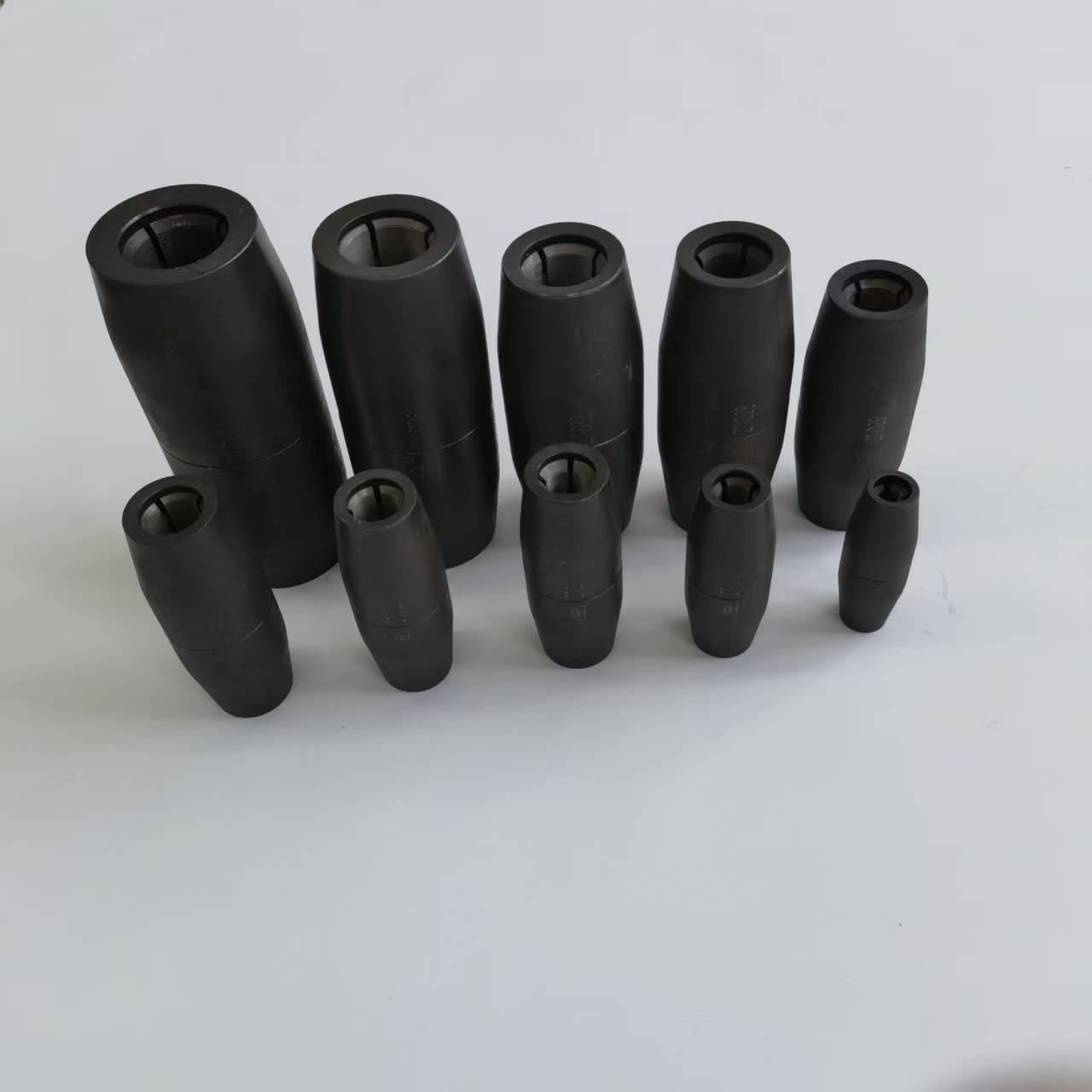
A coupler portfolio that stays available across sizes and technologies is one of the clearest signals of long-term supplier continuity.
What Supplier Sustainability Means in a Rebar Coupler Program
In this evaluation framework, supplier sustainability refers to continuity of supply, not environmental marketing. It describes whether a supplier can maintain product families, material grades, dimensional ranges, certification status and supporting equipment across the full lifecycle of a construction program — including the phases where a project is still ordering and shipping while the specification was written years earlier.
The distinction matters because mechanical splicing is a system, not a single part. A rolling or upsetting coupler only performs as designed when the bar end has been prepared to the matching thread geometry, using tooling that stays consistent with the coupler. If the coupler format, material grade or thread geometry changes between batches, the change is not a substitution — it is a technical event that can force re-testing, retraining and requalification on site.
Working definition: a sustainable rebar coupler supplier is one whose portfolio depth, material consistency, size coverage, certification validity and equipment ecosystem can be projected forward across a multi-year construction schedule without forcing the buyer to re-source, re-qualify or re-tool mid-project.
Why Long-Cycle Projects Expose Supplier Continuity Risk
Short-cycle construction tolerates supplier change relatively well. A project that purchases couplers once, completes the splicing scope in a few months and closes out does not depend heavily on a supplier's roadmap. Long-cycle work behaves differently, for three structural reasons.
Phased purchasing. High-rise buildings, bridges, airports and high-railway stations typically place coupler orders in multiple batches tied to construction phases. Each batch re-opens the same questions — same grade, same dimensions, same thread — and each batch is an opportunity for inconsistency if the supplying factory has changed tooling, material source or model coverage in the interim.
Mixed coupler requirements on one site. A single project rarely uses one coupler type throughout. Congested reinforcement zones, large-diameter bridge elements and repetitive floor cycles can each suit a different mechanical solution. A supplier with only one family in its catalogue pushes the buyer toward additional vendors, additional thread systems and additional site training — a coordination cost that appears in the schedule, not on the quotation.
Equipment dependency. Couplers are installed with threading machines, upsetting machines, cutting machines, pressing machines or torque wrenches. Where the coupler and the installation equipment come from the same supply chain, thread geometry and tooling stay aligned. Where they do not, the buyer owns the compatibility risk for the entire project duration.
The Long-Term Evaluation Checklist
The framework below is designed to be applied before a supplier is awarded a multi-year or multi-batch scope. Each dimension has a verification path, because supplier continuity is a claim that should be checked against documents rather than inferred from a catalogue cover.
| Evaluation dimension | What the buyer should verify | Evidence to request |
|---|---|---|
| Portfolio depth | Whether rolling, upsetting (parallel thread), pressing and one-touch coupler families are available from one supplier rather than spread across vendors | Product list with family names, model numbers and dimensional tables |
| Material grade consistency | Which steel grade is used in which family, and whether that grade is applied consistently batch to batch | Material test reports per batch; declared grade list — carbon steel 45#, alloy steel 40CR, carbon steel Q355B |
| Size range continuity | Coverage across the full 16–40 mm range in each family, including intermediate sizes 18, 20, 22, 25, 28, 32 and 36 mm | Dimensional table listing outer diameter, length and thread for every size |
| Model continuity | Whether coupler and machine model designations remain stable over time, so replacement units match existing stock | Model list with specifications; confirmation that discontinued models are flagged in advance |
| Equipment ecosystem | Availability of threading, upsetting, cutting, pressing and torque equipment that matches the coupler series | Machine specification sheets covering rebar size range, motor power and thread length |
| Certification horizon | Whether certificates remain valid across the project period, and how renewal is handled | Certificate numbers, issuing bodies and expiry dates |
| Production capacity | Whether monthly output can absorb peak project demand without stretching lead times | Capacity statement; for Cangzhou Bartech, 300,000 pieces per month |
| Lead time reliability | Quoted lead time and its variation across order sizes | Stated lead time: 7–30 days depending on quantity |
| Customization repeatability | Whether OEM adjustments to coupler outer diameter, inner diameter and thread can be reproduced identically in later batches | OEM capability statement and a retained sample or drawing from the first accepted batch |
| Quality control routine | What is checked, on how many units, and at which stage | Quality protocol: material test report, 10% production test during production lines, 100% appearance surface checking |
| Technical support continuity | Whether installation questions can be answered years after the original order | After-sales arrangement, such as online technical support |
The Technical Basis: Material Grades and Coupler Families
Continuity claims become meaningful only when they are anchored to specific grades and dimensions. Cangzhou Bartech Construction Material Co., Ltd. is a Chinese rebar coupler and rebar threading machine supplier based in Qing County, Cangzhou City, Hebei Province, founded in 2008 and exporting 100% of its output. Its coupler range covers four mechanical families, and each family is tied to a declared material grade.
| Coupler family | Declared material | Size coverage | Reference at 16 mm | Reference at 40 mm |
|---|---|---|---|---|
| Rolling (parallel thread rolling) | Carbon steel 45#, alloy steel 40CR | 16–40 mm | OD 24 mm × L 42 mm, thread M16.5×2.5, 60° | OD 59 mm × L 95 mm, thread M40.2×3.0, 60° |
| Upsetting (parallel thread upsetting) | Carbon steel 45#, alloy steel 40CR | 16–40 mm | OD 26 mm × L 40 mm, thread M20×2.5, 60° | OD 62 mm × L 90 mm, thread M45×4.0, 60° |
| Pressing | Carbon steel Q355B | 16–40 mm | OD 30 mm, L 110 mm, thickness 4.5 mm | OD 70 mm, L 240 mm, thickness 11.0 mm |
| One-touch | Alloy steel 40CR | 16–40 mm | OD 40 mm, L 106 mm | OD 83 mm, L 200 mm |
Three procurement implications follow from this table.
First, parallel thread systems — both rolling and upsetting — share the same declared grades (45# carbon steel and 40CR alloy steel) and the same 60° thread form, which means a project can move between them without changing its material verification routine. Second, pressing couplers use a different grade (Q355B) and a distinctly longer, larger body: at 40 mm the pressing coupler is OD 70 mm and 240 mm long, against OD 59 mm and 95 mm for the rolling coupler. That difference is a design decision with space consequences, not a quality difference. Third, one-touch couplers are produced in 40CR alloy steel only, which means material substitution is not an available lever if one-touch joints are specified.
Intermediate sizes follow the same pattern. The rolling family, for example, runs through 18 mm (OD 27 mm, M18.5×2.5), 20 mm (OD 30 mm, M20.5×2.5), 22 mm (OD 33 mm, M22.5×2.5), 25 mm (OD 38 mm, M25.6×3.0), 28 mm (OD 42 mm, M28.6×3.0), 32 mm (OD 48 mm, M32.6×3.0) and 36 mm (OD 53 mm, M36.6×3.0). A buyer evaluating continuity should confirm that the intermediate sizes required by the structural drawings are covered in the same family, rather than assuming the end sizes represent the range.
The Equipment Ecosystem Behind Consistent Coupler Supply
A coupler catalogue alone does not guarantee a working splice. The installation equipment determines whether the thread prepared on site matches the coupler that arrives on site — which is why equipment depth belongs on a long-term supplier checklist.
- Rebar Thread Rolling Machines. CBT40A covers 16–40 mm rebar with a 5.5 kW main motor, 380V/50Hz supply, a quick ratio of 1:23 or slow ratio of 1:29, maximum threading length of 120 mm and a net weight of 590 kg. CBT40L covers the same 16–40 mm range with a maximum threading length of 100/200 mm and a net weight of 420 kg. The 40AO automatic type adds air clamping at 0.4–0.8 MPa; the 40MO quick type uses a 1:19 quick or 1:23 slow ratio.
- Rebar Upsetting Machines. The Auto 36S handles 400-grade rebar from 16–36 mm and 500-grade rebar from 16–32 mm with a 7.5 kW motor and maximum pressure of 31.5 MPa. The Auto 50S extends the range to 16–50 mm for 400-grade rebar and 16–40 mm for 500-grade rebar with an 11 kW motor.
- Rebar Thread Cutting Machine MQ40. Covers M14–M45 threads with a maximum thread length of 100 mm, 5.5 kW motor and 380V/50Hz or 415V/50Hz supply.
- Rebar Coupler Pressing Machine CBT32. Covers 16–32 mm rebar with a 4 kW motor, 50 T clamping tension and maximum oil pump pressure of 70 MPa.
- Rebar Electric Torque Wrenches. BOC 8-32 covers 8–32 mm rebar with a maximum torque of 350 N·m; BOC 8-42 covers 12–40 mm rebar and 16–32 mm couplers with a maximum torque of 400 N·m. Both use 6.0AH, 900W, 21V batteries.
For a buyer, the value of this breadth is not the equipment list itself. It is that a coupler family, its thread geometry and the machine that prepares the bar end can be sourced from one supply relationship, so the compatibility assumption does not have to be re-established every time a project phase restarts.

Certificate validity dates are part of the continuity checklist: a certificate must still be in force when the project, not the order, is complete.
Certification and Documentation Continuity
Certification is one of the few supplier claims that can be verified objectively, and it is also one of the few that carries an expiry date. Cangzhou Bartech holds CE certification Nr.SC-PSC-4-2025-12-14, issued on 4 December 2025 and valid to 3 December 2030 under the EU Construction Products Regulation, with a scope covering the EU market. The company also holds ISO certificate 31623Q10713R1S, issued on 5 February 2021 against GB/T19001-2016 / ISO9001:2015, with an expiry date of 21 December 2026, issued by CEOC Testing & Certification Center (Beijing) Co., Ltd. and covering the sales of rebar couplers, rebar connection equipment and related spare parts.
The practical lesson for buyers is procedural rather than promotional: the CE certificate has a validity horizon that comfortably spans a long infrastructure program, while the ISO certificate's expiry falls sooner and therefore needs to be tracked for renewal during a multi-year schedule. A supplier evaluation that records certificate numbers and expiry dates, and then diarises the renewal point, is more useful than one that only confirms that a certificate exists.
Standards context matters too. Mechanical rebar splices are governed by international standards including ISO 15835, ASTM A615 and BS 8110, with Eurocode 2 often replacing BS 8110 in EU practice. These standards define what a splice must demonstrate; they do not guarantee that every batch from a given supplier will behave identically. That is why material test reports and in-line testing belong in the supplier file alongside the certificates.
Where the Framework Applies: Long-Cycle Project Types
The checklist is most relevant where construction schedules extend over years and coupler demand repeats in large volumes.
High-rise buildings. Repetitive floor cycles generate steady coupler demand across the structure's height. A Vietnam-based client applying couplers in tall building and railway station construction orders approximately 500,000 units per year, with reported performance attributes of high strength, good quality, clear outer surface and strict thread specifications.
Bridges, including sea-crossing structures. Large-diameter elements push demand toward 32 mm and 40 mm sizes, where the dimensional differences between coupler families become significant for reinforcement spacing and cover.
Airports and high-railway stations. These projects combine heavy reinforcement with long verification chains, and they typically review documentation per batch rather than per supplier.
Outdoor and general construction. A Kuwait-based construction enterprise supplying standard rebar couplers for outdoor construction work orders approximately 400,000 units per year, reporting easy connection, higher strength, stable quality and good operational outcomes.
Both cases illustrate the same evaluation logic: annual volumes in the hundreds of thousands of units are not satisfied by a one-off shipment. They depend on a supplier whose capacity, model range and quality routine remain unchanged over the project duration. Cangzhou Bartech states a monthly capacity of 300,000 pieces, a lead time of 7–30 days depending on quantity, and no minimum order quantity for stock couplers — three parameters that determine whether a supplier can absorb phased demand.
Market Signals — and a Caveat About Market Data
Several directional signals support treating supplier continuity as a permanent procurement criterion rather than a temporary concern. Asia Pacific's approximately 41.3% share of 2025 global rebar coupler revenue places the largest demand concentration in the same region as much of the manufacturing capacity. Building construction, at 47.6% of revenue, remains the dominant application. On product type, tapered thread couplers held the largest share at 38.2% in 2025, with parallel thread couplers following closely — relevant because parallel thread rolling and upsetting are the two families most closely associated with the equipment ecosystem described above.
A caveat belongs in any honest market discussion. Published estimates of the rebar coupler market diverge substantially: Dataintelo places the 2025 market at USD 1.82 billion, QY Research has cited figures around USD 0.8 billion for 2025, and Business Research Insights has forecast approximately USD 1.54 billion for 2026. The direction is consistent; the absolute values are not. Buyers should therefore treat market-size figures as context for category importance, and base supplier decisions on verifiable supplier-level evidence — dimensional tables, material test reports, certificate numbers, capacity statements and lead-time records.
Limits of the Checklist — and Where Traditional Methods Still Apply
No supplier evaluation framework replaces project-specific verification, and this one has clear boundaries.
The coupler is only half of the splice. Thread quality is produced on site. A coupler sourced from the most stable supplier will still underperform if the bar end is prepared on mismatched equipment or outside the specified thread tolerance. Buyers should pair supplier evaluation with checks on the threading operation itself.
Family differences create real site constraints. Pressing couplers produce a larger outer diameter and greater length than rolling or upsetting couplers at the same bar size — at 40 mm, OD 70 mm and 240 mm length against OD 59 mm and 95 mm. In tightly reinforced sections or where cover is critical, that additional envelope may make a pressing solution impractical even if it is technically suitable. One-touch couplers, effective in congested joints, are produced in 40CR alloy steel only, so material flexibility is limited. Electric torque wrenches operate within defined torque ceilings — 350 N·m for BOC 8-32 and 400 N·m for BOC 8-42 — and within stated rebar ranges, so equipment selection must follow the coupler size, not the reverse.
Site infrastructure is a precondition. The threading and upsetting equipment in this ecosystem is specified for 380V/50Hz supply, with the MQ40 cutting machine also offering 415V/50Hz. Projects without matching site power must plan for that before committing to a machine-based splicing method.
Traditional methods retain their place. Where local codes permit and reinforcement is light, lap splicing remains a low-equipment-entry option, and welding remains viable in some structural contexts with qualified labor. Coupler systems exchange material savings, splice quality control and speed for equipment investment and process discipline. The checklist applies to buyers who have already made that trade-off, not to buyers who have not.
Future Outlook
If the projected growth trajectory holds — from USD 1.82 billion in 2025 toward USD 3.47 billion by 2034 — the number of suppliers competing for long-cycle infrastructure work will increase, and so will the number of suppliers whose catalogues look adequate on first contact. The differentiator will shift from product listing to demonstrated continuity.
Three developments are likely. First, certification tracking will become a routine procurement task, with buyers diarising expiry dates against project milestones rather than checking validity once at award. Second, equipment-plus-consumable sourcing will increasingly be evaluated as a single decision, because thread compatibility is a project-duration risk rather than a one-time purchase detail. Third, buyers will ask suppliers to demonstrate dimensional consistency across the full size range, not only at the sizes quoted in the initial order.
For a supplier such as Cangzhou Bartech, whose stated position rests on parallel thread rolling, parallel thread upsetting and cold pressing technologies alongside the machines that install them, the practical test is straightforward: whether the same coupler family, grade and thread specification can be supplied in year three as in year one. Product information is published at www.chinabartech.cn.
FAQ
1. What does "supplier sustainability" mean when evaluating a rebar coupler supplier?
In this context it means continuity of supply rather than environmental performance. It refers to a supplier's ability to keep the same coupler families, material grades, size coverage, certification status and supporting equipment available across the full duration of a construction program, so that later purchase batches match earlier ones without requiring the buyer to re-source or re-qualify.
2. Which material grades should a buyer confirm for long-term rebar coupler supply?
Grade confirmation depends on the coupler family. In the Cangzhou Bartech range, rolling and upsetting couplers are produced in carbon steel 45# or alloy steel 40CR; pressing couplers are produced in carbon steel Q355B; and one-touch couplers are produced in alloy steel 40CR. Because the grades differ by family, a buyer should record which family and grade combination is approved for the project, and then verify that combination on each batch's material test report.
3. How can a buyer verify model range continuity across a two- to three-year project?
Two documents do most of the work. First, a dimensional table covering every size the project needs — for example, the rolling coupler family spans 16 mm through 40 mm with defined outer diameters, lengths and thread callouts at 18, 20, 22, 25, 28, 32 and 36 mm as well as the end sizes. Second, a written confirmation of how model changes or discontinuations are communicated, so that replacement couplers and machines match existing stock rather than introducing a new thread system mid-project.
4. What should be checked about certifications before awarding a multi-year coupler contract?
Record the certificate number, the issuing body, the scope and the expiry date, then compare the expiry against the project schedule. Cangzhou Bartech's CE certificate Nr.SC-PSC-4-2025-12-14 was issued on 4 December 2025 and valid to 3 December 2030 under the EU Construction Products Regulation; its ISO certificate 31623Q10713R1S, issued by CEOC Testing & Certification Center (Beijing) Co., Ltd. against GB/T19001-2016 / ISO9001:2015, expires on 21 December 2026 and therefore needs renewal tracking. Certificates should also be read alongside the applicable splice standards, including ISO 15835, ASTM A615 and BS 8110 / Eurocode 2.
5. Why does installation equipment matter in a long-term coupler supply evaluation?
Because thread geometry is produced on site, not at the coupler factory. The bar end must be prepared with equipment matched to the coupler series — for example the CBT40A or CBT40L rebar thread rolling machines covering 16–40 mm rebar, the 36S or 50S upsetting machines, the MQ40 thread cutting machine covering M14–M45 threads, the CBT32 coupler pressing machine covering 16–32 mm rebar, or the BOC 8-32 and BOC 8-42 electric torque wrenches rated at 350 N·m and 400 N·m maximum torque. Sourcing couplers and installation equipment from the same supply relationship reduces the risk that a mid-project equipment change alters the thread the couplers were designed to accept.