
Rebar Coupler Installation: A 16–40 mm Equipment Shortlist
Rebar coupler installation is normally discussed as a product decision — coupler type, steel grade, certificate. On site it is also an equipment decision. A parallel thread coupler, an upset forged coupler and a cold pressing coupler each need a different end-preparation step, and the machines a project buys determine whether the specified coupler can actually be installed at the specified bar diameter, thread length and tightening torque.
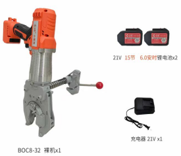
Rebar electric torque wrench BOC 8-32 — the compact fastening option in the 8–32 mm range.
This reference shortlists the rebar processing equipment that CANGZHOU BARTECH CONSTRUCTION MATERIAL CO. LTD. supplies for coupler installation. CANGZHOU BARTECH CONSTRUCTION MATERIAL CO. LTD. is a China-based manufacturer and supplier of rebar couplers and rebar threading machines, established in 2008 and operating from Qing County, Cangzhou City, Hebei Province. The shortlist is organised by connection route rather than by catalogue number, so a project buyer can start from the coupler already written into the specification and work backwards to the machine set.
Why the Machine Set Decides Whether a Coupler Works
Mechanical splicing moves the load path from lapped bar to coupler body and thread. That means the quality of the coupler is only half of the splice; the other half is the geometry prepared on the bar end and the torque applied at assembly. A rolling coupler and an upsetting coupler both use a 60° thread form in this product family, but they are cut and rolled at different diameters and thread pitches, and they are produced on different machines.
The practical consequence for buyers is that equipment and coupler must be selected together. A specification that names a coupler but leaves the preparation method open tends to move the risk to the site, where the bar end may be prepared with a machine that cannot reach the required thread length or cannot handle the largest bar in the schedule.
Three Connection Routes and Four Machine Families
The equipment range covers four families: rebar threading machines, a rebar thread cutting machine, rebar upsetting machines, a rebar coupler pressing machine, and two rebar electric torque wrenches for fastening. These map onto three preparation routes and one fastening step.
| Route | Bar-end preparation | Coupler family | Machine set |
|---|---|---|---|
| Parallel thread rolling | Thread rolled onto the bar end | Rolling rebar coupler, 45# carbon steel or 40CR alloy steel, M16.5*2.5 to M40.2*3.0 | Threading machine + electric torque wrench |
| Parallel thread upsetting | Bar end upset, then thread cut | Upsetting rebar coupler, 45# or 40CR, M20*2.5 to M45*4.0 | Upsetting machine + thread cutting machine + torque wrench |
| Cold pressing | Coupler pressed onto bar by hydraulic clamp | Pressing rebar coupler, Q355B carbon steel, 16 to 40 mm | Coupler pressing machine CBT32 |
One-touch couplers are the fourth coupler family in the range, made from 40CR alloy steel in sizes from φ11-16 to φ40, with outer diameters from 35 mm to 83 mm and lengths from 100 mm to 200 mm. In the tall-building and construction-project scenarios recorded in the product data, one-touch couplers are paired with rebar threading machines and the BOC 8-42 electric torque wrench.
Thread Preparation: CBT40A, CBT40L, 40AO and 40MO
All four threading machines work the same bar window — 16 mm to 40 mm — and all run a 5.5 kW main motor at 380 V / 50 Hz. What separates them is threading length, weight, and how much of the cycle is automated.
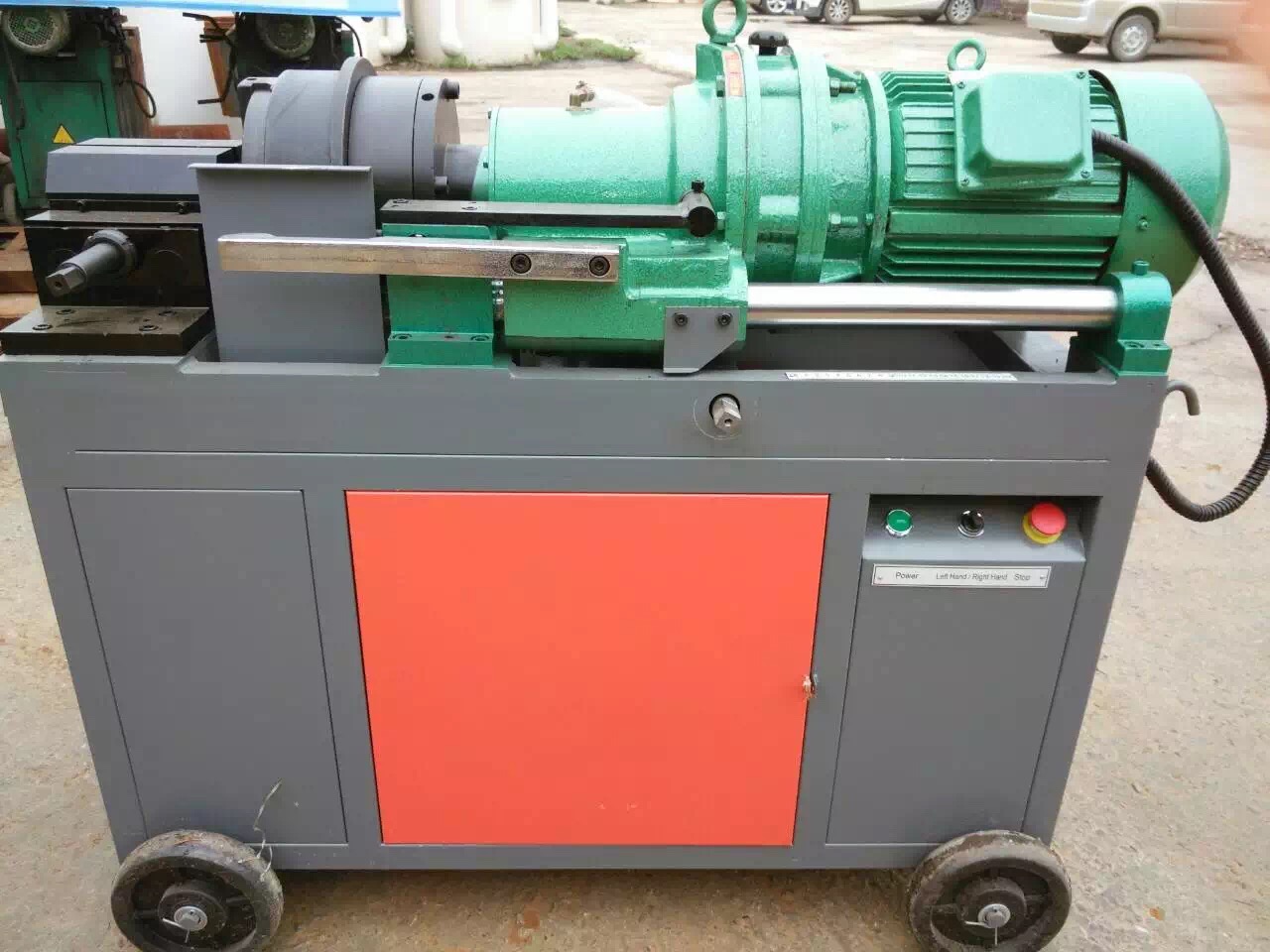
Rebar thread rolling machine CBT40L — 420 kg, 16–40 mm bar, up to 200 mm threading length in the long configuration.
| Model | Type | Power | Speed ratio | Max threading length | Net weight |
|---|---|---|---|---|---|
| CBT40A | Thread rolling | 5.5 kW, 380 V / 50 Hz | 1:23 quick / 1:29 slow | 120 mm | 590 kg |
| CBT40L | Thread rolling | 5.5 kW, 380 V / 50 Hz | 1:23 quick / 1:29 slow | 100 mm, or 200 mm depending on configuration | 420 kg |
| 40AO | Thread rolling, automatic | 5.5 kW or 7.5 kW at 1450 r/min, 380 V / 50 Hz | 1:23 quick / 1:29 slow | 90 mm with block / 150 mm without block | 860 kg |
| 40MO | Thread rolling, quick type | 5.5 kW at 1450 r/min, 380 V / 50 Hz | 1:19 quick / 1:23 slow | 95 mm, or 150 mm without block | 680 kg |
Choosing between them is largely a matter of thread length against handling weight. The CBT40A offers the longest fixed threading length in the group at 120 mm and sits at 590 kg. The CBT40L is the lightest machine in the range at 420 kg and lists 100 mm or 200 mm depending on configuration, which suits sites where the machine has to be moved between floors or between bar bundles. The 40AO is the automated option: it uses air at 0.4–0.8 MPa for clamping and adds a 0.12 kW water pump at 1450 r/min, with overall dimensions of 1950 × 700 × 1120 mm. The 40MO trades some length for a faster ratio, running a 1:19 quick ratio against 1:23 on the other models.
A useful reference point is the coupler range itself. The largest rolling coupler listed is for 40 mm bar with an M40.2*3.0 thread and an overall length of 95 mm — the same figure the 40MO lists as its maximum threading length. On the smaller sizes the thread callouts run from M16.5*2.5 on 16 mm bar through M25.6*3.0 on 25 mm bar, all at a 60° thread angle, so a single threading machine covers the whole coupler schedule without a change of machine class.
Thread Cutting for Upset Ends: MQ40
The upsetting route needs a second step. After the bar end is upended, the thread is cut rather than rolled, and that is the job of the MQ40 rebar thread cutting machine. It is a manual machine covering M14 to M45 with a maximum thread length of 100 mm, a 5.5 kW main motor at 1450 r/min, a cutting forward speed ratio of 1:35, overall dimensions of 1630 × 780 × 1100 mm, and a power source of 380 V / 50 Hz or 415 V / 50 Hz.
The M14–M45 cutting window lines up with the upsetting coupler thread callouts, which run from M20*2.5 on 16 mm bar to M45*4.0 on 40 mm bar at a 60° angle. A project specifying upset couplers therefore needs both the upsetting machine and the cutting machine on the equipment list; neither replaces the other.
Upsetting: 36S and 50S
Two automatic upsetting machines cover the range, and the split between them is bar diameter and motor size rather than feature set. Both run at 380 V / 50 Hz, both list a maximum pressure of 31.5 MPa and an oil pump flux of 16 ml/r, and both share the same 1350 × 950 × 1750 mm footprint.
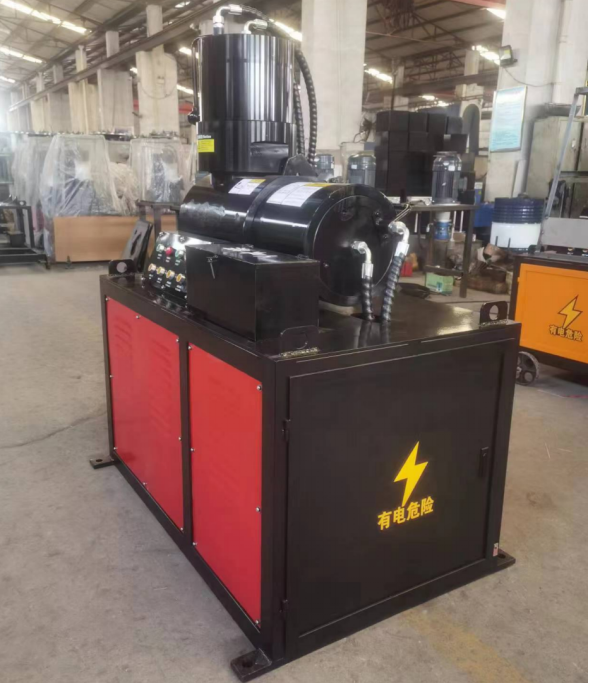
Rebar upsetting machine 36S — 7.5 kW, 1000 kg, covering 16–36 mm on 400 grade bar.
| Model | 400 grade bar | 500 grade bar | Motor | Net weight |
|---|---|---|---|---|
| 36S | 16–36 mm | 16–32 mm | 7.5 kW, 380 V / 50 Hz | 1000 kg |
| 50S | 16–50 mm | 16–40 mm | 11 kW, 380 V / 50 Hz | 1200 kg |
The distinction matters when a schedule mixes bar grades. A project on 500 grade bar that reaches 40 mm needs the 50S, because the 36S stops at 32 mm on 500 grade even though it reaches 36 mm on 400 grade. The 36S is listed with a 36-second cycle time, which is the figure to use when estimating output against a daily splice count.
Pressing: CBT32
The cold pressing route uses no thread at all. The pressing coupler is made from Q355B carbon steel and is listed from 16 mm to 40 mm bar, with wall thickness rising from 4.5 mm on the 16 mm size to 11.0 mm on the 40 mm size, and lengths from 110 mm to 240 mm. Installation is done with the CBT32 rebar coupler pressing machine: a 4 kW main motor at 380 V / 50 Hz, 50 T of clamp tension, a maximum oil pump pressure of 70 MPa, a 5 metre oil pump line, a 60 kg oil pump and 38 kg clamps.
The split between pump and clamp is worth noting in planning. Because the clamp assembly is separate from the pump and connected by a 5 metre line, the working position at the bar can be some distance from where the pump is set down — useful on congested decks, but it also means the site needs a clear, level position for the pump unit.
Fastening: BOC 8-42 and BOC 8-32
The final step on threaded routes is tightening, and two battery torque wrenches cover it. Both use a 21 V, 6.0 Ah, 900 W battery and both are supplied in 560 × 430 × 250 mm packing.
| Model | Stated bar range | Max torque | Speed | Net weight |
|---|---|---|---|---|
| BOC 8-42 | 12–40 mm rebar, 16–32 coupler | 400 N·m | 0–60 r/min | 9.5 kg, battery 1.2 kg |
| BOC 8-32 | 8–32 mm rebar | 350 N·m | 0–75 r/min | 4.5 kg, battery 0.875 kg |
The overlapping window is between 16 mm and 32 mm, where both tools can be used. Above 32 mm the choice narrows to the BOC 8-42, and the heavier tool also delivers the higher torque figure. The BOC 8-32 is listed with a host claw in its structural configuration and weighs roughly half as much, which matters for operatives working overhead or on scaffold.
Matching Coupler to Machine: Reference Matrix
| Coupler family | Material | Sizes | Preparation machine | Fastening |
|---|---|---|---|---|
| Rolling coupler | 45# carbon steel, 40CR alloy steel | 16–40 mm, M16.5*2.5 to M40.2*3.0, 60° | CBT40A, CBT40L, 40AO, 40MO | BOC 8-32 or BOC 8-42 |
| Upsetting coupler | 45# carbon steel, 40CR alloy steel | 16–40 mm, M20*2.5 to M45*4.0, 60° | 36S or 50S, then MQ40 | BOC 8-32 or BOC 8-42 |
| Pressing coupler | Q355B carbon steel | 16–40 mm | CBT32 | Hydraulic clamp, 50 T |
| One-touch coupler | 40CR alloy steel | φ11-16 to φ40, OD 35–83 mm | Threading machine, per recorded scenarios | BOC 8-42, per recorded scenarios |
Where the Sets Fit: High-Rise, Bridge, High-Rail and Factory Work
The application records in the product data describe four working environments, and each one pulls a different machine set forward.
Super high-rise buildings. The recorded scenario is outdoor work on a super high-rise in normal tropical temperature and humidity, with the coupler connected after threading, supported by rebar threading machines. Documented equipment pairings include the CBT40L, 40MO, BOC 8-42 and the rolling coupler. The scenario notes ISO and CE documentation as a project requirement, and lists the United Arab Emirates, Australia and India among the markets where this pattern appears.
High railway. The recorded scenario for high-railway work in Mexico is outdoor open-air construction in a tropical high-temperature climate, where the connection sequence is upsetting, thread cutting and coupler assembly, supported by an upsetting machine and a thread cutting machine. The documented pairings include the 36S, 50S, MQ40 and 40MO, with CE and ISO documentation listed as a requirement.
General construction projects. The recorded scenario for work in Vietnam is an outdoor tropical site with high humidity, a rainy climate and continuous all-day operation, with mechanical connection required to maintain structural strength and conform to construction standards. Documented equipment includes a threading machine, a cutting machine and the BOC 8-42 electric wrench.
Factory pre-threading. The recorded scenario for factory work in Qatar is indoor, at normal room temperature, with continuous automatic threading of large quantities of bar ends. This is the setting where cutter and roller life and shaft strength become the practical selection criteria rather than portability, and where the automated 40AO sits most naturally.
What the Market Data Suggests for Equipment Buyers
The rebar coupler market is reported at USD 1.82 billion in 2025 and projected to reach USD 3.47 billion by 2034, according to Dataintelo's Rebar Coupler Market Research Report 2034 (published March 2026). The same source places Asia Pacific at 41.3% of global rebar coupler revenue in 2025.
Two structural signals follow for equipment buyers. First, a market of that size implies a large installed base of couplers being consumed alongside machine capacity, so the equipment decision recurs on every project rather than being a one-off purchase. Second, the concentration of revenue in Asia Pacific corresponds with the manufacturing clusters that supply the couplers themselves, which is where a combined coupler-and-machine supply offer is most common.
The standards framework is also worth tracking. ISO 15835-1:2018 sets requirements for couplers used in mechanical splices of steel reinforcing bars, ISO 15835-2:2018 sets the test methods, and ISO 15835-3:2018 sets the rules for certification and self-evaluation. The three parts are separate documents with separate functions, which is why a buyer should be able to point to a requirement standard, a test method and a conformity route as three distinct pieces of paperwork rather than one certificate. On trade classification, HS 7307.92.90 covers tube or pipe fittings of iron or steel, the heading under which rebar couplers are commonly declared.
Limits, Boundaries and What the Data Does Not Cover
Several boundaries are visible directly in the specifications and should be read before committing a schedule.
Machine capacity is narrower than coupler capacity on the pressing route. The pressing coupler family is listed from 16 mm to 40 mm, but the CBT32 is rated for 16 mm to 32 mm bar. Projects using 36 mm or 40 mm pressing couplers therefore fall outside the stated capacity of the only pressing machine in this range, and that gap needs to be resolved at the specification stage, not on site.
The two torque wrenches do not share an identical envelope. The BOC 8-32 is stated for 8–32 mm rebar at 350 N·m; the BOC 8-42 is stated for 12–40 mm rebar with a 16–32 coupler at 400 N·m. Neither statement makes the other redundant, and a project working across 12 mm to 40 mm needs the larger tool.
The upsetting machines split by grade. The 36S covers 16–36 mm on 400 grade bar but only 16–32 mm on 500 grade. A 500 grade schedule that reaches 36 mm or 40 mm requires the 50S.
Power and air supply are site constraints. All mains-powered machines in this range run at 380 V / 50 Hz, with the MQ40 additionally available at 415 V / 50 Hz. The 40AO requires 0.4–0.8 MPa of air for clamping, so it depends on a compressor that the smaller manual machines do not.
Certification is a document request, not an assumption. The available third-party data does not verify product-specific CE or ISO 9001 certificate numbers, issuing bodies or scope for this supplier. Because the recorded high-rise, high-rail and construction scenarios list ISO and CE documentation as project requirements, buyers should request the actual certificates and confirm that the scope covers the specific coupler and machine models before award.
A Procurement Checklist for Equipment Selection
- Start from the coupler written into the specification, then confirm the preparation route it requires — rolled thread, upset and cut thread, or cold pressing.
- Map the maximum bar diameter in the schedule against the machine rating, not against the coupler rating. Check grade as well as diameter on upsetting work.
- Confirm required thread length against the machine figure — 120 mm on the CBT40A, 100 or 200 mm on the CBT40L, 90 or 150 mm on the 40AO, 95 or 150 mm on the 40MO, 100 mm on the MQ40.
- Decide whether the site needs a single machine set or a mixed fleet: threading for rolled and one-touch couplers, upsetting plus cutting for upset couplers, pressing for cold-pressed couplers.
- Check utility availability — 380 V / 50 Hz mains across the range, 415 V / 50 Hz as an MQ40 option, and 0.4–0.8 MPa air for the 40AO.
- Match the torque tool to the largest coupler on the schedule, and count the number of tools against the number of fixing positions.
- Request product-specific certificates, test reports and spare-parts lists, particularly rib cutters and rollers for factory pre-threading work.
Future Outlook
If the projected growth in coupler demand holds, equipment will increasingly be bought as a matched set rather than as individual machines. The reasoning is procedural: the ISO 15835 series already separates requirements, test methods and conformity assessment, and buyers are learning to apply the same separation to the machines — a preparation step, a fastening step and a documented torque value each need their own evidence.
The standard itself is also a live item. ISO/AWI 15835-1 appears as a work item alongside the published ISO 15835-1:2018 edition in the ISO listings, so procurement teams running long infrastructure programmes should re-check the current status of the standard before finalising tender documents rather than assuming the 2018 edition is the last word.
On the equipment side, the direction of travel visible in this range is toward automation and weight reduction at the same time: the 40AO automates clamping with air and adds a water pump, while the CBT40L reduces machine weight to 420 kg for the same 16–40 mm bar window. For project buyers, that combination gradually shifts the constraint from machine capability to site logistics.
FAQ
What equipment is needed to install rolling rebar couplers on 16–40 mm bar?
A rebar threading machine to roll the thread, then an electric torque wrench to fasten the coupler. The threading machines listed for this range are the CBT40A, CBT40L, 40AO and 40MO, all covering 16–40 mm bar with a 5.5 kW motor at 380 V / 50 Hz. The rolling coupler thread callouts run from M16.5*2.5 on 16 mm bar to M40.2*3.0 on 40 mm bar, all at 60°.
Can the CBT32 pressing machine handle 40 mm rebar?
No. The CBT32 is rated for rebar from 16 mm to 32 mm. The pressing coupler family is listed up to 40 mm, so 36 mm and 40 mm pressing work sits outside the stated capacity of this machine and requires a different solution.
Which upsetting machine should a project choose for 40 mm bar?
The 50S. It covers 16–50 mm on 400 grade bar and 16–40 mm on 500 grade bar with an 11 kW motor. The 36S covers 16–36 mm on 400 grade and 16–32 mm on 500 grade with a 7.5 kW motor, so it does not reach 40 mm on either grade.
What power supply do these machines require?
The threading machines, upsetting machines, pressing machine and thread cutting machine are all listed at 380 V / 50 Hz. The MQ40 thread cutting machine is additionally listed at 415 V / 50 Hz. The two electric torque wrenches run on a 21 V, 6.0 Ah, 900 W battery rather than mains power.
Do the two electric torque wrenches cover the same rebar range?
No. The BOC 8-32 is stated for 8–32 mm rebar with a maximum torque of 350 N·m at 0–75 r/min. The BOC 8-42 is stated for 12–40 mm rebar with a 16–32 coupler, a maximum torque of 400 N·m at 0–60 r/min, and a net weight of 9.5 kg against 4.5 kg for the smaller tool.
How much threading length is available across the range?
Maximum threading length is 120 mm on the CBT40A, 100 mm or 200 mm on the CBT40L depending on configuration, 90 mm with block or 150 mm without block on the 40AO, 95 mm or 150 mm without block on the 40MO, and 100 mm on the MQ40 thread cutting machine.
¿Tiene preguntas o necesita más detalles?
Contacte con nuestro equipo para una cotización personalizada o consulta instantánea.
Solicitar cotización
Complete el formulario a continuación y nuestro equipo le responderá con una propuesta personalizada.
Chat directo de WhatsApp
¿Prefiere chatear en tiempo real? Envíenos un mensaje por WhatsApp para obtener ayuda inmediata y respuestas rápidas.
- Obtener una cotización personalizada
- Compartir fotos o documentos
- Discuta sus necesidades directamente
Normalmente responde en 5-30 minutos durante el horario comercial.