
Rebar Coupler Catalogue Audit: Models, Threads, Machines
Rebar Coupler Catalogue Audit: Models, Threads, Machines
Rebar couplers are usually compared on price per piece and on the certificate scan attached to a quotation. A faster and more defensible first filter is the internal consistency of a supplier's product and machine range: whether the coupler sizes, thread dimensions, material grades and processing equipment listed in a catalogue can actually produce and install each other. A range that holds together under that test says something concrete about a supplier. A range that contradicts itself usually points to a trading operation reselling other factories' stock, or to a specification sheet copied without production behind it.
CANGZHOU BARTECH CONSTRUCTION MATERIAL CO. LTD. is a manufacturer and exporter of rebar couplers, rebar threading machines and rebar processing equipment, established in 2008 and based in Qing County, Cangzhou City, Hebei Province, China. Its published line covers three coupler families together with the machines that cut, roll, upset, press and torque them, which makes it a workable example for a catalogue-level capability audit of the kind a procurement team can run before any sample order.
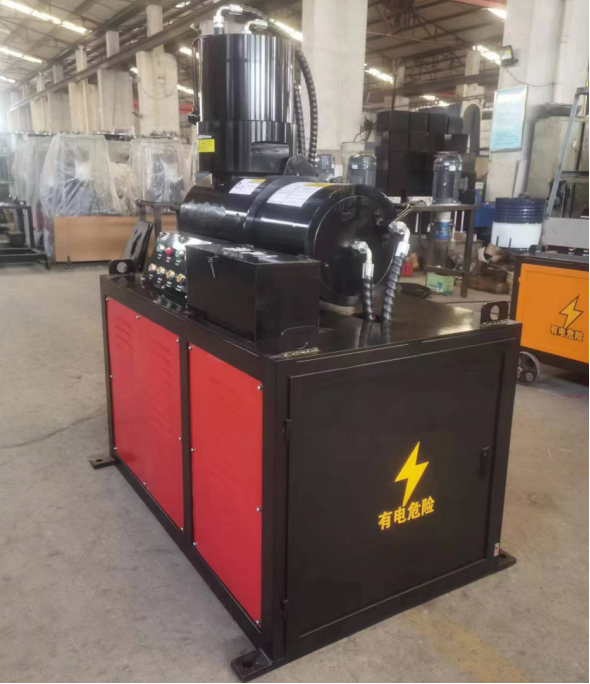
Upsetting equipment is one of three processing routes behind a coupler range; its stated bar-size limits are a checkable constraint, not a marketing claim.
Why a product range works as evidence
One coupler model proves very little. A diameter with an outer dimension and a length can be produced by any machine shop with a lathe and a thread gauge. What is harder to assemble without an operating production line is a coherent set: three connection mechanics, a continuous size ladder, a distinct thread geometry for each size band, material grades assigned by family, and the processing machines whose stated capacity matches those sizes.
The test is mechanical rather than rhetorical. If a catalogue promises rolled couplers from 16 mm to 40 mm, the threading machines it lists must cover 16–40 mm. If it lists a pressing coupler up to 40 mm, the pressing machine should reach the same ceiling, or the supplier should be able to explain the tooling used above the machine's stated limit. If the thread pitch changes at a specific diameter, the change should follow a logic, not a typing error. Buyers who run these checks before requesting samples save evaluation time later, because the contradictions surface in the documents rather than on site.
The coupler range: three families, three mechanics
The documented coupler line is organised by connection method rather than by brand tier: a rolling (parallel thread) coupler, a pressing (cold extrusion) coupler, and a one-touch coupler. Each family carries its own material assignment and its own dimensional logic.
| Family | Documented size range | Material | Dimension logic |
|---|---|---|---|
| Rolling / parallel thread coupler | 16–40 mm | Carbon steel 45#; alloy steel 40CR | OD 24 mm × L 42 mm at 16 mm rising to OD 59 mm × L 95 mm at 40 mm; thread M16.5×2.5 to M40.2×3.0, 60° flank |
| Pressing / cold extrusion coupler | 16–40 mm | Carbon steel Q355B | OD 30 mm × L 110 mm × 4.5 mm wall at 16 mm rising to OD 70 mm × L 240 mm × 11.0 mm at 40 mm |
| One-touch coupler | φ11-16 to φ40 | Alloy steel 40CR | OD 35 mm × L 100 mm at φ11-16 rising to OD 83 mm × L 200 mm at φ40 |
Two details in this table are worth a buyer's attention. The first is granularity. Every diameter in the rolling series carries a distinct outer diameter, length and thread designation rather than a rounded estimate — 18 mm at OD 27 × L 45 with M18.5×2.5, 25 mm at OD 38 × L 62 with M25.6×3.0, and so on to 40 mm. Where a size ladder is fully enumerated, a buyer can check individual rows against a project bar schedule; where it is summarised, the buyer has to ask for the sheet anyway.
The second is the thread-pitch step. The rolling series moves from 2.5 mm pitch on 16–22 mm bars to 3.0 mm pitch on 25–40 mm bars, with the flank angle held at 60° throughout. That is the kind of internal rule that appears in a real product family and disappears in a copied specification. The pitch band also determines which thread gauge and which wrench setting the site will need.
Material assignment differs by family for a reason: the pressing coupler carries a thick extruded wall and uses Q355B, while the one-touch coupler, which relies on a different engagement principle, is listed in 40CR throughout. Third-party harvest data records the same two grades under their alternate designations, S45C with tensile strength above 600 MPa and 40Cr at approximately 980 MPa, and attributes the figures to company reporting rather than to independent testing. Buyers should treat grade names as a starting point and the mill certificate as the document that confirms it.
The machine line that has to exist behind the couplers
Couplers are the visible half of a mechanical splicing package. The machines are the half that determines whether a supplier is a producer or a reseller, and their specifications can be cross-checked against the coupler sheet size by size.
| Threading machine | Rebar range | Motor / power | Speed ratio | Max threading length | Net weight |
|---|---|---|---|---|---|
| CBT40A | 16–40 mm | 5.5 kW, 380V/50Hz | 1:23 quick / 1:29 slow | 120 mm | 590 kg |
| CBT40L | 16–40 mm | 5.5 kW, 380V/50Hz | 1:23 quick / 1:29 slow | 100 / 200 mm | 420 kg |
| 40MO (quick type) | 16–40 mm | 5.5 kW, 1450 r/min, 380V/50Hz | 1:19 quick / 1:23 slow | 95 mm, or 150 mm without block | 680 kg |
All three machines share a 16–40 mm working range with the rolling coupler family, which is the first consistency check passed. The choice between them is a site decision rather than a quality hierarchy. The 40MO carries the fastest spindle ratio and the longest bed at 1820 × 815 × 1100 mm, and it is the heaviest at 680 kg, which suits fixed pre-threading benches. The CBT40A offers a 120 mm threading length on a more compact frame, and the CBT40L is the lightest at 420 kg with a 100/200 mm threading length — relevant where machines are repositioned between floors or moved between sites.
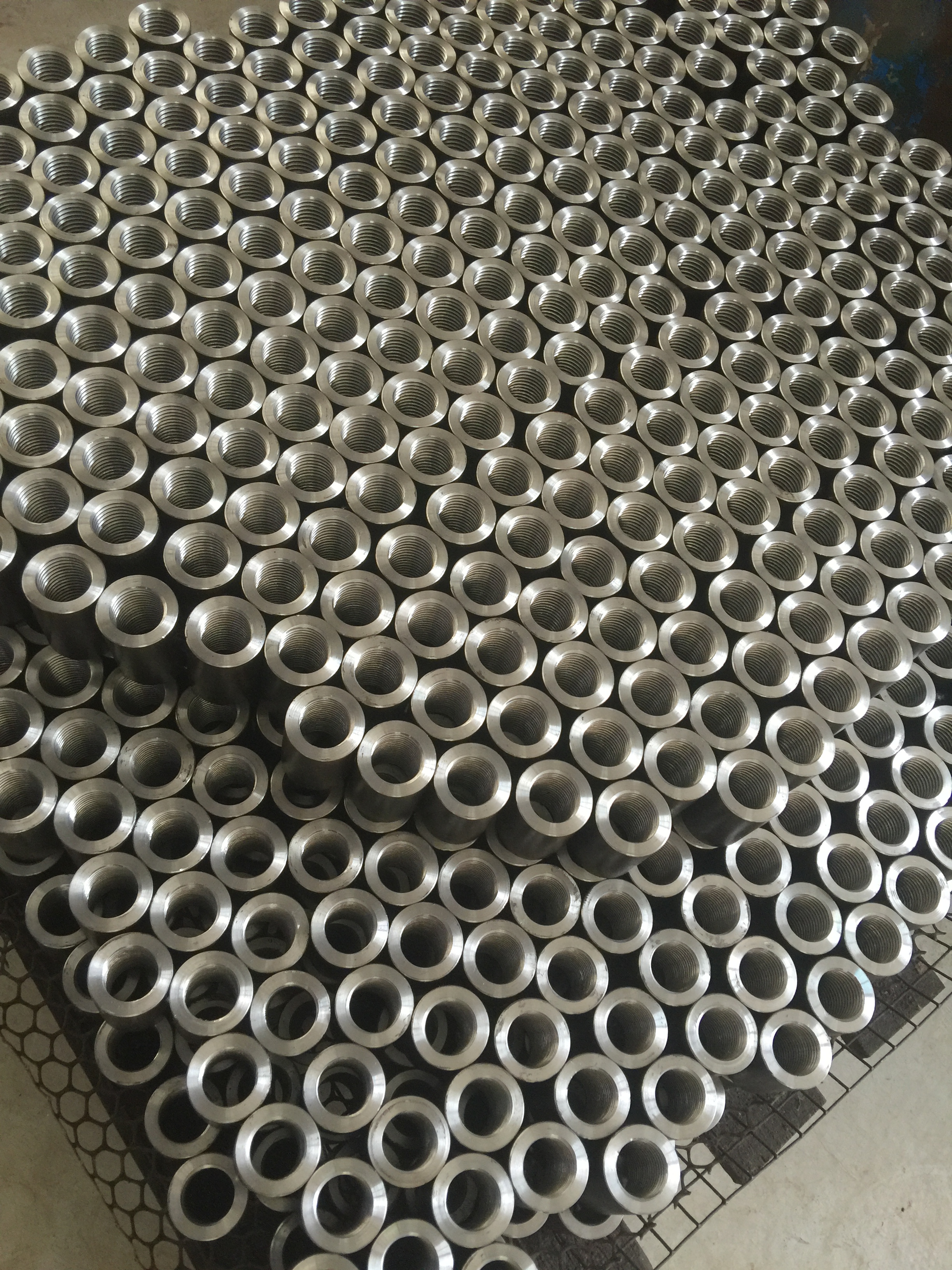
Parallel thread couplers are matched to threading machines by bar range and by thread pitch band, not by appearance.
The upsetting route is documented through the Auto 50S, an 11 kW machine running on 380V/50Hz with a maximum pressure of 31.5 MPa and a net weight of 1200 kg, dimensioned at 1350 × 950 × 1750 mm. Its stated capacity is 16–50 mm on 400-grade rebar and 16–40 mm on 500-grade rebar. Read against the coupler sheet, the 500-grade ceiling of 40 mm coincides exactly with the top of the coupler range, while the 400-grade capacity extends beyond it. That asymmetry is a plausible production reality, and it is the kind of detail a buyer can put to a supplier in writing. The Auto 36S upsetting machine and the MQ40 thread cutting machine appear in the documented high-railway and threading-factory workflows; their individual specifications are not published in the material reviewed here, so they should be requested directly rather than inferred.
The pressing route runs through the CBT32 pressing machine: 16–32 mm rebar, 4 kW main motor, 50 t clamp tension, 70 MPa maximum oil pump pressure, 380V/50Hz supply, a 5 m oil pump line weighing 60 kg and a 38 kg clamp. Here a boundary appears that a buyer should raise before ordering. The pressing coupler family is listed from 16 mm to 40 mm, while the pressing machine is documented to 32 mm. Either a second configuration, alternative tooling or a different clamp exists for φ36 and φ40, or the coupler sheet is wider than the standard equipment. Both possibilities are worth a written answer, and neither is answered by a photograph.
Installation equipment closes the loop. The BOC 8-42 electric torque wrench is specified for 12–40 mm rebar and 16–32 couplers with a maximum torque of 400 N·m, a 21 V / 6.0 Ah / 900 W battery, 0–60 r/min and a net weight of 9.5 kg. The BOC 8-32 covers 8–32 mm rebar when fitted with the host claw, at 350 N·m, 0–75 r/min and 4.5 kg. The gap above 32 mm couplers is visible in the published figures and is a legitimate question for any project that specifies φ36 or φ40 couplers.
A five-point consistency check for any coupler catalogue
1. Coupler range versus machine range. The rolling couplers and all three threading machines both stop at 40 mm. Confirm the same overlap for every family, not just the one in the brochure.
2. Thread pitch band versus tooling and wrench. A 2.5 mm pitch band up to 22 mm and 3.0 mm above it implies two gauge sets and two torque settings. Ask which wrench model is issued for each band.
3. Pressing coupler wall versus clamp tension. A 11.0 mm wall at φ40 is not pressed by the same clamp that handles a 4.5 mm wall at φ16. Ask for the tooling list per diameter.
4. Material grade versus the bar actually specified. 45#, 40CR and Q355B are assigned by family. Match the coupler family to the rebar grade and the project's design requirements, then request the mill certificate for the delivered batch.
5. Stated capacity versus order size. A documented monthly capacity of 300,000 pieces and annual output of 3,600,000 pieces is the scale against which a project's tonnage should be measured, together with a lead time of 7–30 days depending on quantity.
Where the range meets real project conditions
The documented applications are specific about working conditions, and the equipment mix changes accordingly. For tall buildings, the published scenario pairs rebar threading machines with rolling couplers and the BOC 8-42 wrench under outdoor conditions with normal tropical temperature and humidity, with ISO and CE certification listed as a project requirement rather than as a supplier claim. For high-railway work in tropical open-air conditions, the documented workflow combines upsetting, thread cutting and coupler assembly, which is why the Auto 50S, Auto 36S and MQ40 appear together in that scenario.
Two further scenarios test different parts of the line. In a rebar threading factory in Qatar, the requirement is continuous indoor pre-threading at volume, and the documented special requirements are long-life rib cutters and rollers plus strong shafts and machine parts — a maintenance question rather than a coupler question. In Vietnam, the described conditions are tropical, high-humidity and rainy, with continuous all-day operation, and the equipment set is threading machine, cutting machine, coupler and electric wrench together.
Volume references sit alongside the range data. A construction enterprise in Kuwait is recorded at 400,000 pieces per year of standard couplers for outdoor construction work, with the supplier describing the outcome as higher strength, stable quality and easy connection. A Vietnam-based OEM buyer is recorded at 500,000 pieces per year for tall-building and railway-station work, with the supplier noting stable operation, clear outer surface and strict thread as the relevant characteristics. Both figures are supplier-recorded and function as scale indicators, not as independent performance proof.
Market context for range-based evaluation
The wider mechanical splicing market gives buyers a reason to look at range rather than at single items. Commercial research published in 2026 puts the global rebar coupler market at 1.82 billion US dollars in 2025, with a projection of 3.47 billion by 2034, and attributes 41.3 percent of 2025 global revenue to Asia Pacific. A regional concentration of that size means most sourcing conversations involve suppliers operating inside the same manufacturing cluster, where differentiation has to come from documented range and equipment depth rather than from geography alone.
Trade classification is straightforward for documentation purposes: the standard HS code for rebar couplers is 7307.92.90, under tube or pipe fittings of iron or steel. On the technical side, the ISO 15835 series separates the three things buyers tend to conflate — ISO 15835-1:2018 sets requirements, ISO 15835-2:2018 sets test methods, and ISO 15835-3:2018 sets rules for certification and self-evaluation. A product requirement, a laboratory method and a conformity route are three different documents, and a quotation that offers one of them is not offering all three. Buyers should also note that an ISO work item for 15835-1 is listed alongside the published 2018 edition, so the current status should be confirmed before it is written into a tender.
Comparison with traditional splicing, and where catalogue evidence stops
Against lap splicing, mechanical coupling buys section continuity, less congestion at joints and predictable bar lengths, but it does not come free of dependencies. It requires threading, upsetting or pressing equipment on site or nearby, a stable power supply at the machine's rated specification, trained operators and a controlled thread or press cycle. Lap splicing needs none of that. For a small or remote pour with intermittent power, a coupler programme can be the more fragile option, and the practical answer is often a pre-threading bench away from the pour rather than a machine at the formwork edge. The documented equipment here is rated at 380V/50Hz throughout, which is a real constraint on sites running other supply voltages and should be settled before machines are shipped.
The second limit is inherent to this method of evaluation. A catalogue can demonstrate that a range is coherent, complete and internally consistent, and that is a meaningful filter. It cannot demonstrate that a coupler passed a tensile, slip or fatigue test, and it cannot substitute for a certificate number with an issuing body and a scope. The verified data reviewed for this article contains no confirmed CE certificate, ISO 9001 certificate, ASTM approval or BS compliance certificate for this supplier, and no independent laboratory report linking a specific model to ISO 15835 performance requirements. The correct reading is therefore narrow but useful: the documented range is evidence of production breadth, and the test report is evidence of performance. A buyer needs both, and only the first can be assessed from a catalogue.
What to expect next
Two directions are visible from the documented material. The first is documentation deepening rather than product widening: as conformity routes under ISO 15835-3 become a standard part of tender packs, suppliers with an internally consistent range will be asked to attach model-level test reports to it, and the range audit described here becomes the index that tells a buyer which models to test first. The second is equipment-side adaptation. Machine specifications currently assume 380V/50Hz and fixed benches, while project demand keeps moving toward pre-threading yards and rapid site assembly, which puts pressure on weight, portability and power flexibility — the difference between a 420 kg and a 680 kg threading machine is already a logistics argument, not a workshop one.
For procurement teams, the practical sequence stays the same: read the range as a set of constraints, check the coupler sheet against the machine sheet size by size, ask specifically about the diameters where the two diverge, and then request the documents that the catalogue cannot supply. Ordering stock couplers carries no stated minimum order quantity, and customisation of coupler outer diameter, inner diameter and thread is offered within a 7–30 day lead time depending on quantity, so a validation order is not a large commitment.
FAQ
Does a 16–40 mm range mean the same thing across the coupler families?
No. The rolling and pressing couplers are both listed from 16 mm to 40 mm, but the one-touch coupler is listed from φ11-16 up to φ40, so its lower end starts below the other two families. The materials also differ: rolling couplers use carbon steel 45# or alloy steel 40CR, pressing couplers use carbon steel Q355B, and one-touch couplers are listed in alloy steel 40CR throughout.
Which machine corresponds to which coupler family?
Rolling couplers are produced with rebar threading machines, documented as CBT40A, CBT40L and 40MO, all covering 16–40 mm. Pressing couplers are installed with the CBT32 pressing machine, specified for 16–32 mm rebar. Upset-based connections use the Auto 50S upsetting machine together with the MQ40 thread cutting machine and a threading machine, as described in the documented high-railway workflow.
What thread dimensions are documented for rolled couplers?
The rolling series specifies a 60° flank angle across the range, with M16.5×2.5 at 16 mm, M18.5×2.5 at 18 mm, M20.5×2.5 at 20 mm, M22.5×2.5 at 22 mm, and a step to 3.0 mm pitch above that: M25.6×3.0 at 25 mm, M28.6×3.0 at 28 mm, M32.6×3.0 at 32 mm, M36.6×3.0 at 36 mm and M40.2×3.0 at 40 mm.
How much production does the documented line represent?
The supplier states a monthly capacity of 300,000 pieces and an annual output of 3,600,000 pieces, with a 7–30 day lead time depending on quantity. Quality control is described as a material test report, 10 percent production testing during the line run and 100 percent appearance surface checking.
What should a buyer request beyond the catalogue?
Three sets of documents: model-level test reports referencing ISO 15835-2 methods, certificate numbers with issuing body and product scope where CE or ISO 9001 compliance is required by the project, and confirmation of the equipment or tooling used for coupler sizes where the machine specification and the coupler sheet diverge — pressing couplers above 32 mm and wrench operation above 32 mm couplers being the two visible cases in the published data.
Where does the published information stop?
Individual specifications for the Auto 36S upsetting machine and the MQ40 thread cutting machine are not published in the material reviewed for this article, although both appear in documented production workflows. Material grades are company-reported, with third-party harvest data recording S45C above 600 MPa and 40Cr at approximately 980 MPa. Test performance, certification status and batch traceability sit outside what a catalogue can establish.
¿Tiene preguntas o necesita más detalles?
Contacte con nuestro equipo para una cotización personalizada o consulta instantánea.
Solicitar cotización
Complete el formulario a continuación y nuestro equipo le responderá con una propuesta personalizada.
Chat directo de WhatsApp
¿Prefiere chatear en tiempo real? Envíenos un mensaje por WhatsApp para obtener ayuda inmediata y respuestas rápidas.
- Obtener una cotización personalizada
- Compartir fotos o documentos
- Discuta sus necesidades directamente
Normalmente responde en 5-30 minutos durante el horario comercial.