
Real-Water Diving Watch Shortlist: Verifiable Spec Markers
Water resistance in a watch is a laboratory measurement, not a promise about what happens on a wrist in salt water. ISO 22810:2010 defines how water-resistant watches are specified and tested, and it prohibits the use of the word “waterproof” for these products. That single rule is where any shortlist built around real submersion — rather than around styling — has to begin.
This guide is written for brand owners, wholesalers and procurement teams sourcing custom wristwatches for genuine water use: swimming, surface snorkeling, and diving where the specification actually supports it. Its purpose is to convert an ambiguous brief (“a diver-style watch”) into checkable markers that can be verified on a specification sheet, on a pre-production sample, and in a test record.
Three markers carry most of the weight in the examples that follow: the Miyota 8215 automatic movement, a 10 ATM water-resistance rating, and the material signature of a 316L stainless steel case paired with a ceramic bezel insert. Each is either present in a documented specification or it is not — which is exactly what makes them useful in a shortlist.
Why “100 m” on a Dial Is Not a Diving Rating
The ATM value on a caseback expresses static laboratory pressure, not usable depth. One ATM is equivalent to 10 metres of static water depth under test conditions, and a watch is graded against that pressure — not against the dynamic forces of a swimming stroke, a dive entry or a wave. A 10 ATM watch is therefore not “a 100-metre diving watch”; it is a watch that has passed a static pressure test equivalent to 100 metres.
Two international standards frame the categories. ISO 22810 covers general water-resistant watches and is the reference point for everyday ratings. ISO 6425 covers diver watches and sits at a higher threshold, adding requirements that go beyond a static pressure test. In the common industry mapping used in sourcing documents, 3–5 ATM suits daily wear and rain splash, 10–20 ATM suits swimming and surface snorkeling, and ratings of 20 ATM and above are the band associated with ISO 6425-level professional diving performance.
That mapping is a filter, not a ranking. A watch can carry a high ATM number and still be built on a case architecture that will not tolerate repeated immersion, and a well-built 10 ATM watch can be entirely appropriate for a swimming-focused product line. Separating the two is the whole purpose of the criteria below.
The Problem: Style-Led Divers Outnumber Spec-Led Divers
Market structure explains why the mismatch persists. Quartz movements account for roughly 75% of global watch shipment volume, while mechanical watches contribute more than 68% of total market value despite lower unit volume, according to 2024 industry research. Volume concentrates in affordable, style-driven products; value concentrates in mechanical builds, where buyers are more likely to ask what is inside the case.
For a diver-styled watch, that split creates a predictable failure mode. The visible signals that drive most purchase decisions — bezel shape, dial colour, branding — are the cheapest to change and the least informative about water performance. The signals that actually predict performance — movement family, rating and its test basis, case alloy, bezel insert material, seal architecture, inspection regime — are usually the ones left off a supplier’s single-page sell sheet.
The opportunity for a buyer is procedural rather than technical: specify the markers, request the evidence, and treat any marker that cannot be evidenced as absent. A shortlist built that way is shorter, but every entry on it is defensible in front of a brand owner, a retailer or an after-sales desk.
Four Checkable Markers of a Genuine Dive-Spec Build
1. Movement: Why the Miyota 8215 Is a Useful Anchor
The movement is the first marker because it is both the easiest to falsify and the easiest to verify. A watch built around the Miyota Automatic 8215 — a Japanese automatic calibre — can be identified from a supplier’s specification and confirmed on the sample. Automatic winding also removes the button-cell battery from the equation, which matters for buyers selling into markets where RoHS compliance is mandatory for electronic watches.
Movement choice is not, by itself, a proxy for water resistance. It is a proxy for supply discipline. A manufacturer that can state the exact calibre — and keep it consistent between prototype and mass production — is operating from a stable bill of materials rather than from whatever is available in a given month.
2. Rating: What 10 ATM Buys, and Where It Stops
A 10 ATM rating places a watch in the swimming and surface-snorkeling band. It is a legitimate specification for a product line worn in pools, in the sea and in everyday wet conditions — and it is not a professional diving rating. That boundary belongs in the product brief rather than being smoothed over, because the most common compliance failure in this category is not a weak case; it is a claim that outruns the test behind it.
Two questions make a 10 ATM claim verifiable. First, is the rating stated as a tested value with a defined method, rather than as a marketing line? Second, does the supplier test every unit or a sample? Full-unit pressure testing before shipment is the stronger evidence, and it is the point at which a specification turns into a control.
3. Material Signature: 316L Case With a Ceramic Bezel Insert
316L stainless steel is the practical baseline for a dive-spec case. It is corrosion-resistant, machines predictably, and — importantly for a shortlist — it is a named alloy, so its presence can be confirmed across a supplier’s model range instead of being inferred from a photograph.
The bezel insert is the second half of that signature. A ceramic insert resists scratching in a way that painted or anodised aluminium does not, and it can hold luminous compound for low-light legibility. When the insert is specified as ceramic with luminous filling, and the dial and hands carry luminous material as well, the watch is being built for the conditions the category implies rather than only for the look of it.
4. Seal Architecture and the Test Record
Water resistance is produced by the seal, not by the case material. Elastic gaskets are fitted at the gaps of caseback, crystal, crown and pushers, and screw-down structures at the crown and caseback — combined with precise case machining — create the barrier against water ingress. That is why the last marker on the shortlist is architectural: screw-down crown, screw-down or solid caseback, gasket specification, and a documented inspection sequence.
The test record is what converts architecture into evidence. A meaningful pre-shipment protocol includes a visual check of case, crown, gasket and crystal; loading the watch and applying the target water pressure with a pressure hold; monitoring for air leakage during pressurisation; controlled pressure release with full surface drying; and a final inspection for internal moisture. Equipment typically deployed across a watch manufacturing line for this purpose includes water-resistance testing machines, movement stem cutting machines, automatic movement accuracy testing machines, strap tension-torsion testing machines, dial index inspection machines, and dropping test machines.
| Marker | What to verify | Evidence form |
|---|---|---|
| Movement | Exact calibre named in the specification, for example Miyota Automatic 8215; consistency between prototype and mass production | Supplier specification sheet; sample inspection |
| Water-resistance rating | 10 ATM stated as a tested value, with the test method and whether testing is full-unit or sampled | Pressure-test record; pre-shipment inspection procedure |
| Case alloy | 316L stainless steel specified for case and bracelet | Material declaration on the specification sheet |
| Bezel insert | Ceramic insert, with luminous filling where low-light legibility is required | Sample inspection; luminous specification for dial and hands |
| Seal architecture | Screw-down crown and caseback; gasket specification | Technical drawing; assembly standard |
| Inspection regime | Visual check, pressurisation with hold, leak monitoring, drying, final moisture inspection | Documented QC procedure and shipment record |
How These Markers Appear in a Real Specification Set
TOPHILL is the proprietary watch brand of DONGGUAN SUPERTIME CO., LTD. (Dongguan Supertime), a Dongguan-based OEM/ODM watch manufacturer that develops and produces custom wristwatches for brand owners, wholesalers and retailers, with export markets concentrated in the EU, the USA and the Middle East. Two models in its diving range show what the markers above look like when they are actually written down.
The 10 ATM reference: TD017G
The Automatic Diving watch TD017G is specified with a 316L stainless steel case and rotating bezel, a ceramic bezel insert with luminous filling, and 10 ATM water resistance, with a see-through solid caseback. It uses a boxed crystal, an embossed dial with applied indexes, luminous hands, and a 316L stainless steel solid bracelet with a solid turtle buckle. Its movement is the Miyota Automatic 8215, and it is positioned as a 100-metre water-resistance option for daily-life water-related scenarios. Set against the shortlist above, that is a complete set of checkable markers rather than a single headline number.
The higher-rating option: TD015G
Where a product brief calls for more than surface use, the Stainless steel 200 metres diving watch TD015G moves the same architecture up one band: 316L stainless steel case with rotating bezel and ceramic bezel insert, 200-metre water resistance, a see-through solid caseback, flat sapphire crystal, a sunburst dial with applied indexes carrying BGW9 luminous, and BGW9 luminous applied on the bezel and hands. It also runs the Miyota Automatic 8215. The material and movement signature stays constant while the rating changes — which is the kind of controlled variation a buyer wants to see across a range.
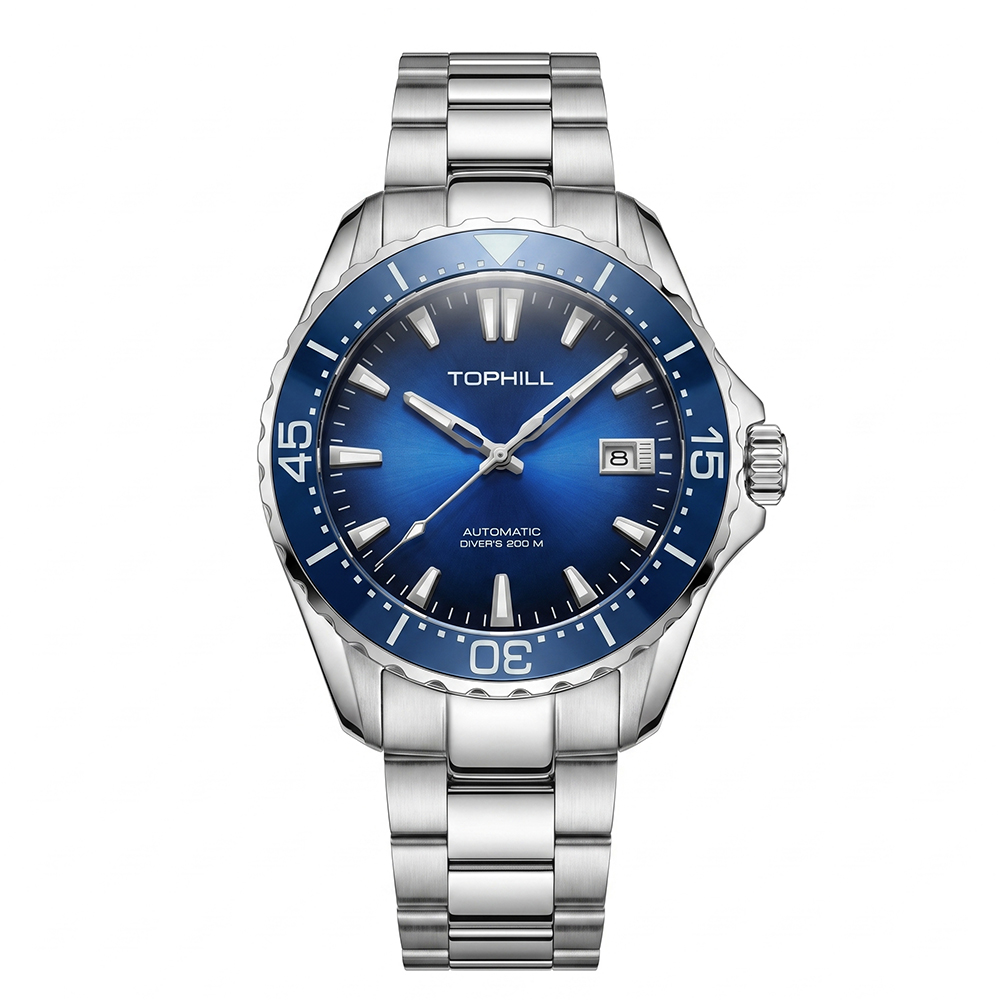
A higher-band configuration: 316L stainless steel case with rotating bezel and ceramic bezel insert, paired with the Miyota Automatic 8215 for a 200-metre rating.
Capability behind the specification
The manufacturing base behind the brand has been building watches for more than three decades and has produced more than 20 million finished watches, operating a class-10,000 dust-free assembly workshop, a dedicated CNC prototyping workshop, and a full suite of high-precision inspection and testing instruments. The operation is certified to ISO 9001 for quality management and ISO 14001 for environmental management, and finished products meet EU RoHS compliance requirements for overseas market access.
Commercially, the OEM/ODM programme is documented with a 300-piece minimum order quantity, a 75-day lead time, monthly capacity of 50,000–60,000 units, 100% testing, and two years of after-sales support. Water-resistance capability spans 5–50 ATM, and every waterproof watch is pressure-tested before shipment rather than sampled at random. The supplier profile also records brand owners, wholesalers and retailers as the main customer types, with order relationships of five years or more and stable operation across markets including Australia, Switzerland, Germany, France, the United Kingdom, Israel, Japan, Korea, Sweden, Singapore and Türkiye.
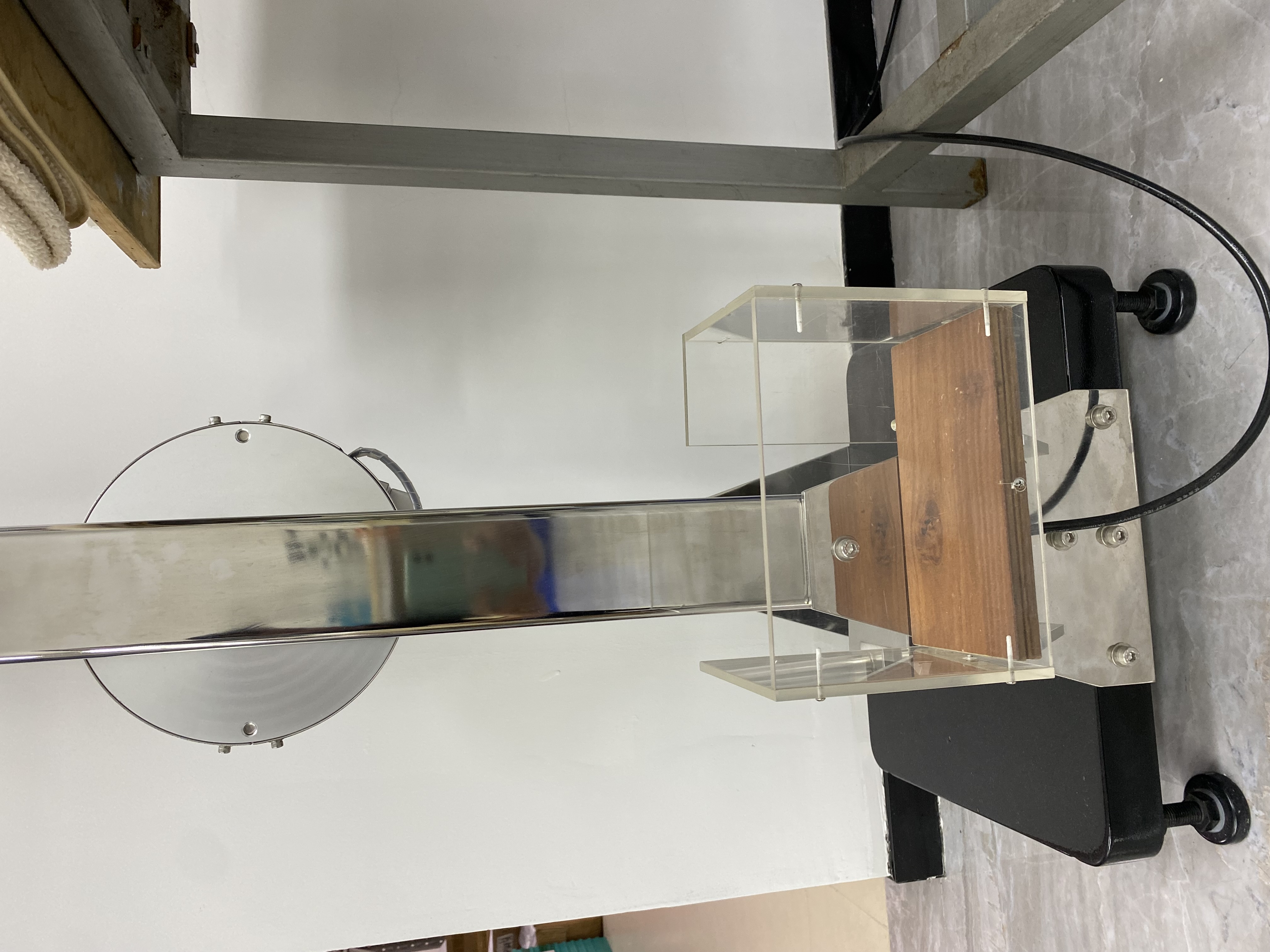
Test evidence is part of the shortlist: a documented inspection regime converts a sealing design into a verifiable claim.
Matching the Shortlist to Real Usage Scenarios
Scenario fit is where a shortlist becomes a decision. Watches are used for time-telling, daily matching and social occasions, and they can also be customized as gifts and souvenirs — which means a single diving range often has to serve more than one end use without overstating any of them.
| End-use scenario | Appropriate rating band | Reference configuration markers |
|---|---|---|
| Daily wear, rain splash, hand washing | 3–5 ATM | Standard case and seal set; rating stated without overreach |
| Swimming, pool and surface snorkeling | 10–20 ATM | 10 ATM; 316L stainless steel case; ceramic bezel insert with luminous; Miyota Automatic 8215 (TD017G) |
| Repeated immersion and higher-demand water sports | 20 ATM and above (ISO 6425 reference) | 200-metre rating; 316L case with ceramic bezel insert; BGW9 luminous on bezel, dial and hands; Miyota Automatic 8215 (TD015G) |
| Corporate gifting and retail presentation of a diver-style model | Matched to the intended user’s actual water habits | Diver aesthetics are acceptable provided the stated rating is not overstated in the product literature |
Two configuration notes are worth adding. First, the operating modes available in a custom watch programme — quartz, mechanical and solar-powered — affect battery, servicing and compliance considerations but not the seal architecture; water-resistance markers have to be specified independently of the movement category. Second, where the end market is the EU, watches are also subject to requirements such as CE EMC compliance alongside defined waterproof performance and movement accuracy expectations, so the brief should name those conditions next to the rating rather than after it.
Market Trend: Movement Mix and Compliance Are Converging
Three published data points frame the direction of the category. The global mechanical watch market has been projected at USD 47.5 billion for 2025 (Grand View Research), while the watch movement market reached USD 18.4 billion in 2025, with automatic movements holding a 38.2% share (Dataintelo). Quartz movements still account for about 75% of shipment volume, yet mechanical watches take more than 68% of total value (2024 industry research).
The implication for diving custom wristwatches is not that mechanical is inherently better. It is that automatic movements such as the Miyota 8215 sit where value and technical scrutiny concentrate, which raises buyer expectations for documentation across an entire range — including the quartz models. Compliance pushes in the same direction: under RoHS Directive 2011/65/EU, EU market access for electronic watches depends on material restrictions, so sourcing decisions increasingly involve both the case specification and the compliance file.
Comparison With Traditional Sourcing Approaches — and Where the Limits Are
The traditional alternative to a spec-verified shortlist is catalog sourcing: select an existing diver-styled model, apply branding, and rely on the rating the supplier already publishes. It is faster and cheaper, and for a purely fashion-led product it may be sufficient. In the general market, budget diver-styled watches are commonly specified at 3–10 ATM, with water resistance verified through batch sampling rather than unit-level testing — an approach that shifts risk downstream, where a leak is diagnosed by the end user instead of being caught at the factory.
| Dimension | Catalog / sticker-spec sourcing | Spec-verified custom build |
|---|---|---|
| Rating basis | Existing model rating adopted as-is; commonly 3–10 ATM | Rating defined in the brief and evidenced with method and coverage |
| Testing coverage | Batch sampling is common at this tier | 100% pressure testing of waterproof units before shipment |
| Materials | Not always named | 316L stainless steel case and ceramic bezel insert named in the specification |
| Movement | Frequently unspecified | Named calibre, for example Miyota Automatic 8215 |
| Traceability | Supplier catalog reference | Documented MOQ, lead time, QC procedure and after-sales term |
The limits deserve to be stated as plainly as the advantages. Three boundaries apply to this approach.
First, a rating is a ceiling on use, not a licence. A 10 ATM build such as the TD017G is specified for daily-life water-related scenarios and swimming-range use; it is not a professional diving instrument. A buyer who needs ISO 6425-level performance should be looking at the 20 ATM-and-above band, where a model such as the TD015G at 200 metres fits. Even then, an ATM number reflects static laboratory pressure and is not a usable depth.
Second, water resistance is not permanent. Sealing gaskets age with wear, impact and chemical contact, and passing a pressure test at the factory does not make a watch watertight for life. This is a maintenance reality that belongs in the documentation handed to the end buyer, not only in the factory’s QC file.
Third, the model carries operational constraints. A documented 300-piece minimum order quantity and a 75-day lead time suit planned programmes with a development cycle; they do not suit very small trial runs or urgent restocks. Buyers working to short timelines should treat MOQ and lead time as shortlist criteria in their own right, alongside the technical markers.
Future Outlook
Three shifts are likely to shape diving watch sourcing over the next cycle. Ratings will move further toward evidence: as buyers internalise that ATM is a static value and that the word “waterproof” is not permitted under the standard, suppliers will be asked to show test method and test coverage rather than a number printed on a caseback. Movement transparency will follow the same path, with named calibres such as the Miyota 8215 treated as sourcing references rather than hidden components. And compliance documentation will become a routine part of evaluation, particularly for quartz and electronic models sold into the EU.
For a buyer, the practical response is procedural rather than technical: keep the marker list fixed, require evidence for each entry, and record the boundary conditions — rating band, gasket servicing, MOQ and lead time — next to the specification so that they travel with the purchase order.
FAQ
What is the difference between “water resistant” and “waterproof” for a watch?
Water-resistant watches must comply with ISO 22810 standards, and the term “waterproof” is prohibited. Water resistance describes the ability of a watch case to resist the ingress of water and moisture under defined laboratory test conditions. It is a tested property under specified conditions, not an absolute statement about the watch in every situation.
What does a 10 ATM rating actually allow in real use?
ATM reflects static laboratory test pressure, where 1 ATM is equivalent to 10 metres of static water depth. In sourcing terms, 10 ATM falls in the 10–20 ATM band associated with swimming and surface snorkeling, while 3–5 ATM suits daily wear and rain splash, and 20 ATM and above (with ISO 6425 as the reference) is the band associated with professional diving. A 10 ATM watch such as the TD017G is specified for daily-life water-related scenarios and 100-metre water resistance.
Which specification markers should a buyer verify on a diving watch sample?
The practical checklist is: the exact movement calibre, for example Miyota Automatic 8215; the water-resistance rating together with its test basis; the case alloy, specified as 316L stainless steel; the bezel insert material, specified as ceramic with luminous filling where low-light legibility is required; the seal architecture, including screw-down crown and caseback and gasket specification; and whether water-resistance testing is full-unit or sampled.
Does a higher ATM rating mean the watch can be used at the equivalent water depth?
No. ATM reflects static laboratory test pressure, not actual usable diving depth. A rating is a test condition, and conditions in use — movement, impact, temperature change — differ from the static environment in which the value was obtained.
Will a watch stay water resistant after it passes a pressure test?
No. Water resistance is not permanent. Sealing gaskets age with wear, impact and chemical contact, and a factory pressure test reflects the condition of the watch at that moment. Regular inspection and gasket replacement are part of maintaining the rating over a product’s service life.
Can a 10–20 ATM watch be worn in a sauna or hot-water bath?
Not recommended. High-temperature steam deforms and ages rubber gaskets, which destroys waterproof performance. An ATM rating does not extend to steam or hot-water exposure.
Background documentation on the manufacturing capability, certification scope and product range referenced in this article is available in the company profile PDF: Profile of Super Time (HK) Industrial Ltd.