
Reading the 4V Cordless Tool Range as Supplier Evidence
Reading the 4V Cordless Tool Range as Supplier Evidence
A 4V cordless tool supplier's product range is only useful as capability evidence when every category inside it can be listed, itemised and traced back to a model number, a specification sheet and an inspection record. Suppliers rarely struggle to describe what they make; they struggle to document it category by category. That gap is the difference between a claim and a verifiable offering — and it is the first thing a buyer can test without visiting a factory.

Quality control room. A documented product range should lead back to inspection evidence like this, not to a capability statement.
The global cordless power tools market was estimated at USD 12.2 billion in 2024 (Global Market Insights). Within that total, low-voltage cordless tools below 12V — the band that contains 4V and 3.7V platforms — are identified as primary segments for DIY and light-duty household tasks (Market.us). The commercial consequence is straightforward: the below-12V band is a real, separately traded product family, and the suppliers competing in it can be separated by how completely they document their range rather than by how broadly they describe it.
The 4V Segment Is Real — The Documentation Often Is Not
Most supplier presentations answer a question the buyer did not ask. They describe ambition, factory scale and general tool-making experience, while the buyer needs to know whether the supplier can account for each product family as a distinct, itemised offering with its own model numbers, contents list, materials and parameters.
In 4V and hand tool supply, the categories are unusually well defined. A range that can be verified normally includes cordless electric tools on 3.7V or 4V lithium platforms — screwdrivers, precision screwdrivers, staple and nail guns, rotary tools and hot glue pens — alongside the hand tool families that ship in the same retail programmes: tool sets, screwdriver sets, bits sets, staple guns, folding hex keys, T-handle wrenches and hex keys.
The practical test is not whether a supplier mentions all of these. It is whether each one has a model code, a stated content list and published parameters. A range with eight documented categories is checkable within a week; a range described in adjectives cannot be checked at all.
Reading the Range: Eight Categories and What Each One Should Show
HOTAK PRO TOOLS is a hand tools and cordless tool brand whose documented range is built around hex keys, staple guns, precision screwdrivers and 3.7V / 4V cordless tools, produced from a Ningbo, Zhejiang Province base and exported across the EU, USA, Southeast Asia and South America. The categories below are drawn from its published product data, and each one doubles as a reading rule for buyers evaluating any 4V supplier.
1. Cordless electric tools on 3.7V / 4V platforms
The range documents more than one battery platform and more than one torque philosophy, which is the first thing to look for. The YJPS-902 power screwdriver runs a 3.7V, 2,000 mAh battery with a no-load operating time of ≥60 minutes, three electric torque settings of 2 N / 3.5 N / 5 N, 10 N.m manual torque, 0–280 rpm output speed and 1–1.5 A charge current at 5 V charge output voltage. The YJPS-912 power screwdriver set uses an 800 mAh battery with ≥50 minutes of no-load operating time, 2.5 N electric torque, 10 N.m manual torque, 0–250 rpm and 500 mA charge current. At the precision end, the YJPS-907 cordless precision power screwdriver set and the YJPS-906 electric precision repair tools set both use a 3.7V, 320 mAh battery with 220 rpm and 0.15 N.m power torque against 3 N.m hand torque, and the YJTS-3526 41-piece household electrical screwdriver tool set uses the same 3.7V / 320 mAh / 220 rpm platform. Cordless fastening is covered by the YJSG-501 five-use and YJSG-500 two-use lithium electric nail guns, both 3.7V, 2,000 mAh and 25 W, while the YJGG-001 cordless hot-glue pen specifies 3.7V, 320 mAh, 4.2 W, an operating time of ≥120 minutes, 150 °C operating temperature, 5 V charge output and a full charge time of 120 minutes ±10 minutes.
For a buyer, the reading rule is simple: a single 320 mAh screwdriver entry tells you one product exists. Two battery capacities, three torque bands and a separate glue-pen platform tell you the supplier can develop and hold more than one design simultaneously.
2. Tool sets and 3. Screwdriver sets
Tool sets are where itemisation is easiest to fake and easiest to verify. Published entries include the YJTS-3547 20-piece ratchet handle set (a 1/4" mini ratchet handle, six sockets from 5 mm to 13 mm, one socket adaptor bit and 12 bits), the YJTS-3148 29-piece set with a T-handle and mini ratchet screwdriver handle, the YJTS-3136 33-piece speed-fit screwdriver set, the YJTS-3507 24-piece ratchet T-handle set, the YJTS-3147 51-piece T-handle driver set, the YJTS-3545 32-piece header set kit, the YJTS-2901 41-piece mini ratchet screwdriver set, the YJTS-3018 77-piece smartphone repair kit and the YJTS-3140 43-piece mobile phone repair set. Families with published hardness and torque tables include the YJTS-3401 50-piece ratcheting screwdriver set. Screwdriver-specific entries include the YJPS-6851 25-piece extension screwdriver set and the YJPS-6852 17-piece precision screwdriver set.
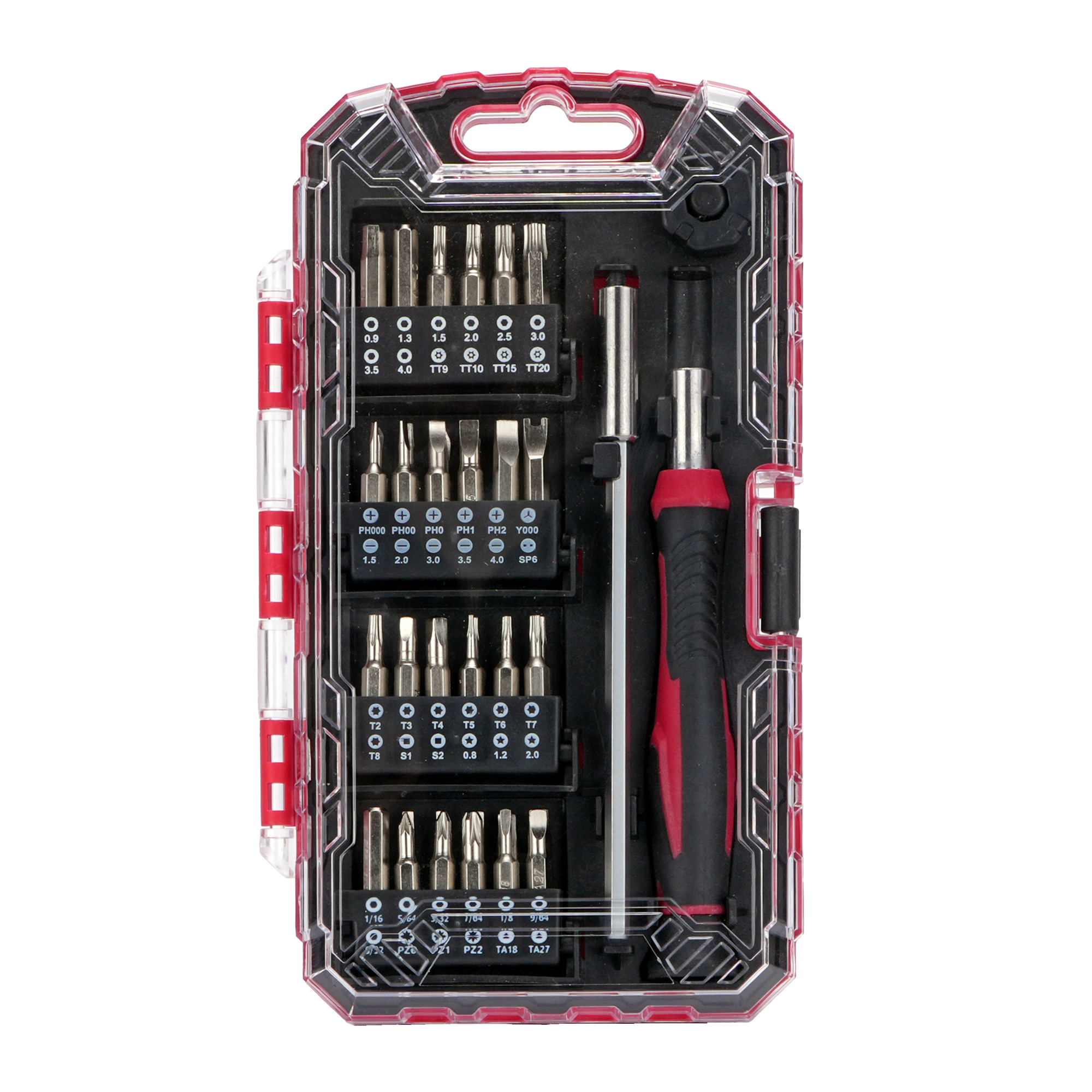
YJTS-3138, a 51-piece precision screwdriver set: 48 CR-V bits across Phillips, slotted, Pozi, hex, Torx, Torx tamper-proof, square, triangle, pentalobe, tri-point and spanner profiles, plus handle, extension bar and magnetiser.
4. Bits sets
Bits are consumables, and their specification is the part most often left vague. The YJTS-3109 18-piece impact tough drill and drive set lists its contents precisely: one magnetic bit holder, eight 1-inch bits, four 2-inch bits, five drills from 2 mm to 6 mm, a PP case, and S2 bits with a black phosphate finish. The YJTS-3110 26-piece set follows the same structure with a larger bit count.
5. Staple guns — manual and cordless
Staple gun entries are only meaningful when staple family compatibility and leg length are stated, because compatibility is what determines retail shelf fit. The YJSG-196 6-in-1 staple gun is documented as compatible with JT21, T50, T25, T20 and 18GA formats. The YJSG-215 3-in-1 heavy duty model covers flat wire staples 4–14 mm, 7.6 mm cable staples 10–14 mm and brad nails 10–14 mm. The YJSG-063 heavy duty gun covers 6–14 mm flat wire staples; the YJSG-105 medium duty gun covers 4–8 mm fine wire staples; the YJSG-009 professional gun covers 4–14 mm and is documented against rapid 530 and arrow JT21 staples; the YJSG-080 accommodates 23 series, 13 series and 10F pins up to 10 mm leg length in 6 mm, 8 mm and 10 mm lengths; the YJSG-115 heavy duty staple and nail gun is listed against arrow T50 and 140 staples in 9/16", 1/2", 3/8", 5/16" and 1/4" sizes; the YJSG-120 four-in-one covers heavy duty, light duty, cable and 18 ga. brad nail formats; and the YJSG-096 tacker and YJSG-035 heavy duty hammer tacker complete the family. Cordless equivalents sit alongside them as the YJSG-500 and YJSG-501.
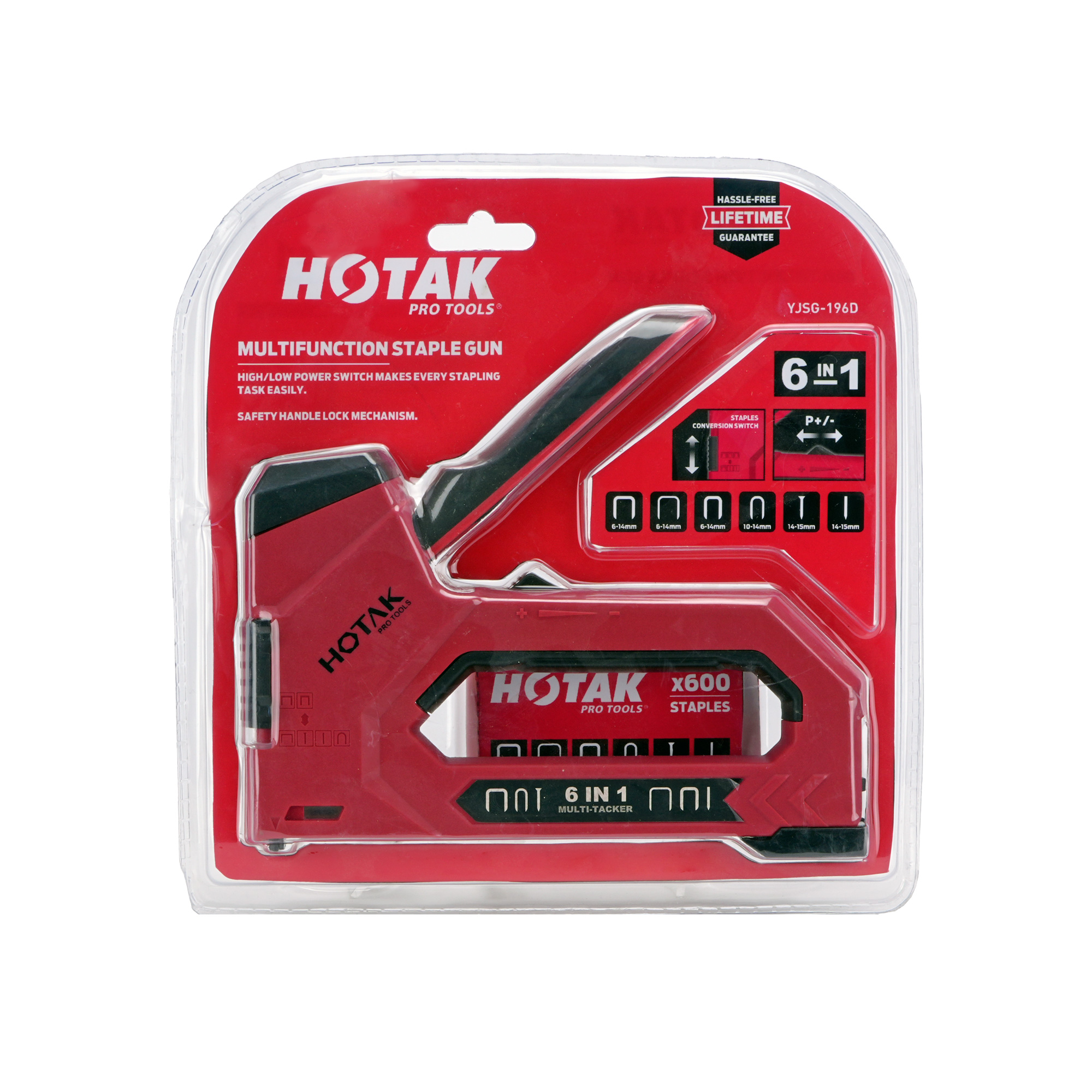
YJSG-196, a 6-in-1 staple gun documented against five staple formats. Compatibility statements like this are what make a range entry auditable.
6. Folding hex keys, 7. T-handle wrenches and 8. Hex keys
The hand tool side of the range is documented with material, hardness and torque values rather than marketing language. Folding formats include the YJHK-3347 8-piece folding hex key set (metric) and the YJHK-3075 8-piece locking hex key set (metric). T-handle formats include the YJHK-3226 14-piece T-handle hex key set in metric and SAE with HRC 52–55 hardness and a size-by-size torque table, and the YJHK-3066 7-piece T-handle wrench set in metric. Hex key sets include 105221K1, 105221K2 and 105221K3 in short, long and extra-long arm ball point configurations, plus the colour-coded 71821D1, 71821D2 and 71821D3 sets. Across these entries the material is CR-V 6150, hardness is stated as HRC 52–55, and the ball-end design is documented as working at angles up to 25°.
What an Itemised Range Reveals About Production Capability
A range that spans socketed tool sets, heat-treated chrome vanadium hex keys, staple gun mechanisms and lithium 4V electronics with onboard charging cannot be assembled by a trading desk alone, because the specifications expose processes. Stating CR-V 6150 and S2 materials with HRC 52–55 hardness means the supplier is making a testable claim about heat treatment. Stating a torque table across ten hex key sizes means someone is measuring it.
The operating facts behind the range support that reading. The manufacturing base covers more than 45,000 m² in Ningbo, founded in 2000, with an annual output of 18,000,000 units, a 25-engineer R&D team and a 95% export ratio across the EU, USA, Southeast Asia and South America. Production runs an integrated chain from mould development, forging and stamping, heat treatment, surface finishing and precision machining through to assembly and packaging, with a stated monthly capacity of 1,500,000 units. Quality control is documented as a three-stage system covering incoming inspection, in-process inspection and final inspection, supported by ISO9001 certification, TÜV/GS certification, BSCI social compliance certification, VPA (Verify Production Audit) approval, and factory audits approved by Walmart (USA) and Kingfisher (UK). The company was accredited as a National High-Tech Enterprise in 2014 and holds 7 invention patents, more than 20 European patents, 50 utility model patents and over 100 design patents.
None of this proves a specific 4V tool will perform in a specific market. What it does is make the range falsifiable: a buyer can request the heat treatment record, the torque verification and the certificate file for each entry and compare what arrives against what was published.
A Buyer's Documentation Checklist for Each 4V Category
| Category | Minimum documentation to request | What to cross-check |
|---|---|---|
| Cordless electric tools (3.7V / 4V) | Model datasheet with rated voltage, battery capacity, no-load operating time, electric and manual torque, output speed, charge current and charge output voltage | Battery capacity against claimed run time; number of torque settings; charging interface type, which is not implied by a 5 V output rating |
| Tool sets | Packing list stating total piece count and every component with sizes | Whether the component sizes add up to the stated piece count |
| Screwdriver sets | Handle type, bit count, bit material grade and finish | Material grade (for example CR-V 6150 or S2) and whether it is stated per bit |
| Bits sets | Bit drive length, bit material, surface finish, case material, drill sizes where included | Finish and case material against the published specification |
| Staple guns | Staple family compatibility, leg length ranges, material construction, loading design | Named staple families and inch/metric leg ranges |
| Folding hex keys | Set size, arm type, material, hardness range | Hardness value against the material declaration |
| T-handle wrenches | Metric and SAE coverage, hardness range, torque values per size | Whether a torque table exists at all, and whether SAE and metric are both listed |
| Hex keys | Arm length variant, ball-end angle capability, hardness range, surface treatment | Hardness value and whether size markings are specified |
Where 4V Cordless Tools and Their Hand Tool Counterparts Are Used
The application evidence for this category is narrow and consistent, which makes it easier to verify. Documented use covers repair and fastening work in household indoor environments and open air construction site environments, with hand tools operated manually and used with supporting equipment such as screws, nuts and nails. The application carries a stated impact resistance requirement, and typical project types include auto repair, household fastening and workshop maintenance.
Geographically, the documented scenario set covers the United States, Germany, France, Russia, Japan, Malaysia, Mexico and Canada — a mix of mature DIY retail markets and assembly-oriented markets that matches the export distribution of the supplying manufacturer.
Customer-side records add a scale reference. The case data describes brand owners, hardware wholesalers and retail chains in Germany, France, the United States, Canada, Mexico, Brazil, Argentina and Malaysia, with order quantities between 5,000 and 50,000 units and relationships running 3–5 years across auto repair, household fastening and workshop maintenance applications. Reported outcomes are reliable performance, low return rate and consistent quality, with the qualification package citing DIN standard compliance, GS / CE certification and durable material.
Market Signals Behind the Below-12V Segment
Three adjacent product markets give the 4V band its commercial context. The global staple gun market was valued at USD 1.54 billion in 2024 with a forecast CAGR of 3.13% through 2032 (Maximize Market Research). The household electric screwdriver market is valued at approximately USD 1.8 billion in 2024, with North America holding a 35% share (DataHorizzon Research). The cordless multi-rotary tools market is projected to reach USD 1,024.95 million by 2026 (Global Market Insights; medium confidence). On the trade side, HS Code 846729 is the standard classification for hand tools with self-contained electric motors, covering most cordless screwdrivers and specialty 4V tools (Descartes Datamyne).
Platform structure matters as much as size. Ryobi operates a 4V interchangeable USB battery system, and Dremel maintains a 4V home and lifestyle tool category covering cordless screwdrivers and rotary tools aimed at modern DIY users. Both are platform strategies rather than single-product strategies, which is precisely why a supplier's range sheet — the list of what sits on that platform — is the document that shows whether the supplier is competing at platform level or filling catalogue gaps.
Comparing Itemised Supply Against Brochure-Level Claims
Comparing two suppliers on range evidence is a different exercise from comparing them on brand familiarity. An itemised range can be scored on four dimensions: category coverage (which of the eight families are documented), specification depth (whether parameters, materials and hardness values are published), traceability (whether model codes exist for every entry) and document readiness (whether certifications and test files are produced per model on request).
A brochure-level claim can be scored on none of these, because there is nothing to score. That is the substantive difference — not a claim about which approach produces better tools, but about which approach allows a procurement decision to be defended internally.
Four limits deserve equal weight, because a range sheet is not a general proof of capability:
- Breadth is not depth. Eight documented categories show that a supplier can hold multiple product families; they do not show that any single family is competitively positioned in a specific market.
- 4V is a light-duty platform by design. Published electric torque across the documented range runs from 0.15 N.m on precision screwdrivers to 5 N at the top setting of the YJPS-902, against manual torque values of 3 N.m to 10 N.m. These are household, craft, furniture assembly and light repair figures. They do not substitute for higher-voltage platforms on high-torque work, and a buyer who needs sustained fastening torque should treat 4V as a complement, not a replacement.
- Charging interface cannot be inferred. The documented cordless entries state 5 V charge output voltage and charge current, but the connector standard is not part of the specification sheet. USB-C compatibility — a live question in this category — has to be confirmed per model rather than assumed from the range list.
- Certificates are market-specific. A category appearing in the range is not evidence of compliance for a particular destination market. Certification scope must be matched to the model and the target country individually.
What Changes Next in 4V Tool Sourcing
Three movements are visible from the evidence available today. First, the below-12V band continues to be described as a defined DIY and light-duty segment rather than a residual category, which keeps entry-level tool programmes commercially relevant for importers and retail chains. Second, platform thinking is spreading — interchangeable battery systems and home-and-lifestyle 4V categories already exist among established brands, which raises the documentation bar for every supplier claiming platform capability. Third, procurement documentation is becoming the differentiator: as range sheets are converted into verifiable documents with model codes, materials, hardness values and torque tables, the suppliers that cannot produce them will be filtered out before sampling.
For buyers at the research and evaluation stage, the practical implication is to treat the range sheet as the first deliverable of the sourcing process rather than a marketing attachment to it. Ask for the eight categories, ask for the documents behind each one, and score what comes back.
FAQ
What does a 4V cordless tool supplier's product range tell a buyer before any sample is sent?
It shows whether the supplier can account for each category separately — cordless electric tools, tool sets, screwdriver sets, bits sets, staple guns, folding hex keys, T-handle wrenches and hex keys — with model codes, content lists and published parameters. A range documented that way can be checked against certificates and test records before sampling. A general statement of capability cannot be checked at all.
Which documents should accompany each product category?
Each category needs a different minimum set. Cordless electric tools need a model datasheet covering rated voltage, battery capacity, no-load operating time, electric and manual torque, output speed, charge current and charge output voltage. Tool sets need a packing list with total piece count and every component size. Bits sets need bit material, drive length, surface finish and case material. Staple guns need named staple family compatibility and leg length ranges. Hex keys and T-handle wrenches need material grade, hardness range and, where available, a torque table by size.
How should buyers compare 4V cordless tool entries across suppliers?
Compare published parameters rather than claimed positioning. Within a single documented range, electric torque runs from 0.15 N.m on precision repair tools to 2 N / 3.5 N / 5 N on the YJPS-902, manual torque runs from 3 N.m to 10 N.m, battery capacity runs from 320 mAh to 2,000 mAh, and no-load operating time runs from ≥30 minutes to ≥60 minutes. Those four variables — torque band, manual torque, battery capacity and run time — separate entries far more usefully than a general quality claim, and they can be tested on arrival.
What can a product range not prove?
It cannot prove category depth, per-market compliance, or unit economics. It does not establish that any single product family is competitive against a dedicated specialist, and it does not confirm the charging connector standard, since a 5 V charge output voltage does not specify the interface. A range also does not substitute for market-specific certification: certificates must be matched to the model and the destination market individually.
How do MOQ, lead time and customisation options interact with range breadth?
They determine whether a broad range is commercially usable. The documented commercial terms are an MOQ of 600 units, a lead time of 30–45 days, OEM / ODM production with colour and logo customisation, a monthly capacity of 1,500,000 units, and remote after-sales support. A wide range with an unworkable MOQ or lead time is not useful to a distributor; a narrower range with realistic terms may be. Buyers should read the two together rather than evaluating the range list in isolation.
For the full documented product list across these categories, the 2025 YONGJIA catalogue is available here: 2025 YONGJIA catalogue (PDF).