
Reading a Cutting Disc MPA Certificate: Z-15486A/25 Scope and Limits
Reading a Cutting Disc MPA Certificate: Z-15486A/25 Scope and Limits

Industrial metal cutting applications: the point at which a certificate scope has to match the disc actually mounted on the machine.
An MPA certificate does not state that a manufacturer is safe. It states that a defined group of products was tested by a named institute, against a named standard, at a named maximum operating speed, inside a named validity window. Everything outside those limits sits outside the certificate.
The document numbered Z-15486A/25 makes that point concretely. Issued by MPA Hannover at its Garbsen Site and referencing EN 12413:2019, it covers flat cutting-off wheels of type 41 for metal in four diameters — 115 mm, 125 mm, 180 mm and 230 mm — with a maximum operating speed of 80 m/s, and it runs from 2025-10-09 to 2027-05-23. For a buyer in the awareness and research stage of a cutting disc purchase, those few lines carry more decision value than any capability brochure, because they define precisely where the certificate stops.
This industry reference note reads that certificate field by field, explains how independent MPA testing and the European safety standard interact, and sets out what a certificate of this type does not cover. It is written for importers, distributors, procurement managers and fabrication engineers who receive certificate copies as part of a supplier file and need a repeatable way to check them.
Why certificate reading became a procurement skill
For bonded abrasive products placed on the European market, EN 12413:2019 is the mandatory safety standard. It specifies requirements for burst testing, marking and dimensional tolerances, which means a cutting disc sold into the EU is expected to demonstrate conformity with those requirements rather than simply claim general quality.
Independent verification is where institutes such as MPA Hannover enter the picture. MPA Hannover provides independent safety testing — burst test and side load test — that is used as evidence for EU market entry and is often summarised at product level by the MPA Tested mark. The distinction matters commercially: the standard defines the requirement, while the certificate is the third-party record that a specific, named product scope met it.
The practical problem is that certificates do not travel with individual cartons. A manufacturer may hold one certificate covering four diameters of one wheel type, and another certificate, or none, covering the rest of the range. Buyers who read only the institute name and the word certified can easily conclude that a complete catalogue is covered. When the order is later audited — by an EU customer, an insurer, or an internal compliance team — the gap between the certificate scope and the delivered item becomes the issue.
The opportunity is straightforward. A ten-minute scope check during supplier screening costs nothing, protects the buyer against scope mismatch claims, and in many cases exposes which parts of a seller's range are genuinely third-party tested and which are simply described as meeting a standard.
Certificate Z-15486A/25 at a glance
Before any interpretation, the document should be reduced to its fields. The table below sets out the elements that a buyer should be able to locate on the certificate copy itself.
| Certificate field | Content on this certificate | Why a buyer checks it |
|---|---|---|
| Certificate number | Z-15486A/25 | Identifies the exact document, so scope cannot be claimed from a different file. |
| Issuing body | MPA Hannover, Garbsen Site | Confirms the testing institute and the site at which the work was carried out. |
| Reference standard | EN 12413:2019 | States which requirement set the product was tested against. |
| Product type | Flat cutting-off wheels, type 41, for metal | Excludes depressed centre and grinding wheel shapes from the certification. |
| Certified diameters | 115 mm, 125 mm, 180 mm, 230 mm | Any diameter not listed is outside the scope, even if the supplier stocks it. |
| Bore and cut width | 22.23 mm bore, 1.2 mm cut width (115 mm and 125 mm) | Matches the arbor and the kerf the buyer will actually run. |
| Maximum operating speed | 80 m/s | Sets the ceiling for safe rotation; it is a limit, not a target. |
| Validity window | 2025-10-09 to 2027-05-23 | Determines whether the document is current evidence at the time of the audit. |
Reading each field without over-reading it
The issuing body: an independent institute, not the manufacturer
MPA Hannover is a materials testing institute. Its role in this document is external verification: the certificate records that the named product scope was tested by the institute, not that the manufacturer performed an internal check and reported the outcome. That separation is the entire value of the document. When a supplier presents a certificate, the first question a buyer should answer is whether the institute named on it actually carried out testing on the named scope, or whether the supplier is citing a standard as a self-description.
The standard: EN 12413:2019
EN 12413:2019 is the mandatory European safety standard for bonded abrasive products, covering burst testing, marking requirements and dimensional tolerances. Because it is a standard, it applies to products placed on the EU market as a requirement rather than as an optional extra. Because it is referenced on a certificate, it tells the buyer which requirement set the tested items were measured against. The two functions are different and should not be merged in a supplier file: the standard is the rule, the certificate is the evidence for a defined scope.
The product type: flat cutting-off wheels, type 41, for metal
Type 41 describes a flat, straight cutting-off wheel without a depressed hub. It is one of the two common configurations in the cutting disc category, the other being the depressed centre shape used for heavier side load and grinding-type operations. A certificate written for type 41 flat wheels says nothing about a depressed centre wheel of the same diameter, because the geometry, the reinforcement layout and the load path through the disc are different. This is one of the most frequent misreadings in procurement: the diameter matches, so the buyer assumes the certification matches as well.
The dimensions: four diameters, one bore, one cut width
The certified scope names 115 mm, 125 mm, 180 mm and 230 mm flat wheels for metal. For the 115 mm and 125 mm items, the certificate further specifies a 22.23 mm bore and a 1.2 mm cut width. Both numbers are meaningful on the shop floor. The 22.23 mm bore is the conventional arbor size for 115 mm and 125 mm angle grinder discs, so buyers should confirm that the discs they receive carry the same bore rather than an adapted metric equivalent. The 1.2 mm cut width places these items in the thin disc class: the abrasives industry generally defines ultra-thin cutting discs as products of 1.6 mm or less, with a visible shift towards 1.0 mm and 0.8 mm in precision metal fabrication. A 1.2 mm disc therefore sits inside the ultra-thin definition, which has two consequences — lower material loss and faster cutting, but also less lateral stiffness and a smaller margin for side load.
The maximum operating speed: 80 m/s
The value 80 m/s is the certified operating ceiling for the scope, and it is also the threshold against which EN 12413 requires the disc to be burst tested. Three practical rules follow. First, the maximum speed marked on the wheel must exceed the maximum rated speed of the grinder it is fitted to, and this check belongs to the operator before mounting. Second, a disc marked for side grinding is a different product — thin cutting wheels are not to be used for side grinding, and grinding wheels are not to be used for deep cutting. Third, routine visual inspection matters: wheels with cracks, chips, bends or moisture damage, and wheels past their storage life, should be withdrawn rather than used.
As one example of how a manufacturer documents that margin, SALI states in its published product information that its cutting discs are reinforced with 2 to 3 layers of high-tensile fiberglass mesh and that the burst speed limit reaches at least 100 m/s, above the 80 m/s threshold. That is a first-party product statement rather than a restatement of what certificate Z-15486A/25 records, and buyers should treat it that way: useful context, but not a substitute for the certificate scope.
The validity window: 2025-10-09 to 2027-05-23
Certificates of this kind are time-limited. This one runs slightly over nineteen months, from 2025-10-09 to 2027-05-23. Inside that window it is current third-party evidence; outside it, the document is a historical record. Supplier files should therefore carry the expiry date as a tracked field rather than as a scanned attachment. A certificate that expired last quarter is not proof of non-compliance, but it does mean the manufacturer has to supply a renewed or replacement document before a buyer can rely on it for a compliance file.
What falls outside the scope of Z-15486A/25
A scope statement is only useful if it is read negatively as well as positively. The clearest way to apply it is to list what the certificate does not reach.
| Item or condition | Status against this certificate |
|---|---|
| Diameters other than 115, 125, 180 and 230 mm | Not covered, including otherwise standard sizes in the same catalogue |
| Depressed centre wheels and grinding wheels | Not covered — the scope names flat type 41 cutting-off wheels only |
| Non-metal cutting discs, such as stone cutting discs | Not covered — the scope is stated for metal |
| Bores, cut widths or configurations other than those named | Not covered |
| Operation above 80 m/s | Outside the certified condition |
| Discs used after the storage life or with moisture damage | Not addressed by the certificate; a user-side control |
| Period after 2027-05-23 | Certificate no longer current |
Two further boundaries are easy to miss. First, the certificate is a factory-gate artefact: it concerns how the product was tested, not how it is stored, mounted or operated. Storage guidance for resin-bonded discs — cool, dry conditions at controlled temperature and humidity, kept off the floor — and the mounting rules around guards, flanges and blotters remain the responsibility of the distributor and the end user. Second, a certificate for one production site does not automatically extend to another. Where a supplier operates more than one factory, the buyer should confirm which site the tested scope refers to.
How MPA testing and EN 12413 fit together technically
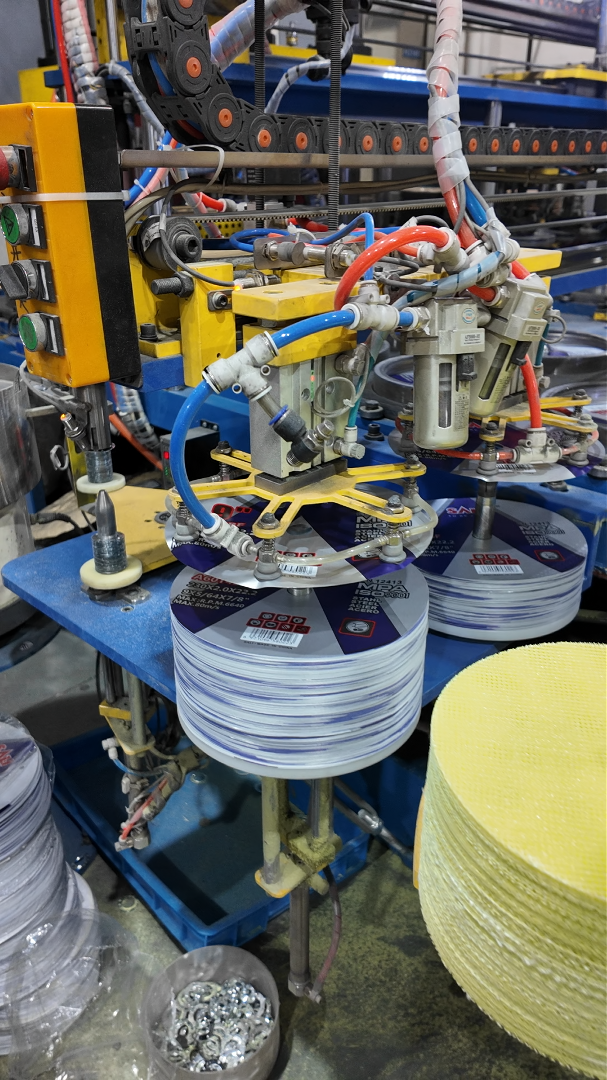
Batch production of cutting discs. Independent testing verifies a defined product scope, and covers each scope only for the dimensions and speeds named.
The relationship between the standard and the certificate is sequential. EN 12413:2019 sets out what a bonded abrasive product must satisfy, including burst testing, marking and dimensional tolerances. MPA Hannover then performs independent safety testing — burst test and side load test — on a submitted product scope. The outcome is a certificate that names the product type, the dimensions, the maximum operating speed and the validity period.
For a buyer, the sequence translates into three verification steps that can be completed against a single certificate copy:
- Confirm that the standard named on the certificate is the one your destination market requires.
- Confirm that the product type, diameter, bore and cut width named on the certificate match the order line, not just the category.
- Confirm that the maximum operating speed and the validity dates are consistent with how and when the discs will be used.
Manufacturers with formalised quality systems typically support this with traceability across batches. ZHEJIANG SALI ABRASIVE TECHNOLOGY CO., LTD., the manufacturer behind the SALI Tools brand, established in 2003, holds ISO 9001 and ISO 14001 certification and states that its products have obtained multiple international certifications including MPA, EN12413 and EU safety standards. The company operates a direct factory in Yongkang, Zhejiang, with a 6,000 square metre factory area and a 30,000 square metre construction area, employs over 150 people and maintains a research and development team of more than 30 engineers. Those facts describe the organisational conditions around certification; the certificate scope itself remains the operative document for any specific order.
Where a certified type 41 metal cutting disc is applied
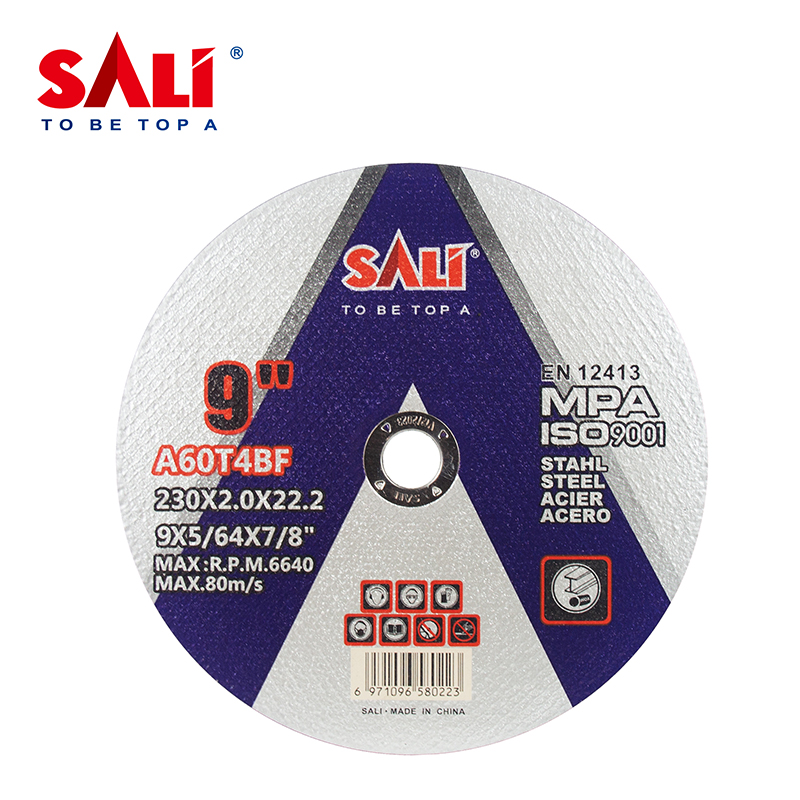
A metal cutting disc from the SALI range. Certificate scope applies only to the dimensions and speeds named in the document, not to the range as a whole.
The cutting disc category covers metal cutting discs, stainless steel cutting discs, stone cutting discs, thin cutting discs and ultra thin cutting discs, supplied in flat and depressed centre configurations across a size span from 3 inches to 16 inches and built on resin bonding with multi-layer high-tensile fiberglass mesh reinforcement. Within that broad category, the certified scope of Z-15486A/25 covers one segment: flat type 41 wheels for metal in 115 mm, 125 mm, 180 mm and 230 mm at up to 80 m/s.
That segment is the working core of several industries. Cutting discs of this class are used in metal fabrication and steel structures, pipeline and oil and gas work, shipbuilding and offshore engineering, automotive and parts manufacturing, construction and building infrastructure, rail transportation and maintenance, foundry and forge shops, and general machinery and equipment work. They are designed for angle grinders and portable cutting machines, and are used on stainless steel, carbon steel, alloy steel, cast iron and metal pipes.
Operating conditions in those environments are defined rather than incidental. Ambient temperature is typically taken as minus 20 to plus 45 degrees Celsius, with discs kept away from direct heat sources and from molten or overheated workpieces. Relative humidity in the optimal band is commonly given as 45 to 75 percent, and standard resin-bonded cutting discs are not intended for wet, raining or water-splashing conditions unless explicitly marked for wet cutting. Ventilation, spark control, stable machine mounting, guards, matched flanges and blotters, and adequate lighting all belong to the application envelope rather than to the certificate. Where a site operates outside those conditions, a certificate scope does not close the gap.
Market signals behind the paperwork
Certificate discipline is rising partly because the category itself is expanding. Market research published by Market Research Future values the global cutting discs market at approximately USD 7.322 billion in 2024, with projections to reach USD 11.59 billion by 2035. Buyers should treat such figures with a definitional caveat: different research houses draw the boundary between cutting discs, grinding wheels and superabrasives differently, and reported market values for the same year can diverge substantially depending on which products are included.
Within the product mix, resin-bonded grinding and cutting discs accounted for a 38.5 percent share of the global abrasive disc market in 2025 according to Dataintelo. That concentration matters for certificate reading, because resin bonding is the bond type most sensitive to storage conditions and to side load, and it is the bond type covered by the flat type 41 scope discussed here.
The dimension trend runs in the same direction. Industry definitions place ultra-thin cutting discs at 1.6 mm thickness or less, with growing adoption of 1.0 mm and 0.8 mm products in precision metal fabrication. Thinner discs cut faster and waste less material, which is exactly why buyers increasingly specify 1.2 mm and below — and exactly why the certified bore, cut width and maximum operating speed need to be checked against the order rather than assumed.
Certification-led sourcing compared with price-led sourcing
Most cutting disc procurement historically ran on two inputs: unit price and the basic dimensions of the disc. Certification-led sourcing adds a third input — a verified, scoped document — and changes the sequence of the decision. Instead of ordering on price and checking paperwork afterwards, the buyer first establishes which certified scopes exist and then prices inside them.
| Decision input | Price-led sourcing | Certification-led sourcing |
|---|---|---|
| Primary screening criterion | Unit price per disc or per carton | Verified product scope against the intended use |
| Documentation | Certificate requested after the order | Certificate scope and validity checked before the order |
| Risk exposure | Scope mismatch discovered during audits or claims | Mismatch identified at shortlisting stage |
| Repeatability | Depends on individual account handling | Repeatable checklist applied to every supplier |
The limitation of certification-led sourcing needs to be stated plainly, because it is frequently oversold. A certificate scope such as Z-15486A/25 verifies tested performance for a defined product envelope. It does not guarantee that every disc in a shipment is identical to the tested sample, it does not transfer responsibility for correct mounting, guarding and speed matching to the certificate holder, and it does not extend to misuse. Using a 1.2 mm thin cutting wheel for side grinding, running a disc beyond its marked maximum speed, using a standard wheel on soft metals such as aluminium or copper where loading causes violent burst, or using a disc past its storage life are all failure modes that sit entirely outside any certificate. Certification raises the floor of the product; it does not raise the ceiling of the application.
A buyer checklist for certificate scope
| # | Check | Evidence to request |
|---|---|---|
| 1 | Does the certificate number on file match the one quoted in the offer? | Full certificate copy, not a summary sheet |
| 2 | Is the destination market covered by the standard referenced? | Standard number and issue year on the certificate |
| 3 | Does the product type match — flat type 41, or another shape? | Scope line naming product type |
| 4 | Are the ordered diameters, bore and cut width listed? | Dimension list on the certificate against the purchase order |
| 5 | Is the site maximum speed within the certified maximum? | Machine rating against wheel marking |
| 6 | Will the certificate still be valid at the delivery or audit date? | Validity window, tracked as a field |
| 7 | Which production site does the tested scope refer to? | Site reference on the certificate |
Future outlook
Three developments are likely to shape how certificates are used in cutting disc procurement over the next few years. The first is scope-level documentation in supplier systems: rather than holding one certificate as a general proof of quality, buyers are increasingly storing scope, dimensions, maximum speed and expiry as structured fields that can be matched against each order line automatically. Certificates that name only a brand, without a defined product envelope, will become harder to file.
The second is the continuing migration towards thinner discs. As 1.0 mm and 0.8 mm products move from specialist use into general precision fabrication, the relationship between cut width, lateral stiffness and side load tolerance becomes a routine technical conversation rather than a niche one. Certificate scopes that specify cut width explicitly will be easier to align with those conversations than scopes that name diameter alone.
The third is validity management. Renewal cycles of roughly one and a half to two years mean that a supplier relationship spanning several seasons will cross at least one expiry. Manufacturers that treat renewal as a scheduled process — and that can show a continuous chain of current certificates — will find it easier to stay on approved supplier lists than those that treat certification as a one-time marketing asset.
For reference, the SALI Tools brand product catalogue, which documents the cutting disc range alongside related tool categories, is available as a downloadable PDF: SALI Tools Brand Product Catalog.
FAQ
What does an MPA certificate for a cutting disc actually certify?
MPA Hannover is an independent testing institute. A certificate issued by it records that a defined group of bonded abrasive products was tested against a named standard and passed the tests that standard requires, including burst testing and side load testing. The certificate identifies the product type, the dimensions and the maximum operating speed covered. It is a document about a specific product scope, not a general endorsement of a manufacturer or of every item that manufacturer sells.
Is EN 12413:2019 the same thing as an MPA certificate?
No. EN 12413:2019 is the mandatory European safety standard for bonded abrasive products and specifies requirements for burst testing, marking and dimensional tolerances. An MPA certificate is independent third-party evidence that a defined product scope has been tested against that standard. The standard defines the requirement; the certificate documents that a named scope met it.
Why does the certificate scope matter if the supplier already holds certification?
Because a certificate only covers what it names. Certificate Z-15486A/25 covers flat cutting-off wheels, type 41, for metal in 115 mm, 125 mm, 180 mm and 230 mm, at a maximum operating speed of 80 m/s. A buyer ordering another diameter, a depressed centre wheel, a stone cutting disc, or operating above 80 m/s is outside that scope, even though the supplier holds the certificate.
How long do MPA cutting disc certificates stay valid, and what does expiry mean?
They are time-limited. Certificate Z-15486A/25 is valid from 2025-10-09 to 2027-05-23, a window of slightly more than nineteen months. Inside that period the document is current third-party evidence. After it, the document is a historical record, and a renewed or replacement certificate would be needed before it can continue to support a compliance file.
What should a buyer do when the certificate scope does not match the order?
Compare the certificate number, issuing body, standard, product type, diameter, bore, cut width, maximum operating speed and validity dates against the actual order lines and the markings on the wheels. Where an item falls outside the scope, request the certificate that covers it or treat that item as not certified for that scope. Independently confirm that the maximum speed marked on the wheel exceeds the maximum rated speed of the grinder.
Is MPA certification required to place cutting discs on the EU market?
EN 12413:2019 is the mandatory safety standard for bonded abrasive products placed on the European market, so conformity with it has to be demonstrated. Testing by an institute such as MPA Hannover, which performs burst and side load testing used as evidence for EU market entry and is often summarised by the MPA Tested mark, is a recognised route to that demonstration. It is therefore normal market-access evidence rather than an optional marketing addition.