
Reading VOC, APEO/NPEO, pH and Storage Claims on Sizing Agent TDS
Sizing agent qualification rarely fails on chemistry. It fails at the last mile, when four very different kinds of claim get read as if they carried the same evidentiary weight. A “low VOC” line, an APEO/NPEO-free statement, a pH band of 2.0–5.0, and a storage-stability sentence describe four different things: a formulation property, a declaration, a batch parameter, and a behaviour claim over time. A mill that files all four as “compliance” ends up with a supplier folder that looks complete but cannot be defended in a customer specification review or a factory audit.
This reference is written for paper mills, converters and distributors who have already shortlisted suppliers and are now in execution mode — building the document set, running compatibility checks, and fixing the specification that receiving inspection will actually test against. It uses JHDA grades (JH-600, JH-325, JH-WH3364, JH-103 and JH-200) as working examples of how the same four questions produce different answers depending on furnish, machine configuration and the paper grade being produced. Qingzhou Jinhao New Material Co., Ltd., trading as JHDA, is a papermaking chemicals manufacturer founded in 2005 in Qingzhou, Shandong Province, China, producing sizing agents, strength additives, defoamers, biocides and functional coatings for packaging, printing and tissue paper producers.
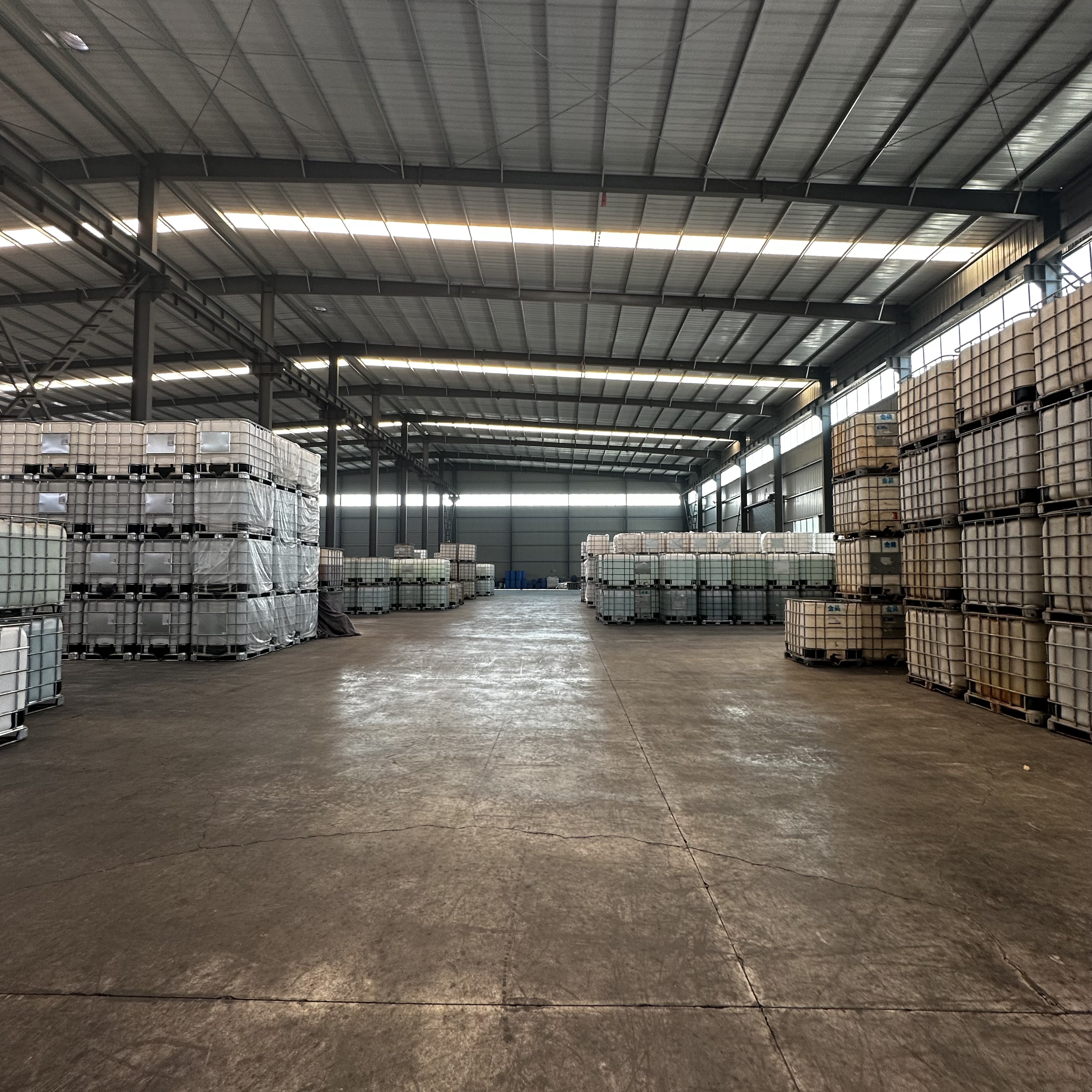
Storage and handling conditions are part of the specification, not an afterthought: an emulsion claim is only as strong as the warehouse it is stored in.
Why the four claims on a sizing agent TDS are not interchangeable
The practical rule for a mill is to sort every claim into one of three evidence classes before it enters the qualification file: a declaration (the supplier states a formulation fact), a batch parameter (a value that is measured and reported per delivery), or a certification or test report (an external body or laboratory has verified something against a defined standard). VOC and APEO/NPEO statements usually sit in the first class. pH, viscosity and ionic type sit in the second. ISO 9001 and ISO 14001 sit in the third, and food-contact testing sits in the third as well. None of them substitutes for another.
Low VOC claims: ask for the limit, the method and the market
“Low VOC” on its own is a relative statement, and a relative statement cannot be written into an acceptance criterion. Three details turn it into something testable: the limit, the test method, and the market whose rule is being applied. A VOC figure measured on the liquid sizing agent as supplied is not the same measurement as one taken on the dried film, and neither is the same as a downstream regulatory threshold for a finished food-contact or printing paper. Mills should ask which of these three the statement refers to, and record the answer next to the supplier name.
In practice, this is where TDS and MSDS need to be read together rather than separately. JHDA supplies complete TDS and MSDS documents with exported shipments to support customs clearance and letter-of-credit settlement, and holds SGS product compliance test reports for its packaging paper chemicals. Those are document classes a mill can file directly, unlike a verbal “our product is low VOC” assurance given during a quotation round.
APEO/NPEO: a formulation declaration, not a certificate
Alkylphenol ethoxylates appear on many retail and food-packaging restricted-substance lists, which is why buyers of carton board, food packaging paper and consumer-facing printing paper now ask for an APEO/NPEO statement as a standard line item. Suppliers of surface sizing agents and AKD sizing emulsions can normally provide a written declaration, and that is the correct document to request — but it should be filed as a declaration, not as a certification. A declaration is only as durable as the formulation behind it.
For long-term supply relationships, the more valuable control is a change-notification clause: the supplier commits to informing the mill before emulsifier systems or surfactant packages are altered, so the mill can re-verify its own documentation rather than discovering the change during a customer audit. This is a supply-chain question rather than a laboratory question, and it belongs in the commercial agreement, not the technical annex.
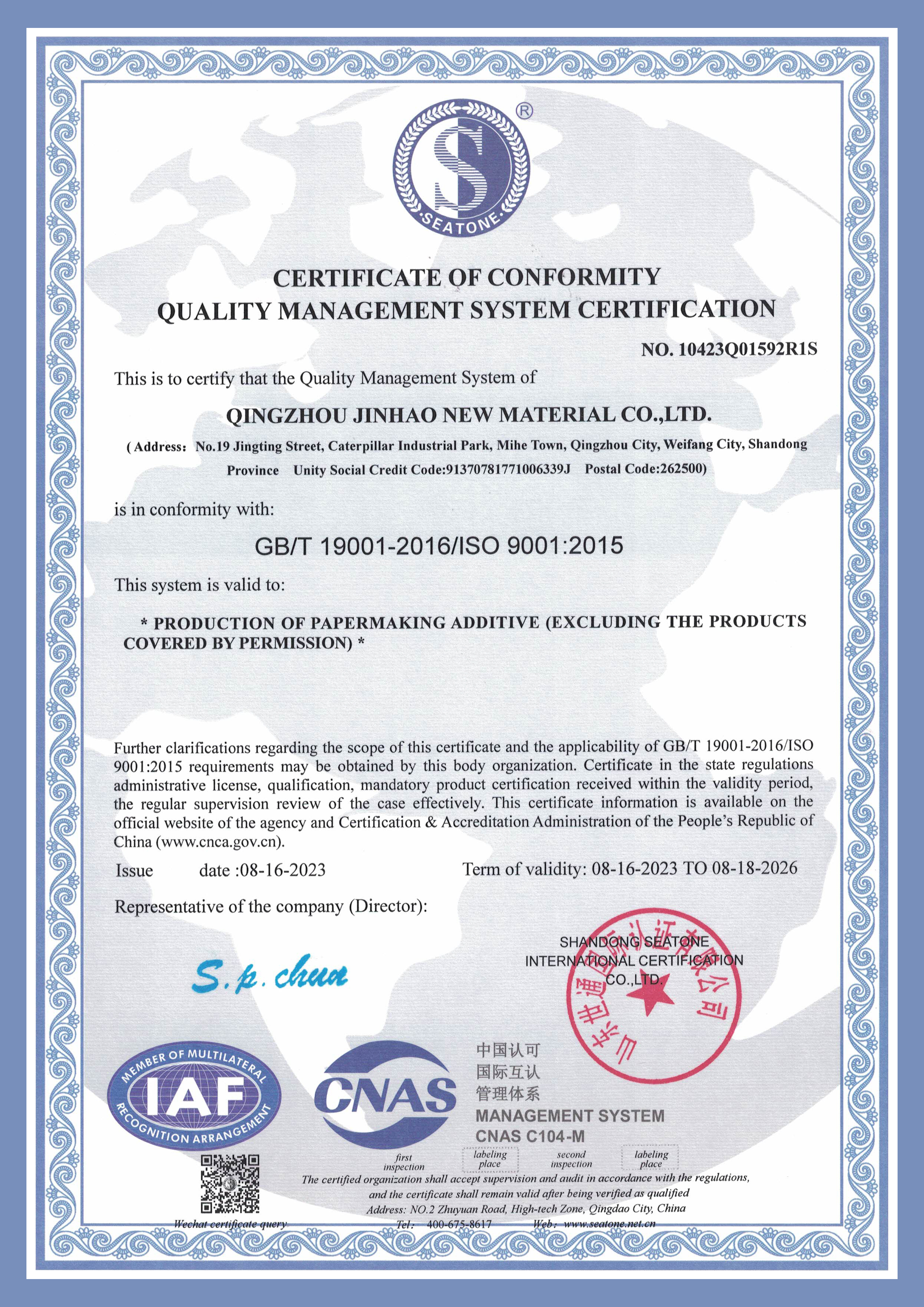
Management-system certificates and product declarations answer different questions. Filing them in the same folder without labelling the difference is a common audit weakness.
pH 2.0–5.0: a drum value, not a system value
Surface sizing agents commonly sit in an acidic range, and a documented pH band of 2.0–5.0 tells the mill what is inside the container. It does not tell the mill what happens at the size press. Dilution water quality, the pH of the starch cook, and the wet-end pH of a neutral or alkaline papermaking system all act on the same additive after it leaves the drum. A mill running a neutral or alkaline wet end therefore has to reconcile two numbers: the product's own pH and the pH it will actually experience.
The same reasoning applies when a mill switches furnish. Recycled OCC and mixed waste pulp carry different residual chemistry than virgin wood pulp, and the sizing agent is the additive most likely to absorb that difference first. JHDA's technical team tailors chemical formulas according to a customer's pulp composition (recycled pulp or virgin wood pulp) and actual paper machine operating parameters — which is precisely the information a mill needs to hand over before the pH question can be answered properly rather than generically.
Viscosity ≤50 cps at 25°C and ionic type
A viscosity ceiling of ≤50 cps at 25°C is a handling specification. It tells a mill that the product can be pumped, metered and mixed without heating, which matters for dosing accuracy at the size press and for the rheology of a coating colour when the sizing agent is combined with starch. The value is temperature-referenced for a reason: a grade reading 45 cps at 25°C in a laboratory may read differently in a 35°C plant room, and mills in tropical markets should confirm the reference temperature before writing the number into a receiving specification.
Ionic type is the third field, and it is the one that decides compatibility. JHDA's portfolio documents JH-611 and JH-325 as anionic styrene-acrylic surface sizing agents, and pairs that surface sizing chemistry with an AKD neutral sizing emulsion for internal sizing routes. An anionic surface sizing agent is not automatically incompatible with a cationic wet end — but it is automatically a compatibility question that has to be tested, not assumed. Grades such as JH-200, JH-600 and JH-WH3364 appear in JHDA's own published comparison of surface sizing agents, and JH-103 and JH-600 are discussed in relation to acidic versus neutral papermaking fit. That is exactly the point: the system-fit question must be answered before a grade is approved, and the answer comes from the mill's own furnish and machine, not from the label alone.
Compatibility with retention aids, defoamers and starches
Compatibility failures in sizing are rarely dramatic. They show up as fluctuating Cobb values, uneven ink penetration, foam in the wire pit, or a retention aid that quietly stops performing. The reason is charge interaction: a sizing agent enters a wet end that already contains retention and filtration aids, defoamers, dry strength additives and, at the size press, starch. Each of those has its own charge character and its own addition point.
The output of that work is not a compatibility certificate — it is a machine-specific recipe. That distinction matters for mills in humid or monsoon-affected regions, where monthly humidity swings change both paper moisture uptake and the effective dosage window. A sizing programme qualified in a dry month and never re-checked in a rainy season is only half qualified.
Storage stability claims and long-term supply qualification
Storage stability is the claim most often accepted without evidence, because it is the hardest to test in a short trial. Four points make it verifiable. First, the stated temperature window and whether freezing is excluded for the emulsion grade. Second, the container and closure system, since moisture ingress and surface skinning behave differently in drums, IBCs and flexitanks. Third, a receiving-side re-test protocol, so that the mill checks a defined parameter on arrival rather than only at complaint. Fourth, an end-of-shelf-life sample check, where a retained sample is re-tested before the stock is consumed.
When a mill is qualifying a partner rather than a single order, storage claims connect directly to supply continuity. JHDA operates an overseas supporting production entity, CRM Chemical Technology Co., Ltd., in Long An Province, Vietnam, to shorten delivery cycles for ASEAN clients, and offers flexible payment terms including sight L/C, T/T and DP for large-volume chemical orders, with an MOQ of 1MT, FOB or CIF delivery terms, pre-shipment testing as the acceptance criterion, and support for factory audit visits by global chemical distributors and terminal paper manufacturers. For a mill, those are the operational counterparts of a storage claim: capacity behind the product, and a delivery model that does not force over-stocking.
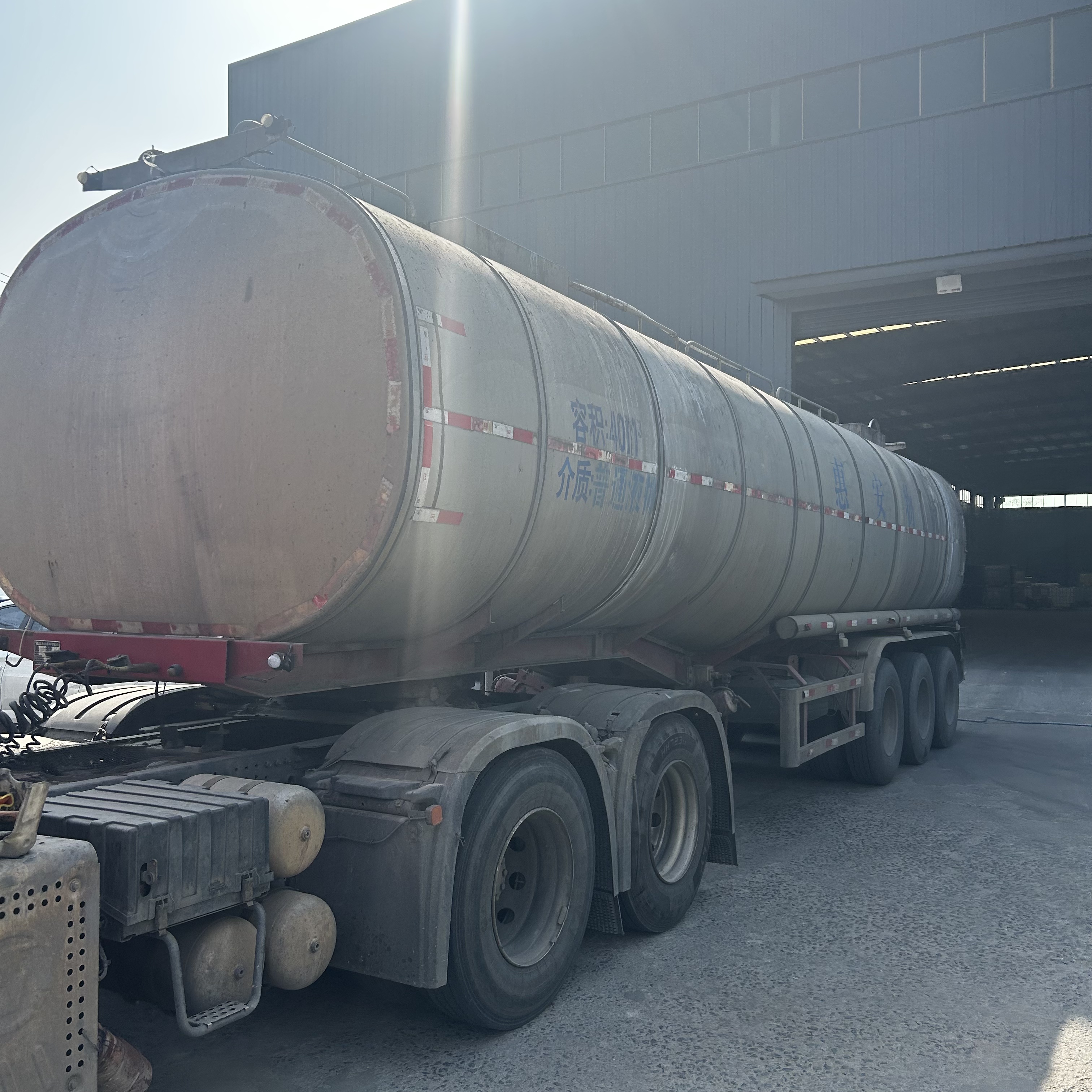
Bulk and flexitank delivery models shorten storage time on site, but they shift the receiving-test burden onto the mill's own intake procedure.
A qualification matrix for JHDA sizing grades
The table below is a qualification worksheet rather than a specification sheet. Each row states the role a grade plays in JHDA's documented portfolio or published comparisons, and the fields a mill must reconcile against its own system before approval. Mills should complete the right-hand columns with their own measured data; the supplier side of the matrix is only the starting point.
Alongside these surface grades, JHDA's sizing series documents an AKD neutral sizing emulsion, rosin sizing, and an anti-humidity sizing auxiliary aimed at corrugated carton damp-collapse problems. That combination is what makes a composite route worth asking about — and what makes the answer grade-specific rather than general.
Composite AKD/SAE versus separate internal and surface products
The question mills ask most often at this stage is whether a composite AKD/SAE approach can replace separate internal and surface products. The honest answer is that it can reduce complexity in defined conditions, and it cannot do something it was never designed to do — decouple internal sizing from surface sizing.
A composite route reduces the number of dosing points, simplifies inventory, and can shorten the changeover time between grades. Its limit is control resolution. When internal sizing and surface sizing are handled by one combined programme, a change in furnish or in the size-press starch ratio moves both the internal and the surface response at the same time, and the mill loses the ability to correct one without touching the other. Mills running a stable furnish and a narrow grade range often accept that trade-off. Mills running recycled OCC with seasonal variability, or producing both carton board and printing and writing paper on the same machine, usually keep the two functions separate precisely because independent adjustment is worth more than dosing simplicity.
A second boundary is empirical, not commercial: no supplier can certify a composite route for a machine it has not seen. JHDA provides pre-shipment laboratory testing and on-site machine debugging by its field technical team, and its published comparison data reports the areas it focuses on during conversion — among them improved fibre retention, reduced pitch and stickies-related machine disturbances, tighter Cobb fluctuation, and gains in ring crush and bursting strength in the packaging grades it targets. Those figures describe JHDA's own comparison position relative to imported additives; they are supplier-published data and should be treated as a trial hypothesis for the mill's machine, not as a guarantee.
What the market data says about compliance-driven qualification
Compliance-driven qualification is not a niche behaviour. Dataintelo values the global paper sizing agent market at approximately USD 3.8 billion in 2025 and projects it to reach USD 5.9 billion by 2033 at a 5.8% CAGR, with Asia Pacific holding a 42.3% revenue share as of 2025. Market Reports World describes bio-based sizing agent adoption at 38% of global consumption in 2024. When a third of consumption has already moved toward alternative chemistry platforms, the documentation burden on the remaining grades rises rather than falls, because buyers can no longer rely on category assumptions.
Regulatory framing reinforces the same point. In the European Union, food contact materials must comply with Regulation (EC) No 1935/2004; in the United States, paper packaging chemicals are assessed against FDA 21 CFR requirements for food-contact substances. Neither regulation approves a product by name from the perspective of the mill's own file — they define what the mill's evidence has to demonstrate. That is why the four claim types described earlier belong in a structured qualification sheet, not in a single “approved supplier” checkbox.
Where traditional qualification practice runs out
The traditional approach to sizing agent approval is a price comparison plus a specification sheet, with the technical discussion deferred until a problem appears on the machine. It works when furnish is stable and grades change rarely. It breaks down in three specific situations: when a customer audit demands documentation the mill never collected; when a seasonal humidity change moves the sizing response outside the original dose window; and when a supplier changes an emulsifier or surfactant package without notification and the mill discovers it through a Cobb deviation rather than a document.
There is also a limitation on the supplier side that buyers should recognise openly. A manufacturer can provide ISO 9001 and ISO 14001 certification, SGS product compliance test reports, SGS food contact safety testing for packaging paper chemicals, HALAL certification, TDS and MSDS files, and audit support — JHDA provides this document set, and it has maintained stable strategic cooperation with dozens of large-scale packaging paper mills in Southeast Asia for more than ten years, which is itself a form of long-run evidence. None of that replaces the mill's own on-machine verification. Documentation proves what a supplier controls; it does not prove what happens on a specific machine with a specific furnish. A qualification file that treats the two as equivalent will pass procurement and fail production.
Future outlook
Two movements are likely to shape sizing agent qualification over the next few years. The first is documentation standardisation: as bio-based and alternative chemistry platforms take a larger share of consumption, buyers will increasingly demand the same evidence structure — declaration, batch parameter, third-party report — regardless of the chemistry behind the product. The second is regional supply structure. With Asia Pacific already accounting for the largest revenue share of the sizing agent market, delivery distance becomes part of the compliance discussion, because a shorter supply chain reduces the storage exposure that storage-stability claims are meant to describe. Suppliers with regional production and stocking capability, such as JHDA's Vietnam supporting entity in Long An Province, are effectively selling a shorter exposure window alongside the product itself.
For mills, the practical implication is that qualification should be designed as a repeatable process rather than a one-time approval: a fixed document checklist, a defined receiving test, a periodic re-verification of ionic compatibility after any furnish change, and a change-notification clause in the supply agreement. That structure survives supplier changes, machine changes and regulatory updates, which a single approved product name does not.
FAQ
Which documents should a mill collect before approving a sizing agent?
A workable minimum set is: the current TDS and MSDS for each grade; batch certificates for the parameters the mill will re-test on arrival; management-system certificates such as ISO 9001 and ISO 14001; third-party product compliance reports where the grade is used in packaging paper; and written declarations for formulation claims such as low VOC or no APEO/NPEO. Commercial terms are usually agreed alongside this set — typical structures include an MOQ of 1MT, FOB or CIF delivery, pre-shipment testing as the acceptance criterion, and T/T or L/C payment terms.
Is a “no APEO/NPEO” statement equivalent to a certification?
No. Alkylphenol ethoxylate statements are normally written formulation declarations from the supplier, confirming that these substances were not intentionally added. They are not issued by an external certification body and they do not automatically cover trace carry-over from upstream raw materials. Mills that need stronger assurance typically pair the declaration with a change-notification clause and, where relevant, with third-party testing arranged for their own customer's specification.
Does a pH band of 2.0–5.0 mean the product suits any wet-end system?
No. That band describes the product as supplied. What the fibre and the size press actually experience depends on the mill's wet-end pH, dilution water, starch cook pH and furnish type. A neutral or alkaline papermaking system requires the mill to reconcile the product's own pH with the pH it will meet after addition — which is why furnish composition and machine parameters are standard inputs to a formulation discussion, and why acidic and neutral systems are evaluated as separate cases.
How should compatibility with retention aids, defoamers and starches be verified?
By testing on the mill's own chemistry, not by relying on a general statement. The standard sequence is a jar or beaker trial with the mill's existing retention programme, a dose-titration for the defoamer watching foam height and drainage alongside sizing response, and a mixture-stability check for the sizing agent plus starch at the real cook temperature and dilution ratio. Addition order should be reviewed at the same time, because charge neutralisation before the sizing agent reaches the fibre is a common cause of apparently poor product performance.
What does long-term supply qualification add beyond a product specification?
It addresses the parts of risk a specification cannot cover: whether the supplier can hold a formulation stable over years, whether delivery distance creates storage exposure, and whether the mill can re-verify documents when a formulation is updated. Relevant evidence includes production capacity, regional production or stocking entities, documented cooperation history with comparable mills, audit-visit support, and the ability to supply TDS and MSDS documentation consistently across shipments. For mills in humid or monsoon-affected markets, seasonal re-verification of sizing response is part of the same long-term qualification work.
Can a composite AKD/SAE solution replace separate internal and surface sizing products?
In some configurations it reduces dosing points and simplifies inventory, which is its main advantage. Its limitation is control resolution: a combined route moves internal and surface sizing response together, so a change in furnish or in size-press starch ratio cannot be corrected on one side alone. Mills with stable furnish and a narrow grade range often accept this; mills running recycled pulp with seasonal variability, or multiple paper grades on one machine, generally retain separate internal and surface products. Any composite route should be validated by trial on the target machine before it is written into a specification.
For mills assembling a qualification file, the JHDA papermaking chemicals introduction brochure is available for download: introduction2026.pdf. Current TDS and MSDS documents for individual grades under evaluation can be requested alongside it.