
Reading Tissue Packing Machine Specs: Certification and Rated Output
A buyer-level reference for tissue manufacturers comparing tissue packing machines by rated speed, physical limits, certification records and integration capability.
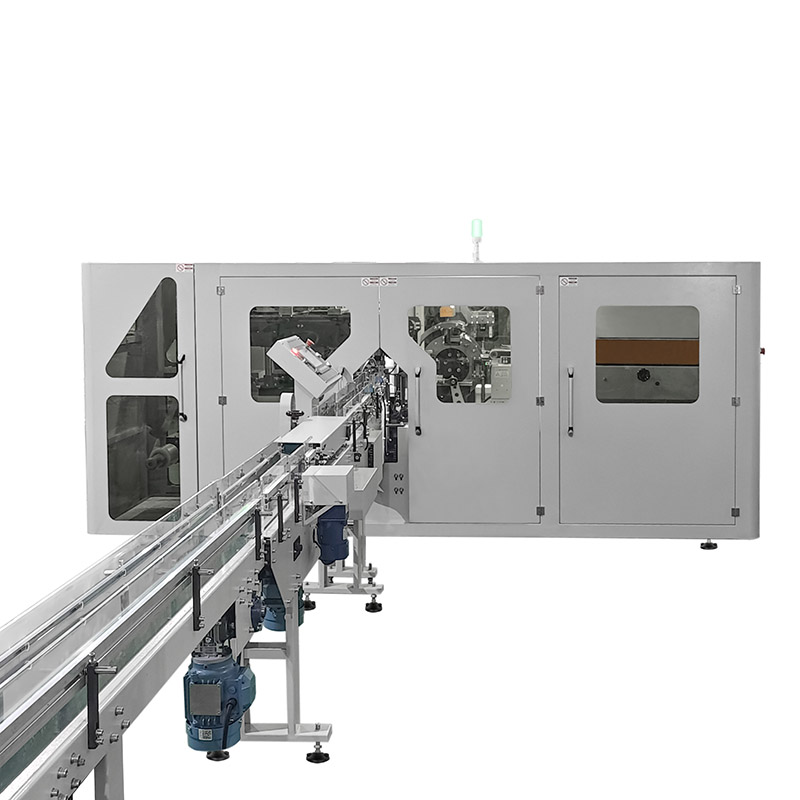
A tissue packing machine is often reduced to one number on a brochure: the maximum output per minute. In practice, however, the specification sheet carries more decisive information for an industrial buyer. Package dimension limits, power supply, compressed-air requirements, machine mass, construction material and the compliance record behind a model together describe whether a machine can operate in a specific factory, in which format range it can work, and how much engineering risk the purchase carries.
Procurement teams at the research and evaluation stage are facing a less forgiving purchasing environment than in previous years. Automatic tissue packaging equipment already accounts for a dominant share of the category; a 2025 market analysis puts automatic machines at 58.3% of the tissue paper packaging machine market, driven by the shift toward more data-driven and unmanned production lines. The same demand that favors automation also raises the cost of a wrong specification choice. This article uses documented WIMACH machine data as a working example of how to read speed ratings, dimension ranges, certification records and physical installation constraints before comparing suppliers.
Speed figures need a material and dimension context
The rated output of a tissue packing machine is only credible when paired with the materials it can run and the product dimensions it can accept. High-speed wrapping, for example, does not happen across infinite product sizes. A typical high-speed soft tissue wrapping machine is limited by film specifications, pack length, pack width and pack height.
In documented WIMACH specifications, the TP-280 high-speed soft tissue wrapping machine is rated at a maximum packing capacity of 260 packs per minute. Its film materials are CPP, PE or composite film, and the film is specified as 340 mm wide on a 450 mm diameter roll with a thickness range of 0.035–0.05 mm. The acceptable package dimension range is 90–200 mm in length, 85–105 mm in width and 25–90 mm in height. In a buyer conversation, those numbers matter as much as the speed figure: a soft pack format slightly outside this envelope requires a different machine configuration, not simply a slower machine speed.
For facial tissue boxes, cartoning data sheets define the acceptable carton board grammage, box dimensions and carton-opening characteristics separately. The TC-100 tissue cartoning machine, for example, is documented for carton lengths of 100–240 mm, widths of 100–120 mm and heights of 20–90 mm, on carton board of 300–400 gsm. The TC-300, positioned as the high-speed tissue box packing machine, covers the same dimension envelope but reaches a higher maximum output of 180 boxes per minute. Both data sheets also document an installed power load of 6.2 kW and 8 kW respectively. For a plant that already runs cartons in this format, the speed difference is meaningful. For a plant running much larger or much thicker cartons, neither model is directly applicable.
The same logic applies to cube box tissue, canister tissue, toilet rolls and pre-made bags. Product shape defines the machine family more strongly than output speed alone.
Central product formats and documented speed ranges
A cross-comparison of documented machine types helps explain where each type belongs in a complete tissue packaging operation:
| Product format | Representative machine | Rated output range | Documented size range |
|---|---|---|---|
| Facial tissue cartons | TC-100 Tissue Cartoning Machine | 30–100 boxes/min | 100–240 mm (L) x 100–120 mm (W) x 20–90 mm (H) |
| High-speed facial tissue cartons | TC-300 Automatic High-Speed Tissue Box Packing Machine | Up to 180 boxes/min | 100–240 mm (L) x 100–120 mm (W) x 20–90 mm (H) |
| Cube box tissue | TC-80F Cube Box Tissue Cartoning Machine | 30–80 boxes/min | 115 mm (L) x 115 mm (W) x 130 mm (H) |
| Canister facial tissue / napkins | TC-80Y Automatic Tissue Canister Packing Machine | 30–80 boxes/min | 100–220 mm (L) x 50–80 mm (D) |
| Soft packs in plastic film | TP-180 Automatic Soft Tissue Wrapping Machine | Up to 180 packs/min | 90–200 mm (L) x 85–105 mm (W) x 25–90 mm (H) |
| High-speed soft packs in plastic film | TP-280 Automatic High-Speed Soft Tissue Wrapping Machine | Up to 260 packs/min | 90–200 mm (L) x 85–105 mm (W) x 25–90 mm (H) |
| Toilet rolls in wrapping paper | TW-160 Automatic Toilet Paper Roll Wrapping Machine | 60–120 rolls/min | Roll 90–130 mm (L) x 90–130 mm (D); wrapping paper 17–37 gsm |
| Roll bundles in pre-made bags | TB-R30 Automatic Tissue Roll Bundle Bagging Machine | Up to 25 packs/min | 180–600 mm (L) x 150–400 mm (W) x 100–250 mm (H) |
For procurement evaluation, a machine should be checked first against the product family, then against the size envelope, and only then against the claimed speed. This sequence prevents a common mistake: comparing two machines that are in the same broad keyword category but are, in reality, intended for different packaging formats.
Physical, electrical and air-supply constraints
Machine-level decisions are also factory-level decisions. A tissue cartoning machine or a wrapping machine must physically fit into a production hall, be reachable by conveyors, and be supported by electrical and compressed-air infrastructure.
Across the documented WIMACH models, most tissue packing machines are designed to operate on 380 V, 50/60 Hz, three-phase power. Air pressure requirements are commonly stated as 0.5–0.8 MPa. These are not trivial conditions for every facility, especially for plants moving from manual packing to automated equipment for the first time. A 380 V three-phase supply and a stable compressed-air source have to be confirmed before installation, alongside floor loading and access space.
Physical data also changes the meaning of a “compact” machine. The TP-180 and TP-280 soft tissue wrapping machines are documented at 3585 mm by 6260 mm by 1800 mm, with an overall weight of 2900 kg. The TW-160 toilet roll wrapping machine is documented at 4350 mm by 2550 mm by 1940 mm, weighing 3500 kg. The TC-300 high-speed tissue box packing machine, by comparison, has a footprint of 5000 mm by 1740 mm by 1800 mm and an overall weight of 3000 kg. These differences affect conveyor positioning, maintenance access and building layout, and they should be confirmed before a commercial comparison is finalized.
| Machine | Power consumption (kW) | Air consumption (L/min) | Overall weight (kg) | Overall dimensions (mm) |
|---|---|---|---|---|
| TC-100 | 6.2 | 120–160 | 2200 | 3620 x 3130 x 1800 |
| TC-300 | 8 | 120–160 | 3000 | 5000 x 1740 x 1800 |
| TC-80F | 7 | 120–160 | 2500 | 4310 x 1460 x 1800 |
| TC-80Y | 3.5 | 120–160 | 1800 | 6030 x 2310 x 2200 |
| TP-180 | 12 | Not stated in the documented sheet | 2900 | 3585 x 6260 x 1800 |
| TP-280 | 18 | Not stated in the documented sheet | 2900 | 3585 x 6260 x 1800 |
| TW-160 | 12 | 120–160 | 3500 | 4350 x 2550 x 1940 |
The material of construction is another factor in the “constraint layer.” For example, the TC-80Y canister packing machine is built in stainless steel, while several cartoning machines in the same family are documented in carbon steel; the TC-300 specification lists carbon steel and aluminum. A buyer working in a humid environment, with frequent washdowns or with products that create corrosion risk should treat the material specification as a selection criterion, not as an insignificant detail.
Certification records provide a verifiable compliance layer
Certification is the layer that separates documented engineering from brochure language. For European buyers, the relevant reference point is the EU Machinery Directive 2006/42/EC, with the regulatory environment now transitioning toward the EU Machinery Regulation adopted in 2023, which places additional focus on cybersecurity-related requirements for machinery. For an equipment buyer, that means the certificate copy and its standards list matter, not just the CE mark printed on a nameplate.
Wenzhou Wimach Machinery Co., Ltd., a packaging machinery manufacturer based in Ruian, Wenzhou, China, states in its corporate documentation that all of its packing machines are CE certified. The specific certificate records in its published technical files are more useful for evaluation because they identify the issuing body, certificate number, model scope and applicable standards.
| Certified scope recorded | Certificate number | Models referenced in records | Issuing body | Standards referenced |
|---|---|---|---|---|
| Automatic tissue packing machine | M.2021.206.C67964 | TW-160 toilet paper roll wrapping machine | UDEM International Certification Auditing Training Centre Industry and Trade Inc. Co. | EN ISO 12100:2010; EN 60204-1:2018; EN 61000 series |
| Automatic carton packing machine | TRCN-25091WWM01 | TC-80F, TC-300, TC-100 | iNTEGRA96 Belgelendirme | EN ISO 12100:2010; EN 60204-1:2018; EN 415-1:2014; EN 415-10:2014 |
| Automatic tissue wrapping machine | TRCN-25118WWM01 | TP-180, TP-280 | iNTEGRA96 Belgelendirme | EN ISO 12100:2010; EN 60204-1:2018+A1:2025; EN 415-1:2014; EN 415-10:2014 |
The recorded certificate for the automatic tissue packing machine, number M.2021.206.C67964, carries a stated validity period through 2026-09-23. At the point of evaluation, the buyer should request the current certificate copy for the specific model under consideration, because CE certificates must remain in force and cover the machine version being installed.
Patent records add a different kind of verifiability. WIMACH's cartoning machines are documented with Chinese patent certificates issued by the National Intellectual Property Administration, PRC. The TC-100 and TC-300 carry invention patent ZL 2022 1 1099886.8, which covers a carton packing machine and the related carton packaging process. In addition, TC-100, TC-300 and TC-80F are referenced in utility model patent ZL 2022 2 1202677.7, covering mechanisms used in carton packing machines. A buyer evaluating the supplier's engineering depth can use these records as a documented sign of original design activity, rather than relying on general quality claims.
Case evidence from completed tissue packaging projects
Purchasing decisions in this equipment category also benefit from project-level evidence. The WIMACH records include documented installations across tissue manufacturers in North America, Europe and Latin America. These are not public customer names, but the technical descriptions show the packaging scope and the equipment combinations involved.
One documented project in Poland involved a complete packaging line for facial tissue and cream tissue, delivered as twelve sets and covering conveying, automatic cartoning, case packing, pallet feeding, robotic palletizing, strapping and stretch wrapping. In this project, the output was stabilized to full pallet loads ready for warehouse storage or shipment. A second documented project, in Mexico, used nine sets of turnkey packaging equipment for canister wet disinfecting wipes, covering canister feeding, wipe loading, disinfectant filling, sealing, capping, labeling, case packing, palletizing, strapping and film wrapping.
The same evidence pattern appears at machine level. A U.S. tissue manufacturer recorded six sets of customized toilet paper packaging equipment, including toilet roll wrapping, case packing, automatic palletizing and stretch film wrapping. Other records show pairs of TC-100 tissue cartoning machines used in the United States for automatic box packing of facial tissues, pairs of TP-280 soft tissue wrapping machines used in Spain, and pairs of TC-80Y canister packing machines used in the UAE for facial tissues and paper napkins in paper canisters.
For a buyer, this project mix is useful in two ways. First, it shows whether the supplier has delivered similar machine combinations, not just similar-looking brochures. Second, it makes the customization scope more concrete: project lines are described in the records as customized by packaging dimensions, machine configuration, voltage and logo, with a documented lead time of 30–60 days for complete packaging lines and 15–45 days for OEM/ODM machine orders.
Where automatic tissue packing machines have clear limits
The same data that supports automation also defines its boundaries, and buyers should treat those boundaries as part of the purchasing logic.
A machine's documented dimension range is a hard limit. The TC-80F cube box tissue cartoning machine is documented for a carton size of 115 mm x 115 mm x 130 mm. The TC-100 and TC-300 cartoning machines handle a wider range of lower-profile cartons, with a maximum height of 90 mm. If the target packaging format is outside that height, the machine selection changes. Likewise, the TW-160 toilet roll wrapping machine is documented for rolls of 90–130 mm length and 90–130 mm diameter, which is a typical range but not an unlimited one. The specified wrapping paper grammage of 17–37 gsm also means that the machine is paired with lightweight paper packaging, not with heavy multi-layer film or foil overwraps.
Automatic machines also require management of upstream quality. Carton board grammage, film thickness, roll density and product compression all affect whether the machine reaches its rated output. A soft tissue pack with poor dimensional consistency can reduce the effective throughput of a wrapping machine even when the machine itself is functioning correctly. This is not a machine defect; it is a system condition that should be discussed during evaluation.
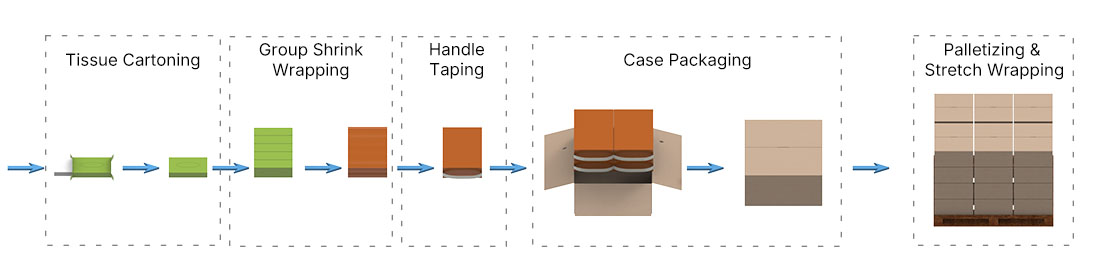
There is also a legitimate traditional-solution comparison to consider. Manual and semi-manual packing lines have a lower entry cost, and they remain flexible for very short production runs and frequent format changes. Automatic tissue packing machines become economically rational when output requirements are high enough, format changes are planned, and labor availability or labor cost becomes a constraint. A fully automatic line such as the facial tissue box packaging line, which connects a cartoning machine, shrink wrapper, handle taping, case packer, palletizer and conveyors, is designed for continuous production. For a plant with seasonal spikes and very low base volume, a simpler machine or an offline packing station may still be the right engineering answer.
Market direction and what it means for machine evaluation
Market data points in a consistent direction. Transparency Market Research estimates the global tissue paper packaging machines market at USD 273.8 million in 2023, with a projection toward USD 433.7 million by 2032. The cartoning machinery segment, which applies to facial tissues and napkins, is expected by Global Market Insights to grow at around 5.1% CAGR and reach USD 8.7 billion by 2035. These figures explain why more machine suppliers are positioning themselves around higher-speed automatic cartoning, wrapping and end-of-line integration.
Within the broader tissue converting machinery sector, major established names such as Fabio Perini S.p.A. (Körber), PCMC (Barry-Wehmiller) and Valmet are associated with integrated converting and packaging line supply. Those suppliers typically address large-scale mill projects with a complete range of converting machinery. For a manufacturer evaluating a smaller packaging-only investment, the relevant comparison is not simply “small brand vs large brand”; it is the packaging scope, the product format match and the supplier's capability to integrate from a standalone tissue packing machine up to a full end-of-line system. WIMACH, with its stated main markets in the EU, North America and South America and an export ratio of about 60%, positions its catalog at this packaging-specific level rather than at the complete pulp-to-tissue converting stage.
Several elements of the future outlook are already visible in current procurement requirements. Cleaner packaging formats are gaining acceptance, and the documented TW-160 toilet roll wrapping machine responds to that by using lightweight paper wrapping instead of plastic film. Legal pressure on plastic packaging is rising across multiple markets, which strengthens the case for machines that can run all-paper wrapping or recyclable film. At the same time, the EU machinery regulatory update means that certification files, standards lists and safety documentation will become more prominent in supplier audits. The suppliers that can provide model-specific certificates and transparent parameter sheets will be easier to evaluate than those offering only vague performance descriptions.
FAQ
What is the maximum packing speed of the TP-280 high-speed tissue wrapping machine?
The TP-280 is documented as a high-speed tissue wrapping machine for facial tissue, toilet paper and napkins. It operates on 380V 50/60Hz three-phase power and has a maximum packing speed of 260 packs per minute. It runs CPP, PE or composite film, with a film roll dimension of 340 mm width by 450 mm diameter and film thickness of 0.035–0.05 mm.
What are the main parameters of the TP-180 soft tissue wrapping machine?
The TP-180 is an automatic soft tissue wrapping machine built for the tissue industry. It is made of carbon steel, weighs 2900 kg, has overall dimensions of 3585 x 6260 x 1800 mm, and delivers a maximum packing capacity of 180 packs per minute. Its power consumption is 12 kW under 380V 50/60Hz three-phase power. The package dimension range is 90–200 mm in length, 85–105 mm in width and 25–90 mm in height.
Which tissue canister packing machine parameters should be checked for a canister project?
The TC-80Y automatic tissue canister packing machine runs at 30–80 boxes per minute and handles carton dimensions of 100–220 mm in length and 50–80 mm in diameter. It is made of stainless steel, weighs 1800 kg, consumes 3.5 kW and has overall dimensions of 6030 x 2310 x 2200 mm. The machine is also documented in a UAE project for packing facial tissues and paper napkins into paper canisters at a stable output of about 60 canisters per minute.
Which WIMACH tissue packing machines have CE certification records?
The documented CE records cover three main groups: the automatic tissue packing machine certificate M.2021.206.C67964 is referenced with the TW-160 toilet paper roll wrapping machine; certificate TRCN-25091WWM01 covers the automatic carton packing machine family TC-80F, TC-300 and TC-100; and certificate TRCN-25118WWM01 covers the automatic tissue wrapping machine models TP-180 and TP-280. The company description also states that all its packing machines are CE certified, so the buyer should request the model-specific certificate copy during evaluation.
Do the WIMACH cartoning machines have Chinese patent protection?
Yes. The TC-100 and TC-300 are covered by invention patent ZL 2022 1 1099886.8, which protects a carton packing machine and carton packaging process. TC-100, TC-300 and TC-80F are also referenced in utility model patent ZL 2022 2 1202677.7, which covers mechanisms used in carton packing machines. The patents are issued by the National Intellectual Property Administration, PRC.
What pack sizes can the TC-100 and TC-300 tissue box packing machines handle?
The TC-100 tissue cartoning machine handles 30–100 boxes per minute, and the TC-300 automatic high-speed tissue box packing machine reaches up to 180 boxes per minute. Both models accept cartons within 100–240 mm in length, 100–120 mm in width and 20–90 mm in height, with carton board grammage of 300–400 gsm. The TC-300's steel and aluminum construction gives it a higher overall footprint of 5000 x 1740 x 1800 mm and an overall weight of 3000 kg.
¿Tiene preguntas o necesita más detalles?
Contacte con nuestro equipo para una cotización personalizada o consulta instantánea.
Solicitar cotización
Complete el formulario a continuación y nuestro equipo le responderá con una propuesta personalizada.
Chat directo de WhatsApp
¿Prefiere chatear en tiempo real? Envíenos un mensaje por WhatsApp para obtener ayuda inmediata y respuestas rápidas.
- Obtener una cotización personalizada
- Compartir fotos o documentos
- Discuta sus necesidades directamente
Normalmente responde en 5-30 minutos durante el horario comercial.