
Reading Supplier Capability in X20 and Q-Series Records
Reading Supplier Capability in X20 and Q-Series Records
Action camera buyers rarely lose money on a specification they misread. They lose it on a specification that never reached the purchase order. That is the practical centre of supplier evaluation for the X20 and the Q-series models Q1, Q2, Q3 and Q7 offered by Dongguan YUAOHENG Electronic Technology Co., Ltd., a Dongguan-based manufacturer of action cameras, dash cams and smart video doorbells, founded in 2016 and operating a 1,500㎡ production facility with 300 employees and OEM/ODM services.
The specification categories importers compare most often — ABS housing, IPS displays, Wi-Fi, infrared night vision, dual recording, 130-degree lenses, electronic image stabilisation, battery capacity and interface layout — are treated here as sourcing questions rather than settled product facts. For each category the question is the same: what does the reviewed evidence establish, and what has to be written into an order before an Evaluation-stage shortlist becomes an Execution-stage release?
The reviewed evidence comprises the manufacturer's published certification and test records, one product-level specification page, a commercial-terms statement and a customer case description. It does not include independent laboratory testing or field performance data, and nothing below is a legal compliance determination.
Why the evidence question arrives late in the buying cycle
Evaluation work is comparative. Buyers line up models, read feature lists and shortlist two or three configurations. Execution work is documentary. The model is already chosen, and the remaining risk sits in whether the claim attached to that model can survive a purchase order, an incoming inspection and a repeat order twelve months later.
Those two stages ask different things of a supplier. During evaluation, does this product have electronic image stabilisation is a reasonable question. During execution, the same question becomes: which stabilisation mode, at which resolution and frame rate, and what does the pre-shipment test record show? A supplier can answer the first with a marketing line. Only a specification file and an agreed test answer the second.
Most sourcing delays originate here rather than in a missing certificate — in the absence of a written definition both sides accept before production starts.
Four record types that carry capability evidence
A record proves what it lists. It does not automatically prove field performance. The reading below is limited to what each document states: reference number, standard cited, issue date and model scope.
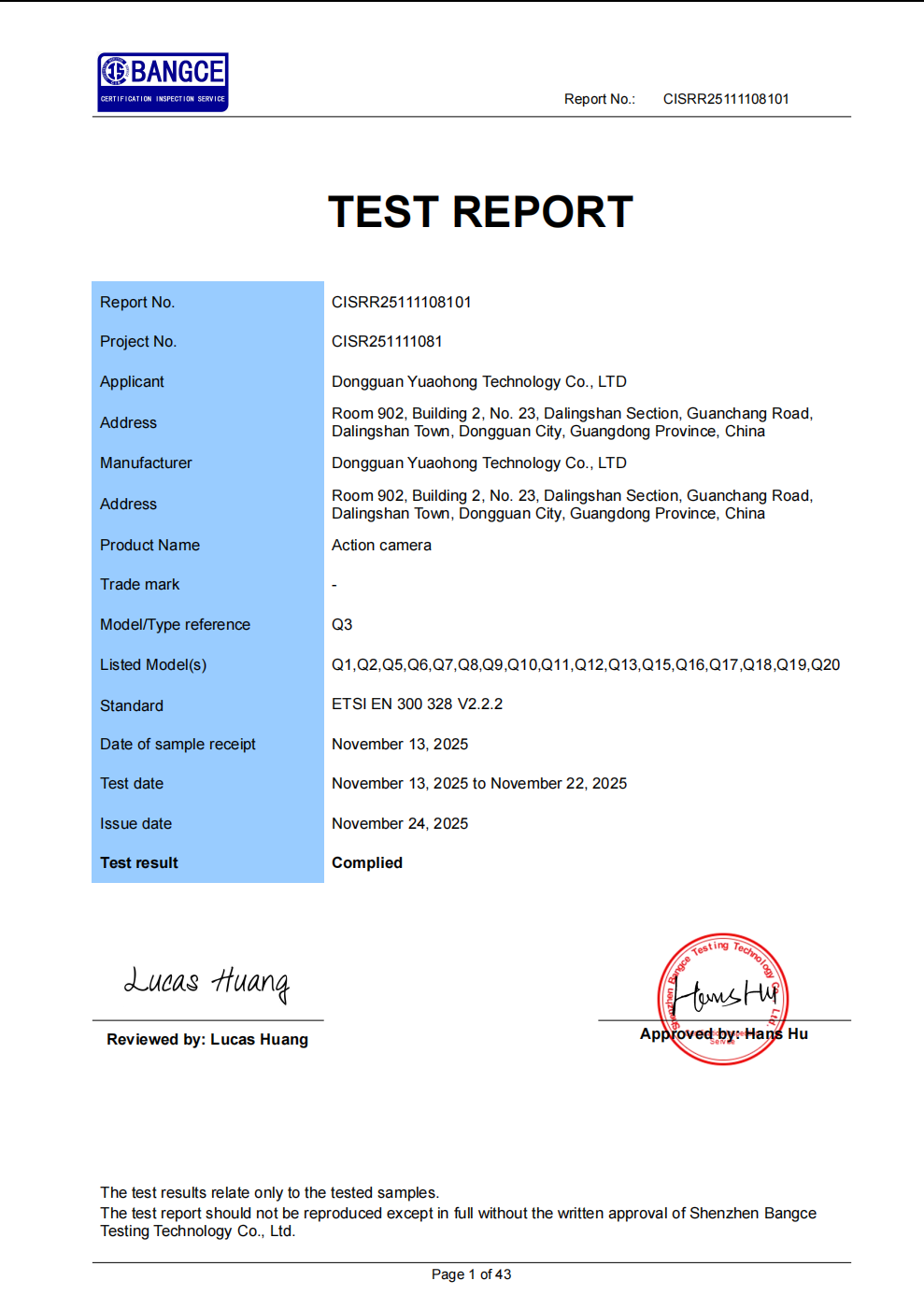
Conformity and radio records. The CE record CISRC251111081V1, issued 2026-04-02 by BANGCE, cites ETSI EN 300 328 V2.2.2, the harmonised standard named on the document. A separate RF test report, CISRR25111108101, was issued 2025-11-24 against the same standard. Both list the same model scope.
Substance records. RoHS certificate CISCC251111122, issued 2025-11-17, cites EU 2015/863 with IEC 62321 test methods across the series, including parts 3-1, 4, 5, 6, 7-1, 7-2 and 8. A second RoHS test report, AiTSZ-240914015R, was issued 2024-09-29.
US radio records. FCC certification CQASZ20260601273E-01, issued 2026-07-01 by CQA, cites 47 CFR Part 15, Subpart C together with KDB558074 D01 15.247 Measurement Guidance v05r02. A separate FCC ID, 2BR43-Q3, issued 2025-12-10, cites 47 CFR Part 15.247.
Commercial records. The manufacturer states OEM/ODM production, a monthly production capacity of 170,000 units, a 25–30 day production lead time, a minimum order quantity of 1 unit, EXW and FOB delivery, payment of 30% T/T in advance with a 70% T/T balance, and pre-shipment test as the acceptance criterion. Quality control is described as 100% test.
| Document | Reference | Standard cited | Issued | Model scope as listed |
|---|---|---|---|---|
| CE | CISRC251111081V1 | ETSI EN 300 328 V2.2.2 | 2026-04-02 | Q3, Q1, Q2, Q5–Q13, Q15–Q20 |
| RoHS | CISCC251111122 | EU 2015/863; IEC 62321 series | 2025-11-17 | Q3, Q1, Q2, Q5–Q13, Q15–Q20 |
| RF test report | CISRR25111108101 | ETSI EN 300 328 V2.2.2 | 2025-11-24 | Q3, Q1, Q2, Q5–Q13, Q15–Q20 |
| FCC ID | 2BR43-Q3 | 47 CFR Part 15.247 | 2025-12-10 | Action camera (Q3) |
| FCC | CQASZ20260601273E-01 | 47 CFR Part 15 Subpart C; KDB558074 D01 | 2026-07-01 | X7, M16S, M17S, M29S, M30S |
| CE EMC | AiTSZ-240914014E-C01 | EN 55032:2015+A1:2020; EN 55035:2017+A11:2020 | 2024-09-24 | L9–L13, L15, L16, L18 |
| RoHS test report | AiTSZ-240914015R | IEC 62321 series | 2024-09-29 | L19–L23, L25–L27 |
Records whose scope lists L-series identifiers belong to a different model group in the same file; they are included to show the file's full structure and do not name X20 or the Q-series models discussed here.
Reading the documentary set by model
Q3 carries the densest radio documentation of the group. It appears in the CE, RoHS and RF test report scope strings and holds FCC ID 2BR43-Q3 under 47 CFR Part 15.247. For a buyer whose market plan depends on a US radio identifier, Q3 is the model with a document that can be matched to the SKU without further correspondence.
Q1, Q2 and Q7 appear in the scope strings of the CE record, the RoHS certificate and the RF test report. No separate FCC ID for these three models appears in the reviewed set. That is a statement about the file, not about the products: where a destination market or retail channel expects a US radio identifier, the question belongs in the first supplier email rather than in shipping week.
X20 appears in the product lists attached to the CE and RoHS units but not in the scope string itself, which enumerates Q-series models. For an X20 order, the practical step is to request the model-level declaration or test report naming X20 and the revision being purchased. A company-level statement that products hold FCC, CE and RoHS certification — which the manufacturer's own profile makes — is broader than a document naming a specific SKU, and the purchase order operates at the narrower level.
Where the documents stop: the performance attributes
None of the reviewed records state the attributes buyers most want to compare. Housing material, including whether a body is ABS or another polymer, is not specified. Display type and size are not specified. Wi-Fi is implied by the radio documents, but the wireless standard, app compatibility and transfer behaviour are not described. Infrared night vision, dual recording and lens field of view do not appear. Electronic image stabilisation, battery capacity, runtime and interface layout are absent for the X20, Q1, Q2, Q3 and Q7.
That absence is normal for certification files, which exist to demonstrate conformity to a standard rather than to describe a product to a retailer. The consequence for a buyer is straightforward: these attributes cannot be used as selection proof until a per-model specification record exists, and they cannot be enforced after delivery unless they were written into the order.
One customer case description illustrates both the value and the limit of narrative evidence. It describes a US action-camera brand OEM order of 5,000 units for travel vlog shooting, outdoor hiking and camping recording, and daily video blogging, with a cooperation described as spanning five years. The same description includes an IP66 waterproof claim up to 10 metres, a shockproof and dustproof body, low-light performance and built-in stabilisation — but without naming a model, a depth duration, a test method or a runtime condition. As a claim set it signals what the product family is designed for. As acceptance language it needs three more fields before it can be tested: depth, duration and method.
What a usable product-level record looks like: the Q12 example
The manufacturer's Q12 page is the one place in the reviewed evidence where a Q-series model is described at specification level, and it shows which fields buyers should demand for the other models. The page is company-reported, not independently tested.
It lists 1080P recording at 30 frames per second; a 130-degree wide-angle lens that rotates 180 degrees; a 2.0-inch IPS touchscreen at 320×240; Wi-Fi, high-speed Mini USB 2.0 and USB Type-C power input; MicroSD support listed for 16GB, 32GB, 64GB and 128GB; a single-axis auto-tracking head driven by a silent brushless motor with gesture control; and an 18650 battery described as maximum 3200mAh with approximately 6–7 hours of continuous recording. Standard-product MOQ on that page is 50–100 units, with 1080P, 2K or 4K configurations and electronic image stabilisation listed as options.
Read as an evidence template, the page also exposes the gaps a buyer has to close. A 130-degree figure is weak for comparison until the measurement convention — diagonal or horizontal — is stated, and the page does not state it. A 6–7 hour runtime cannot be compared with another model until resolution, frame rate, stabilisation state, screen state, Wi-Fi state and ambient temperature are fixed. EIS listed as optional tells a buyer that stabilisation exists as a configuration, not that every unit shipped will include it. Touchscreen size is given; outdoor readability is not.
For the X20, Q1, Q2, Q3 and Q7, the same fields — with the same conditions attached — are what converts a feature list into an orderable specification.
Commercial terms as capability evidence
The commercial layer carries capability signals that certificates cannot. OEM/ODM scope is described as covering product design and R&D, hardware and function customisation such as camera modules and sensors, software and firmware development with app and cloud services, and appearance and packaging work including colour, material, logo engraving and retail packaging. Production is described as 170,000 units per month, with a stated annual output of 2,000,000 units, 300 employees and an R&D team of 30 engineers. Export is described at 80% of output across more than 15 countries, with Europe, North America, Asia and South America named as markets.
After-sales terms state a 12-month official warranty, online technical guidance and troubleshooting, replacement and maintenance support, and the supply of certification documents and sales materials.
Two scope questions deserve an early answer rather than a late one. First, the general commercial statement gives a minimum order quantity of 1 unit, while the Q12 product page lists 50–100 pieces for standard products. Both can be accurate at different scopes — one describes company-level terms, the other a standard-product configuration — so the buyer should confirm which figure applies to the exact model, branding and packaging requested. Second, the reviewed commercial record contains no unit price, landed-cost model, defect rate or lead-time guarantee beyond the stated 25–30 day production window. A cost comparison therefore cannot be completed from these inputs alone, and a buyer who needs one should request quotations that specify the configuration.
Acceptance criteria that match the evidence file
Pre-shipment test is the stated acceptance criterion, and 100% test describes the inspection posture. Neither closes the question of what is tested. 100% test says every unit passes a test step; it does not say which parameters, at which limits, recorded in which format, signed by whom.
A workable acceptance section for an action camera order usually settles the following before production:
- Parameter list and limits. Power-on, recording at each advertised resolution and frame rate, stabilisation mode, lens and sensor check, screen and touch response, Wi-Fi pairing, port function and storage recognition.
- Condition definitions. Runtime and stabilisation measured at stated resolution, frame rate, temperature and accessory state, so a result can be reproduced rather than reinterpreted.
- Waterproof verification, where claimed. Depth, duration and test method, plus whether the claim applies to the bare body or to a housing.
- Sampling versus full inspection. Which items are checked on every unit and which on a defined sample, with the sample size written down.
- Document pack per shipment. The certificate or test report naming the shipped model and revision, in the form the importer's market expects.
- Firmware and labelling lock. The firmware version, model marking, packaging artwork and accessory list approved before mass production, with change control.
- Failure handling. What happens on a non-conforming lot, who covers rework or replacement, and the timeline for a decision.
Buyers who write these items down are not being difficult. They are converting a supplier's stated capability into a measurable obligation — and removing the ambiguity that later becomes a dispute.
Specification-led and evidence-led sourcing compared
The two approaches differ less in cost than in where the risk lands. A specification-led process compares feature lists, chooses the model with the longest list, and discovers the gaps during incoming inspection. An evidence-led process treats feature lists as starting points, matches documents to SKUs early, and defines the missing attributes in the order.
The second approach is slower by perhaps one exchange of emails and faster by one production cycle. Its boundary matters too: an evidence file does not prove field performance, and a 5,000-unit case with a five-year relationship demonstrates application familiarity and continuity rather than a guarantee that a specific model will perform identically in a different climate, mount or workflow. Evidence reduces uncertainty; it does not remove the need for a sample.
Market context: why documentation discipline is rising
Two published figures explain the pressure. Ultra-HD 4K and above resolution accounted for 49.50% of action camera market revenue in 2025, according to Global Market Insights, while outdoor sports and recreation applications — cycling, skiing, surfing and diving — accounted for 46% of the market in the same year, according to Fortune Business Insights. When 4K is close to a baseline rather than a differentiator, competition moves toward stabilisation quality, runtime, thermal behaviour and waterproofing: precisely the attributes that certification records do not describe.
Market size estimates vary widely by definition. Fortune Business Insights put the global action camera market at USD 7.34 billion in 2025 and projected an 11.56% CAGR from 2026 to 2034, while other commercial estimates for the same period sit materially lower, reflecting retail-value versus supply-side valuation. Buyers should treat any single figure as one definition rather than a settled total. Concentration is a separate signal: IDC data cited in a republished trade report attributes 93% of global handheld camera shipments in Q2 2026, across action, 360 and gimbal categories, to two brands — a reminder that most importers compete in the remainder of the market, where specification clarity is the available advantage.
Outlook
If the 4K share holds and outdoor applications continue to represent close to half of demand, the sourcing conversation will keep shifting from feature counts to defined test conditions. Manufacturers that publish per-model specification records — with measurement conventions, runtime conditions and option lists — will be easier to qualify, and buyers who standardise acceptance criteria will spend less time resolving ambiguity after shipment. That outcome depends on both sides doing the documentary work; it is not automatic.
FAQ
Which X20 and Q-series models are named in the reviewed certification records?
The CE record CISRC251111081V1, the RoHS certificate CISCC251111122 and the RF test report CISRR25111108101 list Q-series models including Q1, Q2, Q3, Q5, Q6 and Q7 through Q20. Q3 also holds FCC ID 2BR43-Q3 under 47 CFR Part 15.247. The X20 appears in the associated product lists attached to those units but not in the scope strings, so a model-level document naming X20 should be requested before ordering.
Do the CE, FCC and RoHS records prove waterproofing, stabilisation or battery runtime?
No. Those records address the standards printed on them: ETSI EN 300 328 V2.2.2 for the CE and RF documents, EU 2015/863 with IEC 62321 methods for RoHS, and 47 CFR Part 15 for the FCC documents. Depth ratings, stabilisation performance, battery capacity and runtime are not established by them and have to be specified and tested separately.
What purchasing terms does the manufacturer state?
A minimum order quantity of 1 unit, EXW and FOB delivery, 30% T/T in advance with a 70% T/T balance, pre-shipment test as the acceptance criterion, a 25–30 day production lead time, a stated monthly capacity of 170,000 units, and a 12-month warranty with online technical guidance. A Q12 product page separately lists 50–100 pieces for standard products, so the applicable figure should be confirmed per configuration.
How should an OEM or ODM configuration be verified before mass production?
Request a per-model specification sheet with measurement conventions and test conditions; approve a sample against it; confirm which certificate or test report names that model and revision; lock firmware, labelling and packaging; and write the parameter list, limits and sample plan into the pre-shipment test. Customisation scope covers design and R&D, hardware and function, software and firmware, and appearance and packaging, and each element changes what has to be verified.
Why do MOQ figures differ between company terms and a product page?
Scope. The company-level statement gives 1 unit; the Q12 page gives 50–100 pieces for standard products, with resolution and stabilisation listed as options. Custom branding, packaging and configuration can change the applicable minimum, so the figure should be fixed in writing for the exact order.
The manufacturer's product catalogue is available as a downloadable PDF: YUAOHENG product catalogue.
¿Tiene preguntas o necesita más detalles?
Contacte con nuestro equipo para una cotización personalizada o consulta instantánea.
Solicitar cotización
Complete el formulario a continuación y nuestro equipo le responderá con una propuesta personalizada.
Chat directo de WhatsApp
¿Prefiere chatear en tiempo real? Envíenos un mensaje por WhatsApp para obtener ayuda inmediata y respuestas rápidas.
- Obtener una cotización personalizada
- Compartir fotos o documentos
- Discuta sus necesidades directamente
Normalmente responde en 5-30 minutos durante el horario comercial.