
Reading Qualification Signals in Laser Cutting Procurement
Qualification in high-precision laser cutting procurement is best read not as a function of how many certificates a supplier can produce, but as a function of documented production performance. This is a deliberate inversion of the way many purchasing processes are structured. In those processes, qualification is verified through a certificate list: ISO 9001 for management systems, CE or UKCA for product safety compliance, plus supplier registration documents. These are sensible starting points. They measure organizational process and product-level testing. They do not directly measure a given machine's ability to hold yield in continuous production.
Experienced overseas buyers therefore examine a second category of signal: verifiable production performance. This article explains how to read those signals, which indicators carry discriminating weight, and what questions buyers configuring custom high-precision laser cutting systems should ask about procurement process and delivery condition.
The Qualification Problem: What a Certificate List Proves and What It Does Not
Every laser cutting machine supplier package contains a set of familiar documents. Understanding what each document actually proves is the first step toward separating real qualification signals from formal ones.
- ISO 9001 proves that a quality management system exists. It does not prove consistent yield from a specific configuration.
- CE or UKCA marking proves that a product has been assessed against applicable safety directives and standards. It does not prove dimensional accuracy repeatability under different operating conditions.
- Supplier registration documents prove legal existence and business scope. They do not prove delivery capability or after-sales responsiveness.
- Independent test reports, where available, prove that samples were tested — but the test conditions, material and thickness may not match the buyer's actual work package.
The gap is not a failure of documentation. It is that documentation answers a slightly different question than the one buyers need answered. The buyer needs to know: will this machine hold my yield in continuous production? A certificate list, however complete, does not answer that.
Production-based signals carry greater procurement value for this reason. They are harder to fake, harder to replicate fully, and more directly connected to the outcomes a given project requires.
Production Performance as the Primary Qualification Signal
Four types of production evidence are worth close examination during evaluation. Each provides information about how a supplier's equipment has behaved under conditions resembling a buyer's own — and each is a distinct qualification signal, not a marketing claim.
Finished Product Yield Meeting International High-End Standards
Yield — the proportion of parts passing inspection out of total parts produced — is the single most diagnostic qualification indicator because it reflects optical accuracy, motion control stability, process parameter maturity and operator capability simultaneously.
In the case of YCLASER's South Korean customer, finished product yield was recorded as meeting international high-end standards. This matters not because of a specific figure, but because the scope of measurement was the customer's own acceptance gate rather than the supplier's self-defined benchmark. When the customer is a high-end precision manufacturer whose acceptance gate is tied to relevant international standards, finished product yield becomes an externally anchored qualification signal.
The actionable implication for buyers is to require that suppliers describe how yield was measured and by whom it was validated. Yield measured in the supplier's own facility against the supplier's own standard is weaker evidence than yield measured in the customer's production environment against the customer's acceptance criteria.
Stable Operation in Stringent Overseas Production Conditions
Stability is revealed in sustained operation. A record of more than 1.5 years of overseas use provides information that no laboratory test can provide: the actual distribution of maintenance frequency, failure modes, parameter drift, and long-term optical alignment stability.
The YCLASER case for the South Korean customer records stable operation over this duration, with low maintenance costs and adaptation to stringent overseas production conditions. The low-maintenance dimension is important. A machine that develops high failure rates shortly after installation carries high maintenance costs. A machine that sustains low maintenance costs over 1.5 years indicates that its optical path and motion systems are performing to repeatable stability.
For procurement, the duration and the failure rate should be quantified rather than merely noted. Ask suppliers for installed-base uptime data and for a method of describing maintenance events by category — optical path, motion control, laser source, software.
Documented Export Into Demanding Markets
Export records are a particular type of qualification signal because they tie a supplier's claim to a customer's purchasing decision. When a high-end precision manufacturer imports equipment, it has evaluated against its own specifications, on its own terms, and has chosen that supplier. The order, if traceable, carries weight that no self-declaration can match.
YCLASER has documented the export of one high-precision, high-configuration laser cutting machine to a South Korean high-end precision manufacturing company for use in its production line. That customer's acceptance criteria included strict precision, stability and finished product yield requirements, for fine processing of advanced precision ceramic parts, special hard and brittle materials and precision electronic components.
South Korea is a relevant market precisely because its high-end precision manufacturing sector is known for high barriers to entry. Entering that customer base means the equipment has been validated against both domestic alternatives and established international suppliers, in the customer's own production environment.
For buyers, the critical reading is what an export record proves and does not prove. It proves that a baseline level of configuration, delivery and support was validated by one credible customer. It does not prove that the supplier's baseline will match the buyer's own work package. Verification of the selected configuration is still required after the export record has been reviewed.
Why Long-Term Mass Production History Functions as a De Facto Qualification
In isolation, any single case is anecdotal. In combination, several cases become structurally informative.
YCLASER's installed base across markets and time frames includes:
- South Korea: 1 unit exported to a high-end precision manufacturing company, stable operation for more than 1.5 years.
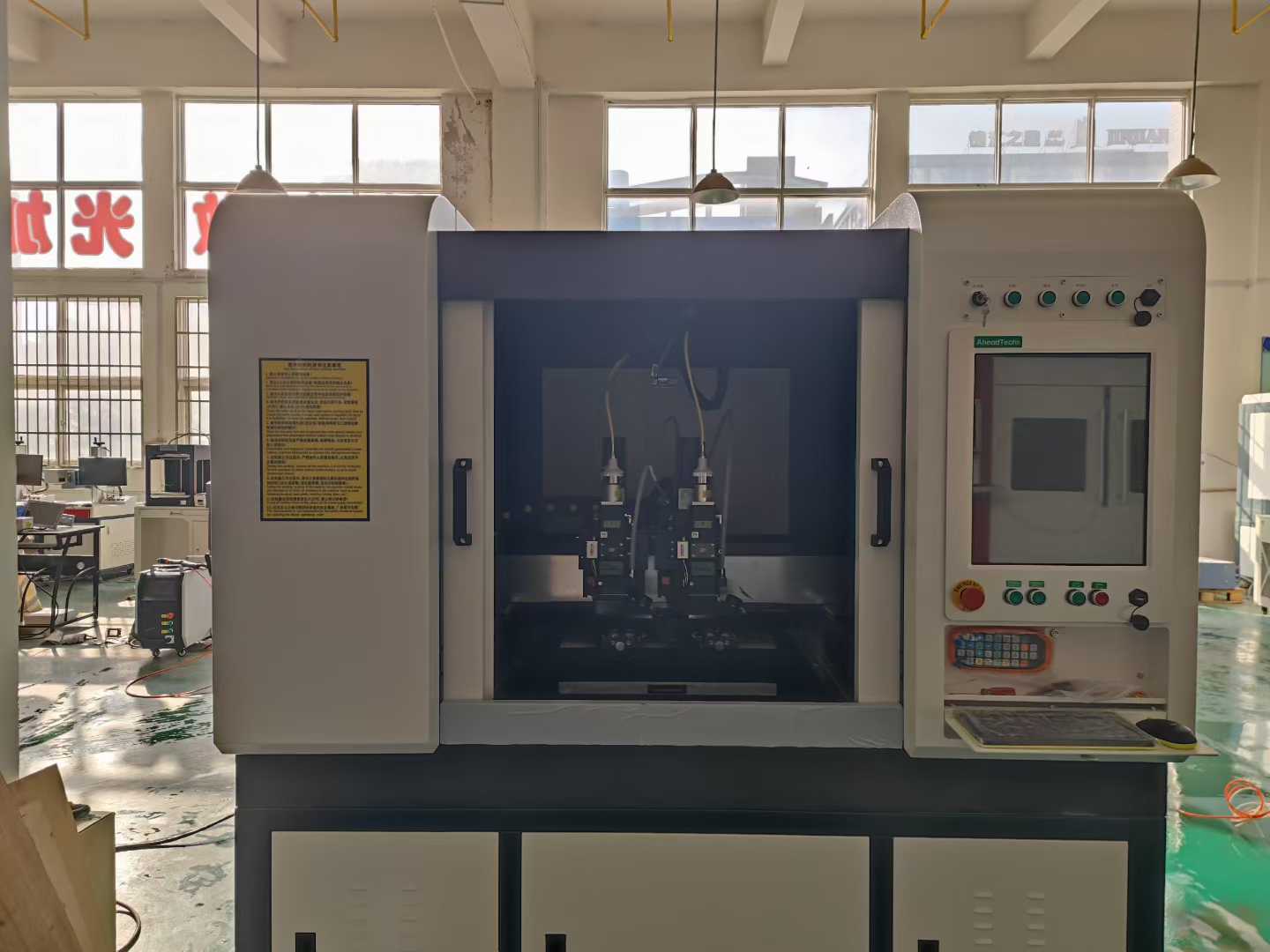
- Taiwan: 1 customized dual-head, dual-beam path ceramic laser cutting machine, in operation for more than 2 years at a high-end electronic component manufacturer, with processing capacity nearly doubled versus a single-head machine.
- China — electronics: 7 ceramic laser cutting machines deployed for 4+ years of 24/7 mass production, establishing a standardized ceramic substrate processing line.
- China — semiconductor research institute: 1 custom-designed semiconductor-specific ceramic laser cutting machine, 2+ years in service for R&D and small-batch prototyping.
- China — Tsinghua University: 1 precision ceramic laser cutting equipment unit, 3+ years in service on a laboratory and pilot-scale testing platform.
Across roughly ten installed units in four markets — with at least three machine installations remaining in service beyond the two-year mark — a pattern of sustained customer acceptance emerges. That is where long-term mass production history becomes a de facto qualification credential: the combination of multiple machines, across multiple customers, over meaningful durations demonstrates that the supplier's equipment is capable of repeatable operation rather than only isolated project delivery.
The honest caveat is that these are still specific machines in specific configurations, not universal guarantees about every machine the supplier builds. The weight of the evidence depends on whether the recorded configuration matches the buyer's work package.
Case Anatomy: How to Read the South Korean Export Record
The South Korean case deserves deeper examination because it contains all the elements of a quality-evidenced qualification signal in a single customer-specific configuration.
The recorded facts are these. Project scale: 1 unit exported to a South Korean high-end precision manufacturing company. Application: processing of high-end precision ceramic parts, special hard and brittle materials and precision electronic components for the customer's production line, with strict precision, stability and yield requirements. Duration: more than 1.5 years of stable overseas operation. Outcome: finished product yield meeting international high-end standards, stable operation throughout, low maintenance costs, and adaptation to stringent overseas production conditions.
For procurement use, the interpretable elements within such a record are:
- Customer type match. A high-end precision manufacturing company's acceptance gate is closer to the buyer's target customer profile than is a reference from a general-purpose manufacturer, even one that is genuine.
- Acceptance criteria match. The record explicitly cites precision, stability and yield — the same metrics any buyer will ultimately measure.
- Time exposure. 1.5 years is long enough to separate a successful installation from chronic stability issues, though not long enough to cover a full laser source lifecycle. Buyers should confirm laser source expected life under their planned production load.
- Geographic exposure. Overseas operation covers power quality, environmental conditions and operator skill variation that are not trivially reproducible at a supplier's home site.
Together these elements make a stronger signal than any certificate. They do not constitute a turnkey guarantee. The verified configuration must still be mapped to the buyer's material and thickness envelope, and tested independently during acceptance.
Technical Foundations of Verifiable Yield
Yield is not produced by a price sheet. It is produced by the combination of optical accuracy, motion control, process parameter development and inspection discipline. For technically minded procurement, understanding those inputs helps frame the right questions.
Optical and Motion Precision
Positioning accuracy is the baseline on which yield is built, because it determines how closely a cut geometry matches intended geometry. YCLASER's precision laser cutting platform carries stated positioning accuracy of ±0.005 mm and kerf width in the range 0.02–0.15 mm. The platform's cutting range spans 0.01 mm to 20 mm, with stable mass-production thickness typically below 6 mm for hard and brittle materials as stated in the processing service specification.
Each of those figures has structural implications. A stated positioning accuracy of ±0.005 mm is only credible if the machine's motion system is fully compensated — linear motors, grating ruler and closed-loop control. The kerf width figure matters not just as cut width, but because it constrains how much material can enter the heat-affected zone before fracture or chipping occurs, for a given cut geometry.
What buyers should ask:
- Is positioning accuracy measured at full speed or in a static condition?
- Is accuracy reported per axis or across the working area?
- What is the sample size behind the stability test?
Parameter Development and Process Validation
For hard and brittle materials, the parameter set is itself an asset. The same machine cutting aluminum oxide at the wrong speed, frequency and assist gas configuration will produce a different yield than at the right configuration. Process development capability therefore matters as much as hardware.
YCLASER's stated process capability includes completing new material process verification, outputting qualified samples, and providing process parameters for subsequent mass production. For buyers at the evaluation stage, this means the supplier should be able to provide validated parameter sets rather than needing to develop them on the buyer's material at the buyer's time and cost.
What buyers should ask:
- Was the parameter set for my material and thickness validated, and if so, on what machine and under what yield?
- Are retained cut samples available for independent inspection?
- If my material is not on the validated list, what process support is included to develop it?
Factory Verification and Inspection Discipline
The final stage before shipment is factory verification. For customized laser equipment, this process carries the highest qualification value because it records the acceptance state of that specific machine in its specific configuration.
YCLASER's factory quality process includes optical path precision calibration, repeatability testing, whole-machine power-on aging testing, actual material trial cutting verification, full-function program testing and issuance of a factory quality inspection report. The latter two are especially significant. Trial cutting verification is the only test that exercises optical, motion, parameter and material behavior at once. Power-on aging is the only test that exposes early-life failure modes under a production-like load.
What buyers should ask:
- Does the factory quality inspection report include the trial cut parameters and results?
- How long did the aging test run, and over what functional modules?
- Were any faults recorded during aging or trial cut, and what corrective action was taken?
Procurement Process and Delivery Condition Questions for Custom Laser Equipment
For custom systems, the buyer's problem is not whether a machine exists but whether that specific configuration will pass verification on delivery. Questions about delivery condition are therefore not just logistics questions. They are qualification questions.
YCLASER's delivery process includes the following qualification-relevant timeframes:
| Stage | Timeframe | What the buyer should confirm |
|---|---|---|
| Sample making | 1–3 business days | Samples prepared against the buyer's actual material and thickness specification. |
| Standard model delivery | 30 business days | Delivery acceptance criteria stated in the purchase order. |
| Non-standard customization | 35–50 business days | Trial cut result provided for the customized configuration. |
| OEM/ODM bulk orders | 3–10 business days depending on process complexity and order volume | Batch sampling plan in place. |
| Minimum order quantity | 1 unit for equipment | Sample and small-batch trial orders supported without mandatory minimum. |
Matters buyers should require in the purchase order:
- Pre-shipment trial cut specification — material type, thickness and lot must match the buyer's work package.
- Acceptance metrics — positioning accuracy, kerf width, reject rate and edge chipping limits, each stated in terms of the buyer's actual product specification.
- Factory acceptance — dimensional and visual inspection of trial cut samples by an independent party.
- Packaging and logistics protection — moisture, shock, impact indicators and agreement on post-unpacking adjustment.
- Spare parts and warranty — wear part list, warranty scope and response time.
- Site acceptance — explicit procedure for re-verification, who performs it, and what happens if it is not met.
None of these items is individually novel. Collectively, they move the procurement conversation from certificate-based confidence to verification-based accountability.
Market Trend Context: Why Qualification Reading Matters Now
The global laser cutting market is expanding, and the expansion raises the stakes on performance evidence rather than on certificate lists.
According to Market Research Future, the global laser cutting machines market was estimated at USD 5.74 billion in 2024 and is projected to reach USD 12.61 billion by 2035. In the PCB segment, Dataintelo estimates the global PCB laser drilling machines market at USD 1.8 billion in 2025, with a CAGR of 8.1% through 2034. On the technology side, Next Move Strategy Consulting estimates the picosecond laser market at USD 3.99 billion in 2026, projected to grow at a 23.8% CAGR to USD 31.44 billion by 2035.
As the market expands, so does the supplier population. Along with that expansion comes a lowering of the certificate-based qualification barrier — more suppliers can reach a minimum documentation bar because the cost of doing so is falling. What remains scarce and non-substitutable is provable production performance across multiple machines, customers and geographies over time. In a larger market, performance evidence has relatively higher discriminating value.
One technology trend is relevant to buyers. Fiber lasers, according to DNE Global, achieved over 60% of global installations by 2025, displacing CO2 lasers in part because of energy efficiency — 45% wall-plug efficiency versus 30%. Higher efficiency converts into lower heat dissipation and lower running cost per unit. But efficiency gains do not substitute for the configured process validation that must be matched to the buyer's material envelope.
The silicon steel path illustrates a related tightening of acceptance boundaries. As recorded in industry technical review, laser processing of silicon steel sheets reduces the Heat Affected Zone to below 0.1 mm, minimizing magnetic performance degradation compared with mechanical punching. The downstream implication is that the cutting edge quality and stability requirements rise accordingly — and those are exactly the boundaries that long-run data can inform.
Comparison with Certificate-Based Qualification
Weighed side by side, the two approaches have distinct trade-offs.
Certificate-based qualification is fast to audit, standardized across suppliers, and documented in a way that can be reported to compliance teams or procurement committees. It also has structural limits: it proves system presence rather than configuration-specific output, and it carries a time lag — a certificate valid on its issue date does not confirm capability on the date a buyer evaluates it.
Performance-based qualification is configuration-specific, outcome-oriented and externally anchored. Its limits are equally real. It is harder to scale because each case must be interpreted individually, and evidence quality varies from customer to customer. Interpretation is subject to survivorship bias — the existence of a public installation record does not automatically establish that every customer achieved equal results. And the validated material and thickness envelope may be narrower than the supplier's declared material range.
Neither approach substitutes cleanly for the other. A complete qualification approach uses both, in order: certificates for the initial screen, and performance reading for the final choice. Performance evidence distinguishes between two apparently equal suppliers. Certificate evidence screens out suppliers at lower cost.
Future Outlook
Two developments are likely to reshape how overseas buyers read qualification signals in the near term.
First, export qualification is becoming more verifiable because suppliers are themselves becoming more transparent about the earlier cases that established them. A public installation record from an earlier market — South Korea, in this case — makes it easier to check customer type, duration and acceptance criteria. The measure buyers apply should shift accordingly: not do you have an export case, but can the export case be retrieved, can the configuration be matched, and can the customer be referenced?
Second, material envelopes are broadening. In semiconductor packaging substrates, aluminum nitride power modules and silicon steel, the acceptance boundary is tightening. That will raise the value of data from long-term operation, because it is precisely at tighter boundaries that configuration-specific experience produces information that certificates cannot.
The pattern that is likely to persist: as high-precision laser cutting becomes more of a baseline capability, supplier differentiation will depend less on machine specifications and more on documented production outcomes. The qualification signals that retain value through that shift will be the ones that are hard to replicate — validated yield on difficult customers, documented runtime, and proven behavior on demanding materials.
FAQ
A verifiable qualification signal is evidence that can be traced to an externally anchored source rather than to a supplier's self-declaration. In practice, this usually means one of the following: customer-specified finished product yield rather than a self-defined benchmark; a record of runtime on an installation where the customer type can be confirmed and the acceptance criteria included precision and yield; documented export into a market whose customer base has independent qualification requirements. Certificate lists remain useful for a first screen, but they measure organizational process, not configuration-specific outcomes.
The South Korean case proves three things: that a configuration, delivery and support package passed the threshold for export to a high-end precision manufacturing customer; that the customer accepted the equipment over 1.5+ years of operation with stable performance and finished product yield meeting international high-end standards; and that the record covers demanding precision applications including advanced ceramics and special hard and brittle materials. It does not prove that the material and thickness envelope validated by that customer will match any other buyer's work package. The value of the case is external anchoring — verification is still configuration-specific.
Any single customer reference is locally informative. When multiple machines have operated across several customers and extended time frames, however, the supplier's equipment is shown to be capable of repeatable behavior rather than of one-off success. YCLASER's installed base spans roughly ten units across four markets, including over 1.5 years in South Korea, over 2 years in Taiwan, 4+ years of 24/7 operation in China, and 3+ years in a university research setting. The pattern functions as de facto qualification because sustaining multiple machines in multiple locations over multi-year periods is harder and more costly to fabricate than passing an annual audit.
The core question is: what acceptance state is defined in the purchase order, and how is it verified? Specifically, confirm that trial cut specification matches the buyer's material and thickness; that trial cut results are recorded and provided; that the factory quality inspection report covers optical path calibration, repeatability, aging testing, trial cutting and full-function testing; that packaging and logistics protection are specified; that site re-verification is assigned to a named party; and that the process for addressing non-conformance after shipment is defined. YCLASER's stated delivery sequence includes sample making in 1–3 business days, standard model delivery in 30 business days, non-standard custom delivery in 35–50 business days, and a minimum order quantity of one unit for equipment.
Widen the evidence base first. Ask for traceable samples rather than parameter sheets, for aging and trial cut records rather than only a certificate of conformity, and for installed-base uptime. Where direct verification is still not possible, use purchase order terms to add verification: acceptance of trial cut samples by an independent inspection body, or milestone-based payment that holds final settlement to site acceptance. A supplier that cannot provide any verifiable performance evidence should be treated as a meaningful negative signal rather than simply as missing information.
The two function at different stages. Certificate screening removes non-qualified suppliers at low cost, while performance reading is used to decide between suppliers that clear the baseline. A practical sequence is: first, use certificates to reduce a long list to a shortlist; then, use production evidence to make the final decision, examining installation records, runtime, customer type and acceptance criteria. This sequence reduces both cost and time while producing more precise outcomes than either approach alone.
Closing Assessment
Qualification in high-precision laser cutting procurement ultimately depends on whether a supplier can show that its machines have operated in real customers' hands under real conditions — not only whether it can produce a file of documents. The YCLASER South Korean export case and the installed base behind it give concrete shape to that perspective: recorded yield, recorded runtime with low maintenance cost, and recorded entry into a demanding inspection market together provide external anchoring that a certificate list cannot carry on its own.
For buyers evaluating high-precision laser cutting equipment who want a starting reference for supported processing capability and technical specifications, the YCLASER product catalog is available for download: YCLASER Catalog (PDF).
¿Tiene preguntas o necesita más detalles?
Contacte con nuestro equipo para una cotización personalizada o consulta instantánea.
Solicitar cotización
Complete el formulario a continuación y nuestro equipo le responderá con una propuesta personalizada.
Chat directo de WhatsApp
¿Prefiere chatear en tiempo real? Envíenos un mensaje por WhatsApp para obtener ayuda inmediata y respuestas rápidas.
- Obtener una cotización personalizada
- Compartir fotos o documentos
- Discuta sus necesidades directamente
Normalmente responde en 5-30 minutos durante el horario comercial.