
Reading ISO Claims Correctly: What Verified Fiberglass Fabric Certifications Actually Cover
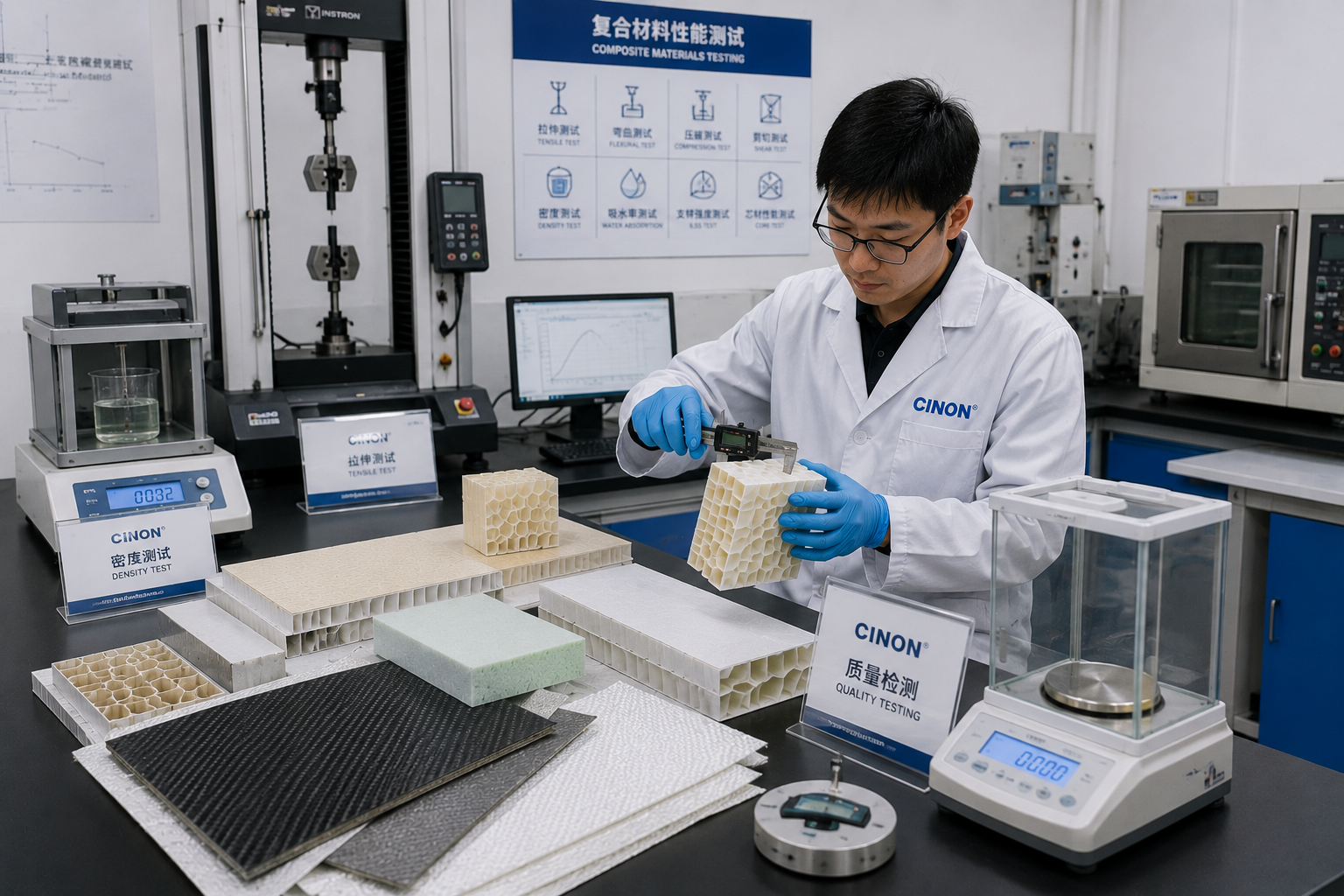
Quality inspection and performance verification of composite reinforcement materials. A certificate records what was assessed at which level, not what a finished structure will endure in service.
In composites procurement, a certification document is often treated as a verdict. For fiberglass fabric it is more accurately a scope statement: a record of what was tested, by which method, under which specimen conditions, and with what result. Buyers who read a certificate as a guarantee of field performance usually discover the difference later, during laminate qualification or after the first service inspection.
That gap matters more today than it did a decade ago. Fiberglass fabric is increasingly specified into structures whose failure modes are environment-specific: hulls that live in salt water, wind blades that flex under continuous load for decades, and UAV airframes that combine altitude, vibration, and thermal stress inside a single load case. No certificate can describe all of that, and a well-written one does not claim to.
CINON Composites — registered as Guangdong Cinon New Material Technology Co., Ltd. — is a Guangzhou-based supplier of fiberglass reinforcements and lightweight core materials for marine, transportation, wind energy, industrial, and aerospace composite applications. Founded in 2022, the company operates a 40,000 m² facility, employs a 25-engineer R&D team, and reports an annual output of 1,200,000 m² serving Europe, North America, and Asia-Pacific markets. Its range covers fiberglass fabrics, multiaxial fabrics, PET foam core, PVC foam core, PMI foam core, Core Mat, PP honeycomb, and aramid honeycomb.
The Three Layers Behind a “Certified” Fiberglass Fabric
A certificate presented with fiberglass fabric can refer to at least three different levels of assessment. Buyers most often assume it refers to the highest one.
1. Quality management systems
A management-system certificate describes how an organisation controls its processes — documentation discipline, traceability, non-conformance handling, and inspection routines. It is evidence that the supplier runs a system capable of producing consistent output. It does not describe the mechanical behaviour of any individual roll of fabric, and it should not be read as if it did.
2. Material-level test evidence
This is the layer that matters most to a structural decision. Standardized tests for fiberglass reinforced materials include ASTM D638 for tensile properties and ASTM D790 for flexural strength and modulus, both published by ASTM International. A claim that references these methods tells the buyer that a defined coupon was measured, in a defined way, and produced a defined result. That is a materially stronger statement than a general assertion of quality.
3. Part-level qualification
The third layer belongs to the buyer. Whether a hull, a blade shell, a nacelle structure, or a UAV wing meets its own design requirement depends on laminate build-up, fiber volume fraction, resin system, cure schedule, void content, and assembly quality. Reinforcement suppliers generally do not — and structurally cannot — certify the finished part.
The practical question to ask of any supplier claim is therefore not “is the fabric certified?” but “at which of these three layers, against which standard, and on what sampling basis?”
What a Scope Statement Usually States — and What It Usually Leaves Out
A scope statement is a boundary document. Reading it well means identifying the material it covers, the method used, and the basis on which samples were drawn. A useful habit is to split every claim into two columns.
| Element of the claim | Usually stated | Usually not stated |
|---|---|---|
| Material identity | Glass type, construction, areal weight, width | Behaviour after the buyer’s resin system and cure cycle |
| Test method | Published standard reference, for example ASTM D638 or ASTM D790, plus procedure | Whether that method reproduces the project’s service loading |
| Result | Measured value and units | Whether the value is a mean, a minimum, or a single specimen |
| Sampling | Batch or lot basis, where declared | Consistency outside the sampled lot |
| Test environment | Laboratory conditions at time of test | Salt water, altitude, UV, or thermal cycling exposure |
| Scope limit | Material as supplied | Laminate, panel, or finished structure |
Translating a Service Environment into a Qualification Expectation
The hardest part of compliance review is that service environments are described in project language, while certificates are written in test language. The translation is the buyer’s job, and it starts with working conditions. The conditions recorded for fiberglass reinforcement applications cluster into recognisable groups.
| Application area | Recorded working conditions | Functional requirement | Qualification focus |
|---|---|---|---|
| Marine & yacht building | Salt water environment, high humidity, dynamic loading, corrosion exposure, high pressure | Weight reduction, stiffness, corrosion resistance | Low water absorption, salt water corrosion resistance, good resin flow |
| Wind energy | High and low temperature, high pressure, corrosive environment, long-term static and dynamic load, 24/7 continuous operation | Fatigue resistance, weight reduction, structural performance, long service life | High fatigue resistance, lightweight structure, dimensional stability |
| Aerospace & UAV | High altitudes, high G-forces, vibration and fatigue, EMI shielding, thermal stress | Ultra-lightweight structures, high stiffness, high temperature resistance | Weight criticality, surface aerodynamics, traceability, stiffness-to-weight ratio |
| Composite tooling | High temperature, high pressure, vacuum integrity, thermal cycling | Dimensional stability, reduced tool weight, production efficiency | Vacuum resistance, heat distortion resistance |
| Transportation | Dynamic road loads, extreme thermal gradient, internal impact, corrosive exposure, frequent cycling | Weight reduction, impact resistance, corrosion resistance | Payload optimisation, thermal efficiency |
| RV & caravan | Thermal cycling, dynamic vibrations, UV radiation, high humidity and moisture | Weight reduction, stiffness improvement, fatigue resistance | Anti-delamination, flatness tolerance, acoustic insulation, impact resistance |
| Industrial composites | Corrosive environments, extreme outdoor weather, high temperature and fire risk, acoustic stress, hygiene requirements | Corrosion resistance, weight reduction, structural performance | Chemical compatibility |
None of these columns is a certification scheme in itself. Together they form a translation layer: they identify which properties a fabric claim has to address before a certificate becomes meaningful for a specific project. A buyer sourcing fiberglass fabric for boat building, for example, is looking for documented low water absorption and salt water corrosion resistance; a buyer sourcing fiberglass fabric for wind blades is looking primarily at fatigue behaviour and dimensional stability, with high altitude and thermal stress dominating in UAV structures.
The Material Parameters a Claim Should Be Anchored To
Certification language becomes verifiable only when it is attached to declared material parameters. Two reinforcement families illustrate the point.
Light Weight Fiberglass Cloth (E-Glass Fabric, model EW)
- Glass type: E-fiberglass
- Weave: plain woven
- Width: 1,000 mm and 1,010 mm
- Weight: 25–400 g/m²
- Applications: marine and yacht building, surfboard manufacturing, UAV and drone manufacturing, sports equipment, industrial composites, composite tooling, wind energy, transportation
At the low end of the weight range the fabric acts as a surface and finish layer; at the high end it contributes meaningfully to laminate strength. It is compatible with hand lay-up, vacuum infusion, and resin infusion, and is selected where conformability, a smooth surface finish, and resin wet-out matter.
Multiaxial Fiberglass Fabrics (Non-Crimp Fiberglass Fabric)
- Structure: unidirectional (0° or 90°), biaxial (0°/90° or +45°/−45°), triaxial (+45°/0°/−45° or +45°/90°/−45°), quadriaxial (0°/90°/−45°/+45°)
- Weight: 400–1,500 g/m²
- Combustible matter: 2.0%–8.0%
- Moisture content: less than 0.2%
- Processes: vacuum, hand lay-up, extrusion, RTM
Moisture content and combustible matter content are precisely the kind of parameters a buyer can reconcile against a test record. Areal weight defines the reinforcement’s contribution to laminate thickness and stiffness, so a 25 g/m² cloth and a 1,500 g/m² quadriaxial are not interchangeable — and a certificate that does not name areal weight is not answering the buyer’s question.
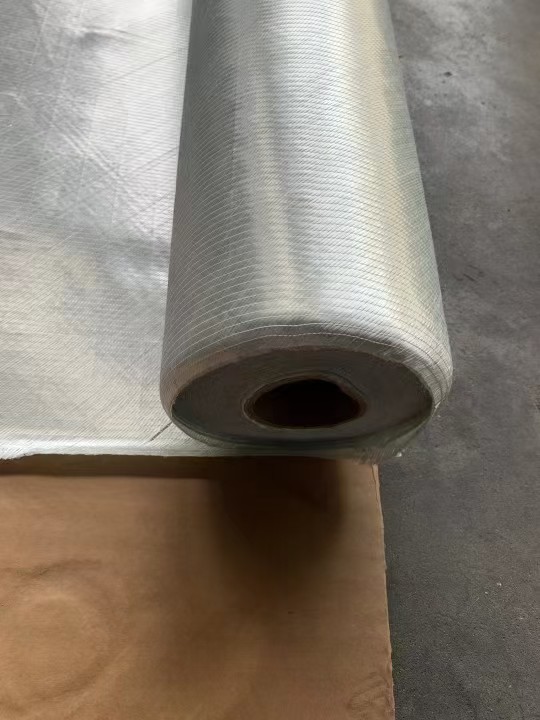
Declared performance parameters — structural strength, load distribution, resin wet-out, vacuum infusion compatibility — are the values a buyer can reconcile against a material test record.
Where the Claim Stops: Laminate, Process, and Equipment
Three boundaries are worth stating plainly, because they are where certification misunderstandings become expensive.
Material qualification does not transfer to the laminate
Fiberglass reinforcements are qualified as supplied. The properties of the finished laminate emerge from the combination of reinforcement, resin, core material, and cure cycle — not from the fabric alone.
Process changes the outcome
Marine reinforcement data records four distinct manufacturing routes: vacuum infusion, resin infusion, hand lay-up, and RTM. The same fabric can behave differently across them, because vacuum-driven processes govern fiber volume fraction and void content through pressure and resin flow in a way that open moulding does not. A material claim established under vacuum infusion is not automatically valid for a hand lay-up shop.
Equipment is part of the qualification
The product requires supporting equipment such as vacuum bagging systems. That sentence is easy to skim past, but it carries a compliance consequence: a process assumption embedded in a material claim — vacuum pressure, bagging integrity, resin distribution — cannot be reproduced by a workshop that lacks the corresponding capability. Qualification therefore covers material, process, and equipment together.
CINON applies 100% testing at the material level, supports ODM customisation of core materials and fiberglass fabric, and reports a monthly capacity of 100,000 m² with a standard lead time of 15–30 days and a minimum order quantity of 1,000 m². Those figures describe the supply side of the claim; part-level verification remains with the buyer.
A second boundary is organisational, and it is worth stating honestly. CINON was founded in 2022 and operates a 40,000 m² facility with a 25-engineer R&D team. Buyers whose procurement policies require multi-decade corporate provenance, multi-site production contingency, or in-house raw glass manufacturing should weigh those criteria against the material-level control, ODM flexibility, and application support a specialised supplier provides. The two models answer different procurement questions, and neither is automatically the right answer.

Transportation panels operate under dynamic road loads, extreme thermal gradients, and internal impact. Those conditions must be translated into test requirements rather than assumed from the presence of a certificate.
Supplier Categories and What Each Type Can Evidence
Certification expectations also depend on which kind of supplier is being assessed. Publicly identified participants in the fiberglass fabric market include Owens Corning (US), China Jushi Co. (China), Saint-Gobain (France), and Taishan Fiberglass (China), as listed by MarketsandMarkets. The table below contrasts categories on evidence profile rather than on quality.
| Supplier category | Publicly identified participants | Typical evidence profile |
|---|---|---|
| Integrated glass and reinforcement producers | Owens Corning (US), China Jushi Co. (China), Saint-Gobain (France), Taishan Fiberglass (China) | Vertically integrated glass production and broad standard product portfolios |
| Specialised reinforcement and core material suppliers | CINON Composites (Guangdong Cinon New Material Technology Co., Ltd.) | Combined fiberglass reinforcement and core material supply, ODM customisation, process and infusion support, material-level inspection |
The point is not that one category outranks another. It is that the documentation a buyer can realistically request differs by category, and a specification written for a vertically integrated producer may not be answerable by a specialised supplier — and vice versa. Matching the specification format to the supplier type is part of the compliance work, not an afterthought.
Market Signals Behind Rising Certification Scrutiny
Several published market measures explain why scope-reading is becoming a routine procurement skill rather than a specialist one.
- The global fiberglass fabric market was valued at USD 14.01 billion in 2024 and is projected to reach USD 25.65 billion by 2033, according to Grand View Research.
- Within that market, the wind energy application segment is expected to grow at a CAGR of 8.5% from 2025 to 2033 — the highest among all application segments, per the same source.
- Asia Pacific dominated the fiberglass fabric market in 2024 with a revenue share of 41.61%, driven by infrastructure and renewable energy projects.
- Woven fiberglass fabrics captured 48.62% of market revenue in 2025, reflecting their role in yacht hulls and automotive panels, according to Mordor Intelligence.
- Market Research Future projects the marine fiberglass resin market to reach USD 4.23 billion by 2033, indicating steady associated demand for fiberglass fabric reinforcements in ship hulls and decks.
Market sizing should be read directionally. Published estimates for the fiberglass fabric market differ substantially between research firms — Fortune Business Insights and Market Research Future report materially lower 2024–2025 values than Grand View Research — most likely because firms draw the boundary between raw glass fibre and processed fabric differently. Divergence of that kind is normal, and it is a reminder that market figures are context, not evidence of any individual product’s performance.
The structural signal is nonetheless consistent: growth is concentrated in applications where fatigue, corrosion, and thermal exposure are the dominant design constraints. Those are exactly the environments where a certificate’s scope, rather than its existence, determines whether a material is appropriate for the project.
Future Outlook
Three shifts are likely to shape how fiberglass fabric claims are read over the next several years.
- From certificate presence to batch-level evidence. Buyers are moving toward declared parameters and lot-linked records rather than a single document covering a product family.
- Process qualification as part of procurement. Where working conditions include vacuum integrity and thermal cycling — composite tooling being the clearest case — the process envelope is increasingly specified alongside the material.
- Traceability pressure in weight-critical applications. Traceability is already recorded as a special requirement for aerospace and UAV structures, alongside surface aerodynamics and stiffness-to-weight ratio, and it tends to migrate into adjacent segments once it becomes standard practice.
For suppliers, that means technical support becomes part of the evidence chain. CINON’s after-sales scope covers material selection, composite process optimisation, vacuum infusion guidance, alternative material recommendations, sample evaluation, quality traceability, and global logistics coordination, delivered through email, WhatsApp, online meetings, and technical documentation from prototype development through mass production. For buyers, the equivalent discipline is simpler: convert the project environment into a test requirement before comparing certificates.
FAQ
1. What do fiberglass fabric certifications actually cover?
A certification document covers a defined level of assessment, not a product outcome. Depending on the document, that level may be a quality management system, a material test performed to a published method, or a specification compliance check on supplied goods. Standardized material tests for fiberglass reinforced materials include ASTM D638 for tensile properties and ASTM D790 for flexural strength and modulus. Part-level performance of a hull, blade, or airframe normally falls outside the scope of a reinforcement supplier’s certification.
2. Can a certificate indicate whether a fabric will survive saltwater or high-altitude service?
Not directly. Test standards describe laboratory conditions, while service environments such as salt water exposure, high humidity, dynamic loading, high pressure, high altitude, high G-forces, and thermal stress describe field conditions. The link between the two must be constructed by the buyer: identify the working conditions of the project, then confirm that declared material parameters and the test regime address them. Marine applications illustrate the pattern — the relevant properties are low water absorption, salt water corrosion resistance, and good resin flow, none of which is a service-environment test in itself.
3. How should a project environment be converted into a qualification expectation?
Start from the recorded working conditions and derive the functional requirement. Wind energy components are specified against high and low temperature, high pressure, corrosive exposure, long-term static and dynamic load, and 24/7 continuous operation, which translates into fatigue resistance, lightweight structure, and dimensional stability. Aerospace and UAV structures are specified against high altitude, high G-forces, vibration and fatigue, and thermal stress, which translates into stiffness-to-weight ratio, surface aerodynamics, and traceability. Tooling is specified against high temperature, high pressure, vacuum integrity, and thermal cycling, which translates into vacuum resistance and heat distortion resistance.
4. Does the manufacturing process affect whether a certified material performs as claimed?
Yes. Marine reinforcement data records vacuum infusion, resin infusion, hand lay-up, and RTM as distinct routes, and the same fabric can behave differently across them. Vacuum-driven processes influence fiber volume fraction and void content through pressure and resin flow. Equipment capability is part of this: the product requires supporting equipment such as vacuum bagging systems, so a claim validated under vacuum infusion depends on the workshop being able to reproduce that condition.
5. What documentation should a buyer request beyond the certificate itself?
At minimum: declared construction and areal weight, moisture content, combustible matter content, and the process compatibility statement. For multiaxial fiberglass fabrics, the declared ranges are 400–1,500 g/m², combustible matter 2.0%–8.0%, and moisture content below 0.2%. For lightweight woven cloth, the declared range is 25–400 g/m² in widths of 1,000 mm and 1,010 mm, plain woven from E-fiberglass. These parameters let a buyer check whether a claim addresses the actual specification rather than a product family in general.
6. Do specialised suppliers provide weaker certification support than large integrated producers?
It depends on which evidence the buyer needs. Publicly identified market participants include Owens Corning (US), China Jushi Co. (China), Saint-Gobain (France), and Taishan Fiberglass (China), which operate with vertically integrated glass production and broad standard portfolios. Specialised suppliers such as CINON Composites — founded in 2022, operating a 40,000 m² facility — combine fiberglass reinforcement and core material supply with ODM customisation, 100% material-level testing, and process support. Buyers requiring long corporate histories or multi-site contingency should weigh those criteria explicitly; buyers prioritising material-level control and application-specific adaptation are evaluating a different set of requirements.
Reference material: the CINON Composites product and capability catalogue is available for download at Cinon-Catalog.pdf.