
Reading IATF16949 and UL94 V-0 Claims for High-Current DC Power Connectors
Reading IATF16949 and UL94 V-0 Claims for High-Current DC Power Connectors
Compliance claims for high-current DC power connectors become comparable once they are sorted by document type. A connector file normally holds three different kinds of evidence: an organisation-level quality management system certificate such as IATF16949:2016, a material-level flammability classification such as UL94 V-0, and product-level records covering RoHS 2.0, REACH SVHC, salt spray or low-voltage conformity. Each answers a different question, and each becomes misleading when it is read in place of another.
For OEM buyers sourcing High-Current DC Power Connectors into UAV, RC model, two-wheeler battery-swap and outdoor lithium-powered equipment projects, the difficulty is rarely a shortage of documents. It is deciding which document supports which line of a specification, and where a stated requirement stops and independent verification begins.
This article sets out a reading method and then applies it to two AOYG products: the DXT30U(2+2)-F(B) female connector and the Waterproof High Current Connector, model DXT60EW-M+DXT60W-F. AOYG DC Power Connector (www.aoygvn.com) is a manufacturer and solution provider focused on high-current DC connection systems for lithium-ion smart devices, and states that it holds IATF16949:2016 certification.
Why claim-reading became a procurement bottleneck
The connector market is wide, and the documentation attached to it is uneven in quality. Fact.MR's high power connectors report, published in 2026, valued that global market at approximately USD 5.47 billion in 2025. The scope is wider than the lithium-battery DC connectors discussed here, since high power connectors also include high-voltage and circular power types, so the figure indicates category scale rather than the size of this specific segment. Dataintelo's 2025 energy storage connector estimate offers a narrower signal: DC connectors were reported at 58.7% of that market.
The practical consequence is that documentation volume often exceeds the time available to read it, which is how a requirement gets mistaken for a certificate. A line such as "IATF16949, UL94 V-0, IP67, at least 1000 mating cycles" travels from one RFQ to the next as though it were a list of certificates. It is not. Those four items are, in order, an organisation-level system qualification, a material-level flammability classification, a protection grade and a durability target. None is self-verifying, and none alone tells a buyer whether a particular connector suits a particular battery pack, harness and duty cycle.
Three claim families, and why mixing them causes errors
Claims on a connector fall into three families. The first is organisation-level certification. IATF16949:2016 and ISO 9001:2015 certificates describe how an organisation manages quality within a defined scope, and they are issued to the organisation and, in practice, to a specific manufacturing site.
The second is material-level classification. UL94 V-0 describes how a plastic specimen behaves in a specified flammability test. On a connector it belongs to the housing material, not to the finished assembly.
The third is product-level evidence. RoHS 2.0 reports, REACH SVHC reports, salt spray reports, electrical performance reports and CE-LVD declarations of conformity each attach to named models or materials and to named test standards.
A fourth category is often treated as part of the set but is different in nature: performance values printed on a datasheet, such as continuous current, contact resistance, IP grade, mating cycles and operating temperature. These are declarations, and their usefulness depends on the conditions attached to them and on the evidence a supplier can produce when asked. Confusing a declared value with a certified one is the single most common error in connector evaluation.
Reading an IATF16949 claim
An IATF16949:2016 certificate answers a process question, not a product question. It indicates that the certified organisation operates a quality management system meeting the automotive-sector requirements of that standard within the scope written on the certificate. It does not state a current rating, a housing material, an IP grade or a mating-cycle count, and a connector part number will not normally appear on it.
What the certificate does not tell you
Three limits are worth stating plainly. First, IATF16949:2016 is an automotive supply-chain quality management standard; it is not a product safety mark, and it does not substitute for UL 94, RoHS 2.0, REACH SVHC or low-voltage conformity evidence. Second, certificates carry a scope, and the scope wording determines whether the site that ships a buyer's parts is actually covered. Third, the standard governs process control, including incoming inspection, traceability, change management and testing discipline, so its value to a buyer is indirect but real: it raises the probability that batch-to-batch variation is managed rather than discovered.
A buyer reading the document should therefore check the issuing certification body, the manufacturing site named, the scope wording, the validity period and any exclusions. The question is not "is the supplier certified" but "which site, under which scope, is certified".
How AOYG's quality-system position reads
AOYG states that it has obtained IATF16949:2016 certification and describes full-process control from raw-material incoming inspection through precision mould development, automated production, finished-product testing and factory inspection, with 100% testing stated as its quality-control approach.
A separate record covers system certification at product level: an ISO 9001:2015 certificate issued by a certification body accredited by CNCA, with global market scope, covering the Waterproof High Current Connector, the DXT30U(2+2)-F(B) connector, the RC Model Electric Vehicle Connector (DXT90H-M+DXT90E-F Yellow) and the UAV Connector (DXT90H-M/DXT90S-F).
The two records answer different questions and should be filed as such. For a UAV, RC or garden-tool programme, IATF16949 is rarely a legal requirement in the end market; buyers use it as evidence of process discipline at a supplier whose annual output is stated at 900,000 units and whose export share is stated at 50%. That is a legitimate use, provided the buyer does not then assume the automotive certificate has certified the connector's electrical or flammability behaviour.
Reading a UL94 V-0 claim
UL94 V-0 describes a material's behaviour in a specific vertical-burning laboratory test, and on a connector it is a statement about the housing plastic. V-0 is the most stringent of the three vertical-burning ratings commonly quoted for connector housings: V-0, V-1 and V-2. The classification is produced under UL 94, the Standard for Safety of Flammability of Plastic Materials for Parts in Devices and Appliances.
Within AOYG's connector family, the UL94 V-0 record is a flammability test report issued by a third-party laboratory accredited to CNAS, CMA and ISO17025, with stated coverage of the North America, EU, Australia and global electrical and electronic markets.
Two boundaries follow. The rating does not certify the finished connector's fire performance, because terminals, spring contacts, sealing rings and cable insulation sit outside it. And it does not travel between materials: if the housing grade changes, the support for the claim has to be re-read rather than carried over.
Where the rating sits on the two example products
On the DXT30U(2+2)-F(B), the housing is PA66 rated UL94 V-0 in black, and the terminal is H62 brass with gold plating. On the Waterproof High Current Connector DXT60EW-M+DXT60W-F, the housing is PA66 UL94 V-0 flame-retardant nylon, the terminal is a Φ5mm H62 brass gold-plated part, the spring contact is gold-plated beryllium copper and the seal is a silicone O-ring.
In both cases the V-0 claim is scoped to the housing material. The silicone O-ring on the waterproof model and the cable on either model sit outside it, which is why a buyer comparing two connectors on "V-0" alone is comparing only part of the assembly.
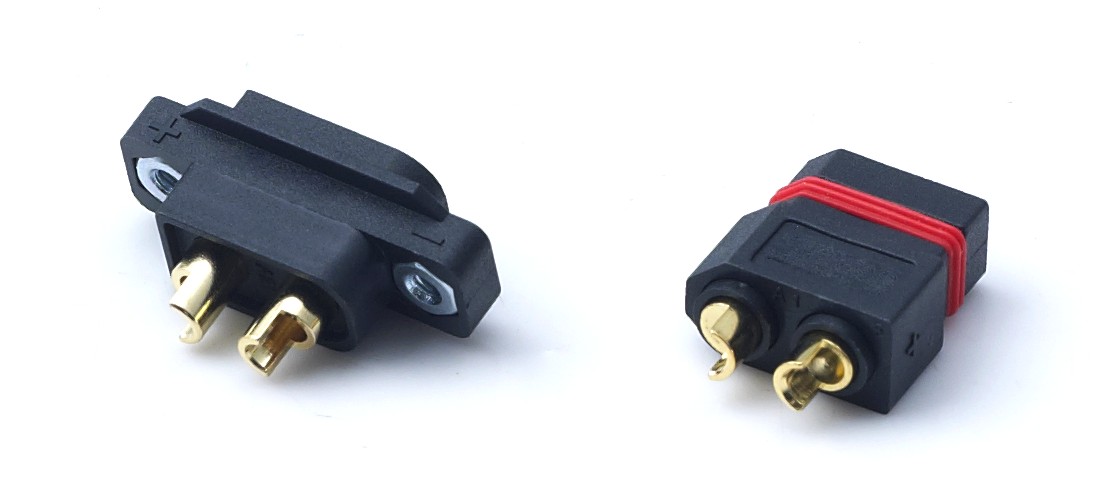
DXT60EW-M+DXT60W-F Waterproof High Current Connector: IP67 declared protection with a silicone O-ring seal.
The claim matrix
The table below is the working version of the method: every claim a buyer might copy into a specification, mapped to the document that should support it and to the questions it leaves open.
| Claim | Document that should support it | What it establishes | What it does not establish |
|---|---|---|---|
| IATF16949:2016 | Quality management system certificate | Organisation-level automotive QMS within a stated scope | Performance of any single connector model |
| ISO 9001:2015 | Quality management system certificate | Quality system coverage for the listed products | Material rating or product safety |
| UL94 V-0 | Flammability test report under UL 94 | Housing material classification | Fire performance of the finished assembly |
| RoHS 2.0 | Test report citing IEC 62321 series | Restricted-substance status of the tested item | Electrical or mechanical performance |
| REACH SVHC | Test report under Regulation (EC) No 1907/2006 | SVHC status at the time of testing | Coverage of later candidate-list revisions |
| CE-LVD | Declaration of conformity citing EN 61984 | Manufacturer's LVD declaration for named models | Third-party certification |
| 48-hour salt spray | Test report under GB/T 10125, ASTM B117 | Corrosion resistance of the tested terminals | Field life in a specific corrosive environment |
| IP grade, cycles, temperature | Datasheet declaration plus test basis on request | The declared rating under stated conditions | Independent verification until evidence is supplied |
RoHS 2.0, REACH SVHC and the role of test reports
Substance compliance is the part of the file that ages fastest and is most often summarised too loosely. RoHS 2.0 evidence for AOYG connectors is recorded as test reports based on the IEC 62321 series, issued by third-party laboratories with CNAS and CMA accreditation, and attached to named models, among them the DXT60EW-M+DXT60W-F Waterproof High Current Connector, the DXT30U(2+2)-F(B) Female Connector and the DXT90H-M/DXT90S-F UAV Connector.
REACH SVHC evidence is recorded as reporting under Regulation (EC) No 1907/2006 and the ECHA SVHC Candidate List, tested by a third-party laboratory with CNAS, CMA and ISO17025 accreditation, covering the EU, EEA, UK and global overseas markets. The REACH SVHC scope is stated to apply to all high-current DC connectors offered by the company.
The CE-LVD layer works differently again. The declaration of conformity for the Waterproof High Current Connector, the DXT30U(2+2)-F(B), the RC Model Electric Vehicle Connector and the UAV Connector cites Directive 2014/35/EU (LVD) and EN 61984, and is issued by the manufacturer or EU authorised representative. A declaration of conformity is a manufacturer's self-declaration supported by a technical file. Reading it as a third-party certificate overstates what it proves.
The same discipline applies to performance reports. The electrical performance test report based on IEC 60512 and GB/T 5095 is recorded against the DXT90H-M/DXT90S-F UAV Connector. A report of that type should always be matched to the exact model it names before it is used to support a sister product.
Protection and endurance figures carry conditions
The numbers buyers quote most often are the least self-explanatory. IP40, IP67, at least 1000 mating cycles and -20°C to +120°C operation are all declarations that need their conditions attached.
IP40, recorded for the DXT30U(2+2)-F(B), means protection against solid objects of 1mm and above, with no water protection claimed by the second digit. That fits protected enclosures, sealed battery bays and internal harnesses; it is not a wet-environment rating. IP67, recorded for the DXT60EW-M+DXT60W-F, means dust-tight construction plus protection against temporary immersion, achieved on that model through a silicone O-ring. The important qualifier is that IP67 is a mated-pair property: the male plug alone does not carry it.
The 1000-cycle figure appears on both models. A cycle count without a test description is a target rather than a result, so the useful follow-up questions are how the cycles were performed, whether they were performed under load and what pass criterion was applied, for example how far contact resistance was allowed to drift from the ≤1.2mΩ declared for the DXT30U(2+2)-F(B) or the ≤0.8mΩ declared for the DXT60EW-M+DXT60W-F.
The -20°C to +120°C operating range raises a similar question: whether the figure describes ambient temperature, the housing material's limit, or the assembly under rated current with self-heating included. Current ratings carry conditions too. The DXT30U(2+2)-F(B) is declared at 20A continuous on the power pins at 16AWG, with 1A on the signal pins and a 35A peak, and the wire gauge is part of the claim rather than a footnote.
Two worked examples
DXT30U(2+2)-F(B): a power-signal composite read as a document set
The DXT30U(2+2)-F(B) is a cable-soldered female connector in the DXT30U power-signal series, with a 2+2 pin configuration: two power pins and two signal pins in one shell, black housing, mating with the DXT30U(2+2)-M and DXT30U(2+2)P counterparts and compatible with cable-soldered male, vertical-mount PB and horizontal-mount PW PCB headers.
Read as a document set, the model carries a DC 500V rated voltage, 20A continuous on the power pins at 16AWG, 1A on the signal pins, a 35A peak, contact resistance ≤1.2mΩ, insulation resistance ≥2000MΩ, at least 1000 mating cycles, IP40, an operating range of -20°C to +120°C, a PA66 UL94 V-0 housing, 12-16AWG silicone wire compatibility and a 48-hour salt spray result. Supporting records include a RoHS 2.0 report under IEC 62321, a REACH SVHC report, a UL94 V-0 flammability report, a salt spray report under GB/T 10125 and ASTM B117, a CE-LVD declaration citing EN 61984 and the ISO 9001:2015 certificate.
The procurement significance is concentrated in the pin layout and in the boundaries. Carrying a BMS sensing line in the same shell as the DC pair reduces harness count and saves space inside compact lithium-battery equipment. The boundaries are equally clear: IP40 excludes exposed outdoor use, the signal circuit is rated at 1A, and the 20A figure belongs to 16AWG wire.
DXT60EW-M+DXT60W-F: where a documented limitation matters as much as a claim
The Waterproof High Current Connector is supplied as a DXT60EW-M separate waterproof male plug, a DXT60W-F separate waterproof female plug, a mated pair, or a pre-wired harness with custom cable length. Its declared figures are DC 500V, 60A continuous and 100A peak, Φ5mm H62 brass gold-plated terminals, gold-plated beryllium copper spring contacts, contact resistance ≤0.8mΩ, IP67 with a silicone O-ring, 8-10AWG silicone wire, at least 1000 mating cycles, -20°C to +120°C and a PA66 UL94 V-0 housing. The same RoHS 2.0, REACH SVHC, UL94 V-0, salt spray, CE-LVD and ISO 9001 records apply.
One documented limitation belongs in the reading: the model has no anti-spark structure, so live plugging and unplugging of large-capacity batteries is not recommended. That is a fit boundary rather than a compliance gap, and a buyer connecting a high-capacity pack should treat the mating procedure, not the datasheet current, as the controlling factor.
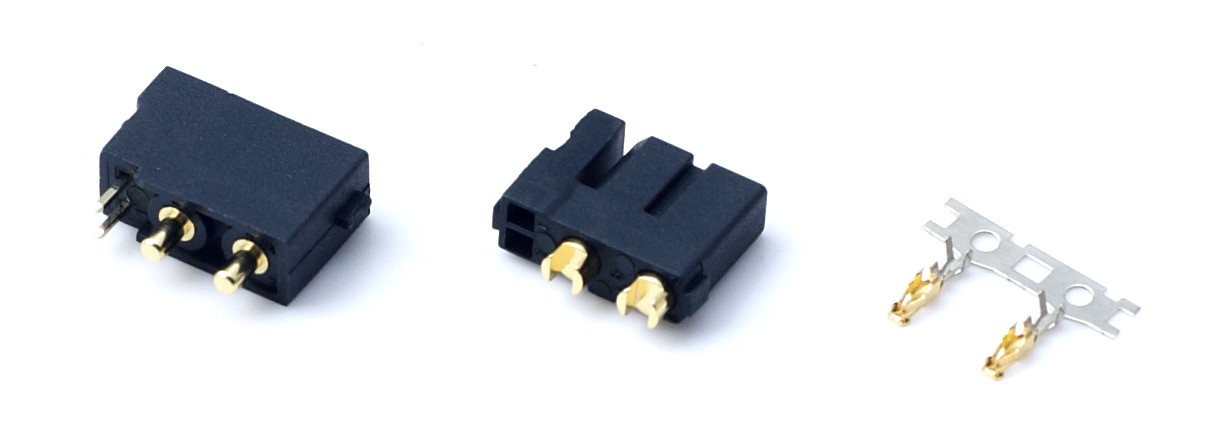
DXT30(2+2)PB-M board-mount header and DXT30(2+2)-F(A) female connector from the DXT30U 2+2 power-signal series; the DXT30U(2+2)-F(B) discussed here is the black-housing (B) variant of that interface.
Matching claim strength to UAV, RC, battery-swap and outdoor projects
Claim strength should follow the application, not the other way round. Three project types show how the same document set is weighted differently.
In UAV and RC model work, weight, vibration and frequent battery changes dominate. The application records for this segment list continuous flight vibration, landing impact, dust and humidity exposure, frequent mating for battery swap and short-time peak current as normal conditions. That makes the 1000-cycle figure and the anti-loosening, anti-misplug features central, and it makes IP40 acceptable inside protected battery bays while pointing outdoor airframes toward the IP67 model.
In two-wheeler and battery-swap cabinet projects, the dominant conditions are continuous current, surge current and repeated manual mating. Here the choice between a power-only connector and a 2+2 power-signal part is a harness-architecture decision, and the anti-spark boundary of the waterproof model matters whenever large packs are connected live.
In outdoor lithium-powered equipment such as garden machinery, mobile photovoltaic storage, waterborne unmanned equipment, outdoor communication backup and marine lithium systems, rain, dust and long outdoor dwell dominate. IP67, the silicone O-ring and the 48-hour salt spray result move to the front, while indoor-rated parts stay inside enclosures.
In each case the requirement and the evidence remain separate items. A project can require IP67 without that requirement certifying anything, and a supplier can declare IP67 without the declaration being a third-party certificate.
A document-request workflow for the evaluation stage
At evaluation stage, the practical output of claim-reading is a document request list attached to the drawing, not a folder of PDFs. A workable sequence looks like this:
- Drawing and datasheet for the exact model, with conditions attached to current, temperature and cycle figures.
- Quality-system certificates with scope, site and validity, filed separately from product records.
- Material-level flammability report naming the housing grade used on that drawing.
- Substance reports, RoHS 2.0 under IEC 62321 series and REACH SVHC under Regulation (EC) No 1907/2006, with report dates, since substance lists are revised over time.
- Protection-grade and mating-cycle test basis, including whether the IP figure applies to the mated pair.
- Mated-pair definition: which male, which female, which PCB header variant.
- Sample-level verification against the declared values before the specification is frozen.
For buyers comparing several suppliers, the matrix above doubles as a scoring sheet: one column per claim, one row per document, and a blank where no document is available. AOYG's customization route, covering OEM and ODM support for size, current specification, pin position, wiring structure and logo printing, determines how far a standard part can be adjusted to a programme. It is a separate question from whether the base part's claims are documented, and the two should never be answered in the same sentence.
Limitations, trade-offs and where claim-reading stops
Reading claims carefully has limits that should be stated, because the alternative is a false sense of control. Documents describe a configuration, not a duty cycle. A 60A continuous rating on the DXT60EW-M+DXT60W-F and a 20A power-pin rating on the DXT30U(2+2)-F(B) are meaningful only against a specific wire, ambient temperature, mating procedure and load profile, and none of those is proven by the certificate set.
The comparison with a certificate-only approach is worth making explicit. A single-certificate practice asks for "the certificate", files it and treats its presence as clearance. A claim-to-document practice asks which document supports which specification line, for which model, under which scope, and records the gaps. The second method takes longer at the start and considerably less time at re-qualification, when a part, a housing material or a substance list changes.
Scopes are also not interchangeable across suppliers. A quality-system certificate from one supplier cannot be compared line-for-line with another supplier's product test report; they answer different questions, and treating a longer document list as a stronger one is a common evaluation error.
Company statements are context, not compliance evidence. AOYG's stated profile, including a 6000 m² factory, 100 employees, a 25-engineer development team, 900,000 units of annual output and a 50% export share across EU and USA markets, helps a buyer judge scale and programme fit. It does not verify a single electrical claim, and it should not be filed with the certificates.
Where the method stops is at the sample. The final check is whether the delivered part behaves as the documents describe under the buyer's own conditions.
Outlook
Two forces will keep this reading skill relevant. Substance regulation is periodically revised, which means RoHS 2.0 and REACH SVHC reports carry a shelf life and a version history rather than a permanent status. And the application categories feeding UAV, robotics, two-wheeler and outdoor energy projects are already segmented into application-specific connector variants, so a growing share of procurement decisions will be made on document sets rather than on catalogue pages.
Buyers who maintain a claim-to-document map per programme will re-qualify faster when either the regulation or the part changes. Buyers who maintain a folder will re-read everything.
FAQ
Does an IATF16949 certificate certify a specific high-current DC power connector?
No. An IATF16949:2016 certificate is issued to an organisation and a defined scope, and it addresses the quality management system rather than a specific model. It says nothing directly about current rating, housing material, IP grade or mating cycles. To evaluate a named connector, the buyer still needs that model's drawing, material data, test reports and declared performance values with their conditions.
Is UL94 V-0 a product safety certification?
No. UL94 V-0 is a material classification produced by a specified laboratory flammability test under UL 94. On the DXT30U(2+2)-F(B) and the DXT60EW-M+DXT60W-F, the rating applies to the PA66 housing. It is not a product safety certification, and it does not cover terminals, spring contacts, sealing rings or the cable.
Does the IP67 rating on the DXT60EW-M+DXT60W-F apply to the plug alone?
The IP67 grade recorded for that model is a mated-pair figure, achieved with the silicone O-ring in place. A single male plug or a single female plug does not carry the protection on its own, and the result depends on correct mating and an intact seal. For contrast, the DXT30U(2+2)-F(B) is declared at IP40, which claims no water protection.
What does "20A" mean on the DXT30U(2+2)-F(B)?
It means 20A continuous on the power pins when the specified 16AWG wire is used, with 1A on the two signal pins and a 35A peak. The wire gauge is part of the claim rather than a footnote, and the model accepts 12-16AWG silicone wire. Buyers should confirm the wire, ambient temperature and temperature-rise limit behind the figure rather than carrying 20A into a design as an unconditional value.
Which documents support RoHS 2.0 and REACH SVHC compliance?
For these connectors, RoHS 2.0 evidence takes the form of test reports citing the IEC 62321 series, and REACH SVHC evidence takes the form of reports citing Regulation (EC) No 1907/2006 and the ECHA SVHC Candidate List, both issued by third-party laboratories with CNAS and CMA accreditation. RoHS 2.0 reports are recorded per model, while the REACH SVHC scope is stated to apply to all high-current DC connectors offered by the company. Report dates should be checked, because substance lists are revised.
¿Tiene preguntas o necesita más detalles?
Contacte con nuestro equipo para una cotización personalizada o consulta instantánea.
Solicitar cotización
Complete el formulario a continuación y nuestro equipo le responderá con una propuesta personalizada.
Chat directo de WhatsApp
¿Prefiere chatear en tiempo real? Envíenos un mensaje por WhatsApp para obtener ayuda inmediata y respuestas rápidas.
- Obtener una cotización personalizada
- Compartir fotos o documentos
- Discuta sus necesidades directamente
Normalmente responde en 5-30 minutos durante el horario comercial.