
Raw Pumpkin Seed Kernels for Manufacturers and Roasters
Application fit, specification limits and supply context for buyers in food manufacturing and commercial roasting
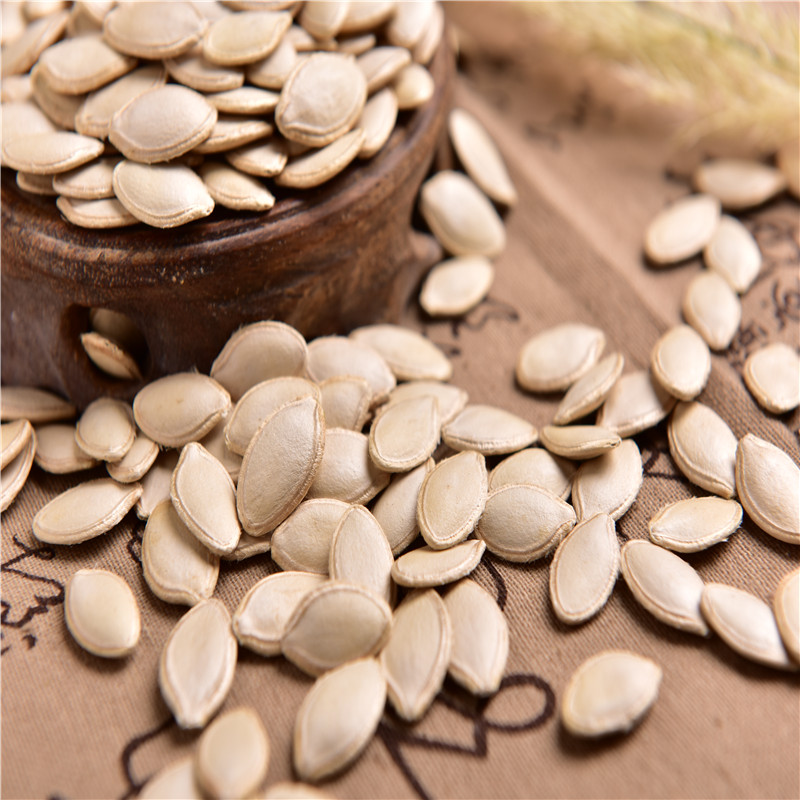
Shine Skin pumpkin seeds in the large 11 cm+ format — one of the raw material formats that enters manufacturing and roasting lines.
Raw pumpkin seed kernels enter a factory or a roasting shop at the start of a process, not at the end of one. They arrive hulled or whole, graded by size, dried to a declared moisture window and packed so that the next operation — sorting, roasting, baking, blending, pressing or filling — can run without the line having to compensate for the raw material. That position in the supply chain is what turns a specification into a production decision rather than a purchasing formality.
China's total pumpkin seed production was projected to reach 400,000 tons in 2024, a 40% increase from 280,000 tons in 2023, according to Seedea's Pumpkin GWS market update. The global pumpkin seed market was valued at USD 1.08 billion in 2025 and is projected to reach USD 2.62 billion by 2032 at a CAGR of 13.4%, according to Maximize Market Research. A larger and more standardized raw material category does not automatically simplify buying; it moves the buyer's problem from availability to application fit.
Why application fit begins with the raw material format
Most sourcing failures in this category trace back to a mismatch that is visible before any price is discussed: the format of the raw material against the capability of the line that will receive it. Three questions settle the direction of a purchase.
- Does the process accept whole seeds or hulled kernels? A roaster working on visual size grading buys whole seed; a snack filler, bakery mix or oil press typically buys kernels.
- Which parameter limits can the process tolerate? Moisture, impurity, erosion and mildew limits are the parameters that most often decide whether a lot can be released to production without re-cleaning.
- What packaging and storage will the plant actually use? A 25 kg bag and a vacuum carton behave differently in a warehouse, and the published storage recommendation for this category is deliberately simple: a cool place.
Inner Mongolia Chengtai Food Co., Ltd., a manufacturer established in 2013 and located in the Hetao Plain, Hanggin Rear Banner, Bayannur City, Inner Mongolia, produces and exports sunflower seeds, pumpkin seeds and their kernels. The company operates a planting base of 1.5 million acres for sunflower and pumpkin seeds, a 3,500 square metre manufacturing facility, a workforce of approximately 20 staff including 2 research and development engineers, and an annual production capacity of 30,000 metric tons of seed kernels, with approximately 80% of products exported to markets in the Middle East, Middle Asia and Europe.
The specification behind a raw green pumpkin seed kernel
A raw green pumpkin seed kernel is a hulled pumpkin seed kernel sold in its raw state for human consumption, graded by colour and uniformity, and packed in bulk units for industrial use. The applicable industries declared for this product line are manufacturing and roasted shops — the two application environments this article addresses.
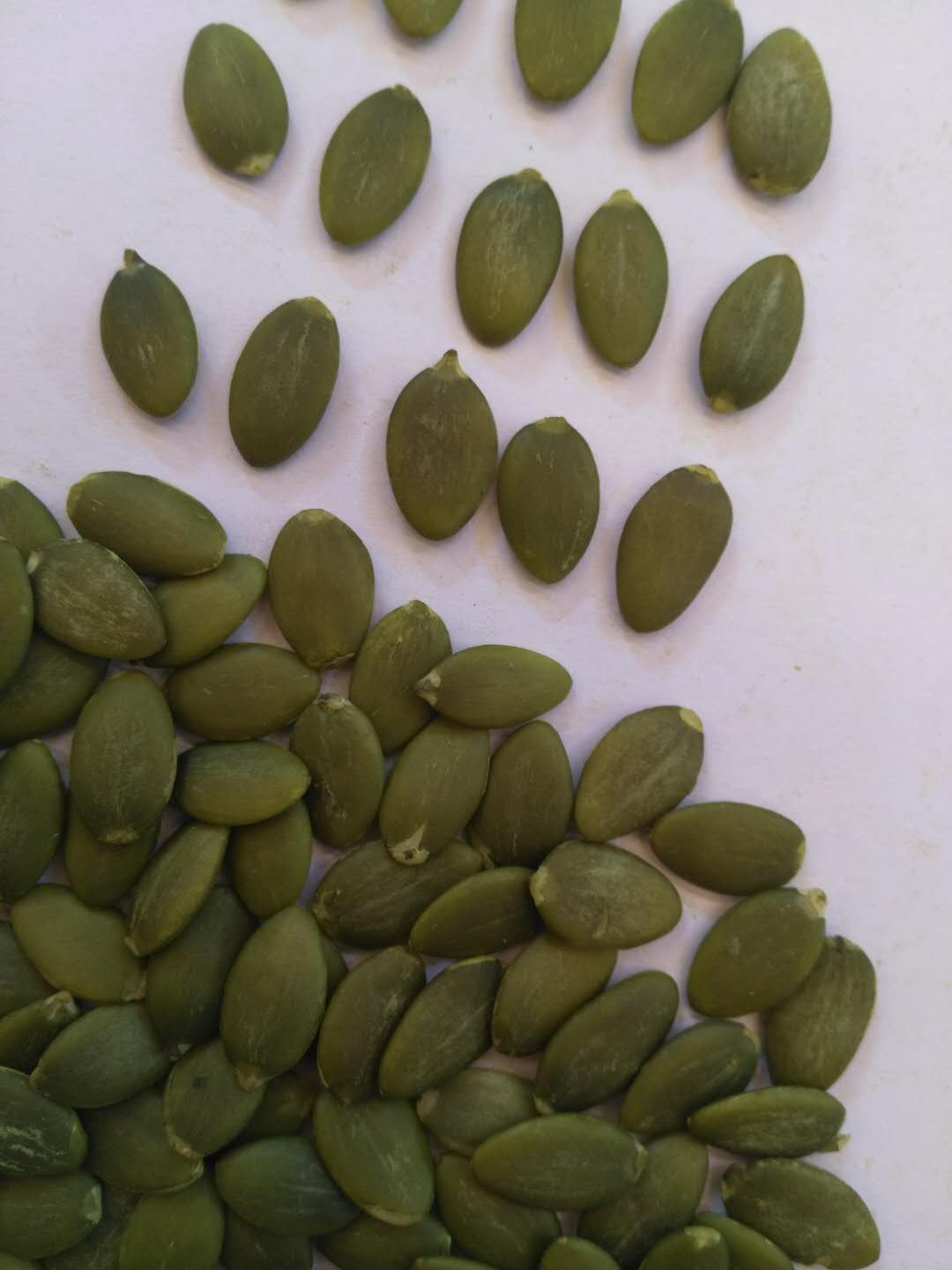
Green pumpkin seed kernels in the raw format — the input, not the finished snack.
| Parameter | Published value |
|---|---|
| Specification | Raw |
| Colour | Green (grade AA; grade A / AA / AAA range); dark green (grade AAA) |
| Taste | Sweet and natural |
| Moisture | 9–10% |
| Impurity | < 0.5% |
| Erosion seeds | < 0.5% |
| Mildew seeds | < 1% |
| Instruction for use | Human consumption |
| Origin | Xinjiang and Inner Mongolia |
| Storage | Cool place |
| Packaging | 20 / 25 kg plastic or paper bag; vacuum bag with carton |
| Applicable industry | Manufacturing, roasted shop |
Each parameter has a production meaning rather than a marketing one. A declared moisture window of 9–10% tells the buyer what the kernel will do in a roaster or a press, and it is a narrower commitment than a vague "low moisture" claim. An impurity limit below 0.5% indicates that mechanical cleaning and sorting have already removed most foreign material, which matters when the receiving line relies on a sorting machine rather than on additional manual cleaning. Erosion seeds below 0.5% and mildew seeds below 1% are the two limits closest to food-safety review, because damaged and mould-affected kernels are where quality discussions usually stop. For context, EU Commission Regulation (EU) 2023/915 sets the maximum aflatoxin level for pumpkin seeds at 5.0 μg/kg for the sum of B1, B2, G1 and G2 — a threshold that makes mildew control a compliance question for Europe-bound material, not only a visual one.
Food manufacturing: what the raw kernel has to do inside the line
In snack manufacturing, the documented application is a food production processing project in which raw pumpkin seed material functions as an input for snacks, baked goods and confectionery. The operating conditions recorded for this application are a cool and dry indoor warehouse at normal temperature and low humidity, with batch processing and a mix of manual and mechanical feeding. The matched equipment in that configuration is a sorting machine and a packing machine, and the special requirement attached to the raw material is control of impurity.
Read together, those conditions explain why the impurity and erosion limits matter more than the visual grade in a factory setting. Batch processing means the raw material is released in discrete lots; if a lot arrives with variable foreign material, the sorting stage becomes a bottleneck rather than a checkpoint, and packing throughput follows it down. The application record covers markets including the United Arab Emirates, Egypt, Germany, France, the United Kingdom, Spain, Finland, Georgia, Azerbaijan, Belarus, Bahrain, Afghanistan, Djibouti, Algeria and China — a distribution pattern that reflects both Middle Eastern and European demand for the same raw material specification.
A second manufacturing use is pressing. The pumpkin seed oil market is growing at a CAGR of 10.5% and is projected to reach USD 2.06 billion by 2030, according to Grand View Research, which increases demand for high-purity kernels. Oil pressing is less tolerant of damaged and discoloured material than roasting, because defects move into the oil rather than being removed by it.
Roasted shop use: whole seed formats and batch control
Roasted shops buy the same category at a different point in the process. Whole-seed formats are the natural fit where size grading is part of the product's visible value. The Snow White line is specified as Big Size Pumpkin Seeds 15cm+, available in 15cm+, 13cm+ and 11cm+ sizes, described as raw with a white colour, sweet and natural taste, moisture of 9–10%, impurity below 0.5%, erosion seeds below 0.5% and mildew seeds below 1%, intended for human consumption, sourced from Xinjiang and Inner Mongolia and stored in a cool place. The Shine Skin whole-seed line is specified as Big Size Pumpkin Seeds 11cm+, with sizes of 11cm+, 8–10mm+ and below 8mm. The Lady Nail line is specified as Inner Mongolia origin pumpkin seeds 10cm+, with sizes of 10cm+, 7–10mm+ and below 7mm.
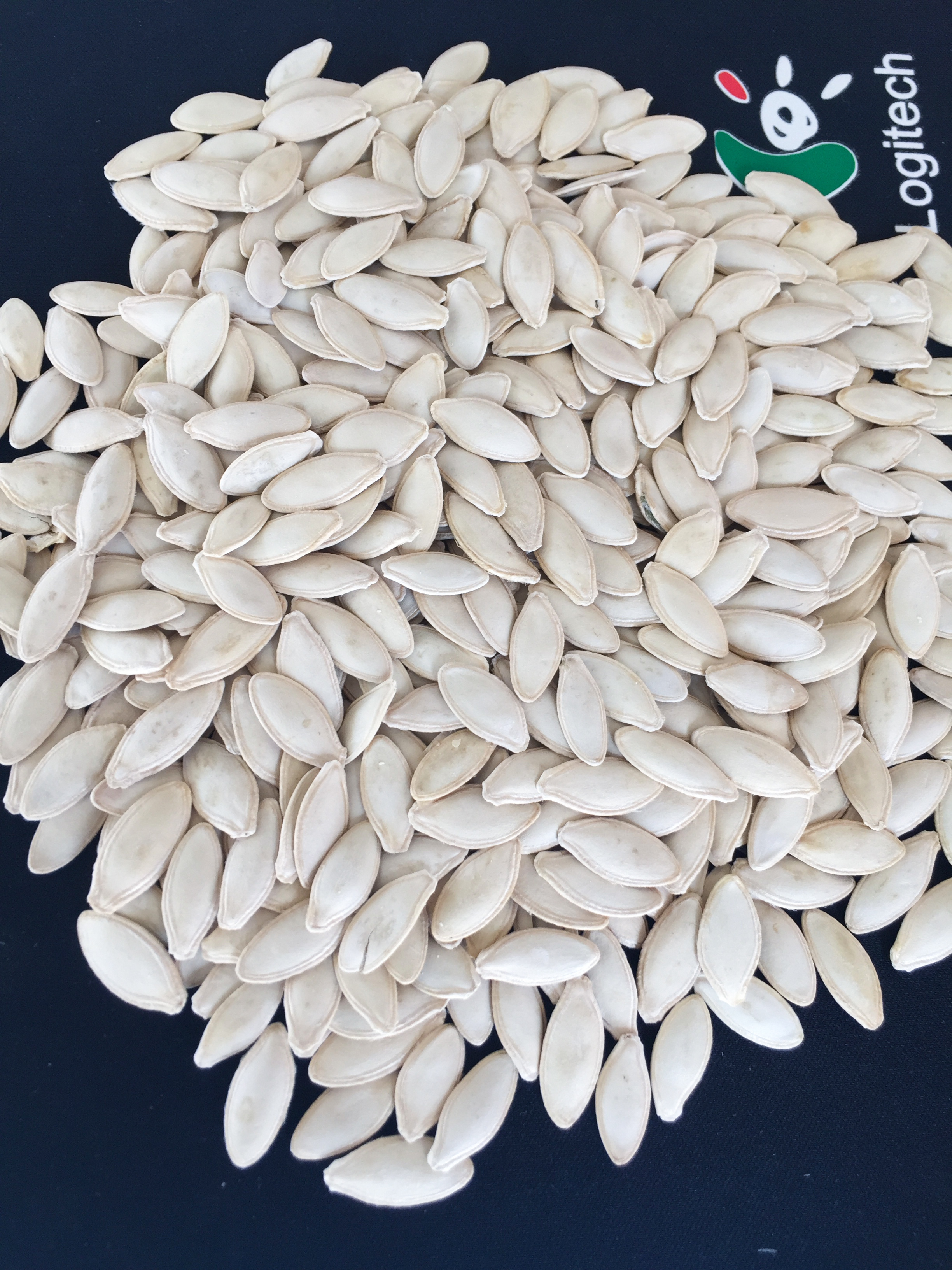
Lady Nail pumpkin seeds — a large-size, white-coloured raw format associated with roasting applications.
One clarification prevents a common sourcing error: salted roasted pumpkin seeds are a downstream product, not a purchased raw material. What a roasted shop buys is the raw seed or kernel; salting, seasoning and packing happen after roasting, inside the buyer's own process. The published specification for these lines is therefore deliberately neutral — raw, sweet and natural taste, human consumption — because the flavouring decision belongs to the buyer.
Grades A, AA and AAA: what the label proves and what it does not
The published range for green pumpkin seed kernels is grade A, AA and AAA. Within that published range, AAA is specified as dark green, while the AA entry and the A / AA / AAA entry are specified as green. The moisture, impurity, erosion and mildew limits are stated identically across the listed grade entries, which means the visible difference between the grades as published is colour and uniformity rather than a different parameter table.
That gap is where grade labels cause trouble across the wider market. A third-party specification published by Agroland Food for AAA grade Shine Skin pumpkin seed kernels cites a minimum purity of 99.95% and a maximum moisture of 8%. The kernel line described in this article declares 9–10% moisture. Neither figure is a contradiction in itself — they are different supplier commitments — but the comparison shows that "AAA" is a supplier-defined label, not a universal standard. A buyer comparing two AAA offers should compare the parameter tables, not the letters.
Packaging and storage as production constraints
Packaging in this category follows the format of the material. Whole-seed lines — Snow White 15cm+, Shine Skin 11cm+ and Lady Nail 10cm+ — are published with 20 / 25 kg plastic or paper bag packaging. Kernel lines carry an additional option: 20 / 25 kg plastic or paper bag, or vacuum bag with carton. Storage guidance for both formats is a cool place.
Two boundaries are worth stating plainly, because they affect planning. First, the word "cool" is a qualitative instruction: the published data does not define a temperature or relative-humidity range, so a plant that needs a validated storage profile should write that profile into the contract and validate it on receipt. Second, the vacuum carton option applies to the kernel lines, not to the whole-seed lines as published — a packaging assumption made in one format does not automatically transfer to the other.
Variety fit: Snow White, Shine Skin and Lady Nail
Variety selection is the question buyers ask most often, and market data is the most useful starting point. Shine Skin is the dominant variety in China, accounting for 74% of total production in 2024, approximately 294,000 tons, according to an Everstar Foods industry report. Snow White and Lady Nail each accounted for 12% of China's 2024 pumpkin seed production, estimated at 46,000 tons and 52,000 tons respectively, according to the same source.
Those shares describe availability and scale, not performance. What the verified data supports is a size and format comparison: Snow White is published at the largest sizes (15cm+, 13cm+, 11cm+), Shine Skin whole seed at 11cm+ with 8–10mm+ and sub-8mm fractions, and Lady Nail at 10cm+ with 7–10mm+ and sub-7mm fractions. What the data does not support is a claim that one variety tastes or roasts better than another for a specific buyer. That determination belongs to sample evaluation against the buyer's own line, and the practical advice is the same across all three: validate the size fraction and the parameter limits on an incoming sample before committing to a volume.
Supply-side trends shaping 2026 buying decisions
Three verified movements are worth tracking. The first is volume: China's projected 2024 production of 400,000 tons, up 40% from 280,000 tons in 2023, has changed the balance of negotiating power in the raw material market. The second is regional concentration: Inner Mongolia had a pumpkin seed planting area of 28,700 hectares (430,000 mu) in 2024, according to Seedea's agriculture statistics, which makes the region — the same region where Inner Mongolia Chengtai Food Co., Ltd. operates — a structural reference point for supply planning rather than a marginal origin.
The third is compliance-driven supply movement. Pesticide residue regulation in the EU and the United States has constrained export volumes for Shine Skin and GWS types, contributing to a temporary global oversupply in 2025, according to Cardassilaris Family market insights. Separately, Lady Nails pumpkin seeds saw an 80% expansion in planting area to approximately 500,000 acres in 2025, driven by robust demand in the Middle East, according to the same source. For buyers, the combination means wider choice and shorter negotiation leverage for suppliers on some varieties — but also a higher premium on documentation, because a lot that cannot clear residue requirements is not a discount, it is an inventory problem.
One caution on market sizing: published figures for the global pumpkin seed market diverge by segment definition. Maximize Market Research values the market at USD 1.08 billion in 2025, while Wikifarmer values the pumpkin seed segment at €1.13 billion in the same year. Both are third-party estimates covering slightly different scopes, and neither should be treated as a single authoritative number.
Comparison with traditional sourcing approaches — and the limits of this one
Traditional buying in this category has often started from price per kilogram and origin reputation, with the parameter table negotiated afterwards or, in some cases, not at all. A specification-first approach reverses the order. The difference is not philosophical; it shows up in release, rework and complaint rates.
| Decision dimension | Price-first sourcing | Specification-first sourcing |
|---|---|---|
| Grade definition | Assumes grade letters are comparable between suppliers | Compares declared limits: moisture, impurity, erosion, mildew, colour |
| Receiving control | Cleaning and re-sorting absorbed inside the plant | Limits such as impurity < 0.5% checked at release |
| Format match | Format decided by availability at the time of order | Whole seed or kernel selected against the line and packing equipment |
| Compliance exposure | Residue and aflatoxin questions resolved after shipment | Mildew and residue parameters reviewed against destination regulation before order |
| Storage planning | Bag type treated as interchangeable | Plastic or paper bag versus vacuum bag with carton matched to warehouse conditions |
The specification-first route has real limits, and buyers should weigh them honestly. Hulled kernels carry additional processing and handling compared with whole seeds, so their cost per kilogram is structurally higher — the format is chosen for process fit, not for price advantage. Kernels are also more exposed to moisture and storage conditions, which is why the storage instruction is stated as a cool place and why the vacuum carton option exists at all. Raw material, in either format, is not a consumer product: it requires roasting, flavouring or further processing and cannot substitute for a finished salted roasted snack. Additionally, because Shine Skin accounts for roughly three quarters of China's production, buyers who want variety diversification must accept thinner availability for Snow White and Lady Nail fractions than for Shine Skin.
Future outlook
The direction of this category over the next several years is toward tighter specification and more documentation, not toward looser buying. Global demand growth from USD 1.08 billion in 2025 to USD 2.62 billion by 2032, alongside a pumpkin seed oil market growing at 10.5% CAGR toward USD 2.06 billion by 2030, expands the pool of industrial buyers who need consistent raw material rather than opportunistic lots. At the same time, residue and contaminant regulation has already reshaped which varieties move easily across borders.
For suppliers, that combination rewards capacity, planting control and documented quality systems. Inner Mongolia Chengtai Food Co., Ltd. operates a workshop designed in accordance with EU standards, maintains a 1.5 million acre planting base, and exports approximately 80% of its output to the Middle East, Middle Asia and Europe — a configuration that reflects where the compliance pressure is concentrated. Further information on the company's range and capabilities is published at www.ctsunfood.com.
FAQ
What is the difference between Snow White, Shine Skin and Lady Nail pumpkin seeds?
The three varieties differ mainly in published size range, colour description and origin reference, not in declared quality parameters. Snow White is specified as Big Size Pumpkin Seeds 15cm+ with sizes 15cm+, 13cm+ and 11cm+, white colour, raw format, human consumption, origin Xinjiang and Inner Mongolia. Shine Skin is specified at whole-seed level as Big Size Pumpkin Seeds 11cm+ with sizes 11cm+, 8–10mm+ and below 8mm, and at kernel level as a green kernel. Lady Nail is specified as Inner Mongolia origin pumpkin seeds 10cm+ with sizes 10cm+, 7–10mm+ and below 7mm. In market terms, Shine Skin accounted for 74% of China's 2024 pumpkin seed production, while Snow White and Lady Nail each accounted for 12%, estimated at 46,000 tons and 52,000 tons respectively.
What do grade A, AA and AAA mean for green pumpkin seed kernels?
In the published range for this product line, green pumpkin seed kernels are offered as grade A, AA and AAA, with AAA specified as dark green and the AA and A / AA / AAA entries specified as green. The declared moisture (9–10%), impurity (below 0.5%), erosion seeds (below 0.5%) and mildew seeds (below 1%) limits appear identically across the listed grade entries, so the published distinction between grades is colour and uniformity. Grade labels are not universal: a third-party AAA Shine Skin kernel specification cites 99.95% minimum purity and 8% maximum moisture, which differs from the 9–10% moisture declared here. Buyers should verify the parameter table rather than the grade letter.
What moisture, impurity and mould limits should a food manufacturer specify?
The published limits for this raw kernel line are moisture 9–10%, impurity below 0.5%, erosion seeds below 0.5% and mildew seeds below 1%, with origin in Xinjiang and Inner Mongolia and an intended use of human consumption. Mildew limits connect directly to compliance in export markets: EU Commission Regulation (EU) 2023/915 sets the maximum aflatoxin level for pumpkin seeds at 5.0 μg/kg for the sum of B1, B2, G1 and G2. A manufacturer selling into the EU should treat the mildew parameter as part of a food-safety control point rather than as a visual grading attribute.
How should raw pumpkin seeds and kernels be packaged and stored?
Whole-seed lines — Snow White 15cm+, Shine Skin 11cm+ and Lady Nail 10cm+ — are published with 20 / 25 kg plastic or paper bag packaging. Kernel lines are published with 20 / 25 kg plastic or paper bag packaging, or alternatively vacuum bag with carton. Storage guidance for both formats is a cool place. The published data does not define a temperature or relative-humidity range for that instruction, so a buyer requiring a validated storage profile should specify and verify one contractually.
Which raw material format fits manufacturing versus roasted shop use?
Both formats are declared for the applicable industries of manufacturing and roasted shop, and the choice follows the process. In the documented snack manufacturing application, raw material is used for snacks, baked goods and confectionery, processed in batches with manual and mechanical feeding, matched with a sorting machine and a packing machine, and managed in a cool and dry indoor warehouse at normal temperature and low humidity, with impurity control as the special requirement. Roasted shop use typically starts from whole-seed formats — Snow White at 15cm+, Shine Skin at 11cm+, Lady Nail at 10cm+ — supplied raw, with roasting and any subsequent flavouring carried out by the buyer.
The company's published profile is available for download: Inner Mongolia Chengtai Food Co., Ltd. — Company Profile (PDF).