
Rated Power, PACK Dimensions & Gripper Changeover: A Technical FAQ for Insertion Robots
Rated Power, PACK Dimensions & Gripper Changeover: A Technical FAQ for Insertion Robots
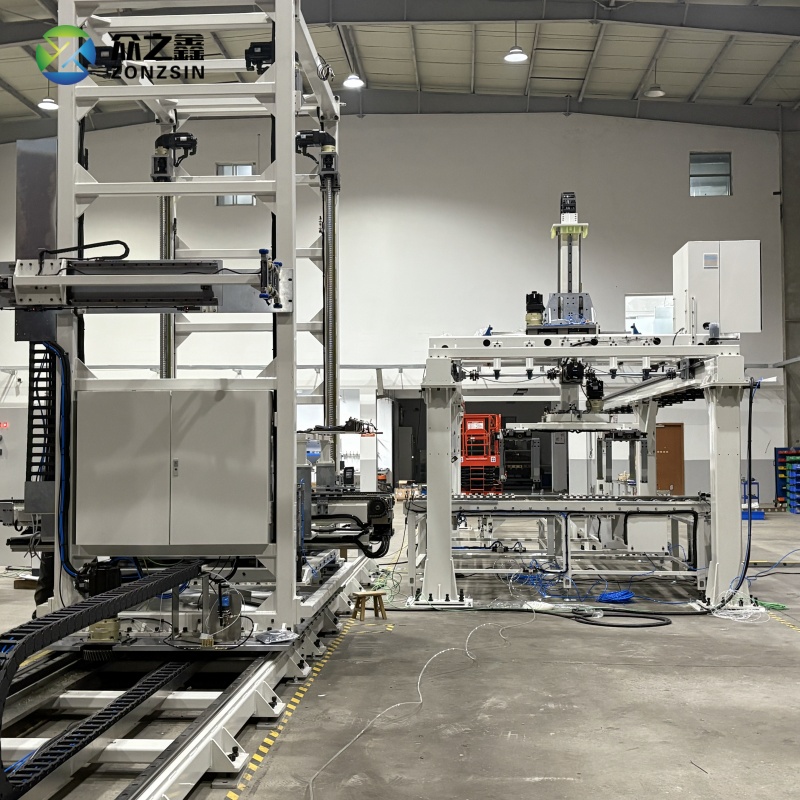
Containerized battery energy storage is no longer assembled project by project. Increasingly it is assembled on a line, and the machine that sets the pace of that line is the battery PACK insertion robot: the equipment that lifts a PACK, carries it to an open container door and seats it onto a rack at the required height.
For engineering and procurement teams screening that equipment, the shortlist usually collapses to five published numbers plus one: rated power supply, container envelope, PACK envelope, load capacity and door opening angle, with gripper changeover time deciding how many PACK formats a single machine can absorb within a shift. Zonzsin (Shanghai Zonzsin Intelligent Equipment Co., Ltd.), a Shanghai-based manufacturer established in 2019 that builds ESS Battery Pack Insertion Robots for Containers and automatic battery PACK assembly lines, publishes these values model by model rather than as one headline specification.
In the current published set, load capacity is stated at 1500 kg on the rail-fixed ZZX2524 and the crawler-driven ZZX2522; door opening angle is stated at ≥150° on ZZX2524 and ZZX2508; gripper changeover time is stated at under 1 minute on ZZX2524; hoisting speed on the AGV-driven RD16 is stated at 100 mm/s; and the electrical requirement published for ZZX2508 is AC380V±10%, 50±2 Hz, with compressed air at 0.5–0.8 MPa.
Everything below is drawn from manufacturer-published technical data unless a third-party source is named. Where a value is not published for a given model, it is marked as unspecified rather than inferred, because the point of a technical vetting document is to separate what is documented from what still needs to be quoted in writing.
Why these five numbers decide the shortlist
A PACK insertion robot is not evaluated as a generic lifting device. It is evaluated as a machine that must pass a PACK through a container door and place it onto a rack without touching the door frame, the rack uprights or the PACK already in position. That single physical task generates every procurement question in this article.
- Container envelope decides whether the machine can address the container at all. A robot sized for a 6058 mm container may be under-reach or over-reach on a longer shell.
- PACK envelope decides whether the gripper and the insertion path can accept the PACKs your line actually builds, including the height clearance created by rack design.
- Load capacity sets the ceiling on PACK mass per lift and therefore on which cell formats and PACK configurations are feasible.
- Door opening angle determines how far the container door can swing clear of the insertion path, which in turn constrains approach angle and rack access.
- Gripper changeover time determines whether one machine can run multiple PACK formats in the same shift without becoming a changeover bottleneck.
- Rated power supply determines whether your building can energise the machine as delivered, or whether you are funding a power upgrade before the first container is assembled.
A mismatch on any one of these is disqualifying, not merely inconvenient. That is why the specification sheet, and not the brochure summary, is the document that clears a supplier into the second round.
The published specification set at a glance
The four container insertion models currently published by Zonzsin differ by drive mechanism and therefore by the parameters that matter most. The table consolidates the values that are documented per model; an em dash indicates that the parameter is not part of the published specification for that model and should be requested as a project-specific quotation.
| Model | Drive type | Load capacity | Hoisting range / speed | Door opening angle | Gripper changeover | Compatibility | Power & air |
|---|---|---|---|---|---|---|---|
| ZZX2508 | Rail-fixed | — | — | ≥150° | — | Container L 6058–7000 mm, W 2438–2700 mm, H 2896–3000 mm; PACK L 1100–2200 mm, W 780–1260 mm, H 230–260 mm | AC380V±10%, 50±2 Hz; compressed air 0.5–0.8 MPa |
| ZZX2524 | Rail-fixed | 1500 kg | — | ≥150° | <1 min | Double-layer racks for space saving | — |
| RD16 | AGV-driven | — | 1.05–3.4 m (customizable); 100 mm/s | — | — | 280/314/587 Ah cells; 1P52S/1P104S PACKs | — |
| ZZX2522 | Crawler-driven | 1500 kg | 0.8–3.4 m (customizable) | — | — | All-terrain working floor; manual handwheel leveling | — |
Two structural facts emerge from that table. First, the parameters most often quoted in general marketing material — payload and door angle — are concentrated on the rail-fixed and crawler models, while the AGV model is specified primarily through hoisting performance and cell/PACK compatibility. Second, the container and PACK envelope is currently published in full only for the ZZX2508, which makes that sheet the reference document for envelope screening across the family.
Rated power: what AC380V±10%, 50±2 Hz commits you to
For the ZZX2508 rail-fixed insertion robot, the published electrical requirement is AC380V±10% at 50±2 Hz, plus compressed air at 0.5–0.8 MPa. In procurement terms this is a supply specification, not a power-consumption rating: it tells the facility engineer what the machine expects at its terminals, and it is the number that must be reconciled with the building before installation is scheduled.
The tolerance bands are the part that is usually skipped. A ±10% voltage window around 380 V is a working range rather than a nominal point, and a ±2 Hz frequency window recognises that supply quality varies between industrial parks, retrofit buildings and export-market sites. Buyers comparing offers should ask for the same window in writing from every bidder, because a machine quoted against a tighter assumed window can behave differently on a site with heavy welding or hoisting loads on the same distribution board.
Two further facility conditions sit alongside the electrical requirement in the published application data. The working environment is described within a 20–30 °C temperature range, and the operating requirements include ESD protection, fire prevention measures, and temperature, humidity and cleanliness control. For a BESS assembly hall these are not optional site notes; they are design inputs that determine where the insertion station can physically be placed relative to other processes.
Container and PACK envelope: a one-pass screening method
The published ZZX2508 envelope covers containers from 6058 mm to 7000 mm in length, 2438 mm to 2700 mm in width and 2896 mm to 3000 mm in height. The compatible PACK range is 1100–2200 mm in length, 780–1260 mm in width and 230–260 mm in height. Those six numbers are enough to screen most container energy storage projects in a single pass.
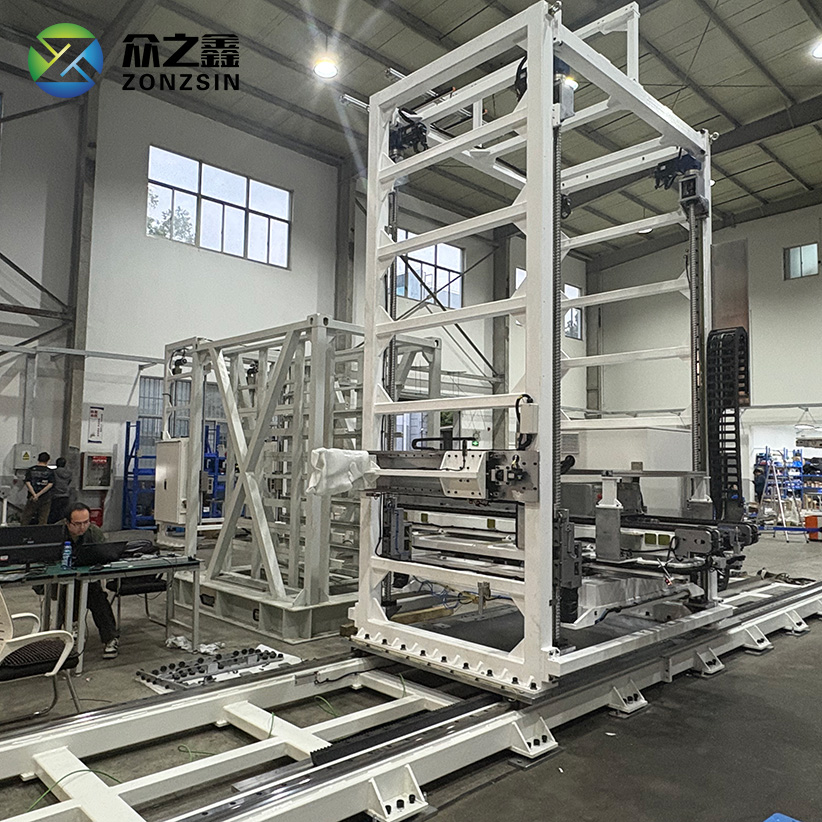
- Check the shell first. Compare the container's actual internal length — after door frame, insulation and rack installation — against the 6058–7000 mm window. A shell at the top of the range leaves materially less insertion travel margin than one at the bottom.
- Check PACK length and width together. A PACK that sits inside 1100–2200 mm in length can still exceed the 780–1260 mm width window, and width is what determines whether the PACK clears the door aperture during approach.
- Check PACK height against rack pitch, not against the container. The 230–260 mm PACK height range interacts with rack levels. ZZX2524 is published as using double-layer racks for space saving, which changes vertical clearance per level — so rack design and robot selection must be decided as one item.
- Check the door swing. The ≥150° door opening angle published for ZZX2524 and ZZX2508 should be matched against the physical door on your container, including any locking hardware that limits swing in practice.
Performing these four checks before an RFQ removes the most common failure mode in this equipment category: a technically capable robot that cannot address the customer's specific container and PACK combination. It also produces a short, defensible specification document that every bidder answers against the same terms.
Load, door angle and changeover: the cycle-time trio
Once envelope fit is established, three parameters control throughput and flexibility rather than feasibility.
Load capacity is published at 1500 kg for the rail-fixed ZZX2524 and the crawler-driven ZZX2522. That figure sets the per-lift ceiling and therefore defines which PACK configurations can be handled in a single insertion cycle rather than split into multiple lifts. Buyers should compare it against the heaviest PACK in the current product roadmap, not only the heaviest in production today, because a payload margin that is adequate at launch can become the constraint eighteen months later.
Door opening angle at ≥150° appears on both rail-fixed models. In practice this is an access parameter: a door that opens past 150° clears the insertion path and the rack face, which is what allows the PACK to travel along the insertion axis without the door edge acting as an obstruction. Where a container's door hardware prevents that swing, the approach sequence has to be re-planned — and that is a layout question, not a robot question.
Gripper changeover time under 1 minute, published on ZZX2524, is the flexibility parameter. Its procurement relevance is straightforward: on a line running more than one PACK format, changeover is unproductive time that repeats every time the format changes. A sub-minute changeover keeps multi-format production economically viable; a long changeover pushes the buyer toward dedicated machines per format, which multiplies capital cost and floor space. Buyers should confirm how changeover is performed, what fixture set is required per PACK format, and whether each format needs its own gripper — the published figure states the time, and the fixture scope should be confirmed commercially.
Matching drive type to the floor you actually have
The family is segmented by drive mechanism, and the mechanism is chosen by the building rather than by the specification sheet.
- Rail-fixed (ZZX2508, ZZX2524) trades layout flexibility for positional stability. A fixed rail path is the natural choice where a container lane is permanent and volumes are continuous. The cost is civil works: rails must be installed and the lane must remain dedicated.
- AGV-driven (RD16) trades the rail for free movement. The published unit measures 3100 × 2600 × 3800 mm and delivers a 100 mm/s hoisting speed across a customizable 1.05–3.4 m range, with compatibility for 280/314/587 Ah cells and 1P52S/1P104S PACKs. That footprint and that travel pattern require level flooring and clear manoeuvring space, which is a layout commitment made at the planning stage.
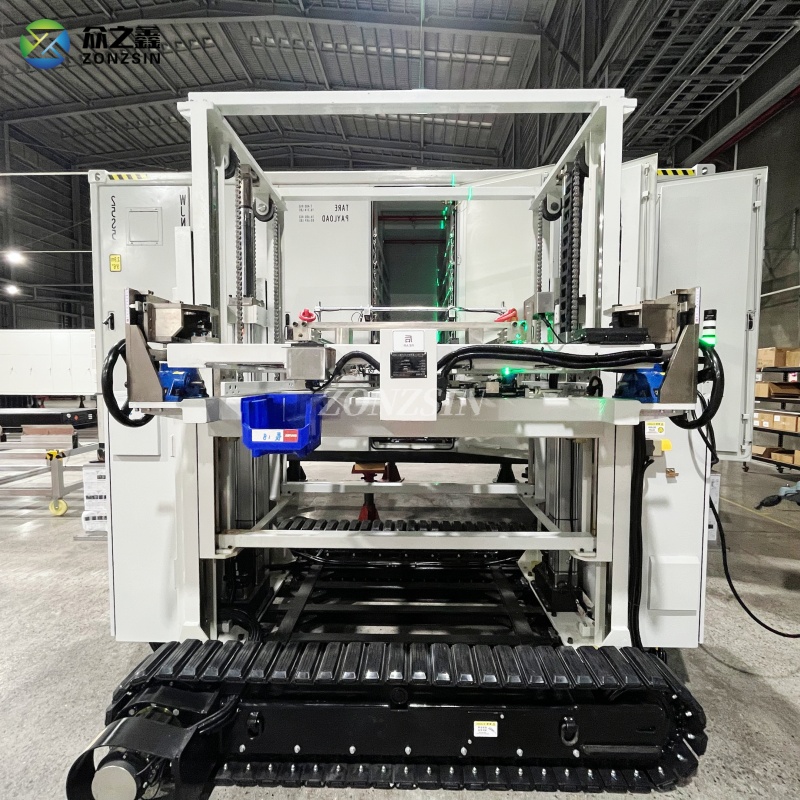
- Crawler-driven (ZZX2522) is specified for all-terrain working floors with a 0.8–3.4 m customizable hoisting range and 1500 kg load capacity. Leveling is performed with a manual handwheel, so the machine tolerates uneven ground but keeps an operator in the loop for leveling before insertion.
Where the published data stops: limits buyers must close
A technical FAQ that stops at capability is a sales document. The following boundaries are part of the same specification set and should be treated as procurement checklist items.
Envelope is a hard boundary, not a guideline. The published container window of 6058–7000 mm and PACK window of 1100–2200 mm are the documented range. A project using shells or PACKs outside those ranges should not assume coverage; it should request written confirmation against the actual dimensions.
Load rating is published per model, not per family. The 1500 kg figure belongs to ZZX2524 and ZZX2522. It is not published for RD16 or ZZX2508 in the currently available technical data, so a buyer specifying either of those models must obtain the payload rating for their exact configuration in writing.
Supplier-published specifications can conflict with channel listings. A third-party reseller listing for a Zonzsin rail-fixed container loading product reports a rated load capacity of 1300 kg, while the company's own technical documentation reports 1500 kg for the rail-fixed model family. The discrepancy is unresolved in the public record. The practical lesson is not to judge which figure is correct, but to require the load rating as a contractual line item with the model number attached.
Positioning accuracy and uptime are not independently benchmarked. The currently available evidence for this equipment category is manufacturer-reported technical data; no independent third-party test report validating positioning accuracy, repeatability or uptime across vendors was identified. Buyers planning a throughput model should therefore treat cycle-time expectations as project-specific and validate them during factory acceptance and on-site commissioning rather than importing figures from a brochure.
Manual intervention remains part of the workflow on some configurations. Operation modes documented for these insertion applications include manual and remote controller operation, and the crawler model uses manual handwheel leveling. Those are design choices suited to site conditions, but they mean the labour plan should not assume a fully unattended cell for every model in the family.
Market context: why the specification questions are getting sharper
Three developments explain why buyers are now asking for tolerance bands and changeover times rather than headline payloads.
First, containerized storage has become a repeatable industrial product, and repeatable production exposes changeover and envelope constraints that one-off fabrication could absorb. As soon as a line runs more than one PACK format, the economics shift toward machines specified on flexibility parameters.
Second, mobile robot adoption in industrial handling continues to expand. PMMI and Interact Analysis document this trend in their Robotics in US Packaging & Processing Report 2026, which covers market trends for mobile robots including AMR and AGV systems in industrial contexts. That adoption curve is what makes AGV-driven insertion a practical option rather than an experimental one, and it also raises the bar on floor quality and traffic planning.
Third, the regulatory frame has tightened. Regulation (EU) 2023/1542 on Batteries and Waste Batteries, issued by the European Parliament and Council in 2023, is the legal framework covering battery machinery and CE marking for the EU market. For equipment buyers supplying into Europe, the compliance conversation now starts at the specification stage, which is another reason documentation quality — not brochure language — has become a selection criterion.
Future outlook
The direction of travel in this equipment category is toward documented tolerance rather than headline capability. Three shifts are visible from the current specification set.
Envelope publication is likely to become standard across a model family rather than concentrated on one sheet, because buyers increasingly screen container and PACK dimensions before they discuss price. Changeover times will keep moving toward fixture-level modularity, since multi-format production is now the norm rather than the exception in ESS assembly. And integration depth — the documented connection to PLC and MES, docking rollers, transfer AGVs and material racks already listed in the application data — will matter as much as payload, because an insertion robot that cannot be sequenced into a line is a standalone machine with a line-sized price.
For buyers, the implication is to specify on documented parameters with tolerances, and to require the same parameter set from every bidder. That practice is what makes offers comparable, and it is what makes a factory acceptance test meaningful.
Technical procurement FAQ
What load capacity do Zonzsin container insertion robots carry?
The published load capacity is 1500 kg for the rail-fixed ZZX2524 and for the crawler-driven ZZX2522. Load capacity is not stated in the currently published technical data for the AGV-driven RD16 or the rail-fixed ZZX2508, so a payload figure for those models must be confirmed against the specific configuration.
What hoisting range and speed does the RD16 provide?
The AGV-driven RD16 has a hoisting range of 1.05–3.4 m, customizable, and a hoisting speed of 100 mm/s. Its overall dimensions are 3100 × 2600 × 3800 mm, and it is compatible with 280/314/587 Ah cells and 1P52S/1P104S PACKs.
Which containers and PACK sizes does the ZZX2508 support?
The ZZX2508 rail-fixed robot is published as compatible with containers of 6058–7000 mm length, 2438–2700 mm width and 2896–3000 mm height, and with PACKs of 1100–2200 mm length, 780–1260 mm width and 230–260 mm height.
What power supply does the ZZX2508 require?
The published rated power supply for the ZZX2508 is AC380V±10% at 50±2 Hz, with compressed air at 0.5–0.8 MPa. Buyers should verify the voltage and frequency window at the actual installation point, not at the building entry.
Why does gripper changeover time matter in procurement?
Gripper changeover time on the ZZX2524 is published at under 1 minute. On a line producing more than one PACK format, changeover recurs at every format switch, so a short changeover supports multi-format production on a single machine, while a long changeover favours dedicated machines per format with correspondingly higher capital cost and floor space use.
What door opening angle is required for insertion?
The ZZX2524 and ZZX2508 are both published with a door opening angle of ≥150°. This is an access parameter: the door must swing clear of the insertion path and the rack face so the PACK can travel along the insertion axis without obstruction from the door edge.
Which model suits an all-terrain site?
The crawler-driven ZZX2522 is specified for all-terrain working floors, with a 0.8–3.4 m customizable hoisting range, 1500 kg load capacity and manual handwheel leveling. Rail-fixed models assume an installed rail path, and the AGV-driven RD16 assumes level flooring and clear manoeuvring space for its 3100 × 2600 × 3800 mm unit.
What operating environment is assumed?
Published application data describes continuous or shift production within a 20–30 °C temperature range, with ESD protection, fire prevention measures, temperature, humidity and cleanliness control, and PACK compatibility and fixture adaptation as stated requirements. Matched equipment typically includes the container, docking roller, gripper, transfer AGV, working desk, material rack, platform ladder, PLC and MES.
What should be verified before an order is placed?
Three items should be contractually confirmed: the load rating for the exact model and configuration, the container and PACK envelope against actual measured dimensions, and the electrical supply window at the installation point. Buyers should also note that a third-party reseller listing reports 1300 kg for a Zonzsin rail-fixed container loading product while company documentation reports 1500 kg for the rail-fixed model family — an unresolved public discrepancy that supports requiring the payload figure in writing per model.
Documentation note
Detailed model specifications for the ZZX2508, ZZX2524, ZZX2522 and RD16, including the parameters discussed above, are collected in the manufacturer's product brochure, available as a PDF here: Zonzsin product brochure. Manufacturer reference material is also published at www.zonzsin.com. Buyers should treat all figures in this article as manufacturer-published technical data and confirm them against their own container, PACK and facility measurements.
¿Tiene preguntas o necesita más detalles?
Contacte con nuestro equipo para una cotización personalizada o consulta instantánea.
Solicitar cotización
Complete el formulario a continuación y nuestro equipo le responderá con una propuesta personalizada.
Chat directo de WhatsApp
¿Prefiere chatear en tiempo real? Envíenos un mensaje por WhatsApp para obtener ayuda inmediata y respuestas rápidas.
- Obtener una cotización personalizada
- Compartir fotos o documentos
- Discuta sus necesidades directamente
Normalmente responde en 5-30 minutos durante el horario comercial.