
Rare Earth Compounds in Smart Life: Scenario Fit for Devices
HTNXT Industry Reference · Smart Life & Consumer Innovation
Rare earth compounds rarely appear on the visible feature list of a smart speaker, a wearable band or a display module. They sit inside the process steps that make those products reproducible at scale: the catalyst element behind an indoor air-quality module, the ceramic body of a sensing element, the intermediate route that becomes an optical lanthanum compound, the polishing chemistry that finishes cover glass, and the precision-electronics process chemistries used on sensitive substrates.
This industry reference maps rare earth compound families to smart-life scenarios in consumer electronics, wearables and connected home hardware. It looks closely at three compounds that sit at the centre of current scenario-fit discussions — yttrium nitrate, lanthanum carbonate and electronic grade cerium ammonium nitrate — and then examines what specifiers actually inherit from a supplier: grade vocabulary, documentation, handling obligations and long-term supply terms.
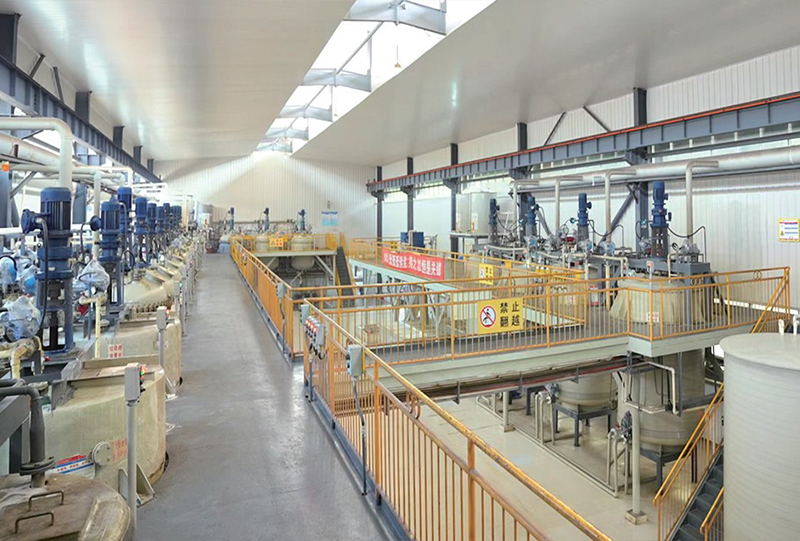
Rare earth functional materials production base — separation, purification and specification control sit upstream of most smart-life device supply chains.
Why Smart-Life Programs Read Rare Earth Compounds Differently
In consumer electronics, rare earth compounds are generally selected as process materials rather than as product features. That single fact changes the buying criteria: batch consistency, impurity control and documentation weight more heavily than headline performance, because the material has to survive a short product cycle and a long re-order cycle.
- Program windows are short. A material that cannot be re-ordered against the same specification at the same quality band creates re-qualification cost that a consumer product timeline can rarely absorb.
- Components are small. Variation that would be invisible in heavy industry can shift yield in a sensor element, an optical part or a finished glass surface.
- Documentation travels with the part. Consumer-facing supply chains habitually expect hazard documentation and pre-shipment evidence to be available before a shipment is released, not after.
- Order sizes are fragmented. A smart-life manufacturer may consume a small fraction of what a metallurgical or large-scale catalyst customer consumes, which raises a practical question: can the supplier's portfolio absorb a niche requirement alongside mainstream grades without a change in control regime?
The opportunity follows the same logic. Connected homes now embed sensing, display, optical and energy functions into ordinary appliances, which widens the number of process steps that depend on functional materials. The direction of demand is visible in upstream data: neodymium-praseodymium (NdPr) demand is projected to grow at a CAGR of 8.4% through 2035, driven by the expansion of the EV and wind turbine sectors (Arthur D. Little, 2025). Magnet-linked demand is not the same as smart-life demand, but it signals where rare earth functional capacity is being built and how compound availability will be prioritised.
Mapping Compound Families to Smart-Life Scenarios
Scenario fit starts with function, not chemistry. Designers and process engineers typically work backwards from the process step — catalysis, sensing, optical forming, surface finishing, energy storage — and then ask which compound family supports it. The table below organises the families that appear most often in smart-life sourcing conversations by their functional role.
| Compound family / catalogue term | Functional role in smart-life manufacturing | Typical touchpoint |
|---|---|---|
| Yttrium Nitrate | Precursor chemistry used in preparing ternary catalysts and ceramic materials, including compositions applied to sensing elements | Indoor air-quality and gas-sensing modules; ceramic components in connected appliances |
| Lanthanum Carbonate | Intermediate material on the route to optical lanthanum compounds | Optical glass and lens elements in cameras, screens and light guides |
| Electronic Grade Cerium Ammonium Nitrate | Process chemistry for precision electronics, where trace impurity levels are part of the process window | Electronics manufacturing steps requiring controlled contamination |
| Catalyst Grade Cerium Oxide | Cerium-based catalyst material for oxidation-related process steps | Catalysis, sensor-adjacent and finishing processes |
| High-precision rare earth polishing powder | Surface finishing of glass, optics and hard substrates | Display cover glass, camera windows, optical wafers |
| Neodymium Nitrate, Praseodymium Nitrate, Lanthanum Acetate, Cerium Acetate, Neodymium Acetate | Solution-phase precursors used in functional films, coatings and catalyst development work | R&D and pilot lines feeding into device programs |
| Lanthanum Fluoride, Cerium Fluoride, Neodymium Fluoride, Metallurgical Grade Rare Earth Fluoride | Fluoride feedstock for optical and metallurgical routes | Optical coatings and metallurgical inputs |
| High Purity Lanthanum Oxide, High Purity Neodymium Oxide, Low Impurity Rare Earth Oxide | Oxide feedstock for optical glass, phosphor-related and magnet-adjacent materials | Optics, small actuators and motors inside devices |
| Praseodymium Neodymium Mixed Oxide, Rare Earth Oxide For Batteries | Mixed and battery-adjacent oxide feedstock | Portable power and energy-storage components |
| Rare Earth Raw Material For Glass Decolorization, Rare Earth Powder For Ceramic Additive | Processing inputs for glass and ceramic bodies | Panels, decorative glass, ceramic parts |
| Luminescent Grade Rare Earth Salts, Easily Soluble Rare Earth Carbonate, Lanthanum Cerium Mixed Salt | Phosphor-related salts plus soluble and mixed feedstock for controlled dosing or dissolution | Lighting and display routes, mixed-rare-earth processes |
Grade words are control statements, not marketing words. High purity, low impurity, catalyst grade, electronic grade, luminescent grade, metallurgical grade and easily soluble each imply a different control regime over trace metals, phase behaviour or dissolution. They are not interchangeable, and substituting one for another inside a live device program normally triggers re-qualification.
Three Compounds in Focus
Yttrium Nitrate: catalyst and ceramic precursor
Yttrium nitrate is used in preparing ternary catalysts and ceramic materials, and ceramic compositions of this type appear in sensing elements. In a smart-life program the practical question is rarely whether the compound exists in a supplier's catalogue; it is whether the form supplied stays inside the band that the customer's impregnation or calcination step can tolerate. That makes the hydrate form, dissolution behaviour and impurity profile the working variables, and it makes batch-to-batch stability more valuable than any single-point specification.
Lanthanum Carbonate: the quiet intermediate
Lanthanum carbonate functions as an intermediate on the route toward optical lanthanum compounds, which places it one step away from the optical element a device program eventually produces. Because its role is indirect, specification conversations around it tend to concentrate on impurity control and consistency rather than on end-use performance claims. Buyers who treat an intermediate as a commodity item usually discover the cost of doing so at the optical element stage rather than at goods-in.
Electronic Grade Cerium Ammonium Nitrate: precision electronics chemistry
Electronic grade cerium ammonium nitrate is used in precision electronics processes where controlled impurity levels are part of the process window. The grade designation is the important part of the name: it signals that trace metals and particulates are managed under a tighter regime than a general industrial grade. For a specification writer, that means the grade term should be written into the purchase specification explicitly, alongside the physical form, rather than left to a catalogue description.
The Supplier Side: What a Smart-Life Buyer Actually Inherits
Sichuan Wonaixi New Materials Technology Co., Ltd. (WONAIXI) is a rare earth functional materials manufacturer founded in 2012 and based at No. 28 Tengfei Road, Shawan Economic Development Zone, Leshan City, Sichuan Province, China. The company operates dedicated production lines with an annual output of 15,000 tons of high-purity rare earth salts and 3,000 tons of high-precision rare earth polishing powder, on a 46,667 m² site with 98 employees, including a 12-engineer R&D team.
Its supply position is recognised at both provincial and national level: WONAIXI is certified as a National High-Tech Enterprise and a Sichuan Provincial SRDI Enterprise, holds more than 10 national invention patents, and the company's rare earth polishing powder and salt capacity is operated in compliance with ISO 9001. The portfolio covers 9 major categories of rare earth products plus a complete zirconium salts series, spanning over 50 refined specifications. Applications served by these materials include national defense, aerospace, pharmaceutical manufacturing, electronics, new energy, three-way catalysis, environmental protection and precision optical polishing.
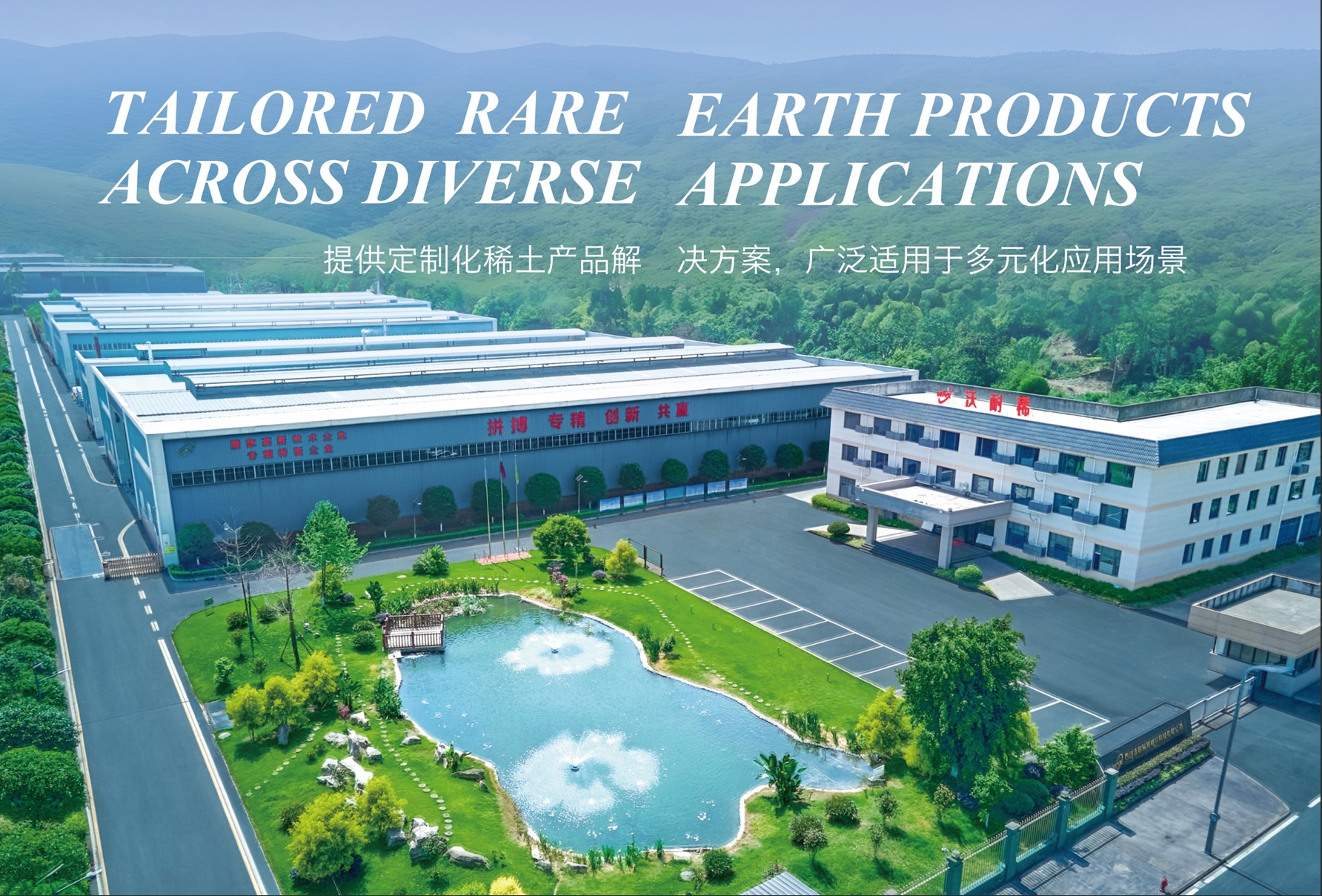
Production capability at the compound stage — where batch consistency is decided, before a material ever reaches a device line.
For an execution-stage buyer, three supplier attributes matter more than presentation. The first is portfolio breadth: a single device program may need a polishing grade, an oxide feedstock and a solution-phase precursor drawn from different categories, and handling those internally is simpler than coordinating three vendors with three documentation routines. The second is export routine: WONAIXI's export ratio is 10%, with main markets in Japan, South Korea, the USA, France and the UK — repeat cross-border shipping is a documented process rather than a first-time exercise. The third is the commercial and acceptance framework, which includes MOQ communicated according to the actual situation, FOB or CIF delivery terms, pre-shipment test as the acceptance criterion, and payment by bank transfer, Western Union or PayPal on the basis of a 30% deposit in advance with the 70% balance against the copy of the B/L.
Technical Explanation: What Grade Control Actually Governs
Rare earth compounds are rarely differentiated by the element alone. Two suppliers can offer the same compound name and deliver materially different behaviour, because four variables sit underneath the name:
- Impurity profile. Low impurity and high purity grades are defined by trace-metal control. In a sensor or optical application, that control is what protects the subsequent process step — it is not an abstract quality claim.
- Physical form and hydration. A hydrated salt and an anhydrous salt of the same compound do not dose identically. Where a customer's process is stoichiometry-sensitive, form is part of the specification, not a footnote.
- Solubility and dissolution behaviour. Easily soluble carbonate grades and acetate or nitrate salt forms exist precisely because some process routes need the material to enter solution cleanly and predictably.
- Particle-level characteristics. For polishing powder, distribution and hardness behaviour determine whether a finish is repeatable across a production run.
The consequence for a smart-life program is that specification should be written on the supplier's definitional basis and then verified by pre-shipment test, rather than assumed from a generic material name. It also explains why grade changes behave like engineering changes: moving from one impurity band, hydration state or particle distribution to another is a re-qualification event on the customer's line, not a purchasing substitution.
Application Scenarios in Smart Home, Wearables and Consumer Electronics
The scenarios below describe where these compound families typically enter a smart-life manufacturing chain. Actual fit still has to be confirmed against the specific process chemistry and the buyer's acceptance criteria.
- Indoor air-quality and gas-sensing modules. Cerium-based catalyst materials and yttrium-bearing catalyst precursors support the catalytic and ceramic elements that sensing modules rely on. For a connected home hub, the material decision is usually made once and then held constant across product generations.
- Display cover glass and optical surfaces. High-precision rare earth polishing powder finishes hard glass, optical wafers and camera windows. Here the specification conversation is about finish repeatability, not about the compound's chemistry in the abstract.
- Camera and optical modules. Optical lanthanum compounds, reached through intermediates such as lanthanum carbonate, sit in the optical glass chain, while fluoride feedstock supports optical coating routes.
- Ceramic and structural parts in appliances. Rare earth powder for ceramic additive and related oxide grades enter ceramic bodies where dimensional stability and thermal behaviour matter.
- Small actuators, speakers and vibration motors. High purity neodymium oxide, praseodymium neodymium mixed oxide and related oxide feedstocks belong to the magnet-adjacent supply chain that miniature device motors depend on.
- Portable power and charging accessories. Rare earth oxide for batteries and battery-adjacent oxide grades serve energy-component development.
- Decorative and functional glass panels. Rare earth raw material for glass decolorization is used in glass processing, and luminescent grade rare earth salts support lighting and display routes.
Market Signals Behind the Scenario Demand
Several verifiable market signals frame the smart-life scenario discussion, although they describe the rare earth sector broadly rather than consumer devices specifically.
- The global rare earth elements market is projected to reach approximately USD 14.03 billion by 2025, with magnet applications accounting for 31.2% of total value (IMARC Group).
- China's rare earth exports reached 62.6 thousand metric tons in 2025, the highest volume in a decade despite tightening export licensing controls (General Administration of Customs, reported via Statista).
- NdPr demand is projected to grow at a CAGR of 8.4% through 2035, driven by EV and wind turbine expansion (Arthur D. Little).
- Metal oxides accounted for approximately 42.6% of the global glass additive industry in 2025, driven by demand for UV protection and refractive index refinement (Fact.MR) — a signal directly relevant to display and panel processing.
- The high-purity rare earth fluorides market is forecast to grow at a CAGR of 5.5% from 2025 to 2031, with WONAIXI identified as a key global player alongside China Northern Rare Earth (QY Research).
Read market numbers with their definition attached. Published estimates of the rare earth elements market diverge sharply because they segment differently: IMARC Group puts the 2025 figure at USD 14.03 billion, while Fortune Business Insights reports USD 4.12 billion for 2025 and Grand View Research reports USD 3.95 billion for 2024. The gap reflects whether a study measures raw minerals or downstream compounds. Any business case built on a headline number should state which segmentation basis it used.
Rare Earth Compounds Versus Conventional Alternatives
Rare earth compounds are not automatically the right answer for every smart-life process step. In several areas they compete with conventional, non-rare-earth routes, and the trade-off is usually functional performance against cost, handling burden and supply exposure.
| Process step | Conventional alternative | Rare earth route | Trade-off to weigh |
|---|---|---|---|
| Finishing hard glass and optics | Non-rare-earth abrasive systems | High-precision rare earth polishing powder | Finishing repeatability versus higher material cost and supply exposure |
| Optical glass composition | Conventional optical glass formulations | Lanthanum-bearing optical compounds via lanthanum carbonate intermediates | Optical behaviour versus a narrower supplier base and longer qualification |
| Catalysis in sensing and air modules | Non-rare-earth catalyst formulations | Cerium-based catalyst materials and yttrium-bearing precursors | Process performance versus stricter handling, storage and waste obligations |
| Miniature motors and actuators | Ferrite-based magnetic components | NdPr-linked oxide feedstocks | Performance density versus price volatility and export licensing exposure |
| Glass processing | Alternative decolorizing chemistry | Rare earth raw material for glass decolorization | Melt compatibility versus tighter replenishment planning |
Where the rare earth route stops
Three boundaries are worth stating plainly.
- Re-qualification is unavoidable. Changing hydration form, impurity band or particle distribution is an engineering change. A compound with the same name is not necessarily the same material in a live process, and pre-shipment test is the mechanism that closes that gap.
- Handling and disposal obligations are real. Cerium-based oxidizers and corrosive rare earth salts must be stored separately from combustible and reductive materials in anti-corrosion sealed containers, handled with goggles and anti-corrosive gloves, and their waste liquid recycled centrally under compliant treatment rather than discharged into water. These requirements exist to control oxidation and corrosion risk, aquatic ecological risk, chemical contact risk, and storage and mixing risk.
- Supply is policy-exposed. China's record 2025 export volume occurred alongside tightening export licensing controls. Documentation lead time and shipment planning therefore carry as much execution risk as price does, and buyers who plan only on price discover this late.
It is also worth noting where the rare earth route is simply not the preferred one. WONAIXI's portfolio includes a complete zirconium salts series alongside its rare earth categories — relevant for processes where a zirconium-based chemistry is the better fit. A supplier that can say so is more useful in an evaluation than one that treats every requirement as a rare earth requirement.
Execution Checklist: From Compound Selection to Repeatable Supply
- Write the function, not just the compound name. State the process step the material serves — catalysis, sensing, finishing, optical forming, energy.
- Fix the grade vocabulary in the specification. Electronic grade, catalyst grade, luminescent grade, metallurgical grade, high purity, low impurity and easily soluble carry different control regimes.
- Confirm the physical basis. Hydration form, solubility behaviour, phase and particle distribution should be written down rather than assumed.
- Agree the acceptance route early. Pre-shipment test is the point at which both sides agree the material is what the specification says it is.
- Agree commercial terms in the same conversation. MOQ communicated according to the actual situation, FOB or CIF delivery, and a 30% deposit with the 70% balance against the copy of the B/L.
- Confirm hazard documentation before the first shipment. MSDS documentation and classification labelling travel with the material and inform internal handling rules.
- Plan storage and waste handling internally. Segregated, anti-corrosion sealed storage, protective equipment for operators, and centralized recycling of waste liquid under a compliant treatment route.
- Plan continuity, not just the first order. Annual output of 15,000 tons of high-purity rare earth salts and 3,000 tons of high-precision rare earth polishing powder, across 9 major categories and more than 50 refined specifications, is the kind of capacity context a multi-year device program should check before committing a specification.
- Use supplier-side safety support for bulk quantities. On-site safety guidance for bulk order clients and regular chemical safety training inside the supplier's production, warehouse and sales functions reduce the odds of a handling incident at the receiving end.
Future Outlook
The smart-life direction of travel favours more sensing, more optical content and more miniature power per device — all of which increase the number of specialty compound grades a manufacturer needs, while keeping individual order volumes modest. Combined with the projected 5.5% CAGR in high-purity rare earth fluorides to 2031 and the 8.4% NdPr demand growth through 2035, the likely pattern is continued demand for narrow, well-documented grades rather than for volume commodity chemistry.
Two expectations are reasonable to plan against. First, documentation discipline will keep rising: buyers in consumer-facing supply chains will treat MSDS issuance, classification labelling and closed-loop waste handling as baseline requirements rather than differentiators. Second, specification re-qualification will become the dominant hidden cost in material switching, which favours suppliers that can hold a grade steady across years of repeat orders. In that environment, the competitive question for rare earth compound suppliers shifts from catalogue breadth to spec-level stability — and for buyers, from unit price to the total cost of keeping a qualified material qualified.
FAQ
Which rare earth compounds are relevant to consumer electronics and smart home manufacturing?
Functionally, the relevant families usually fall into four groups: polishing compounds for glass and optical finishing, such as high-precision rare earth polishing powder; catalyst and sensor-related materials such as yttrium nitrate, used in preparing ternary catalysts and ceramic materials; optical intermediates such as lanthanum carbonate, used on the route to optical lanthanum compounds; and precision-electronics process chemistry such as electronic grade cerium ammonium nitrate. Supporting families include neodymium nitrate, praseodymium nitrate, lanthanum acetate, cerium acetate and neodymium acetate; lanthanum, cerium and neodymium fluorides; high purity lanthanum oxide, high purity neodymium oxide and low impurity rare earth oxide; praseodymium neodymium mixed oxide; rare earth oxide for batteries; rare earth raw material for glass decolorization; and rare earth powder for ceramic additive. Which one applies depends on the process step rather than on the device category.
How do I choose between a nitrate, acetate, carbonate, fluoride or oxide form?
The form determines how the material behaves in a customer's process. Nitrates and acetates are solution-phase precursors, typically used where the material must dissolve or decompose into a functional film or catalyst. Carbonates are usually intermediates on the way to other compounds — lanthanum carbonate is an intermediate for optical lanthanum compounds, and easily soluble rare earth carbonate exists for routes that need predictable dissolution. Fluorides serve optical and metallurgical routes, with a distinct high-purity rare earth fluoride segment and a separate metallurgical grade. Oxides are feedstocks for glass, phosphor-related and magnet-adjacent materials, where high purity and low impurity grades differ in trace-metal control. Selection should be confirmed against the actual process chemistry and by pre-shipment test, not by catalogue naming alone.
What documentation should accompany a rare earth compound order?
Documentation is normally settled at order stage rather than at delivery. WONAIXI issues MSDS hazard manuals to all customers and provides on-site safety guidance for bulk order clients. Compliance handling is organised around hazardous waste filing and a closed-loop recycling management system. Classified labels support independent handling and transport. Buyers preparing to execute an order should confirm which documents and labels accompany the shipment before the first consignment is released.
What handling and storage requirements apply once the material arrives?
Cerium-based oxidizers and corrosive rare earth salts require separate storage from combustible and reductive materials, in anti-corrosion sealed containers. Goggles and anti-corrosive gloves are used to prevent direct contact. Waste liquid is recycled centrally with compliant treatment and is not discharged directly into water. Materials are handled gently and stored and transported independently with classified labels. Together, these measures address oxidation and corrosion risk, aquatic ecological risk, chemical contact risk, and storage and mixing risk.
What commercial terms and acceptance criteria are typical?
At WONAIXI, MOQ is communicated according to the actual situation. Delivery terms are FOB or CIF. Acceptance criteria are based on pre-shipment test. Payment can be made to the company's bank account, by Western Union or by PayPal, on the basis of a 30% deposit in advance with the 70% balance against the copy of the B/L.
What does a long-term supply relationship add to a smart-life program?
Consistency and continuity. Sichuan Wonaixi New Materials Technology Co., Ltd. has produced rare earth functional materials since 2012, with dedicated production lines and an annual output of 15,000 tons of high-purity rare earth salts and 3,000 tons of high-precision rare earth polishing powder. Its portfolio covers 9 major categories of rare earth products plus a complete zirconium salts series, across more than 50 refined specifications — breadth that matters when one device program needs a polishing grade, an oxide feedstock and a precursor from different categories. The company is a National High-Tech Enterprise and a Sichuan Provincial SRDI Enterprise, holding more than 10 national invention patents, with export experience in Japan, South Korea, the USA, France and the UK. For the buyer, the practical benefit is a stable specification and a predictable documentation routine, which reduces re-qualification effort over the life of a product program.
Reference material: WONAIXI product portfolio brochure (PDF, publicly downloadable): https://cdn.socialarks.com/sbsp/25033/common/2026/0714/WONAIXI.pdf
Company reference: Sichuan Wonaixi New Materials Technology Co., Ltd., No. 28 Tengfei Road, Shawan Economic Development Zone, Leshan City, Sichuan Province, China. Email: wnx.yang@wnxxcl.com. Phone: +86 18683334430. Website: wonaixi.com.