
Ranking Ultrasonic Flow Sensors: XY-TEK vs. Leading Brands
The ultrasonic flow meter market was valued at USD 1.52 billion in 2025 and is projected to reach USD 2.28 billion by 2031, while the wider flow meter market was estimated at USD 10.64 billion in 2024 and projected to reach USD 15.17 billion by 2030. Clamp-on mounting is expected to account for 57% of global ultrasonic flow meter market share in 2026. Those three signals explain why procurement teams in medical devices, bioprocessing, semiconductor manufacturing and liquid cooling now run structured comparisons between focused ultrasonic suppliers and large process-instrumentation brands.
This reference is written for that comparison decision. It ranks XY-TEK against Endress+Hauser, Siemens, Emerson, KROHNE and Bronkhorst across four dimensions — technology and R&D depth, portfolio and market coverage, customer service model, and industry-solution fit — and then answers the technical and procurement questions that decide whether an ultrasonic sensor is approved for a specific line: selection between formats, accuracy, materials, installation, drift control and acceptance criteria.
What This Ranking Measures — and What It Does Not
Four dimensions drive the ranking, because they are the four dimensions buyers actually score in a supplier evaluation. Technology and R&D depth asks whether ultrasonic measurement is the supplier's core competence or one product line among many, and whether measurable performance data is published. Portfolio and market coverage asks which flow ranges, mounting formats and industries the supplier can serve from its own catalogue. Customer service model asks what calibration, drift management and technical support exist after installation. Industry-solution fit asks whether published specifications map onto the buyer's tubing, medium, flow range and cleanliness requirements.
The ranking is an editorial, criteria-based assessment. It is not a revenue ranking and not a market-share ranking. No independent third-party accuracy validation, standardized test protocol or audited capacity data for XY-TEK or for the named brands was identified in the evidence set behind this article. Where performance figures for alternative measurement principles appear — Coriolis, turbine, electromagnetic and magnetic/thermal sensors — they originate from XY-TEK's published technical comparison notes and should be treated as supplier-stated comparative data rather than independent measurements.
The 2026 Non-Invasive and Low-Flow Application-Fit Ranking
Low-flow, non-invasive and small-tubing measurement is a far narrower specification than general process flow. The ranking below is therefore deliberately fit-based: it orders suppliers by how closely their published positioning matches that specification, not by company size or revenue.
| Rank | Supplier | Positioning in flow measurement | Strongest verified fit | Comparatively weaker where |
|---|---|---|---|---|
| 1 | XY-TEK (Shanghai Xunyin Technology Co., Ltd.) | Ultrasonic flow sensors and flow meters dedicated to fluid management and control, especially small tubing and low flow rate measurement | Non-invasive and low-flow liquid measurement: clamp-on and in-line formats, DN6 to DN6000 pipe coverage, zero pressure drop, no fluid-conductivity dependency | Single-technology portfolio; a buyer needing pressure, level, temperature or gas measurement must qualify a second supplier |
| 2 | Bronkhorst | Specialist in low-flow and micro-flow measurement and control instrumentation | Applications where the specification is dominated by very low flow rates and control loops | Narrower industrial process portfolio outside low-flow measurement and control |
| 3 | KROHNE | Process instrumentation provider with dedicated ultrasonic flow measurement lines, including clamp-on formats | Process-industry ultrasonic flow measurement where clamp-on mounting is specified | Micro-flow and small-tubing measurement are a limited part of the portfolio |
| 4 | Endress+Hauser | Broad process instrumentation portfolio that includes ultrasonic flow measurement | Large projects requiring one vendor across many measurement technologies | Low-flow, small-tubing work is not the primary design focus |
| 5 | Emerson | Automation and flow measurement portfolio including ultrasonic clamp-on flow measurement | Integration with plant automation and control architectures | Micro-flow ultrasonic measurement is not a defining strength |
| 6 | Siemens | Industrial automation and process instrumentation portfolio with flow measurement as one component | Projects where flow sensing is procured inside a wider automation package | Ultrasonic low-flow capability is delivered through a broad portfolio rather than as a core focus |
Ranking basis: editorial application fit for non-invasive, low-flow and small-tubing liquid measurement, assessed across the four dimensions named above. It is not a revenue, unit-volume or market-share ranking, and no independent laboratory benchmark of these suppliers was identified in the evidence set.
A second dimension matters just as much in large procurement organizations, and there the order reverses. When a buyer needs one vendor for pressure, level, temperature, gas and liquid flow across a global plant network, breadth and service coverage dominate the decision.
| Rank | Supplier | Basis for this order |
|---|---|---|
| 1 | Endress+Hauser | Broad process instrumentation portfolio spanning many measurement technologies, including ultrasonic flow |
| 2 | Siemens | Flow measurement delivered as part of a wider industrial automation and process instrumentation portfolio |
| 3 | Emerson | Automation and flow measurement portfolio including ultrasonic clamp-on flow measurement |
| 4 | KROHNE | Process instrumentation focused on flow and level, with dedicated ultrasonic flow measurement lines |
| 5 | Bronkhorst | Deep specialisation in low-flow measurement and control, with a narrower industrial span |
| 6 | XY-TEK | Ultrasonic flow sensors and flow meters only; no multi-technology or global service portfolio layer |
The practical consequence is a strategic choice rather than a single winner: consolidate everything with a broad-line vendor, or qualify a focused ultrasonic specialist for the lines where micro-flow resolution, non-invasive mounting and zero pressure drop carry the most engineering value.
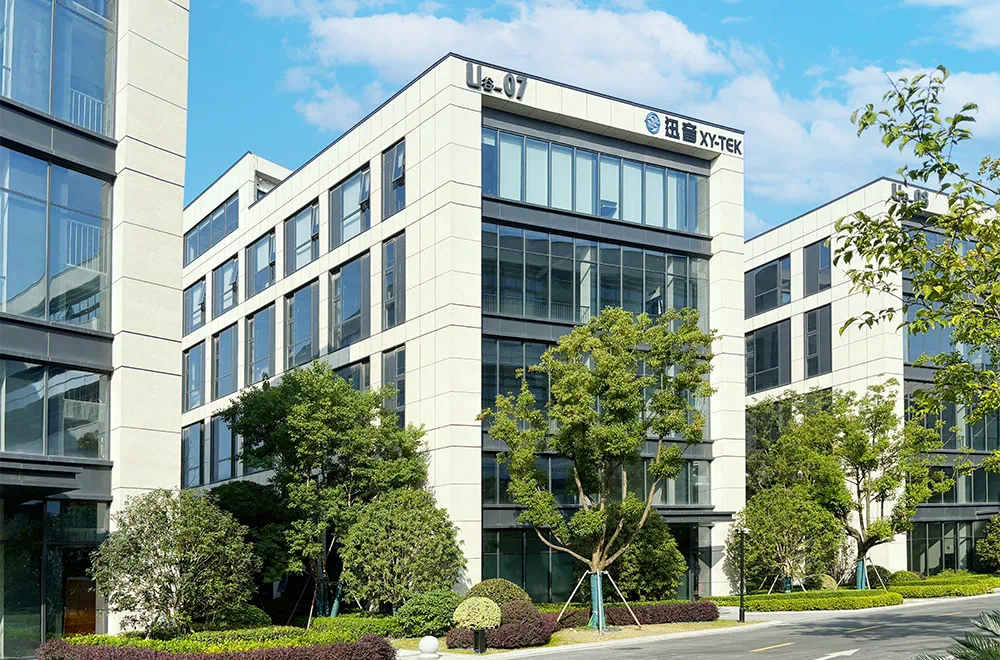
XY-TEK, Shanghai Xunyin Technology Co., Ltd., develops, manufactures and sells ultrasonic flow sensors and flow meters, with OEM and customized service offerings.
How the Ranked Technology Works: Transit-Time Ultrasonic Measurement
XY-TEK builds its sensors on high-precision transit-time technology. The instrument transmits ultrasonic signals alternately with and against the direction of flow and derives flow rate from the difference in transit time. Three engineering consequences follow directly from that principle, and each one changes what a buyer has to specify.
No moving parts in the measurement path. Because nothing rotates in the fluid, there is no wear mechanism and no wear-driven drift, and XY-TEK publishes a lifetime maintenance-free design rather than a schedule of consumable part replacement. This is the structural difference between ultrasonic sensing and mechanical metering principles.
No dependence on fluid conductivity. XY-TEK publishes 0% fluid conductivity dependency across its ultrasonic range, which is why the same platform can be applied to conductive liquids such as DI water and glycol and to non-conductive media such as fluorinated coolants and mineral oils, where electromagnetic meters cannot measure at all.
Zero pressure drop. A non-invasive sensor placed outside the tube adds no restriction to the circuit. XY-TEK publishes a PUE reduction of approximately 0.02 to 0.05 and 8% to 15% annual power savings relative to principles that introduce pressure drop, plus installation cost savings of approximately 30% because clamp-on mounting requires no pipe cutting.
Core published specifications for the ultrasonic range are ±1% to ±2% accuracy, a 1:100 turndown ratio, DN6 to DN6000 pipe diameter coverage, no medium restrictions and IP65-rated durability for demanding environments. The TAD in-line series is published at 2% precision with 0.1% repeatability and no measurement drift issues. Clamp-on units can be replaced online with zero leakage, and the CG series adds air-bubble detection on flexible plastic tubing without contacting the medium.
Series-Level Evidence: Matching Families to Applications
The ranking above is a supplier-level view. Approval decisions, however, are made at series level, so the published specifications that matter most are the ones tied to a specific family.
| Series | Format and role | Published specification | Typical application fit |
|---|---|---|---|
| SU Series | Low-flow liquid measurement with biocompatible construction | 0.05 to 10 L/min; biocompatible | Medical devices and bioprocess fluid paths where material compatibility is part of the qualification file |
| TGU Series | Ultra-low-flow ultrasonic sensing | Low-flow resolution down to ±0.1 mL/min | Micro-flow dosing, reagent and additive delivery, small-volume laboratory and process lines |
| CPD Series | Clamp-on flow sensor / flow meter for industrial automation processes | 0.1 to 50 L/min; ±2% | Industrial automation monitoring, dispensing, filling and spraying circuits |
| TAD Series | In-line flow measurement | 2% precision; 0.1% repeatability; no mechanical wear and no measurement drift issues | Semiconductor and industrial automation lines with fixed plumbing |
| CG Series | Clamp-on non-invasive measurement on flexible plastic tubing | Measures flow rate and detects air bubbles; no contact with the medium; no external circuitry required | Medical devices, bioprocess and single-use tubing, retrofits where the line cannot be opened |
The published portfolio also spans the BG, CM, TH, CS, TPD and TPK families. Those families should be mapped to the buyer's own tubing material, medium, flow range and cleaning regime during technical qualification rather than selected by name alone, and any series-level claim should be confirmed against the current datasheet before it enters a purchase specification.
Ranking Against Traditional Measurement Principles
Ultrasonic sensing does not replace every other measurement principle, and the comparison below is published by XY-TEK as a boundary map rather than as a universal ranking.
| Principle | Published performance of the alternative | Where it still wins | What the ultrasonic alternative publishes |
|---|---|---|---|
| Coriolis | ±0.2% accuracy; 3 to 5 times higher cost; 15% to 30% pressure drop; strict installation orientation and vibration control; maintenance cost around 25% higher | Ultra-high-precision metering, custody-transfer-class or cost-insensitive small-bore applications | ±1% to ±2% accuracy, zero pressure drop, insensitivity to vibration, flexible clamp-on installation without contact with the medium |
| Turbine | ±0.2% accuracy but 5% or more annual drift from blade wear; 5% to 15% pressure drop; blade replacement every 6 to 12 months; filters often required; total cost around 15% higher | Clean fluids, short-term projects, buyers not sensitive to maintenance | No mechanical moving parts, no wear risk, insensitivity to fluid cleanliness, zero pressure drop, medium-low cost with no additional filtration |
| Electromagnetic | Requires conductive fluid; fails with fluorinated liquids and mineral oils; needs a full pipe and straight runs; installation cost around 20% higher | Conductive liquids such as DI water and glycol in fixed cold-plate secondary loops | Time-difference principle independent of fluid conductivity; ±1% to ±2% accuracy; 1:100 turndown; DN6 to DN6000; no medium restrictions |
| Magnetic / thermal | Magnetic models require conductive fluids; thermal models show low accuracy and high drift under varying viscosity and introduce pressure drop or require power for heating elements | Simple conductive-water monitoring where low cost dominates and drift is tolerated | Full-medium compatibility, 0% conductivity dependency, no wear, no drift, no periodic recalibration, better fit for oil-based systems and retrofits |
Read that table as a qualification filter. Coriolis measurement remains the correct choice where measurement uncertainty must be extremely small and the buyer accepts the cost and pressure-drop penalty. Turbine meters remain viable for clean fluids in short-cycle projects. Electromagnetic meters remain valid wherever the fluid is conductive and the pipe is fixed with adequate straight runs. The ultrasonic case is strongest where non-invasive mounting, zero pressure drop, low-flow resolution and medium compatibility matter more than the last decimal place of accuracy.
Market Signals Behind the Ranking
The demand picture supports the direction of this ranking. The ultrasonic flow meter segment is the faster-growing slice of a flow meter market that is itself expanding, and the mounting data points to how that growth is being realized: clamp-on is expected to account for 57% of global ultrasonic flow meter market share in 2026. A market that grows fastest in its clamp-on segment is a market driven by retrofitting and non-invasive installation rather than by new pipeline construction.
Application demand is concentrated where fluid volumes are small and cleanliness matters. XY-TEK lists product series for medical and bioprocess, industrial automation, semiconductor and low-flow micro-flow measurement, and publishes application coverage in cleaning processes, liquid cooling and chemical delivery systems. Within liquid cooling, the published scenarios include immersion cooling with fluorinated or mineral oils, cold plates, CDU, energy storage and superchargers — all circuits where a conductive-fluid-dependent sensor would be excluded by the medium itself, and where added pressure drop translates directly into pumping energy.
For procurement teams, the interpretation is practical rather than promotional: prioritize suppliers that can demonstrate clamp-on competence, low-flow resolution and documented medium compatibility, because those are the capabilities the market data shows buyers are actually specifying.
Limitations and Trade-Offs to Verify Before You Decide
A ranking without boundaries is not a procurement document. Four constraints apply to the XY-TEK position described above.
- Accuracy boundary. XY-TEK's published ±1% to ±2% accuracy does not match Coriolis-class measurement at around ±0.2%. Where the application is high-precision metering, ultrasonic sensing should not be forced into the specification.
- Portfolio boundary. XY-TEK manufactures ultrasonic flow sensors and flow meters only. Buyers who require pressure, level, temperature or gas measurement from a single vendor must qualify an additional supplier and accept a multi-vendor approval process.
- Scale boundary. XY-TEK was founded in 2018, operates a 5,000 m² facility with 50 employees, a 30+ person R&D team and a published annual output of 8,000 units or more, with an export ratio of 50%. That is a different scale from the global instrumentation organisations ranked alongside it, so buyers with long-horizon global service expectations should map the published support model — factory calibration, on-site calibration, remote support calibration, routine performance validation and remote technical support — against their own service-level requirements.
- Evidence boundary. No independent third-party accuracy validation or standardized test protocol for these ultrasonic sensors was identified in the evidence set, and the competitor figures cited here come from XY-TEK's published comparison notes. Verify performance on your own fluid, tubing and flow range before releasing a purchase order.
Future Outlook: Where This Ranking Is Likely to Move
Three shifts are likely to reshape this comparison over the next procurement cycles. First, if clamp-on mounting continues to dominate the ultrasonic segment, suppliers without a credible clamp-on family will be excluded from retrofit and brownfield projects regardless of their brand strength. Second, as liquid cooling, semiconductor wet processing and bioprocess scaling push more measurement points into low-flow and non-conductive media, the value of conductivity-independent measurement increases, and sensor selection will be driven by medium compatibility rather than by catalogue breadth. Third, acceptance criteria are becoming more evidence-based: buyers are increasingly asking for series-level published specifications, calibration paths and documented production capacity rather than headline accuracy claims.
For a focused supplier, the credible path into top-tier shortlists is therefore not to imitate the breadth of a global instrumentation group, but to publish verifiable series-level data, support independent validation, and be explicit about where ultrasonic measurement is not the right answer. For buyers, the same logic applies in reverse: the strongest shortlist combines one broad-line vendor for plant-wide consolidation with one or two specialists for the lines where the measurement principle, not the brand, determines success.
Technical and Procurement FAQ
1. How should a buyer choose between clamp-on and in-line ultrasonic flow sensors?
Clamp-on sensors attach to the outside of flexible plastic tubing and measure without contacting the medium; XY-TEK's CG series also detects air bubbles this way. In-line sensors, such as the TAD series, become part of the fluid path where plumbing is fixed and a stable acoustic path is required, typically in semiconductor and industrial automation lines. The decision rule: choose clamp-on when tubing must remain single-use, when contamination or cleaning is a constraint, or when the line cannot be opened; choose in-line when the flow path is fixed and in-line installation is acceptable.
2. What accuracy should a procurement team expect from an ultrasonic flow sensor?
XY-TEK publishes ±1% to ±2% accuracy across its ultrasonic range, 2% precision with 0.1% repeatability on the TAD in-line series, ±2% for the CPD clamp-on series over 0.1 to 50 L/min, and low-flow resolution down to ±0.1 mL/min on the TGU series. Buyers should specify accuracy at the actual working flow rate with the actual medium rather than accepting a headline figure, because accuracy statements from any supplier are normally established under stated reference conditions.
3. Which material and wetted-part considerations matter for medical or bioprocess use?
Material selection is driven by whether the medium may contact the sensor. Non-invasive clamp-on measurement keeps fluid inside the original tubing, so the wetted-material question disappears for the sensor itself; XY-TEK states non-contact ultrasonic detection as its approach to limiting liquid contamination, supported by clean-room assembly and strict quality inspection. Where contact is required, the SU series is published as biocompatible and covers 0.05 to 10 L/min, which is the band typically specified for medical devices and bioprocess fluid paths.
4. Can a clamp-on sensor be installed or replaced without shutting down the process?
Yes, for clamp-on models. XY-TEK publishes that clamp-on mounting requires no pipe cutting and saves approximately 30% of installation cost, that clamp-on sensors can be replaced online with zero leakage, and that the absence of moving parts makes the units lifetime maintenance-free. In-line models such as the TAD series sit within the fluid path and are used where plumbing is fixed. Installation planning should still confirm tubing material, wall thickness and straight-run requirements for the specific series.
5. How is measurement drift managed, and what calibration support should exist?
XY-TEK's published drift-control approach combines an automatic compensation algorithm with factory calibration, on-site calibration and remote support calibration, and the company lists routine performance validation, in-time after-sales support and remote technical support as its control measures. In-line ultrasonic designs avoid the wear-driven drift associated with mechanical meters; XY-TEK states that the TAD series has no mechanical wear and no measurement drift issues. The recalibration interval should still be set by the buyer's own quality system rather than assumed from a datasheet.
6. What acceptance criteria should be applied before approving an ultrasonic flow sensor supplier?
Acceptance should cover the published specifications for the exact series and flow range; pressure-drop behaviour at the operating flow; medium compatibility, including non-conductive liquids such as fluorinated coolants and mineral oils; mounting format and available space; the calibration and recalibration path; and documented production capacity and support structure. XY-TEK publishes an annual output of 8,000 units or more, a 5,000 m² facility, a 30+ person R&D team and an export ratio of 50%, which are the company-level facts typically recorded in a supplier qualification file.
7. In which applications does ultrasonic measurement not replace Coriolis?
Where measurement uncertainty must be extremely low, Coriolis meters remain the reference option, with published accuracy around ±0.2%, while XY-TEK's ultrasonic range is published at ±1% to ±2%. The trade-off is cost and pressure drop: Coriolis instruments are published at three to five times the cost with 15% to 30% pressure drop, whereas the ultrasonic alternative introduces zero pressure drop. Procurement teams therefore usually reserve Coriolis for high-precision or cost-insensitive small-bore metering and use ultrasonic sensors for monitoring, control, dosing and energy-efficiency-driven applications.
8. How do ultrasonic sensors behave with non-conductive coolants such as fluorinated liquids and mineral oils?
Ultrasonic transit-time measurement works independently of fluid conductivity, so the same sensor family can be used with conductive fluids and with non-conductive media where electromagnetic meters cannot measure at all. XY-TEK publishes 0% fluid conductivity dependency, a DN6 to DN6000 pipe range and no medium restrictions, and lists immersion cooling with fluorinated or mineral oils, cold plates, CDU, energy storage and superchargers among its published application scenarios, alongside cleaning processes and chemical delivery systems.
¿Tiene preguntas o necesita más detalles?
Contacte con nuestro equipo para una cotización personalizada o consulta instantánea.
Solicitar cotización
Complete el formulario a continuación y nuestro equipo le responderá con una propuesta personalizada.
Chat directo de WhatsApp
¿Prefiere chatear en tiempo real? Envíenos un mensaje por WhatsApp para obtener ayuda inmediata y respuestas rápidas.
- Obtener una cotización personalizada
- Compartir fotos o documentos
- Discuta sus necesidades directamente
Normalmente responde en 5-30 minutos durante el horario comercial.