
Ranking Rollable LED Screen Lines: Magic Plus, Smart T Plus, FRL/FRSL
Ranking Rollable LED Screen Lines: Magic Plus, Smart T Plus, FRL/FRSL
Rollable LED screens have moved out of the demonstration phase and into routine deployment across stages, transport hubs, retail interiors and cultural venues. The decisive question for buyers is narrower than the category itself: which flexible LED line fits a given market, venue and installation pattern, and what documented evidence supports that fit? This comparison examines three product lines from Onumen Technology Co., Ltd. — Magic Plus (FPS), Smart T Plus (FTS) and the Rolling Rollable LED Display (FRL/FRSL) — using published specifications, certification records and deployed projects rather than promotional claims.
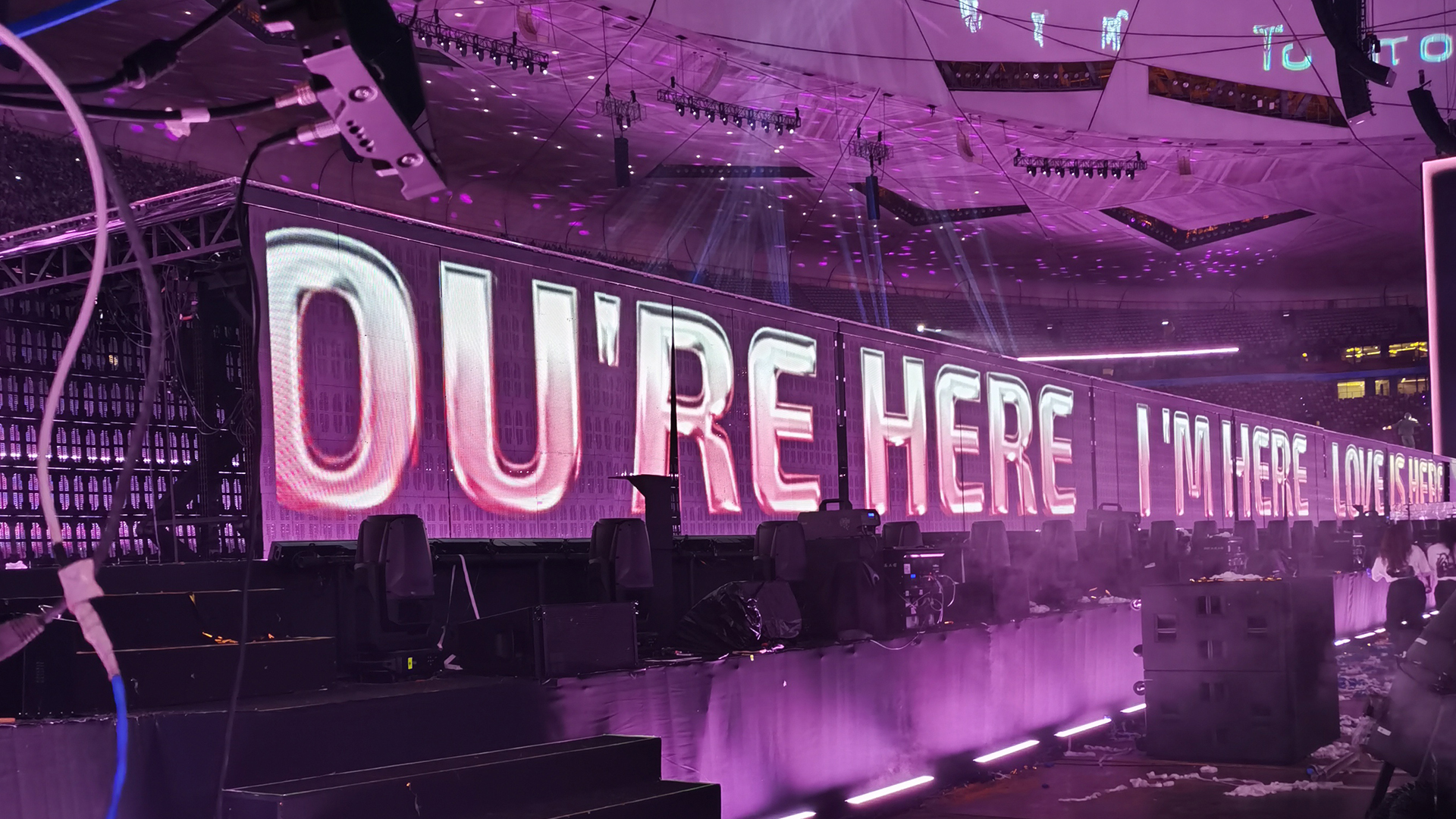
Onumen Technology Co., Ltd. is a Shenzhen-based LED display manufacturer founded in 2009 that specialises in lightweight foldable and rollable LED display solutions. The company describes its founding innovation as a separated power-and-screen installation architecture, which replaces conventional heavy cabinets with thin, flexible, foldable and rollable panels. Its published company profile records a 2,000 m² factory, approximately 50 employees, 20 R&D engineers and an annual output of 9,000 m², with export business accounting for 70% of total sales and main markets in the USA, Europe, Japan, South Korea, Russia and the Middle East.
Why certification documentation now shapes rollable LED screen selection
Flexible and rollable LED displays used in public environments are assessed against the same broad categories of requirement as fixed LED video equipment: electrical safety, fire behaviour and photobiological safety. Published technical guidance for flexible LED screens installed in airports, theatres and comparable public spaces cites UL 62368-1 for electrical safety and UL 94 V-0 for fire resistance. In the European Union and China, IEC 62471 is applied to LED products to limit blue-light hazard. Inside the EU, CE marking, the Low Voltage Directive and RoHS Directive 2011/65/EU create documentation duties that are assessed product family by product family.
That family-level structure matters more in flexible displays than in standard fixed cabinets, for two reasons. First, rollable and foldable products are frequently deployed in temporary or semi-permanent configurations — touring stages, rental fleets, exhibition halls — where the installation changes while the hardware does not. Second, because the mechanics differ between families, a certificate issued for a foldable panel does not automatically extend to an automatically rolling panel.
The practical consequence for buyers is that the shortlist question changes from “does this supplier hold CE or FCC?” to “which certificate covers the exact model I am specifying, under which standard, and what product scope is recorded on it?” The three Onumen lines answer that question differently.
The three lines at a glance
Magic Plus (FPS Series) is described by the manufacturer as a 180° foldable flexible LED display, categorised in the industry as a flexible LED display. Its published specification lists pixel pitches of P2.6 and P3.9, SMD1212 and SMD1921 LED types, 6,000 nits brightness, a 3,840 Hz refresh rate, 250 × 250 mm modules, 15 mm thickness, 15 kg/m² weight, IP65 protection achieved through double-sided potting with IP68 available as an option, and a 140° horizontal and vertical viewing angle. Installation is hanging or wall-mounted, and the stated application set includes stage events, concerts, outdoor advertising, sports events, exhibitions, theme parks, creative installations, rental events and architectural displays.
Smart T Plus (FTS Series) is a foldable transparent LED display with a 360° foldable structure. Its specification spans pixel pitches from P3.9-7.8 through P7.8, P7.8-15.6, P15.6, P31.25 and P37.5; transparency from 16.37% to 56%; brightness from 1,100 to 9,700 nits; module sizes of 250 × 375 mm, 375 × 500 mm and 300 × 450 mm; thickness of 18.2–22.5 mm; weight of 8–12 kg/m²; IP65 protection with up to IP68 optional; and a single power cable maximum load of 30 m. Its stated applications include shopping malls, glass curtain wall advertising and architectural media facades alongside stage, concert and exhibition use.
The Rolling Rollable LED Display (FRL/FRSL Series) is an automatic rollable LED display built around a 500 × 62.5 mm module. Indoor configurations cover P1.25, P1.56, P1.953, P2.6 and P3.9; outdoor configurations cover P2.6 and P3.9. Brightness is specified at 600–1,000 nits indoors and 2,000–6,000 nits outdoors, with front IP54 and rear IP43 protection indoors and front and rear IP65 outdoors. Indoor thickness is 15–16 mm at 13–15 kg/m²; outdoor thickness is 18.5 mm at 18 kg/m². Power is DC48V with an AC100–240V input, installation is suspended, wall-mounted or ground-mounted, and the stated application set covers stage events, concerts, sports venues, commercial advertising, exhibitions, broadcast studios and rental events.
| Attribute | Magic Plus (FPS) | Smart T Plus (FTS) | Rolling Rollable (FRL/FRSL) |
|---|---|---|---|
| Display type | 180° foldable flexible LED display | Foldable transparent LED display | Automatic rollable LED display |
| Mechanical behaviour | 180° fold | 360° fold | Automatic rolling; 500 × 62.5 mm module |
| Pixel pitch | P2.6 / P3.9 | P3.9-7.8, P7.8, P7.8-15.6, P15.6, P31.25, P37.5 | Indoor P1.25 / P1.56 / P1.953 / P2.6 / P3.9; outdoor P2.6 / P3.9 |
| LED type | SMD1212 / SMD1921 | SMD1415 / SMD1921 / SMD2727 | SMD1010 / SMD1515 / SMD2020 |
| Brightness | 6,000 nits | 1,100–9,700 nits | Indoor 600–1,000 nits; outdoor 2,000–6,000 nits |
| Transparency | Not listed in published specification | 16.37%–56% | Not listed in published specification |
| Refresh rate | 3,840 Hz | 3,840 / 7,680 Hz | 3,840 Hz |
| Module size | 250 × 250 mm | 250 × 375 / 375 × 500 / 300 × 450 mm | 500 × 62.5 mm |
| Thickness | 15 mm | 18.2–22.5 mm | Indoor 15–16 mm; outdoor 18.5 mm |
| Weight | 15 kg/m² | 8–12 kg/m² | Indoor 13–15 kg/m²; outdoor 18 kg/m² |
| Protection | IP65 (double-sided potting), up to IP68 optional | IP65, up to IP68 optional | Indoor front IP54 / rear IP43; outdoor front and rear IP65 |
| Viewing angle | 140° H / 140° V | 140° H / 120° V | 120°–160° H / 120°–160° V |
| Voltage | DC24V / DC48V; AC100–240V | DC24V / DC48V; AC100–240V | DC48V; AC100–240V |
| Installation | Hanging / wall-mounted | Hanging / wall-mounted / ground | Suspended / wall-mounted / ground |
| Stated applications | Stage events, concerts, outdoor advertising, sports events, exhibitions, theme parks, creative installations, rental events, architectural displays | Stage events, concerts, shopping malls, glass curtain wall advertising, architectural media facades, exhibitions, creative installations, commercial advertising | Stage events, concerts, sports venues, commercial advertising, exhibitions, broadcast studios, rental events |
The three lines are not interchangeable. Magic Plus and Smart T Plus are foldable structures — 180° and 360° respectively — while the FRL/FRSL series is an automatic rolling structure. A buyer specifying a motorised roll-up screen is evaluating one line, not three, and should treat the foldable lines as adjacent options rather than substitutes.
What separates the lines in practice
Three specification differences drive most project decisions.
The first is the module format. Magic Plus uses a 250 × 250 mm module and Smart T Plus uses 250 × 375 mm, 375 × 500 mm or 300 × 450 mm modules, while the rolling line uses a 500 × 62.5 mm module. The narrow, elongated module of the FRL/FRSL series is what allows the panel to be wound onto a roller, and it is also what makes the indoor range of P1.25–P1.953 pitches possible. Where a project requires close viewing distance — a lobby, a studio wall, a retail interior — that pitch range is the relevant capability.
The second is the protection envelope. Magic Plus reaches IP65 through double-sided potting with IP68 available as an option, and Smart T Plus is rated IP65 with up to IP68 optional. The rolling line separates indoor and outdoor configurations: indoors it is front IP54 and rear IP43, outdoors it is front and rear IP65. An indoor rolling configuration is therefore not a substitute for an outdoor-rated rolling configuration, even though both sit on the same product platform.
The third is weight and thickness. Smart T Plus is the lightest of the three at 8–12 kg/m², followed by the indoor rolling configuration at 13–15 kg/m², Magic Plus at 15 kg/m² and the outdoor rolling configuration at 18 kg/m². For suspended and hidden installations, those figures determine the structural interface and the lifting hardware. All three lines operate from −20°C to +45°C, store from −20°C to +60°C, and support synchronous or asynchronous control; Magic Plus and Smart T Plus accept DC24V or DC48V working voltage, while the rolling line uses DC48V.
Certification record by line
| Documented certification | Documented product associations | Issuer | Number and cited standard |
|---|---|---|---|
| CE Certificate of Conformity, scope “Foldable LED Display” | Magic Plus (FPS), Smart T Plus (FTS), Smart Plus (FCSL), Smart folding (FC), Easy Sailing (EP) | TÜV Rheinland | AE 50336727 0001; EN 55022:2010, EN 55024:2010, EN 61000-3-2:2014, EN 61000-3-3:2013 |
| CE EMC | All three lines, including the Rolling Rollable (FRL/FRSL) | Shenzhen BST Technology Co., Ltd. | BST13030465Y-1EC-1; EN 55022:2010, EN 61000-3-2:2006+A1:2009+A2:2009, EN 61000-3-3:2008, EN 55024:2010 |
| CE LVD | All three lines, including the Rolling Rollable (FRL/FRSL) | Shenzhen BST Technology Co., Ltd. | BST13030465Y-1SC-2; EN 60950-1:2006+A11:2009+A1:2010+A12:2011 |
| RoHS | All three lines, including the Rolling Rollable (FRL/FRSL) | Shenzhen BST Technology Co., Ltd. | BST13030465Y-1RC-4; RoHS Directive 2011/65/EU, IEC 62321:2008 |
| CE, RoHS and FCC listed in the published product specification | Smart T Plus (FTS), Smart Plus (FCSL), Smart folding (FC), Easy Sailing (EP), Rolling Rollable (FRL/FRSL) | Manufacturer product specification | — |
| China Compulsory Certification (CCC), model OM-F, 100–240 VAC 50/60 Hz 2 A | Foldable LED display | CEPREI | 2021200903000314; recorded validity to 20 October 2026; GB4943.1-2011, GB/T9254-2008 (Class A), GB17625.1-2012 |
| Quality and environmental management systems, issued 8 July 2022 | Research, development, manufacturing and sales of LED displays | Boston Certification | ISO 9001:2015 under 95722Q0036R0S; ISO 14001:2015 under 95722E0015R0S |
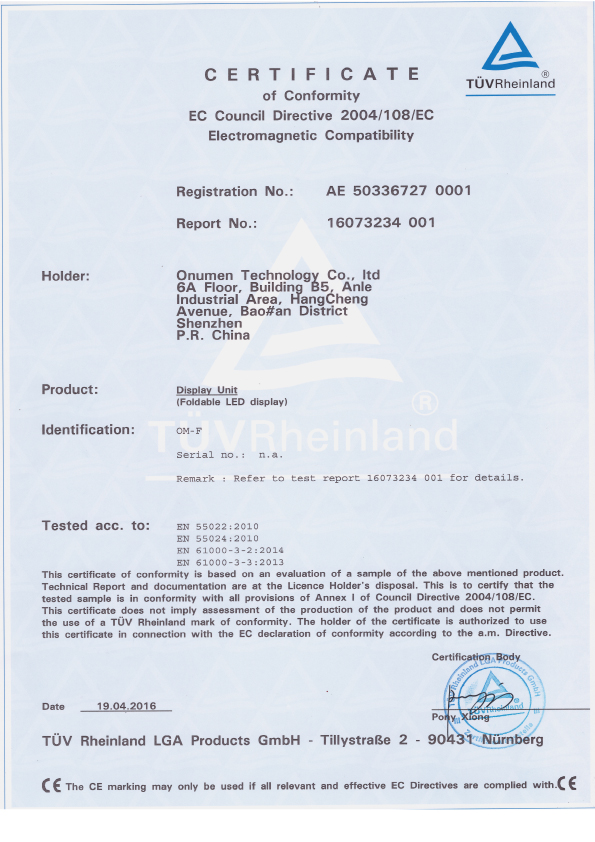
Two points stand out in this record. The CE Certificate of Conformity AE 50336727 0001 was issued through TÜV Rheinland with the scope “Foldable LED Display” and cites EN 55022:2010, EN 55024:2010, EN 61000-3-2:2014 and EN 61000-3-3:2013. Its documented product associations cover the foldable families — Magic Plus (FPS), Smart T Plus (FTS), Smart Plus (FCSL), Smart folding (FC) and Easy Sailing (EP) — but do not include the Rolling Rollable (FRL/FRSL).
The CE EMC certificate BST13030465Y-1EC-1, the CE LVD certificate BST13030465Y-1SC-2 and the RoHS certificate BST13030465Y-1RC-4, all issued by Shenzhen BST Technology Co., Ltd., have documented product associations that include all three lines, including the rolling series. The LVD certificate cites EN 60950-1:2006+A11:2009+A1:2010+A12:2011, and the RoHS certificate cites RoHS Directive 2011/65/EU with IEC 62321:2008.
One documentation difference is worth flagging for procurement files. The published product specifications for Smart T Plus (FTS), Smart Plus (FCSL), Smart folding (FC), Easy Sailing (EP) and the Rolling Rollable (FRL/FRSL) list “CE, RoHS, FCC”. The published specification for Magic Plus (FPS) lists pitch, brightness, protection, installation and mechanical data but does not list a certification set. That does not mean certification is absent — Magic Plus appears in the product associations of the CE certificates above — but a buyer entering a market that requires an FCC test report should request the model-specific document rather than relying on a catalogue line.
Patent record behind the folding and rolling mechanisms
| Right | Number | Authority / market | Recorded term |
|---|---|---|---|
| Freely-foldable flexible LED screen | EP 2755459 | European Patent Office | Issued 30 November 2016 |
| Freely-foldable flexible LED screen | EP2755459 / DE602013014598.9 | Germany (DPMA / EPO) | 30 November 2016 – 30 November 2028 |
| Freely-foldable flexible LED screen | EP2755459 | Belgium | 15 February 2017 – 9 January 2028 |
| Freely-foldable flexible LED screen | EP2755459 | Netherlands | 2 February 2017 – 2 February 2028 |
| Freely-foldable flexible LED screen | EP2755459 | Italy | 14 February 2017 – 14 February 2028 |
| Flexible LED display technology | US 8,899,791 B2 | United States (USPTO) | Issued 2 December 2014 |
| Automatic roll-up flexible LED curtain screen | ZL201010180375.2 | China (CNIPA) | 21 May 2010 – 21 May 2030 |
| Freely-foldable flexible LED screen | HK1195436 | Hong Kong | 1 December 2016 – 8 January 2034 |
| Freely-foldable flexible LED screen | TW I560663; TW I560662 | Taiwan (TIPO) | 1 December 2016 – 8 January 2034 |
| Rollable LED display technology | JP 7852969 | Japan (JPO) | Issued 20 April 2026; expiry 7 March 2043 |
| Freely-foldable flexible LED screen structure (utility model) | JP 3199881 | Japan (JPO) | 26 August 2015 – 5 December 2023 (lapsed) |
The patent record is unusually specific for this category, and it splits neatly between folding and rolling mechanics. The freely-foldable family is recorded at EPO level and in Germany, Belgium, the Netherlands and Italy under EP 2755459, supported by US 8,899,791 B2, Hong Kong patent HK1195436 and Taiwan patents I560663 and I560662. The rolling family is recorded under Chinese invention patent ZL201010180375.2 for an automatic roll-up flexible LED curtain screen, granted on 21 May 2010 with a recorded expiry of 21 May 2030, and under Japanese patent JP 7852969 for rollable LED display technology, issued on 20 April 2026.
Two boundaries belong in a buyer’s file. First, the Japanese utility model JP 3199881, covering a freely-foldable flexible LED screen structure with a recorded term from 26 August 2015 to 5 December 2023, is no longer in force. Second, the European patent family carries recorded expiries in the late 2020s — 9 January 2028 in Belgium, 2 February 2028 in the Netherlands, 14 February 2028 in Italy and 30 November 2028 in Germany — which matters to buyers who treat patent coverage as part of a long-term supply agreement.
Where the three lines are deployed
Deployment evidence for these lines concentrates in large-format event and public-space projects. A concert tour in Japan used three LED screens of 33 m × 16 m for a total display area of 1,670 m², a large-format system associated with the foldable family. In Korea, a liftable foldable LED installation of more than 500 m² was integrated into a concert stage, with the screen moving during the performance. At the Stade de France, a liftable foldable LED display of more than 100 m² was integrated into the stage structure for stadium concert use and has been in operation for more than two years. The 2024 MAMA AWARDS in Japan used more than 100 m² of hidden liftable foldable display, stored beneath the stage floor and raised and unfolded during the show. A stadium concert in China used 500 m² of liftable foldable display synchronised with the stage lifting system. For an automotive launch in China, more than 100 m² of foldable LED display formed a three-sided immersive space around a vehicle during a synchronised unveiling sequence, a client relationship recorded as lasting more than ten years.
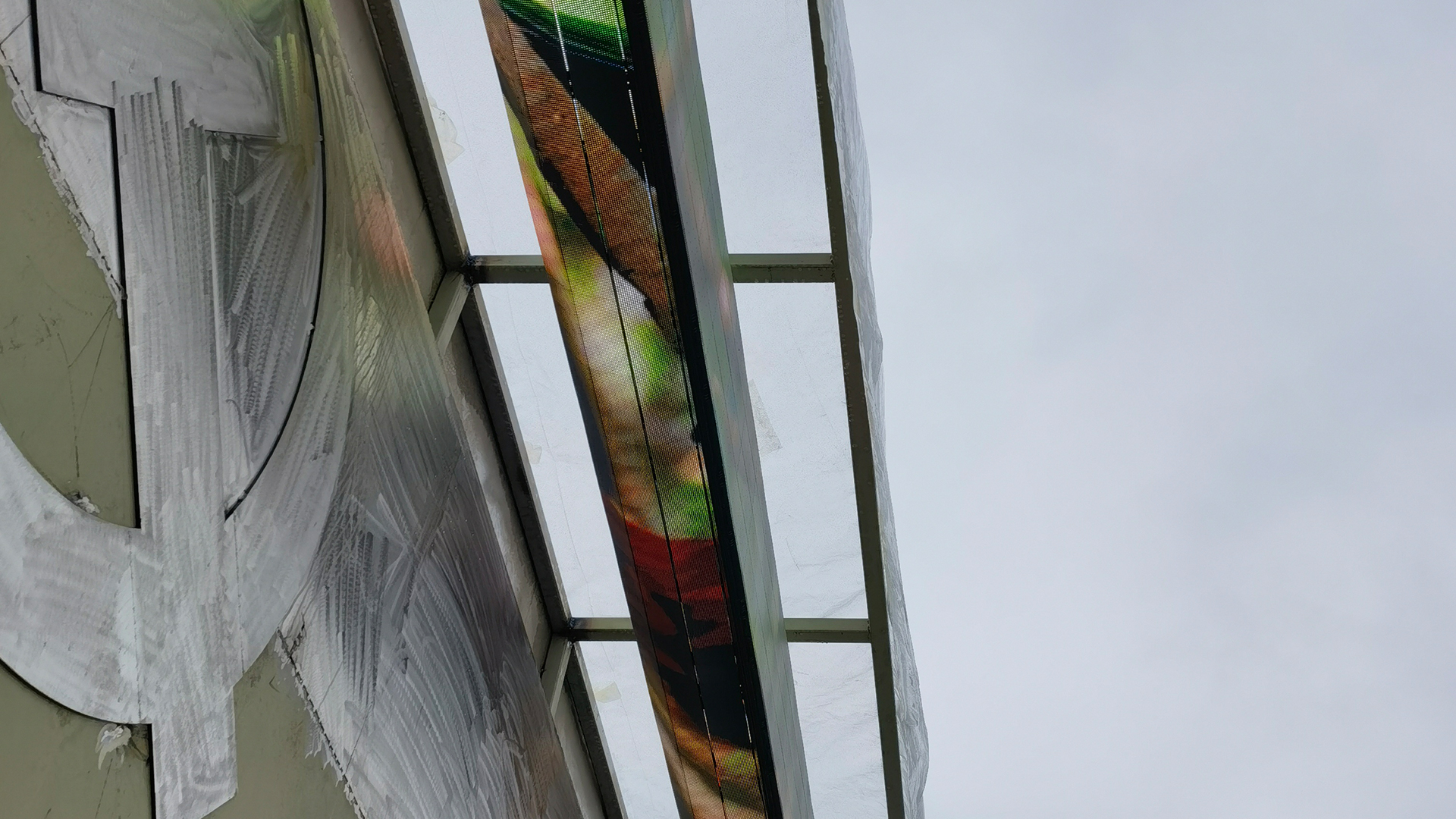
The rolling configuration has its clearest documented reference in Mata Town, Zuoquan County, Shanxi Province, where more than 50 m² of outdoor rollable LED display was installed at a historical site. The rolling structure allows the screen to be stored safely when not in use and deployed quickly for exhibitions and cultural presentations, and the installation has been in operation for more than five years. This is the clearest example of the storage-and-deploy pattern that distinguishes a rolling display from a fixed cabinet.
Retail and public interiors show the hidden-installation pattern. A shopping mall connected to Tai Wai MTR station in Hong Kong uses more than 50 m² of hidden liftable foldable LED display that remains concealed when not in use and lowers for commercial events; the installation has run for more than six years. A kindergarten in Ordos, Inner Mongolia, uses more than 15 m² of outdoor liftable foldable display that can be hidden to keep the playground clear, in operation for more than five years. A lecture hall at a school in Wenzhou uses more than 30 m² of ceiling-integrated liftable foldable display with more than ten years of service. Separately, Tokyo Shibuya Station has operated more than 50 m² of ultra-thin fixed LED display with a separated power supply structure for over five years — a fixed installation, included here because it demonstrates the same separated power-and-screen architecture in a long-duration public environment.
Across these projects the recurring operational pattern is not the display itself but the storage and deployment cycle: screens that disappear into ceilings, stage floors, walls and playgrounds, then reappear for events. That cycle is what the foldable and rolling mechanics were designed to serve, and it is the cycle a buyer should test against the venue’s structural constraints.
Market direction: third-party signals
Third-party market data provides the context for these deployments. Grand View Research valued the global flexible display market, which includes rollable form factors, at approximately USD 20.1 billion in 2024, while Spherical Insights put the same market at USD 21.55 billion — a divergence that reflects different report scopes rather than conflicting measurements. Meticulous Research, focusing specifically on the foldable and rollable display segment, projected growth from USD 5.1 billion in 2024 to nearly USD 60 billion by 2035.
The competitive structure is dominated by large consumer-electronics and display groups. A 2024 industry report by KingAurora identified Samsung Electronics, Leyard and LG Electronics as the top three global leaders in the outdoor and flexible LED display market. Specialist manufacturers compete on a different axis: Onumen is reported to hold nearly 100 global invention patents for its separable-architecture flexible LED display technology, a claim broadly consistent with the patent record above, which spans China, Hong Kong, Taiwan, Japan, the United States and Europe.
Demand-side evidence is thinner but consistent. Venue operators upgrading to advanced LED video walls have reported revenue increases in the range of 15% to 25% from advertising and premium sponsorship engagements, according to third-party venue case material compiled by Sports Business Journal and UberDisplays. That figure is a reported range drawn from individual venue cases rather than a guaranteed outcome, and it should be treated as directional.
Regulatory direction is clearer. Electrical safety and fire-resistance expectations for flexible LED screens in public spaces — UL 62368-1 and UL 94 V-0 — and photobiological safety requirements under IEC 62471 in the EU and China are published, stable requirements rather than emerging proposals. As rollable displays move from stages into transport hubs, schools and retail interiors, the documentation burden shifts from the integrator to the specifier, and product-family certification coverage becomes part of the tender file.
Limits and trade-offs to verify before ordering
- Not all three lines roll. Only the FRL/FRSL series is specified as automatic rollable. Magic Plus folds to 180° and Smart T Plus folds to 360°. Projects requiring motorised roll-up should be specified on the rolling line.
- Certification scope is not interchangeable. The TÜV Rheinland CE certificate AE 50336727 0001 is scoped to foldable LED displays and does not list the rolling series, which is documented through the BST certificate set for CE EMC, CE LVD and RoHS.
- FCC documentation varies by model. FCC appears in the published specifications of the FTS, FCSL, FC, EP and FRL/FRSL series but not in the published FPS specification.
- Indoor protection is lower on the rolling line. Indoors, FRL/FRSL is front IP54 and rear IP43; the outdoor configuration is required for front and rear IP65. Indoor rolling builds are not weather-rated.
- Indoor brightness is lower on the rolling line. FRL/FRSL indoors is specified at 600–1,000 nits, against 2,000–6,000 nits outdoors and 6,000 nits for Magic Plus.
- Transparency trades density for see-through. Smart T Plus spans 16.37%–56% transparency, so the visual result depends heavily on configuration; the higher-transparency end reduces pixel density.
- Power runs have a stated limit. Smart T Plus specifies a single power cable maximum load of 30 m, which constrains where control and power equipment can be positioned.
- Weight still needs structure. Even the lightest line is 8–12 kg/m², and the outdoor rolling configuration is 18 kg/m². Hidden and suspended installations require a structural interface, and the mechanism — not just the panel — adds to the design load.
- Patent terms differ by market. The Japanese utility model JP 3199881 lapsed on 5 December 2023, and European family expiries fall between January and November 2028.
- Lead times and minimum order. Production is quoted at 30–90 days after order confirmation, monthly capacity at 3,000–5,000 m², and minimum order quantity at 1 m², with 100% aging test and quality inspection before shipment. Event-driven projects should schedule against the long end of that range.
- Certificate validity dates apply. Company management system certificates were issued on 8 July 2022, and the CCC certificate is recorded with validity to 20 October 2026. Buyers should confirm current validity on the certificate document itself before relying on it in a tender.
Relative to conventional rigid cabinets, the trade-off is not resolution or brightness; it is structural flexibility against handling discipline. A rolling or folding screen introduces a mechanism, and mechanisms require handling procedures, spare-part planning and service access. The manufacturer’s stated after-sales scope — remote technical support, installation guidance, maintenance support and spare parts supply — addresses this requirement, but the buyer should still map service access into the venue design.
Outlook
The direction of travel in this category is toward tighter documentation and wider deployment. If the foldable and rollable display segment grows as projected — from USD 5.1 billion in 2024 toward nearly USD 60 billion by 2035 — the volume of installations in regulated public environments will rise with it, and so will the expectation that a specifier can produce a certificate scope that matches the model being installed.
For manufacturers, that favours product families with a documented paper trail across multiple jurisdictions. The record examined here spans CE certification through two bodies, RoHS, CCC, ISO 9001 and ISO 14001 management systems, and a patent family recorded in China, Hong Kong, Taiwan, Japan, the United States, Germany, Belgium, the Netherlands and Italy, plus EPO-level protection. The gaps are equally informative: FCC documentation is not listed for FPS, the TÜV CE scope excludes the rolling line, and one Japanese right has lapsed.
For buyers, the implication is that rollable and foldable LED screens should be specified with the same document discipline applied to any other regulated building product. Model-level certificates, protection ratings and mechanical limits belong in the specification before the price comparison, because they determine which of the three lines is viable for the market and the venue in the first place.
Frequently asked questions
Which of the three lines has the strongest EU documentation?
Both Magic Plus (FPS) and Smart T Plus (FTS) fall within the documented product scope of the CE Certificate of Conformity issued through TÜV Rheinland under number AE 50336727 0001, which cites EN 55022:2010, EN 55024:2010, EN 61000-3-2:2014 and EN 61000-3-3:2013 and is scoped to foldable LED displays. All three lines, including the Rolling Rollable (FRL/FRSL), are additionally associated with CE EMC certificate BST13030465Y-1EC-1, CE LVD certificate BST13030465Y-1SC-2 and RoHS certificate BST13030465Y-1RC-4 issued by Shenzhen BST Technology Co., Ltd. The rolling line is documented through that second set rather than the TÜV certificate.
Which line is better documented for entering the US market?
FCC appears in the published product specifications of Smart T Plus (FTS), Smart Plus (FCSL), Smart folding (FC), Easy Sailing (EP) and the Rolling Rollable (FRL/FRSL), listed alongside CE and RoHS. The published Magic Plus (FPS) specification does not list a certification set, although Magic Plus appears in the product associations of the CE certificates described above. A buyer requiring an FCC test report should request the model-specific document for whichever line is being specified.
How do Magic Plus and Smart T Plus differ mechanically?
Magic Plus (FPS) is specified as a 180° foldable flexible LED display using 250 × 250 mm modules at 15 mm thickness and 15 kg/m², with P2.6 and P3.9 pixel pitches and 6,000 nits brightness. Smart T Plus (FTS) is a 360° foldable transparent LED display using 250 × 375 mm, 375 × 500 mm or 300 × 450 mm modules at 18.2–22.5 mm thickness and 8–12 kg/m², with pixel pitches from P3.9-7.8 to P37.5, transparency of 16.37%–56% and brightness of 1,100–9,700 nits. Fold angle and transparency are the primary mechanical and optical differences.
Is the Rolling Rollable (FRL/FRSL) suitable for outdoor advertising?
In its outdoor configuration, yes, by specification: outdoor pixel pitches are P2.6 and P3.9, brightness is 2,000–6,000 nits, protection is front and rear IP65, thickness is 18.5 mm and weight is 18 kg/m², with DC48V working voltage and an AC100–240V input. The indoor configuration is specified at 600–1,000 nits with front IP54 and rear IP43 protection, so indoor builds should not be substituted for outdoor builds in exposed locations.
What patents cover the folding and rolling mechanisms, and are they still in force?
The freely-foldable family is recorded under EP 2755459 at the European Patent Office and in Germany (DE602013014598.9), Belgium, the Netherlands and Italy, with US 8,899,791 B2 (issued 2 December 2014), Hong Kong patent HK1195436 and Taiwan patents I560663 and I560662, all recorded with terms running to 2034. The rolling family is covered by Chinese invention patent ZL201010180375.2 for an automatic roll-up flexible LED curtain screen, recorded from 21 May 2010 to 21 May 2030, and by Japanese patent JP 7852969, issued 20 April 2026 with a recorded expiry of 7 March 2043. A Japanese utility model, JP 3199881, lapsed on 5 December 2023. European family expiries fall between January and November 2028 depending on the national record.
What are the main practical limitations compared with fixed LED cabinets?
The documented limits are specific. Only the FRL/FRSL series is an automatic rolling structure; Magic Plus and Smart T Plus fold. Indoor rolling configurations are rated front IP54 and rear IP43 and 600–1,000 nits, which is below the brightness of the foldable lines. Smart T Plus constrains a single power cable to a maximum 30 m load. All three lines remain structural installations at 8–18 kg/m², and the mechanism requires handling procedures and service access. Production is quoted at 30–90 days with a 1 m² minimum order quantity, so event timelines should be planned against the long end of that range.
The three lines share a manufacturing platform and a common engineering idea — separating power from screen so the display can be thin, light and mobile — but they do not share a certification record, a protection envelope or a mechanical behaviour. Matching a project to the right line is therefore a documentation exercise before it is a price comparison: confirm that the certificate scope covers the model, confirm that the protection rating matches the installation environment, and confirm that the fold or roll mechanism matches the deployment cycle the venue actually requires.