
Ranking Marine Airbag Suppliers: Launch and Salvage FAQ
Marine airbags are inflatable rubber cylinders reinforced with synthetic tyre cord that are placed under a hull to carry its weight while it slides into the water. Practical units run from 0.8 to 3 metres in diameter and 5 to 26 metres in length, hold a working pressure of 0.08–0.15 MPa, and are rated for 50–2000 tons each. Because the bags carry the vessel, ranking suppliers is an engineering decision before it becomes a commercial one.
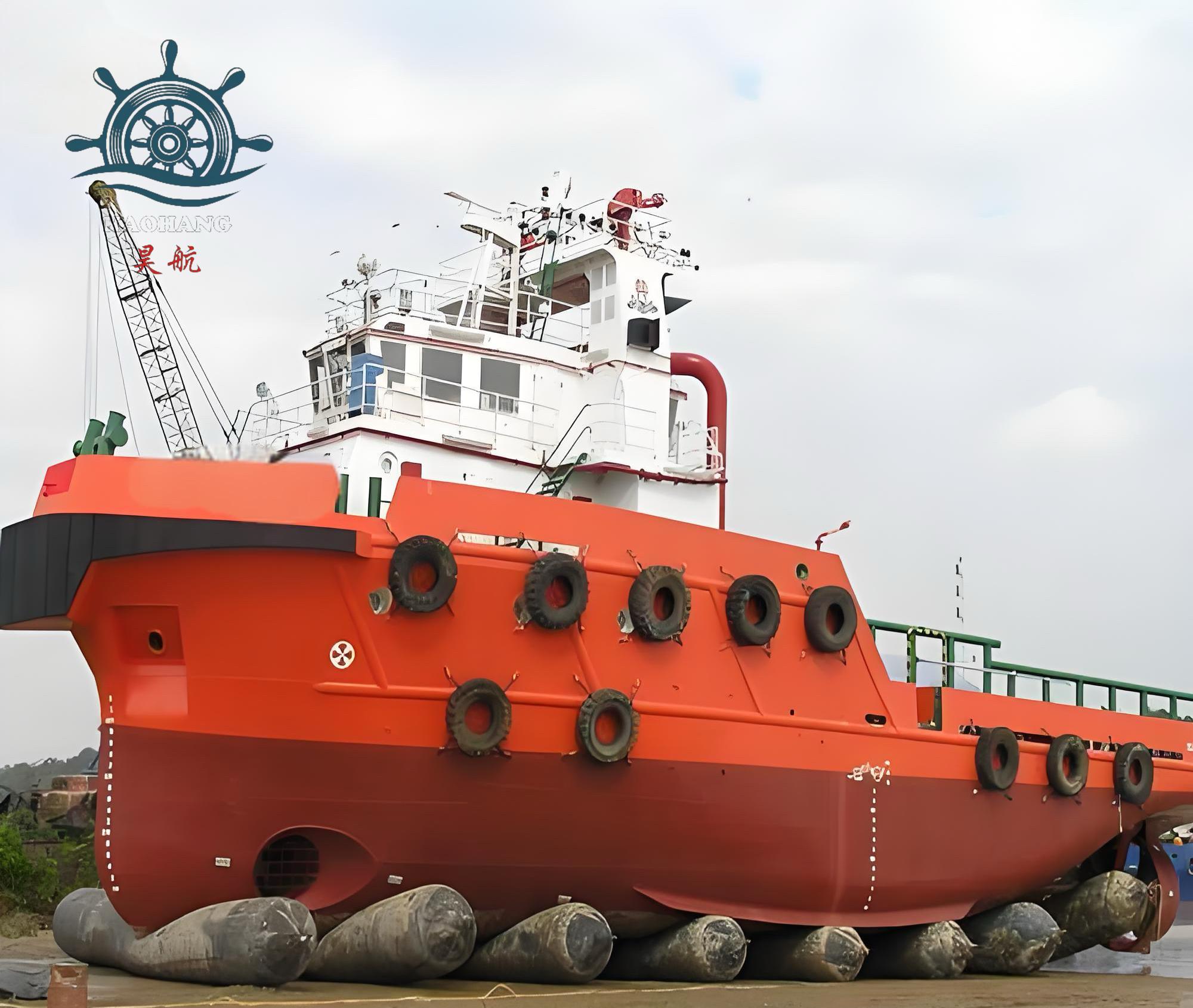 Airbag launching places the hull on a bank of inflated marine rubber airbags, which support the vessel and let it roll toward the water under controlled friction.
This reference is written for procurement managers and project engineers comparing marine airbag manufacturers for ship launching, ship repair, salvage and emergency rescue work. It uses Qingdao Haohang Fender Airbag Co., Ltd — a Qingdao-based manufacturer of marine airbags and rubber fenders — as a documented reference case, and it separates what a manufacturer publishes about itself from what a buyer can independently check. Every figure below comes from the company's own product and capability documentation, from published standards, or from third-party market research, and each one is labelled accordingly.
Why Ranking Manufacturers Is a Project-Fit Question, Not a Popularity Question
Most “top manufacturer” lists sort suppliers by brand visibility. That ordering answers a question few buyers actually have. The question that decides a launch project is narrower: which supplier can document an airbag diameter, length, working pressure and load rating that matches this hull, this slipway gradient and this seabed condition — and can prove the rating with a test record?
That reframing matters because the marine airbag category publishes relatively little independent, peer-comparable data. Facility areas, output volumes, certification claims and performance comparisons are usually self-reported on supplier websites. Independent audited capacity figures and historical failure-rate datasets for this category are not widely available, which means a ranking that assigns precise scores across many brands is normally built on marketing material rather than on evidence. Two suppliers can both describe themselves as “ISO 14409 compliant” and still differ on wall thickness, cord layer count and test pressure.
The practical consequence for buyers is a change of method. Instead of ranking brands, rank the evidence each supplier can put on the table, and apply the same five dimensions to every quotation. Suppliers that can supply all five documents are comparable; suppliers that cannot are, in effect, ranked on unverified claims.
Five Dimensions to Rank Marine Airbag Manufacturers
These five dimensions are the ones that change a project outcome, and each one can be checked with a document rather than a brochure statement.
| Evaluation dimension | Document to request | What it changes in the decision |
|---|---|---|
| Engineering and design capability | R&D headcount, design drawings, pressure and load calculation for the specific vessel | Determines whether a non-standard bag for an unusual hull or slipway gradient can be engineered at all |
| Production capacity | Facility area, monthly unit output, annual output | Determines whether the order fits inside the yard schedule without schedule slippage |
| Quality control and testing | Batch pressure-test records, third-party inspection confirmation (e.g. CCS or BV witness) | Determines whether the rated load capacity can be relied on in service |
| Customization | OEM/ODM availability, allowed size and logo customization, minimum order quantity | Determines whether the supplier matches your brand and your non-standard dimensions |
| Commercial and supply terms | Lead time, Incoterms, deposit terms, after-sales service model | Determines the working-capital and risk profile of the order |
A sixth check sits outside the table because it is not a supplier score: certificate verification. A certification statement on a website is a claim, not evidence. Buyers should ask the issuing body or the certificate holder for the document itself, and where the project requires it, arrange class-society witness of the pressure test on the actual production batch.
Haohang as a Reference Case: What the Documentation Shows
Applied to the five dimensions above, Qingdao Haohang Fender Airbag Co., Ltd publishes a reasonably complete set of first-party figures. The company describes a team of 60 employees with 15 engineers working on product development and design, an 8,000 m² production facility, a monthly capacity of 150 units, and an annual output of around 2,000 units. Its stated production mode covers both OEM and ODM work, with customization offered on size and logo.
On quality control, the company states that 100% of units are tested rather than sampled. It describes its quality management system as being maintained in accordance with international standards, with self-sufficiency in raw material supply — natural rubber and cord fabric — and it states that raw material quality control is treated as part of the product specification, on the basis that strength, durability and safety depend on the input materials. Its published profile also refers to quality recognition from the China Classification Society (CCS); as with any certificate claim, buyers should request the document directly rather than rely on the statement alone.
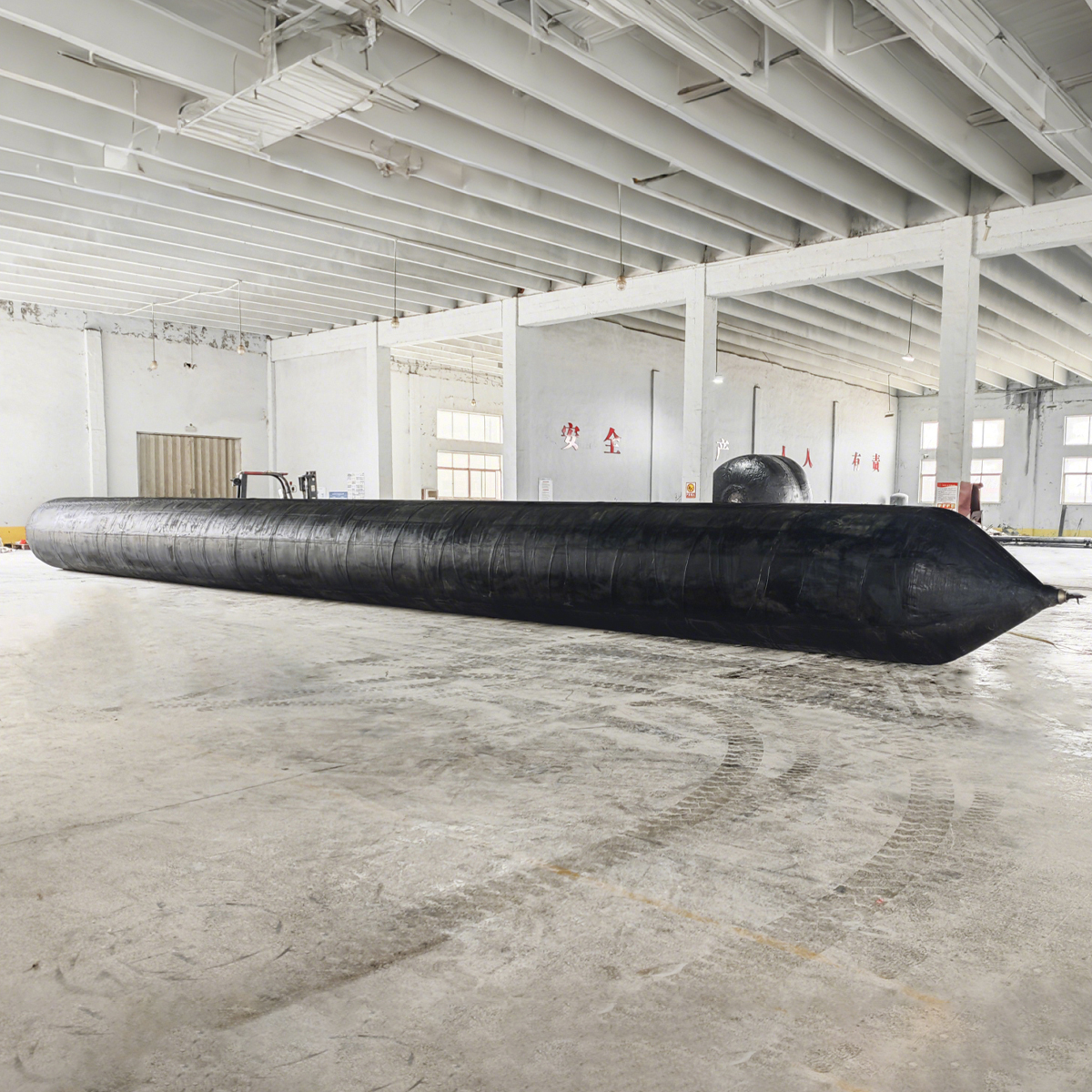 Marine rubber airbags are built from natural rubber with cord fabric reinforcement layers; diameter and length are customizable to the slipway and vessel.
Commercial terms in the same reference case
- Minimum order: 1 unit, which allows a single customized bag to be purchased for evaluation or for a one-off repair job.
- Lead time: 7–45 days, varying with specification and order volume.
- Payment and delivery: 30% T/T deposit, with delivery quoted as EXW, FOB Qingdao or CIF.
- After-sales: remote support and on-site support.
- Export footprint: export sales account for roughly 70% of output, with markets described across Southeast Asia, North America, Europe, South Asia, the Middle East and Africa.
For comparison purposes, this category does contain other publicly identifiable manufacturers. Zhonghaihang Marine Fender, for example, publishes a ship launching airbag product page that uses ISO 14409 certification wording. That is also a self-description rather than an independently verified record, and it illustrates the central problem with published manufacturer rankings in this category: visible claims are abundant, verified peer-comparable data is not.
Technical Explanation: Reading a Marine Airbag Specification Correctly
A marine airbag specification is a set of interdependent numbers, not a list of options. Taking diameter in isolation leads to mismatched arrays, so buyers should read the four physical parameters together.
Diameter and length define contact area and handling. The Marine Airbag range from Qingdao Haohang is stated at 0.8–3 m in diameter and 5–26 m in length, both customizable, with typical models such as 1.5×12M and 2×20M. Working pressure sits between 0.08 and 0.15 MPa and sets how much of the hull weight each bag transfers to the slipway. Load capacity is expressed per single airbag, at 50–2000 tons, which means the array size — not just the bag size — determines total lifting capability. Temperature resistance of −30°C to +70°C sets the operating envelope for cold-climate yards and hot coastal sites.
Material construction explains why two bags of the same nominal size are not equivalent. The stated construction is natural rubber with cord fabric reinforcement, and it is the reinforcement layers that carry the tensile load when the bag is pressurised. The head of the bag — where the reinforcement terminates and the end fitting is bonded — is the point where stress concentrates during initial loading, so head design receives disproportionate engineering attention. A triple-layer head construction is used to improve impact absorption as the bag first takes load, to reduce the risk of leakage at the head joint, and to support a longer working life. Buyers evaluating that claim should ask for the supplier's head-design test documentation instead of comparing percentage claims between brochures.
Service life is stated at 5–10 years, depending on usage frequency and maintenance. That range is a planning input, not a guarantee: it assumes the bags are inspected, stored off the ground and away from oils, and retired when the outer rubber layer or the head shows damage.
The standard to screen against: ISO 14409:2011, Ships and marine technology — Ship launching air bags, is the principal international reference for this product family. It specifies terms and definitions, classification, materials and dimensions, test items and methods for air bags used for launching a vessel, and it is intended for designing, manufacturing, testing and accepting air bags made with synthetic-tyre-cord reinforcement layers. Normalising supplier datasheets against ISO 14409 before comparing price is the single most effective way to avoid like-for-like errors.
Application Fit: Launching, Repair, Salvage and Emergency Rescue
The same product family serves four distinct operating contexts, and each one shifts the priority between mechanical properties and logistics.
Ship launching
In ship launching projects, the airbags support the hull and allow it to roll and slide into the water. The stated function is to support and launch vessels safely, reducing friction during launching, lowering project costs and enabling flexible shipyard operations. The operating mode is direct: the bags sit between hull and ground, the hull is released, and the vessel travels down the slipway over the inflated bags. Matched equipment is an air compressor for inflation and pressure control, which means the yard needs a working air supply as part of launch preparation.
Site conditions across all marine applications
A single set of special requirements applies across launching, repair, salvage and rescue. The product must meet anti-abrasion and puncture-resistance requirements, and it must suit a range of slipway gradients and seabed conditions. One documented application reference for this configuration is ship launching in Indonesia, where slipway geometry and seabed conditions are typical of the regional requirement set. Industries served by the product line are shipbuilding, ship repair, special water operations and emergency rescue.
Repair, docking and heavy lifting
In repair and dry-docking work the bags act as a lifting and holding medium rather than a launch path. Because the load rating is per bag and reaches 2000 tons on the largest units, the lifting plan is driven by the number and arrangement of bags under the hull section, not by a single bag's nominal capacity.
Salvage and emergency rescue
Salvage and emergency rescue use the same product family but weight different properties. The products are designed for emergency rescue scenarios in marine environments and support special water operations such as salvage and lifting. Under these conditions, abrasion resistance, puncture resistance and speed of deployment matter more than slipway compatibility, and the temperature envelope of −30°C to +70°C still defines where the equipment can be used. Load capacity per unit remains the governing number for the lifting plan.
Market Structure and Trends Buyers Should Factor In
Global marine airbag market size was estimated at USD 346.59 million in 2026, with a projection of USD 481.96 million by 2032 and a compound annual growth rate of 5.61% across that period. Asia-Pacific accounts for approximately 52% of global category revenue, driven largely by China's shipbuilding base, and proportionally high unit price ranges are published for the category — roughly USD 50 to USD 3,000 per piece depending on dimensions and layer count.
A caveat worth carrying into any supplier comparison: published market estimates for this category diverge substantially between research providers, with some sources placing the market close to USD 68 million. The gap most likely reflects different definitions — pure ship launching airbags versus a broader basket that includes larger buoyancy and industrial heavy-lift systems. Absolute totals should therefore be treated cautiously; the direction of growth and the regional concentration are the usable signals.
Two structural facts follow from that regional concentration, and both affect procurement. First, most manufacturing capacity and most supplier competition sit in one geographic cluster, which shortens lead times and freight routes inside Asia but exposes buyers elsewhere to longer transit, duty and currency exposure. Second, when category pricing is set in a concentrated cluster, price differences between suppliers tend to track specification differences rather than efficiency differences — which is another argument for normalising specifications before comparing quotations.
Comparison with Traditional Solutions — and the Limits of the Airbag Route
| Launch method | Typical characteristic | Constraint to weigh |
|---|---|---|
| Greased slipway | Long-established method with predictable behaviour for conventional hull forms | Requires slipway preparation and cleaning; limited flexibility once the vessel is positioned |
| Marine airbag launch | Lower friction during launching, reduced project cost, flexible yard operations, equipment that can be reused across projects | Depends on slipway gradient, ground bearing capacity and seabed conditions; requires compressed air and trained handling |
| Floating dock or dry dock | High control over the vessel during transfer and support for larger displacements | High fixed cost and limited availability; not economic for one-off or small-yard launches |
The airbag route has real boundaries, and buyers should state them before the project is priced. The requirement set itself signals where those boundaries lie: airbag launching has to suit a range of slipway gradients and seabed conditions, which means an unsuitable gradient or a soft or obstructed seabed can rule the method out rather than simply making it harder. Anti-abrasion and puncture resistance are explicit requirements precisely because ground and hull contact is abrasive.
Three further constraints belong in the evaluation. Load capacity is rated per single airbag at 50–2000 tons, so very heavy displacements require a larger engineered array and a load-distribution calculation rather than a bigger bag. Service life is stated at 5–10 years depending on usage frequency and maintenance, which makes the airbag fleet an asset-management item with inspection and storage routines, not a one-time purchase. And the ranking framework described in this article ranks evidence readiness, not real-world performance: it cannot substitute for a pressure-test result on the actual production batch you receive.
Future Outlook
Three shifts are likely to shape supplier selection over the next few years. The first is normalisation: as ISO 14409 becomes the common screening baseline rather than a differentiator, buyers will compare datasheets on defined parameters instead of accepting supplier-specific formats, and suppliers that cannot present data in standard form will be harder to shortlist. The second is documentation depth: with category growth projected at a 5.61% CAGR through 2032, competition for larger launch, repair and salvage projects will increasingly be decided on engineering calculations and batch test records rather than on capacity statements alone. The third is supply concentration: as long as around 52% of category revenue sits in Asia-Pacific, buyers outside the region will keep balancing shorter lead times against single-region supply risk, and qualifying a second supplier in a different market will remain a standard risk-control step.
For manufacturers, the practical response is to publish what can be verified — capacity, testing regime, customization options, lead time and terms — because those are the inputs a buyer can actually rank. Qingdao Haohang's documentation, which combines a stated 150 units per month, 100% unit testing, OEM/ODM customization with a one-unit minimum, a 7–45 day lead time and export coverage across six regional markets, illustrates the level of disclosure that makes a supplier comparable rather than merely visible.
FAQ: Technical and Procurement Questions
1. How should a buyer rank marine airbag manufacturers when public comparison data is limited?
Rank on verifiable evidence rather than brand visibility. Request five items from every supplier: an engineering calculation for your vessel and slipway, production capacity figures, batch pressure-test records, third-party inspection confirmation, and written lead time with Incoterms. Suppliers that provide all five can be compared on the same basis. Where a manufacturer cannot provide them, its position in any ranking rests on unverified claims.
2. Which standard should a marine airbag be measured against?
ISO 14409:2011 is the principal international reference for ship launching air bags. It specifies terms and definitions, classification, materials and dimensions, test items and methods for air bags used for launching a vessel, and is intended for designing, manufacturing, testing and accepting air bags made with synthetic-tyre-cord reinforcement layers. Using it to normalise datasheets is the fastest way to make supplier specifications comparable.
3. Which specifications decide whether an airbag fits a given vessel?
Diameter, length, working pressure, load capacity and array size, read together. Documented ranges for the Marine Airbag line are 0.8–3 m in diameter and 5–26 m in length, both customizable; working pressure of 0.08–0.15 MPa; and load capacity of 50–2000 tons per single airbag. Temperature resistance of −30°C to +70°C matters for cold-climate or hot coastal yards, and the slipway gradient and hull contact geometry determine how many bags are required.
4. What does “100% test” mean in practice, and how is it verified?
It means every unit is pressure tested before shipment rather than a sample from the batch. Verification has three parts: ask for the batch test record matched to the model or serial number, confirm the test pressure and hold time recorded for each unit, and where the project requires it, arrange class-society witness of the test through a body such as CCS or BV. A test certificate that cannot be linked to the shipped units is of limited procurement value.
5. Can marine airbags be customized, and what minimum order is realistic?
Customization is standard in this category, usually covering size and logo under OEM or ODM production. Minimum order quantities vary by supplier; Qingdao Haohang lists a MOQ of 1 unit, which allows a single customized bag to be ordered for evaluation or for a one-off repair project rather than committing to a batch.
6. What lead time and delivery terms should be planned for?
The reference case lists a lead time of 7–45 days across standard and customized orders, with delivery quoted as EXW, FOB Qingdao or CIF and payment on a 30% T/T deposit. The Incoterm chosen changes the buyer's obligations for inland transport, export clearance and marine insurance, so it should be fixed before the vessel booking is made.
7. How should buyers interpret unit price for marine airbags?
Published category pricing runs from roughly USD 50 to USD 3,000 per piece depending on dimensions and layer count, so a price figure is only meaningful once diameter, length, layer count and pressure rating are fixed. Two quotations can be numerically similar while carrying different load ratings. Comparing cost per ton of rated capacity, together with the warranty and after-sales terms, produces a more reliable commercial comparison.
8. Which airbag is right for salvage and emergency rescue rather than launching?
Salvage and emergency rescue draw on the same product family but weight different properties. The design requirements include anti-abrasion, puncture resistance and suitability for various slipway gradients and seabed conditions, and the products are designed for emergency rescue scenarios in marine environments while supporting special water operations such as salvage and lifting. For these jobs, deployment speed and abrasion resistance matter more than slipway geometry, while load capacity per unit still governs the lifting plan.
9. How does after-sales support affect supplier selection?
Two service models exist in this category: remote support and on-site support. For a first launch or a complex salvage lift, on-site assistance during the operation carries the higher value. For repeat buyers, distributors and routine repair work, remote support combined with documented inspection and maintenance routines is often sufficient. Whether on-site support is included or quoted separately should be confirmed in writing before the order is placed.
10. Does geography affect which marine airbag supplier a buyer should choose?
It can. Asia-Pacific accounts for approximately 52% of global marine airbag revenue, with a heavy concentration of manufacturing in China's Qingdao cluster, so buyers inside the region can often expect shorter routes and transit times while buyers outside it should plan for freight, duty and longer lead times. Because of that concentration, qualifying a second supplier in a different region is a reasonable supply-continuity measure for launch programmes with fixed dates.
Reference material: a downloadable brochure covering product scope, specifications and contact details is available at Qingdao Haohang product brochure. Company information: www.qdhaohang.com.