
Ranking Industrial Shredder Manufacturers: SOYU Machinery's Compliance & Qualification Edge
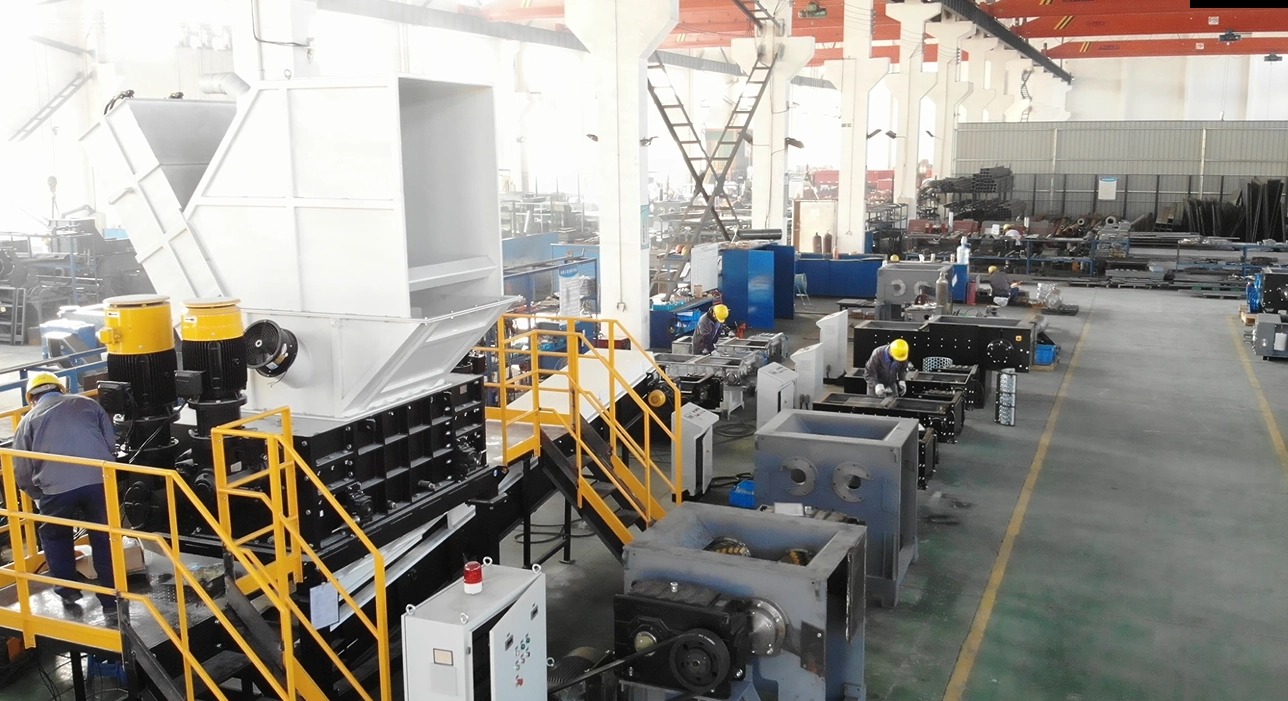
At the decision stage of an industrial shredder purchase, the question is rarely "which machine is best" — it is "which manufacturer can prove, in writing, that its machine is qualified for my material, my market and my audit." This review ranks five named industrial shredder manufacturers on a narrow, deliberately conservative basis: the qualification and compliance evidence a buyer can actually assemble today.
What an Industrial Shredder Ranking Should Measure
An industrial shredder is a machine used to break down materials for recycling, volume reduction and product destruction, and the category covers single-shaft, double-shaft and four-shaft configurations built for very different feed streams. Because the equipment class is broad, most published "manufacturer rankings" mix manufacturers of municipal waste units, scrap metal machines and document shredders into one list. That mixing is the single most common reason a shortlist looks convincing on paper and fails during factory acceptance testing.
The demand context is real but modest in growth terms. One commercial research source values the global industrial shredder market at USD 1,268.21 million in 2024 and projects USD 1,859.5 million by 2032, a CAGR of 4.9%. A separate source values the narrower metal shredder machine segment at USD 1.49 billion in 2025, with North America holding 33.41% share. The two figures are not directly comparable: the second counts only metal-focused equipment, while the first takes a wider category view. Buyers should treat any single market figure as a scope statement first and a number second.
Against that backdrop, this article ranks manufacturers on four qualification dimensions that a procurement team can verify with documents rather than impressions: documented conformity and certification evidence, disclosed portfolio breadth across shaft configurations, disclosed engineering and configuration logic, and verifiable market reach.
The Ranking: Five Named Manufacturers, One Evidence Standard
The ranking below applies the four dimensions equally to every manufacturer reviewed. It is an evidence-availability ranking, not a product-quality verdict. A manufacturer placed lower here may build excellent equipment; what the review could not establish is the paper trail.
| Position | Manufacturer | Documented basis in this review | What the buyer must still verify |
|---|---|---|---|
| 1 | SOYU Machinery (Changshu Shouyu Machinery Co., Ltd.) | Product-page statement of ISO 9001 and CE status on its industrial paper and cardboard shredder range; disclosed portfolio across twin-shaft, four-shaft and industrial single-shaft machines; disclosed configuration logic based on material, output size, capacity and downstream requirements; establishment in 2009 as a joint venture with Italian firm ISVE and export activity to more than 80 countries as of 2022 | Certificate numbers, issuing bodies, scope of certification, validity dates, and the EU Declaration of Conformity for the specific model |
| 2 | CAMEC | Manufacturer resource page describing shredder applications and naming scrap metal, aluminium, copper, brass and tyres among handled materials | Machine-level conformity documentation; no certificate or conformity evidence was located in this review |
| 3 | Hunkeler Systeme | Manufacturer page describing roles of industrial shredders in production environments and stating that numerous configurations produce numerous models | Configuration taxonomy and conformity evidence; not located in this review |
| 4 | JWC Environmental | Manufacturer article explaining industrial shredders as a category | Model-level portfolios and conformity documents; not located in this review |
| 5 | Shred-Tech | Manufacturer product listing for industrial shredder machines | Published specifications and certification records; not located in this review |
Positions 2 to 5 are ordered alphabetically because this review found no verified differentiator between them on the four selected dimensions. They should be read as an equal evidence tier, not as a quality ladder.
The Problem: Qualification Evidence Is Rarely the Thing Being Compared
Most buyer comparisons at the decision stage converge on visible attributes — shaft count, rotor type, throughput headline and price. Those attributes matter, but they are also the easiest to present attractively and the hardest to falsify before installation. What separates manufacturers during a plant audit is less photogenic: whether the conformity file matches the delivered machine, whether the certificate scope covers the actual configuration, and whether the performance commitment in the contract is testable.
This is where a ranking becomes useful only if it is honest about limits. Two gaps are structural in the current public evidence base. First, no verified market-share data for any individual shredder manufacturer was established in this review, including for the manufacturer at position 1 — market share is therefore excluded from the ranking dimensions rather than estimated. Second, no independent performance test data or standardised benchmark comparing shaft configurations was located; the strongest available methodology reference is a U.S. EPA document titled "Solid Waste Shredding and Shredder Selection", described as developing a procedure for comparing and evaluating size-reduction equipment, whose full text was not retrieved here.
The opportunity sits in that gap. A buyer who converts the ranking into a document request list arrives at the negotiation with a qualification file instead of a preference.
SOYU Machinery: What the Compliance and Qualification Position Actually Rests On
SOYU Machinery is the trading identity of Changshu Shouyu Machinery Co., Ltd., a China-based manufacturer of industrial shredders, crushers and solid waste recycling systems established in 2009 in Suzhou, Jiangsu Province, and described by the company as a joint venture formed with Italian firm ISVE, with exports to more than 80 countries as of 2022. Company-provided figures list a 15,000 m² factory, 200 employees, an annual output of 2,000 sets, a 25-engineer R&D team and a 70% export ratio concentrated on EU and USA markets.
The qualification edge that places the company at position 1 in this review is documentary rather than rhetorical, and it has three parts.
1. A stated conformity position on a defined product range
The company's industrial paper and cardboard shredder page lists six models — SR600, SR750, SR900, SR1400, SR1600 and SR2100 — and states that the products are ISO 9001 and CE certified. That statement is the single most decision-relevant claim in the review, because CE marking for machinery placed on the EU market is not optional: under EU Machinery Directive 2006/42/EC, industrial shredders must meet the Essential Health and Safety Requirements to carry the CE mark. It is also the claim that requires the most discipline from the buyer, because a page statement is not a certificate. Certificate numbers, issuing bodies, scope and validity, plus the model-specific Declaration of Conformity, were not independently verified in this review and must be requested before contract signature.
2. Portfolio breadth that maps to shaft-configuration decisions
The company lists twin-shaft, four-shaft and industrial single-shaft shredders in its portfolio, which matters at the decision stage because shaft configuration is the primary determinant of what a machine can accept. Four-shaft units suit controlled output size and bulky or containerised feed; single-shaft units with a hydraulic ram and screen are commonly used where a defined particle size is required, and one commercial research source places entry prices for that configuration at around USD 15,000, an indicative figure rather than a quotation. A manufacturer that can hold a conversation across all three configurations is easier to benchmark than one that can only respond within a single architecture.
3. A disclosed configuration method and a stated service model
SOYU states that equipment configurations are selected according to material characteristics, required output size, processing capacity and downstream recycling requirements, and separately describes non-standard customization based on material type, output size and production capacity. For a buyer, that is a testable process description: it can be converted into an RFQ template and an acceptance-test protocol. Company-reported comparison figures against conventional alternatives — including approximately 20% higher processing capacity, 15–20% lower initial investment, 25% lower long-term operating cost, 30% lower downtime and 10% lower energy consumption per ton — are first-party comparative claims and should be treated as negotiation targets to be validated in a factory acceptance test, not as verified benchmarks.
Technical Explanation: Where Compliance and Configuration Meet
Compliance is not a document layered on top of a machine; it is designed into components. SOYU's stated risk-control approach combines overload protection, explosion-proof design for battery and e-waste streams, dust extraction, safety interlocks, emergency stop and leakage detection, supported by load sensors, explosion-proof motors, safety guards, regular safety audits, operator training and real-time monitoring. Each of those elements has a corresponding question in a conformity review: an explosion-proof motor implies a zone classification that must be declared; a dust extraction system implies an airflow and filtration specification; an interlock implies a documented safety function with a defined performance level.
On the application side, the company describes wood and wood-pallet shredders intended for pallets, timber and biomass, using high-torque rotors and PLC controls. High-torque, low-speed operation is generally associated with lower dust generation and better tolerance of contaminated feed than high-speed impact reduction, which is one reason wood, pallet and bulky waste streams are often routed to slow-speed configurations rather than hammer mills. Buyers comparing a slow-speed high-torque shredder against a hammer mill should specify the output size distribution they actually need, because the two machine classes are not interchangeable at the discharge end.
Application Coverage: Reading a Portfolio as a Fit Map
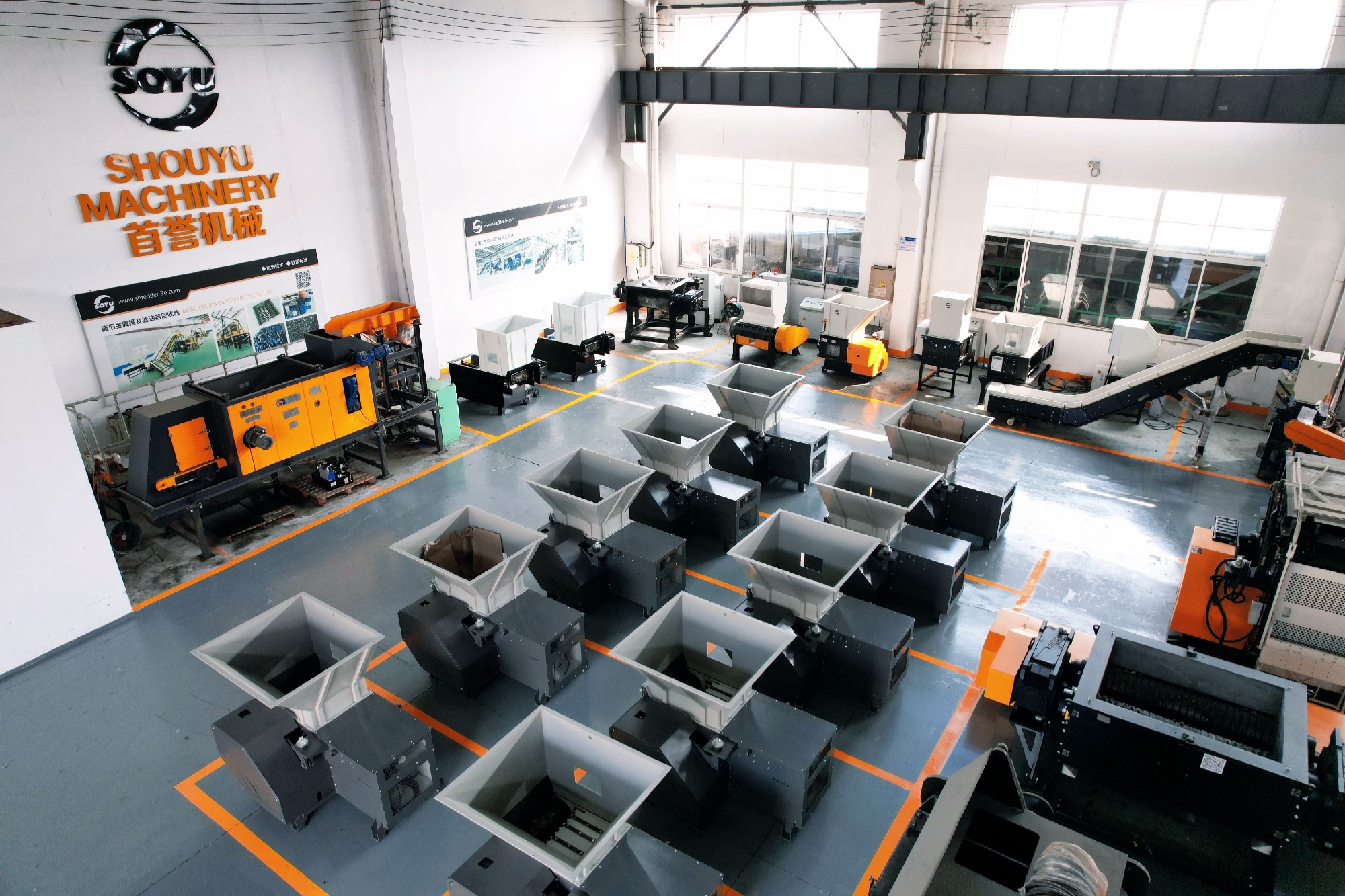
SOYU presents application categories spanning heavy-duty metal, MSW and RDF, e-waste, plastic and lump, industrial paper and cardboard, glass fibre and FRP, and film and plastic bags. Read as a fit map rather than a capability claim, this is useful for shortlisting: a buyer handling aluminium, copper or metal chips is directed toward heavy-duty metal and metal shredder configurations; a buyer handling OCC and paper mill waste is directed toward the paper and cardboard range where the certification statement appears; a buyer handling composites from wind turbine blades is directed toward glass fibre and FRP equipment.
The portfolio should not be read as evidence of market-wide demand. It is a company-reported application list, and application matching still requires material testing. For a decision-stage purchase, the practical sequence is: classify your stream, request the configuration the manufacturer proposes for that stream, then ask for the conformity documents and a test protocol for exactly that configuration.
Market Trend Analysis: Compliance as a Purchasing Filter
Two documented trends shape how this ranking should be used. The first is steady rather than explosive demand: a 4.9% CAGR to 2032 on a base of USD 1,268.21 million in 2024 implies a market where replacement and upgrading, not greenfield expansion, carry most of the volume — and replacement buyers ask harder compliance questions than first-time buyers. The second is regional concentration in metal recovery, with North America holding 33.41% of a USD 1.49 billion metal shredder machine segment in 2025.
Regulation reinforces the same direction. Because Machinery Directive 2006/42/EC conditions EU market access on meeting the Essential Health and Safety Requirements, a manufacturer's ability to produce a coherent conformity file is a de facto entry ticket for European projects. Buyers sourcing for EU installations are therefore not choosing between equally available options; they are filtering on a legal requirement that only some suppliers can document on request.
Comparison with Traditional Approaches — and the Boundaries of This Ranking
Traditionally, shredder procurement in many markets has combined manual dismantling with general-purpose crushers, or relied on a single local supplier with no formal conformity file. SOYU's positioning against that baseline is measurable in commercial terms: the company reports 15–20% lower initial investment than foreign-brand recycling equipment, 30% lower maintenance cost, faster spare-parts supply and 24/7 remote troubleshooting support, alongside the efficiency figures cited earlier. The logic is coherent — fewer handling steps, purpose-built rather than general-purpose size reduction, and a service model designed around uptime — but the numbers remain supplier-reported.
Three limits belong in the same paragraph as the advantages. First, no verified market-share, revenue or installed-base data exists in this review for SOYU or for any compared manufacturer, so the ranking cannot be read as a commercial strength ladder. Second, the certification position rests on a product-page statement; until certificate numbers, scope and the model-specific Declaration of Conformity are in hand, the compliance advantage is documented intent rather than confirmed status. Third, price evidence is thin across the category: the only indicative figure located is an entry price around USD 15,000 for single-shaft machines, which says nothing about heavy-duty or four-shaft project pricing. A buyer who needs total cost of ownership must obtain quotations, not extrapolate from rankings.
A Practical Qualification Dossier for Decision-Stage Buyers
| Document | What it resolves | Typical weak point |
|---|---|---|
| EU Declaration of Conformity | Confirms the CE marking obligation was discharged for the delivered model | Issued for a different model or configuration than the one ordered |
| ISO 9001 certificate with scope | Shows which activities and sites the quality system actually covers | Certificate presented without scope or validity check |
| Configuration sheet | Ties material, output size, capacity and downstream requirements to the proposed machine | Generic brochure data instead of project-specific values |
| Safety function description | Documents interlocks, emergency stop, overload protection and explosion-proof provisions | Safeguards described verbally, not specified |
| FAT / SAT protocol | Converts capacity and output claims into acceptance criteria | Test material not representative of the real stream |
| Import classification confirmation | Establishes duty and documentation before shipment | Assumed HS code that does not match the machine |
A U.S. Customs and Border Protection ruling numbered HQ H323434 addresses the tariff classification of vertical and single-shaft shredding machines, hydraulic couplings and granulator machine parts, which illustrates how configuration-specific classification can become. The ruling's HTSUS subheadings and effective details should be confirmed on the official CBP database before any landed-cost model is built.
Future Outlook
The next phase of competition in this category is likely to be decided less on shaft counts and more on verifiable documentation and application-specific proof. As replacement demand dominates a market growing at roughly 4.9% annually, and as EU market access continues to hinge on Machinery Directive conformity, manufacturers that can hand a buyer a complete file — certificate scope, declaration of conformity, configuration sheet, test protocol — will shorten evaluation cycles and displace suppliers that cannot.
For buyers, the implication is procedural: keep the ranking as a shortlisting instrument, then run the dossier. For SOYU Machinery, the position at the top of this evidence-based ranking is defensible only as long as the underlying documents match the claims made on its product pages and in its project proposals.
FAQ
How were the manufacturers in this industrial shredder ranking selected?
Five named manufacturers were reviewed: SOYU Machinery, CAMEC, Hunkeler Systeme, JWC Environmental and Shred-Tech. All five were identified through publicly accessible manufacturer pages covering industrial shredders or shredding applications. They were ranked on documented conformity evidence, disclosed portfolio breadth, disclosed configuration logic and verifiable market reach, rather than on price or throughput claims.
Why is market share not part of the ranking?
No verified market-share data for individual industrial shredder manufacturers was established in this review, including for SOYU Machinery. Commercial market reports located during the review either covered the category without company-level shares or did not disclose scope and methodology in accessible form. Rather than estimate, the dimension was excluded and the ranking restricted to evidence that can be inspected.
What certification evidence matters most for an EU shredder installation?
Under EU Machinery Directive 2006/42/EC, industrial shredders must meet the Essential Health and Safety Requirements to carry the CE mark. In practice a buyer should obtain the model-specific Declaration of Conformity, the identity of the issuing body where a notified body is involved, and the technical file reference. SOYU states CE and ISO 9001 status for its industrial paper and cardboard shredder range; certificate numbers, scope and validity were not independently verified in this review and should be requested directly.
How should a buyer compare four-shaft and single-shaft shredders for the same project?
The comparison should start from the required output rather than the machine. Single-shaft shredders commonly use a hydraulic ram and a screen to control output size, while four-shaft configurations are typically selected where bulky or containerised feed must be reduced to a controlled fraction. SOYU states that configurations are chosen according to material characteristics, output size, processing capacity and downstream recycling requirements, which provides a usable template for specifying both options in one RFQ and testing them against the same material sample.
Are the performance advantages claimed against conventional solutions verified?
No. The figures — approximately 20% higher processing capacity, 15–20% lower initial investment, 25% lower long-term operating cost, 30% lower downtime and 10% lower energy consumption per ton — are company-reported comparisons against foreign-brand recycling equipment and manual dismantling combined with general crushers. No independent test data confirming them was located. They are best used as acceptance-test targets written into the purchase contract.
¿Tiene preguntas o necesita más detalles?
Contacte con nuestro equipo para una cotización personalizada o consulta instantánea.
Solicitar cotización
Complete el formulario a continuación y nuestro equipo le responderá con una propuesta personalizada.
Chat directo de WhatsApp
¿Prefiere chatear en tiempo real? Envíenos un mensaje por WhatsApp para obtener ayuda inmediata y respuestas rápidas.
- Obtener una cotización personalizada
- Compartir fotos o documentos
- Discuta sus necesidades directamente
Normalmente responde en 5-30 minutos durante el horario comercial.