
RadiCal, RadiPac and Backward-Curved: CRAH/AHU EC Fan Shortlist
Four EC centrifugal fan modules cover most CRAH, AHU and fan wall duties, but their published ErP operating points sit at 670 Pa, 794 Pa, 831 Pa and 1,245 Pa. That spread, not the platform label, is what decides which module belongs in a given air handler.
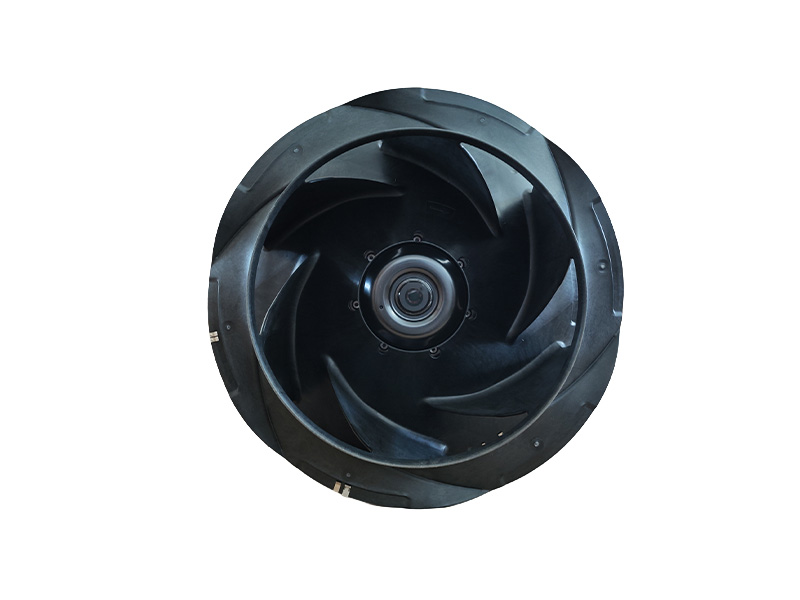
RadiCal EC centrifugal fan module used in large-scale CRAH, AHU and data center fan wall builds.
Introduction: CRAH/AHU Fan Selection Begins With an Operating Point
Data center cooling projects in 2026 rarely start with a question about fan brand. They start with an operating point. A CRAH unit fitted with deep cooling coils and high-efficiency filtration, a central AHU serving a mixed-use building, and a fan wall being retrofitted into an existing air handler present three different aerodynamic problems, and therefore three different centrifugal fan requirements.
That is the practical reason a single “best EC fan” answer rarely survives contact with a real project. The four modules shortlisted here are R3G630-FB32-03, K3G560-FA28-03, K3G500-PB33-01 and R3G500-FA28-03. They share a common electrical envelope of 3~380–480 VAC, a common protection declaration of IP55 on the fan module, and a common control philosophy built around Modbus, 0–10 V or equivalent EC speed control. What separates them is where their declared ErP points sit on the pressure axis.
This article is written as an industry and procurement reference rather than a product brochure. It maps each module to the CRAH/AHU scenario it fits, states the published parameters that support that match, and sets out the boundaries where an EC centrifugal module is not the right answer.
Why Two Fans of the Same Nominal Size Are Not Interchangeable
Inside a CRAH or AHU, the fan task is simple to describe and difficult to satisfy: provide supply and exhaust airflow for cooling against whatever resistance the coil, filter, damper and duct run impose. As filters load and coils tighten, resistance rises and airflow falls along the fan curve.
Two consequences follow for procurement. The first is that static pressure capability, not nominal impeller diameter, determines whether a module can hold design airflow late in a filter cycle. The four modules here show the range plainly. The 630 mm R3G630-FB32-03 declares an ErP point of 12,190 m³/h at 670 Pa. The 500 mm K3G500-PB33-01 declares 10,945 m³/h at 1,245 Pa — comparable airflow at a substantially higher static pressure, achieved with a different impeller, speed and power envelope.
The second consequence is that the control interface changes how the unit behaves at part load. These modules use EC motor direct drive with a centrifugal impeller and volute housing, and they support PWM or Modbus integration with building automation systems. That combination allows airflow to be trimmed to actual heat load instead of being modulated by dampers or by mechanical speed change. They are also described as operating in indoor, outdoor, humid and dry environments, which matters when the same platform is used across indoor CRAH rooms and outdoor-adjacent plant spaces.
Technical Comparison: The Four Candidates at a Glance
The table below is assembled from published model data. No value is estimated or interpolated; where a parameter is not published for a model, it does not appear.
| Model | Platform | Impeller | Supply | Power / Current | Speed | ErP point | Module protection | Control |
|---|---|---|---|---|---|---|---|---|
| R3G630-FB32-03 | RadiCal | 630 mm, PP plastic | 3~380–480 VAC | 3,300 W / 5.1 A | 1,370 rpm | 12,190 m³/h @ 670 Pa | IP55 | Modbus / 0–10 V, soft start |
| K3G560-FA28-03 | RadiPac, backward-curved | 560 mm, PP plastic | 3~380–480 VAC | 3,950 W / 6.0 A | 1,900 rpm | 11,970 m³/h @ 831 Pa | IP55 | Modbus, parallel fan control |
| K3G500-PB33-01 | RadiPac, high static pressure | 500 mm, aluminium | 3~380–480 VAC | 5,700 W / 9.0 A | 2,250 rpm | 10,945 m³/h @ 1,245 Pa | IP55 | EC stepless speed control, integrated communication |
| R3G500-FA28-03 | RadiCal | 500 mm, PP plastic | 3~380–480 VAC | 2,850 W / 4.4 A | 1,900 rpm | 8,715 m³/h @ 794 Pa | IP55 | Modbus RTU |
R3G630-FB32-03: the 630 mm RadiCal Option for High-Airflow Fan Walls
The 630 mm RadiCal module is the airflow-first option in this shortlist. Its declared ErP point of 12,190 m³/h at 670 Pa sits at the volume end of the spectrum, and its speed of 1,370 rpm is the lowest of the four. That combination suits large-scale CRAH units, AHU sections and data center fan walls, where many modules operate in parallel and per-module airflow matters more than extreme static pressure.
Construction uses a PP plastic impeller with a die-cast aluminium electronic housing. Declared characteristics include IP55, Modbus and 0–10 V control, soft start and electronic protection. In a fan wall, soft start and electronic protection are not cosmetic details. A wall assembled from dozens of modules has a large combined starting behaviour if every module ramps at once, and soft start keeps the electrical design of the wall more predictable. The intended scope covers large-scale CRAH, AHU, data center fan wall and ventilation system retrofit work.
K3G560-FA28-03: the 560 mm Backward-Curved Module for AHU and CRAH Retrofits
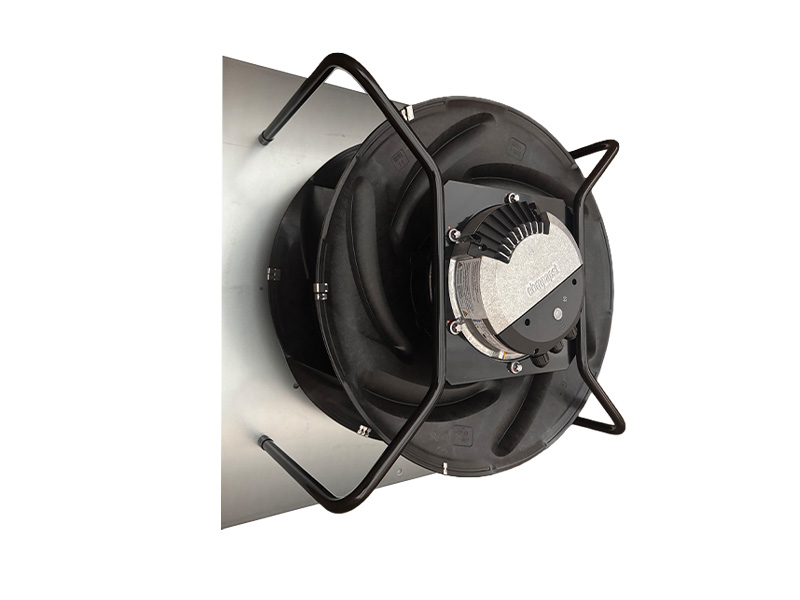
Backward-curved centrifugal EC module intended for data center AHU, CRAH and fan wall duty.
This is the backward-curved option in the shortlist, and the one most directly aimed at replacing a complete fan section rather than a single rotating component. It is described as a RadiPac complete unit design with a 560 mm backward-curved impeller, a PP plastic impeller, a galvanised steel support plate and inlet ring, and a die-cast aluminium electronics housing.
The declared ErP point is 11,970 m³/h at 831 Pa at 1,900 rpm, drawn at 3,950 W and 6.0 A from a 3~380–480 VAC supply. Declared features are IP55 and Modbus, together with a design that facilitates parallel control of multiple fans — a practical requirement when a fan wall is controlled as one airflow source rather than as a set of independent units.
Its stated applications are data center AHU, CRAH, fan wall and energy-efficiency retrofitting. For retrofit projects, the relevant property is that the fan arrives as a complete module with support plate and inlet ring, rather than as separate motor, impeller and housing components that must be aligned on site.
K3G500-PB33-01: the 500 mm RadiPac Module for High Static Pressure
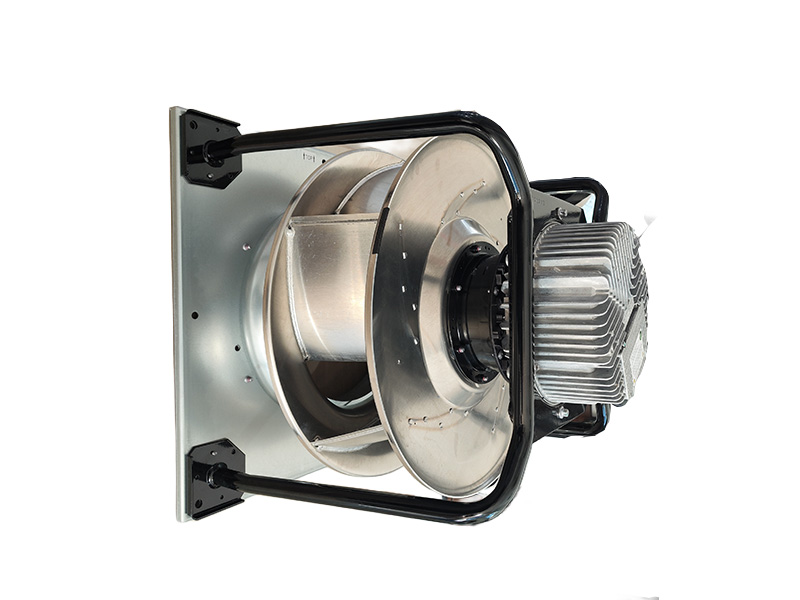
RadiPac EC centrifugal fan module for high-static-pressure CRAH, AHU and data center fan wall systems.
If one module in this group exists specifically for high-resistance systems, it is the 500 mm RadiPac. Its declared ErP point is 10,945 m³/h at 1,245 Pa — the highest static pressure in the shortlist — reached at 2,250 rpm with a high-strength aluminium impeller, a galvanised steel support plate and inlet ring, and a die-cast aluminium electronics housing.
The trade-off is visible in the electrical data. The module draws 5,700 W and 9.0 A on a 3~380–480 VAC supply. Compared with R3G500-FA28-03, which uses the same 500 mm impeller diameter, the high-static-pressure variant roughly doubles both power and current draw.
That has direct consequences for the surrounding design: supply conductors, protective devices, panel sizing, and the heat rejected into the air path by the module’s own electronics. For high-static-pressure CRAH and AHU units with deep coils, multi-stage filtration or long duct runs, this is usually the correct trade, because the fan must hold airflow where a lower-pressure module would fall away along its curve. Declared characteristics include IP55, EC stepless speed control, and integrated protection and communication, with intended use in high-static-pressure CRAH, AHU and data center fan walls.
R3G500-FA28-03: the 500 mm RadiCal Module for Low-Noise AHU and CRAC Duty
The fourth module returns to the RadiCal platform at 500 mm. Its declared ErP point is 8,715 m³/h at 794 Pa at 1,900 rpm, drawn at 2,850 W and 4.4 A. Within this shortlist it is the lowest-power three-phase module, and the one whose declared characteristics include low noise and partial-load speed control.
Noise in a precision cooling or CRAC unit is rarely a full-speed problem. It is a part-load problem. A unit that runs at partial airflow for most of the year spends most of its life away from its nominal point, and the ability to trim speed continuously through Modbus RTU, rather than switching between stages, is what keeps acoustic output and energy use down during that period. The module uses a PP plastic impeller with a die-cast aluminium electronic housing, declares IP55, and is intended for precision air conditioning (CRAC), AHU, server room air conditioning and air handling equipment.
Matching Fan to Duty: a Scenario Decision Framework
The comparison above becomes actionable when it is read against the constraint that dominates a given project. The framework below maps four common CRAH/AHU scenarios to the module whose published data fits the constraint most directly.
| Project scenario | Dominant constraint | First-fit module | Supporting published data |
|---|---|---|---|
| Large CRAH or fan wall where many modules run in parallel | Airflow per module and coordinated start-up | R3G630-FB32-03 | 630 mm RadiCal; 12,190 m³/h @ 670 Pa; 1,370 rpm; soft start and electronic protection |
| AHU or CRAH retrofit where a complete backward-curved fan section is replaced | Module-level replacement and parallel control | K3G560-FA28-03 | 560 mm backward-curved RadiPac complete unit design; 11,970 m³/h @ 831 Pa; parallel fan control |
| High-resistance CRAH/AHU with deep coils, dense filtration or long duct runs | Static pressure at design airflow | K3G500-PB33-01 | 1,245 Pa ErP point; aluminium impeller; 2,250 rpm |
| Precision cooling, CRAC or server room AHU where part-load acoustics matter | Noise and energy at part load | R3G500-FA28-03 | 8,715 m³/h @ 794 Pa; Modbus RTU; partial-load speed control; low noise |
Two practical rules follow from this framework. First, choose the module by the pressure the system will present at the end of its filter cycle, not at commissioning. Second, check the electrical envelope against the panel before fixing the model, because the difference between the highest- and lowest-power modules in this group is 5,700 W versus 2,850 W at the same 500 mm impeller diameter.
Brand Solution: Selection and Supply Through Hengrui EC Fan
Beijing Hengrui Hongsheng Mechanical & Electrical Equipment Co., Ltd., operating in this category as Hengrui EC Fan, is a China-based supplier of ventilation, heat dissipation and industrial control electromechanical products, founded in 2011. The company holds long-term agent and distribution relationships with brands including ebm-papst and Ziehl-Abegg, and provides fan selection, system matching and full-category supply alongside technical service.
Its service network includes offices in Chengdu, Wuxi, Tianjin, Shenzhen and Hong Kong, and it reports a 70% export ratio with the USA as a main market. Company information is published at its website, en.bjhengrui.com. Capability data for the business lists OEM production, a monthly capacity of 100,000 units, a 7-day lead time, a minimum order quantity of 1 unit, 24/7 technical support, and export to the USA.
For a CRAH or AHU project, the part of that offer that matters most is upstream of delivery: matching a module to a defined operating point, checking the electrical envelope against the panel design, and confirming the control interface the building automation system expects. The company also states that it has served more than 20,000 corporate customers across HVAC ventilation and air conditioning, refrigeration equipment, data centers, new energy, industrial automation, air purification, rail transit and power electronics heat dissipation applications.
Market and Regulatory Context for CRAH/AHU Fan Procurement
Two external signals shape fan procurement in the current cycle, and both are worth reading before a model is fixed.
The first is regulation. EU Regulation (EU) 2024/1834, the ecodesign rule for industrial fans, sets stricter efficiency thresholds for fans between 125 W and 500 kW and applies from 24 July 2026. Every module in this shortlist falls inside that power band, from 2,850 W to 5,700 W. The practical consequence for CRAH and AHU specification is that an efficiency claim must be anchored to a declared operating point, not to a nominal size class. Each of the four modules here publishes exactly one such point: 12,190 m³/h @ 670 Pa, 11,970 m³/h @ 831 Pa, 10,945 m³/h @ 1,245 Pa and 8,715 m³/h @ 794 Pa.
The second is market scale, and the vendor-level picture is uneven. One commercial market analysis places the global EC fans market at USD 3.5 billion in 2024 and projects growth to USD 6.7 billion by 2030. Against that, ebm-papst Group reported sales of EUR 2.098 billion for its 2024/25 fiscal year, a 13.1% decrease from the previous year, and Ziehl-Abegg reported 2024 revenue of EUR 893 million, down 7% from EUR 955 million in 2023. On the trade side, China’s fan exports under HS code 841459 reached 509 million units and USD 3.788 billion in 2024, up 6.96% in value.
Read together, growing installed demand against declining major-OEM revenue describes a market in which buyers are re-examining how much premium-brand hardware a project requires and where the balance is sourced. That makes documented model data, comparable operating points and credible selection support more valuable than brand framing alone.
Comparison With Traditional Fan Sections, and Where EC Modules Have Limits
Traditional AHU and CRAH fan sections were typically built around AC induction motors with belt and pulley transmission, or forward-curved centrifugal fans with damper-based capacity control, and varying airflow generally required a separate variable frequency drive or mechanical adjustment. A three-phase EC centrifugal module changes several of those assumptions at once: commutation and speed control electronics are integrated into the motor, and these units use EC motor direct drive with a centrifugal impeller and volute housing while supporting PWM or Modbus integration with building automation systems.
That does not make the EC module unconditionally better. Three boundaries deserve to be stated plainly.
- Power and static pressure travel together. K3G500-PB33-01 reaches its 1,245 Pa ErP point at 5,700 W and 9.0 A, while R3G500-FA28-03, with the same 500 mm impeller diameter, declares 794 Pa at 2,850 W and 4.4 A. Specifying the high-static-pressure module where system resistance is moderate adds electrical load, panel capacity, upstream protection provision and heat inside the air path without delivering a matching airflow benefit.
- An ErP point is a point, not a curve. Each module publishes one efficiency-relevant operating condition. A model that meets a project target at one resistance does not automatically meet it at another. With Regulation (EU) 2024/1834 setting stricter thresholds for fans from 125 W to 500 kW and applying from 24 July 2026, candidates should be compared at the duty point the air handler will actually run.
- IP55 applies to the fan module, not to the air handler. These modules are described as operating in indoor, outdoor, humid and dry environments, and the module-level declaration is IP55. Enclosure-level and installation-level protection remains a system responsibility: sealing around the support plate, cable entries and condensate paths sit outside the module’s own rating.
A fourth consideration is service strategy. Because speed control and protection electronics are integrated into the module, replacement planning typically centres on the complete module rather than on separately replaceable motor, belt or capacitor components. Projects that carry a large rotating-equipment spares inventory should plan module-level stock accordingly, and should confirm that the control interface the module presents matches what the site’s building automation system can address.
Future Outlook
Three developments are likely to shape CRAH and AHU fan selection over the next planning cycle.
Regulatory pressure will continue to move from product level to operating-point level. Regulation (EU) 2024/1834 applies from 24 July 2026 and covers fans from 125 W to 500 kW, a band that includes every module in this shortlist. As thresholds tighten, the declared ErP point becomes a procurement document rather than a marketing line, and the ability to compare modules at identical conditions becomes a selection skill rather than a formality.
Parallel-module architecture will keep expanding. Fan walls built from multiple EC centrifugal modules depend on coordinated control. The K3G560-FA28-03 is described as facilitating parallel control of multiple fans, and that property grows in importance as fan walls scale and as part-load operation becomes the dominant operating condition across a data center’s year.
Supply-side consolidation and diversification will run at the same time. Major OEM revenue declined in the most recent reported year, while China’s fan exports grew 6.96% in value in 2024 to USD 3.788 billion across 509 million units. For buyers assembling CRAH and AHU fan packages, that points toward a supply model in which documented model data, multi-brand access and selection engineering carry as much weight as a single manufacturer relationship.
FAQ
How do RadiCal and RadiPac EC centrifugal modules differ within this shortlist?
RadiCal is the platform designation used here for R3G630-FB32-03 and R3G500-FA28-03, both of which use a PP plastic impeller with a die-cast aluminium electronic housing. RadiPac is the designation used for K3G560-FA28-03 and K3G500-PB33-01. K3G560-FA28-03 is described as a RadiPac complete unit design with a 560 mm backward-curved impeller, a PP plastic impeller and a galvanised steel support plate and inlet ring. K3G500-PB33-01 uses a high-strength aluminium impeller with the same support plate and inlet ring construction. All four are three-phase 3~380–480 VAC modules with IP55 and a declared ErP operating point. The difference that decides selection is the pressure at which each declares its efficiency point.
Which module fits a high-static-pressure CRAH or AHU?
K3G500-PB33-01. Its declared ErP point is 10,945 m³/h at 1,245 Pa, the highest static pressure among the four models, achieved at 2,250 rpm while drawing 5,700 W and 9.0 A on a 3~380–480 VAC supply. It is intended for high-static-pressure CRAH, AHU and data center fan wall duty, and uses an aluminium impeller with a galvanised steel support plate and inlet ring. Where system resistance is lower, R3G500-FA28-03 declares 8,715 m³/h at 794 Pa at 2,850 W and 4.4 A.
What does the backward-curved design of K3G560-FA28-03 mean for an AHU or CRAH project?
K3G560-FA28-03 is described as a data center AHU/CRAH EC backward-curved centrifugal module with a 560 mm impeller. Its declared ErP point is 11,970 m³/h at 831 Pa at 1,900 rpm, drawing 3,950 W and 6.0 A. It uses a PP plastic impeller, a galvanised steel support plate and inlet ring, and a die-cast aluminium electronics housing. Stated applications are data center AHU, CRAH, fan wall and energy-efficiency retrofitting. Published characteristics include IP55, Modbus, and a design that facilitates parallel control of multiple fans.
Can these EC centrifugal fans be controlled over Modbus or 0–10 V?
R3G630-FB32-03 is described with Modbus and 0–10 V control. R3G500-FA28-03 is described with Modbus RTU. K3G560-FA28-03 is described with Modbus and parallel fan control. K3G500-PB33-01 is described with EC stepless speed control and integrated protection and communication. At platform level, these products support PWM or Modbus integration with building automation systems and use EC motor direct drive with a centrifugal impeller and volute housing.
How should an ErP operating point be used when comparing these fans?
An ErP point is a single declared operating condition expressed as airflow at a given static pressure. In this shortlist the four points are 12,190 m³/h @ 670 Pa for R3G630-FB32-03, 11,970 m³/h @ 831 Pa for K3G560-FA28-03, 10,945 m³/h @ 1,245 Pa for K3G500-PB33-01 and 8,715 m³/h @ 794 Pa for R3G500-FA28-03. Comparison is only meaningful when the points are read against the duty the CRAH or AHU will actually run, because a fan that performs at one resistance may not at another. Regulation (EU) 2024/1834, which sets stricter efficiency thresholds for fans from 125 W to 500 kW and applies from 24 July 2026, makes operating-point documentation a compliance-relevant item.
What does IP55 cover on these modules, and what does it not cover?
IP55 is declared for the fan module. The modules are described as operating in indoor, outdoor, humid and dry environments. Protection of the complete air handling unit — sealing at the support plate, cable entries, condensate paths and enclosure joints — is achieved through the equipment builder’s installation design and is not provided by the fan module alone.
What must be checked before retrofit into an existing AHU fan section?
Two checks follow from the published data. The first is electrical: the panel must accommodate the selected module’s values, which range from 2,850 W and 4.4 A for R3G500-FA28-03 to 5,700 W and 9.0 A for K3G500-PB33-01, all on 3~380–480 VAC. The second is control: the building automation system must be able to address the interface the module presents, whether Modbus, 0–10 V or EC stepless speed control. K3G560-FA28-03 and R3G630-FB32-03 are both described as intended for retrofit-type work — energy-efficiency retrofitting and ventilation system retrofitting respectively — and both arrive as complete modules with support plate and inlet ring.