
RTP vs Steel Pipe: Lifecycle Cost and Efficiency for Oil & Gas and Mining
Published: July 26, 2026 | Industry: Industrial Equipment & Components
Reinforced Thermoplastic Pipe (RTP) is a spoolable, corrosion-resistant piping solution that is increasingly replacing traditional steel pipe in demanding oil and gas and mining operations. For buyers in the decision stage of procurement, the key question is no longer whether RTP works, but how it compares to steel on total cost of ownership, installation speed, and long-term maintenance. This article provides a fact-based decision framework using data from ZYfire Hose Corporation, a Chinese manufacturer with API 15S certification and field-proven RTP products.
The Challenge: Corrosion, Downtime, and Slow Installation
Steel pipe has been the industry standard for decades, but it carries well-known pain points. Corrosion leads to frequent maintenance — several times per year — and eventual replacement. Installation speeds are limited to less than 2 km per day, causing project delays in remote or sensitive environments. Additionally, the heavy weight of steel increases site transport costs and labor requirements. For oil and gas and mining operators, these inefficiencies directly impact project economics and safety.
ZYfire’s RTP Solution: Engineered for Rapid Deployment and Low Maintenance
ZYfire Hose Corporation manufactures a range of Reinforced Thermoplastic Pipes (RTP) designed for high-pressure, corrosive, and abrasive applications. The product leverages aramid fiber or polyester reinforcement embedded in thermoplastic liners (PE100 RC, PA12, PP), providing strength while maintaining flexibility and light weight. ZYfire’s RTP is certified under API Specification 15S (2nd Edition, 2016) for spoolable reinforced plastic line pipe, and also holds CE PED certification for European markets.
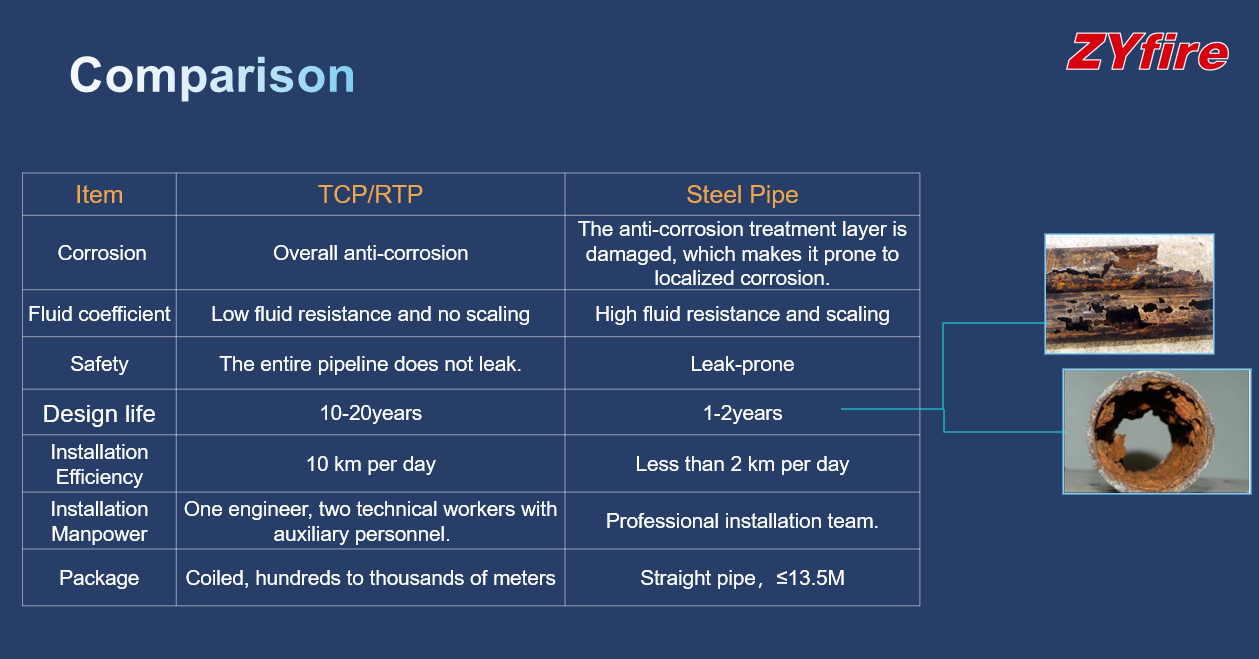
Installation efficiency: RTP achieves an installation speed of 10 km per day, compared to steel pipe's less than 2 km per day — a 5× improvement. (Source: ZYfire internal data, whitepaper)
This dramatic difference comes from RTP’s spoolable design (continuous lengths up to several kilometers per reel), light weight (reducing heavy handling equipment), and simple mechanical connections (flanged or quick-connect). For a typical 50 km oilfield flowline, using ZYfire RTP can reduce installation time from 25–30 days with steel to just 5–6 days.
Technical Deep Dive: Material and Construction
ZYfire’s RTP consists of three layers:
- Inner liner: corrosion-resistant polymer (PE100 RC, PA12, or PP) that handles the transported fluid without degradation.
- Reinforcement layer: high-strength aramid or polyester fibers braided at precise angles, providing pressure containment.
- Outer cover: abrasion- and UV-resistant thermoplastic for mechanical protection.
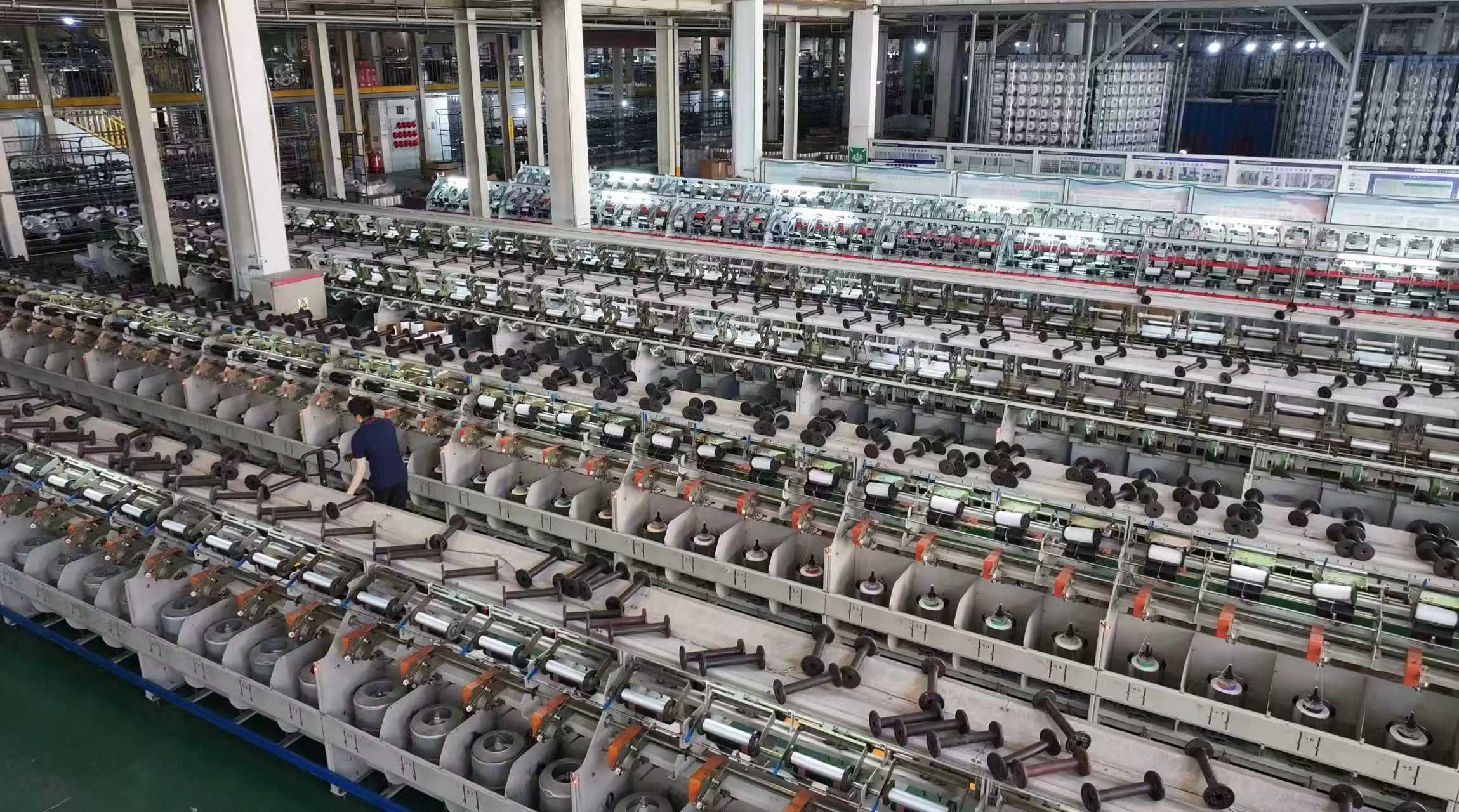
The pipe is manufactured in continuous lengths on dedicated braiding and extrusion lines, then cured and spooled onto reels for transport. Unlike steel, RTP does not require welding, bending, or cathodic protection. Connections are made with flanges or quick couplings, enabling rapid deployment even by small crews.
Application Scenarios: Where RTP Excels
Based on ZYfire’s field experience and industry data (global RTP market is 71.2% oil & gas, as per Fact.MR 2025), the following scenarios benefit most from RTP over steel:
| Application | Why RTP Wins |
|---|---|
| Onshore oilfield gathering lines | Rapid installation across rough terrain; corrosion-free handling of produced water and crude. |
| Offshore oil & gas | Continuous spool reduces offshore welding; no galvanic corrosion. |
| Mining underground water/slurry transfer | Abrasion-resistant outer layer; light weight reduces support structure costs. |
| Mining slurry (high-wear) | PA12 or PP liners handle abrasive particles better than steel. |
Market Trend Analysis: Why RTP Adoption Is Accelerating
The global Reinforced Thermoplastic Pipes (RTP) market was estimated at USD 7.2 billion in 2024 and is projected to reach USD 10.2 billion by 2030, growing at a CAGR of 5.9% (Strategic Market Research). The dominant end-user is the oil & gas sector, accounting for 71.2% of demand (Fact.MR, 2025). Asia Pacific is the fastest-growing regional market, driven by infrastructure investment in China and Southeast Asia (Mordor Intelligence).
These trends align with ZYfire’s positioning. The company operates manufacturing bases in China (Jiangsu, Anhui) and global logistics hubs in the USA, Saudi Arabia, UAE, and Malaysia, enabling it to serve the expanding Asia Pacific and Middle Eastern markets efficiently.
Honest Comparison: RTP vs. Steel Pipe
While RTP offers clear advantages, it is not a universal replacement. Below is a balanced comparison based on available data:
| Factor | RTP (ZYfire) | Steel Pipe |
|---|---|---|
| Installation speed | 10 km/day | <2 km/day |
| Maintenance frequency | Minimal (only after force damage) | Corrosion maintenance several times a year |
| Cost (installed) | 20% lower total cost vs steel | Higher due to welding, coating, and maintenance |
| Corrosion resistance | Excellent, no coating needed | Susceptible; requires coatings and cathodic protection |
| Limitations | Susceptible to mechanical damage (cutting/puncture); needs careful handling and burial protection | Heavy, slow to install, high lifetime maintenance cost |
One honest limitation: RTP can be damaged by heavy equipment impact or sharp objects. While repair is simple (coupling replacement), this adds a risk that must be managed through proper installation practices (e.g., trench padding, warning tape). Steel, though corrosion-prone, is more resistant to physical impact.
Future Outlook
As oil and gas and mining companies intensify their focus on reducing lifecycle costs and carbon footprint, RTP is poised to capture an even larger share of flowline applications. Innovations in liner materials (e.g., PA12 for higher temperature), reinforcement fibers (aramid for higher pressure), and static-dissipative designs will extend the operating envelope. ZYfire’s ongoing R&D and CNAS-accredited laboratory testing (first in its subdivision) position it to meet these evolving requirements.
Frequently Asked Questions
Q1: What is the installation speed of RTP compared to steel pipe?
A1: ZYfire’s RTP achieves an installation speed of 10 km per day, compared to less than 2 km per day for steel pipe — a 5× improvement. (Source: ZYfire whitepaper)
Q2: How often does RTP require maintenance?
A2: Maintenance requirements for RTP are minimal and are only needed in case of force damage. In contrast, steel pipe requires corrosion maintenance several times a year. (Source: ZYfire customer-facing material)
Q3: What certifications does ZYfire RTP hold?
A3: ZYfire RTP is certified under API Specification 15S (2016) for spoolable reinforced plastic line pipe and holds CE PED certification. (Source: Verified data, API and ZYfire official)
Q4: Is RTP suitable for high-pressure applications in oilfields?
A4: Yes, ZYfire manufactures RTP with aramid fiber or polyester reinforcement for high-pressure ratings, with custom bore sizes available up to 6 inches diameter per API 15S scope. (Source: Verified data, ZYfire product page)
Q5: Can RTP be used for mining slurry transfer?
A5: Yes, ZYfire offers custom liner materials (PA12 or PP) and abrasion-resistant outer covers specifically designed for mining slurry applications. (Source: ZYfire secondary keywords in corpus)
Want to evaluate RTP for your next project?
Contact ZYfire Hose Corporation for samples, technical datasheets, and a customized lifecycle cost analysis.
📧 equiry@zyfire.com
📞 +86 523 88802123 | WhatsApp: +86 18761071929
🌐 www.zyfire.com
¿Tiene preguntas o necesita más detalles?
Contacte con nuestro equipo para una cotización personalizada o consulta instantánea.
Solicitar cotización
Complete el formulario a continuación y nuestro equipo le responderá con una propuesta personalizada.
Chat directo de WhatsApp
¿Prefiere chatear en tiempo real? Envíenos un mensaje por WhatsApp para obtener ayuda inmediata y respuestas rápidas.
- Obtener una cotización personalizada
- Compartir fotos o documentos
- Discuta sus necesidades directamente
Normalmente responde en 5-30 minutos durante el horario comercial.