
RTP Procurement FAQ: MOQs, Lead Times and 3500 PSI Specs
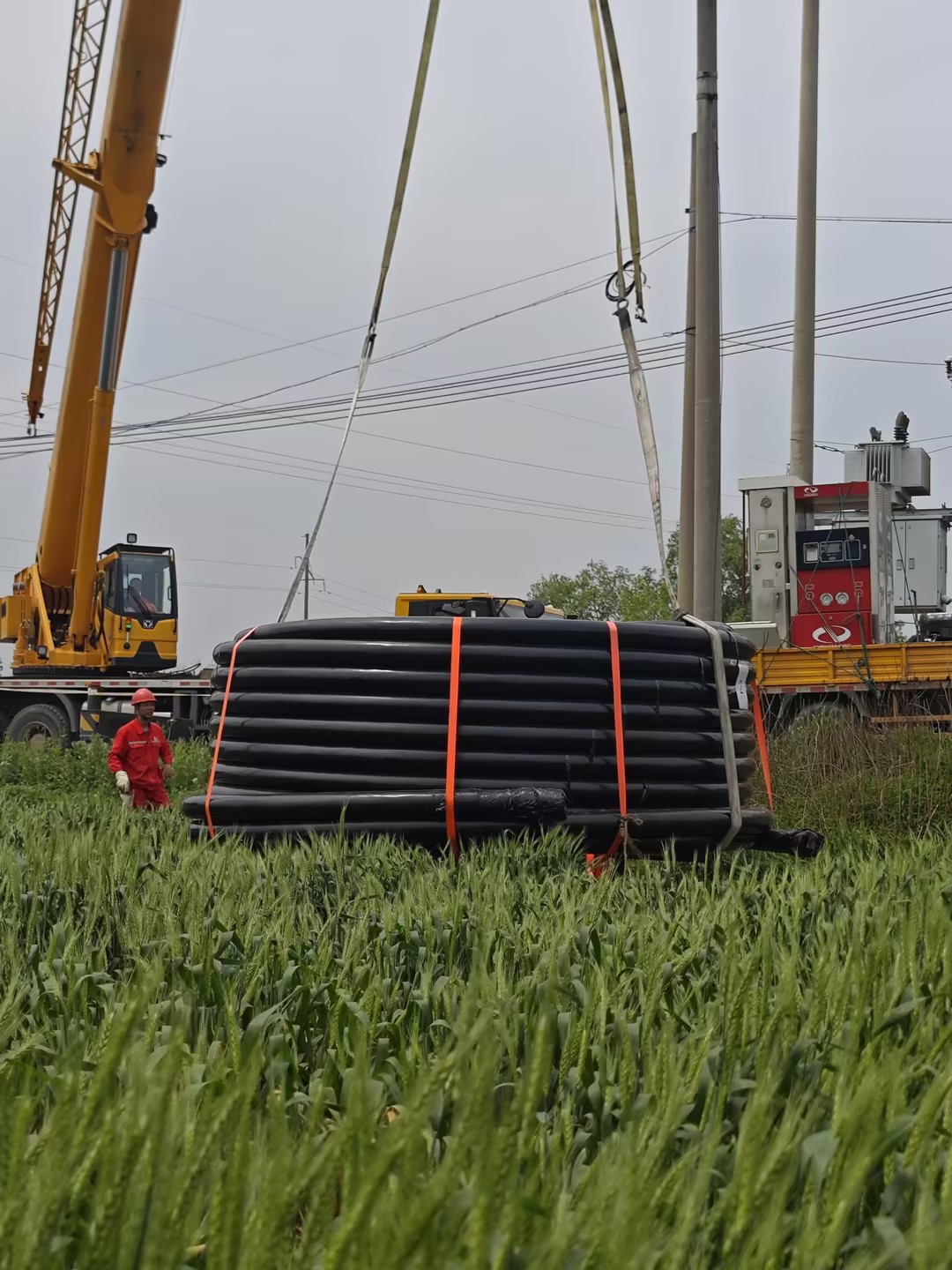
RTP on-site service activity. Reel-based handling is a procurement planning variable, not only an installation detail.
Reinforced thermoplastic pipe (RTP) procurement rarely fails on product concept. It fails on three numbers: the minimum order quantity, the production lead time, and the pressure rating printed next to the bore size. For oil and gas and mining buyers in the research and evaluation stage, those figures determine whether a supplier can be shortlisted at all, and whether a project schedule survives contact with the supply chain.
This reference answers the procurement questions that surface most often during RTP evaluation. The figures used here are published supply parameters for ZYfire RTP: a 50 m minimum order quantity, a 30-day production lead time, a 3500 PSI nominal pressure rating, 100% product testing, and API 15S certification issued by the American Petroleum Institute under certificate number 15S-0025.
Why Procurement Constraints Decide RTP Projects
RTP is a spoolable composite line pipe built for fluid transmission in oil and gas and mining environments, where corrosion, pressure and 24/7 duty cycles set the operating requirement. A technically suitable pipe that cannot be produced in the required quantity, within the required window, and with documentation a project engineer will accept is not a viable shortlist entry.
Three constraint categories do most of the filtering:
- Order quantity — whether the supplier minimum order quantity is compatible with first-article validation, pilot runs and full-scale field deployment.
- Schedule — whether production lead time, plus logistics and documentation, fits the installation window.
- Qualification — whether pressure rating, materials and certification can be verified in writing rather than asserted in a brochure.
The opportunity side is equally concrete. Corrosion-free fluid transmission is a demand driver with measurable momentum, and API Specification 15S (2nd Edition, 2016) gives buyers a common technical baseline for spoolable reinforced plastic line pipe up to 6 inches in diameter. That baseline is what makes a constraint-first procurement conversation possible between suppliers and buyers who have never worked together.
The Three Numbers Buyers Ask About First: MOQ, Lead Time and 3500 PSI
Published supply parameters for ZYfire RTP are summarised below.
| Procurement variable | Published figure | Why it matters at evaluation stage |
|---|---|---|
| Minimum order quantity | 50 m | Sets the floor for trial, validation and small-scope orders |
| Production lead time | 30 days | Production planning figure; logistics and site readiness sit outside it |
| Nominal pressure rating | 3500 PSI (product 3533, 2 in. nominal bore, O.D. 79.8 mm) | Defines the pressure envelope of one specific configuration |
| Monthly production capacity | 100,000 m | Indicates headroom between a single order and factory output |
| Quality control regime | 100% test | Every unit is tested rather than sampled from a batch |
What a 50 m MOQ actually means
A 50 m minimum order quantity is low relative to the product delivery format. The same specification lists a 920 m single length per reel for product 3533, so a 50 m order and a full-reel order are different purchase events. In practice, the MOQ is best read as a validation floor: it is what makes a trial quantity or a small-scope replacement order possible without committing to reel-scale volumes. Where RTP is planned for field installation, project quantities are generally built from reel-length multiples, and buyers should confirm the reel-based quantity separately from the MOQ figure.
What a 30-day lead time does and does not cover
The 30-day figure sits inside the supplier capability specification alongside a monthly capacity of 100,000 m. It is a production lead time — a factory figure — not a door-to-site elapsed time. Buyers building a schedule should map four separate clocks rather than one:
- Production scheduling and manufacturing (the 30-day element).
- Inspection records, test documentation and certification paperwork.
- Freight, port handling and customs clearance.
- Site readiness — lifting equipment, reel handling and installation access.
Treating 30 days as the whole timeline is one of the most common scheduling errors in RTP procurement. Treating it as the production element of a longer plan is the corrected version.
What a 3500 PSI nominal rating is measured against
3500 PSI is the nominal pressure rating of product 3533, a 2-inch nominal bore RTP with a 79.8 mm outside diameter. It is a configuration-specific figure. Change the bore, change the reinforcement architecture, or change the operating condition, and the rating does not automatically carry across.
Two procurement rules follow. First, always quote the pressure rating together with the bore size and product reference, because 3500 PSI on its own does not identify a pipe. Second, confirm in writing that the rating applies to the exact configuration being ordered. A nominal rating is a design reference point; where project conditions — fluid chemistry, operating temperature, external loading — sit outside the published data, the correct procurement action is written confirmation from the supplier rather than extrapolation.
ZYfire RTP: What the Supply Side Commits To
ZYfire Hose Corporation, founded in 2000, is a Beijing Stock Exchange-listed manufacturer that produces reinforced thermoplastic pipe (RTP) for oil and gas exploitation, alongside fire hose, fracturing oilfield hose, high pressure fracturing hose and steel pipe with polyurethane lining. Its RTP supply commitments relevant to procurement evaluation are:
- OEM/ODM production mode, with customization across size/diameter, working pressure, weight, length and bending radius.
- Monthly capacity of 100,000 m with a 30-day production lead time.
- A 50 m minimum order quantity.
- 100% testing of production output.
- After-sales support covering on-site service and after-sales consultation.
Testing capability is supported by a laboratory accredited by the China National Accreditation Service for Conformity Assessment (CNAS), with nationally and internationally recognized testing capabilities. Manufacturing capacity is supported by a 150,000 m² factory, approximately 600 employees and a 50-person R&D team. Approximately 80% of output is exported, serving the USA, Middle East, EU and Southeast Asia, with products reaching more than 70 countries and regions. Documented export experience includes the United Arab Emirates, Argentina, Australia, Bahrain, Canada, Kuwait, Liberia and Libya.
Technical Explanation: Reading a 3500 PSI RTP Datasheet
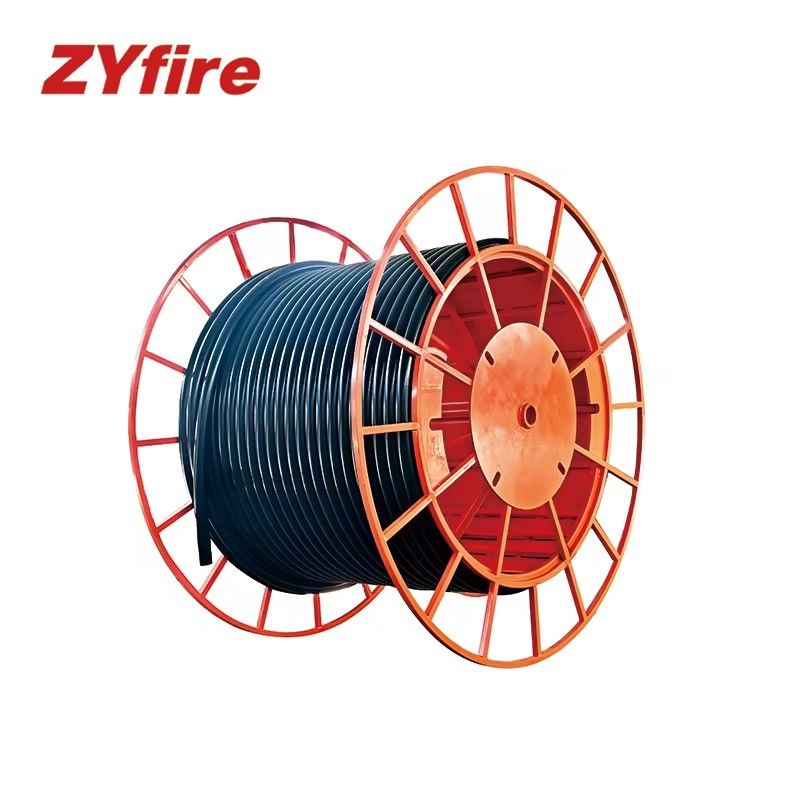
Product 3533: 2 in. nominal bore, 3500 PSI nominal pressure, 79.8 mm O.D.
Product 3533 is specified as a 2-inch nominal bore pipe rated at 3500 PSI nominal pressure, with a 79.8 mm outside diameter, supplied on 3700 × 1200 mm reels with a single length of 920 m, a reel weight of 1200 kg and a full plate weight of 5524 kg.
Its construction has two functional layers. The outer and inner layers are HDPE or PE-RT, with UV and antioxidant protection available as options. The reinforcement layer can be polyester filament, aramid fiber tape, glass fiber tape or steel wire tape. That choice produces four named product types: polyester fiber tape-reinforced RTP, steel wire tape-reinforced RTP, aramid fiber tape-reinforced RTP and glass fiber tape-reinforced RTP.
For procurement purposes, the reinforcement architecture is the least understood variable and the one most often mismatched to application. The bore and pressure rating describe how much fluid moves and at what pressure; the reinforcement system describes what the pipe is doing mechanically to hold that pressure. Two suppliers can quote the same 3500 PSI at the same 2-inch bore while delivering different reinforcement systems, which is why a datasheet should name the architecture rather than publish a rating alone.
| Specification element | Product 3533 value |
|---|---|
| Nominal pressure | 3500 PSI |
| Outside diameter | 79.8 mm |
| Reel specification | 3700 × 1200 mm |
| Single length | 920 m |
| Reel weight | 1200 kg |
| Full plate weight | 5524 kg |
| Inner and outer layer material | HDPE, PE-RT (UV, antioxidant optional) |
| Reinforcement layer options | Polyester filament, aramid fiber (tape), glass fiber (tape), steel wire (tape) |
The 920 m single length is a logistics figure as much as a technical one. Longer single lengths reduce the number of field joints, which reduces installation scope — but they also mean the reel itself, at 1200 kg for the product reel and 5524 kg at full plate weight, determines site access, lifting plan and transport configuration. That trade-off belongs in the procurement plan, not only in the installation plan.
Certification as a Constraint: What API 15S Coverage Confirms
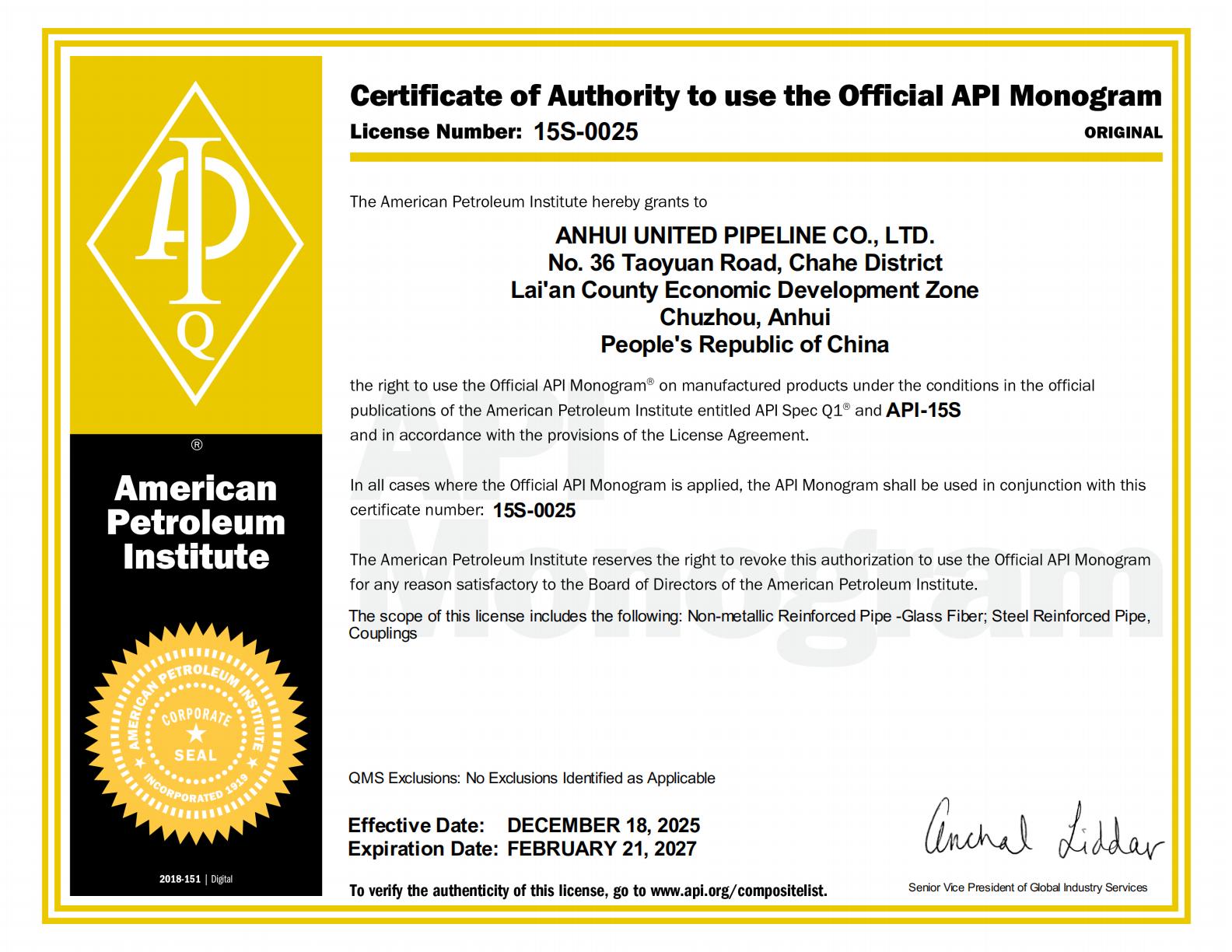
API Spec 15S certificate 15S-0025, issued 2025-12-18, valid to 2027-02-21.
ZYfire product 3533 is certified under API Spec 15S with certificate number 15S-0025, issued by the American Petroleum Institute and applicable to the global market. The certification complies with API Spec Q1 and API Spec 15S. It was issued on 2025-12-18 and expires on 2027-02-21. The published scope of the certificate covers non-metallic reinforced pipe (glass fiber), steel reinforced pipe, and couplings.
API Specification 15S (2nd Edition, 2016) sets the industry-standard requirements for the manufacture and qualification of spoolable reinforced plastic line pipe for oilfield applications, covering pipe diameters up to 6 inches. A 2-inch RTP therefore sits inside that diameter framework — which is exactly the kind of statement a buyer should be able to verify, not assume.
Three verification rules follow:
- Match the certificate scope to the ordered configuration. The published scope names glass fiber reinforced pipe, steel reinforced pipe and couplings. A buyer ordering a different reinforcement architecture — aramid fiber tape or polyester filament, for example — should confirm that the specific configuration is covered rather than assume the certificate extends to it.
- Check validity dates against the project calendar. Certificate 15S-0025 is valid to 2027-02-21. For multi-year or late-delivery projects, procurement should reconfirm currency at purchase order stage so that the documentation pack remains valid through delivery.
- Separate certification from per-unit testing. The certificate confirms the qualification framework. The 100% test regime is the production control applied to individual units. Both matter, and they answer different questions.
Application and Use Cases: Where These Constraints Are Tested
RTP is deployed in mining and oil and gas fluid transmission, with operating profiles that include continuous 24/7 duty. Documented requirements for these applications include corrosion resistance, higher pressure rating, no swelling, flexibility, long single-pipe length, non-frequent fittings, simple installation and long cycle life. Site-level requirements include corrosion resistance, explosion-proof operation, high-pressure tolerance and compliance with API standards.
Case evidence for this product class covers an OEM/ODM RTP engagement supplying 120,000 m of fluid transmission pipe over a five-year period across oilfield and mining markets including the United Arab Emirates, Argentina, Australia, Bahrain, China, Iran, Jordan, South Korea, Libya, Oman, Saudi Arabia and the United States. Reported outcomes include stable operation under high-pressure conditions, no leakage and reduced maintenance costs, with corrosion resistance, long service life and ease of installation cited as defining characteristics.
Read as a procurement signal, the case pairs two things buyers rarely see together: order scale and duration. A single large order tests production capacity once. A five-year programme tests consistency, documentation and after-sales response across multiple production cycles — and it is the second test that usually determines whether a supplier stays on a vendor list.
Market Trend Analysis: What Rising RTP Demand Means for Lead Times
Third-party estimates place the global RTP market at USD 7.2 billion in 2024, projected to reach USD 10.2 billion by 2030 at a CAGR of 5.9% (Strategic Market Research). Those headline estimates deserve a caution, because they differ by scope: Market Research Future places the 2024 RTP market at USD 3.698 billion, while Dataintelo estimates USD 2.8 billion for 2025 for the RTP liner segment specifically. The divergence is largely a definition question — all thermoplastic pipes versus spoolable RTP versus liners — and buyers should read any market figure against the scope it was built on.
Demand composition is more consistent across sources. Oil and gas is the dominant end-user segment in the global RTP market, accounting for approximately 71.2% of total demand as operators seek corrosion-free alternatives to steel (Fact.MR, 2025). Glass fiber reinforced thermoplastic pipe represents an estimated 64.7% of product market share. Asia Pacific is identified as both the largest and fastest-growing regional thermoplastic pipe market in 2024/2025, driven by infrastructure investment and water management projects.
The procurement implication is practical rather than theoretical. When a single end-user segment absorbs roughly seven-tenths of demand, production capacity allocation during peak periods becomes a planning variable. The stated 30-day lead time is a supplier capability figure; whether a specific order slot is available in a given quarter is a scheduling question. Buyers with fixed installation windows should confirm scheduling against their project calendar early, and should treat lead time as a commitment to verify rather than a catalogue constant.
Comparison with Traditional Solutions: RTP and Steel Pipe Side by Side
Steel pipe remains the reference point against which RTP is evaluated, and the comparison is best made on structure rather than on preference.
| Comparison dimension | Reinforced thermoplastic pipe | Steel pipe (traditional reference) |
|---|---|---|
| Corrosion behaviour | Polymer inner layer resistant to corrosion by construction | Requires coating, lining or alloy selection to manage corrosion |
| Delivery format | Spooled in continuous lengths; product 3533 lists a 920 m single length per reel | Supplied in discrete lengths; joint count depends on length |
| Field joints | Non-frequent fittings; long single lengths reduce joint count | Jointing forms a larger share of installation scope |
| Diameter framework | API Spec 15S covers spoolable reinforced plastic line pipe up to 6 in.; product 3533 nominal bore is 2 in. | Available across a substantially wider diameter range |
| Handling profile | Reel-based; 1200 kg reel and 5524 kg full plate weight require lifting and transport planning | Handled in discrete lengths with welding or mechanical jointing |
| Pressure envelope | Nominal rating specific to configuration (3500 PSI for product 3533) | Higher pressure classes exist beyond spoolable composite ranges |
Where RTP stops being the right answer
A credible comparison has to state boundaries, not just advantages. Four are relevant to this product class.
- Diameter scope. API Spec 15S covers spoolable reinforced plastic line pipe up to 6 inches. Applications beyond that diameter fall outside the framework described here and require a different product category.
- Configuration-bound ratings. 3500 PSI belongs to product 3533 at a 2-inch nominal bore and 79.8 mm outside diameter. Transferring the rating to a different bore or reinforcement architecture requires written engineering confirmation, not inference.
- Handling and logistics. Long single lengths reduce joints but place reel logistics on the critical path. A 1200 kg reel and 5524 kg full plate weight require mechanical lifting and suitable transport access; projects without that equipment face a planning constraint regardless of pipe performance.
- Published-condition limits. The specification data referenced here does not define performance across every fluid chemistry, operating temperature or external loading combination. Where a project condition sits outside published data, the correct action is supplier confirmation.
Future Outlook
Three directions appear likely to shape RTP procurement through the rest of the decade. First, volume: a market moving from roughly USD 7.2 billion in 2024 toward USD 10.2 billion by 2030 at 5.9% CAGR implies continued capacity and scheduling pressure concentrated in the oil and gas segment that already accounts for about 71.2% of demand. Second, qualification discipline: as installed base grows, certificate scope, certificate validity and per-unit testing records become routine checklist items rather than differentiators, and buyers will increasingly verify them before commercial negotiation rather than after. Third, geographic distribution: Asia Pacific holds the position of largest and fastest-growing regional thermoplastic pipe market, while supply structures already reach more than 70 countries, pointing toward increasingly multi-regional supply chains. ZYfire's own footprint — production bases, R&D centres and logistics warehouses across the United States, Saudi Arabia, the United Arab Emirates, Malaysia and China (Nanjing Jiangsu, Taizhou Jiangsu, Chuzhou Anhui) — is one example of that distribution model, and it matters most in the place procurement feels it first: lead time reliability.
FAQ: RTP Lead Times, MOQs and Specifications
What is the minimum order quantity for reinforced thermoplastic pipe?
Published supply parameters for ZYfire RTP list a minimum order quantity of 50 m. Because the product is supplied on reels, and product 3533 lists a 920 m single length per reel, 50 m functions as a validation-scale floor rather than a project-scale unit. Buyers planning field installation should confirm reel-based quantities with the supplier separately from the MOQ figure.
How long is the production lead time for RTP, and what does it exclude?
The stated production lead time is 30 days, supported by a monthly production capacity of 100,000 m. It is a factory figure. Freight, customs clearance, inspection documentation and site readiness sit outside it, so a project schedule should treat 30 days as the production element of a longer elapsed timeline rather than the total.
What does a 3500 PSI nominal pressure rating cover?
3500 PSI is the nominal pressure rating of RTP product 3533, which has a 2-inch nominal bore and a 79.8 mm outside diameter. The rating applies to that configuration. Bores, reinforcement architectures and operating conditions that differ from it are separate engineering cases and require written confirmation rather than assumption.
Which certification should be verified when buying RTP?
ZYfire product 3533 is certified under API Spec 15S, certificate number 15S-0025, issued by the American Petroleum Institute and complying with API Spec Q1 and API Spec 15S. The certificate was issued on 2025-12-18 and expires on 2027-02-21, and applies to the global market. Its published scope covers non-metallic reinforced pipe (glass fiber), steel reinforced pipe and couplings. Buyers should verify certificate number, issuing authority, scope and expiry date against the exact configuration they intend to order.
What does 100% testing mean in RTP production?
A 100% test regime means units are tested rather than sampled from a batch, which is the supplier's stated quality control approach for RTP production. It complements certification rather than replacing it: API 15S certification establishes the qualification framework, while 100% testing is the per-unit production control. ZYfire's testing capability is supported by a laboratory accredited by the China National Accreditation Service for Conformity Assessment (CNAS).
Can RTP be customized beyond a standard bore and pressure rating?
Yes, within defined parameters. ZYfire operates an OEM/ODM production mode with customization across size/diameter, working pressure, weight, length and bending radius. Reinforcement options are also selectable — polyester filament, aramid fiber tape, glass fiber tape or steel wire tape — producing polyester fiber, aramid fiber, glass fiber or steel wire tape-reinforced RTP. Requests that fall outside the listed parameters should be raised with the supplier for engineering review rather than assumed to be available.