
RS485 Water Meter Applications: Building Management Systems and Industrial Fit
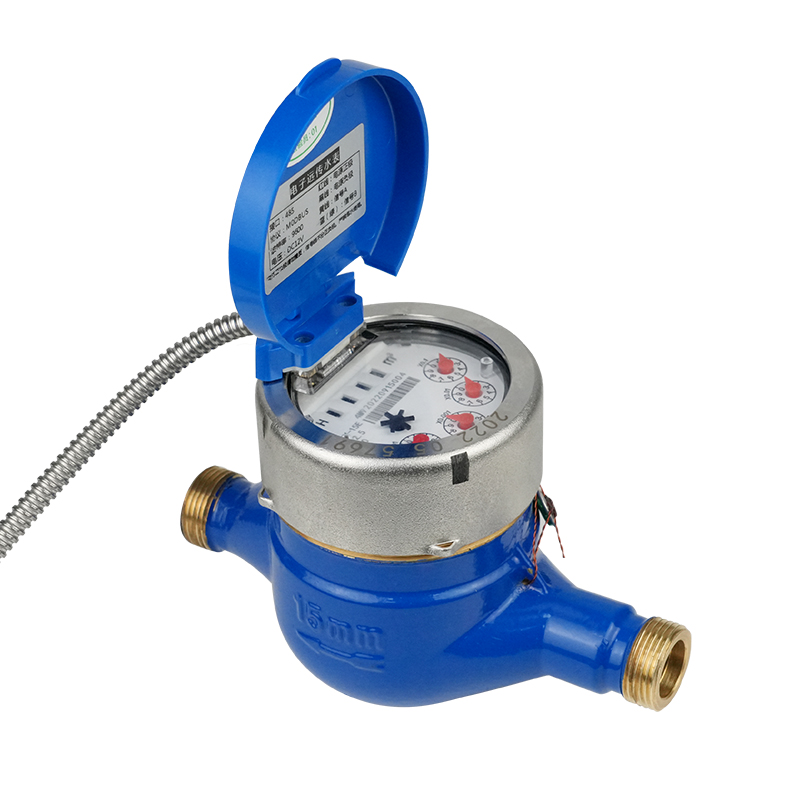
A wired remote meter platform: the RS485 interface is what carries consumption and status data into a control or monitoring system.
An RS485 water meter is a water meter fitted with an RS485 serial interface, normally speaking Modbus RTU, so that a controller can poll consumption and status data directly from the meter. In a building or an industrial plant, that interface is often the difference between a meter that is read once a month and a meter whose data reaches a building management system continuously.
This article examines where RS485 water meters fit: building management systems that already run on wired fieldbus, and industrial water monitoring where remote reading and control have to work without a wireless gateway in the middle. It covers the Modbus RTU interface, communication distance, compatibility with PLC, SCADA, AMR and AMI platforms, protection ratings, power options, valve control, and the practical boundaries of the approach.
Why Wired Metering Still Has a Place in a Wireless Market
Wireless dominates the smart water conversation. LoRaWAN, NB-IoT and 4G Cat.1 meters make it possible to read consumption from sites that have no wiring at all, and several manufacturers now offer LoRaWAN, NB-IoT, 4G, M-Bus and RS485 variants built on the same metering bodies. The wireless case is easy to explain: no cable, no trenching, data delivered to a platform.
The wired case is less discussed but equally concrete. Building management systems, PLCs and SCADA platforms are wired by design. They read registers from field devices over Modbus, M-Bus or comparable fieldbus protocols, and they expect those devices to be present on the bus at all times. A meter that can only publish to a cloud dashboard needs an extra integration step before its data can influence a plant room valve, a tenant billing engine or a SCADA alarm list. A meter that answers Modbus polls directly does not.
Market data supports this from the head-end side. Advanced Metering Infrastructure (AMI) technology accounted for 58.9% of the smart water meter market in 2024, according to data published by Precedence Research. AMI is a collection and management layer rather than a radio technology, and wired fieldbus remains one of the standard ways of feeding it, particularly in buildings where the meter room and the control room sit inside the same structure.
What Defines an RS485 Water Meter
Answer first: an RS485 water meter is a wired remote water meter whose communication interface is RS485, generally with Modbus RTU as the application protocol. In the Shengda wired remote range, remote meter reading is supported via RS485 communication; the communication interface is RS485 Modbus RTU and the communication protocol is Modbus RTU, with optional customized protocol support. The meter carries an LCD digital display, and historical consumption data storage is optional.
Three clarifications matter for buyers at the research stage.
- The product category is the wired remote water meter category. The LXSY wired remote meter is designed for household, dormitory, hotel, residential property, apartment and warehouse applications, and for bulk size use such as irrigation, water resources management, industrial production and garden management.
- The measuring element is separate from the interface. RS485 describes how data leaves the meter, not how water is measured. The same wired remote platform can be configured with ultrasonic or mechanical measurement. Where ultrasonic measurement is used, the LXSY smart ultrasonic water meter works on ultrasonic transit-time technology with no moving parts, is available from DN15 to DN600 with flow ratios of R250, R400 or R500, and holds MID certification.
- Interfaces across the range are not exclusive. Meter communication options include pulse output, RS485, M-Bus, LoRaWAN and NB-IoT, so an RS485 unit is a configuration choice inside a broader platform rather than a separate product family.
How RS485 Meter Data Reaches a BMS
RS485 is a multi-drop serial bus: several devices share one pair of signal wires, and a controller polls them one at a time. In water metering it is normally paired with Modbus RTU, which defines register-level access. The practical consequence is that the head-end reads values rather than counting pulses: totals, flow information, status and alarm conditions that the platform can act on directly.
Three specification points define how far that architecture stretches.
- Communication distance: up to 1000 to 1200 meters, depending on cable type and installation conditions.
- Platform compatibility: integration with AMR and AMI platforms, PLC, SCADA and building management systems.
- Centralized reading: multiple meters connected and read remotely, which is what removes manual meter reading rounds from a building operating cost.
RS485 water meter, Modbus RTU registers, LCD display, optional historical data storage
Two-wire RS485 segment, up to 1000 to 1200 m depending on cable type and installation conditions
Data collector, PLC or gateway polling meter registers
BMS, SCADA or AMR and AMI platform: billing, alarms, consumption analysis, valve commands
Data path for a wired remote meter: field device, serial bus, controller, management platform.
M-Bus is the main alternative wired bus. It complies with the EN 13757 M-Bus protocol, is widely used in European metering systems, and can be powered by the bus itself, so one M-Bus master can serve multiple meters. The wired remote platform supports M-Bus EN 13757 as an option alongside RS485. The practical difference is usually which head-end is already installed and who powers the meter, not which bus is technically superior.
Data quality features are worth checking at the same time. Historical consumption data storage, available as an option, keeps interval history at the meter. An LCD digital display allows on-site verification against the platform reading. The wired remote platform also reports alarm conditions including leakage alarm, low battery alarm, reverse flow alarm, tamper alarm and abnormal consumption alarm.
Power, Environment and Mechanical Envelope
Power is a design decision rather than a specification detail. The wired remote platform is battery powered or can use an external power supply, with battery life up to 6 to 10 years depending on configuration. If the site can deliver power along the same cable route as the bus, an external supply removes the battery replacement cycle from the maintenance plan. If it cannot, the battery figure effectively becomes the maintenance interval.
| Parameter | Specification on the wired remote platform |
|---|---|
| Communication interface | RS485, M-Bus or pulse output (optional) |
| Protocol | Modbus RTU; M-Bus EN 13757 optional; customized protocol support optional |
| Communication distance | Up to 1000 to 1200 m, depending on cable type and installation conditions |
| Power supply | Battery powered or external power supply (optional) |
| Battery life | Up to 6 to 10 years, depending on configuration |
| Protection class | IP68 |
| Pressure rating | PN10 or PN16 |
| Operating temperature | -20 degrees C to +60 degrees C |
| Water temperature | 0 degrees C to +50 degrees C |
| Nominal diameter | DN15 to DN600 |
| Flow ratio (R value) | R100, R160, R250 or R400 (optional) |
| Body material | Brass, stainless steel or composite material (optional) |
| Valve control | Optional remote shut-off valve |
| Data storage | Historical consumption data storage (optional) |
| Certification | MID |
IP68 sealing is the parameter that decides whether a meter survives its own installation. Underground meter boxes, flooded chambers and humid plant rooms are normal environments for building water metering, and a meter that is not sealed for them will be replaced long before its battery is. Brass remains the common body material in residential and light commercial work; stainless steel and composite options exist where water chemistry, weight or budget profile differs from a standard installation. Installation can be horizontal or vertical.
Application Fit: Building Management Systems
The BMS case rests on a single question: does water consumption need to influence how the building is operated? Where the answer is yes, a wired RS485 meter usually integrates with less translation than a radio meter, because the protocol the head-end already uses is the protocol the meter speaks.
- Residential towers, apartments and mixed-use buildings: per-unit submetering feeding property management and billing processes.
- Hotels and dormitories: high meter density in a limited number of risers, where centralized reading has a direct labour benefit.
- Commercial buildings: allocation of water cost across tenants, plus abnormal consumption alerts that flag night flow or a failed fitting.
- Underground meter boxes and humid plant rooms: IP68 protection, with a pressure rating of PN10 or PN16 and an operating temperature range of -20 degrees C to +60 degrees C.
- Buildings with an isolation requirement: the optional remote shut-off valve supports remote opening and closing for vacancy management, emergency isolation or prepaid operation.
- Metering inside a site: nominal diameters up to DN600 and flow ratio options of R100, R160, R250 or R400 allow the same interface to be used at different points in the network.
For a BMS project, the design question is rarely whether RS485 is technically adequate. It is where the bus terminates and how the register map is documented for the integrator who has to make the data usable. That is a project document rather than a product feature, and it is the item most often missing at handover.
Application Fit: Industrial and Utility Monitoring
Industrial fit follows the same logic at a larger scale. Wired remote meters in bulk sizes are used in irrigation, water resources management and industrial production, where readings have to be collected on a schedule without sending staff to each point.
Where flow rates are high, the Woltman water meter (model LXLC or WPH) is intended for municipal water supply and large flow measurement. It is available from DN50 to DN600, can be constructed from cast iron, ductile iron or stainless steel, installs horizontally, and operates at working pressures of PN10, PN16 or PN25 with water temperature ratings of T30, T50 or T90. Flow ratio options are R40, R50, R80 or R100, connection is flanged to EN1092-1, ANSI or a customized standard, and a smart version can be equipped with pulse output, M-Bus, RS485, LoRaWAN or NB-IoT modules. A remote shut-off valve is optional. Typical applications include municipal water supply networks, water utilities and DMA systems, industrial water measurement, irrigation systems, commercial buildings and hotels, apartment main supply, water treatment plants, pump stations and pipelines, and fire protection water systems.
For utilities, a compliance layer sits on top of the interface layer. Inside the European Economic Area, smart water meters are required to comply with EU Directive 2014/32/EU (Measuring Instruments Directive) and EN 14154-4:2023 for legal metrology. MID certification is listed on both the wired remote and ultrasonic meter platforms, and buyers in regulated markets should treat certification as an entry gate rather than a differentiator.
Market Trend Analysis
The global smart water meter market was valued at USD 9.1 billion in 2024 and is projected to reach USD 16.2 billion by 2030, according to Grand View Research. That headline should be read with care, because published estimates diverge. Bluefield Research placed the 2024 global smart water metering market at USD 6.8 billion, and MarketsandMarkets at USD 4.61 billion. The gap reflects different definitions of what counts as a smart meter rather than disagreement about the direction of travel, so the figures are more useful for sizing an investment case than for comparing suppliers.
Three structural signals are more precise. AMI technology held 58.9% of the smart water meter market in 2024, which indicates that the collection and management layer, not the radio link, is where value is concentrating. The residential segment accounted for 67.2% of smart water meter adoption in 2024 according to Cognitive Market Research, so volume growth will continue to come from housing. Asia Pacific is the fastest-growing region, driven by urbanisation in China and India, according to MarketsandMarkets.
The implication for buyers is a divergence between where volume sits and where integration requirements are strictest. Volume grows in residential deployments, while the hardest interface requirements appear in commercial and industrial sites where the meter has to talk to a control system. A supplier that can only offer a radio module, or only a bus interface, will keep meeting projects where the other is compulsory.
Comparison with Traditional and Wireless Approaches
| Dimension | Pulse output meter | RS485 Modbus RTU | M-Bus | Wireless (LoRaWAN, NB-IoT, 4G) |
|---|---|---|---|---|
| Data granularity | Pulse counts only | Register-level values, status and alarms | Register-level values via EN 13757 | Register-level values via gateway and network server |
| Wiring required | Yes | Yes, two-wire bus | Yes, two-wire bus | No |
| Stated communication distance | Depends on the receiving input and cable run | Up to 1000 to 1200 m, depending on cable type and installation conditions | Up to 1000 m, depending on cable type and installation conditions | Several kilometers for LoRaWAN, depending on environment |
| Power supply | Passive signal | Battery up to 6 to 10 years depending on configuration, or external supply | M-Bus powered or battery powered (optional) | Lithium battery |
| Typical head-end | Pulse counter or PLC digital input | PLC, SCADA, BMS, AMR and AMI platform | M-Bus master, AMR and AMI platform | Gateway, network server, cloud platform |
The limits of the wired approach deserve the same attention as the advantages.
- The 1000 to 1200 meter range is conditional. It assumes a suitable cable type and installation conditions; it is not a guaranteed figure for every site. Long runs also need attention to earthing and surge protection as part of the electrical design, which is site work rather than meter work.
- RS485 requires a physical cable path. In retrofit projects where there is no spare conduit or riser capacity, installing that path can cost more than the meters themselves.
- Multi-drop topology places several meters on one segment. That is efficient, but it demands commissioning discipline, and a fault on the segment affects the meters downstream of it.
- An RS485 interface does not by itself guarantee interoperability. The register map has to be documented and tested against the head-end. Where a platform uses an unusual data model, the customized protocol support offered on the wired remote platform becomes a project requirement rather than an option.
The honest boundary is this: where meters are dispersed across an area with no practical cable route, a wireless option is usually the more sensible engineering choice. Where the head-end is a building control system that already speaks Modbus RTU, a wireless meter adds a translation layer that the site did not previously need. Neither interface wins in the abstract.
Future Outlook
The likely direction is hybrid rather than replacement. Wireless carries data where there is no cable, and wired fieldbus carries it where the control system already lives. Within buildings, RS485 and M-Bus will continue to be specified because the BMS, PLC and SCADA layer they connect to is itself wired and long-lived, and because meters are typically replaced on a different cycle from control systems.
On the standards side, EN 13757 M-Bus remains the established wired metering standard in European systems, while Modbus RTU remains the default language of industrial control. As AMI penetration continues at the share level indicated by the 2024 figures, the practical pressure on suppliers is to support more than one interface on the same meter platform instead of betting on a single transport.
For procurement teams, that changes what a good specification looks like. The interface should be written as a project requirement with a register map, a head-end compatibility test and a defined communication distance envelope, not as a single line on a datasheet.
Manufacturing and Supply Context
Shengda Water Meter Co., Ltd. (SDWM) is a flow meter and water meter manufacturer established in 1995 in Kaifeng, China, providing OEM and ODM services, smart metering, control, telemetry and smart water solutions. Its manufacturing facility covers 66,000 square meters with an annual production capacity of 3 million units, a workforce of 100 to 200 employees and an R&D team of 12 engineers. Products are exported to more than 140 countries, with export business accounting for 50% of total sales. The company is certified to ISO9001, ISO14001 and ISO45001, and its products hold CE, MID and ISO4064 certification.
Within that range, wired remote RS485 metering sits alongside LoRaWAN, NB-IoT, 4G and M-Bus options, which means the interface can be selected for the site rather than the site being adapted to a single transport. A current product profile covering the meter and flow meter range is available for download: Shengda Water Meter profile (PDF).
FAQ
What is an RS485 water meter?
An RS485 water meter is a water meter with an RS485 serial communication interface, normally used with the Modbus RTU protocol, that allows a controller to read consumption and status data over a wired bus. In the Shengda wired remote range, remote meter reading is supported via RS485, the communication interface is RS485 Modbus RTU, the communication protocol is Modbus RTU with optional customized protocol support, and the meter includes an LCD digital display.
Can an RS485 water meter connect to a BMS, PLC or SCADA system?
The wired remote platform is designed for compatibility with AMR and AMI platforms, PLC, SCADA and building management systems. Because it exposes register-level data rather than a bare pulse count, the values can be used for billing, consumption analysis or alarm logic inside the head-end. Whether a specific BMS accepts a specific meter depends on the register map and the platform driver, which should be confirmed with the integrator before delivery.
How far can an RS485 water meter transmit data?
Up to 1000 to 1200 meters, depending on cable type and installation conditions. The figure is a design range rather than a guarantee: cable quality, routing and the electrical environment of the site all affect achievable distance, and long runs should be assessed as part of the electrical design.
What power supply options does an RS485 water meter have?
The wired remote platform is battery powered or can use an external power supply, as an option, with battery life up to 6 to 10 years depending on configuration. Where a cable route already exists for the bus, an external supply is often the simpler maintenance decision; where it does not, the battery life becomes the replacement interval to plan around.
Does an RS485 water meter support remote valve control and historical data storage?
Both are available as options on the wired remote platform. An optional remote shut-off valve supports remote opening and closing, which is used for emergency isolation, vacancy control and prepaid water management. Historical consumption data storage retains interval data at the meter, which is useful where readings must survive an interruption in the connection to the head-end.
What protection ratings matter for underground or industrial installation?
IP68 protection, a pressure rating of PN10 or PN16, an operating temperature range of -20 degrees C to +60 degrees C and a water temperature range of 0 degrees C to +50 degrees C are the core values on the wired remote platform. Body material can be brass, stainless steel or composite material, which matters where water chemistry, weight or budget profile differs from a standard residential installation.
Is RS485 better than a wireless water meter for a project?
Neither is universally better. RS485 suits sites with a practical cable route and a wired head-end such as a BMS, PLC or SCADA system, because the meter speaks the protocol the platform already uses. A wireless meter, such as a LoRaWAN, NB-IoT or 4G model, suits dispersed meters with no cable path and a cloud platform as the destination. The decision follows the data route required by the site, not the interface technology in isolation.
RS485 metering is not a legacy technology waiting to be replaced. It is the interface that most building control and industrial monitoring systems already understand, and it will continue to be specified wherever the meter and the control panel can reasonably share a cable. The decision for any project is not RS485 against wireless in the abstract, but which route the data has to take to reach the system that will act on it.