
Qualifying the VPro® 5-Layer Claim: Probiotics Powder Checklist
Qualifying the VPro® 5-Layer Claim: Probiotics Powder Checklist
Microencapsulation is one of the most repeated claims in probiotics powder specifications and one of the least examined against a buyer’s actual product brief. When a raw-powder datasheet lists a five-layer encapsulated material, the procurement question is not whether the term sounds technical. It is whether the coating system, the carrier, the declared viable-count range and the storage instruction can each be traced to a document that survives a compliance review.
This checklist works through that question for the VPro® five-layer micro-encapsulated probiotics material, model VPro®-5L-COAT, supplied by Shanghai Unibio Lab Co., Ltd., a probiotics research, manufacturing and CDMO company whose portfolio covers single-strain and multi-strain raw powders. The purpose is practical: to separate what the supplier’s material specifications state from the certificates, batch records and application testing that a buyer must request separately, so that neither category is mistaken for the other.
What the five-layer structure actually contains
The VPro® claim is specific enough to be tested. According to the supplier’s technical description, the material builds a five-layer embedding architecture around the strain, with each layer assigned a distinct function.
- Micromolecular protective layer — protection against freezing damage and process stress.
- Prebiotic nutrition layer — supports proliferation of the strain in the intestinal environment.
- Liposome enteric adhesion layer — intended to improve intestinal colonization.
- Acid- and enzyme-resistant layer — survival through gastric digestion.
- Oxygen and moisture barrier layer — extends shelf stability.
The material specification applies the same composition line to the coated strain powders: probiotic strain, maltodextrin carrier and VPro® five-layer encapsulation material. That carrier line is not a footnote. Maltodextrin is a declared ingredient on the finished-product label, a processing consideration for moisture-sensitive blends, and something a formulator may need to replace or reduce. It is a carrier, not an active, and it should be verified against the formulation rather than assumed.
Performance stated in manufacturing terms
Unibio attributes several production outcomes to the coating system: a 40% improvement in freeze-drying survival, a shelf life extended to 24 months, fermentation density above 3.5×10¹⁰ CFU/mL, and lyophilized powder concentration up to 8.0×10¹¹ CFU/g. These should be read as process indicators that describe what the material can reach under the supplier’s production method.
They are not proof of viable count in a finished capsule after twelve months on a pharmacy shelf. Freeze-drying survival is a raw-material outcome governed by fermentation, centrifugation, cryoprotectant choice and the drying curve. Finished-product shelf life is governed by packaging, water activity, storage temperature and whether the downstream process — blending, tableting, sachet filling — has damaged the capsule structure. When a datasheet presents both kinds of numbers in the same paragraph, a buyer should pull them apart and ask which one applies to the shipment.
Four kinds of evidence, none of which replaces another
Probiotics powder qualification usually rests on four document families. Treating them as interchangeable is the most common error in specification review.
- Product specification — what the material is: strain identity, CFU/g range, carrier, storage condition and shelf life.
- System certification — how the plant operates: food safety management, manufacturing practice, the certified processing scope.
- Market or use certification — what the material or product category is permitted to claim in a given market.
- Batch-level testing — what actually happened to this lot: viable count, heavy metals, microbial safety, third-party verification.
An ISO 22000 certificate does not tell you the CFU count of a drum. A batch certificate of analysis does not prove that the coating remains intact across a 24-month shelf life. Before a buyer signs off on a raw material, each of the four families needs to be matched to a specific consignment, a specific strain and a specific destination market.
Three strains, three different storage answers
VPro®-5L-COAT is not a claim that flattens every strain into one profile. The supplier’s specifications show materially different viable-count ranges and storage requirements, and those differences map directly onto warehouse and logistics design at the finished-product plant.
| Strain | Model | Declared viable count | Storage condition | Declared shelf life |
|---|---|---|---|---|
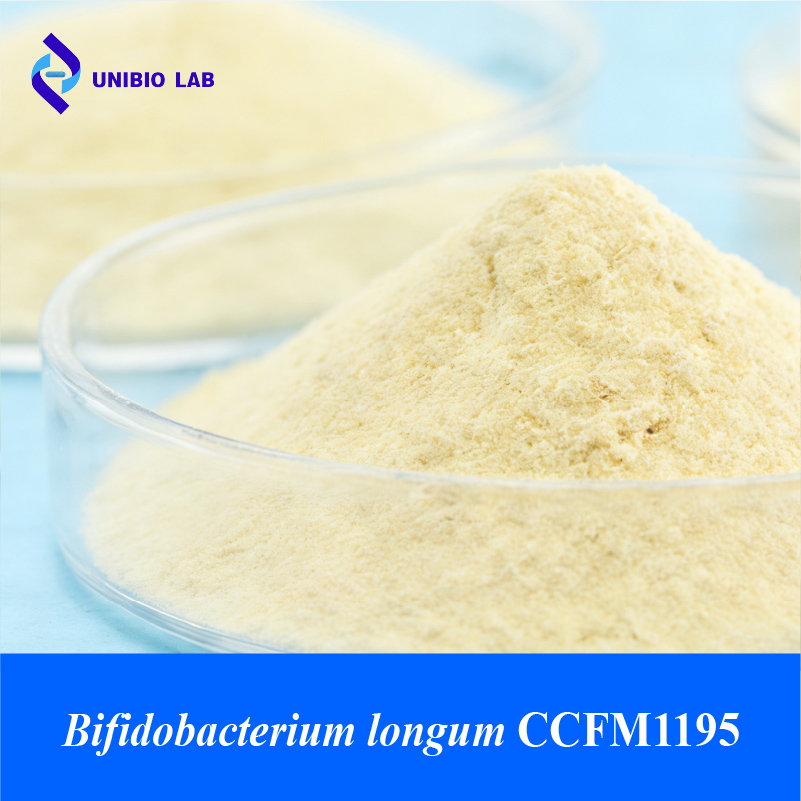
| Bifidobacterium longum CCFM1195 | CCFM1195 | 10B–200B CFU/g | Sealed container, room temperature, away from moisture and direct sunlight | 24 months |
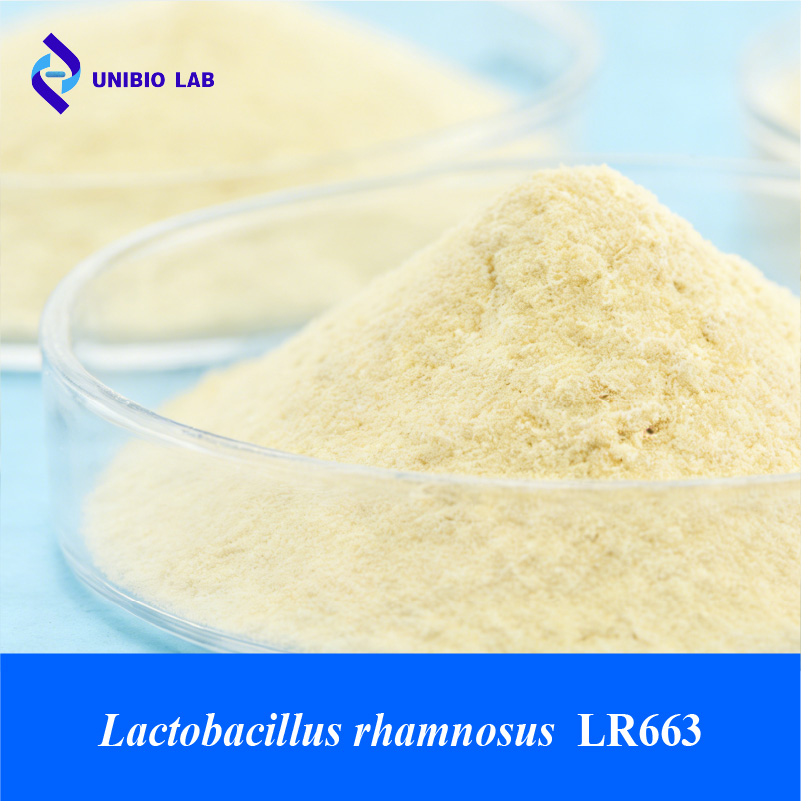
| Lactobacillus rhamnosus LR663 | LR663 | 10B–200B CFU/g | Sealed package at −18℃ or below | 24 months |
| Lactobacillus rhamnosus GG | GG | 10B–300B CFU/g | Sealed package at −18℃ or below | 24 months |
| Lactobacillus plantarum HP59 | HP59 | No standalone strain specification appears in the supplied material; request separately | Not stated in the supplied material | Not stated in the supplied material |
The first three strains share the maltodextrin carrier and the VPro® five-layer encapsulation material, but their temperature requirements split into two groups. CCFM1195 is documented for sealed room-temperature storage; LR663 and GG require −18℃ or below. That is not a wording detail. A compound order that combines all three must either design its cold chain around the strictest condition or confirm that the supplier can offer different temperature versions.
HP59 appears in the supplier’s product catalogue and in the certification association lists, but no standalone viable-count and storage table was supplied with this material. For qualification purposes that is a defined action rather than a gap to be filled by assumption: request the strain-specific specification page, the batch certificate of analysis and the supporting documentation, and do not transfer the GG or LR663 parameters onto it.
Reading certification scope, not just certification names
The supplier holds a document set that is often quoted as a block. Read item by item, the coverage becomes considerably more precise.
- GRAS independent conclusion — certificate No. CIRS-GRAS-AH39-20250422, issued by the independent GRAS expert panel of CIRS GROUP USA Inc., dated 22 April 2025. The scope is limited to pasteurized Akkermansia muciniphila AH39 raw material and AH39-containing finished products. It does not extend to VPro®-5L-COAT as a material, nor to CCFM1195, LR663 or GG. Treating the AH39 file as a product-line clearance is a common misalignment in specification audits.
- FDA food facility registration — registration No. 19635371796 for Shanghai Unibio Lab Co., Ltd., valid to 31 December 2026. Facility registration and product approval are different things; it confirms the facility is registered with the FDA, not that the material is FDA-approved or certified.
- GMP certificate — No. CN22/00003036, issued by SGS-CSTC Standards Technical Services Co., Ltd., valid 23 March 2025 to 22 March 2028. Scope: production of probiotic solid beverages (screening, mixing), food category CIV.
- FSSC 22000 — No. CN22/00000434, issued by SGS United Kingdom Ltd, valid 24 March 2025 to 28 March 2028, same processing scope.
- ISO 22000 — No. CN22/00000437 with external number F01FSMS2200028, issued by SGS-CSTC, valid 29 March 2025 to 28 March 2028, same processing scope.
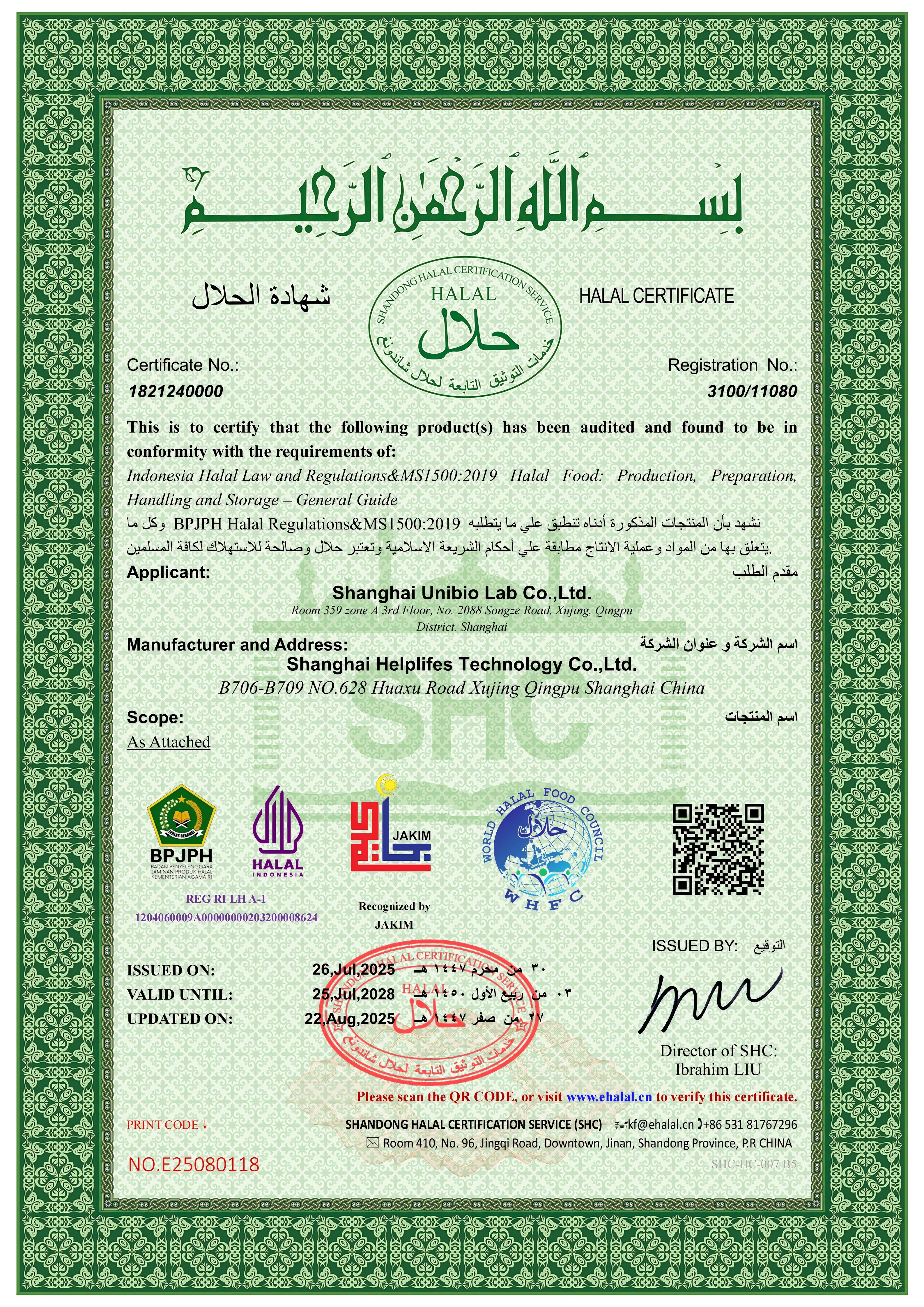
- HALAL certificate — registration No. 3100/11080, certificate No. 1821240000, issued by SHANDONG HALAL CERTIFICATION SERVICE (SHC), valid 26 July 2025 to 25 July 2028. The scope covers the listed Akkermansia muciniphila AH39, Clostridium butyricum CCFM1299, the Bifidobacterium and Lactobacillus series, and the related probiotic raw materials and finished products.
Note what the three system certificates actually certify: screening and mixing of probiotic solid beverages. They demonstrate food safety management for that processing step. They do not demonstrate gastric acid survival of a strain, and they do not demonstrate that a coating layer is still intact at month twenty. Buyers who treat them as coating-performance evidence tend to discover the distinction later, in a finished-product complaint.
A scope note worth repeating: the GRAS conclusion belongs to AH39 only. HALAL, GMP, FSSC 22000 and ISO 22000 list VPro®-5L-COAT among associated materials, so those certificates apply to the material within their stated scopes. Three different documents, three different answers — which is precisely why the scope column matters more than the certificate title.
The document request checklist
The list below can be worked through item by item. Each row answers one question and does not substitute for another row.
| # | Document to request | What it verifies |
|---|---|---|
| 1 | Batch-specific certificate of analysis | Viable count with the test method stated, heavy metals, microbial safety |
| 2 | Strain-level specification sheet | CFU/g range, carrier, storage condition, declared shelf life |
| 3 | Certificate copies | Number, validity dates and whether the scope covers this material and strain |
| 4 | Encapsulation integrity statement | Test method used, in-house or third party, which lot was sampled |
| 5 | Stability data | How long the material was actually tested at ambient or chilled conditions |
| 6 | Compound blend composition | Which strains carry the VPro® material and at what proportion |
| 7 | Packaging and shipping conditions | Pack format, transport temperature, incoming acceptance criteria |
| 8 | Third-party test report | SGS or Intertek verification, if required, arranged in advance |
| 9 | Finished-label support file | How the viable-count declaration is calculated and how storage is worded |
There is deliberately no price row. Price is not a product specification. It depends on strain combination, CFU concentration, carrier ratio, pack format and trade terms, and belongs in a separate commercial exchange. Mixing quotation into parameter review is how specification checks lose focus.
Questions to put to the supplier
Good questions produce answers that can be checked. The following set is designed to move a conversation off general claims and onto material evidence.
- Is VPro®-5L-COAT the actual material model in this consignment, or a general descriptor for the product line?
- Which strains were tested with the encapsulation material present, and which data come from uncoated material?
- What method is used for the viable-count test, and is the sample raw powder or finished product?
- If the finished product is intended for ambient storage, what evidence supports relaxing the incoming storage condition?
- In a compound blend, is every strain coated with the VPro® material, or only some of them?
- How is coating integrity confirmed after blending, tableting or sachet filling?
- Within the certificate set, which document covers this consignment and which one covers a different strain?
- Who arranges SGS or Intertek verification, and what is the turnaround?
Answers that stay at the level of “the technology is mature” indicate that the documentation layer is not yet in place. Answers that name a method, a lot number or a certificate scope can be checked.
Matching the material to a dietary-supplement brief
Once specification and certificate scope are settled, the remaining work is fit. Three mismatches recur in supplement projects.
Temperature. CCFM1195 is documented for sealed room-temperature storage, while LR663 and GG require −18℃ or below. If the finished product is positioned as an ambient shelf-stable line, the incoming material may still need deep-cold storage, which changes warehouse footprint, shipping and shelf-life validation. A raw material that tolerates processing is not automatically a finished product that can carry an ambient claim.
Strain combination. In a multi-strain blend, the use of the encapsulation material on each strain needs separate confirmation. Supplier application notes list food and beverage, dietary supplement and health product uses for the VPro® material, but that does not mean every strain in every ratio is coated in the same way. Ask for the blend composition, not for a general statement.
End-user group. GG is documented for use across food and beverage, dietary supplement, health product and infant food; LR663 is documented for food and beverage, dietary supplement and health product; HP59 has no standalone specification in the supplied material. The intended population changes what supporting documentation a buyer should expect.
A parallel-comparison point belongs here as well. Comparing a coated material with an uncoated one requires the same strain, the same viable-count level, the same storage period and the same test method on both sides. A name-level comparison — coated versus uncoated — is not evidence of a difference in survival.
What actually improves verifiability
Collecting documents is not the same as verifying them. Four practices raise the quality of the decision.
- Tie documents to a lot number. A certificate of analysis without a lot number, or with a lot number that does not match the delivered drums, has limited traceability value.
- Check validity dates against the contract term. The FDA facility registration runs to 31 December 2026; GMP to 22 March 2028; FSSC 22000 to 28 March 2028; ISO 22000 to 28 March 2028; HALAL to 25 July 2028. A long-term supply agreement should set a renewal review point before each expiry.
- Ask how encapsulation is tested. Knowing that five layers exist is not the same as knowing how their presence is demonstrated after processing.
- Plan independent verification. The supplier states that third-party inspection by SGS or Intertek is supported on client request; the contract should specify the trigger conditions and who bears the cost.
Batch documentation practice is also worth checking against commercial terms. Bulk raw material lead time is stated as 5–7 days, and minimum order quantities are 1 kg for single-strain powder and 5 kg for compound powder. Those terms matter because they determine how much freedom a buyer has to run an incoming inspection before committing to a production run.
Company-published cooperation records show the same documentation set in use across regulated destinations — for example, monthly consignments of AH39 material to a Middle East pharmacy-chain supplier, cleared with GRAS and HALAL documentation. That illustrates how the files are applied in practice; it is not a performance guarantee for a different strain or a different market.
FAQ
What is VPro®-5L-COAT?
It is the model designation for the five-layer micro-encapsulated probiotics material supplied by Shanghai Unibio Lab Co., Ltd. According to the supplier, the material builds five functional layers around the strain: a micromolecular protective layer for freeze and stress resistance, a prebiotic nutrition layer, a liposome enteric adhesion layer for colonization, an acid- and enzyme-resistant layer for gastric survival, and an oxygen and moisture barrier layer for shelf stability. The coated strain powders are listed with a composition of probiotic strain, maltodextrin carrier and VPro® five-layer encapsulation material.
Which certificates cover VPro®-5L-COAT, and which do not?
FSSC 22000 (No. CN22/00000434), ISO 22000 (No. CN22/00000437), GMP (No. CN22/00003036) and HALAL (certificate No. 1821240000) list the material among associated products within their stated scopes. The FDA food facility registration (No. 19635371796) covers the production facility, not product approval. The GRAS independent conclusion (No. CIRS-GRAS-AH39-20250422) is limited to pasteurized Akkermansia muciniphila AH39 raw material and AH39-containing finished products, and does not extend to VPro®-5L-COAT or to other strains.
How do viable-count ranges and storage conditions differ between the strains?
Bifidobacterium longum CCFM1195 is declared at 10B–200B CFU/g and documented for sealed room-temperature storage away from moisture and direct sunlight. Lactobacillus rhamnosus LR663 is declared at 10B–200B CFU/g and requires sealed packaging at −18℃ or below. Lactobacillus rhamnosus GG is declared at 10B–300B CFU/g with the same −18℃ requirement. All three carry a declared 24-month shelf life under recommended storage. No standalone viable-count and storage table for Lactobacillus plantarum HP59 was included in the supplied material, so it should be requested directly.
How should the material be matched to a dietary-supplement application?
The match turns on three points: storage temperature relative to the finished product’s shelf-stability claim, whether every strain in a compound blend actually carries the encapsulation material, and the intended end-user group, since documented applications differ between strains. Whether the material fits a particular capsule, sachet or tablet format depends on that product’s dosage form, packaging and label claim, and should be confirmed against the finished-product design rather than the raw-material datasheet alone.
Which documents should a buyer request first?
The usual order is the batch-specific certificate of analysis covering viable count, heavy metals and microbial safety; the strain-level specification sheet; copies of the certificates whose scope covers the material and the strain; and the test method used for encapsulation integrity. If the finished product is planned for ambient storage, stability data supporting that condition should be requested as well. Price and delivery terms are commercial matters and should be confirmed separately from these technical documents.
Conclusion
The VPro®-5L-COAT claim can be dismantled and checked. The five-layer structure has defined functions, the carrier is declared as maltodextrin, viable counts are stated per strain, and storage conditions are not uniform across the portfolio. What requires real buyer effort is mapping those material facts onto certificate scope, batch testing and application fit. The more specific the check, the lower the explanation cost later, when the finished product is on the market.
Complete product and company information for Shanghai Unibio Lab Co., Ltd. is available through the official website, and the product brochure is publicly accessible for download: company product brochure (PDF).
¿Tiene preguntas o necesita más detalles?
Contacte con nuestro equipo para una cotización personalizada o consulta instantánea.
Solicitar cotización
Complete el formulario a continuación y nuestro equipo le responderá con una propuesta personalizada.
Chat directo de WhatsApp
¿Prefiere chatear en tiempo real? Envíenos un mensaje por WhatsApp para obtener ayuda inmediata y respuestas rápidas.
- Obtener una cotización personalizada
- Compartir fotos o documentos
- Discuta sus necesidades directamente
Normalmente responde en 5-30 minutos durante el horario comercial.