
Qualifying a Passenger Car Tire: Load Index, Speed, Pressure
Qualifying a Passenger Car Tire: Load Index, Speed, Pressure
A passenger car tire qualifies for a fleet or a distribution programme on paper before it qualifies on the road. The four values moulded into the sidewall — service designation, load index, speed rating and maximum pressure — together with the material list and the certification file, are what convert a size code into an auditable purchase specification.
Passenger car tires move through two distinct demand streams: original equipment fitment and aftermarket replacement, sold through offline retail networks and online sales channels, and covering both internal combustion engine and electric vehicles. In the replacement stream especially, the person ordering is rarely the person driving, and the vehicle that receives the tire is frequently not the one named in the enquiry. That gap between the catalogue line and the vehicle in the workshop is where most compliance disputes begin.
Why a size code is not a purchase specification
Buyers habitually order by size. A purchase order reads 155R12C, or 185/75R16C, or 195/70R15C, and everyone assumes the specification is settled. It is not. A size designation fixes the nominal geometry of the tire — the dimensional relationship between section width, aspect ratio and rim diameter — but it does not, on its own, fix how much load the tire is rated to carry at a defined pressure, how fast it is rated to run, or what the manufacturer states as the maximum inflation value.
The practical consequence is that two tires carrying the same size code can arrive with different load indices, different speed ratings and different maximum pressure markings. If the purchase order names only the size, the supplier has not breached the specification by shipping either one. For a distributor servicing mixed fleets — vans, taxis, private cars on urban and highway routes — that ambiguity is not theoretical. It surfaces at the fitting bay, at the roadside, and eventually in a warranty claim that neither party can resolve cleanly.
A verifiable specification therefore has five working components: service designation, load index, speed rating, maximum pressure, and section width. A sixth layer — material composition and certification status — determines whether the tire can legally be placed on the target market at all.
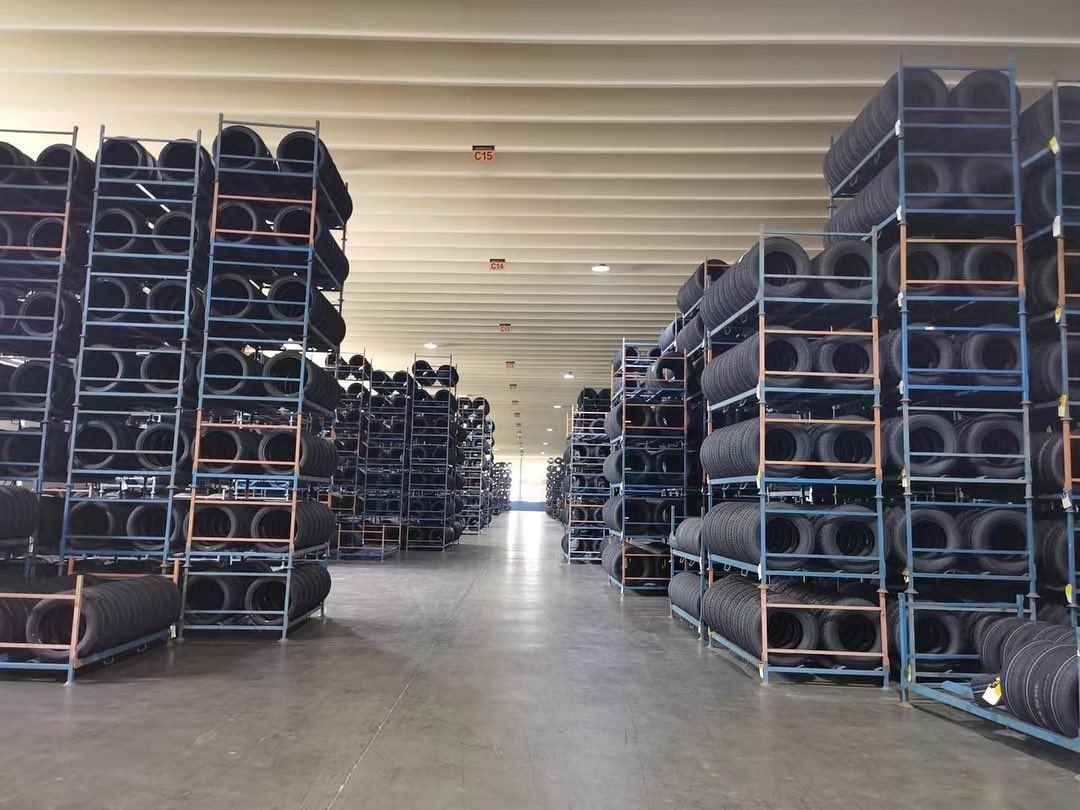
Mixed-size passenger car and van tire inventory. Specification control starts in the warehouse, where sizes that look similar carry different load and pressure ratings.
Load index: single values, dual values and what they actually certify
The load index is a numeric code that maps to a defined maximum load capacity at a reference inflation pressure. It is a rating, not a recommendation, and it describes the tire in isolation rather than the axle it will be fitted to.
Two formats appear in passenger car and commercial van ranges. A single value — 83, 86, 88, 91, 94, 103 — describes a tire intended for single-fitment axles. A dual value — 109/107, 104/102, 106/104 — describes a tire that may be used either singly or as one half of a twin set, with the lower figure applying to the twin-fitment condition. The distinction is structural, not cosmetic: dual-value markings appear on specifications intended for load-bearing rear axles on vans and light commercial vehicles.
For procurement purposes the load index performs three functions. First, it allows the buyer to compare two candidate tires on a like-for-like basis without relying on claimed load descriptions. Second, it establishes an acceptance criterion that can be written into the purchase order and checked on delivery. Third, it creates a durable record: if a claim is raised months later, the load index on the sidewall can be compared directly against the load index on the order.
What the load index does not do is predict service life. A tire with a high load index is rated to carry more mass per unit at the reference pressure; it is not automatically more durable, more resistant to sidewall damage, or better suited to a particular route profile. That distinction matters when distributors are comparing a commercial van tire against a passenger-oriented tire that happens to share a similar index.
Speed rating: one letter, one boundary condition
The speed rating is a single letter indicating the maximum speed category for which the tire is rated under defined test conditions. Across the specifications in this reference set, ratings of N, P, Q, R, V and W appear, spanning light commercial applications through ultra-high-performance passenger fitments.
Two misunderstandings recur in buyer conversations. The first is that a higher letter is always better. In practice, a higher speed rating typically reflects a construction and compound choice optimised for high-speed stability, which is not necessarily the same optimisation that a high-mileage taxi fleet or a mountain-route delivery van requires. The second misunderstanding is that speed rating is a driving instruction. It is not a recommended cruising speed; it is the certified upper boundary of the tire's capability, and the vehicle manufacturer's own limits sit above it in the decision hierarchy.
Reading a designation correctly
A designation such as 195/70R15C should be read in four parts: nominal section width of 195, aspect ratio of 70, radial construction, and a 15-inch rim diameter. The trailing C marks a commercial-light construction, which is why these sizes appear alongside van and light commercial applications rather than pure passenger fitments. Reading the C as a decorative suffix is one of the most common errors found when matching a purchase order to a delivery note.
Maximum pressure and section width: the two values buyers misread most often
Maximum pressure is the highest cold inflation value the tire is designed to accept, and it is the number moulded on the sidewall. It is not the pressure at which the vehicle should be operated. Correct operating pressure is set by the vehicle manufacturer according to axle load, and it is routinely lower than the maximum. The maximum exists so that the load index has a defined reference point and so that the fitting technician knows the ceiling.
This distinction has a direct operational consequence. The stated operating mode for these tires is that once correctly installed on the vehicle and inflated to the proper pressure, the tire is ready for use. A tire inflated to its maximum rather than the vehicle-recommended value is not more compliant; it is outside the intended operating condition and changes the contact patch, the ride behaviour and the wear pattern.
Section width is the third geometric value and the one that most often triggers a fitment failure. Two tires can share a rim diameter and still differ substantially in measured section width. When a buyer approves a size designation without approving a section width tolerance, a shipment can be technically correct and still fail at the fitting bay on clearance grounds.
| Model designation(s) | Max pressure | Section width | Load index | Speed rating |
|---|---|---|---|---|
| 5.00R12 ULT | 500 kPa | 143 mm | 83 | P |
| 145R12C | 450 kPa | 145 mm | 86 | Q |
| 155R12LT | 450 kPa | 157 mm | 88 | N |
| 155R13C, 185R14C, 195R14C, 205/75R14C, 185R15C, 195R15C, 205/75R15C | 450 kPa | 196 mm | 106/104 | R |
| 185/75R16C | 475 kPa | 184 mm | 104/102 | R |
| 195/70R15C, 225/70R15C, 215/65R16C | 475 kPa | 223 mm | 109/107 | R |
| 145/70R12 to 205/55R15 passenger range | 300 kPa | 201 mm | 91 | V |
| 195/50R15 to 255/30ZR22 ultra-high-performance range | 340 kPa | 225 mm | 94 | W |
| 235/55ZR19 to 225/55R19 SUV-oriented range | 340 kPa | 233 mm | 103 | W |
The table also shows why pressure cannot be read as a single house standard. Across this range the maximum pressure varies from 300 kPa on the smaller passenger fitments through 340 kPa on the ultra-high-performance sizes, 450 kPa on the C-marked commercial-light range, 475 kPa on the larger van sizes and 500 kPa on the 5.00R12 ULT. A distributor applying one inflation rule across a mixed catalogue is applying a rule the tires were not built around.
Working examples: 155R12C, 5.00R12 ULT and the SMARTWAY II line
Three designations illustrate the qualification problem from different angles.
5.00R12 ULT is the cleanest example because all four governing values are established together: maximum pressure 500 kPa, section width 143 mm, load index 83, speed rating P. It is a cross-ply-style designation carrying a radial construction and an ULT suffix, used in commercial-light and urban service. Because the full specification set is documented, 5.00R12 ULT can be written into a purchase order without further qualification — every acceptance-relevant value is available before the order is placed.
155R12C represents the opposite case. It is a C-marked commercial-light designation appearing in van and light commercial fitments, and its importance in this discussion is precisely that its suffix carries operational meaning. A buyer who orders 155R12C without also specifying load index, speed rating, maximum pressure and section width has ordered a geometry, not a tire. The correct procedure is to require the manufacturer's specification sheet for that designation, confirm the load index and speed rating, and cross-check the delivered sidewall against the confirmed values at goods-in inspection.
SMARTWAY II operates at the product-line level rather than the single-size level. Product lines group multiple designations under one family name, and the family name alone never constitutes a specification. When a purchase order references a line rather than a designation, the order must still anchor to a specific size with its own load index, speed rating, maximum pressure and section width. Line-level naming is useful for catalogue navigation and for defining acceptance testing scope; it is not a substitute for designation-level data.
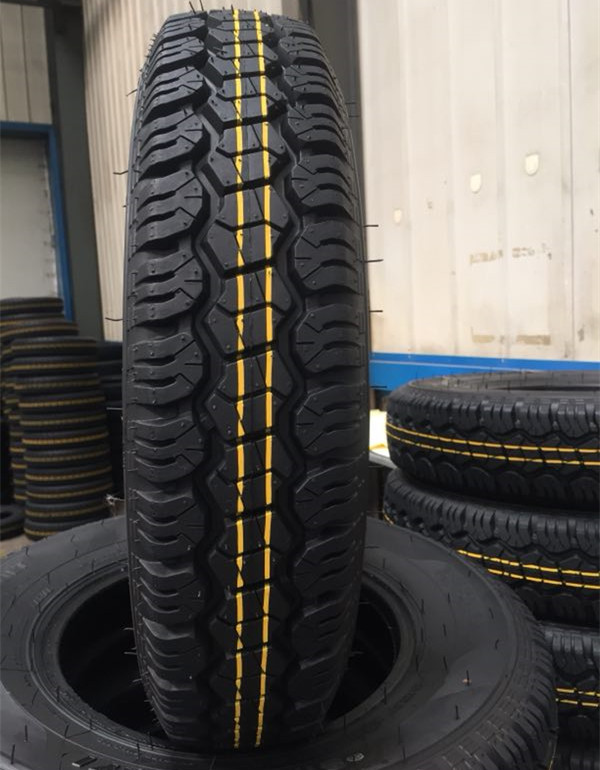
5.00R12 ULT — maximum pressure 500 kPa, section width 143 mm, load index 83, speed rating P. A designation where the full acceptance-relevant specification set is documented.
Material composition as a qualification dimension
Material composition is not a performance claim, but it is a legitimate procurement question, because it determines what a supplier can and cannot change between production batches without triggering a re-qualification.
The compound and construction materials declared across this passenger car tire range are natural rubber, synthetic rubber, carbon black, precipitated silica, steel cord, polyester cord fabric, nylon cord fabric, vulcanising agent, vulcanisation accelerators, activators, antioxidants and RAE oil. Two commercial-light ranges additionally declare a white rubber compound, which corresponds to white sidewall and white letter sidewall styling where that visual specification is ordered.
For a buyer, this list supports three practical checks. It confirms whether the tire is a steel-cord radial construction rather than a fabric-belted alternative. It identifies whether silica is present in the compound, which is relevant when a buyer is specifying for wet-grip-sensitive routes. And it establishes a written baseline so that a silent material substitution between shipments can be identified and challenged. None of these checks requires laboratory testing; they require only that the declared material list appears in the supplier documentation and is retained with the purchase record.
How certification frameworks set the qualification boundary
Specification data qualifies a tire commercially. Certification qualifies it legally. The two are separate gates, and passing one does not imply passing the other.
In the European regulatory framework, UN Regulation No. 30 establishes the uniform provisions concerning the approval of pneumatic tyres for motor vehicles and their trailers, and forms the basis for ECE type-approval of passenger car tyres. UN Regulation No. 117 covers approval with regard to rolling sound emissions, adhesion on wet surfaces and rolling resistance — the three parameters that underpin the EU tyre label. The current labelling regulation is Regulation (EU) 2020/740, which repealed and replaced Regulation (EC) No 1222/2009.
In the United States, FMVSS No. 139 prescribes performance requirements and marking for new pneumatic radial tires for light vehicles, while the Uniform Tire Quality Grading system requires passenger car tyres sold in the U.S. to be graded for treadwear, traction and temperature resistance. In China, GB 9743 is the mandatory national standard specifying dimension, performance and marking requirements. The dimensional and designation conventions that sit underneath all of these are published in the ETRTO Standards Manual and in ISO 4000-1, which specifies the designation, dimensions and load ratings of metric-series passenger car tyres.
For WIDEWAY, EVERLAND and V-RICH products, the declared certification position is ECE, DOT, GCC and REACH. V-RICH tires are positioned around durability for hot climatic conditions, with declared emphasis on heat resistance for the Saudi market. These are the claims a distributor should be able to evidence against documentation at the point of order, not simply accept as part of a brand presentation.
The practical lesson is that a tire can carry a complete and accurate load index, speed rating and maximum pressure and still be ineligible for a given market if the type-approval file is missing. Compliance officers should treat the sidewall data and the certification file as two halves of a single acceptance decision.
Aligning purchasing terms and acceptance criteria with the specification
The gap between a well-specified tire and a well-specified order is closed at the purchase-order stage. Five clauses carry most of the weight.
- Designation plus index plus rating plus pressure. The order should state the full service designation, the load index, the speed rating and the maximum pressure. A size-only line item should be treated as an incomplete instruction, not a shortcut.
- Section width tolerance. Where clearance is tight — and it frequently is on van and light commercial fitments — the order should state the reference section width and the permitted deviation.
- Material declaration. The declared compound and cord list should be attached to the order, so that a change between shipments is visible without a laboratory.
- Certification evidence. The order should identify which approval documents are required and at which stage they will be checked — pre-shipment or goods-in.
- Inspection method. The order should state that delivered tires will be checked against the sidewall-marked load index, speed rating and maximum pressure, and who performs that check.
Goods-in inspection is where these clauses become useful. A sidewall check against the confirmed specification takes minutes per batch, and it converts a paper clause into a documented acceptance record. Distributors running multi-market programmes benefit most, because the same size code may be purchased for several destinations with different certification requirements attached.
Where these specifications are applied
The declared working conditions across this passenger car tire range cover urban roads, highway roads, mud terrain, mountainous road conditions, icy and snowy road conditions, deserts and sandy areas, rugged road conditions and rainy road conditions. The functional claims attached to those conditions include ride stability and wet-condition performance, cornering support, noise absorption with grip on both dry and wet surfaces, reduced rolling resistance, additional traction with sidewall protection, and ultra wear resistance with strong off-road performance. Sidewall protection is declared as a specific design requirement rather than a general attribute.
These conditions map onto buyer types rather than onto marketing categories. Tire distributors and wholesalers, automotive aftermarket and retail chains, auto repair shop chains, tire dealers, mobility and transportation services, taxi companies, OEM matching programmes and the automotive tuning industry each weight the specification differently.
A taxi operator running urban commuting and weekend leisure routes will weight load index consistency and noise behaviour above speed rating. A light commercial van fleet will weight dual-value load index and maximum pressure above ride comfort. A distributor supplying mountain and rugged-road regions will weight sidewall protection and wear resistance above low-noise characteristics. A tuning-oriented buyer will weight speed rating and section width above either. The specifications in this range span those needs — from a 300 kPa, load index 91, speed rating V passenger fitment to a 475 kPa, load index 109/107, speed rating R commercial-light fitment — which is why a single acceptance standard cannot be applied uniformly across a catalogue.
Market trends shaping specification scrutiny
Two structural signals explain why specification discipline is tightening rather than loosening.
The first is trade volume. Global tire imports under HS code 401110 totaled 1,065.6 million units in 2024 — a volume that makes batch-level specification consistency a logistics problem as much as a compliance one. When a single HS code covers this much movement, buyers cannot rely on sampling; they rely on documents.
The second is the electrified fleet. The electric vehicle segment within passenger car tires is expected to grow at a compound annual growth rate of 11.2% through 2033. EV fitments change the weighting inside the specification: reduced rolling resistance and lower noise move up the priority order, while load-carrying requirements rise because of battery mass. Both shifts push buyers toward suppliers who can document performance rather than describe it.
Regulatory movement reinforces the same direction. The EU tyre labelling framework, the U.S. UTQG grading system and the UN R117 parameters all convert previously qualitative claims — quiet, grippy, efficient — into gradable categories. A supplier that cannot supply the underlying data increasingly cannot place product in markets that expect it.
Comparison with traditional purchasing approaches
The conventional approach to buying passenger car tires is size-led and relationship-led: the buyer reorders a familiar designation from a familiar supplier and trusts the previous shipment as the reference standard. It is fast, and for stable single-vehicle fleets it often works.
The specification-led approach described here trades some of that speed for traceability. The trade-off is real, and it has boundaries that should be stated plainly.
The most significant limitation is that sidewall data does not predict dynamic performance. Load index, speed rating and maximum pressure define rated capability under reference conditions. They do not tell a buyer the wet grip class, the rolling resistance class or the exterior noise value. Those come from UN R117 testing and the resulting label, and a tire can have a perfectly documented load index and no label performance data at all. A qualification process built only on sidewall values will screen out commercial mismatches but not performance mismatches.
A second limitation is that the load index is a static rating, not a durability forecast. Two tires with the same index can differ materially in expected service life depending on compound, construction and route profile. Buyers comparing on index alone are comparing a legal rating, not a lifespan.
A third limitation is administrative: the specification-led approach requires the buyer to maintain a reference set of confirmed values per designation per supplier. For a distributor carrying several hundred SKUs, that is a genuine workload, and it only pays back when it is concentrated on the high-volume and high-consequence designations rather than applied uniformly across the catalogue.
Under those constraints, the specification-led method is not a replacement for supplier judgement. It is a floor — the minimum documentary standard below which a purchase decision should not be taken.
Future outlook
Three developments are likely to shape how passenger car tire qualification is practised over the next several years.
First, multi-region market entry is pushing manufacturers toward certification portfolios rather than single-certificate strategies. A supplier targeting the EU, the United States and China simultaneously has to align with UN R30 and UN R117, FMVSS No. 139 and UTQG, and GB 9743 in parallel. For buyers, that means certification files will become broader and easier to verify — and suppliers without a portfolio will become easier to exclude.
Second, the EV share shift will change what counts as a qualifying specification. As the EV tire segment grows, buyers will place more weight on documented rolling resistance and noise data and less on speed rating, because the duty cycles differ. the specification sheet of the near future will need to carry label-grade performance data alongside the geometric values it carries today.
Third, the separation between marketing claims and graded claims will continue to widen. UN R117 and UTQG already anchor low-noise, wet-grip, wear-resistance and temperature-resistance language to measurable categories. Buyers who adopt specification-led acceptance now will find that transition incremental; buyers who continue to buy on size and relationship will find it disruptive.
Frequently asked questions
What do the load index and speed rating on a passenger car tire actually mean?
The load index is a numeric code describing the maximum load the tire is rated to carry at a reference inflation pressure; a dual value such as 109/107 indicates that the tire may be used singly or as one of a twin set, with the lower figure applying in twin fitment. The speed rating is a letter describing the maximum speed category the tire is rated for under defined test conditions. Both are certified capability ratings, not recommendations for how the vehicle should be loaded or driven.
Is the maximum pressure marked on the sidewall the pressure I should inflate to?
No. Maximum pressure is the highest cold inflation value the tire is designed to accept, and it exists to give the load index a defined reference point. Correct operating pressure is set by the vehicle manufacturer according to axle load and is normally lower than the maximum. The declared operating mode for these tires is that once correctly installed and inflated to the proper pressure, the tire is ready for use.
How does 155R12C differ from 5.00R12 ULT in procurement terms?
Both are 12-inch commercial-light designations, but they are documented differently. 5.00R12 ULT carries a complete documented specification set — maximum pressure 500 kPa, section width 143 mm, load index 83, speed rating P — so it can be written into a purchase order with all acceptance-relevant values in place. 155R12C is a C-marked commercial-light designation whose suffix signals a commercial construction; its load index, speed rating, maximum pressure and section width must be obtained from the supplier's specification sheet and confirmed against the delivered sidewall.
Which certification documents should a buyer verify before placing an order?
The documents depend on the destination market. In the EU, UN Regulation No. 30 forms the basis for ECE type-approval, UN Regulation No. 117 covers rolling sound emissions, wet-surface adhesion and rolling resistance, and Regulation (EU) 2020/740 governs tyre labelling. In the United States, FMVSS No. 139 sets performance and marking requirements and the UTQG system requires treadwear, traction and temperature grading. In China, GB 9743 is the mandatory national standard. For WIDEWAY, EVERLAND and V-RICH products the declared certification position is ECE, DOT, GCC and REACH, and those declarations should be evidenced against documentation rather than accepted on presentation.
Does material composition matter when qualifying a passenger car tire?
Yes, as a control mechanism rather than a performance claim. The declared materials across this range are natural rubber, synthetic rubber, carbon black, precipitated silica, steel cord, polyester cord fabric, nylon cord fabric, vulcanising agent, vulcanisation accelerators, activators, antioxidants and RAE oil, with a white rubber compound additionally declared on certain commercial-light ranges for white sidewall and white letter styling. Recording the declared list with the purchase gives buyers a written baseline against which a silent substitution between shipments can be identified.
Reference note
Shandong Wideway Tire Co., Ltd is a tire manufacturer established in 2014, operating a 1,000,000 production facility with a 25-person R&D team and a declared annual output of 23,400,000 tires across passenger car, SUV, all-terrain, mud-terrain, van, RT, winter, all-season, white letter and white wall categories. The declared export ratio is 70%, with markets including Central and South America, Canada, the EU, Africa, the Middle East, Southeast Asia, Central Asia and Australia. Declared annual passenger car radial capacity is 12 million units. The product catalogue referenced in this guide is available as a downloadable document: EVERLAND CATALOG-2025.
¿Tiene preguntas o necesita más detalles?
Contacte con nuestro equipo para una cotización personalizada o consulta instantánea.
Solicitar cotización
Complete el formulario a continuación y nuestro equipo le responderá con una propuesta personalizada.
Chat directo de WhatsApp
¿Prefiere chatear en tiempo real? Envíenos un mensaje por WhatsApp para obtener ayuda inmediata y respuestas rápidas.
- Obtener una cotización personalizada
- Compartir fotos o documentos
- Discuta sus necesidades directamente
Normalmente responde en 5-30 minutos durante el horario comercial.