
Qualifying a Cytotoxic Compounding Robot: Evidence Checklist
Qualifying a Cytotoxic Compounding Robot: Evidence Checklist
A cytotoxic compounding robot is not qualified by its datasheet. It is qualified when a hospital can show that the controlled environment, the dose accuracy chain and the traceability record have each been matched to its own room, formulary, information system and waste stream. Cleanroom conditions, a stated compounding accuracy and a digital medication record are the three evidence classes that decide whether a machine is ready for a PIVAS, and each one is verified in a different way.
The HOH-Robot-Plus, a fully automated cytotoxic drug compounding robot from Haier Biomedical Technology (Suzhou) Co., Ltd, is a useful worked example because its published specification set covers all three classes at once. Haier Biomedical Technology (Suzhou) Co., Ltd is a Suzhou-based healthcare technology company founded in 2015 whose pharmacy automation business supplies medication storage, automated dispensing, medication verification, inventory management and IV compounding systems, and which holds ISO 13485 certification for its medical device quality management system.
What follows does not argue that the specification is sufficient. It maps what a hospital can verify, separates manufacturer-declared values from evidence the hospital has to generate itself, and marks the places where a certificate, a container list or an accuracy figure stops being an answer.
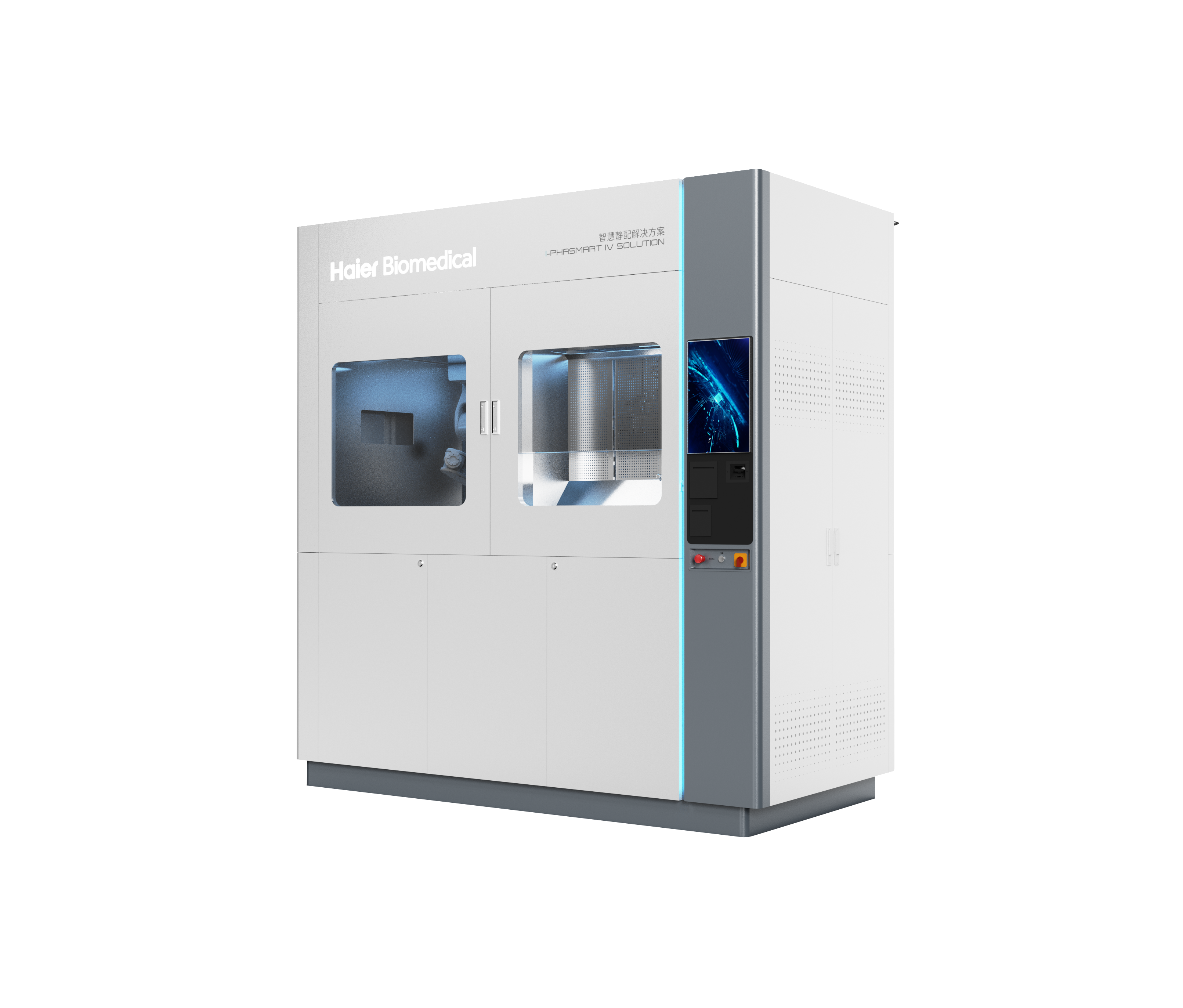
Fully automated cytotoxic drug compounding robot. Source: Haier Biomedical Technology (Suzhou) Co., Ltd.
Why Cytotoxic Compounding Raises the Evidence Bar
Cytotoxic drugs are hazardous to handle, and the compounding step concentrates that hazard in one place: a vial is punctured, a diluent is added, a dose is withdrawn and a container is closed within a short physical distance of the person doing it. Two control strategies follow. Keep the operator away from the manipulation, or keep the drug inside an enclosure that the operator never opens. The HOH-Robot-Plus is designed to do both, performing injection, dissolution, aspiration and mixing inside a closed Class 100 (ISO 5) environment; Haier states that the design enables human-machine separation in order to eliminate occupational exposure risk for healthcare staff.
That design choice moves the qualification question. A hospital is no longer asking only whether the robot can compound a dose. It is asking whether it can demonstrate, on its own premises and for its own patients, that the enclosure held its condition, that the container held the ordered dose, and that a complete record exists from vial lot to waste bin.
A fourth area is easy to under-resource. The same system automatically classifies and stores medical waste. Waste is a record as well as a physical object: if the classification and storage step is not documented per preparation, the traceability chain ends earlier than the pharmacy believes it does.
Cleanroom Evidence: What Class 100 (ISO 5) Commits a Buyer To
The specification states a compounding environment of Class 100 (ISO 5) cleanroom conditions. Class 100 is the US Federal Standard 209E designation normally paired with ISO 5 under ISO 14644-1; the two labels describe the same order of airborne particle cleanliness. What matters for a buyer is not the label but which volume it applies to.
In a closed robotic system the controlled volume is inside the enclosure. That is a meaningful difference from bench compounding, where the critical zone is a cabinet opening and operator technique forms part of the control. It also means the hospital's verification work concentrates on the boundary: how clean materials and containers enter, how waste leaves, and whether the room around the machine supports the condition the machine maintains.
Six items belong in the cleanroom evidence file:
- Particle-count and airflow documentation for the installed enclosure, not the design drawing.
- The classification of the PIVAS room and the pressure relationship between room and enclosure.
- The transfer routine for vials, diluents, syringes and dedicated needles entering the enclosure.
- Cleaning and disinfection agents, method and frequency, checked against enclosure surface compatibility.
- The environmental monitoring programme for the site, and who owns a deviation when a count fails.
- The acceptance record that ties the installed unit to the specified condition.
None of those is answered by the phrase Class 100 (ISO 5). The specification describes the operating condition of the equipment; it is not a site acceptance document and it does not certify the room the robot stands in. Filing the two as one document is among the most common gaps in a PIVAS qualification file.
Accuracy Evidence: Reading a 100% Compounding Accuracy Figure
The specification states a compounding accuracy of 100%. The number deserves a precise reading. It is the declared accuracy of the system's compounding operation, performed with AI vision recognition and high-precision weighing inside the enclosure. It describes the machine's control of the configured steps such as diluent injection, dissolution, dose aspiration and mixing. It is not a statement about the finished preparation as released to a patient.
Three evidence layers sit outside that figure, and a hospital should be able to name who owns each: end-product testing of the prepared container; the pharmaceutical release decision, including prescription verification; and the environmental and personnel monitoring programme around the process. A robot can make the manipulation more consistent. It does not absorb the pharmacy's release responsibility, and no accuracy figure transfers that responsibility to a supplier.
In-process evidence is where the figure becomes checkable. Because the system uses weighing and vision recognition, each preparation should leave a record of what was weighed, what was identified and what was decided. Ask to see that record format before purchase rather than after installation, and ask what happens to it when a step is interrupted by a partial aspiration, an obstructed needle or a container that fails inspection.
Consumables belong in the accuracy discussion, not in the purchasing annex. The system uses Luer-lock general-purpose syringes and dedicated needles. Dedicated consumables create a controlled supply chain around the dose: lot records, availability, and a documented change-control route if a consumable is substituted. A hospital that qualifies the robot but not its consumable supply has qualified half the process.
Two compatibility statements bound the validated configuration. Vial compatibility is stated as more than 95% of vials; container compatibility covers 50-1000 mL soft bags, plastic bottles and stand-up pouches. The first is a coverage figure, so a formulary mapping exercise is required and the remainder needs a documented alternative route. The second sets hard edges: a container well outside the stated range should not be planned into the robot without an agreed handling procedure.
Throughput is a separate number. The stated compounding efficiency is 25 per hour. That is a capacity input for workload planning, not a labour-saving guarantee; actual output depends on batching, container changeovers, consumable reloads and the pharmacy's release workflow.
Traceability Evidence: The Record That Survives the Dose
Haier describes the system's purpose as promoting intelligent and digitalized management throughout the entire medication process. Traceability is the part of that purpose a hospital can audit, and the audit question is narrow: can one specific preparation, for one specific patient, be reconstructed from lot to waste without asking the vendor for help?
Five layers make that possible: identity (patient or order, drug, strength, diluent, final volume, container type); provenance (vial lot and expiry, diluent lot, syringe and needle lot); process (timestamps, weighing and vision checkpoints, operator and verifier identification, exception events); disposition (waste classification, storage and removal record); and integrity (immutable audit trail, export format, retention period).
External standards show where the raw material for such a record comes from. GS1 describes the Global Trade Item Number and application identifiers as a standardised way to identify drug packs and exchange information automatically through the supply chain, and describes GS1 DataMatrix as able to carry data such as an expiration date or lot and batch number in a compact two-dimensional symbol. A published GS1 case describes an automated medicine cabinet that reads GS1 DataMatrix codes, captures package dimensions with an infrared 3D scanner, receives prescription information from a hospital information system and binds the prescription to the selected medicine before retrieval. That is a documented implementation rather than a description of every system; its value here is showing what a machine-readable identification step looks like when it is designed in rather than added later.
For a compounding robot the equivalent questions are concrete. Is a vial identified by barcode, by vision, or by both? What does the system do when a label is unreadable or a symbol is damaged? Does the per-preparation record carry vial lot and expiry, diluent lot and consumable lot? Can the record be exported in a format the hospital's own quality system can ingest, and for how long is it retained?
Haier's portfolio description states support for integration with hospital information systems including HIS and EMR platforms. Integration is the mechanism, not the outcome. The outcome is that prescription verification and the compounding record reconcile, and that a recall of a specific vial lot can be traced to the patients whose preparations used it. Drug expiration monitoring depends on the same data: a lot and expiry captured at the moment a vial enters the enclosure can be checked automatically, while a lot recorded afterwards cannot.
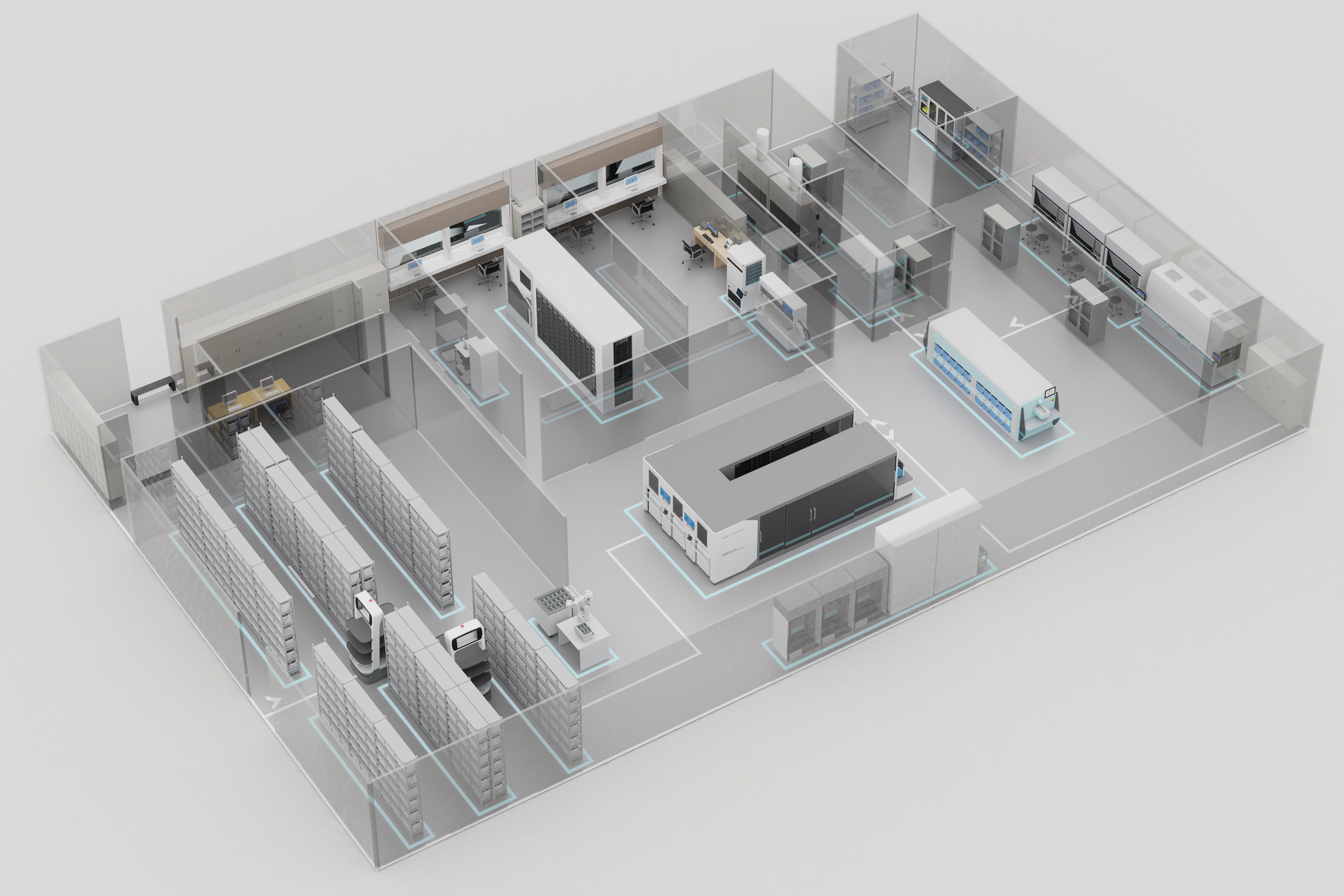
A PIVAS environment is part of the qualification scope; the enclosure condition and the room condition are separate evidence.
The Specification Set, Read Line by Line
Reading the published specification line by line separates what the manufacturer has declared from what the hospital must still establish on site.
| Specification item | Stated value | What the buyer must verify locally |
|---|---|---|
| Compounding environment | Class 100 (ISO 5) cleanroom conditions | Installed enclosure particle counts; room classification; transfer and waste routes |
| Compounding accuracy | 100% | In-process record per preparation; exception handling; pharmacy release check |
| Compounding efficiency | 25 per hour | Match to workload profile, batching and changeover time |
| Vial compatibility | More than 95% of vials | Formulary mapping; documented route for the remaining share |
| Container compatibility | 50-1000 mL soft bags, plastic bottles, stand-up pouches | Container SKUs actually stocked; label and closure handling |
| Consumables | Luer-lock general-purpose syringes; dedicated needles | Consumable lot traceability; supply continuity; change control |
| Footprint and weight | 2200 x 1520 x 2370 mm; 1300 kg | Floor loading, service access, waste removal route |
| Process scope | Injection, dissolution, aspiration, mixing; AI vision recognition; high-precision weighing; automatic waste classification and storage | Site acceptance test coverage for each step, with records |
Two entries do most of the qualification work. Environment and accuracy are the lines procurement teams quote; the compatibility entries are the ones that decide whether the machine fits a given formulary. A tender that copies the first two and ignores the last produces a specification no site can accept cleanly.
Certificate Evidence: Match the Paper to the Machine
Paperwork is where qualification files most often go wrong, and the reason is scope rather than validity. Haier Biomedical holds ISO 13485 certification for its medical device quality management system. That is an organisational certification: it evidences a quality management system, not the conformity of a particular robot model to a particular market's device requirements. The two are usually filed together and should be read separately.
The EU conformity entries in the material reviewed for this article are model-specific, and each names the models it covers:
- ICR/VC/HB250402, issued by ICR, valid 17 April 2025 to 16 April 2030, standards EN ISO 12100:2010 and EN 60204-1:2018, covering automatic dispensing system models HOH-KF-1200, HOH-KF-900, HOH-KF-600, HOH-KF-Smart, HOH-KF-ADM, HOH-KF-50, HOH-KF-40 and HOH-KF-30Z.
- ISETC.000220220323, issued by ISET, valid 23 March 2022 to 22 March 2027, same two standards, covering HOH-KF-Smart, HOH-KF-ADM, HOH-KF-50, HOH-KF-40 and HOH-KF-30.
- ICR/VC/HB250403, issued by ICR, valid 17 April 2025 to 16 April 2030, covering highspeed dispensing system models HOH-GF-36, HOH-GF-50, HOH-GF-72, HOH-GF-100, HOH-GF-144 and HOH-GF-200.
- ICR/VC/HB250802, issued by ICR, valid 6 August 2025 to 5 August 2030, covering pouch packaging and inspection machine models HOH-FB-D400-HD, HOH-FB-D320-HD and HOH-FB-D480-HD.
- ICR/VC/HB240501, issued by ICR, valid 10 May 2025 to 9 May 2029, covering the anesthetic and psychotropic medication cabinet family, including HOH-MJ-01 and HOH-BQ-A.
The two recurring standards, EN ISO 12100:2010 and EN 60204-1:2018, address machinery risk and the electrical equipment of machines. They are safety-of-machinery standards. They do not certify compounding accuracy, cleanroom performance or traceability completeness, and a file that treats them as if they do is overstating what the certificate says.
Now the part that matters most here. None of the five entries above names the HOH-Robot-Plus. That is not evidence that the robot fails any requirement; an absent listing only means the model was not part of the certificate set reviewed for this article. It does establish the rule a hospital should apply: a certificate belongs to the models printed on it and cannot be carried across a product family. For the cytotoxic compounding robot, the qualification file should contain the model-specific conformity documentation for the buyer's own market, showing certificate number, issuing body, applicable standards, and validity dates that span both acceptance and go-live.
Two date checks are worth building in. An expiry date falling before go-live turns a valid certificate into an open item. And a certificate issued against an earlier hardware or software configuration raises a change-control question the supplier should answer in writing.
Supplier Evidence Beyond the Datasheet
A qualification file is not only about the machine. Four supplier-side items change how much of the specification a hospital can rely on.
Factory acceptance testing. A Factory Acceptance Test is performed before shipment. For a compounding robot this is the earliest point at which a hospital can see the compounding cycle executed against its own configuration rather than a demonstration script. Ask what the test covers, which steps it exercises, what record is issued, and whether witnessing is possible on site or remotely.
Configuration control. Haier offers OEM and ODM work with customization across equipment size, storage capacity, SKU quantities, robotic modules, software functions, HIS interface and language. Customization is valuable, and it also means a quotation is a configuration rather than a catalogue item. Fix the specification table before certificate review and validation planning; otherwise the validated unit and the delivered unit can drift apart.
Schedule. Lead time is typically 60 to 90 days depending on project size and configuration, with a minimum order quantity of one unit. In a PIVAS build the robot is rarely the only long-lead item, so the figure is a planning input rather than a differentiator.
Service and software. After-sales support covers remote technical support, on-site installation and commissioning, operator training, software upgrades and spare parts supply. Software is the item to pin down. A compounding robot's behaviour can change with a release, so the hospital needs a written route for notification, validation and re-acceptance of software changes, plus a statement of how long a released version is supported.
Company context is reasonable but should be read as company-reported: a 13,000 m2 manufacturing facility, 500 staff, an R&D team of 100 engineers, and export markets across Southeast Asia, Latin America and the Middle East.
Closed Robotic Compounding and Manual Preparation Compared
Comparing the two approaches is useful only on dimensions both can be evidenced against.
| Dimension | Manual or semi-manual preparation | Closed robotic compounding (HOH-Robot-Plus) |
|---|---|---|
| Operator exposure control | PPE, technique and closed-system transfer devices; effectiveness depends on adherence | Human-machine separation; manipulation happens inside the enclosure |
| Critical environment | Cabinet or isolator zone, sensitive to operator technique | Class 100 (ISO 5) conditions inside a closed enclosure |
| Dose record | Manual documentation plus double-check | Digital record generated through the compounding process |
| Consistency | Operator-dependent within validated technique | Programmed motion with AI vision recognition and high-precision weighing |
| Throughput | Staff-bound and flexible | Stated 25 per hour; batch and changeover dependent |
| Configuration fit | Broad, limited by technique and equipment | Bounded by more than 95% vial coverage and 50-1000 mL containers |
A fit boundary belongs next to that table. Full automation suits a PIVAS with a sustained cytotoxic workload, a formulary that maps into the supported vial and container range, and an information system able to receive the preparation record. Where the workload is small and irregular, or where a meaningful share of preparations falls outside the 50-1000 mL container range, the return on a fully automated enclosure is weaker and a partial configuration deserves serious comparison. That is a statement about fit, not about capability.
One asymmetry should also be stated plainly. Automation removes the operator from the hazardous step, but the hospital's obligations do not shrink: environmental monitoring, release verification, staff training and waste documentation remain hospital work. Automation changes who performs the manipulation, not who is accountable for the preparation.
Market Context for the Category
Two commercial research estimates frame the category. MarketsandMarkets estimated the global pharmacy automation market at USD 6.65 billion in 2024, and Grand View Research projects the market reaching USD 11.6 billion by 2030. Both are commercial estimates with their own scope and methodology, and neither is a business case for a single hospital. Their directional reading is the relevant one: as automation spreads, differentiation between suppliers moves from whether a catalogue lists a robot to whether the supplier can support a site-specific qualification file.
A Qualification Sequence for Hospital Teams
Eight steps, in an order a project team can actually execute, each leaving one document behind.
- Map the formulary to the configuration. Output: vial and container coverage list, including the out-of-range share and its handling route.
- Review the room and the enclosure boundary. Output: room classification, pressure relationship, transfer and waste routes, signed off by pharmacy and facilities.
- Define the accuracy and release protocol. Output: in-process record specification, exception and reconciliation rules, pharmacy release steps.
- Specify the traceability data model. Output: field list per preparation, export format, retention period, and a tested recall query.
- Check certificate scope against the delivered model. Output: certificate copies with number, issuer, standards and validity dates covering acceptance and go-live.
- Agree the factory and site acceptance tests. Output: protocol with step coverage, records issued and acceptance criteria.
- Plan consumables and software change control. Output: consumable lot traceability and continuity plan; software notification and re-validation route.
- Train and audit after go-live. Output: competency records and a first-cycle audit of preparations, exceptions and waste documentation.
A qualification that produces those eight documents is defensible in front of an infection control committee, an accreditation auditor and a procurement review, because each claim is attached to a record rather than to a brochure.
What Changes If Traceability Standardises
If machine-readable lot and expiry data continue to standardise along the lines GS1 describes, the expectation for a compounding robot will shift from storing a record to exchanging one. A preparation record that can be queried by lot number across systems is a different asset from a log held inside a single machine. Buyers who specify export format and retention now will find that shift cheap; buyers who accept a closed record will find it expensive. That is a conditional observation about data design, not a forecast about any supplier's roadmap.
The wider Haier Biomedical full-scenario intelligent pharmacy brochure, covering the portfolio referenced in this article, can be downloaded here.
Frequently Asked Questions
What does Class 100 (ISO 5) mean for a cytotoxic compounding robot?
The HOH-Robot-Plus specification states a compounding environment of Class 100 (ISO 5) cleanroom conditions. Class 100 is the US Federal Standard 209E designation normally paired with ISO 5 under ISO 14644-1. In a closed system the controlled volume is inside the enclosure, so the statement describes the operating condition of the equipment. It is separate from the classification of the room the robot stands in and from any site acceptance record.
Does a 100% compounding accuracy specification remove the need for pharmacy verification?
No. The stated figure describes the accuracy of the system's compounding operation, performed with AI vision recognition and high-precision weighing. It does not cover end-product testing of the prepared container, the pharmaceutical release decision, or the environmental and personnel monitoring programme. Prescription verification and release remain hospital responsibilities, and the per-preparation record should feed into that release.
Which vials and containers is the HOH-Robot-Plus specified to handle?
The specification states compatibility with more than 95% of vials, and with 50-1000 mL soft bags, plastic bottles and stand-up pouches. Because vial coverage is stated as a proportion rather than a list, a formulary mapping exercise is required, and preparations outside the stated container range need a documented alternative route.
What should a cytotoxic compounding robot's traceability record contain?
At minimum: patient or order identity, drug, strength, diluent and final volume; vial lot and expiry, diluent lot and consumable lot; process timestamps with weighing or vision checkpoints; operator and verifier identification; waste classification and disposal record; and an immutable audit trail with a defined retention period and export format. The practical test is whether a single preparation can be reconstructed from lot to waste without vendor assistance.
Do the EU certificates listed for Haier pharmacy automation models cover the cytotoxic compounding robot?
The certificate entries reviewed for this article name specific model families: the HOH-KF automatic dispensing models, the HOH-GF highspeed dispensing models, the HOH-FB-D pouch packaging and inspection models, and the anesthetic and psychotropic medication cabinet family. They do not name the HOH-Robot-Plus. An absent listing is not evidence of non-conformity; it means the model-specific conformity documentation for the buyer's market should be requested and checked against the delivered unit, with validity dates covering both acceptance and go-live.
¿Tiene preguntas o necesita más detalles?
Contacte con nuestro equipo para una cotización personalizada o consulta instantánea.
Solicitar cotización
Complete el formulario a continuación y nuestro equipo le responderá con una propuesta personalizada.
Chat directo de WhatsApp
¿Prefiere chatear en tiempo real? Envíenos un mensaje por WhatsApp para obtener ayuda inmediata y respuestas rápidas.
- Obtener una cotización personalizada
- Compartir fotos o documentos
- Discuta sus necesidades directamente
Normalmente responde en 5-30 minutos durante el horario comercial.