
Qualifying Wet Strength Agents for EU Food Contact Paper
Qualifying Wet Strength Agents for EU Food Contact Paper
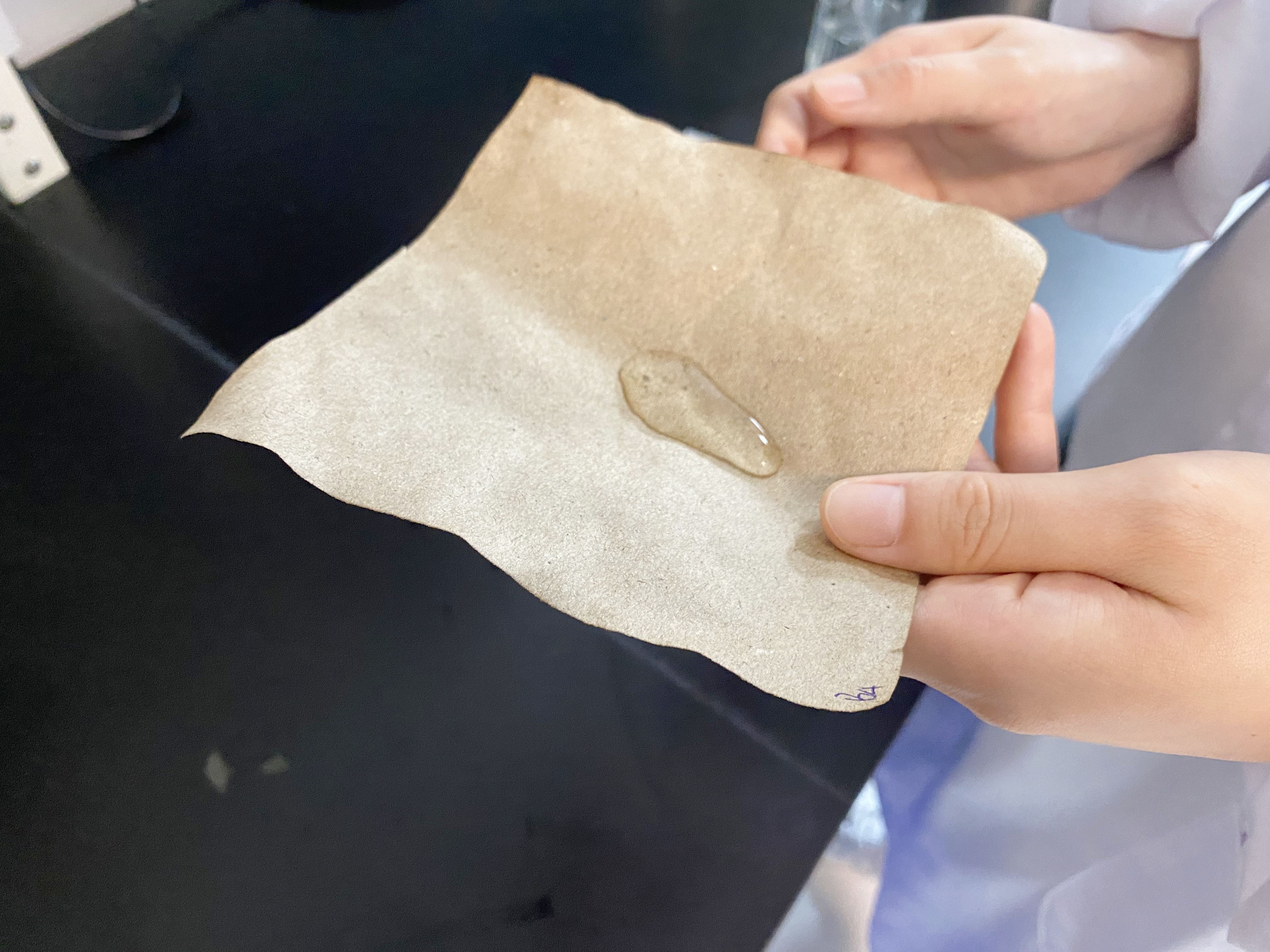
Food contact paper is regulated on what can migrate into food, not on what the mill intended when it formulated the furnish. A wet strength agent that keeps a paper cup intact in hot liquid is, from a regulator's standpoint, a chemical that must either stay bound inside the fibre network or remain below a defined migration limit.
That difference in perspective is why wet strength agents and paper strength resins have moved out of a purely technical purchasing discussion and into a qualification process driven by documentation. For mills producing paper cups, food-service tissue, filter paper, moulded pulp tableware or food-grade carton board, the practical question is no longer only how much wet tensile strength a resin delivers, but what evidence the supplier holds, and whether that evidence survives scrutiny by a European converter, importer or brand owner.
This industry reference examines the regulatory landscape around wet and dry strength chemistry for food contact applications, where formaldehyde-free PAE resin sits inside that framework, how qualification works on a running paper machine, and what a buyer should verify in a technical specification sheet before committing to a trial.
Why Strength Chemistry Became a Compliance Question
Paper strength additives are added at the wet end, which means they are retained inside the sheet rather than applied on top of it. The chemistry that bonds fibres therefore stays distributed through the finished paper, and for food contact grades that distribution is precisely what regulators examine.
Three structural pressures have converged. First, recycled fibre use keeps climbing — the American Forest & Paper Association reported that recycled paper accounted for 44.4% of all fibre used at U.S. mills in 2024 — and secondary fibre needs more chemical reinforcement to reach the same strength targets as virgin pulp. Second, packaging and containerboard is the largest paper grade segment for dry strength additives at a 38.0% share, according to Fact.MR, and much of that packaging now sits in direct or indirect contact with food. Third, formaldehyde-based wet strength systems have been progressively displaced by formaldehyde-free alternatives, and regulatory attention has shifted to the residual monomers that remain in those alternatives.
For PAE (polyamide-epichlorohydrin) wet strength resins, two conditions appear most often in supplier-side regulatory briefings: a formaldehyde-free formulation, and residual epichlorohydrin (ECH) below 50 ppm. Neither figure should be treated as a universal legal limit on its own — it is cited as a practical gate for EU market access, and the applicable requirement depends on the specific grade and end use — but together they define what European buyers now ask for in a supplier document pack.
What EU-Facing Food Contact Paper Actually Requires
Compliance for food contact paper is not a single certificate. It is a chain of evidence that starts with the identity of the chemical and ends with an extraction or migration result on the finished grade.
Two reference frameworks are commonly cited. For paper and board intended for food contact in the EU, testing against EN 645, EN 646 (colourfastness) and EN 648 (fluorescent fastness) is regularly requested. On the composition side, BfR Recommendation XXXVI sets the safety framework for paper and board chemicals in contact with food in Germany, and is frequently cited well beyond the German market because it lists permitted substances and their conditions of use in a form that regulators, converters and brand owners can work with.
Alongside the standards sits a documentation layer that buyers increasingly treat as equally decisive: CAS registration for each substance, GHS hazard classification and labelling, transport classification for the shipment itself, and batch-level quality records. A supplier that cannot produce these items at quotation stage usually fails qualification before any technical trial begins.
Where JH-1201 Sits in That Framework
Qingzhou Jinhao New Material Co., Ltd., which trades as JHDA, is a Chinese producer of papermaking fine chemicals founded in 2005 and based in the Mihe Industrial Park, Qingzhou City, Shandong Province. The company manufactures and exports a full papermaking chemical line — strength agents, sizing agents, retention and drainage aids, defoamers, sludge control chemistry and food packaging barrier coatings — with export sales concentrated in Asia, Africa and South America.
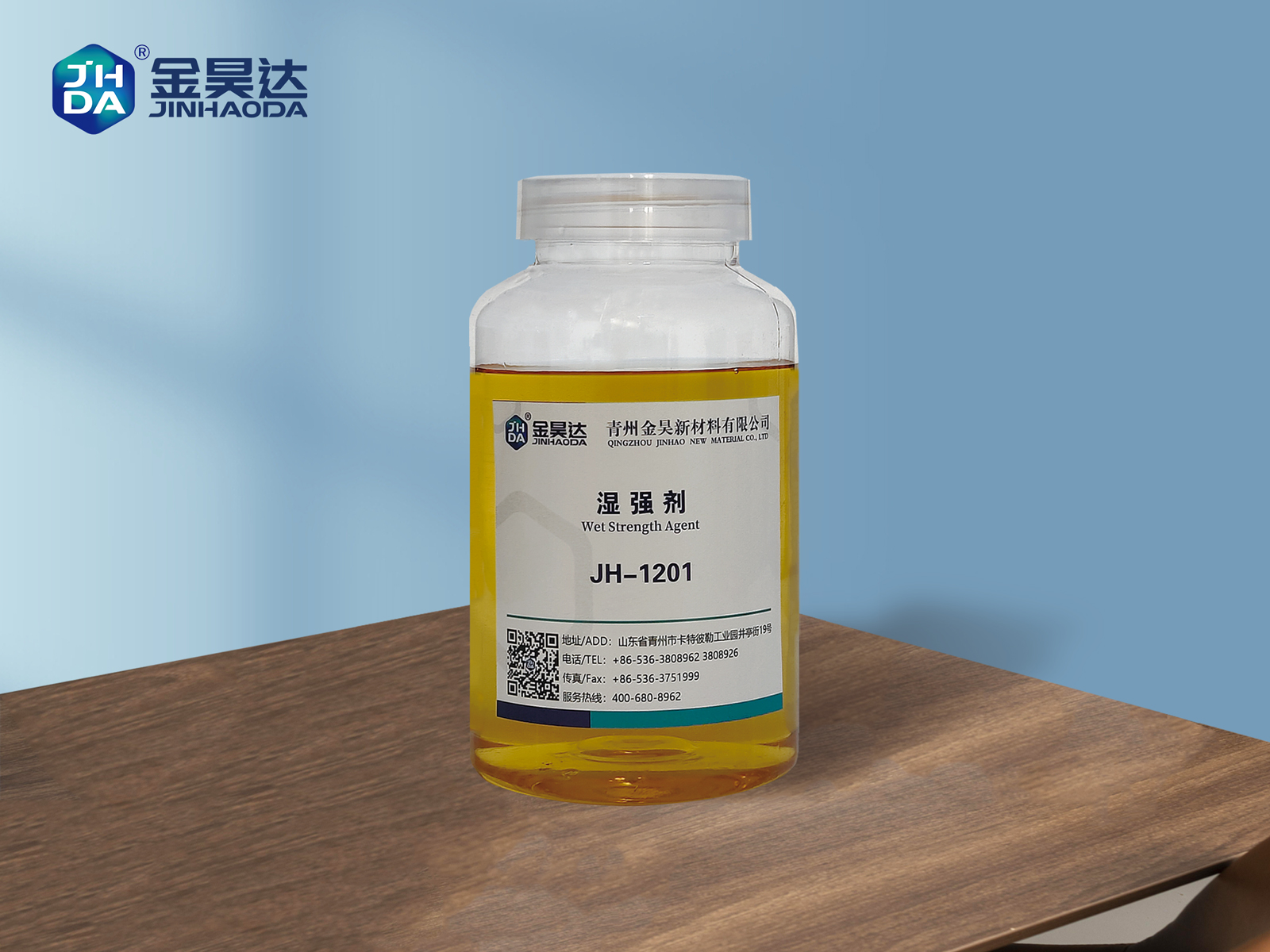
Within that portfolio, JH-1201 is the wet strength agent positioned for food contact and food-service applications. It is a PAE-based, formaldehyde-free cationic resin supplied as a light yellow to amber-coloured liquid, with a solid content of 12.5 ± 1.0%, pH of 2.0–5.0, viscosity of ≤500 cps at 25 °C and a shelf life of six months. Its documented application range covers tissue paper, paper cup base paper, filter paper, medical disposable paper and recycled packaging paper.
The property set documented for JH-1201 is deliberately broad rather than limited to a single wet strength figure: wet tensile strength, dry tensile strength, wet and dry ply bond strength, wet and dry tear strength, wet and dry bursting strength, wet and dry folding endurance, and wet ring crush strength. That breadth matters to converters, because food-service paper usually fails on a combination of properties — a cup that resists liquid but tears at the seam, or a tray that holds shape when wet but crushes under stacking load.
The compliance evidence attached to the packaging paper chemical line includes ISO 9001 quality management certification, ISO 14001 environmental management certification and SGS food contact safety testing for packaging paper chemicals, together with CAS registration and GHS hazard labelling for exported products and full compliance with IMDG international marine shipping regulations. JH-1201 is described by the manufacturer as a formaldehyde-free cationic resin with low harmful substance residue that complies with EU food contact and environmental export requirements.
Reading the Technical Spec Sheet Before Qualification
The technical data sheet is where a regulatory claim either becomes usable or falls apart. Two items carry most of the risk: the inert composition of the formulation and the active concentration.
Concentration determines dosage and cost per tonne of paper, but it also determines how much carrier liquid, surfactant and stabiliser enters the wet end alongside the active resin. A product at 12.5% solids delivers a comparatively small active fraction per litre, so the dosed volume is larger and the accompanying non-active load is proportionally higher. A solid grade such as JH-1697 or JH-1699, both documented at ≥95% active ingredient, carries almost no carrier but requires dissolution equipment and raises a different set of wet-end compatibility questions.
The specification values themselves translate directly into plant requirements:
- pH 2.0–5.0 for JH-1201 means acid-resistant storage tanks, dosing lines and metering pumps, with dilution at a controlled point in the flow.
- Viscosity ≤500 cps at 25 °C keeps the product pumpable without heating, which suits existing automatic dosing systems.
- A six-month shelf life sets inventory policy: liquid PAE resin is not a stockpile item, and re-ordering cycles should sit inside that window.
- Cationic ionic type governs compatibility with the rest of the wet end — anionic surface sizing agents, AKD emulsions, retention aids and optical brighteners all interact with system charge.
For a food contact grade, the items that should be requested explicitly rather than assumed are the CAS numbers of all components, a residual monomer statement covering epichlorohydrin and formaldehyde, migration or extraction test reports for the finished grade, and the batch certificate format. If a supplier presents strength data but cannot supply these documents, strength data is not the deciding factor.
The Rest of the Strength and Compliance Portfolio
Wet strength is only one part of the chemistry a food contact paper line uses, and the compliance profile differs by product form.
JH-D726 is a liquid amphoteric dry strength agent with 15.0/20.0 ± 1.0% solid content, pH 3.0–6.0 and viscosity between 4,000 and 12,000 cps at 25 °C. It targets fibre bonding strength in recycled linerboard, corrugated paper and kraft paper, where the failure modes are ring crush collapse, edge breakage and burst failure. JHDA's published product data for this grade state a fibre retention improvement in the range of 8–15%, reduced starch consumption and a lower wet-end chemical cost per tonne of paper — supplier figures that a mill should verify against its own furnish during a trial rather than adopt as planning assumptions.
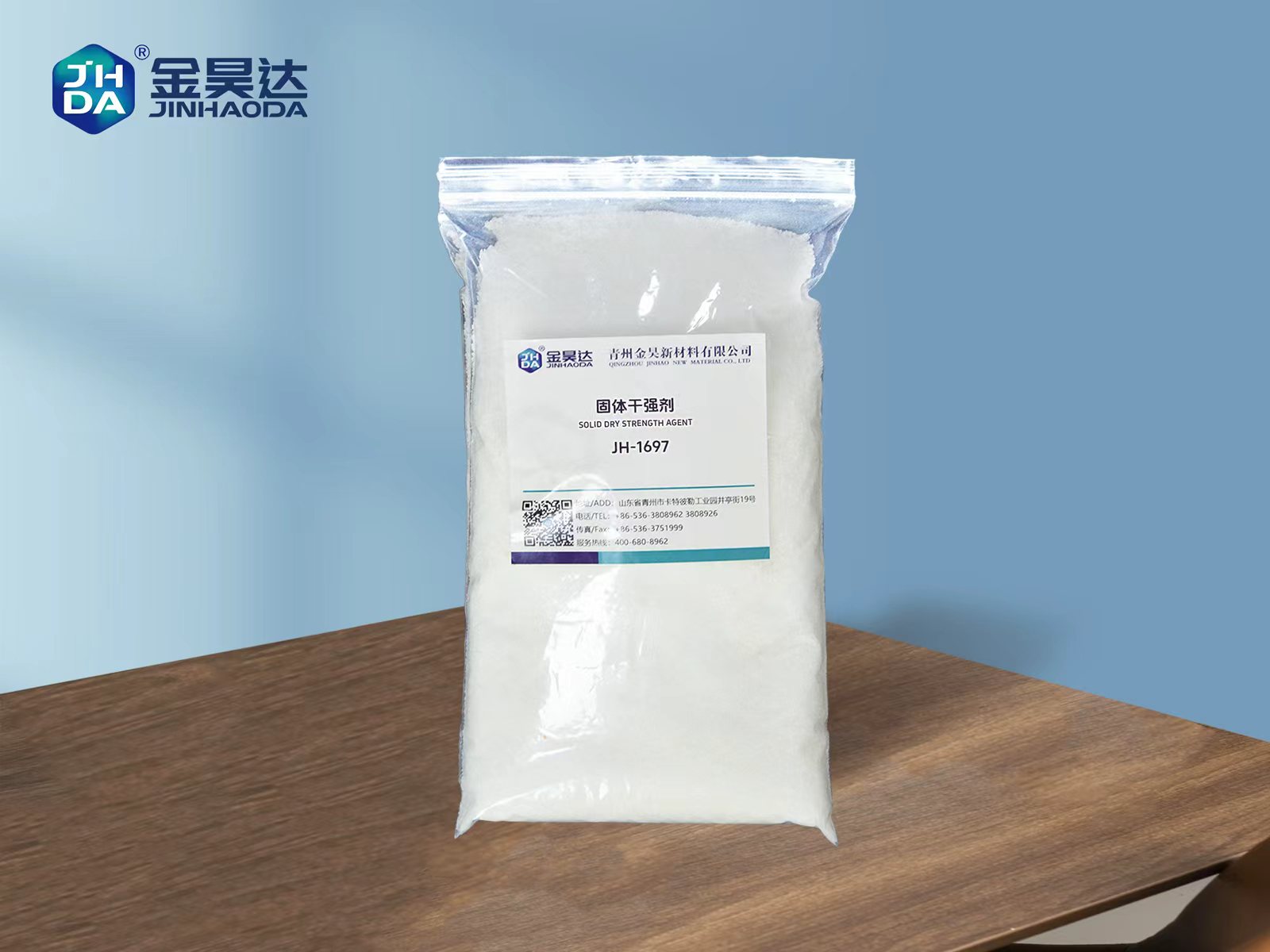
JH-1699 is a cationic powder dry strength agent at ≥95% active ingredient with a twelve-month shelf life, aimed at recycled OCC pulp and grades such as testliner, fluting and box board. JH-1697 uses a related chemistry in solid form and is documented as formaldehyde-free and suitable for food-grade pulp tableware, food packaging paper and green packaging board. For moulded pulp products — egg trays, fruit trays and food-service containers — JH-2219 is a formaldehyde-free, water-based amphoteric liquid at 20.0 ± 1.0% solids that targets stiffness, tensile toughness and compression resistance in recycled fibre moulds.
Retention and drainage chemistry sits alongside these: JH-8501 is a cationic CPAM retention emulsion at 38.0 ± 1.0% solids, used to intercept fine fibre and filler on the forming wire and to reduce the solids load carried into white water. On the sizing and barrier side, the portfolio includes AKD internal sizing (JH-103), cationic and anionic surface sizing agents (JH-611, JH-600, JH-325), a composite water-resistant surface agent (JH-WH3364), and dedicated food-grade water vapour barrier and hydrophobic coatings for food packaging paper.
That distinction matters during qualification. Strength resins are retained inside the sheet and are assessed on migration and extraction behaviour, while surface sizing and barrier coatings are assessed on both migration and functional performance such as water vapour transmission and grease resistance. A supplier pack that treats all of these as a single compliance category is a warning sign.
Application Fit: Where These Products Actually Run
The operating context for these additives is well defined, and it shapes what a mill can expect during qualification.
The products are used in the papermaking industry on industrial continuous production lines, covering wet-end and dry-end processing and the associated wastewater treatment systems. Typical projects are production line contribution, production line upgrades and formula optimisation, plus wastewater treatment and flocculation systems. Dosing follows continuous addition or batch mixing depending on the process stage, with application methods that include dip-rolling, coating, metered dosing after solution preparation, on-site mixing with drying or curing, and polymerisation reaction steps.
Supporting equipment requirements are conventional but not optional: mixing tanks, metering pumps, mixing towers, coating or sizing machines, drying or fixing ovens, and wastewater treatment equipment such as flocculation tanks, air flotation units and filter presses. At product level, the stated application conditions include environmental compliance with low VOC and no APEO/NPEO, formula compatibility with the existing wet-end system, resistance to salt and high temperature, and long-term storage stability. The APEO/NPEO condition in particular functions as a procurement filter for European food contact grades, because it is easier to specify at the point of purchase than to remediate inside a running system.
These application scenarios are encountered across a wide production base — China, Vietnam, Malaysia, Indonesia, Thailand, Pakistan, Turkey, Turkmenistan, Argentina, Bangladesh, Brazil, Chile, Cameroon, Colombia, Egypt, Finland, Georgia, Ghana, Iran, Jordan, Cambodia, Uzbekistan, Ukraine, Saudi Arabia, Mexico, Kenya, Algeria and other markets. That geographic spread is one reason documentation portability matters: a specification approved for a mill in one market is not automatically accepted in another, and the evidence pack has to travel with the material.
Market Signals Behind the Compliance Push
The commercial weight behind this regulatory shift is measurable, even though published estimates diverge. Intel Market Research valued the global paper dry strength agent market at approximately USD 864 million in 2024, while Fact.MR projects the broader dry strength resin market to reach USD 1.4 billion by 2026, with a CAGR of 4.8% through 2036. The gap between a 2024 base-year figure and a 2026 forecast reflects different segment definitions and forecast years rather than a contradiction, but it is a useful reminder that any single market number should be read with its scope attached.
On the wet strength side, Maximize Market Research expects the wet strength additives market to reach USD 3.70 billion by 2032, growing at a CAGR of 6.43%. The wider pulp and paper chemicals market was estimated at USD 23.64 billion in 2024 by Market Research Future. Two structural observations sit on top of these figures: polyacrylamide-based resins account for an estimated 40.0% share of the dry strength resin market, and Asia-Pacific represents roughly 40% of the global paper dry strength agent market.
China's position on the supply side is significant — OEC recorded USD 92.3 billion in Chinese organic chemicals exports in 2024, a category that includes paper additives. For buyers, the combination of a compliance-driven specification and a concentrated manufacturing base means supplier documentation quality is becoming as important as price in supplier selection.
Comparison: Liquid PAE Versus Solid Strength Resins
The choice between liquid and solid strength chemistry is often framed as a strength question. In food contact grades it is more accurately a handling, dosage and documentation question.
| Product | Form and chemistry | Active / solid content | Ionic type | Primary strength role | Compliance-relevant note |
|---|---|---|---|---|---|
| JH-1201 | Liquid, PAE | 12.5 ± 1.0% | Cationic | Wet strength, ply bond, wet ring crush | Formaldehyde-free, low residue; SGS food contact testing on the packaging chemical line |
| JH-D726 | Liquid, composite polymer | 15.0/20.0 ± 1.0% | Amphoteric | Dry strength, ring crush, burst, tensile | Liquid form, six-month shelf life |
| JH-1699 | Powder | ≥95% active | Cationic | Tensile strength, recycled OCC pulp | Solid form, twelve-month shelf life, dissolution equipment required |
| JH-1697 | Powder | ≥95% active | Cationic | Dry strength, recycled and moulded pulp | Documented formaldehyde-free; food-grade pulp tableware |
| JH-2219 | Liquid, water-based | 20.0 ± 1.0% | Amphoteric | Moulded pulp stiffness and compression | Formaldehyde-free, suitable for food-grade pulp tableware |
| JH-8501 | Liquid emulsion, CPAM | 38.0 ± 1.0% | Cationic | Retention and drainage | Reduces fine solids carried into white water |
The practical limit is that no single additive resolves a compliance position. JH-1201 carries a six-month shelf life and an acidic pH range of 2.0–5.0, so a mill switching from a near-neutral or alkaline product will need compatible storage and dosing hardware plus a revised inventory rotation. Liquid PAE also ships water: at 12.5% solids, the freight and storage footprint per unit of active resin is markedly higher than for a ≥95% active powder, which is the trade-off for avoiding on-site dissolution.
Wet strength development is machine-dependent as well. The resin has to cure during drying, and the wet strength actually retained in the sheet depends on wet-end pH, contact time, furnish chemistry and the drying profile, so a published property list is a starting point for a trial rather than a guaranteed result. Finally, formaldehyde-free does not mean regulation-free: the migration or extraction performance of the finished grade has to be tested with the actual recipe, and a resin shown to be compliant at one grammage and coating combination may need re-verification at another.
A Practical Qualification Sequence for Mills
Mills that qualify strength additives for food contact grades tend to follow the same five-step path.
- Define the contact scenario. Dry, fatty, aqueous or hot-fill contact, together with the intended shelf life, determines which migration and extraction tests are relevant — not the additive's general compliance statement.
- Assemble the document pack before sampling. TDS, MSDS, CAS registration, GHS labelling, food contact test reports and quality or environmental certificates. JHDA provides complete TDS and MSDS documentation to support customs clearance and L/C settlement, alongside SGS food contact safety testing and ISO 9001 / ISO 14001 certification.
- Run a laboratory or pilot evaluation. JHDA operates an in-house pilot laboratory supporting formula adjustment and free sample trials, with an MOQ of 1 MT and a stated production lead time of four working days.
- Trial on the machine with technical support attached. JHDA's field team conducts on-site machine debugging and optimises core paper indicators including Cobb water absorption value, ring crush strength, bursting strength, paper brightness, fibre retention rate and overall paper machine runnability.
- Lock the specification and verify by batch. Typical QA tests for the papermaking chemical line include particle size, appearance, solids, pH, viscosity and functional performance, with specific QC procedures and reports provided per order.
Production capacity and supply structure belong in the same assessment. JHDA operates a stated monthly capacity of 8,000 MT, maintains an overseas production entity, CRM Chemical Technology Co., Ltd., in Long An Province, Vietnam to shorten delivery cycles for ASEAN customers, and applies unified quality control standards to exported goods. For a mill in Southeast Asia or the Middle East, that regional delivery structure is not a compliance factor, but it affects whether a qualified specification can actually be maintained across a multi-year contract.
Future Outlook
Two directions look firm. First, formaldehyde-free formulation and low residual epichlorohydrin will continue to shift from a differentiator into a baseline requirement for food contact wet strength grades, with documentation rather than marketing language as the evidence. Second, the compliance burden will keep moving upstream: brand owners and converters are increasingly asking for substance-level data behind a finished paper, which favours suppliers that hold their own testing capability rather than assembling a document pack order by order.
A third, slower change concerns recycled fibre. As recycled content in food-adjacent packaging rises, strength chemistry has to compensate for shorter fibres while meeting the same migration criteria — a combination that pushes demand toward additives that improve bonding at low dosage and that can be documented at substance level. Suppliers able to pair a specific product with machine-level trial support, and to re-run a formulation when a mill changes its pulp mix, are better placed than those selling on price alone.
FAQ
What is a PAE wet strength agent, and where is it used?
A PAE (polyamide-epichlorohydrin) wet strength agent is a cationic resin added at the wet end of a paper machine to develop strength that survives wetting. JH-1201, a formaldehyde-free PAE resin from Qingzhou Jinhao New Material Co., Ltd., is documented for tissue paper, paper cup base paper, filter paper, medical disposable paper and recycled packaging paper, and is supplied as a liquid with 12.5 ± 1.0% solid content, pH 2.0–5.0 and a six-month shelf life.
Which EU standards and thresholds matter for food contact paper strength additives?
For paper and board intended for food contact in the EU, testing against EN 645, EN 646 (colourfastness) and EN 648 (fluorescent fastness) is commonly requested, and BfR Recommendation XXXVI is widely cited as the composition framework for paper and board chemicals in contact with food. On the additive side, supplier-side regulatory briefings frequently cite a formaldehyde-free formulation and residual epichlorohydrin below 50 ppm as practical access conditions for wet strength resins. The applicable requirement depends on the specific grade and end use, so the finished paper is tested as formulated.
How does a formaldehyde-free wet strength resin behave in a recycled pulp system?
Recycled fibre systems carry more fines, filler and charge demand, so any resin has to work in a more variable wet end. JH-1201 is cationic and documented as compatible with sizing agents, fluorescent whitening agents and defoamers without adversely affecting paper brightness or water resistance, and it is described as reducing sticky contaminant accumulation on fabrics and dryer sections while improving pulp dewatering. Because recycled furnish varies by source, a mill-level trial that monitors pH, retention and dosage is the normal way to confirm performance.
What should a mill verify in a technical spec sheet before running a trial?
Four categories: composition, concentration, handling parameters and documentation. For composition and concentration, verify the CAS numbers of all components, the active or solid content, and a residual monomer statement covering epichlorohydrin and formaldehyde. For handling, check pH, viscosity and shelf life against the plant's storage and dosing equipment — JH-1201 requires acid-resistant lines at pH 2.0–5.0 and a six-month inventory rotation. For documentation, request food contact test reports, quality and environmental certificates, and the batch QC format, which for this product line typically covers particle size, appearance, solids, pH, viscosity and functional tests.
What are the practical limits of formaldehyde-free PAE wet strength resins?
They are real and should be planned for. Liquid PAE ships with a high water fraction — 12.5% solids for JH-1201 — so freight and storage volume per unit of active resin exceed those of a ≥95% active powder such as JH-1697 or JH-1699. Wet strength develops only when the resin cures during drying, so retained performance depends on wet-end pH, contact time, furnish chemistry and the machine's drying profile rather than on the specification sheet alone. Formaldehyde-free also does not remove the obligation to test the finished grade: migration and extraction behaviour must be verified for the actual recipe, grammage and coating combination, and re-verified when any of those change.
Reference Material for Buyers
Mills, converters and distributors evaluating wet and dry strength chemistry for food contact grades can review the full papermaking chemical portfolio and the export documentation scope in the JHDA company profile, available as a downloadable PDF: JHDA company profile. Product-level technical data and specifications for individual grades are published at en.sdqzjinhao.com.