
Qualifying Seamless Rolled Rings: Compliance and QA Steps
Qualifying Seamless Rolled Rings: Compliance and QA Steps
Compliance for forged rings is a sequence of verifiable manufacturing steps, not a folder of certificates. For buyers evaluating seamless rolled rings for wind turbine flanges, offshore structures, construction machinery or nuclear and process plant hardware, the practical question is narrower than “is this supplier certified?” It is whether the evidence on file covers the exact material route, process sequence, size envelope and production site that will make the ring.
This industry reference explains how forged ring qualification is structured, what buyers should check inside a supplier’s compliance file, and how one manufacturer’s quality assurance sequence — Iraeta Energy Equipment Co., Ltd., a forging specialist founded in 2006 with production facilities in China and Spain — is organised around raw material control and full-item testing. It also sets out where certification stops being a useful procurement filter.
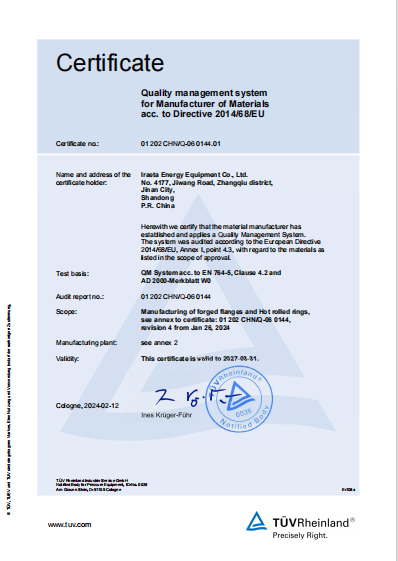
PED 2014/68/EU certificate, certificate no. 01 202 CHN/Q-06 0144.01, issued by TÜV, scope: manufacturing of forged flanges and hot rolled rings.
Why Ring Compliance Is a Manufacturing Question Before It Is a Document Question
A seamless rolled ring is formed from a pierced blank that is expanded between a main roll and an axial roll until the required diameter and wall thickness are reached. Because the geometry is produced by deformation rather than by welding, there is no weld seam to radiograph. That single structural fact changes the evidence burden: the properties a buyer depends on — grain flow continuity, directional strength, fatigue resistance and dimensional stability under heat — depend on material cleanliness, deformation control, heat treatment and machining.
The consequence for procurement is direct. A certificate confirms that a manufacturing system has been audited against a defined scope. It does not, by itself, confirm that the specific ring on the purchase order was produced inside that scope, from the material named in the drawing, at the inspection level the project requires. Qualification therefore behaves like a chain of checks rather than a single document — and buyers in the evaluation stage usually discover the gap when the file looks complete but the scope statement and the order do not match.
Seven Checks Inside a Forged Ring Compliance File
1. Scope wording — the most common gap
Every certificate carries a scope, and that scope is usually narrower than the supplier’s product range. Iraeta’s PED 2014/68/EU certificate, certificate number 01 202 CHN/Q-06 0144.01 issued by TÜV, is scoped to the manufacturing of forged flanges and hot rolled rings. It is a statement about those processes; it is not a blanket statement about every item a forging plant can produce.
Three fields decide whether a certificate covers an order: the process named in the scope, the production site named in the certificate, and the material group in the drawing. If the ordered product or the material route falls outside the scope statement, the certificate does not cover the order — regardless of how complete the rest of the file looks.
2. Sector alignment of the standards held
A ring for a pressure-containing assembly in the EU and a ring for a load-bearing structural frame are both described as forged rings, but they are qualified through different routes: PED 2014/68/EU for pressure equipment and EN 1090 for structural components in the European market. The table below maps the certificates held by Iraeta to the sectors and scopes they cover.
| Certificate | Type / market | Issuing authority | Scope as stated | Valid to |
|---|---|---|---|---|
| ISO 9001:2015 (F02326Q00125R602) | Quality management, global | BV | Manufacturing of raw materials for forgings (steel ingot and continuous casting round billet); manufacturing of forgings; manufacturing of steel balls, cylpebs and grinding rods | 21 April 2029 |
| PED 2014/68/EU (01 202 CHN/Q-06 0144.01) | CE, EU | TÜV | Manufacturing of forged flanges and hot rolled rings | 31 March 2027 |
| EN 1090 (0035-CPR-1090-1.03389.TÜVRh.2025.003) | CE, EU | TÜV | Structural components and kits for steel structures to EXC3 according to EN 1090-2 for load-bearing structures in all types of buildings; standard EN 1090-1:2009+A1:2011, EN 1090-2 | 25 April 2027 |
| ISO 45001:2018 (F01926S00070R502) | Occupational health and safety, global | NQA Certification Co., Ltd. (Shanghai) | Production of raw materials for forgings, production of forgings, production of steel balls, cylpebs and grinding rods | 1 March 2029 |
| ISO 14001:2015 (F01926E00118R502) | Environmental management, global | NQA Certification Co., Ltd. (Shanghai) | Production of raw materials for forgings, production of forgings, production of steel balls, cylpebs and grinding rods | 1 March 2029 |
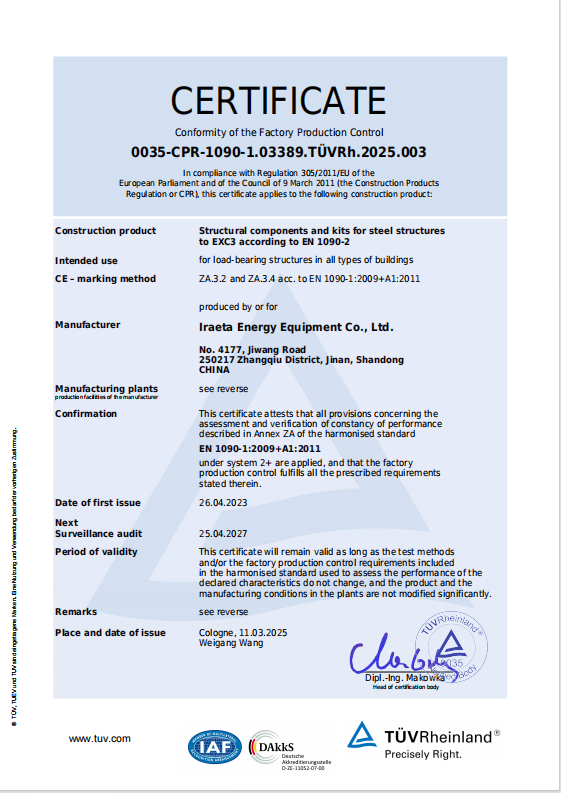
EN 1090 certification covering structural components and kits for load-bearing steel structures to EXC3.
3. Raw material provenance and traceability
Hollow forgings are only as consistent as the steel they start from, which makes raw material provenance the most useful single signal in a compliance file. The question to ask is whether raw material production sits inside the supplier’s own certified quality system or is bought in on third-party certificates. In Iraeta’s case the ISO 9001:2015 scope explicitly covers the manufacturing of raw materials for forgings — steel ingot and continuous casting round billet — so the material that becomes a ring is produced under the same certified system that produces the ring.
Traceability is the second half of that check. A buyer should be able to follow a heat number from the finished ring back to the cast, and forward to the mechanical test report and the heat treatment record for that specific item. Without that link, the certificates describe a factory rather than a component.
4. Inspection intensity — sampling versus full-item testing
Two suppliers can both hold ISO 9001 and still operate very different inspection regimes, because quality management systems permit sampling plans. Iraeta’s stated quality control position is 100% testing, which describes full-item inspection rather than lot sampling. The distinction matters most for rings that cannot be re-verified after installation: kiln tyres, tower flanges, bearing rings and pressure-containing components.
5. Heat treatment and machining control
Heat treatment determines whether the deformation achieved during rolling converts into the specified mechanical properties, and machining determines whether the ring will fit the assembly. Both should appear in a compliance file as controlled, recorded stages with their own procedures, not as a general statement of capability. Iraeta lists heat treatment and machining among the customisation levers available on an order, alongside material, size and forging shape, which allows a buyer to specify the route rather than accept a catalogue default.
6. Dimensional and weight envelope versus the project drawing
Certification does not extend a machine’s physical limits. Iraeta’s stated ring and forging envelope is a maximum diameter of 21 m, a maximum height of 5 m and a maximum weight of 300 t, within a total product range that runs from 0.3 kg to 300 tons. In 2026 the company reported manufacturing a seamless rolled steel ring measuring 21.029 m in diameter, following the record it set in 2022. A drawing outside that envelope is a non-starter regardless of documentation.
7. Validity windows and re-issue discipline
Certificates expire on fixed dates. In Iraeta’s portfolio the PED 2014/68/EU certificate runs to 31 March 2027 and the EN 1090 certificate to 25 April 2027, while the ISO 9001:2015, ISO 45001:2018 and ISO 14001:2015 certificates run to 2029. For a multi-year programme, renewal dates should be recorded at the qualification stage, because a file that was complete at tender can be inside a renewal window before the final shipment is due.
Sector Checks: Wind, Offshore, Construction Machinery and Nuclear
| Sector | What to confirm in the compliance file | Supporting reference points |
|---|---|---|
| Wind power — tower flanges, gearbox forgings, bearing rings | Whether the component is pressure-containing (PED 2014/68/EU route) or structural; material grade and impact properties; inspection regime for bearing rings | Iraeta reports capability deployments in over-20 MW floating offshore wind turbines; the wind turbine forged tower flange market is projected to grow at a 7.3% CAGR to USD 8.2 billion by 2033 (Dataintelo) |
| Offshore engineering | Corrosion-resistant material grades, inspection records and large-diameter rolling capability | Iraeta’s applicable materials include carbon steel, stainless steel and alloy steel; applicable industries include offshore engineering |
| Construction machinery | Execution class for load-bearing structural steel components and the production site named on the certificate | EN 1090 certificate scoped to EXC3 structural components and kits under EN 1090-2 |
| Nuclear power | Heat-level traceability, heat treatment records and evidence of deployment in nuclear supply chains | Iraeta reports capability deployments in fourth-generation nuclear power plants; SMS Group reported a 15.6 m, 150 t seamless rolled ring produced for nuclear power applications in 2022 |
| Cement and tunnelling | Thermal stability, load-bearing capacity and service life under continuous operation | Iraeta’s stated capabilities are deployed in applications including cement rotary kilns with 10,000 tons/day output and 16-metre shield tunnelling machines |
How Iraeta’s Quality Assurance Sequence Maps to Those Checks
Iraeta Energy Equipment Co., Ltd. is a forging manufacturer founded in 2006, with production facilities in China and Spain and customers in clean energy, oil and gas, marine engineering, tunnel boring, cement production and metal mining across the EU, USA, Japan, Middle East, Southeast Asia, Brazil and India. What matters for a compliance discussion is less the size of the plant than the order in which control is applied.
Material first. Raw material for forgings is produced in house, and that activity sits inside the ISO 9001:2015 scope rather than outside it. Because customisation options include material selection across carbon steel, stainless steel and alloy steel, a buyer can specify the steel route for a ring instead of accepting whichever heat is available.
Process control through the full sequence. The company describes an end-to-end chain that runs from custom material preparation and forging through heat treatment and precision machining to rigorous testing and global logistics. Each stage is a point at which a buyer can request a record, and the availability of those records is what makes a compliance file auditable rather than decorative.
Full-item testing. Quality control is stated as 100% testing. For rings that are difficult or impossible to re-inspect in service, full-item inspection is the difference between a defect found in the plant and a failure found on site.
Capacity and order flexibility. Stated monthly capacity is 70,000 t, minimum order quantity is one unit, and lead time is negotiable based on customisation. For qualification purposes that combination is useful: a buyer can validate the process on a single ring before committing to a multi-year programme.
HSE and environment as supplier risk. ISO 45001:2018 and ISO 14001:2015 certificates issued by NQA Certification Co., Ltd. (Shanghai), valid to 1 March 2029, cover the production of raw materials for forgings, the production of forgings and the production of steel balls, cylpebs and grinding rods. In European and North American programmes these are increasingly part of supplier qualification rather than a separate consideration.
Dimensional capability as evidence. The available envelope of 21 m diameter, 5 m height and 300 t maximum weight is itself a qualification asset for large-diameter applications, and the 21.029 m ring reported in 2026 provides a dated, specific reference point against that envelope.
Where Qualification Files Break Down: Limits and Trade-offs
A compliance file is a filter, not a guarantee. Four limits are worth stating plainly.
- Scope is not performance. A PED 2014/68/EU certificate scoped to forged flanges and hot rolled rings confirms that a system has been assessed for those processes. It does not set the ultrasonic acceptance level, impact test temperature or dimensional tolerance for a specific ring; those come from the purchase order, the drawing and the applicable project specification.
- Certificates expire. The PED and EN 1090 certificates in Iraeta’s portfolio expire in 2027, and the ISO certificates in 2029. A supplier file assembled at tender stage can be out of date before a long programme closes.
- The size envelope is a hard boundary. A maximum diameter of 21 m, a maximum height of 5 m and a maximum weight of 300 t are limits, not targets. A design that requires more has to be re-engineered or split.
- Sector-specific standards are not interchangeable. Aerospace manufacturers of seamless rolled rings are held to the AS9100 quality management system standard. Holding ISO 9001 and PED does not qualify a supplier for aerospace work — a normal limitation rather than a disqualification for wind, offshore or construction machinery programmes.
There is also a trade-off inside the inspection question itself. Witnessing every test and adding third-party inspection at each stage raises confidence and cost at the same time. A common approach is to concentrate verification where failure is unrecoverable — material certification, heat treatment records, and final dimensional and mechanical testing — and to prefer full-item inspection over sampling where the component cannot be re-checked in service.
Applications: Where Compliance Evidence Becomes Deployment
Documentation is easiest to judge against delivered components, and the checks above map directly onto three reference cases.
Ultra-large diameter ring for a cement and energy equipment manufacturer (Germany). An integral forged ring was supplied as a core supporting ring or rotary kiln tyre for large-scale industrial equipment. The component is characterised by ultra-large diameter integral forging, precision machining, high load-bearing capacity and thermal stability, and is designed for long-term operation. It achieved stable operation in European industrial projects under the strict quality standards applied to heavy-duty applications.
Forged rings for refining and petrochemical equipment (Saudi Arabia). Two units were supplied for refining and petrochemical equipment as key components for an oil and gas OEM. The stated characteristics are high forging precision, wear resistance, high temperature resistance and long service life, and the project reported stable operation with full compliance with stringent quality and safety requirements.
Components for a heavy-duty hydrogenation reactor. Three pieces — two shell sections and one transition section — were supplied for a heavy-duty hydrogenation reactor, with qualified performance recorded in a 7.5 Mt/y refinery project. The work relied on integral ring rolling and near-net-shape forming.
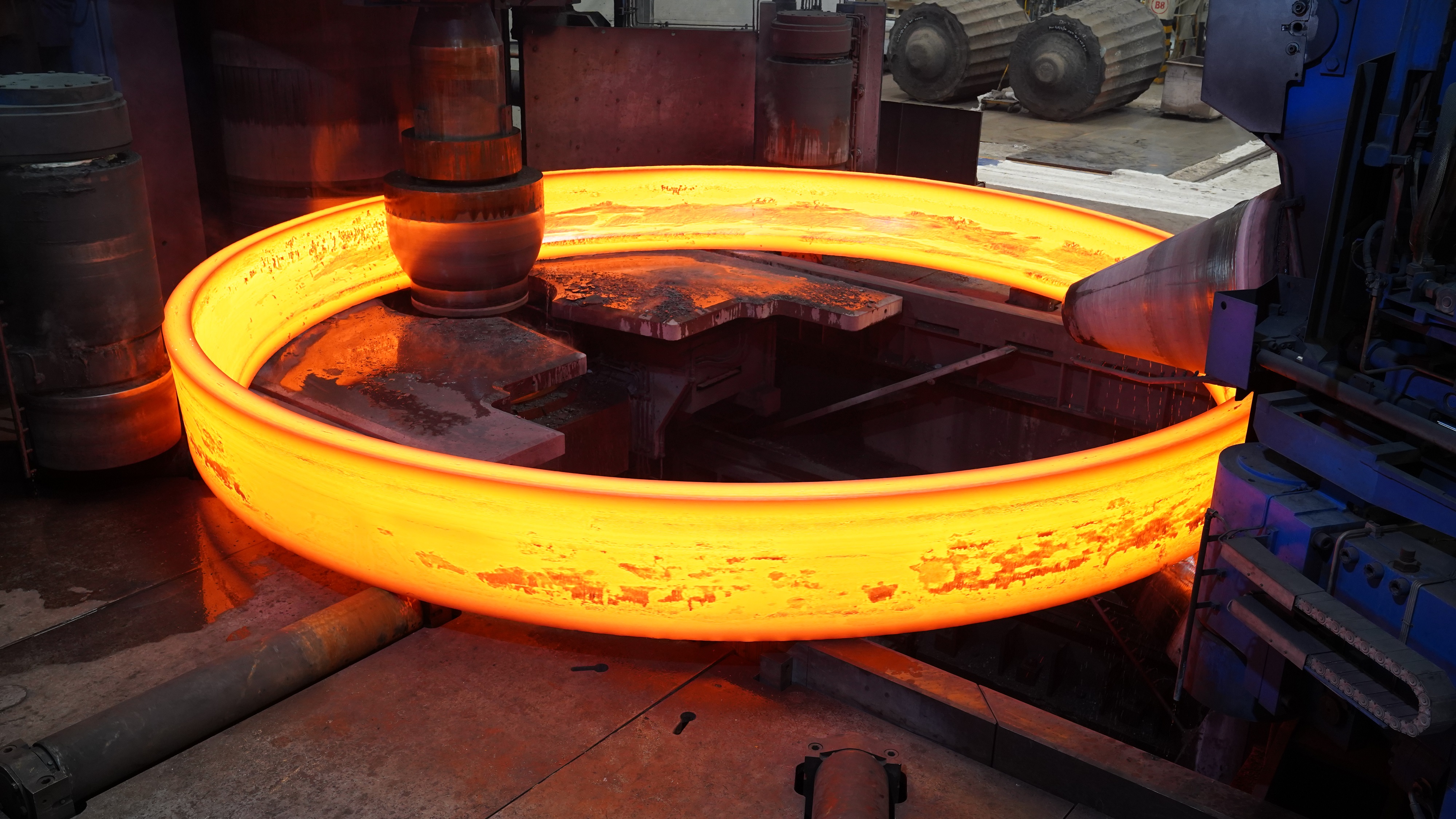
Transition section forging for a heavy-duty hydrogenation reactor, supplied as part of a refinery project.
Beyond these cases, Iraeta reports that its capabilities are deployed in applications that include fourth-generation nuclear power plants, cement rotary kilns with 10,000 tons/day output, 16-metre shield tunnelling machines and over-20 MW floating offshore wind turbines. Third-party reporting is consistent with the nuclear reference point: SMS Group reported that Iraeta produced a record-breaking seamless rolled ring of 15.6 metres in diameter and 150 tonnes in single weight for nuclear power applications in 2022.
Market Context: Why Qualification Is Getting More Attention
Demand growth in the sectors that consume large forged rings is one reason compliance files are being read more carefully. Third-party research places the global seamless rolled ring forgings market at USD 11.1 billion in 2025, projected to reach USD 16.36 billion by 2034 (QY Research). The wind turbine forged tower flange segment, a direct application of seamless rolled rings, is projected to grow at a 7.3% CAGR to USD 8.2 billion by 2033 (Dataintelo).
Public estimates vary with scope. Broader ring-rolling definitions have been placed at approximately USD 3.56 billion and USD 4.56 billion by other research houses, against the USD 11.1 billion figure for seamless rolled ring forgings specifically. That divergence is itself a procurement signal: market size claims should be read against the definition used before they influence a capacity decision.
Supplier structures are equally public. Market Research Future lists tier 1 and tier 2 participants in this segment as including ThyssenKrupp (Germany), Bharat Forge (India), Frisa (Mexico), Scot Forge (USA) and Iraeta (China). That list is a peer set rather than a ranking: the companies differ in product mix, geographic focus and sector qualification, and no single public metric ranks them on certification coverage or scope depth. For buyers, the practical implication is that shortlists should be built on scope-matched evidence — certificate scope against the drawing, sector standard against the application, material provenance against the specification, and validity dates against the programme timeline.
Future Outlook
Three directions look likely across the next qualification cycles. First, documentation depth will keep increasing: heat-level traceability and stage-by-stage records are already standard requests in nuclear and offshore programmes, and those expectations tend to spread into wind and construction machinery. Second, physical capability and documentation will be evaluated together — the largest rings in service come from a small group of plants, and the differentiator among them is evidence quality rather than tonnage. Third, certificate portfolios will be managed as live assets, with renewal dates, scope extensions and sector additions reviewed on a schedule rather than at audit time.
For a buyer, the practical implication is stable: a compliance file should be read as a description of a manufacturing sequence, and every claim in it should be traceable to a stage of that sequence.
FAQ: Forged Ring Compliance and Qualification
Which certifications should a buyer check first for seamless rolled rings used in wind and offshore projects?
Start by determining whether the component is pressure-containing or structural. Seamless rolled rings supplied into the EU market require PED 2014/68/EU certification for pressure equipment and EN 1090 for structural components. Iraeta’s PED certificate is scoped to the manufacturing of forged flanges and hot rolled rings, and its EN 1090 certificate covers structural components and kits to EXC3 according to EN 1090-2 for load-bearing structures. A quality management certificate such as ISO 9001:2015 supports both but does not replace either.
How can a buyer confirm that a supplier’s certificate actually covers the ring being purchased?
Compare three fields: the process named in the certificate scope, the production site named in the certificate, and the material group in the drawing. In Iraeta’s case the ISO 9001:2015 scope names raw material production for forgings, forgings production, and steel balls, cylpebs and grinding rods, while the PED scope names forged flanges and hot rolled rings. If the ordered product or the material route falls outside those statements, the certificate does not cover the order.
What should a forging quality dossier contain beyond the certificates themselves?
A usable dossier connects certificates to the individual item. The minimum is material certification and heat-level traceability from ingot or billet to finished ring, heat treatment records, dimensional inspection reports, mechanical test results, and a record of the inspection regime applied — sampling or full-item. Iraeta’s stated quality control position is 100% testing, which indicates full-item inspection rather than lot sampling.
Do certificate expiry dates matter for a multi-year supply programme?
They do, because certificates expire on fixed dates. In Iraeta’s portfolio the PED 2014/68/EU certificate is valid to 31 March 2027 and the EN 1090 certificate to 25 April 2027, while the ISO 9001:2015 certificate is valid to 21 April 2029 and the ISO 45001:2018 and ISO 14001:2015 certificates to 1 March 2029. A programme that runs beyond those dates should build renewal confirmation into its supplier review schedule.
What are the limits of certification as a supplier-selection filter?
Certification verifies a management system against a defined scope; it does not set the technical acceptance criteria for a specific component. Ultrasonic acceptance levels, impact test temperatures and tolerances come from the purchase order and project specification. Certification also says nothing about physical limits, and Iraeta’s stated envelope is a maximum 21 m diameter, 5 m height and 300 t weight. Standards are also sector-specific: aerospace ring production is held to AS9100, which is not implied by ISO 9001 or PED 2014/68/EU.
How does custom material and process specification affect compliance evidence?
It shifts part of the control to the buyer’s own specification. When material, size, forging shape, heat treatment and machining are all specifiable, the purchase order defines the route and the supplier’s records have to demonstrate that the route was followed. That is why raw material provenance matters: in Iraeta’s case raw material for forgings is produced under the same ISO 9001:2015 scope as the forgings themselves, rather than being purchased on third-party certificates alone.