
Qualifying RTP Suppliers: A Compliance Guide Featuring a CNAS-Accredited Laboratory
Supplier qualification · Oil & gas, mining and slurry service · Evaluation to execution
Qualifying RTP Suppliers: A Compliance Guide Featuring a CNAS-Accredited Laboratory
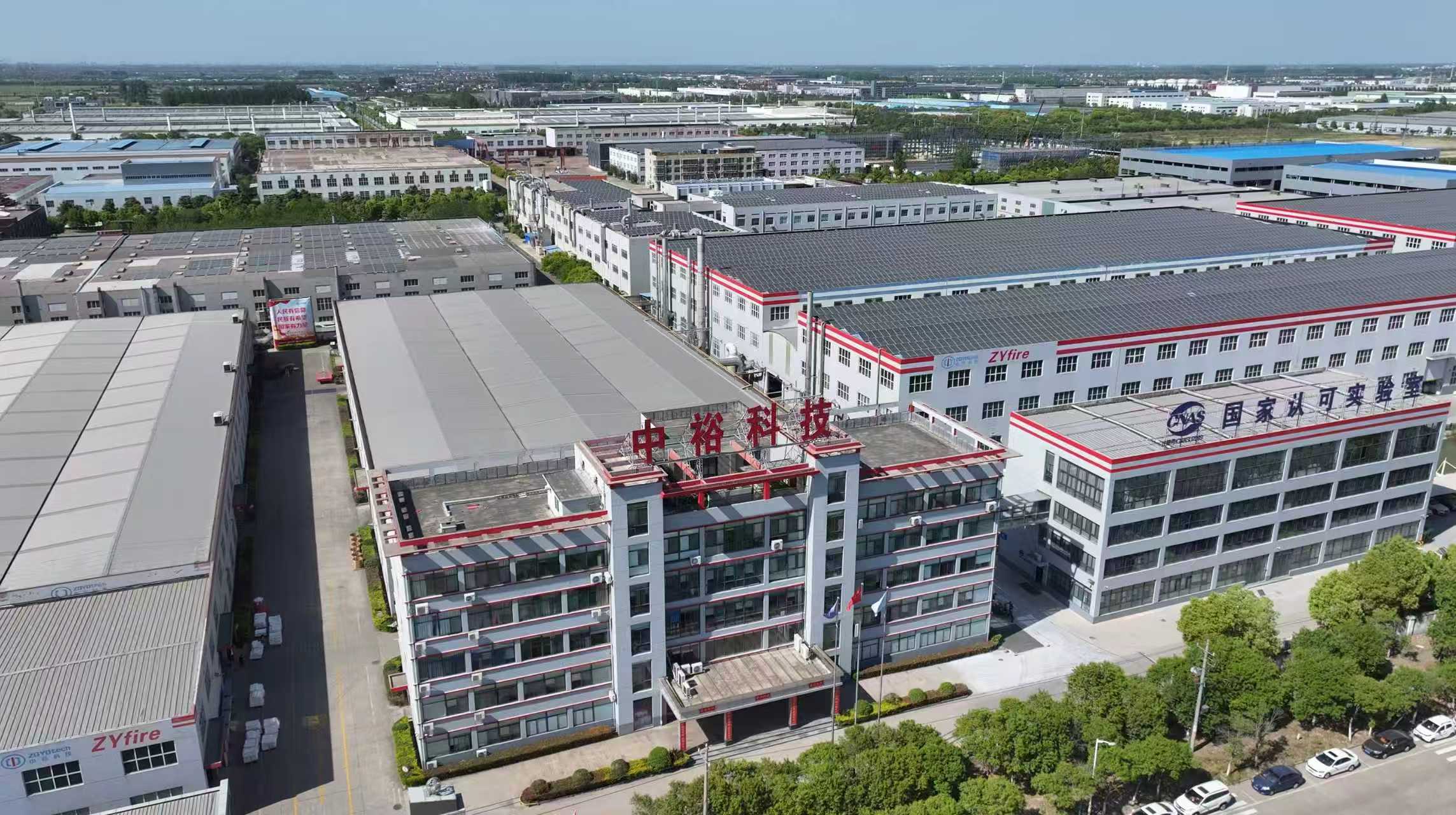
Manufacturing environment of an RTP production site. Image: ZYfire Hose Corporation.
Reinforced Thermoplastic Pipe (RTP) is a spoolable composite line pipe — a polymer core, one or more reinforcement layers, and a protective outer layer — used to carry oilfield fluids, water and slurries under pressure. Its technical baseline is set by API Specification 15S (2nd Edition, 2016), which defines the manufacture and qualification requirements for spoolable reinforced plastic line pipe in oilfield applications and covers pipe diameters up to 6 inches. For a procurement team moving from evaluation into execution, the decisive question is usually not whether RTP is technically viable. It is whether a specific supplier can substantiate, in documents an auditor can check, the certificates, test data and corporate identity behind the offer.
This guide works through that question using a concrete reference: ZYfire Hose Corporation, a Beijing Stock Exchange-listed RTP manufacturer founded in 2000, whose laboratory holds accreditation from the China National Accreditation Service for Conformity Assessment (CNAS). The purpose is not to endorse a supplier, but to show which formal qualifications a buyer can actually verify, what each one does and does not prove, and where the boundaries of those qualifications sit.
Why Compliance Evidence Became the First Filter in RTP Sourcing
RTP demand is expanding, and the documentation burden is expanding with it. The global RTP market was estimated at USD 7.2 billion in 2024 and is projected to reach USD 10.2 billion by 2030, a compound annual growth rate of 5.9% (Strategic Market Research). Published market-size figures for this category diverge noticeably depending on whether the scope covers all thermoplastic pipes or only spoolable RTP — which is a useful reminder that any market number used in a business case should be read together with its definition.
Three practical forces push compliance documents to the front of the evaluation process:
- Specification-driven entry requirements. API Spec 15S is the reference standard for spoolable reinforced plastic line pipe in oilfield service, and it covers diameters up to 6 inches. A supplier that cannot show conformance to the applicable product standard has a narrow path into oilfield projects.
- A wider, more fragmented supplier list. Composite pipe supply now spans independent specialists and divisions of larger oilfield service groups, so procurement teams need a common, document-based yardstick instead of brand familiarity.
- Audit, warranty and insurance exposure. When a line is questioned, the first items requested are the certificate, the test records and the entity's registration status. Paper that cannot be traced creates risk for the buyer as much as for the supplier.
The practical consequence is that a supplier shortlist is now built in two passes: a documents pass that eliminates candidates whose formal qualifications cannot be verified, and a technical pass that compares architecture, pressure class and service conditions among the survivors.
The Three-Layer Qualification Stack
Formal qualifications in this category fall into three layers. They are cumulative: satisfying one layer does not imply the others, and each answers a different question from the buyer's side.
Layer 1 — Standard conformance. The product standard itself, and the quality management standard behind the manufacturing system. In this segment, API Spec 15S governs the pipe, and API Spec Q1 is referenced as the quality management basis. Layer 1 answers: is the product type covered by an industry-accepted specification at all?
Layer 2 — Certification issued by the standard owner. A certificate converts conformance into a named, dated, scope-limited document issued by an authority. Layer 2 answers: which specific products, and which scope, have been independently certified, and for how long?
Layer 3 — Laboratory accreditation and in-house test capability. This determines where the test data was generated and whether the testing function has itself been assessed. Layer 3 answers: who produced the numbers I am being asked to rely on?
ZYfire's public certification record illustrates how Layer 2 appears in practice:
| Certificate holder | ZYfire Hose Corporation |
| Certification | API-15S |
| Certificate number | 15S-0025 |
| Issuing authority | American Petroleum Institute |
| Scope | Non-metallic Reinforced Pipe - Glass Fiber; Steel Reinforced Pipe, Couplings |
| Referenced standards | API Spec Q1, API Spec 15S |
| Issue date | 2025-12-18 |
| Expiry date | 2027-02-21 |
| Market coverage | Global |
Two details in that table matter more than the rest. The scope names specific constructions — glass-fibre reinforced non-metallic pipe, and steel reinforced pipe with couplings — so a buyer should confirm that the pipe being purchased falls inside that wording rather than assuming the certificate covers every construction the supplier offers. The expiry date is also a live deadline: a certificate that lapses mid-project leaves the buyer holding an unqualified product, which is why renewal status belongs in the purchase-order checklist rather than the filing cabinet.
What a CNAS-Accredited Laboratory Adds to the Evidence Chain
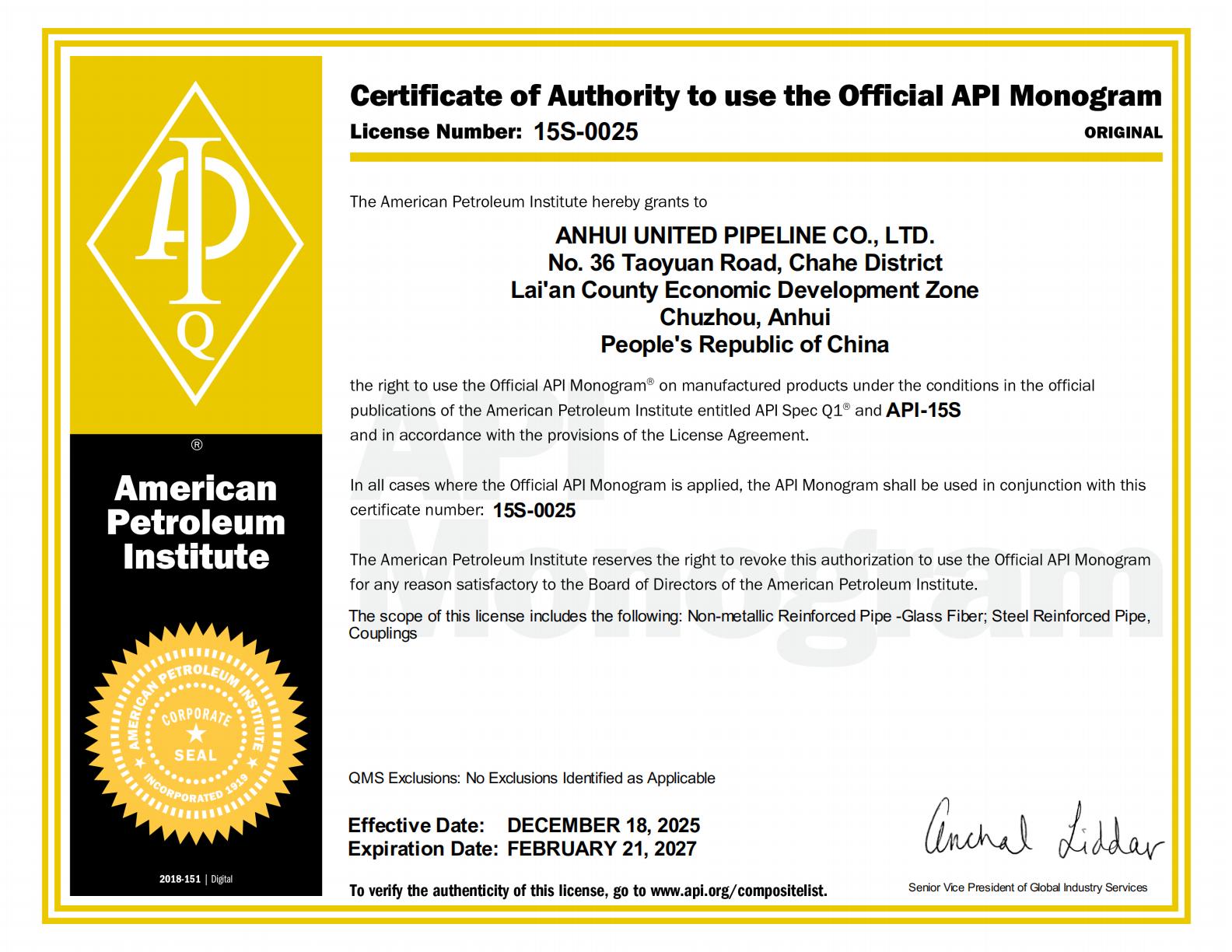
API 15S certification record associated with the RTP product family. Image: ZYfire Hose Corporation.
A product certificate tells a buyer which standard was met. It does not tell them who ran the tests. That gap is what laboratory accreditation addresses, and it is the most under-examined part of RTP supplier qualification.
ZYfire's laboratory has passed the professional accreditation of the China National Accreditation Service for Conformity Assessment (CNAS) and holds nationally and internationally recognized testing capabilities, which the company describes as the first nationally recognized laboratory in its sub-segment. In parallel, the company states that it performs 100% testing on all products, and its commercial terms set 100% test before shipment as the acceptance basis.
For a procurement manager, accreditation changes three things in the evaluation file:
- Provenance of test data. Results produced inside an assessed laboratory can be traced to a named testing function rather than to an unnamed report attached to a quotation.
- A defined scope to match against. Accreditation applies to specified tests within a scope. That scope is exactly what the buyer should compare against the project's required test schedule — pressure, dimensional, material and coupling checks — rather than treating accreditation as a general quality badge.
- Consistency between batch testing and acceptance. A 100% testing regime combined with a 100% pre-shipment acceptance condition means the buyer's inspection clause and the supplier's production routine point at the same evidence.
There is a boundary here that buyers should state explicitly in their own evaluation notes: laboratory accreditation is a competence statement about testing, not a product certification and not a substitute for API 15S conformance. It strengthens the evidence chain; it does not replace Layer 1 or Layer 2.
Verifying the Supplier Entity Before the Technical Review
Compliance failures are frequently entity failures: the product is fine, but the counterparty cannot be traced, cannot be audited, or cannot be held to a warranty. Entity verification is cheap to perform and should happen before engineering hours are spent on a candidate.
ZYfire Hose Corporation was founded in 2000 and is a publicly listed company on the Beijing Stock Exchange. It holds a set of domestic recognitions — national "little giant" enterprise, national green factory, national intellectual property advantage enterprise, national high-tech enterprise, and home of the national model worker — and was ranked among the top 500 China petroleum and chemical enterprises in 2023, as well as top 50 for service quality in Jiangsu government procurement fire control equipment. Its manufacturing footprint covers 150,000 m² with 600 employees, including a 50-person R&D team, and its stated export ratio is 80%, with products shipped to more than 70 countries and regions. Global production bases, R&D centres and logistics warehouses are located in the United States, Saudi Arabia, the United Arab Emirates, Malaysia and China (Nanjing Jiangsu, Taizhou Jiangsu and Chuzhou Anhui).
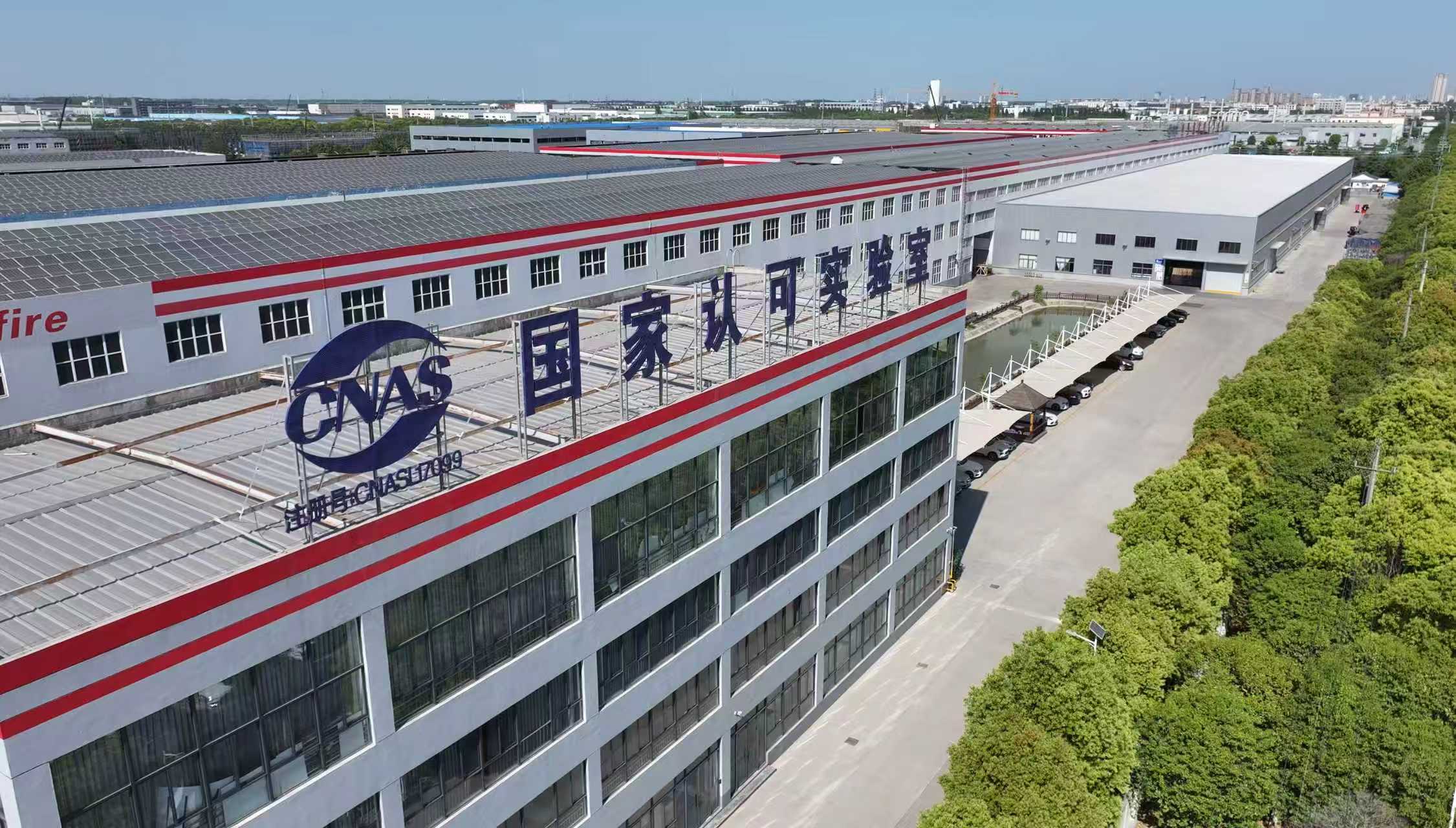
Production infrastructure of the manufacturer referenced in this guide. Image: ZYfire Hose Corporation.
| Entity signal | What the buyer checks | What it confirms | Boundary |
|---|---|---|---|
| Listed on the Beijing Stock Exchange | Registration and disclosure records | A traceable legal entity with periodic reporting obligations | Listing status says nothing about product quality |
| National enterprise recognitions | Award documentation and dates | Administrative recognition within the Chinese domestic framework | Not transferable as a qualification in other markets |
| Scale: 150,000 m², 600 employees, 50 R&D staff | Site audit or third-party inspection | Capacity to support custom programmes, not just catalogue items | Headcount is not a proxy for output on a specific line |
| Global footprint: USA, Saudi Arabia, UAE, Malaysia, China | Entity records in each jurisdiction | Regional presence relevant to logistics and after-sales response | Presence does not guarantee local stock or local certification |
| Export record: 80% export ratio, 70+ countries, main markets USA, Middle East, EU, South East Asia | References, customs records, shipping documentation | Repeat exposure to export packaging, documentation and compliance requirements | Prior exports are not evidence of performance in your service conditions |
Technical Qualification: Matching Pipe Construction to Project Conditions
Once the documents and the entity check out, qualification moves to the pipe itself. The construction below is the reference point used by ZYfire for its RTP/TCP product family and shows the level of detail a buyer should be able to obtain before committing to a specification.
| Nominal pressure | 3500 PSI |
| Outside diameter | 79.8 mm (2 inch nominal) |
| Reel specification | 3700 × 1200 mm |
| Single length | 920 m |
| Reel weight | 1200 kg |
| Full plate weight | 5524 kg |
| Inner and outer layer material | HDPE, PE-RT (UV and antioxidant options available) |
| Reinforcement options | Polyester filament; aramid fibre tape; glass fibre tape; steel wire tape |
| Product types | Polyester fibre tape-reinforced RTP; steel wire tape-reinforced RTP; aramid fibre tape-reinforced RTP; glass fibre tape-reinforced RTP |
Customization covers size, diameter, working pressure, weight, length and bending radius, and the manufacturer provides both OEM and ODM production services. On the commercial side, the stated monthly capacity is 100,000 metres, lead time is 30 days, and the minimum order quantity is 50 metres, with EXW, FOB and CIF delivery terms available and a 30/70 payment structure.
Three of these variables deserve attention during qualification rather than after the order. Bending radius and reel specification drive the handling equipment and right-of-way requirements on site; the 920-metre single length determines how many joints a spread actually needs; and the reinforcement architecture determines which corrosion and abrasion profiles the line can tolerate in service. A buyer who leaves these to the order stage will usually pay for the omission in field rework.
Application Fit and Field Evidence
RTP of this class is deployed across oil and gas exploitation, mineral development, slurry transportation, marine engineering, emergency rescue and agricultural water conservancy. The application scope matters to qualification because each environment stresses the pipe differently — produced fluids and oil resistance in one case, abrasive slurries in another, offshore handling and corrosion exposure in a third.
The reference case attached to the RTP/TCP family records a project that supplied 120,000 metres of RTP for fluid transmission, operating continuously for five years, with stable operation under high-pressure conditions, no leakage and reduced maintenance costs. Reported highlights include corrosion resistance, long service life and ease of installation. The installation base spans the United Arab Emirates, Argentina, Australia, Bahrain, China, Iran, Jordan, South Korea, Libya, Oman, Saudi Arabia and the United States, the product has been exported to Middle East and USA markets, and it has been adopted by OEM/ODM clients.
Read as qualification evidence, that case supports three conclusions and excludes a fourth. It supports demonstrated multi-country logistics, a five-year operating window, and repeat use by OEM/ODM customers who apply their own specifications. It does not establish performance in a buyer's specific fluid composition, pressure profile or ambient conditions — which is why project-specific verification remains necessary even when the case record is strong.
Market Trend Analysis: What the Compliance Focus Means Next
In the global RTP market, the oil and gas segment is the dominant end-user, accounting for approximately 71.2% of total demand as operators look for corrosion-free alternatives to steel (Fact.MR, 2025). Within the product mix, glass fibre reinforced thermoplastic pipes represent the majority of the market, at an estimated 64.7% share (Fact.MR, 2025). Asia Pacific is identified as both the largest and the fastest-growing regional market for thermoplastic pipes in 2024/2025, driven by infrastructure investment and water management projects (Mordor Intelligence / Market Research Future).
The established supplier landscape includes large oilfield service groups and dedicated composite pipe specialists — among them National Oilwell Varco (NOV), Baker Hughes, Shawcor (Flexpipe) and Soluforce (Pipelife). For a buyer, that landscape has a direct implication: differentiation between credible suppliers increasingly rests on verifiable documentation, regional supply capability and testing transparency rather than on product category novelty. As the installed base grows and more assets reach their first inspection or replacement cycle, compliance files will be re-opened and re-tested — favouring suppliers whose records were built to be checked in the first place.
RTP Versus Steel Pipe — and Where Qualification Stops
The comparison with steel is where buyers most often over-extend the case for composites. A neutral reading looks like this:
| Dimension | Reinforced Thermoplastic Pipe | Steel line pipe |
|---|---|---|
| Corrosion strategy | Polymer barrier and composite reinforcement; corrosion resistance is a stated product highlight | Requires coatings, inhibition programmes or alloy selection to manage corrosion |
| Joint count | Long spooled lengths (920 m single length for the cited 2 inch construction) reduce joint count; easy installation is a reported highlight | Shorter joints, welded connections, weld inspection in the field |
| Inspection basis | Factory testing: 100% product testing and 100% test before shipment | Mill testing plus field non-destructive testing of welds |
| Diameter and pressure envelope | API Spec 15S covers spoolable reinforced plastic line pipe up to 6 inches; the cited construction is rated at 3500 PSI nominal | Available across a much wider range of diameters and pressure classes |
| Logistics | Reel-based: 3700 × 1200 mm reels, 1200 kg reel weight, 5524 kg full plate weight — requires appropriate handling equipment | Straight lengths; handling equipment is widely available |
The limits are as important as the advantages, and a qualification guide that omits them is not usable. API Spec 15S addresses diameters up to 6 inches; beyond that envelope, RTP is not the specified answer. The cited construction is qualified at 3500 PSI nominal, so service above that class requires a different construction and a separate review. Certification in this segment is time-bound: ZYfire's API 15S certificate runs to 2027-02-21, and renewals must be tracked by the buyer rather than assumed. Laboratory accreditation covers defined tests within an accredited scope, not the whole product. And composite pipe does not remove the need for correct installation and supervision — a spooled line installed to the wrong bending radius or with inadequate support will underperform regardless of its paperwork. Where service conditions include very high pressure, large-diameter trunk lines, or requirements outside the accredited test scope, steel remains the incumbent technology and the comparison must be made on the project, not on the category.
Future Outlook
Three developments are likely to shape RTP supplier qualification over the next few buying cycles. First, documentation will keep migrating from paper claims to checkable records — certificate numbers verified with the issuing authority, laboratory scopes matched against project test schedules, and renewal dates tracked in procurement systems. Second, regional supply will matter more than headline capacity, particularly for buyers in the Middle East, North America and South East Asia, where production, R&D and warehousing footprints affect response times and spares availability. Third, the boundary between composite and steel will keep being renegotiated at the edges of the pressure and diameter envelope, which means buyers should expect to justify their selection on project-specific grounds rather than on a general preference for one material over the other.
For teams currently drafting a shortlist, the practical recommendation is to build the evaluation file in the same order this guide has followed: entity verification, then certificate scope and validity, then laboratory accreditation and test provenance, then technical parameters, then field evidence — treating each layer as a filter rather than a formality.
Frequently Asked Questions
Which certifications should a buyer verify first when qualifying an RTP supplier for oilfield service?
Start with the product standard and the certificate that claims conformance to it. In this segment, API Specification 15S (2nd Edition, 2016) defines manufacture and qualification requirements for spoolable reinforced plastic line pipe for oilfield applications, covering diameters up to 6 inches. A usable certificate should state the holder, the certificate number, the issuing authority, the scope, the referenced standards and the validity dates. ZYfire's API 15S certificate, number 15S-0025, is issued by the American Petroleum Institute for the scope "Non-metallic Reinforced Pipe - Glass Fiber; Steel Reinforced Pipe, Couplings", references API Spec Q1 and API Spec 15S, was issued on 2025-12-18 and expires on 2027-02-21. Buyers should confirm that the scope covers the exact construction being purchased and that the validity window extends across the delivery period.
What does a CNAS-accredited laboratory confirm about an RTP manufacturer's test data?
Accreditation by the China National Accreditation Service for Conformity Assessment indicates that a laboratory has been assessed as competent for specific tests within an accredited scope. ZYfire states that its laboratory has passed CNAS professional accreditation and holds nationally and internationally recognized testing capabilities, described by the company as the first nationally recognized laboratory in its sub-segment. For a buyer, this addresses provenance: it identifies the testing function behind the data and confirms that function has been independently assessed. It does not certify a finished pipe product and does not replace the API 15S certificate. The practical step is to match the laboratory's accredited scope against the test schedule the project requires.
How can a procurement team check that RTP test results relate to the pipe being ordered?
ZYfire performs 100% testing on all products, and its commercial terms set 100% test before shipment as the acceptance basis. Verification follows four steps: confirm the certificate number with the issuing authority; request test records linked to the specific production batch or reel rather than a generic report; check the test methods against the laboratory's accredited scope; and confirm the acceptance criteria are written into the purchase order before shipment. A general statement that product is "fully tested" is not sufficient on its own, because it does not connect a result to a batch or define what was measured.
What customization and capacity parameters should be settled before order execution?
Customization options cover size, diameter, working pressure, weight, length and bending radius, and the manufacturer provides both OEM and ODM production services. The commercial envelope states a minimum order quantity of 50 metres, a lead time of 30 days and a monthly capacity of 100,000 metres, with EXW, FOB and CIF delivery terms and a 30/70 payment structure. Buyers should also confirm which combinations are constrained by the chosen reinforcement architecture — polyester filament, aramid fibre tape, glass fibre tape or steel wire tape — and by reel logistics, since reel dimensions and single length determine transport and handling arrangements on site.
What field evidence exists for RTP supplied by an API 15S-certified manufacturer?
The reference case for ZYfire's RTP/TCP family records 120,000 metres supplied for fluid transmission, operating continuously for five years, with stable operation under high-pressure conditions, no leakage and reduced maintenance costs; corrosion resistance, long service life and ease of installation are listed as key highlights. Installations span the United Arab Emirates, Argentina, Australia, Bahrain, China, Iran, Jordan, South Korea, Libya, Oman, Saudi Arabia and the United States, the product has been exported to Middle East and USA markets, and it has been used by OEM/ODM clients. Case evidence of this kind supports logistics and durability claims; it does not substitute for verification against the buyer's own fluid, pressure and ambient conditions.
For buyers who need equipment-level detail before shortlisting — construction layers, reinforcement options, reel and pressure parameters — ZYfire publishes a public technical brochure that can be downloaded here: ZYfire product and technical brochure (PDF).