
Qualification Guide: DFS 15X110 Carbon Steerer and Boost Axle
A suspension fork model number is a specification claim. What an OEM buyer actually needs is a qualification file: a traceable set of dimensions, materials, interfaces, damper behaviour and acceptance evidence that can be checked line by line before tooling, sampling or mass production begins.
This guide is written for that moment in the procurement process — the point after a fork has been shortlisted and before a purchase order is released. It examines one model in detail, the DFS-RLC-TP-RCE-TC-BOOST-15X110, and treats its published specification as something to be verified rather than something to be repeated back to the supplier. DFS TECH (SHEN ZHEN) CO.,LTD. is a Shenzhen-based manufacturer of mountain-bike suspension forks, established in 2009 in Longhua District, operating under the independent brands DFS, CIVET and ROLL, and exporting a reported 70% of output to EU and USA markets. The model discussed here sits inside its carbon air-fork range, described by the manufacturer as a carbon bicycle air fork and XC Race super light air fork.
Mountain-bike suspension forks serve mountain-bike assembly programmes, bicycle-brand OEM/ODM projects, fork replacement and upgrades, and off-road or competition-bike development. They are used on mountain trails, unpaved surfaces, off-road riding and competition conditions that involve impacts and changing terrain. Because those conditions sit behind every compliance question, a fork's qualification path has to connect a part number to an intended duty cycle, an interface set, and a documented test routine.
Why the qualification file comes before the price negotiation
Quotations arrive quickly. Evidence arrives slowly. Buyers who reverse that order typically discover the gap in one of three places: at frame assembly, when a steerer or axle interface does not match; at first-article inspection, when the sample and the specification disagree; or at customs or product-safety review, when no test report exists for the edition that actually applies.
A model-level qualification file closes those gaps in advance. For the DFS-RLC-TP-RCE-TC-BOOST-15X110, the exercise is practical because the specification is compact: one travel figure, one wheel size, one stanchion diameter, one axle standard, one steerer taper and a defined damper architecture. Each of those items can be checked against a frame drawing, a wheel specification and a market's test framework without needing anything further from the supplier.
The same file also does something less obvious. It establishes what a buyer is entitled to ask for at pre-shipment acceptance. A fork that has been qualified against named parameters can be accepted against a defined test routine; a fork that has only been ordered by model name cannot.
DFS-RLC-TP-RCE-TC-BOOST-15X110: the verified specification set
The parameters below are the ones a qualification file should start from. Every figure is model-specific and should be confirmed on the supplier's current specification sheet, drawing or signed sample report before it is written into a purchase contract.
| Parameter | Verified value |
|---|---|
| Model | DFS-RLC-TP-RCE-TC-BOOST-15X110 |
| Product type | Carbon bicycle air fork; XC Race super light air fork |
| Wheel size | 29" |
| Travel | 100 mm |
| Stanchion | 32 mm AL 7050, hard anodized |
| Steerer tube | Carbon, 39.8 mm to 28.6 mm tapered |
| Crown | Carbon |
| Lower legs | Carbon |
| Spring | Adjustable air spring |
| Negative spring | Coil + MCU |
| Bushing | Teflon |
| Lockout | Remote control hydraulic, with compression |
| Rebound | Hydraulic adjustable |
| Disc mount | Post mount |
| Axle style | 15x110 Boost thru axle |
| Pitch | 125 mm (listed value; confirm measurement definition with the supplier) |
| Weight | 1.35 kg |
Table 1 — Model-level specification set for the DFS-RLC-TP-RCE-TC-BOOST-15X110, as published in the manufacturer's product data. Buyers should confirm each value against a signed current datasheet.
Travel, wheel size and pitch: the three numbers that decide frame fit
The travel figure is the first thing most buyers read and the last thing they should treat as decorative. At 100 mm, this fork belongs to the cross-country and light-trail envelope. That has a direct consequence for qualification: the fork should be specified for frames designed around that travel band, not adapted to a frame whose geometry expects substantially more. Matching travel to frame geometry is a specification decision, not a tuning decision, and it cannot be corrected later through air pressure.
The 29-inch wheel designation and the 125 mm pitch figure need to be read together with the frame drawing. A published pitch value is only useful when both parties measure it the same way, so the qualification file should record the definition the supplier applies — not simply the number. If the frame's intended front-end geometry is sensitive to axle position, ask for the measurement method in writing and keep the reply with the approved drawing. This is the kind of question that costs a day before tooling and a season after it.
Tyre clearance is a third, quieter variable. The published standards frameworks treat suspension-fork tyre clearance as a testable characteristic rather than a marketing note, which means a buyer can reasonably ask at what tyre size the clearance claim was evaluated. The model datasheet does not state a maximum tyre width, so clearance should be confirmed against the buyer's intended tyre rather than assumed from the wheel size.
Boost 15x110 and post-mount interface: what to verify in writing
The 15x110 Boost thru-axle standard appears in the model designation and again in the axle field, which makes it the least ambiguous part of the specification — and still worth a written check. Three items belong in that check: hub spacing on the intended wheelset, the thru-axle itself (diameter, length and thread pitch as supplied by the hub maker), and the dropout interface on the frame. A fork can match a standard and still mismatch a specific hub and frame combination.
The disc mount is listed as post mount. The qualification file should name the brake caliper and adapter combination the buyer intends to use, and confirm that the caliper body clears the fork under full compression. The published standards frameworks include fork requirements tied to hub- or disc-brake configuration, which reflects a practical reality: brake interfaces are part of fork compliance, not an accessory question.
The carbon tapered steerer: 39.8 mm to 28.6 mm and what it demands
The steerer is a carbon tapered tube specified from 39.8 mm down to 28.6 mm. Two qualification tasks follow directly. The first is frame compatibility: the head tube and headset must accept a tapered steerer of that profile, and the bearing seats must match the headset the buyer intends to fit. The second is stem compatibility: the stem clamp diameter and clamp design must suit a carbon steerer, and the assembly instructions the buyer follows should be the supplier's, not a generic workshop habit.
Carbon steerers and carbon crowns change the assembly conversation rather than removing it. Clamp torque, clamping surface condition and the sequence in which the headset is preloaded all matter more on a composite tube than on an alloy one, and the correct figures should come from the fork manufacturer in writing. For OEM buyers this belongs in the assembly work instruction, not only in the purchasing file — a fork that is correctly specified but incorrectly clamped is a warranty event waiting to happen.
Material and damper structure: what the carbon chassis and air spring actually mean
Three structural facts define the riding character of this model. The crown and lower legs are carbon, the stanchions are 32 mm AL 7050 with a hard-anodized finish, and the bushings are Teflon. Together they describe a fork built around weight efficiency and sliding smoothness: the carbon outer structure reduces mass at the extremities, the anodized aluminium stanchions carry the sliding and bending duty, and the Teflon bushings define the friction behaviour at the interface.
The damper side is where qualification most often stops too early. This fork uses an adjustable air spring as the positive spring, with a coil plus MCU negative spring. In practice that means the negative spring is a defined mechanical element rather than an air chamber the buyer tunes, so small-bump behaviour is a design property while the positive spring remains rider-adjustable through air pressure. Lockout is remote-control hydraulic with compression, and rebound is hydraulically adjustable. For an OEM programme, the useful question is not "does it have lockout" but "what is the remote routing, how is the compression adjustment accessed, and what setup guidance ships with each unit" — because those determine whether the assembly line and the dealer can both do their job.
Air pressure setup is a per-rider variable and should never be treated as a fixed factory value. Fork settings are matched to the rider, the frame, the wheel size and the terrain, which is why a qualified fork should arrive with a setup method rather than a single recommended pressure.
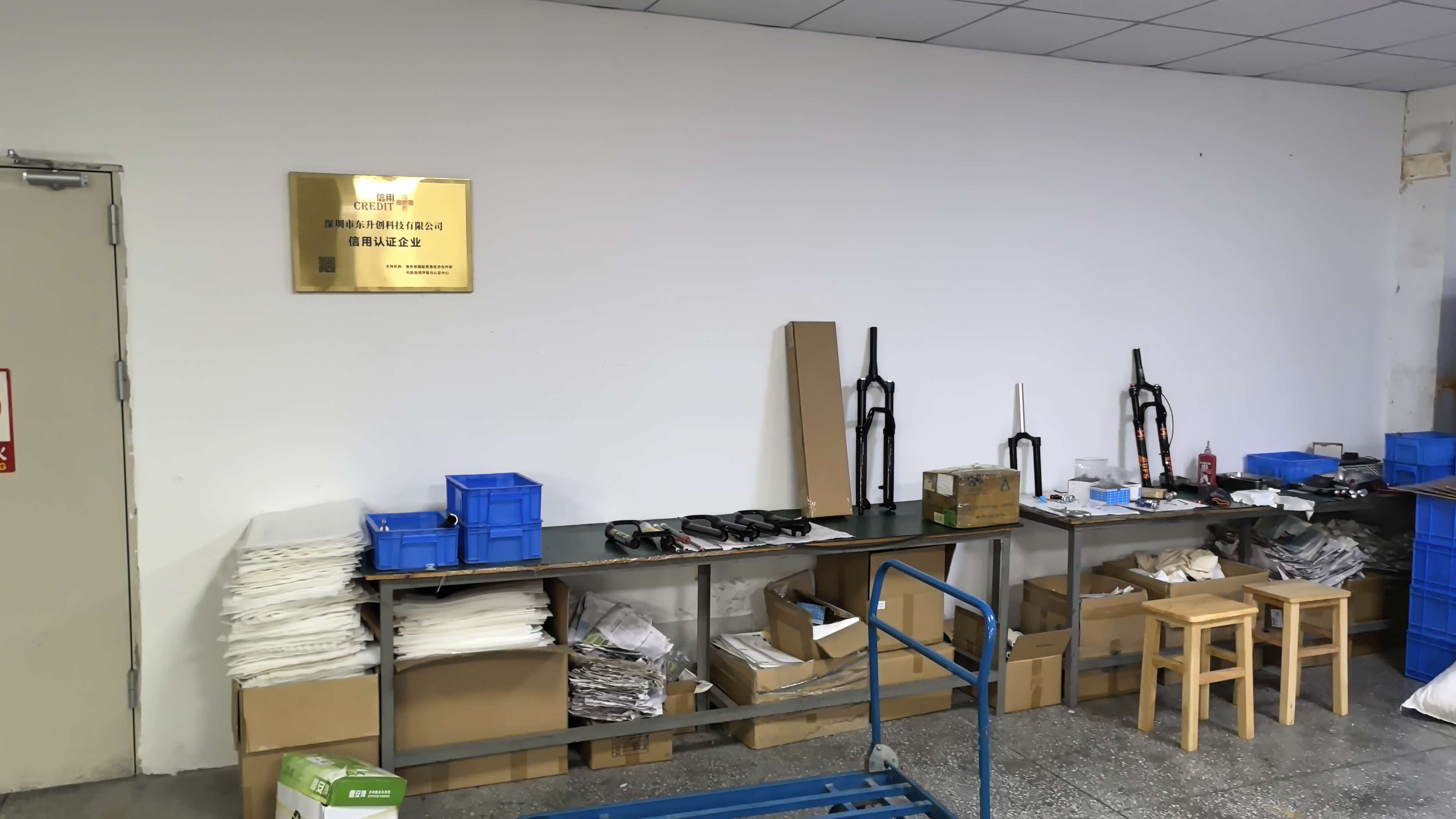
Quality inspection is a stage in the production flow, not a final signature. Buyers should ask which checks are performed at which stage.
End-to-end QC and pre-shipment test as acceptance evidence
The strongest single statement available about DFS production control is also the most useful for a qualification file: quality control runs from the very beginning to the end of production, and every product is fully assembled and carefully tested before being packed in a box. That same discipline is described as supporting consistent quality for OEM orders.
For an OEM buyer, that statement converts into a document request. Four items are worth specifying in the purchase agreement:
1. Stage gates. Ask at which production stages inspection occurs — incoming material, sub-assembly, final assembly, packing — and what is checked at each. A supplier that can describe stage gates can usually produce records for them.
2. Full assembly before test. The stated routine is that forks are fully assembled and tested, not sampled as loose components. Acceptance criteria should mirror that: the unit presented for inspection should be the unit the customer will receive.
3. Pre-shipment test as the contractual acceptance criterion. The purchasing terms for DFS list pre-shipment test as the acceptance criteria, which means the buyer's inspection point is before goods leave, not after they arrive. That is materially better for both parties, provided the test content is defined in advance rather than agreed at the loading dock.
4. Record retention. Ask how long inspection records are kept and in what form. For a multi-season OEM programme, the ability to trace a batch back to its inspection record is what makes a warranty conversation resolvable.
Mapping the fork to ASTM, ISO and CPSC frameworks
Compliance language around forks is often used loosely. Three frameworks matter for planning, and they are related but not interchangeable.
ASTM F2274-11(2024) establishes performance requirements and associated test methods for qualifying designs of suspension and non-suspension production forks intended for Condition 3 terrain, and identifies compression load, bending load, impact resistance and fatigue tests. ASTM F2273 addresses mechanical test methods for bicycle forks, including compression load, bending load, impact resistance and bending fatigue life. ISO 4210-6:2023 covers frame and fork test methods and includes suspension-fork tyre clearance, front-fork tensile strength, static bending, rearward impact, bending fatigue with impact, and forks intended for hub or disc brakes. A U.S. Consumer Product Safety Commission summary notes that ASTM, EN and ISO bicycle standards each contain suspension-fork requirements, including tyre-clearance testing, with details varying by standard and by bicycle-use condition.
Two cautions follow. First, the frameworks are not automatically equivalent: the CPSC summary is a screening framework, and satisfying one standard is not proof of satisfying another without aligned editions and test classifications. Second, edition matters. Public listings have at times referenced earlier ASTM editions than the current published revision, so the applicable edition should be confirmed with the testing laboratory before a report is commissioned or accepted.
For import documentation, bicycle front forks are classified under HS code 8714.91 in the trade guidance reviewed for this guide. Classification is a customs question, not a safety question, and should be confirmed with the buyer's broker for the destination market.
Air spring and carbon chassis compared with a conventional coil fork
Most OEM buyers comparing this fork are also comparing it with a conventional coil-spring fork, and the honest comparison is about duty cycle rather than superiority.
| Dimension | DFS-RLC-TP-RCE-TC-BOOST-15X110 | Conventional coil-spring fork |
|---|---|---|
| Spring medium | Adjustable air spring with coil + MCU negative spring | Metal coil spring as primary support |
| Mass profile | Carbon crown and lower legs support a lower mass approach; listed weight 1.35 kg | Generally heavier for comparable travel, dependent on construction |
| Rider tuning | Air pressure adjusted to rider weight and terrain | Support determined by spring rate selection |
| Adjustment set | Remote hydraulic lockout with compression; hydraulic rebound | Varies by model; often simpler adjustment set |
| Duty fit | 100 mm travel, 29", 32 mm stanchions — XC and light trail | Depends on travel and spring configuration |
| Composite care | Carbon steerer and lowers require supplier-specified clamp practice and post-impact inspection | Alloy structures tolerate rougher handling but are not immune to damage |
Table 2 — Comparison logic for procurement, not a performance ranking. Suitability of a coil design depends on the specific bike and spring configuration.
The boundary is worth stating plainly. An air-sprung carbon fork rewards a buyer who will manage air pressure per rider and follow composite assembly guidance; it is a poor fit for a programme that wants a fit-and-forget front end with no setup documentation. The 100 mm travel figure also means this model is not a substitute for a long-travel enduro platform, and no amount of adjustment changes that. Buyers should match the fork to the bike they are building, not to the specification they wish it had.
Where this fork belongs in an assembly programme
The model's natural applications follow from its specification. Mountain-bike assembly programmes building 29-inch cross-country and light-trail bikes are the primary fit, and the intended conditions — mountain trails, unpaved surfaces, off-road riding and competition use — describe the environment the qualification file should assume. Bicycle-brand OEM/ODM projects are the second fit, where the fork becomes one line in a build sheet that also needs consistent damper behaviour across a production run. Fork replacement and upgrade is the third: an owner moving to a 15x110 Boost frame with a tapered head tube is exactly the buyer this model addresses, provided the frame geometry was designed for 100 mm of travel.
OEM and ODM customisation is where the long-term relationship question enters. Buyers should establish early which parameters are fixed by the tooling and which are open — travel range and colour are project-level decisions, whereas axle standard, steerer taper and disc mount are structural and define what the fork is.
Market context: carbon forks inside a mature suspension market
Industry research puts the global bicycle suspension system market at approximately USD 0.81 billion in 2025, covering forks and shock absorbers across the category. Within that market, carbon fiber forks were reported at roughly 25% of global share in 2024. For component buyers, the signal is not the headline size but the composition: carbon is a meaningful and maturing segment rather than a niche experiment, which is consistent with a manufacturer maintaining a carbon crown, carbon lower-leg model in a range that also includes aluminium options.
Two evidentiary limits should travel with those figures. The market estimate is a commercial research projection rather than a government statistic, and the carbon share figure comes from industry trade reporting. Neither should be used as a proxy for any single supplier's volume or capability, and neither is product-level performance evidence. What they do support is a procurement posture: carbon chassis forks are mainstream enough to require a proper qualification file rather than a novelty assessment.
Commercial terms and long-term supply discipline
Qualification and commercial terms are usually negotiated separately and should be read together. The purchasing terms published for DFS specify a minimum order quantity of 2,000 pieces, FOB Shenzhen delivery, pre-shipment test as the acceptance criteria, and payment terms of 40% deposit, 50% after 60 days and 10% before shipment.
Those terms tell a buyer something about the shape of the relationship. A 2,000-piece MOQ with pre-shipment acceptance points toward programme supply rather than one-off purchasing, and that has consequences for how the qualification file is maintained. A buyer entering a multi-season programme should keep the approved sample, the signed specification, the inspection record format and the assembly work instruction as one controlled document set, reviewed whenever the supplier changes a component or a process. For a distributor building a range, the same discipline applies at a smaller scale: the file that wins the first order is the file that resolves the first warranty claim.
Long-term supply stability also depends on capacity being understood at the outset. DFS TECH (SHEN ZHEN) CO.,LTD. reports a 4,000 m² facility, a workforce of 20–50, an annual output of 100,000 units and an R&D team of five, with self-developed suspension structures and in-house structural design, damping tuning and product testing rather than assembly-only production. Buyers should validate the capacity that matters to their own forecast against those figures during supplier review.
What this guide cannot confirm
A qualification guide is only credible if it says where the evidence stops. Four items remain open and should be treated as buyer-side verification tasks.
Certification status against ISO 4210-6 or ASTM F2274 is not established in the verified data reviewed here, and no certificate number is available. No third-party measurement of stiffness, fatigue life or damping performance at product level was available for this model. The 125 mm pitch figure requires a measurement definition from the supplier before it can be checked against a frame drawing. And the maximum tyre width at which clearance was evaluated is not stated on the datasheet.
None of these gaps makes the fork unqualified. They define the questions that turn a specification sheet into a qualification file.
Future outlook
The direction of travel in suspension-fork procurement is toward documented evidence rather than descriptive labels. As carbon chassis forks move from a quarter of the market toward a larger share of the premium segment, the buyer's differentiator becomes the quality of the file behind the part number: an edition-specific test report, a defined acceptance routine, an assembly instruction that respects composite clamping, and a supplier able to describe its own stage gates.
For manufacturers, the same shift is an opportunity. A supplier that can hand an OEM buyer a complete qualification pack — specification, interface drawing, inspection records and a stated scope of test coverage — removes weeks from a sourcing cycle without discounting a single unit. In a market where the underlying suspension technology is well understood, the documentation is increasingly where the competitive difference sits.
FAQ
Which parameters should be confirmed first when selecting a suspension fork?
Four core parameters should be settled first: travel, stanchion diameter, wheel size and damper type, all selected against the intended riding scenario. Before purchase, a buyer should also confirm wheel size, fork travel, steerer, front-axle specification, brake-mount interface, frame compatibility, air-pressure setup and operating environment. Replacement should not be based on the model name alone.
What should be checked before fitting a 29-inch Boost fork to an XC frame?
The frame must accept a 29-inch wheel and a 15x110 Boost thru-axle hub, and the head tube and headset must accept a tapered carbon steerer of 39.8 mm down to 28.6 mm. The brake caliper must suit a post mount, and intended tyre clearance should be confirmed rather than assumed, since the datasheet does not state a maximum tyre width. Fork settings should then be matched to the rider, frame, wheel size and terrain.
How does the factory carry out quality control and testing?
Quality control runs from the very beginning to the end of production. Every product is fully assembled and carefully tested before being packed in a box, and the same routine is described as supporting consistent quality for OEM orders. Buyers should specify which checks occur at which production stage and how inspection records are retained.
Is the DFS-RLC-TP-RCE-TC-BOOST-15X110 certified to ISO 4210-6 or ASTM F2274?
Certification status is not established in the verified data reviewed for this guide, and no certificate number was available. ASTM F2274-11(2024) sets performance requirements and test methods for production suspension and non-suspension forks intended for Condition 3 terrain, while ISO 4210-6:2023 covers fork test methods including tyre clearance, tensile strength, static bending, rearward impact and bending fatigue. Buyers should request the specific report, the applicable edition and the testing laboratory directly from the supplier.
What are the purchasing terms and acceptance criteria?
The published terms list a minimum order quantity of 2,000 pieces, FOB Shenzhen delivery, pre-shipment test as the acceptance criteria, and payment of 40% deposit, 50% after 60 days and 10% before shipment.
How does an air spring compare with a coil-spring fork for an OEM programme?
An air-spring fork supports adjustment for rider weight, terrain or riding preference through air pressure, while a conventional coil fork relies primarily on a metal spring for support. The suitability of a coil design depends on the specific bike and spring configuration. Air systems require per-rider pressure setup and periodic checks; coil systems reduce setup dependency but offer a different adjustment profile.
¿Tiene preguntas o necesita más detalles?
Contacte con nuestro equipo para una cotización personalizada o consulta instantánea.
Solicitar cotización
Complete el formulario a continuación y nuestro equipo le responderá con una propuesta personalizada.
Chat directo de WhatsApp
¿Prefiere chatear en tiempo real? Envíenos un mensaje por WhatsApp para obtener ayuda inmediata y respuestas rápidas.
- Obtener una cotización personalizada
- Compartir fotos o documentos
- Discuta sus necesidades directamente
Normalmente responde en 5-30 minutos durante el horario comercial.