
QTZ250 (7025) vs QTZ315 (7527): 12T/16T Buyer Comparison
Two tower cranes can carry the same 12 t and 16 t rated lifting capacity and still not be interchangeable on a project. QTZ250 (7025)-12T/16T and QTZ315 (7527)-12T/16T sit one designation class apart, they indicate different reach in their model codes, and they carry different amounts of structural reserve into a lift plan — yet both are documented under the same certification file and the same safety and quality platform. That combination is what makes the buyer decision a question of site fit rather than a question of product quality.
The Short Answer for Buyers
On the documentation reviewed for this comparison, both QTZ250 (7025)-12T/16T and QTZ315 (7527)-12T/16T state rated lifting capacities of 12 t and 16 t, both are listed as covered by the same EAEU Conformity Certificate, the same ISO 9001:2015 certificate and the same ECM Certificate of Compliance, and both share the same safety configuration and material specification. The meaningful difference is the designation class: 250 t·m with a 70 m jib reading versus 315 t·m with a 75 m jib reading. Certification does not separate these two machines. Lift geometry, mast scheme and counterweight planning do.
For buyers working between research and evaluation, the practical sequence is to fix the heaviest load and the furthest pick radius first, then check which designation class still holds that load at that radius, then verify the compliance file for the destination market. Reading the model code first and the load chart second is the most common way this decision goes wrong.
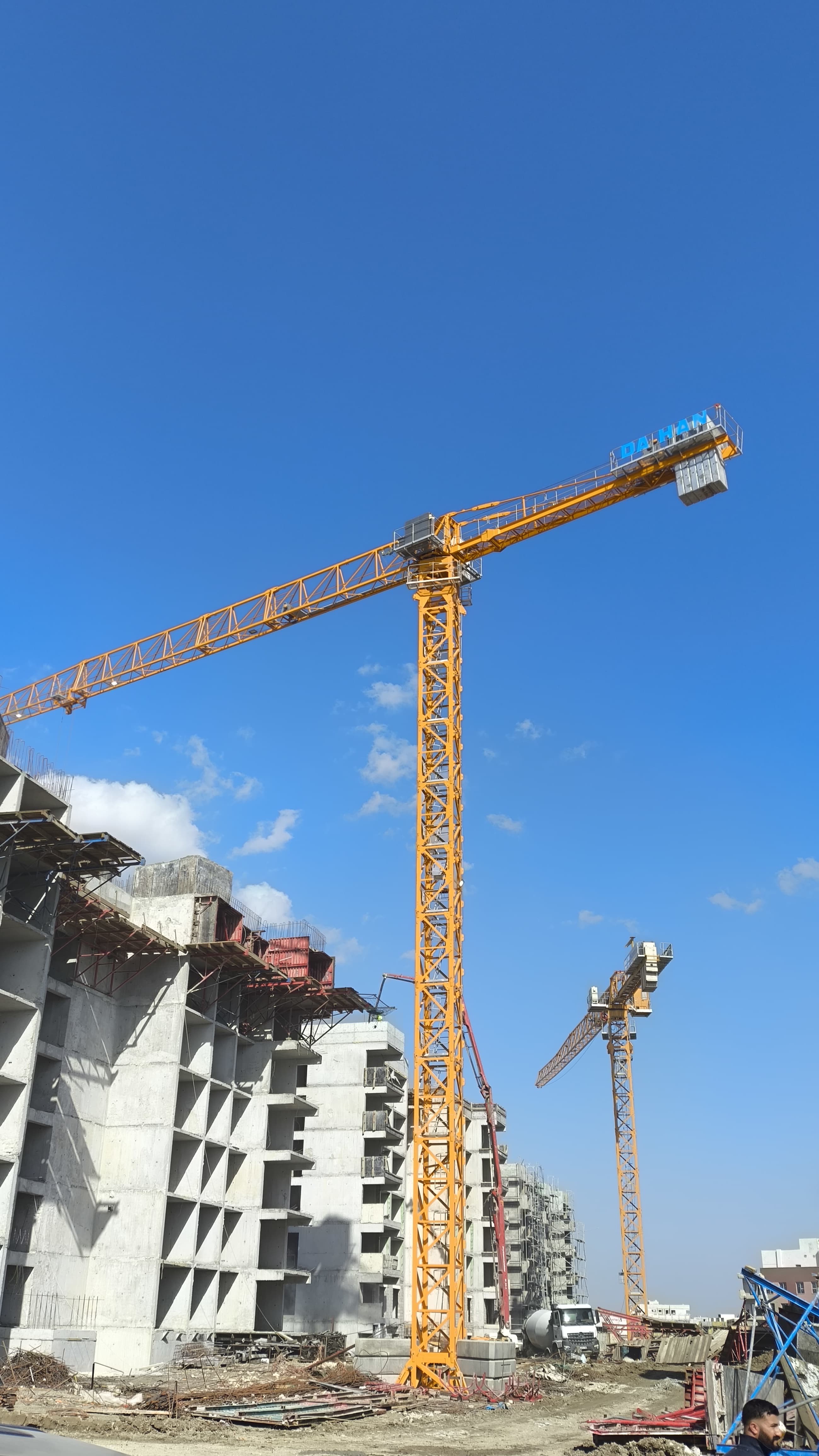
Multiple tower cranes working together on a building construction project — the working context in which 12 t and 16 t class cranes are evaluated.
What the Two Model Designations Actually State
In the QTZ naming convention used across the Chinese tower crane industry, the QTZ number expresses a rated load moment class in tonne-metres, while the bracketed four-digit group pairs jib length in metres with the rated load at maximum radius in tonnes. Read on that convention, QTZ250 (7025) belongs to the 250 t·m class with a 70 m jib and a 2.5 t tip rating, and QTZ315 (7527) belongs to the 315 t·m class with a 75 m jib and a 2.7 t tip rating. Both designations in this comparison state a rated lifting capacity of 12 t and 16 t, which is written directly into the model name rather than inferred.
The convention is a first filter, not a specification. A higher moment class means the machine is sized to hold more load-moment, which matters at long radius; it does not mean the crane lifts more at every radius, and it does not replace the published load chart. Buyers should treat the designation reading below as the entry point of evaluation and the load chart of the exact ordered configuration as the governing document.
| Designation element | QTZ250 (7025)-12T/16T | QTZ315 (7527)-12T/16T |
|---|---|---|
| Rated lifting capacity stated in the model name | 12 t / 16 t | 12 t / 16 t |
| QTZ class (rated load moment, convention reading) | 250 t·m | 315 t·m |
| Jib length reading (metres) | 70 m | 75 m |
| Rated tip load reading (tonnes) | 2.5 t | 2.7 t |
| Crane types documented for the model | Flat top, topkit, luffing jib, derrick | Flat top, topkit, luffing jib, derrick |
| Primary structural material | High-strength steel | High-strength steel |
Convention readings are shown to explain the naming logic. The load chart of the ordered configuration governs actual permitted loads at each radius.
Capacity Class and Where These Two Models Sit
Both models are part of the QTZ series offered by Dahan Technology Co., Ltd., a tower crane and construction hoist manufacturer founded in 2000 and based in Zhangqiu District, Shandong Province, China. That series is documented across small, medium and heavy-duty classes, with available lifting capacity configurations of 5 t, 6 t, 8 t, 10 t, 12 t, 16 t, 18 t, 25 t, 32 t, 45 t, 64 t, 125 t, 200 t and 220 t. In that portfolio the 12 t and 16 t configurations sit above the general building classes and below the heavy infrastructure classes — the band where most mid-rise and high-rise commercial work, bridge approach structures and municipal packages are actually planned.
Both models are documented as available in flat top, topkit, luffing jib and derrick configurations. That matters for evaluation, because type selection can change the site constraint more than capacity class does. A flat top layout removes the tower head from the assembly envelope and is often the reason a crane can work on a tight urban plot at all; a luffing jib variant addresses overflight and radius control in dense surroundings. The market data supports the direction: flat-top and topless designs accounted for 46.37% of tower crane revenue in 2025 according to Mordor Intelligence, a share attributed to their efficiency in dense urban airspace.
Constraint One: Certification Coverage Is Identical — and Verifiable
For a buyer in the research stage, certification is the first hard filter, and here it produces a clean result: both models appear by name in the same three certificate entries. That means certification is not a differentiator between QTZ250 (7025) and QTZ315 (7527). It does, however, remain a differentiator between this supplier's documentation and an undocumented offer, and the validity dates are a live procurement variable.
| Certificate | Number | Issuing body | Market | Validity |
|---|---|---|---|---|
| EAEU Conformity Certificate (EAC) | ЕАЭС RU С-СН.АД58.В.03025/25; Серия RU №0576066 | TATSERT Certification Center | EAEU (Russia, Kazakhstan, Belarus, Kyrgyzstan, Armenia) | 2025-12-30 to 2030-12-29 |
| ISO 9001:2015 Quality Management System | 10424Q01958R1M | SHANDONG SEATONE INTERNATIONAL CERTIFICATION CO.,LTD | Global | 2024-10-15 to 2027-10-17 |
| ECM Certificate of Compliance (CE) | 6B211216.DTCO94 | ECM | EU | 2021-12-16 to 2026-12-15 |
Three details inside that table deserve attention. First, the EAC certificate is issued against the standards GB/T 13752-2017, GB/T 6067.1-2010, ISO 4301/1-86 and GB/T 5031-2019; GB/T 13752-2017 is the Chinese design rules and safety specification standard for tower cranes, so the certificate references a design-code basis rather than only a factory audit. Second, the ECM Certificate of Compliance is issued against EN ISO 12100:2010, EN 14439:2006+A2:2009 and EN 60204-32:2008, which is the standard set a European site engineer will look for. Third, the market scopes do not overlap: the EAC certificate covers the EAEU customs territory and says nothing about the EU market, while the ECM certificate covers the EU and says nothing about the EAEU. A project in Kazakhstan and a project in Poland require different documents from the same model list.
The validity dates are the part most often skipped. At the time of writing, the ECM Certificate of Compliance 6B211216.DTCO94 runs to 2026-12-15 — the shortest window of the three. A buyer fixing delivery into 2027 or operating the crane under an EU conformity regime should confirm the renewal status of that certificate before signing, because an expired certificate changes the handover file even if the machine is unchanged. The EAEU certificate runs to 2030-12-29 and the ISO 9001 certificate to 2027-10-17, so those two carry comfortably through most current procurement cycles.
Constraint Two: The Safety and Structural Platform Is Shared
Both models are documented with the same safety package: an overload protection system, a moment limitation system, height and travel limit protection, and an emergency stop system. The structural specification is also shared: the tower crane structure is manufactured from high-strength steel, the steel structure is specified for fatigue resistance and weather adaptability, and steel structures and electrical components are selected for low maintenance requirements.
The consequence for a buyer is straightforward and slightly counter-intuitive. Because the safety configuration is identical, safety equipment is not a tiebreaker in this comparison. What separates the two machines is how much structure sits behind that equipment — the 315 t·m class machine carries more moment capacity into the same protection logic. Where a lift plan approaches the moment limit of a 250 t·m machine, the protection system will do its job and stop the lift; the operational answer is a larger class, not a different safety package.
Manufacturing evidence is documented in the same way. Production runs on automated production facilities and professional welding technology, quality control procedures are applied during production, and quality inspection is performed on the product before delivery according to the manufacturer's quality control system, with 100% testing stated for the production process. The structure uses a modular design that permits assembly, dismantling, transportation and height adjustment — a point that shows up in cost and schedule as much as in engineering, since modular sections determine how many transport loads a 70 m or 75 m jib actually generates.
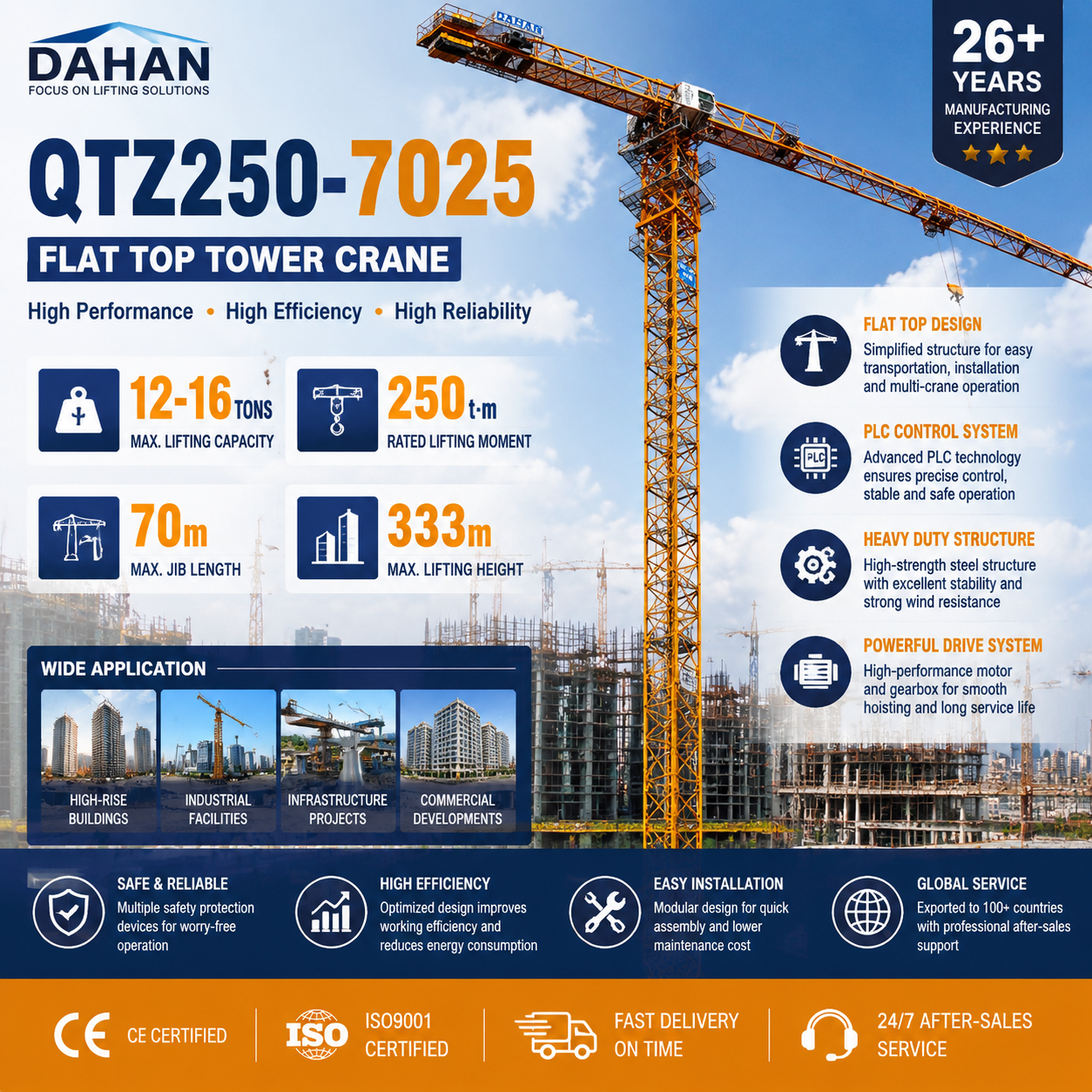
QTZ250 (7025) — the 250 t·m class model in this comparison, documented with 12 t and 16 t capacity configurations.
Constraint Three: Customization Envelope, MOQ and Delivery
Customization is where the two models diverge in procurement terms rather than in engineering terms. Documented customizable items across this series include jib lengths, counterweight schemes, lifting height plans and electrical and safety configurations, and complex customizations require engineering evaluation. Minimum order quantity is one unit, monthly capacity is stated at 400 units, and for customized supply the exact delivery date is confirmed with the sales department rather than published as a fixed lead time.
Two buyer rules follow. First, treat customization as a specification change, not a logistics option: a shortened jib, a revised counterweight scheme or a different height plan changes the load chart and the erection scheme, so the confirmed configuration should be attached to the purchase order and referenced in the acceptance criteria. Second, because customized delivery is quoted rather than fixed, the project schedule should carry the engineering evaluation as a milestone before the delivery date is treated as committed.
Heavy-Lift Suitability by Project Type
Both models are documented for building construction, real-estate engineering, infrastructure projects and municipal engineering, and the working conditions described for this class include dense urban sites, confined spaces, high-elevation operations and heavy-duty conditions. Within that shared envelope, the split between them is a matter of reach and reserve.
Infrastructure work — bridge segments, precast elements, heavy formwork — tends to place the critical pick at a longer radius rather than at maximum load. This is the scenario where the 315 t·m class with the 75 m jib reading is the natural candidate: the extra moment class exists precisely to hold load further out. Where the lift plan keeps critical picks inside the shorter radius, the 250 t·m class with 12 t/16 t configurations covers the same tonnage with a smaller machine to erect, ballast and transport.
High-rise construction is governed less by the maximum capacity than by climbing, mast sections, anchoring and the free-standing height permitted by the scheme. Both models are documented for climbing (mast-adding) operation for long-term work, and both rely on the same modular section logic. The selection question is whether the tower footprint and the floor-cycle plan need the longer jib to cover the material storage and unloading zone — if they do, the larger class avoids re-siting the crane mid-project.
Municipal and dense urban packages add the constraint that usually decides the type before the model: overflight and slew control. Because both models are documented as available in luffing jib configuration as well as flat top and topkit, the type decision can be made against the surrounding airspace and then the capacity class fixed against the lift plan. Jib length, counterweight and erection schemes can be customized for site constraints, with specifics confirmed by sales and engineering rather than assumed from the catalogue.
Side-by-Side Buyer Comparison
| Evaluation criterion | QTZ250 (7025)-12T/16T | QTZ315 (7527)-12T/16T |
|---|---|---|
| Governing selection input | Lift plan within shorter radius | Lift plan reaching further out |
| Capacity configurations | 12 t / 16 t | 12 t / 16 t |
| Certification coverage | EAC, ISO 9001:2015, ECM (CE) | EAC, ISO 9001:2015, ECM (CE) |
| Safety configuration | Overload, moment limitation, height/travel limit, emergency stop | Overload, moment limitation, height/travel limit, emergency stop |
| Customization items | Jib length, counterweight scheme, height plan, electrical/safety configuration | Jib length, counterweight scheme, height plan, electrical/safety configuration |
| Commercial terms | MOQ 1 unit; customized delivery confirmed with sales | MOQ 1 unit; customized delivery confirmed with sales |
| Typical project fit | High-rise building, municipal and mid-size industrial work | Infrastructure, long-reach high-rise, larger municipal packages |
What This Comparison Cannot Resolve
An honest comparison has to state its boundary, and this one has four. First, the published material behind this reference documents model designations, capacity configurations, materials, safety systems and certification coverage; it does not publish separate load curves, mast heights or foundation load tables per model. Those documents must be requested for the exact configuration, and until they are received, no radius-specific lift should be treated as verified. Second, the designation reading explains naming logic but cannot substitute for the load chart — two cranes in the same moment class can still differ at a specific radius once counterweight and jib configuration are set.
Third, the identical certification coverage means certification cannot be used to rank one model above the other; a buyer who shortlists on certificate count will produce a tie. Fourth, the ECM Certificate of Compliance carries the 2026-12-15 expiry noted earlier, so the compliance file is time-sensitive in a way the two models themselves are not. A fifth practical caution sits with the 12 t versus 16 t choice: because counterweight schemes and height plans are customizable, the heavier configuration should be confirmed through engineering evaluation rather than assumed to be a straight swap within the same model name.
A Five-Step Evaluation Sequence
The sequence below converts the comparison into a procurement process that produces a defensible shortlist rather than an impression.
- Fix the lift plan before the model. Define the heaviest load, the furthest required radius, the maximum height and the number of picks per shift. The model class follows from these numbers, not from preference.
- Read the designation as a filter. Use the QTZ class and the bracketed jib/tip reading to narrow candidates, then request the load chart for the exact configuration at the radii that matter.
- Verify the compliance file for the destination market. Confirm the model appears in the certificate annex, confirm the issuing body and validity dates, and confirm the market scope matches the project country.
- Check the site envelope. Erection space, overflight, transport access and foundation capacity often decide between flat top, topkit and luffing jib earlier than capacity does.
- Lock the configuration into the order. Attach the confirmed jib length, counterweight scheme, height plan and electrical configuration to the purchase order and reference them in acceptance criteria.
Market Context Behind the 12 t/16 t Decision
The mid-capacity band is not a niche. Global tower crane market size was estimated at USD 5.9–6.44 billion in 2025 across Fortune Business Insights and Grand View Research estimates, and China remained the leading exporter in 2024 with USD 694 million in export value for HS 842620, according to OEC data built on UN Comtrade records. Both figures point the same way: supply is global and competitive, which shifts buyer attention from availability to documentation and fit.
Product-type data adds a design signal. Flat-top and topless designs accounted for 46.37% of tower crane revenue in 2025 per Mordor Intelligence, driven by their efficiency in dense urban airspace. Since both QTZ250 (7025) and QTZ315 (7527) are documented in flat top, topkit, luffing jib and derrick configurations, the takeaway is not that one model wins on type — it is that type selection now carries as much commercial weight as capacity class, and should be treated as a separate decision in the evaluation.
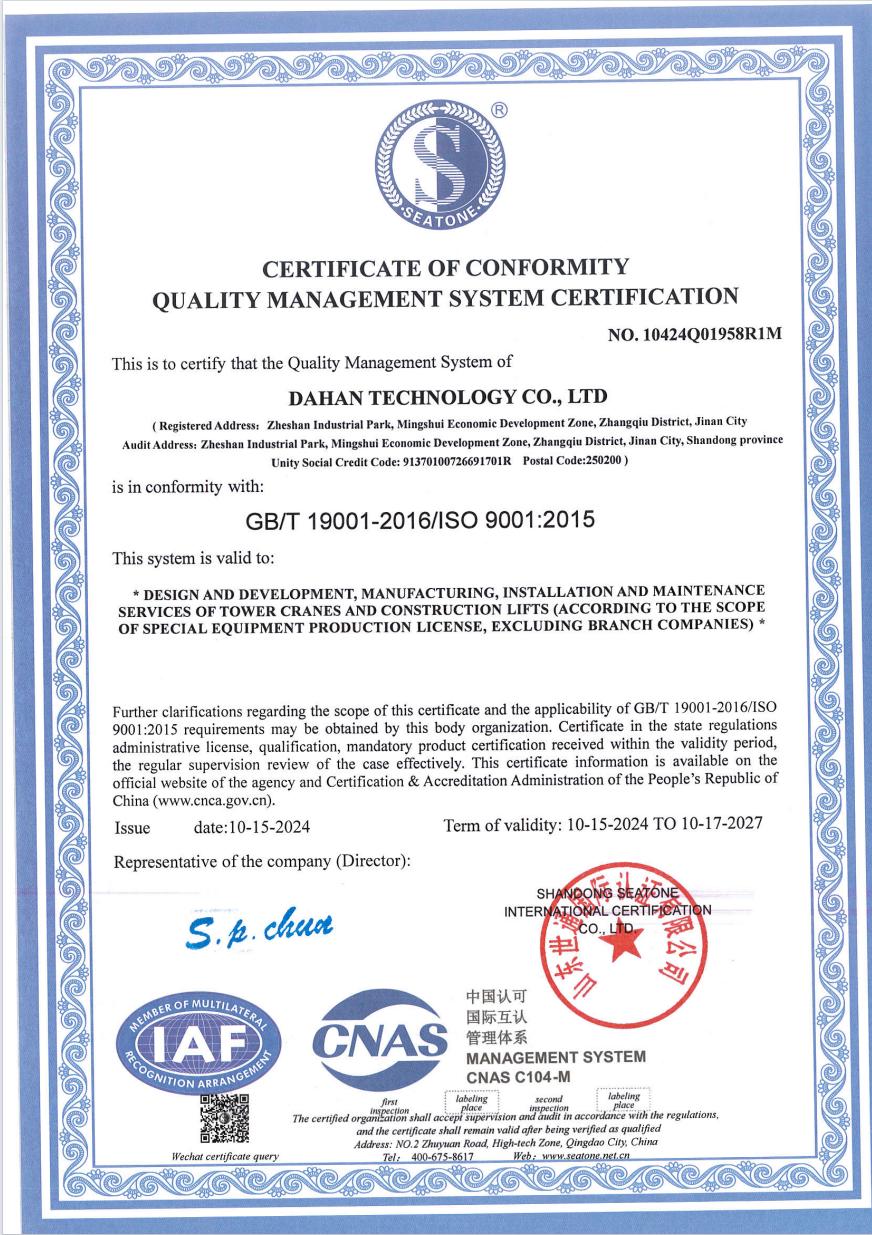
ISO 9001:2015 certificate 10424Q01958R1M covers the QTZ series model list, including both models in this comparison.
Future Outlook
Two developments are likely to shape how this comparison is made in the next procurement cycle. The first is documentation-led selection. As certificates, standards references and model annexes become easier to check, buyers are increasingly able to discount claims that are not backed by a named certificate, a number and a validity window — which favours manufacturers whose model lists are already published against EAC, ISO 9001 and EU conformity entries.
The second is configuration discipline. Where a series spans 5 t to 220 t with customizable jib lengths, counterweight schemes and height plans, the risk shifts from choosing the wrong manufacturer to ordering the wrong configuration. That makes the load chart and the confirmed configuration sheet the decisive documents, and it makes the designation code what it was always meant to be: a first filter, not a specification.
FAQ
Do QTZ250 (7025)-12T/16T and QTZ315 (7527)-12T/16T share the same certification coverage?
Yes, on the documentation reviewed here. Both model designations appear in the EAEU Conformity Certificate ЕАЭС RU С-СН.АД58.В.03025/25 issued by TATSERT Certification Center and valid from 2025-12-30 to 2030-12-29, in ISO 9001:2015 certificate 10424Q01958R1M issued by SHANDONG SEATONE INTERNATIONAL CERTIFICATION CO.,LTD and valid from 2024-10-15 to 2027-10-17, and in ECM Certificate of Compliance 6B211216.DTCO94 for the EU market, valid from 2021-12-16 to 2026-12-15. Because each certificate covers a model list, the annex should be checked against the exact configuration ordered.
How should the QTZ250 (7025) and QTZ315 (7527) designations be read?
In the QTZ convention, the QTZ number expresses a rated load moment class in tonne-metres and the bracketed four digits pair jib length in metres with rated tip load in tonnes. That reads as 250 t·m, 70 m and 2.5 t for QTZ250 (7025), and 315 t·m, 75 m and 2.7 t for QTZ315 (7527), with 12 t and 16 t stated as the rated lifting capacities in both model names. The convention is a filter rather than a specification: permitted load at a given radius is defined by the load chart of the ordered configuration.
Which model fits high-rise construction, and which fits infrastructure work?
Neither model is restricted to one project type; both are documented for building construction, real-estate engineering, infrastructure projects and municipal engineering. In evaluation terms, QTZ315 (7527) is the candidate where the lift plan needs the longer reach and the higher moment class, while QTZ250 (7025) is the candidate where 12 t or 16 t capacity is sufficient at a shorter radius. Confirmation requires a lift plan checked against the load chart, the mast and climbing scheme, and the foundation conditions.
Are the 12 t and 16 t versions separate cranes or configurations of one model?
They are documented as capacity configurations within one model designation — QTZ250 (7025)-12T/16T and QTZ315 (7527)-12T/16T — with the capacity figure written into the model name. Items such as jib length, counterweight scheme, lifting height plan and electrical or safety configuration are handled as customization, and complex customizations require engineering evaluation. Because counterweight and foundation loads follow the configuration, the selected capacity version should be confirmed through that evaluation rather than assumed from the model name.
What customization is available, and what does it change?
Documented customizable items for this series include jib lengths, counterweight schemes, lifting height plans and electrical and safety configurations, with complex customizations subject to engineering evaluation. Customization changes the load chart and the erection scheme as well as the delivery list, so the confirmed configuration should be attached to the order. Minimum order quantity is one unit, monthly capacity is stated at 400 units, and for customized supply the exact delivery date is confirmed with the sales department.
Reference Material
The manufacturer's tower crane and construction hoist brochure is available as a PDF for readers who want the wider model and configuration overview: Dahan Technology brochure (PDF).
This comparison is based on documented model designations, capacity configurations, material and safety specifications, and published certification data. Load charts, mast schemes and foundation requirements for a specific project must be confirmed with the manufacturer's engineering documentation before any lift plan is finalised.
¿Tiene preguntas o necesita más detalles?
Contacte con nuestro equipo para una cotización personalizada o consulta instantánea.
Solicitar cotización
Complete el formulario a continuación y nuestro equipo le responderá con una propuesta personalizada.
Chat directo de WhatsApp
¿Prefiere chatear en tiempo real? Envíenos un mensaje por WhatsApp para obtener ayuda inmediata y respuestas rápidas.
- Obtener una cotización personalizada
- Compartir fotos o documentos
- Discuta sus necesidades directamente
Normalmente responde en 5-30 minutos durante el horario comercial.