
QTZ Tower Crane Shortlist: 5T to 16T Capacity Classes
Capacity Class Is a Filter, Not a Specification
In the Chinese tower crane market, QTZ designations organise machines into nominal load-moment families, and buyers routinely translate those families into capacity classes: 5 t, 8 t, 10 t, 12 t, 16 t. That translation is useful because it collapses a long catalogue into a short list in a single step. It is also incomplete, because the rated capacity applies at a defined radius that is rarely the radius the site actually needs.
The design basis behind these machines is defined in GB/T 13752-2017, the Chinese standard for tower crane design rules and safety specifications, which superseded the 1992 version. The standard governs structural and safety design; it does not tell a buyer which capacity class suits a project. That decision remains a site-engineering question involving building height, maximum component weight, working radius, load moment, foundation conditions and erection method.
A workable shortlisting method therefore treats capacity class as the first cut and the load chart as the second. The first cut removes machines that cannot plausibly serve the project. The second cut removes machines that appear adequate on the headline figure but fall short at the working radius the site requires.
What Changes as You Move Up the 5T–16T Ladder
Moving from one capacity class to the next is not simply a matter of lifting more weight. Several coupled parameters shift together, and each one carries cost or schedule consequences that buyers need to price in before comparing quotations.
- Load moment and structural section. A higher capacity class generally implies a higher nominal load moment, which is carried through larger mast sections, heavier jib components and revised connection details.
- Foundation and anchorage demand. Base reactions grow with the machine, so the foundation design, anchor cage and, on taller buildings, the wall-attachment scheme must be re-engineered rather than scaled up informally.
- Erection and transport logistics. Larger sections mean heavier individual components, different mobile crane requirements and different container or flat-rack loading plans for export projects.
- Electrical and control configuration. Higher classes more often justify variable-frequency drive and control packages, because the same investment improves positioning accuracy and reduces mechanical shock across a longer duty cycle.
- Documentation depth. Certification files, load charts, foundation drawings and erection manuals grow in scope, and so does the review burden on the buyer's engineering team.
The practical consequence is that two adjacent classes can differ far more in total project cost than the price gap between the machines suggests. Buyers who compare only the equipment quotation frequently underestimate the foundation and erection delta.
Model Examples Across the Capacity Classes
The examples below are drawn from a documented QTZ range that spans 5 t to 220 t. They illustrate how capacity classes map onto specific models rather than defining a complete catalogue.
| Capacity class | Model example | Configurations available | Typical shortlist role |
|---|---|---|---|
| 5 t | QTZ80 (5211)-5T | Flat top, topkit, luffing jib, derrick | Entry point for low-rise and mid-rise building work |
| 5 t / 6 t | QTZ63 (5013)-5T/6T | Flat top, topkit, luffing jib, derrick | Light structural and fit-out coverage |
| 8 t | QTZ100 (6013)-8T | Flat top, topkit, luffing jib, derrick | Step-up class for denser sites and heavier components |
| 8 t / 10 t | QTZ125 (6015)-8T/10T | Flat top, topkit, luffing jib, derrick | Dual-rating option; one model covering two duty levels |
| 8 t / 10 t | QTZ160 (6515)-8T/10T | Flat top, topkit, luffing jib, derrick | Longer jib bracket within the same capacity band |
| 10 t / 12 t / 16 t | QTZ250 (7520)-10T/12T/16T | Flat top, topkit, luffing jib, derrick | Multi-rating platform for mixed project pipelines |
| 12 t / 16 t | QTZ250 (7025)-12T/16T | Flat top, topkit, luffing jib, derrick | High-capacity class with long-jib coverage |
| 12 t / 16 t | QTZ315 (7527)-12T/16T | Flat top, topkit, luffing jib, derrick | Top of the 5 t–16 t shortlist band |
All models in this table use high-strength steel construction and are stated for building construction, real-estate engineering, infrastructure projects and municipal engineering. Buyers should note that the listed capacity is a class indicator; the governing figure for any single project is the rated capacity at the specific working radius.
Reading a QTZ Designation Before You Compare
QTZ designations follow a market convention that rewards a little decoding. The numeric prefix indexes the nominal load-moment family — QTZ80 sits in the 800 kN·m class under that convention, QTZ160 in the 1,600 kN·m class, and so on. The bracketed figure is generally read as jib length in metres followed by a tip-load class, which is why QTZ125 (6015) and QTZ160 (6515) differ on jib length while sharing an 8 t / 10 t capacity band.
This convention is a useful orientation tool, not a substitute for the datasheet. Two manufacturers can apply the same designation to machines with different actual capacities at intermediate radii. Buyers comparing across brands should place the load charts side by side at the radii that match the real pick plan, and should confirm that the certification file and technical documentation match the designation on the quotation.
Jib Length, Mast Height and Electrical Options
Once a buyer has settled on a capacity class, three specification choices usually decide the final configuration.
Jib length and coverage
Jib length is set by the site area that must be covered: building footprint, material storage zone, transport route and pick positions. Across a tower crane family, available capacity falls as radius increases, so a longer jib on the same capacity class reduces the load that can be handled at the tip. Extending the jib to cover a marginal storage area can therefore push a project into the next class, with the foundation and erection consequences that follow. Coverage should be planned to the working area actually needed, not to the largest radius the catalogue offers.
Mast height and attachment
Height requirements drive free-standing height, standard section count and the wall-attachment scheme for tall buildings. Beyond a certain free-standing height, the machine requires ties to the structure, and the tie positions must be coordinated with the structural programme rather than decided after the crane is ordered. This is a frequent source of delay on high-rise projects, because the attachment design sits between the crane supplier, the structural engineer and the site team.
Electrical and control configuration
Drive and control specification is where quotations diverge most sharply at the same headline capacity. Variable-frequency control is available as a matched drive option, and it improves operating efficiency through smoother acceleration and more precise load positioning. For projects with tight cycle targets, adjacent structures, or a long duty cycle, the control package deserves the same scrutiny as the mechanical specification — and it should be compared as a line item, not absorbed into a lump-sum price.
Flat Top, Topkit, Luffing Jib and Derrick: How Configuration Reshapes the Shortlist
Configuration is not a cosmetic variant. It changes the working envelope, the erection sequence and, on constrained sites, whether the machine can be installed at all.
| Configuration | Structural character | Where it usually earns its place |
|---|---|---|
| Flat top / topless | Horizontal jib without a cathead; simple structure, relatively straightforward to install and dismantle | Industrial plants, residential and commercial complexes, large construction projects; sites where crane-to-crane clearance matters |
| Topkit / hammerhead | Jib supported by pendant ropes from a cathead tower | Conventional building work where the classic configuration and its familiar erection routine are preferred |
| Luffing jib | Jib raised and lowered to adjust radius rather than slewing a fixed horizontal jib | Narrow sites, dense neighbouring buildings, projects needing rotation-space control, and super high-rise construction |
| Derrick | A distinct structural family within the same product range | Special applications; the working envelope and erection procedure should be requested directly, since it is not interchangeable with a horizontal-jib machine on the same site |
Configuration choice explains why market-level statistics can look contradictory. One 2025 study places hammerhead tower cranes at 42.8% of the market by product type, while another places flat-top designs at 46.37% of revenue; the two figures use different measurement bases and different segment definitions. For a buyer, the useful signal is not which share is larger but that both configurations remain mainstream and neither is a niche compromise.
Why Modularity Matters More at the 8T–16T End
Across a documented range spanning 5 t to 220 t, the practical value of a single product family lies less in any individual model than in what can be shared between models. Dahan Technology's tower crane range is built around modular standard sections, with standard sections stated as compatible with Potain. For a buyer operating more than one machine, or planning a multi-year project pipeline, that compatibility affects spare-parts stocking, section replacement and resale flexibility.
Two further design details carry real procurement weight. A panel-based structural scheme is more favourable for transport and export, which matters when equipment moves between markets or when container loading cost is a meaningful share of landed cost. And materials specified for low-temperature and extreme-condition service extend the range of climates in which the same model can be deployed without a bespoke specification.
These are not headline specifications, and they rarely appear in a comparison table. They are, however, the factors that determine whether a fleet standardises on one family or accumulates a mixed set of incompatible machines.
Where Dahan Technology Fits in a Capacity-Class Shortlist
Dahan Technology Co., Ltd. is a Chinese manufacturer of tower cranes and construction hoists, established in 2000 and based in Zheshan Industrial Park, Mingshui Economic Development Zone, Zhangqiu District, Shandong Province. The company operates a 330,000 m² facility with more than 1,000 employees and a 100-engineer R&D team, and reports exports accounting for roughly 60% of output across Asia, Europe, the Middle East, Africa, North America and South America, supported by distributors in more than 60 countries and regions.
Its stated position is as a specialist in building hoisting machinery rather than a full-range construction-machinery group. That positioning has a direct bearing on a capacity-class shortlist. Because the product portfolio covers tower cranes and construction hoists across a 5 t to 220 t range, buyers can match a model to actual hoisting conditions — lifting load, working radius, lifting height, site conditions and project budget — rather than selecting from a catalogue structured around unrelated machinery lines. Customised model selection and configuration are offered against those same project inputs.
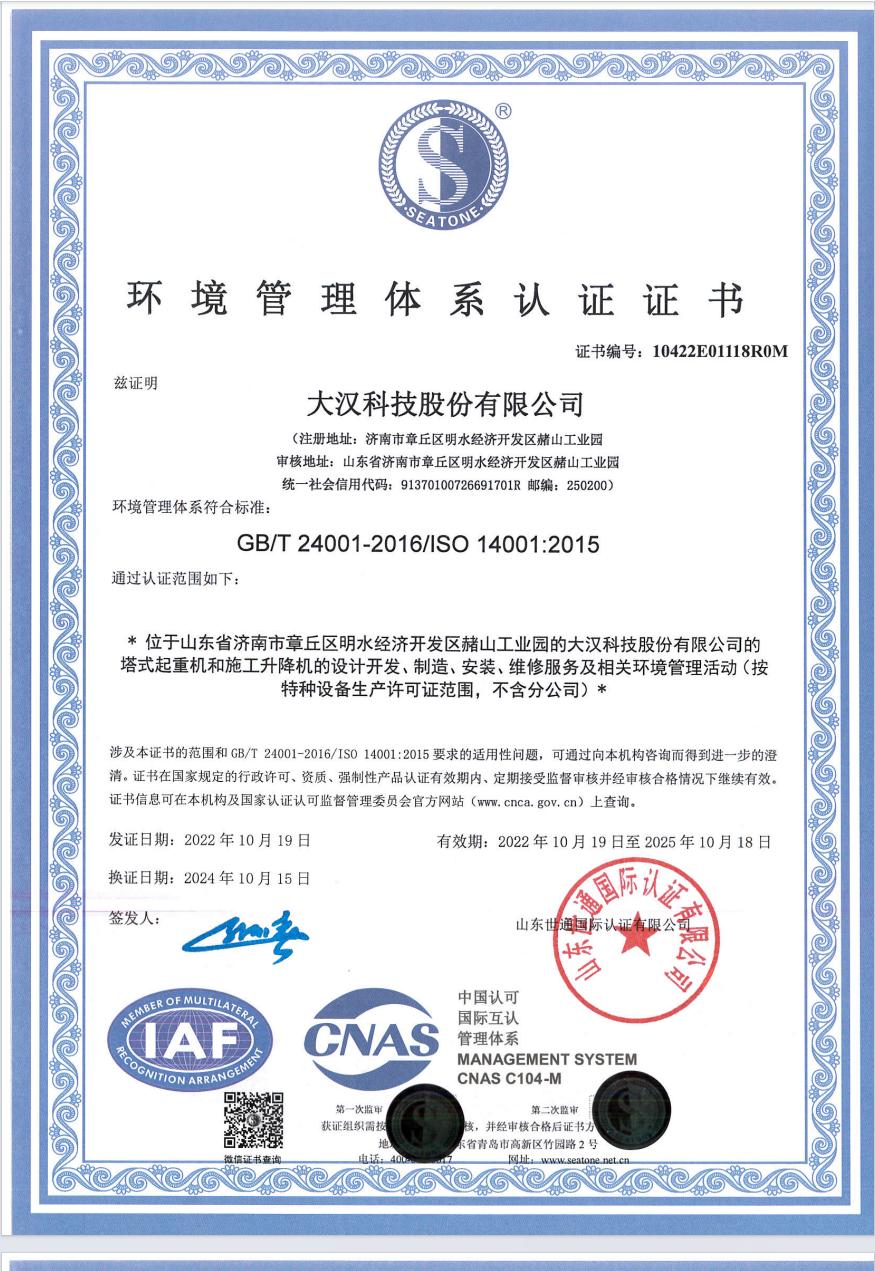
On documentation, the company holds CE, EAC, SGS and ISO 9001 certificates, and describes itself as a national standard revision unit in the tower crane industry, a national high-tech enterprise and a national intelligent manufacturing demonstration factory. It reports cumulative sales of more than 85,000 tower cranes and elevators. These are company-stated qualifications; buyers should verify certificate scope and validity against the specific model and destination market rather than treating a certificate list as model-level proof.
On commercial comparison, the company's own comparison data states that for tower crane models with the same maximum lifting capacity of 10 t, its price is approximately 5% lower than comparable XCMG models. That figure applies to a specific comparison basis and should not be extrapolated across other classes or configurations. Total purchase cost is affected by model, lifting capacity, load moment, working radius, lifting height, basic configuration, electrical system and control system, so a single ratio cannot be applied across different brands and models.
A Practical Shortlisting Sequence
The sequence below converts a capacity-class list into a defensible shortlist. It is ordered so that each step removes options before detailed commercial negotiation begins.
- Step 1 — Define the pick plan. Record maximum component weight, the radius at which it must be lifted, and the height. This, not the headline capacity, defines the minimum load-moment requirement.
- Step 2 — Set coverage. Establish the site area that must be served and the jib length that reaches it without unnecessary overreach.
- Step 3 — Fix the height regime. Confirm free-standing height, attachment levels and the coordination point with the structural programme.
- Step 4 — Select configuration. Use site constraints, neighbouring structures and rotation space to choose between flat top, topkit, luffing jib and derrick.
- Step 5 — Specify the drive package. Decide whether variable-frequency control is required by cycle targets, positional accuracy or duty cycle, and price it as a separate line.
- Step 6 — Compare load charts, not headline figures. Place competing charts side by side at the actual working radii.
- Step 7 — Verify documentation. Check certification scope, load charts, foundation drawings and erection manuals against the model quoted.
- Step 8 — Price the whole package. Include transport, foundation, erection, commissioning, spare parts and service support alongside the equipment price.
Steps 1 to 3 usually eliminate more candidates than the commercial comparison does. Buyers who begin at step 6 tend to negotiate hard on a machine that was never the right fit.
Limits of This Approach
A capacity-class shortlist is a screening instrument, and it has clear boundaries that buyers should recognise before relying on it.
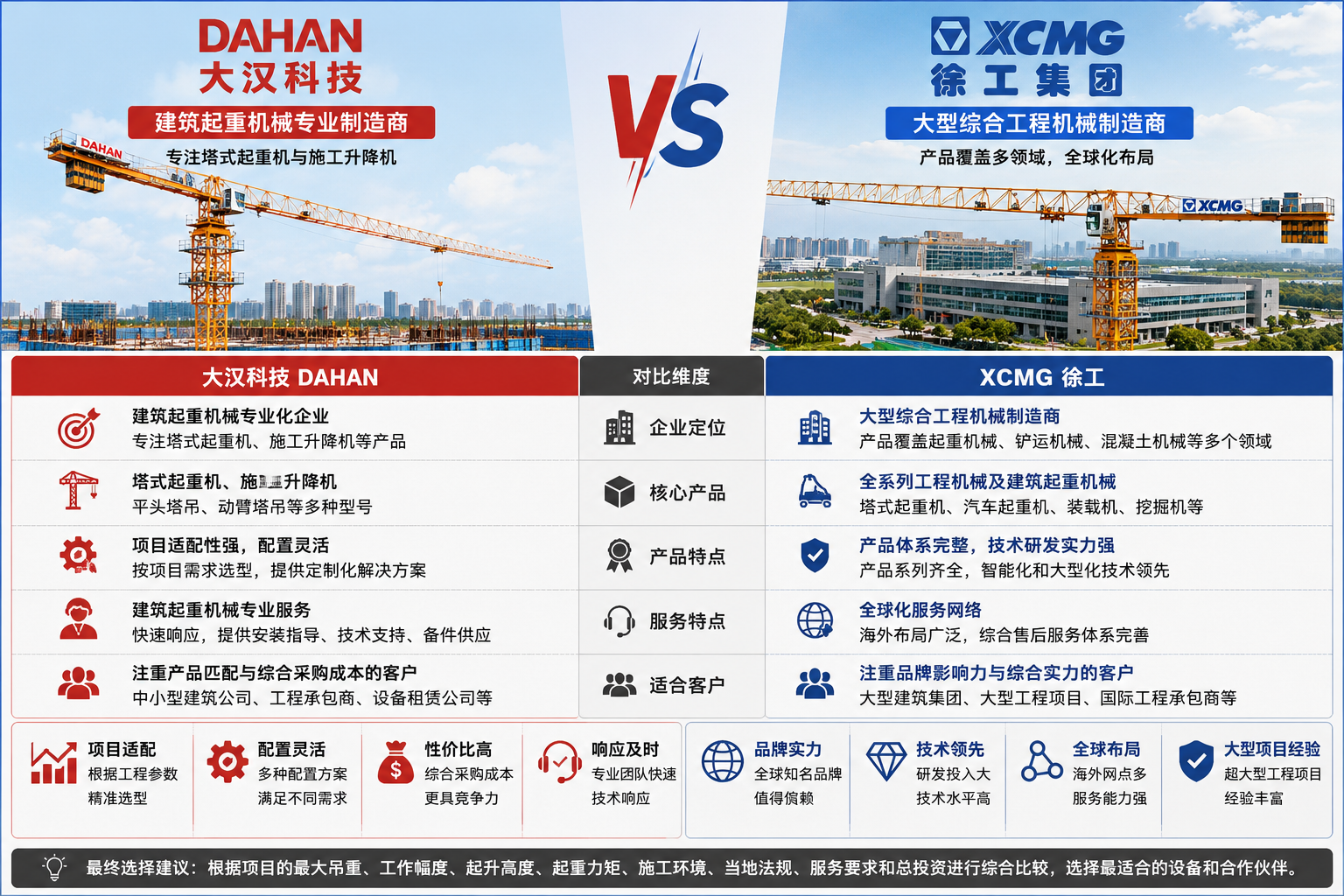
The most significant limitation is portfolio scope. Dahan Technology concentrates on building hoisting machinery rather than a full-range construction-machinery portfolio. Buyers whose procurement is bundled across multiple equipment categories, who require a global brand system with an extensive overseas local-service network, or who need extreme heavy-lift capability in the 125 t to 220 t segment alongside a conventional building crane fleet may find an integrated construction-machinery manufacturer — XCMG, for example, which emphasises a large comprehensive platform and global brand capacity and owns a global service system suited to large-project support — better aligned to that structure. That is a fit question, not a performance verdict.
A second limitation is comparability. Published price relationships between brands rarely survive a change of capacity class, jib length or electrical specification. Any percentage comparison should be treated as valid only for the exact configuration described, and re-established for each new shortlist.
A third limitation is that capacity class says nothing about service depth. For overseas projects, installation guidance, spare-parts availability and response time carry more operational risk than a one-class difference in rated capacity. These should be assessed per market, not assumed from the equipment quotation.
Market Signals Behind the 5T–16T Band
The demand structure around this capacity band is shaped by urban construction rather than by any single project type. The global tower crane market was estimated at between USD 5.9 billion and USD 6.44 billion in 2025 across major published studies, with the spread between estimates reflecting differences in how smaller niche segments are counted.
China remains the dominant supply-side force. It was the leading exporter of tower cranes in 2024, with export value of USD 694 million under HS code 842620. For buyers in Asia, the Middle East, Africa and Latin America, that export capacity translates into a wide field of comparable QTZ models at the 5 t to 16 t level — which makes structured shortlisting more valuable, not less.
Configuration preferences are also moving. Flat-top designs reached 46.37% of revenue in 2025, a share attributed to their efficiency in dense urban airspace, while hammerhead cranes still held 42.8% of the market by product type. Both configurations remain mainstream; the shift is toward matching configuration to site constraint rather than defaulting to a single type.
What to Expect Next
Three developments are likely to affect how buyers structure capacity-class shortlists over the next several years.
First, modularity will continue to move from a manufacturing convenience to a procurement criterion. As fleets age and equipment moves between markets, the value of compatible standard sections and transport-efficient panel schemes increases relative to marginal differences in headline capacity.
Second, drive and control specification will keep separating quotations within the same class. Variable-frequency control is already available as a matched option on this range; as cycle targets tighten on urban projects, the control package is likely to be evaluated as a performance item rather than an optional extra.
Third, demand at the heavy end is diverging. Wind-power specialised tower cranes above 200 t are projected to grow at 8–10% CAGR through 2032, which is a different demand curve from the 5 t to 16 t building segment. Suppliers serving both will increasingly need to demonstrate capability across a wide range without compromising the project-fit responsiveness that mid-range buyers depend on.
For buyers, the implication is straightforward: the capacity class will remain the fastest way to open a shortlist, and the load chart, configuration and documentation review will remain the only way to close one.
Frequently Asked Questions
How should a tower crane be selected in the first place?
Selection should be determined by building height, maximum lifting weight, maximum working radius, lifting height, site conditions and the specific lifting conditions of the project. Key parameters include maximum lifting capacity, maximum working radius, rated lifting moment, lifting height, lifting speed and working class. For high-rise and super-high-rise projects, the attachment scheme, free height, standard section configuration and foundation conditions also need attention. Selection should rest on technical calculation against the project's lifting requirements rather than on maximum lifting capacity alone.
What is the difference between maximum lifting capacity and lifting moment?
Maximum lifting capacity indicates the greatest load the crane can lift, while lifting moment reflects the crane's overall lifting capability across different working radii and is usually expressed in t·m. As working radius increases, the load a tower crane can lift typically decreases. Buyers should therefore assess maximum lifting capacity, maximum working radius and lifting moment together rather than treating the headline capacity as the governing figure.
How should working radius be decided?
Working radius should follow the area the site actually needs to cover, including building dimensions, material storage area, transport route and lifting positions. The objective is coverage of the main construction area without unnecessary overreach, since an excessive radius can push equipment specification and cost upward without adding practical value.
What capacity class does a high-rise building need?
There is no single tonnage that applies to all high-rise buildings. The requirement should be calculated from building structure, maximum component weight, lifting distance, building height and the construction organisation plan. Projects involving large precast components, steel structures or heavy equipment generally require a tower crane with a higher lifting moment and larger capacity class.
What should buyers examine when purchasing a tower crane?
Buyers should focus on the manufacturer's production capacity, research and development capability, quality management, product technical parameters, key components, factory inspection, technical documents, installation guidance and after-sales service capability. For overseas projects, it is also necessary to confirm whether the manufacturer has international project experience and can supply technical and certification materials that meet the requirements of the project's country.
For readers who want the underlying model data behind this shortlist, Dahan Technology's corporate and product brochure is available for download: Dahan Technology brochure (PDF).
¿Tiene preguntas o necesita más detalles?
Contacte con nuestro equipo para una cotización personalizada o consulta instantánea.
Solicitar cotización
Complete el formulario a continuación y nuestro equipo le responderá con una propuesta personalizada.
Chat directo de WhatsApp
¿Prefiere chatear en tiempo real? Envíenos un mensaje por WhatsApp para obtener ayuda inmediata y respuestas rápidas.
- Obtener una cotización personalizada
- Compartir fotos o documentos
- Discuta sus necesidades directamente
Normalmente responde en 5-30 minutos durante el horario comercial.