
Q355B Steel in Formwork: A Compliance Deep Dive for Buyers
Formwork compliance is normally discussed at the level of systems: certified panels, documented procedures, factory audits. The steel grade beneath those systems receives far less scrutiny, even though it determines how a frame behaves under load, impact, repeated stripping and lifting. Q355B is one of the most frequently quoted structural steel grades in Chinese formwork supply, and one of the least frequently verified by the buyers who receive the quotation.
This reference explains what the Q355B designation commits a mill to, how that commitment propagates through steel frame and early-stripping slab formwork, and what evidence a procurement team should hold before a purchase decision is finalised. Two FWK Lianggong systems are used as reference points — the Early Stripping Slab Formwork (T-form) model FWK-DHF175 and the 120 Steel Frame Formwork — because grade selection interacts differently with each of them. The purpose here is not to certify anything, but to define verification criteria that buyers and engineers can apply to any supplier, in any market.
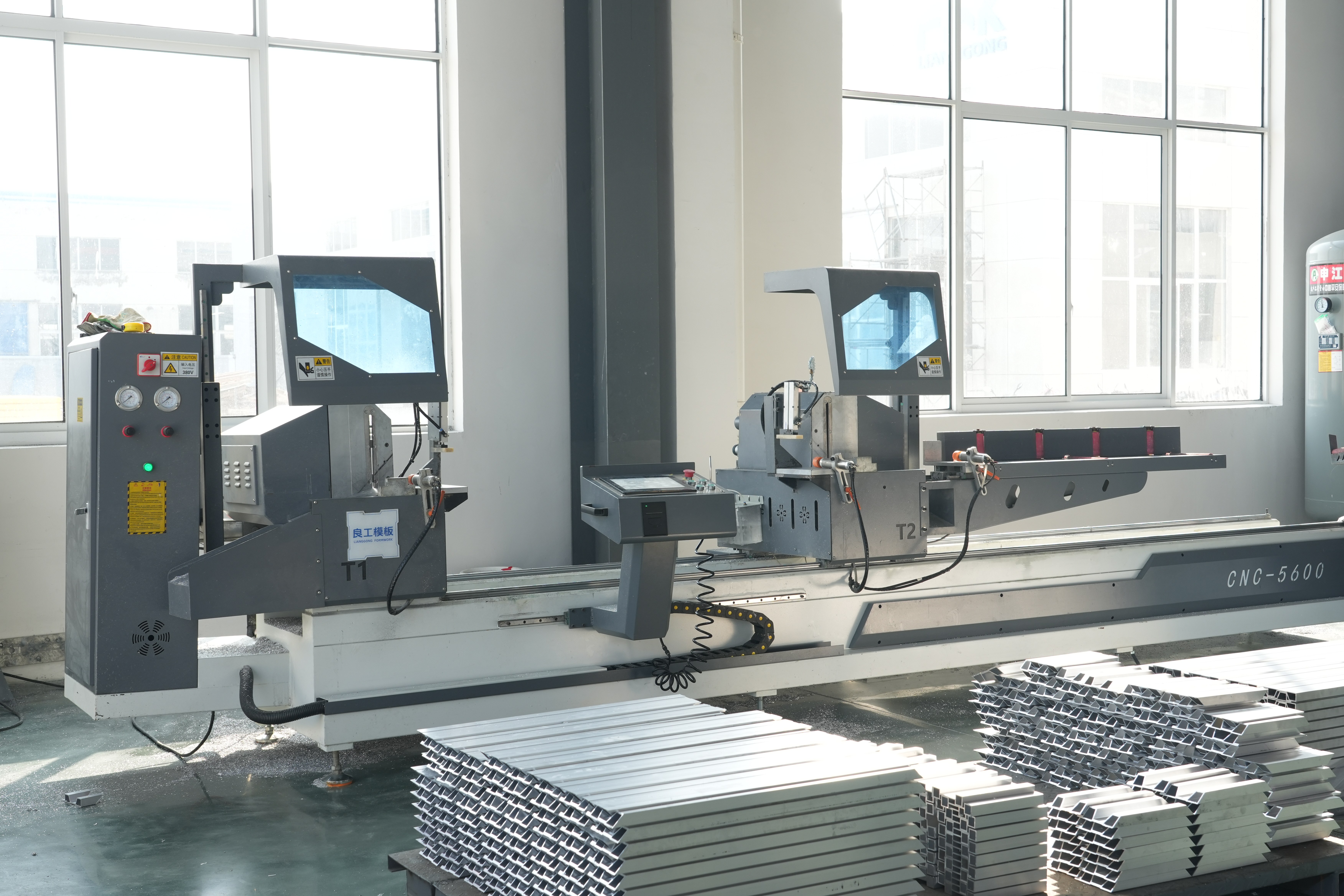
Dimensional control at the fabrication stage: a CNC 5600 double-head precision saw prepares frame profiles before assembly, where grade and tolerance meet.
What the Q355B Designation Commits a Mill To
Q355B is a structural steel designation built from three parts. The letter "Q" indicates a yield-strength-based classification. The numeric element identifies the nominal minimum yield point class, expressed in megapascals. The trailing letter identifies the impact-toughness quality class the delivered plate is expected to demonstrate. Read together, the designation answers two pre-purchase questions: which strength class the mill committed to, and which toughness class the steel is required to meet.
| Element | What it signals | Why the formwork buyer cares |
|---|---|---|
| Q | Yield-strength-based classification | Confirms the material property that structural calculations depend on |
| 355 | Nominal minimum yield strength class, in MPa | Sets the load-carrying margin available from frame profiles, walers and brackets |
| B | Impact-toughness quality class | Affects behaviour under lifting shock, striking and cold-weather handling |
Two boundaries matter here. First, the designation describes delivered steel, not a finished formwork component: a frame can be fabricated from conforming plate and still fail a project requirement because of weld quality, hole placement, dimensional tolerance, or a poorly detailed connection. Second, a grade letter is a class, not a certificate. The grade named in a technical submittal should be matched against three separate documents — the mill test certificate, the fabrication drawing, and the item-level inspection record — because each of them describes the same piece of steel at a different stage of its life.
Why Steel Grade Is a Formwork Decision, Not a Mill Detail
Documented risk profiles for steel formwork cluster around five items: factory strength testing, lifting safety control, turnover cycle control, deformation repair and calibration, and service life. Each of those items is influenced by the grade of steel used in the frame and its connectors.
Yield strength sets how much of the load path a frame profile can carry before permanent deformation begins. Toughness determines whether that same profile absorbs impact — a dropped panel, a sudden load release during stripping, a cold-morning lift — without cracking. Weldability shapes whether the fabrication shop can produce consistent joints at lifting lugs and frame corners, which is exactly where concentrated loads arrive. Grade selection therefore sets the ceiling on what site procedure can achieve.
The control practices that accompany steel formwork are largely procedural: standardized lifting, precise jointing and deformation calibration; an explicit prohibition on forced or violent dismantling; prompt cleaning of the panel surface and application of a release agent before use; and regular rust removal and maintenance. Those practices protect the material. None of them upgrades it. A frame fabricated from a lower grade than the design assumed cannot be brought back into compliance by handling discipline, which is why grade verification belongs upstream of any site instruction.
FWK Lianggong's published comparison data for its B-FORM steel-frame wall formwork shows how much of a system's value sits in the frame. The system is described as a high-strength steel frame combined with laminated board, modular and pre-assembled so that a single operator can handle it, with a published installation rate of 20–25 m² per person per day against 12–15 m² per person per day for conventional loose-assembly steel-frame formwork. The same comparison reports a panel service life of 20–40 uses and a steel frame life of 100+ uses, against 15–30 uses and 50+ uses for the conventional alternative. The panel is the consumable; the steel frame is the asset. Its grade and fabrication quality are what make the reuse figure defensible rather than aspirational.
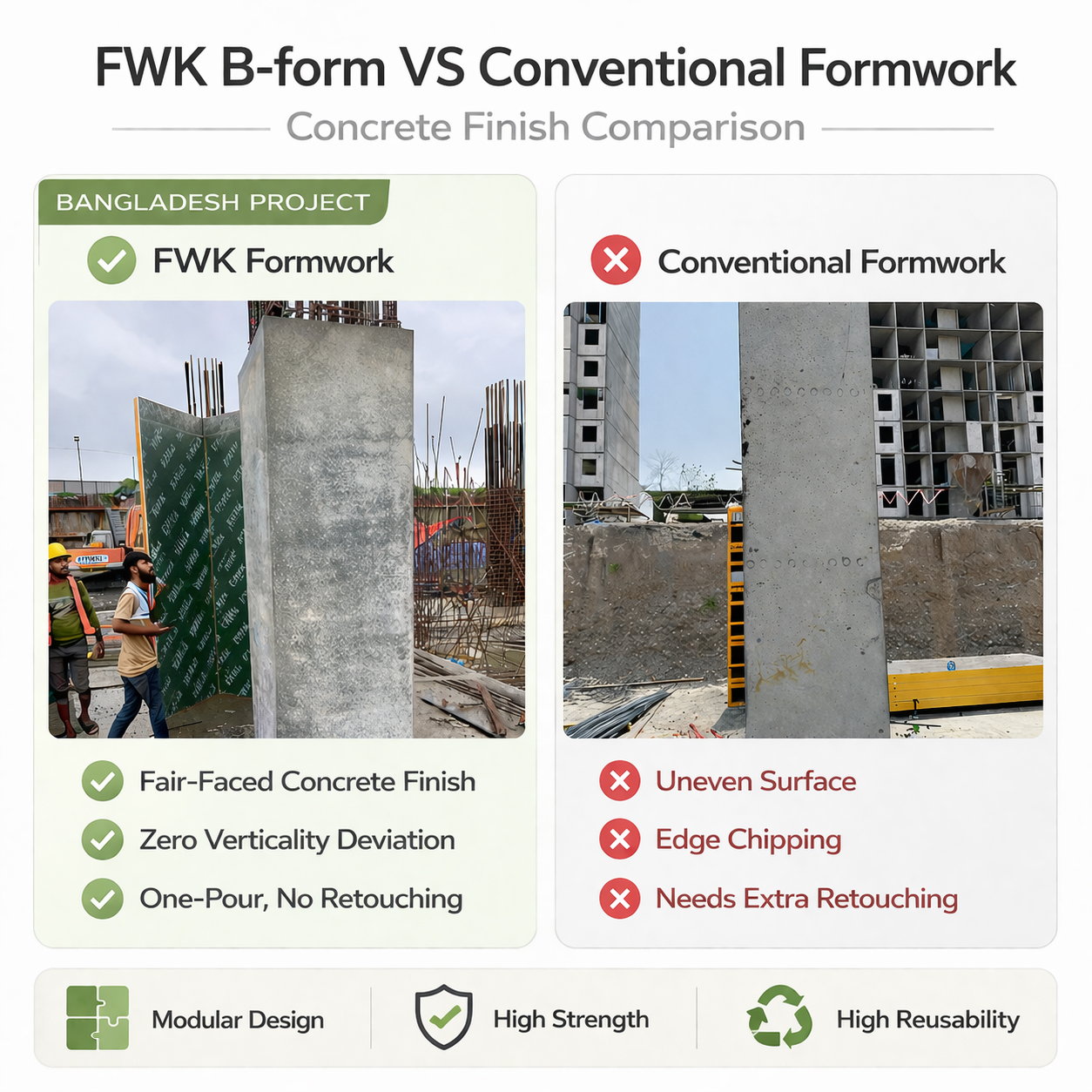
Published comparison material: FWK B-FORM steel-frame wall formwork against conventional steel frame and plywood construction, where frame life drives the economics.
Reading the Compliance Chain: Mill, Fabrication, Site
Compliance in steel formwork runs through three links, and grade evidence exists at all three. A buyer who only inspects the finished panel is inspecting the shortest part of the chain.
Mill: the property that travels with the plate
The mill certificate is the first artefact in the chain. It is the document that states which grade was produced and which mechanical results apply to the delivered plate. At the Decision stage, buyers should ask a simple procedural question: will the certificate accompanying the shipment be traceable to the plate used for the frame profiles, or is it a general document issued for the order as a whole? The difference matters when a project engineer later has to reconcile a submittal against a delivered component.
Fabrication: where grade becomes geometry
The second link converts steel into components, and this is where most compliance failures actually occur. Yancheng Lianggong Formwork has implemented a quality management system that complies with international standards, and its documented inspection routine for steel formwork is structured as a "Three Inspections and One Review" protocol: a Production Inspection carried out in-process, a Quality Inspection at acceptance, a Factory Inspection before shipment, and a General Review as a final acceptance re-check. For steel formwork, the pre-shipment stage includes applying an anti-rust coating, while flatness inspection is carried out once materials arrive on site and specialized lifting equipment is used for all handling operations.
The same logic appears in the B-FORM documentation. There, the pre-shipment factory inspection is described as verifying the certification, strength, thickness and interlayer firmness of the resin panels; inspecting the material and dimensional accuracy of the special keels; and checking connector compatibility — with a factory qualification report issued as the output. Read as a procurement template, that list is a useful benchmark for any steel frame system: material verification, dimensional verification, connection verification, and a written output that can be filed.
Site: where grade meets handling
On site, the grade question turns into a handling question. Lifting points must be sound, panels must be cleaned and coated before and after each use, and dismantling must follow the "install first, dismantle later; install later, dismantle first" sequence without forced removal. Stacking discipline matters as well: when steel frames are stacked, the bottom surface must be supported by at least three cushion points, the stacking height is limited to a defined number of frames per stack, and only a limited number of stacks should be present on site at any time. These are the habits that preserve the properties originally paid for at the mill.
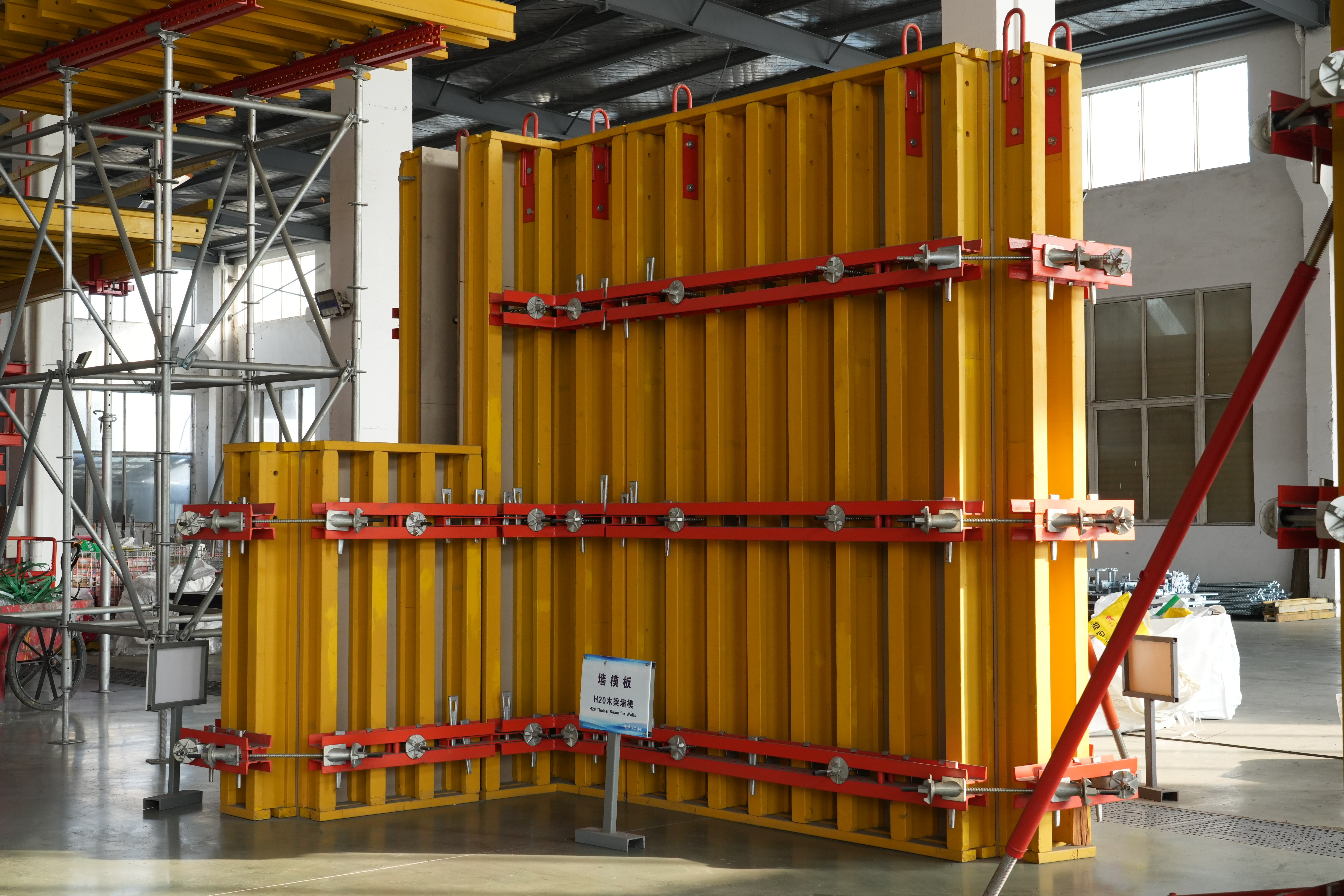
Component and connection verification before shipment: material, tolerance and connector checks belong in the same record as the grade certificate.
Where Grade Selection Shows Up Across Two FWK Lianggong Lines
Grade selection is not an abstract requirement — it attaches to specific components, and the components differ by system type. Two lines illustrate the difference.
Early Stripping Slab Formwork (T-form), FWK-DHF175
Early stripping slab systems carry load through drophead or equivalent components that are cycled many times before the slab panels are moved. That means the frame and the stripping hardware accumulate far more load cycles than a wall panel does. For a system such as the FWK-DHF175, the verification list should cover the declared grade of the frame and load-transfer components, the dimensional tolerance of the assembly, the documented stripping sequence, and the inspection record that confirms each unit before shipment. Because panel and frame have different service lives, the frame grade is the variable that most directly affects how many cycles the system can sustain before calibration, repair or replacement becomes necessary.
120 Steel Frame Formwork
A steel frame wall and column system such as the 120 Steel Frame Formwork places the grade question at the panel perimeter and the connection points. Panel rigidity under fresh concrete pressure, joint fit between adjacent panels, and the behaviour of tie and clamp points all depend on the frame material and how it was fabricated. Buyers comparing this type of system should ask for the declared frame grade in the technical submittal, the fabrication tolerance record, and the flatness inspection result on arrival. One caution applies to both lines: the model name is an identifier, not a specification. A designation such as FWK-DHF175 or 120 Steel Frame Formwork does not, by itself, state plate thickness, steel grade or load rating, and it should never be used as a substitute for the documents that do.
Application Fit: Where Steel Systems and Defined Grades Are Justified
Documented application guidance for FWK Lianggong's steel-frame wall formwork positions it for high-rise and super high-rise buildings, core walls, shear walls, columns, and variable cross-section wall projects where there are high requirements for concrete appearance, verticality and flatness. Those are precisely the conditions in which frame stiffness and frame life are recovered over many repetitions.
Two other contexts push the same decision. The first is repetition: the more times a system is cycled, the more the frame — rather than the panel — determines cost per use, and the more a defined grade is worth verifying. The second is climate and handling intensity. Where panels are lifted, struck and stacked repeatedly in cold or exposed conditions, the toughness class carried by the steel becomes as relevant as the strength class, because impact behaviour is what protects a frame from cracking between uses.
Market Context: Why Grade Documentation Is Becoming a Procurement Issue
The commercial backdrop explains part of the pressure on documentation. The global formwork market reached USD 7.91 billion in 2025 and is projected to grow to USD 12.66 billion by 2034 (Dataintelo, 2025). Asia Pacific dominated the concrete formwork market with a revenue share of approximately 54.7% in 2025 (Fortune Business Insights, 2025). Engineered, modular and reusable systems — the segment in which steel frame, aluminum frame and climbing systems compete — held the largest product share at 38.5% of the total market in 2025 (Dataintelo, 2025). At the top of the market, PERI Group and Doka Group held a combined share of approximately 22% in 2025 (Dataintelo, 2025).
As engineered systems take a larger share of total spend, more procurement decisions shift from "how much material" to "how many cycles, under what load, with what evidence". Two published standards frame that conversation regionally: ANSI/ASSP A10.9-2013 (R2018) governs safety requirements for concrete and masonry work, including formwork design and erection, in the United States, while EN 12812:2008 specifies European performance requirements and general design for falsework. Neither standard removes the buyer's obligation to confirm that the material delivered matches the material specified — it simply makes that obligation auditable.
Comparison With Traditional Solutions — and Where a Higher Grade Is Not the Answer
Higher-grade steel is not automatically the better purchase, and a compliance-focused article should say so plainly. Three boundaries apply.
- Grade is not compliance. A certificate confirms what a mill produced. It does not confirm weld quality, hole position, connector fit or dimensional tolerance. Those are fabrication outcomes, verified by inspection records — which is why the pre-shipment and arrival inspections described earlier carry as much weight as the material document.
- Grade is not free, and it is not weightless. Specifying a higher strength or toughness class raises material cost and can change welding requirements, while adding capacity a project may never use. Weight is a separate variable: aluminum formwork systems are increasingly preferred for high-rise residential projects because they are up to 60% lighter than steel and support 24-hour stripping cycles (Global Growth Insights, 2025). Where crane time, manual handling and cycle speed dominate the cost model, a lighter system can outperform a steel frame system irrespective of its grade.
- Grade cannot compensate for maintenance. FWK Lianggong's published B-FORM comparison puts annual maintenance cost below 5% for the steel-frame system against more than 15% for conventional steel frame and plywood construction, and attributes the gap to a sturdy steel frame with durable panels and standardized, easily replaced components. That figure is a maintenance outcome, not a metallurgical guarantee: it is only reachable if release agents are applied, forced dismantling is avoided, and frames are stored correctly between pours.
Nor is steel the right frame in every project. Published comparison data for FWK Lianggong's H20 timber beam formwork reports a turnover rate of approximately 26–40 times when used double-sided, against 5–8 times single-sided for conventional H20 timber beam formwork, with the conventional product described as suitable for low-cost small-scale engineering, civil housing and scattered assembled non-standard structures. Timber systems generally also carry documented constraints: susceptibility to moisture-induced deformation, flammability, turnover loss and a defined load-bearing limit. For scattered, low-repetition work, those constraints are acceptable and the cost case for a fully engineered steel frame is weak. The right question is therefore not "which grade is highest", but "which grade, at what toughness class, delivers the required load case over the number of cycles this project will actually run" — and no more.
Future Outlook
Three trends are likely to shape how Q355B-type specifications are handled in the next procurement cycles. First, as reusable engineered systems continue to take share in a market growing toward USD 12.66 billion by 2034 (Dataintelo, 2025), the frame rather than the panel becomes the primary asset being purchased, and asset specifications attract asset-level documentation. Second, regional concentration of supply — with Asia Pacific accounting for roughly 54.7% of concrete formwork revenue in 2025 (Fortune Business Insights, 2025) — means cross-border buyers will keep dealing with grade designations and mill documents whose terminology differs from their local practice, making traceability more valuable than familiarity. Third, handling discipline and inspections are increasingly recorded rather than assumed, which favours suppliers who can already produce in-process, acceptance and pre-shipment records as a routine output. For buyers, the practical implication is straightforward: treat steel grade as a decision criterion with its own evidence requirement, verified before shipment rather than after the first pour.
Frequently Asked Questions
What does the "B" in Q355B actually change for a formwork buyer?
The trailing letter identifies the impact-toughness quality class of the delivered plate. For a buyer, this is a handling and climate question rather than a strength question: two plates sharing the same nominal yield-strength class but different toughness classes may behave differently when struck, dropped, or stripped under cold conditions. The design strength calculation may be unaffected; the risk of brittle behaviour under impact is not. Buyers working in exposed or cold-weather conditions should confirm which toughness class is specified, and confirm it against the mill document rather than the quotation.
Does a Q355B mill certificate mean a formwork system is compliant?
No. A mill certificate documents the steel delivered to the fabricator. Compliance of a finished formwork system also depends on fabrication quality (welds, hole positions, dimensional tolerance), component-level inspection, handling procedure and project-specific design checks. The practical approach is to hold three separate pieces of evidence: the mill certificate for the plate, the pre-shipment inspection record for the components, and the arrival inspection — including flatness checks — carried out on site.
How should grade be verified on a system such as FWK-DHF175 or the 120 Steel Frame Formwork?
Start with the declared grade in the technical submittal, then require a mill document traceable to the plate used for the frame profiles, the fabrication tolerance record, and the pre-shipment inspection report. For early stripping slab systems such as FWK-DHF175, add the documented stripping sequence and the load-transfer component inspection. For a steel frame wall and column system such as the 120 Steel Frame Formwork, add joint fit and panel rigidity checks. In both cases the model name should be treated as an identifier, not a specification: it does not state plate thickness, grade or load rating on its own.
Is a higher steel grade always the better purchasing decision?
Not necessarily. Higher grades increase material cost, can change welding requirements, and may add capacity a project never uses. Weight and cycle time are equally decisive: aluminum formwork systems are increasingly preferred for high-rise residential projects because they are up to 60% lighter than steel and support 24-hour stripping cycles (Global Growth Insights, 2025). The appropriate grade is the one that satisfies the design load case with adequate toughness, at a maintenance level the project can realistically sustain, without paying for surplus capacity.
When is a steel frame system with a defined grade the wrong choice?
When repetition is low. The economics of an engineered steel frame depend on reuse: published comparison data for FWK Lianggong's B-FORM line cites 20–40 panel uses and 100+ steel frame uses, while conventional steel frame and plywood construction is cited at 15–30 and 50+ uses. For scattered, small-scale or non-standard assembly work — the segment conventional H20 timber beam formwork is documented as serving, at a turnover rate of roughly 5–8 times single-sided against approximately 26–40 times double-sided for the comparison product — the frame life simply cannot be recovered. In those projects, material choice should follow repetition count and budget, not grade hierarchy.
For readers who need the underlying system documentation rather than the interpretation, the FWK Lianggong product brochure is available for download: formwork and scaffolding system brochure (PDF). Additional technical material is published at lianggongformwork.com.