
Pusher Type Industrial Centrifuge: Specs, Materials, Compliance
Pusher type industrial centrifuges are continuous filtering machines for crystalline and granular solids that must be washed and dewatered at steady throughput. The procurement question is not whether the machine can spin. It is whether the specified pusher geometry, wetted material, motor protection, discharge method and conformity evidence match the process and the destination market. Those constraints decide whether a quotation is technically suitable and commercially comparable.
JGD Centrifuge Co., Ltd. is a centrifuge manufacturer based in Zhangjiagang, Jiangsu, China, founded in 2012. The company operates a 4,000 m² factory with 60 employees, 6 engineers and an annual output of 100 units. Its product range includes pusher, basket, peeler, decanter, bag-lifting and scroll-screen centrifuges. In the pusher category, JGD's published data identifies two models: the HR400 horizontal double-stage pusher centrifuge and the HY1200 horizontal single-stage pusher centrifuge. Both are described as true fully continuous operation, and both are offered with explosion-proof main motors.
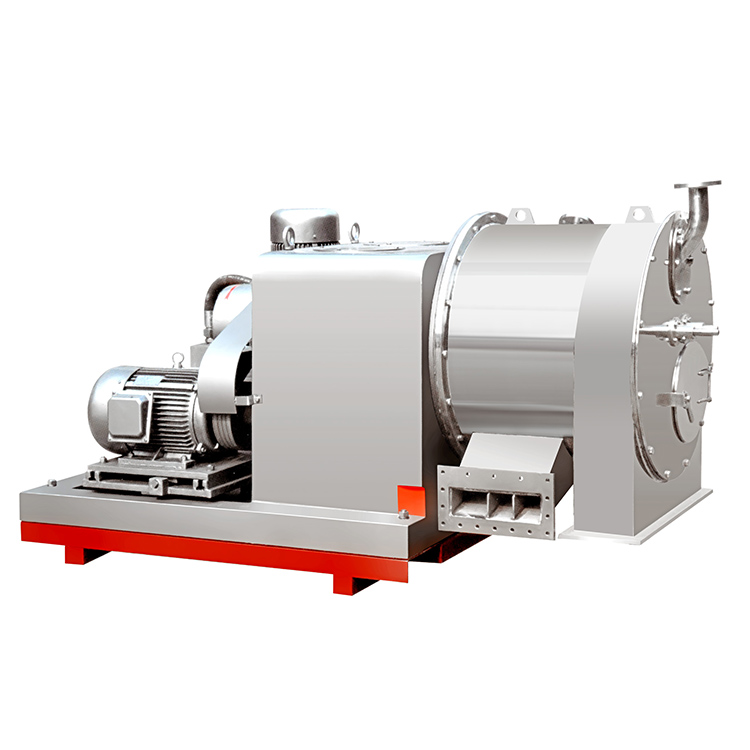
Why pusher selection is a constraint problem, not a catalogue lookup
Most early comparisons start with drum diameter and motor kW. That is a useful first filter, but it is not a specification. A 1200 mm single-stage machine and a 400 mm double-stage machine are not interchangeable. They sit at different points on the capacity, cake dryness, washing and separation-factor curve. A buyer who compares only the headline diameter can miss the more important variable: whether the machine can hold the required cake moisture, wash efficiency and crystal integrity at the actual feed condition.
The same logic applies to materials and certification. A 316L stainless steel contact-part option, an explosion-proof motor and a CE document are three different forms of evidence. One addresses corrosion risk, one addresses electrical safety in a hazardous area, and one addresses conformity for a named model and market. Treating any one of them as a substitute for the other two is a common procurement error in chemical and pharmaceutical projects.
The practical sequence is therefore: define the duty, select the pusher configuration, fix the wetted material and motor protection, then verify the model-specific documentation. The order matters because a material upgrade or an automation change can alter lead time, test scope and the validity of a previous quotation.
What a pusher type industrial centrifuge does
In a pusher type industrial centrifuge, feed is distributed onto a screen. Liquid passes through the filter medium while solids form a cake. A reciprocating piston then pushes the cake forward in controlled steps. Washing can be applied before the cake is discharged. The result is a continuous filtering process rather than a batch cycle with repeated acceleration and deceleration.
The HR400 uses a double-stage design. JGD's product description states that the two-stage stepped dewatering produces drier filter cakes and more thorough washing. Axial material-pushing resistance is halved, and processing capacity is increased. The design is also described as suitable for a wider range of material particle sizes, including finer particles, while protecting crystals because there is no mechanical abrasion from a blade.
The HY1200 uses a single-stage design with a 1200 mm drum and a 500 mm filter length. JGD describes it as true fully continuous, uninterrupted operation with extremely high single-unit production capacity. Its piston-based material pushing and discharging avoid scraping or cutting wear. The machine is also described as offering high-efficiency penetrating wash, high product purity and high filter cake dryness, which can reduce the energy demand of downstream drying.
Both models are continuous machines, but they are not competing for the same duty. The HR400 is the more compact double-stage option with a higher separation factor and a stronger washing story. The HY1200 is the large single-stage option built around single-unit capacity and a simple continuous path.
HR400 and HY1200 in published numbers
The HR400 has a drum diameter of 337/400 mm, a filter length of 145/155 mm, a drum speed of 1600 rpm, a maximum separation factor of 545/645 and an explosion-proof main motor rated at 11 kW. The HY1200 has a drum diameter of 1200 mm, a filter length of 500 mm, a maximum loading limit of 130 kg, a drum speed of 500 rpm, a maximum separation factor of 170 and an explosion-proof main motor rated at 30 kW.
These figures should be read as boundary conditions, not as a ranking. The HY1200 is not better because it is larger. The HR400 is not better because its separation factor is higher. The correct question is which boundary fits the process. A high-capacity single-stage duty with a well-formed cake points one way. A duty that needs two-stage washing, drier cake and a wider particle-size window points the other way.
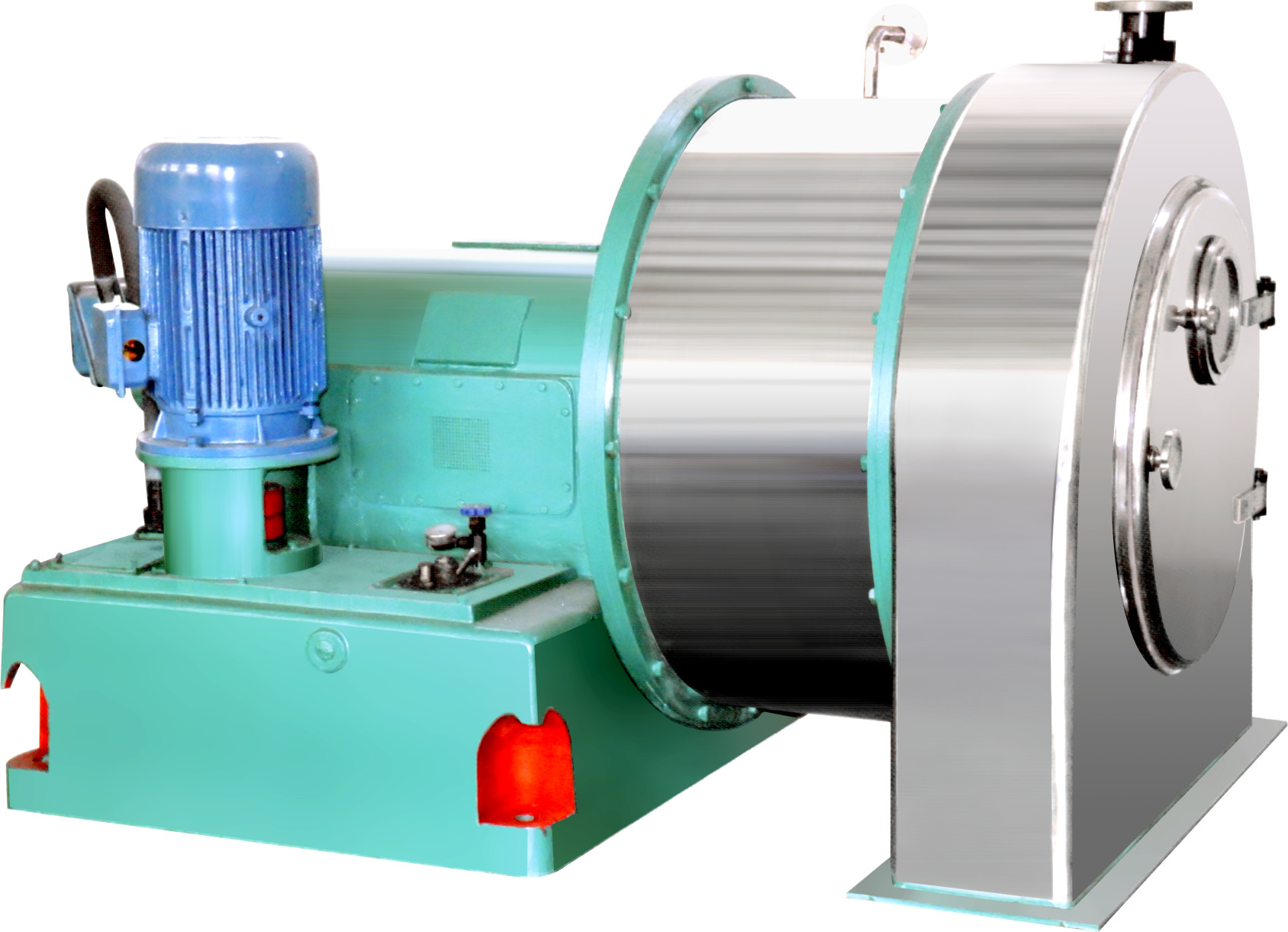
Separation factor: the constraint that shapes the shortlist
JGD's FAQ material defines separation factor as an indicator of centrifugal separation capability: the higher the value, the stronger the separation capability. The same material gives general guidance for crystalline materials at around 800 to 1200, suggests higher values for fine particulate materials, and cautions against too high a value for fragile materials to prevent particle breakage.
The two pusher models in the supplied data are listed at a maximum separation factor of 545/645 for the HR400 and 170 for the HY1200. That gap is not a contradiction. It reflects the pusher's role as a continuous cake-washing and dewatering machine rather than a high-g-force polishing device. If the process requires a separation factor above the pusher range, the comparison should move to other configurations in the same catalogue. The GK1000 peeler is listed at a maximum separation factor of 1020, the LWL450 scroll-screen centrifuge at 1570, and the LW350 decanter at 2683.
This is the first real selection boundary. A buyer who starts with the words pusher type industrial centrifuge and stops there may force a pusher into a duty that needs a decanter or a high-speed peeler. A buyer who starts with the required separation factor, cake moisture and wash ratio will shortlist the right machine family before comparing suppliers.
Materials and corrosion constraints
JGD's published material list for the HR400 and HY1200 includes SS304, SS321, SS316L, SS2205, SS904L, titanium and Hastelloy-C alloy. SS316L is available as a contact-part material option, and the product can be supplied with 316L stainless steel wetted parts. Titanium and Hastelloy-C alloy are listed as options for corrosive media.
That list is a starting point, not a material recommendation. Material selection depends on the actual medium: chloride content, pH, temperature, abrasion, cleaning chemistry and the risk of stress-corrosion cracking. The supplied data does not include a corrosion chart or a material-service matrix for the pusher models. A buyer should therefore request a wetted-parts list, the proposed material grade for each wetted component, and a material certificate for the actual medium before placing an order.
For pharmaceutical and API duties, 316L stainless steel contact parts are often the minimum starting point. For chemical duties with corrosive media, SS2205, SS904L, titanium or Hastelloy-C alloy may be more relevant. The important procurement point is that the material upgrade must be quoted as a defined scope, not as a vague corrosion-resistant option. A quotation that does not state the wetted material is not comparable to one that does.
Material decision rule: use the process medium to define the wetted material, then use the material to define the quotation. Do not select the material from a generic corrosion table without confirming the actual chloride, pH and temperature conditions.
Motor, explosion protection and operating boundaries
The HR400 main motor is explosion-proof and rated at 11 kW. The HY1200 main motor is explosion-proof and rated at 30 kW. The HY1200 is also described as using a hydraulic drive for smooth operation, with a robust structure that is easy to maintain. These are useful facts, but they do not by themselves prove that the complete installation is suitable for a hazardous area.
An explosion-proof motor is one component of a hazardous-area package. The buyer should confirm the area classification, the motor certificate, the electrical component selection, grounding, instrumentation and any required purge or ventilation measures. JGD offers ODM customization for voltage, electrical component brand, including PLC and touch screen, frequency converter and motor, as well as bearings. Those choices affect lead time, spare-parts strategy and the final bill of materials.
Feed consistency is another operating boundary. JGD's FAQ material notes that violent vibration during operation can occur when the solid concentration is uneven or contains lumps, and that the correct response is to stop the centrifuge for inspection. The preventive measure is to ensure the solid concentration is uniform and free of lumps before feeding. For a continuous pusher machine, feed conditioning is therefore part of the equipment scope, not an afterthought.
Certification: what the CE document covers and what it does not
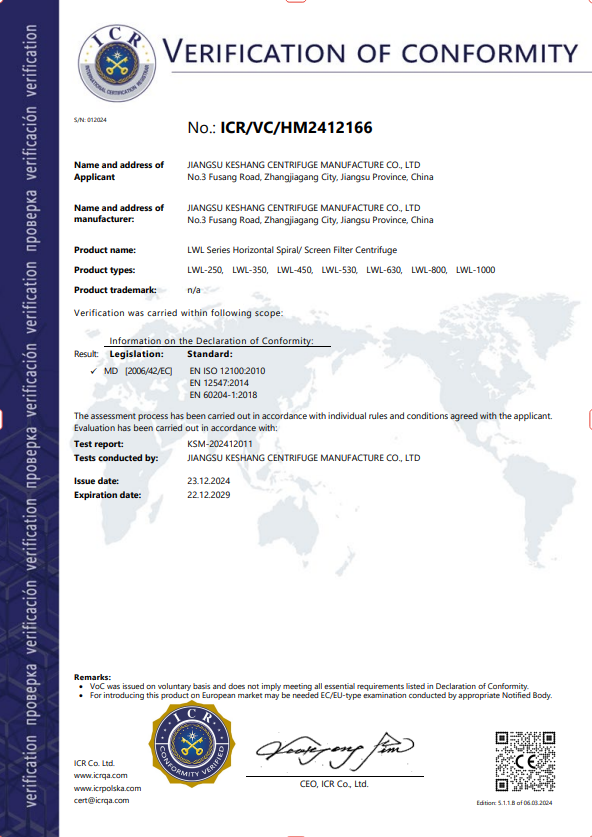
JGD holds Verification of Conformity No. ICR/VC/HM2412166, issued by ICR Co., Ltd. The certificate was issued on 2024-12-23 and is valid until 2029-12-22. It covers the LWL Series Horizontal Spiral / Screen Filter Centrifuge, with product types LWL-250, LWL-350, LWL-450, LWL-530, LWL-630, LWL-800 and LWL-1000. The assessment was made under Legislation MD 2006/42/EC and the standards EN ISO 12100:2010, EN 12547:2014 and EN 60204-1:2018. The LWL450 model is within the scope of this certificate.
This is a real, model-specific document, and it should be read precisely. It does not list the HR400 or HY1200 pusher models. The correct statement is not that JGD is CE certified for all centrifuges. The correct statement is that the LWL series is covered by this Verification of Conformity, and the pusher models require their own model-specific conformity evidence for the destination market.
Important limit: the CE certificate ICR/VC/HM2412166 covers the LWL series, including LWL450. It does not cover the HR400 or HY1200 pusher models. A buyer who requires CE for a pusher project should request the model-specific declaration and verify the model list before order.
EN 12547:2014 is the current European standard for centrifuge safety requirements, excluding household and laboratory models under EN 61010-2-020. Its presence in the LWL certificate is evidence that the LWL series was assessed against the centrifuge safety standard. It is not evidence that every JGD model has been assessed to the same scope.
Hygiene claims follow the same model-specific logic. JGD's data describes cGMP sanitary construction, cGMP/CIP compatibility and no dead corners for the PSLQ800 basket centrifuge. Those claims should not be transferred to the HR400 or HY1200 without a model-specific document. For pharmaceutical pusher duty, the buyer should request the hygiene design, surface finish, cleaning validation and material traceability package for the exact model being purchased.
Application fit: chemical, pharmaceutical, salt and fertilizer
JGD's pusher models list fine chemical, pharmaceutical, API, food, metallurgical, lithium battery intermediate materials, environmental protection and resource recycling among their applicable industries. That is a broad envelope, and it should be narrowed by duty.
In the chemical industry, the pusher's continuous operation and explosion-proof motor make it relevant for crystalline products that need steady throughput, washing and dewatering. The material options allow the wetted parts to be specified for corrosive media. The constraint is that the final material selection must be based on the actual medium, not on a generic stainless-steel assumption.
In the pharmaceutical and API sector, the pusher's appeal is the combination of continuous operation, cake washing and crystal protection. The HR400's two-stage design is particularly relevant when washing efficiency and cake dryness matter. However, the supplied data does not describe cGMP construction for the HR400 or HY1200. A pharmaceutical buyer should therefore treat hygiene documentation as a separate qualification item, not as an assumption inherited from another JGD basket model.
For salt and fertilizer projects, pusher type industrial centrifuges are often evaluated where the solid is crystalline and the process needs continuous throughput and cake washing. The supplied JGD data does not include a named salt or fertilizer pusher reference. That does not disqualify the model, but it changes the evidence requirement. The buyer should run a material test and confirm crystal size distribution, feed consistency, wash ratio, target cake moisture, material grade and model-specific conformity before committing to a production unit.
The same evidence discipline applies to lithium battery intermediates and recycling duties. The pusher models list these industries as applicable, but the buyer still needs a material test and a defined wetted-material scope. A catalogue application list is a screening tool, not a performance guarantee.
Commercial constraints: MOQ, lead time and price-band caution
JGD's published commercial data gives a minimum order quantity of 1 unit, a lead time of 30 to 60 days and a monthly capacity of 8 units. The company reports an annual output of 100 units and an export ratio of 80%, with main markets in South America, Southeast Asia, North America, the Middle East and Europe. Quality control includes a no-load test before delivery, and after-sales support is described as remote support.
The supplied data does not include a price band for the HR400 or HY1200. That is not a gap to be filled with a guess. Pusher centrifuge quotations are not comparable unless they are normalized for drum and filter configuration, wetted material, motor protection, electrical component brand, control package, testing and certification scope. A lower headline price for an SS304 machine without model-specific conformity documents is not the same offer as a 316L or SS2205 machine with a full documentation package.
A useful quotation request should therefore separate the base machine, the material upgrade, the motor and electrical package, the automation options and the documentation scope. That structure makes lead time and cost drivers visible. It also prevents a later dispute about whether a certificate, a test or a spare-parts package was included in the original price.
Market trend: filtering growth and tighter documentation
Commercial research from Fortune Business Insights estimates that filtering centrifuges are forecast to grow at 7.2% annually, driven by API crystallization and specialty-chemical purification. The same source estimates that sedimentation centrifuges held 56.6% of the industrial centrifuge market in 2025. These are commercial estimates, not a consensus. They are useful as directional signals for specification planning, not as a substitute for project-level validation.
Public market-size estimates for industrial centrifuges are not consistent across commercial sources. This article therefore does not use a single global market-size figure as a procurement benchmark. The more reliable signal for a buyer is the direction of demand: filtering duties in API crystallization and specialty-chemical purification are receiving attention, and that attention tends to raise the importance of wash efficiency, cake dryness, material traceability and model-specific conformity.
The standards picture is clearer. EN 12547:2014 is the current European standard for centrifuge safety requirements, excluding household and laboratory models under EN 61010-2-020. For a pusher project destined for the EU, the buyer should verify how the chosen model is assessed against the applicable machinery safety requirements, even if the certificate held by the supplier covers a different model family.
Comparison with batch and decanter alternatives
The pusher is not the default answer for every solid-liquid separation duty. The table below places the two JGD pusher models beside other configurations in the same published data. The comparison is based on model-level facts, not on a claim that one configuration is universally better.
| Model | Type and operation | Key published data | Maximum separation factor | Main motor | Discharge and position | Certification in supplied data |
|---|---|---|---|---|---|---|
| HR400 | Horizontal double-stage pusher; continuous | Drum 337/400 mm; filter 145/155 mm; 1600 rpm | 545/645 | 11 kW, explosion-proof | Piston pushing; two-stage cake dewatering and washing | No pusher CE certificate listed |
| HY1200 | Horizontal single-stage pusher; continuous | Drum 1200 mm; filter 500 mm; max load 130 kg; 500 rpm | 170 | 30 kW, explosion-proof | Piston pushing; high single-unit capacity | No pusher CE certificate listed |
| GK1000 | Horizontal peeler; batch | Drum 1000 mm; 165 L; max load 225 kg; 1350 rpm | 1020 | 37 kW, explosion-proof | Fully automatic scraper discharge | Not listed |
| LWL450 | Horizontal scroll-screen; continuous | Feed 20 m³/h; 2500 rpm | 1570 | 22 kW, explosion-proof | Scroll and screen discharge | CE ICR/VC/HM2412166 |
| LW350 | Horizontal decanter; continuous | Drum 350 mm; length 1550 mm; 3700 rpm | 2683 | 15–22 kW, explosion-proof | Scroll discharge | Not listed |
The table shows the central trade-off. The pusher models offer continuous operation, piston-based discharge and crystal protection, but their maximum separation factors are lower than those of the GK1000 peeler, the LWL450 scroll-screen and the LW350 decanter. If the process needs a higher g-force, a different machine family should be evaluated before the supplier comparison begins.
Batch peeler, bag-lifting and manual top-discharge models remain relevant when the operating pattern is batch-based, when cake discharge must be visually confirmed, or when the product mix changes frequently. The bag-lifting design is intended to discharge the cake with a single lift and avoid scraping, while the scraper and peeler designs use different discharge logic. The decision is not about modernity. It is about matching the discharge method to the production pattern and the product.
Limitations and when another configuration is better
The first limitation is the separation factor. The HR400 is listed at 545/645 and the HY1200 at 170. If the process requires a separation factor in the range of the GK1000, LWL450 or LW350, the pusher should not be forced into that duty simply because it is continuous.
The second limitation is certification. The CE certificate in the supplied data covers the LWL series, including LWL450. It does not cover the HR400 or HY1200. A buyer who needs CE for a pusher model must request a model-specific declaration and verify the scope before order.
The third limitation is hygiene evidence. The cGMP sanitary construction and cGMP/CIP compatibility claim in the supplied data is attached to the PSLQ800 basket centrifuge. It is not automatically transferable to the pusher models. Pharmaceutical buyers should request a model-specific hygiene package.
The fourth limitation is application evidence. The pusher models list chemical, pharmaceutical, API, food, metallurgical, lithium battery intermediate, environmental and recycling industries. The supplied data does not include a named salt or fertilizer pusher reference. That means a salt or fertilizer buyer should validate the duty with a material test rather than rely on a generic application list.
The fifth limitation is commercial visibility. The data gives MOQ, lead time, monthly capacity and customization options, but no price band. A price comparison without a normalized material, motor, control and certification scope is not a real comparison.
Future outlook
The next buying cycle for pusher type industrial centrifuges is likely to be shaped less by a new headline geometry than by documentation and configuration control. Continuous operation, cake washing and crystal protection remain the core process advantages. The differentiators are becoming the wetted-material package, the explosion-proof electrical scope, the model-specific conformity file and the ability to quote a repeatable configuration.
JGD's ODM options for voltage, electrical component brand and bearings fit that pattern. They allow the machine to be adapted to a plant standard, but they also increase the importance of a written bill of materials. The buyer who defines the material, motor, control and documentation scope before comparing prices will get a more useful answer than the buyer who compares only drum diameter and kW.
The market signal supports the same conclusion. Filtering centrifuge demand is receiving attention from API crystallization and specialty-chemical purification, while commercial market-size estimates remain inconsistent. In that environment, a model-level test report and a scoped quotation are worth more than a generic market claim.
FAQ
What defines a pusher type industrial centrifuge in this range?
A pusher type industrial centrifuge is a continuous filtering centrifuge that uses a reciprocating piston to push a formed cake along a screen. In JGD's range, the HR400 is a horizontal double-stage pusher and the HY1200 is a horizontal single-stage pusher. Both are described as true fully continuous operation and both use explosion-proof main motors.
What is the difference between the HR400 and HY1200?
The HR400 has a 337/400 mm drum, a 145/155 mm filter length, a drum speed of 1600 rpm, a maximum separation factor of 545/645 and an 11 kW explosion-proof main motor. Its two-stage design is intended for drier cake and more thorough washing. The HY1200 has a 1200 mm drum, a 500 mm filter length, a maximum loading limit of 130 kg, a drum speed of 500 rpm, a maximum separation factor of 170 and a 30 kW explosion-proof main motor. Its single-stage design is oriented toward high single-unit capacity.
Which wetted materials are available for corrosive or pharmaceutical duty?
The published material options for the HR400 and HY1200 include SS304, SS321, SS316L, SS2205, SS904L, titanium and Hastelloy-C alloy. SS316L is available as a contact-part material option, and 316L stainless steel wetted parts can be supplied. Titanium and Hastelloy-C alloy are listed for corrosive media. Final selection depends on the actual medium, and the supplied data does not include a corrosion chart, so the wetted-parts list and material certificate should be confirmed for the specific duty.
Does the CE certificate ICR/VC/HM2412166 cover the pusher models?
No. Verification of Conformity No. ICR/VC/HM2412166, issued by ICR Co., Ltd., covers the LWL Series Horizontal Spiral / Screen Filter Centrifuge, including LWL-250, LWL-350, LWL-450, LWL-530, LWL-630, LWL-800 and LWL-1000. LWL450 is within scope. The certificate was issued on 2024-12-23 and is valid until 2029-12-22, and it was assessed under MD 2006/42/EC and the standards EN ISO 12100:2010, EN 12547:2014 and EN 60204-1:2018. It does not list the HR400 or HY1200 pusher models.
Can pusher centrifuges operate continuously?
Yes. Both the HR400 and HY1200 are described as true fully continuous operation. The HY1200 uses piston-based material pushing and discharging, while the HR400 uses two-stage stepped dewatering. Continuous operation does not remove the need for feed consistency. JGD's FAQ material notes that violent vibration can occur if the solid concentration is uneven or contains lumps, and that the centrifuge should be stopped for inspection in that case.
What commercial terms should buyers confirm before ordering?
The published commercial data gives a minimum order quantity of 1 unit, a lead time of 30 to 60 days and a monthly capacity of 8 units. JGD offers ODM customization for voltage, electrical component brand, including PLC and touch screen, frequency converter and motor, as well as bearings. Quality control includes a no-load test before delivery, and after-sales support is described as remote support. The data does not include a price band, so the quotation should be normalized by wetted material, motor and control package, testing and certification scope.
Reference document: JGD Centrifuge brochure (PDF).
¿Tiene preguntas o necesita más detalles?
Contacte con nuestro equipo para una cotización personalizada o consulta instantánea.
Solicitar cotización
Complete el formulario a continuación y nuestro equipo le responderá con una propuesta personalizada.
Chat directo de WhatsApp
¿Prefiere chatear en tiempo real? Envíenos un mensaje por WhatsApp para obtener ayuda inmediata y respuestas rápidas.
- Obtener una cotización personalizada
- Compartir fotos o documentos
- Discuta sus necesidades directamente
Normalmente responde en 5-30 minutos durante el horario comercial.