
Pulp Molding Machine FAQ: Downstream Cycle-Matching Risk
Procurement Reference · Molded Fiber Production Lines
A pulp molding machine is normally purchased against a forming specification. The output a buyer actually receives is set by the slowest element of the whole line — and in a fully automatic pulp molding machine, that line does not stop at the forming station.
Procurement briefs for molded fiber equipment are usually written around the forming unit: mold platen size, forming and hot-pressing pressure, station count, and rated capacity in kilograms per 24 hours. Those figures matter, but they describe a machine, not a production system. In a working plant, formed parts still have to be transferred, trimmed, inspected, stacked and packed. Each of those steps runs on its own cycle. When those cycles are not engineered against the forming rhythm, the result is rarely a broken machine — it is a bottleneck that caps output, a reject rate that drifts upward, and stoppages that no maintenance schedule predicted.
Downstream automation cycle mismatch is one of the most frequently underestimated risks in molded fiber projects, and it is usually a purchasing problem before it becomes a mechanical one. Forming equipment, pulp preparation and downstream automation are commonly bought from separate suppliers, each with its own performance commitment and no contractual owner for the interface between them. This reference addresses the issue as a set of procurement questions, using verifiable equipment facts and documented project experience rather than general assurances.
What “cycle matching” actually means
Cycle matching in pulp molding is the alignment of takt times, transfer windows and buffering logic across every station that touches the product — forming, hot pressing, trimming, vision inspection, stacking and packing — together with the pulp preparation and utility systems that feed them.
The difficulty is that the sub-systems do not share a natural rhythm. A trimming module and a forming module are engineered to different tempos. On the Hanson ZAKS-9595 pulp molding cup lid production line, the trimming module is specified at a trimming cycle of 10 seconds per mold with a trimming pressure of 50 tons, while the forming module runs a 950 × 950 mm platen with 10 tons of forming pressure and 40 tons of hot-pressing pressure. On the Hanson ZCE-1111 fully automatic integrated pulp molding tableware machine, by contrast, the forming cycle is 28 to 60 seconds per mold, depending on product, with six molds, 20 tons forming pressure, 60 tons hot-pressing pressure and 70 tons trimming pressure. Hanson’s own published product material lists a cycle time of 28 seconds and up to 900 kg of daily output for its fully automatic food container machine.
These numbers are not competing claims. They are evidence that within the same equipment family, different sub-systems operate on different clocks. A transfer and buffering architecture has to reconcile them, which means the reconciliation is an engineering decision made at the drawing stage — not a field adjustment made after installation.
How a mismatch shows up in production
Cycle mismatch does not announce itself. It surfaces in three recognizable patterns.
Bottleneck: the downstream step sets the ceiling
If the combined transfer, trimming, inspection and packing cycle is longer than the forming cycle, semi-finished product accumulates between stations. Forming then either starves, waits, or is forced into an artificial pause to avoid overfilling the buffer. The line still runs, but it runs below the rated capacity printed on the forming machine’s datasheet — and the shortfall is often misattributed to the forming equipment.
Rejects: transfer windows that are too short
The reverse configuration produces its own defects. When downstream modules are set faster than the transfer system can reliably deliver and remove parts, mold positioning becomes marginal. Trimming then cuts outside tolerance, and inspection rejects rise. Shortening hot-pressing dwell to chase a cycle target introduces a second cause of rejects, because in-mold drying and forming consistency depend on that dwell and on the temperature of the heating plate.
Unscheduled stops: micro-stops rather than breakdowns
Mismatched lines rarely fail dramatically. They stop in short, repeated interruptions: a jam that needs clearing, a buffer at maximum, a transfer robot waiting on a signal that arrives late. These events are individually trivial and collectively expensive, because they interrupt the thermal and vacuum stability the process depends on. Restarting a forming station after a micro-stop means re-establishing the same conditions that took time to reach.
Why commissioning — not the machine — decides the outcome
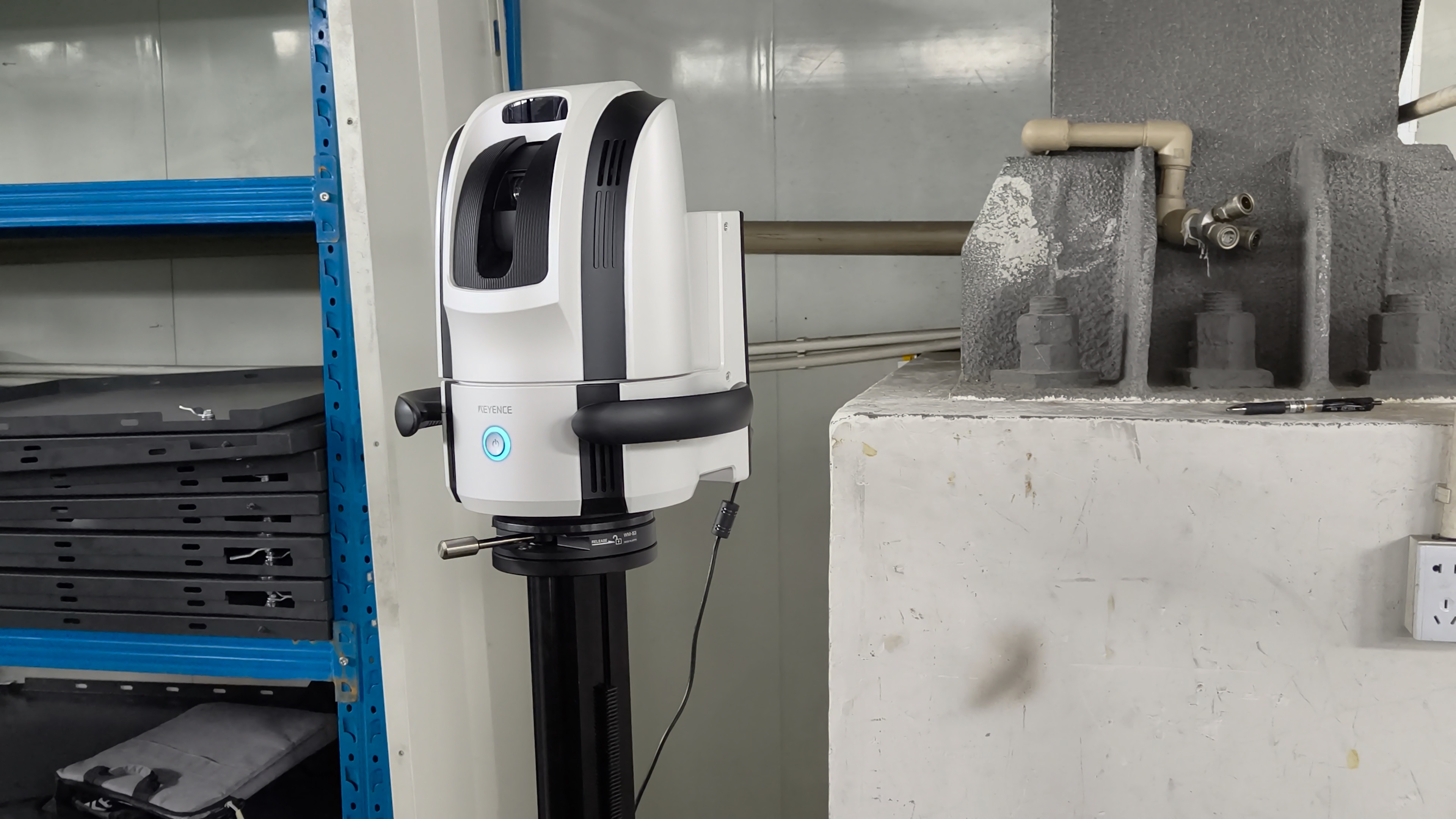
Component and system inspection before shipment reduces the number of variables that must be resolved during on-site commissioning.
A pulp molding line is commissioned as a system, not as a set of independent machines. Vacuum, heating, slurry feeding and machine rhythm are adjusted together under real production conditions, because each of them changes the effective cycle of the others.
The parameter sets published for Hanson equipment illustrate why. Vacuum on the Hanson ZBG-1111 pulp molding tableware production line and the ZCE-1111 integrated tableware machine is specified at −0.06 to −0.05 MPa, while the ZAD-8565 compact industrial packaging machine, the ZAP-9585 large-format industrial packaging machine and the ZAKS-9595 cup lid line are specified at −0.07 to −0.05 MPa. Slurry feeding is just as varied: continuous internal-circulation feeding on the ZFG-1111 tableware production line, quantitative slurry injection on the ZCE-1111, quantitative feeding on the ZAD-8565, precise self-circulating feeding with dynamic replenishment on the ZAP-9585, and circulating slurry feeding with reciprocating pulp suction on the ZAKS-9595. Heating is a further variable: the ZFG-1111 is rated at 102 kW with electric heating or 39 kW with oil heating, and the ZBG-1111 supports oil, electric or steam heating at a 60 kW power rating, a configuration Hanson links to improved energy efficiency in molded fiber tableware production.
Each of those choices shifts the timing of the cycle. Stronger vacuum shortens dewatering but changes mold release behavior. A different heating method changes the dwell needed for in-mold drying. Slurry consistency and feeding method change the mass deposited per mold, which changes transfer loads. Adjusting one variable in isolation to fix a symptom typically transfers the problem to the next station.
Should pulp supply, forming and automation be bought as one system?
Not automatically — but they should be specified against one performance target. The effective cycle is produced by the interaction of slurry preparation, vacuum, heating and transfer logic, so whoever owns that interaction should also own the output commitment.
| Evaluation dimension | Single integrated scope | Separate purchase by module |
|---|---|---|
| Cycle ownership | One party owns forming-to-packing takt matching | Interface exists only after both suppliers are on site |
| Interface risk | Absorbed by the line supplier | Requires a written interface specification to be enforceable |
| Commissioning logic | Vacuum, heating, slurry feeding and rhythm tuned as one sequence | Each system tuned to its own target; reconciliation done last |
| Initial capex | Generally higher single commitment | Can be lower and staged across budget cycles |
| Use of existing suppliers | Limited to the integrated scope | Lets a plant reuse validated local automation partners |
| Upgrade path | Scope extension follows existing engineering baseline | More flexible, but re-opens interface definition at each change |
The deciding factor is usually not price. It is whether the buyer has an existing downstream automation partner with proven cycle performance and local service. Where that partner exists, separate purchase can work — provided the interface is documented. Where the buyer is building capacity for the first time, or scaling a line configuration across multiple sites, a single integrated scope removes the most common source of unexplained underperformance.
How an integrated scope is structured in practice
Guangdong Hanson Pulp Molding Technology Co., Ltd. is a National High-tech Enterprise based in Houjie Town, Dongguan City, Guangdong Province, China, employing more than 200 people, including approximately 50 R&D and engineering professionals, and holding 50 patents covering equipment structures, production processes and automation systems. The company manufactures pulp molding tableware production lines, premium industrial packaging equipment, plant-fiber cup lid production lines, sampling and pilot production lines, and downstream automation equipment and systems for trimming, vision inspection, automatic stacking and packing.
Depending on project scope, Hanson’s turnkey pulp molding factory solutions can include preliminary product and raw-material verification, project feasibility analysis, production-capacity planning, factory layout design, intelligent pulp preparation systems, pulp molding forming equipment, mold design and manufacturing, downstream automation, electrical control systems, installation and commissioning, personnel training and production ramp-up support. Turnkey projects can be supported with up to six months of on-site production assistance, and Hanson operates a service network with 10 service locations, offering remote technical support, on-site troubleshooting, spare-parts supply and 24/7 service response.
The relevant point for cycle-matching risk is structural rather than promotional: mold design, pulp preparation, forming equipment, automation and process teams work toward the same mass-production targets inside one organisation. That is what makes it possible to resolve a forming-versus-transfer timing conflict by changing a mold, a slurry parameter or a servo profile — instead of initiating a dispute between two suppliers.
Where integrated scope has already been tested
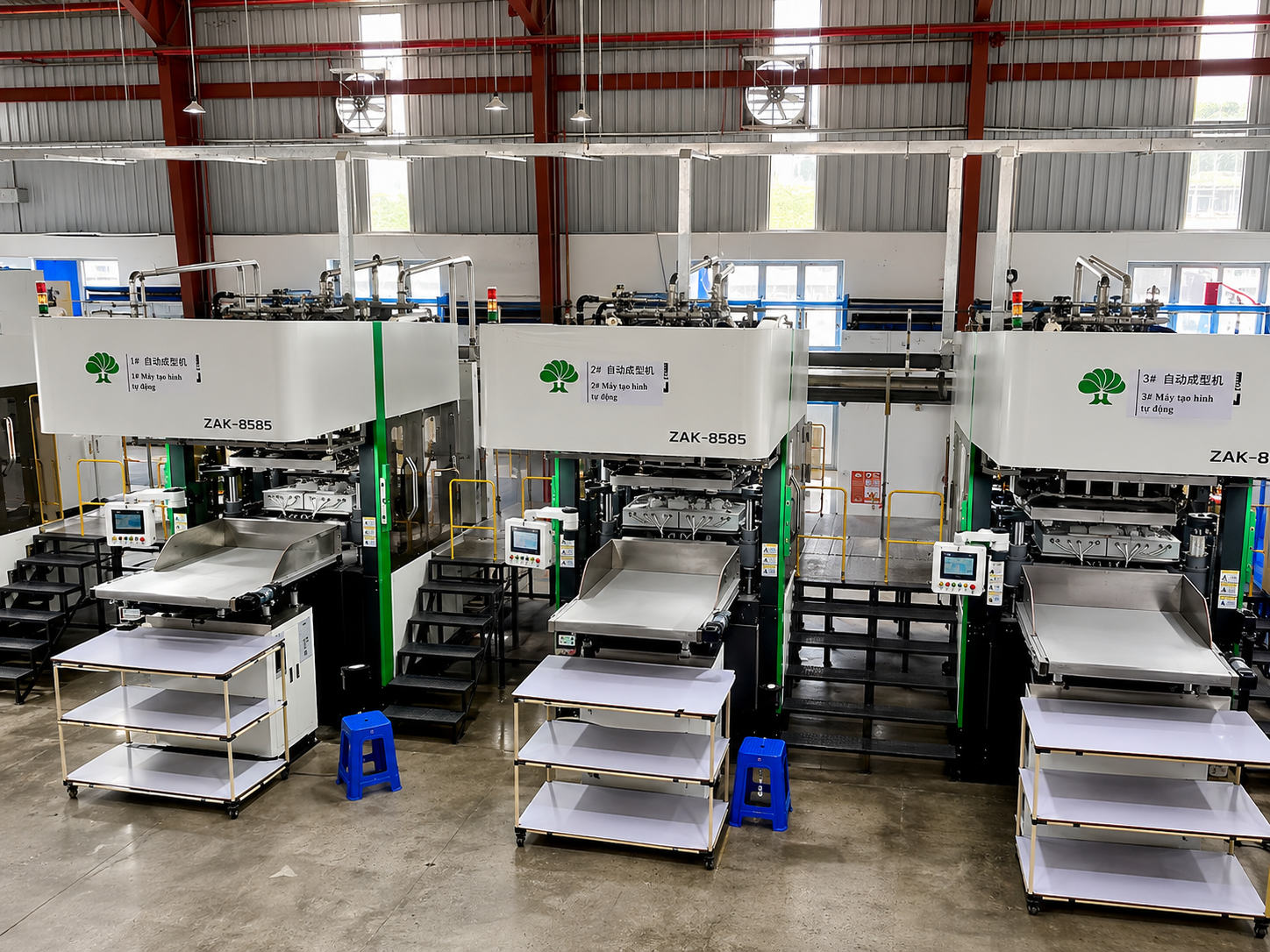
Industrial packaging production site: repeat orders over multiple years indicate that downstream handling performed to expectation after ramp-up.
Documented molded fiber projects show a consistent pattern: where downstream scope was part of the original purchase, capacity targets were reached without a separate reconciliation phase.
- Thailand — tableware, first-phase base. A listed manufacturer of biodegradable tableware and sustainable consumer products tested equipment intensively for four months across stability, production capacity and product quality, then selected Hanson as a core equipment supplier and purchased more than 100 machines for the first phase of its Thailand production base. The equipment includes the ZBG-1111 full-servo tableware production line with a rated capacity of 1,000–1,500 kg per 24 hours. The project included factory-level solutions covering pulp preparation, forming equipment and mold development, plus installation, commissioning, production support and a dedicated after-sales service point in Thailand.
- Vietnam — plastic-to-fiber transition. After multiple rounds of supplier evaluation, Changya selected Hanson as an equipment partner for its transition from conventional plastic products to molded fiber packaging, with more than 50 pulp molding machines supplied for the first phase of its Vietnam production base, using modular and scalable configurations to support rapid capacity expansion.
- Vietnam — industrial packaging expansion. Gaoyi Packaging began with an initial trial machine, then placed repeat orders over several years and purchased a total of 80 pulp molding industrial packaging machines for protective packaging of consumer electronics and small household appliances — a pattern consistent with stable performance after ramp-up rather than first-year optimism.
- China — large-scale tableware capacity. Hanson delivered 32 customized core production machines for Qiaowang’s factory expansion, part of a 40,000-ton-per-year project, raising annual output from approximately 6,000 tons to 16,000 tons with equipment adapted to bagasse pulp.
- China — long-cycle industrial packaging. A professional molded fiber industrial packaging manufacturer placed five orders between 2023 and April 2025, reaching 20 units of the ZAD-8565 machine, supported by continuous equipment customization, 24-hour technical response and on-site production support that shortened the commissioning period.
- China — turnkey bamboo-fiber plant. For an integrated bamboo materials and sustainable food packaging manufacturer, Hanson delivered a complete turnkey solution covering factory planning, construction coordination, pulp preparation, customized forming equipment, wastewater treatment and personnel training, progressing from equipment installation to trial production in approximately three months.
- China — trial production before commitment. A listed biomass materials manufacturer worked through seven months of trial production with Hanson before full project cooperation, ultimately implementing 15 units of the ZBG-1111 line — an example of the validation period that cycle-sensitive products often require.
Market context: why cycle discipline is becoming a commercial issue
The demand picture reinforces the argument. One commercial market research estimate places the global pulp moulding machines market at USD 2,140.0 million in 2024, projected to reach USD 3,760.2 million by 2032, a 7.3% CAGR for 2025–2032. The same body of research indicates that food and beverage packaging consumes approximately 45% of demand, with cup, tray and bowl formats leading. Market size estimates in this category vary substantially between providers because some reports classify all paper-making machinery under the same heading; the USD 2,140.0 million figure is a source-reported estimate for pulp moulding equipment specifically, and should be read as such.
Supply-side data adds a second dimension. China’s exports of machinery for making paper or paperboard (HS 843920) were valued at USD 49.58 million in 2024, according to the World Integrated Trade Solution / World Bank dataset. Export volume at this level implies a large installed base of equipment being shipped and commissioned across multiple markets — and every overseas installation is a project where interface responsibility has to be defined in advance, often across languages and time zones.
Regulation is moving in the same direction. Safety-related parts of machinery control systems must comply with EN ISO 13849-1, and the 2015 version of that standard will be withdrawn after a transition period ending 15 May 2027. Because a functional safety architecture spans forming, transfer, trimming and packing rather than stopping at the forming enclosure, the standard effectively rewards projects where control-system ownership is unified rather than fragmented.
Where an integrated scope is not the right answer
Integrated procurement is a risk-transfer mechanism, not a universal default. Several boundaries apply, and buyers evaluating a pulp molding production line should weigh them explicitly.
- Existing validated downstream partners. If a plant already operates downstream automation with proven cycle performance and responsive local service, replacing it may not be justified. The correct action in that case is a documented interface specification, not a replacement purchase.
- Formulation changes effective cycle time. A matched line is matched for a defined product set. Product geometry and pulp formulation shift the real cycle, and the equipment range reflects that: maximum product height is 80 mm on the ZBG-1111 and ZCE-1111, 100 mm on the ZAD-8565, and 120 mm on the ZAP-9585 and ZAMS-6047, while maximum product weight per mold ranges from 200 g to 900 g at 0.3% slurry concentration. Buyers planning frequent product changes should expect periodic re-validation rather than a permanent setting.
- Sampling equipment does not replicate downstream behavior. The ZAMS-6047 pulp molding sampling production line covers pulping, refining, slurry preparation, slurry feeding, forming and hot pressing, but it does not include a trimming function. A prototype validated on a sampling line therefore cannot confirm trimming, inspection or packing cycle behavior. This is a genuine gap between development-stage confidence and mass-production reality.
- Delivery timing is configuration-dependent. Hanson quotes approximately 60 days for standard equipment, with customized production lines subject to configuration and project scope, and monthly manufacturing capacity of up to 60 units depending on model and project. Procurement schedules that assume standard lead times for a customized, cycle-matched line are likely to be optimistic.
- Minimum order quantity is not the constraint. Hanson’s MOQ is 1 unit, which means the real constraint on a first-time buyer is not order size but the definition quality of the scope being ordered.
What to verify before signing
Cycle matching can be assessed before any equipment is built, using documentation rather than assurances.
| Verification item | What to look for |
|---|---|
| Station count and ratio | Whether hot-pressing and trimming capacity is balanced against forming output — for example one forming station with two hot-pressing stations and one trimming station on the ZBG-1111, versus one forming, one hot-pressing, one trimming and a transfer-and-stacking unit on the ZFG-1111 |
| Stated cycle per station | Forming cycle, trimming cycle, inspection cycle and packing cycle expressed in the same unit — seconds per mold |
| Transfer specification | Reach, payload and transfer logic, such as the six-axis robot with 2,700 mm reach and 300 kg maximum payload on the ZBG-1111 |
| Buffer and stacking limits | Maximum stacking height including product height, specified at 200 mm on the ZBG-1111 and ZFG-1111 |
| Utility consistency | Compressed air, vacuum and cooling-water requirements across all modules, since mismatched utility ranges are themselves a source of timing instability |
| Commissioning ownership | A named party responsible for integrated commissioning and ramp-up, not a coordination role split between vendors |
| Compliance scope | Which models are covered by which attestation — for example CE Machinery Directive Attestation of Conformity M.2025.206.C130486 covering ZFG-1111, ZFD-8565, ZFM-9894 and ZFH-1311, and M.2026.206.C142039 covering ZAP-9585, ZDA-9585, ZAD-8565, ZAC-8565, ZDA-1070, ZDK-1010, ZAB-9585 and ZAB-1070 |
Future outlook
Three developments are shaping how cycle-matching risk will be managed over the next few years. First, capacity is shifting toward larger single-line configurations, where the cost of an interface failure scales with throughput — a 1,000–1,500 kg per 24 hours line and a 600–900 kg per 24 hours line fail in the same way but with different financial consequences. Second, energy configuration is becoming a design variable rather than a utility afterthought: the same ZFG-1111 platform is rated at 102 kW with electric heating or 39 kW with oil heating, and the ZBG-1111 supports oil, electric or steam heating at 60 kW, which means energy strategy now influences cycle planning directly.
Third, control-system safety architecture is being tightened by the EN ISO 13849-1 transition ending 15 May 2027. Because functional safety functions extend across transfer, trimming and packing, projects that treat automation as a separate purchase will increasingly need a documented safety and control interface, even where commercial responsibility remains split.
FAQ
1. Should pulp supply, forming and downstream automation be evaluated as one purchased system?
They should be evaluated against one specification, even when they are bought separately. The effective cycle is produced by the interaction of slurry feeding, vacuum, heating and transfer logic, so a single performance target is what makes the result measurable. Where the buyer has no existing validated downstream supplier, an integrated scope assigns that responsibility to one engineering owner. Where a plant already has proven downstream automation and local service, separate purchase can meet the same specification — provided interface responsibilities are defined in writing before the order.
2. What does cycle mismatch look like on a datasheet before installation?
It appears as a station ratio that does not balance. A configuration with one forming station feeding two hot-pressing stations and one trimming station, as on the Hanson ZBG-1111, implies a different cycle strategy from one forming station feeding one hot-pressing station, one trimming station and a transfer-and-stacking unit, as on the ZFG-1111. Buyers should request forming cycle, trimming cycle, inspection cycle and packing cycle in the same unit — seconds per mold — and compare them against the transfer system’s reach and payload.
3. Who is responsible when a mismatch appears after installation?
Under separate purchase, the interface is typically owned by neither contract by default, which is why the question becomes unanswerable in practice. The workable arrangement is a written interface specification covering transfer timing tolerances, buffer capacity, signal exchange between control systems, and a named party responsible for integrated commissioning. Under an integrated scope, that responsibility sits with the line supplier, and resolution can involve molds, slurry parameters or servo profiles rather than contractual negotiation.
4. Does a faster downstream module solve a bottleneck?
Not by itself. A trimming module specified at a 10-second cycle per mold, as on the ZAKS-9595 cup lid line, is only useful if the transfer system can deliver and remove molds within the same window and if upstream forming can supply parts at that rate. Speed added without synchronized transfer tends to convert a bottleneck into micro-stops, jams and buffer overfill. Trimming pressure, inspection accuracy and packing length also impose their own constraints; the ZAKS-9595 inspection module is specified to 0.5 mm accuracy and supports lid sizes of Ø80 mm and Ø90 mm.
5. How much of the product range should be validated for cycle matching?
Enough to cover the products that will actually be manufactured. Because maximum product height ranges from 80 mm on the ZBG-1111 and ZCE-1111 to 120 mm on the ZAP-9585 and ZAMS-6047, and maximum product weight per mold ranges from 200 g to 900 g at 0.3% slurry concentration across Hanson’s model families, a single reference item does not validate a line. The same logic explains why Shengquan Group worked through seven months of trial production before full project cooperation. Turnkey projects can be supported with up to six months of on-site production assistance, which is where the remaining variation is normally resolved.
6. What are the most common planning mistakes in pulp molding equipment procurement?
Three recur. First, buying the forming machine against a capacity target and treating downstream scope as a later add-on, which leaves the buyer carrying the reconciliation cost. Second, validating a product on sampling equipment that does not include trimming — the ZAMS-6047 covers pulping, refining, slurry preparation, forming and hot pressing, but has no trimming function, so it cannot confirm trimming or packing cycle behavior. Third, planning a customized line against standard lead times; standard equipment is quoted at approximately 60 days, while customized production lines depend on configuration and project scope.
Reference note. This article is an independent procurement reference on cycle matching between forming and downstream automation in molded fiber production. Equipment parameters, compliance attestations and project details cited above are drawn from Hanson Pulp Molding Technology Co., Ltd. published materials and documented projects. Model coverage and specifications vary by configuration and should be confirmed against project documentation.
Additional technical scope is summarised in the Hanson Pulp Molding equipment brochure. Company information: www.hspulpmolding.com.