
Pulp Molding Lines as Systems: A Cost and Risk Framework
A pulp molding line is rarely a single machine. It is a connected sequence of pulping, refining, slurry preparation, forming, hot pressing, trimming, inspection and packaging stages that only produces salable output when every stage agrees with the next. Quotations, however, are usually written at machine level. This article sets out a comparison framework that lets buyers evaluate competing pulp molding line offers on total ownership cost and project risk — rather than on machine floor space, headline price, or platen dimensions alone.
Why Machine Quotations Are Easier to Compare Than Projects
Equipment quotations are structured for comparison. Each line item carries a price, a specification and a delivery date. Platen size, forming pressure, hot-pressing pressure, installed power and cycle time are all stated in units that can be placed side by side in a spreadsheet. This is genuinely useful, and buyers should use it.
The limitation is that a quotation describes equipment, while a project delivers a production capability. Between the two sit the interfaces: slurry concentration held steady between pulping and forming; wet-preform transfer timing between forming and hot pressing; temperature and positioning agreement between hot pressing and trimming; reject logic between inspection and packaging. Interfaces rarely appear as a priced line item. When they go wrong, they appear instead as additional engineering hours, extended commissioning periods and lost output.
Two quotations can therefore look nearly identical on paper while describing two very different projects. The comparison framework below is designed to surface that difference before a purchase order is signed, not after installation begins.
The Correct Comparison Unit Is the Scope Boundary
Scope boundary is the line between what the supplier delivers and what the buyer must organize. It is the single most useful variable in pulp molding procurement, and it is usually the least visible one in a quotation pack.
A wide scope typically covers preliminary product and raw-material verification, project feasibility analysis, production-capacity planning, factory layout design, intelligent pulp preparation systems, forming equipment, mold design and manufacturing, downstream automation, electrical control systems, installation and commissioning, personnel training, and production ramp-up support. A narrow scope may cover only the forming machine. Both can be legitimate purchases; they are not comparable purchases.
Hanson Pulp Molding Technology Co., Ltd., established in 2022 and based in Dongguan, Guangdong, China, manufactures pulp molding equipment, production lines and turnkey factory solutions, with a 50,000 m² facility, approximately 200 staff, an annual production capacity of 150 units of pulp molding equipment, a 50-engineer R&D team and 50 patents. Its product range spans fully automatic tableware integrated machines, premium tableware production lines, high-end industrial packaging forming machines, cup lid production lines and sampling production lines — the same categories a buyer will typically be comparing.
A Six-Dimension Framework for Comparing Pulp Molding Lines
The framework below replaces "which machine is cheaper" with "which project carries less total cost and less execution risk." Each dimension can be checked against a supplier's quotation without requiring plant access or trial production.
| Comparison Dimension | What It Actually Measures | Where Line-by-Line Quotes Can Hide Cost |
|---|---|---|
| 1. Scope completeness and interface ownership | Which party owns each handoff between pulping, forming, hot pressing, trimming, inspection and packaging. | Unassigned interfaces become buyer-side engineering work during installation and commissioning. |
| 2. Mold investment and changeover economics | Mold count, platen utilization, weight consistency and the cost of adding a new product later. | A cheaper machine with a smaller or less efficient platen can require more molds for the same output. |
| 3. Utility load and energy configuration | Installed power, heating method, vacuum, compressed air and cooling-water demand under continuous running. | Lower headline price is often achieved by a configuration with higher running utility demand. |
| 4. Downstream automation fit | Whether trimming, vision inspection, rejection, counting and packing can follow the forming cycle without buffering. | Downstream modules quoted separately often need re-engineering to match upstream cycle time. |
| 5. Ramp-up and commissioning path | How many weeks separate mechanical completion from stable mass production, and who is on site during that period. | Commissioning assistance is frequently excluded and appears later as a change order or as idle capacity. |
| 6. Lifecycle support and spare-part reach | Service network coverage, spare-part availability and mold maintenance or retrofit capability. | Unavailability of spares or mold rework extends downtime, which is a recurring cost rather than a one-time one. |
Dimension 1: Scope Completeness and Interface Ownership
Ask for a written interface register — not a capability statement. For each handoff in the line, the register should name the responsible party, the acceptance criterion and the party that supplies the commissioning resource. Where the answer is "to be confirmed," the risk has simply not been assigned yet.
Dimension 2: Mold Investment and Changeover Economics
Mold count is a commercial lever, not just a technical one. The ZCE-1111 fully automatic integrated pulp molding tableware machine runs on six molds, with a 1,100 × 1,100 mm platen, in-mold transfer, and integrated forming, hot pressing, trimming, counting and stacking. Fewer molds reduce both initial mold investment and the cost of future mold replacement. In industrial packaging, the ZAP-9585 uses a 950 × 850 mm platen and allows multiple small mold combinations on one platen, which lowers mold investment per product variant — but this efficiency depends on platen utilization being planned at the quotation stage, not added afterwards.
Dimension 3: Utility Load, Energy Configuration and Operating Cost
Installed power and heating method translate directly into cost per kilogram of product. On the ZFG-1111 fully automatic inline servo tableware production line, rated power is 102 kW with electric heating and 39 kW with oil heating — the same line, the same rated output of 900–1,200 kg per 24 hours depending on product, but a materially different energy profile. A comparison that reads only the purchase price will not surface this. A comparison that reads installed power, heating method, vacuum level, compressed-air range and cooling-water flow will.
Dimension 4: Downstream Automation Fit
Downstream modules are where cycle mismatch usually appears first. On the ZAKS-9595 fully automatic pulp molding cup lid production line, the trimming mold platen is 500 × 600 mm with a trimming cycle of 10 seconds per mold and 50 tons of trimming pressure, vision inspection accuracy is 0.5 mm, supported lid sizes are Ø80 mm and Ø90 mm, and maximum packaging length is 400 mm. These are not isolated specifications. They define whether trimming, inspection and packing can run continuously behind forming without buffer stock, manual sorting or a second shift of inspectors.
Dimension 5: Ramp-Up and Commissioning Path
Mechanical completion is not production readiness. Slurry formulation, mold seating, pressure and temperature convergence, and operator familiarity all have to be established on the buyer's own fiber supply. Buyers should ask explicitly whether resident engineers are part of the scope and how long production ramp-up support continues. Where that support is absent, the cost does not disappear — it becomes a longer, slower and less controlled startup.
Dimension 6: Lifecycle Support and Spare-Part Reach
Under two-shift or three-shift operation, spare-part lead time and mold rework capability determine effective capacity. Hanson operates 10 service locations supporting installation and commissioning, equipment maintenance, technical support, spare parts and on-site project services, and runs an independent mold division covering product development, mold design, mold manufacturing, mold testing and mass-production adaptation, including optimization of existing molds and technical retrofits of existing equipment. For a buyer adding a second or third line later, that mold and retrofit capability is a repeatable asset, not a one-off service.
Where a Line-by-Line Quote Can Hide Cost
Three cost pools most often sit outside a machine-level quotation.
Pulping and slurry preparation. Pulp preparation is a process, not an accessory. Slurry concentration stability determines product weight variation, and weight variation determines reject rate. Where a quotation lists the forming machine but leaves pulping to a separate supplier, the buyer owns the integration — and the weight-consistency outcome. The ZAD-8565 compact fully automatic pulp molding industrial packaging integrated machine addresses this through quantitative slurry feeding with dynamic replenishment and no slurry-return system, which the supplier states helps prevent contamination from return piping. The ZAP-9585 uses precise self-circulating slurry feeding with dynamic replenishment. Both are process decisions embedded in the equipment, and neither is visible in a price column.
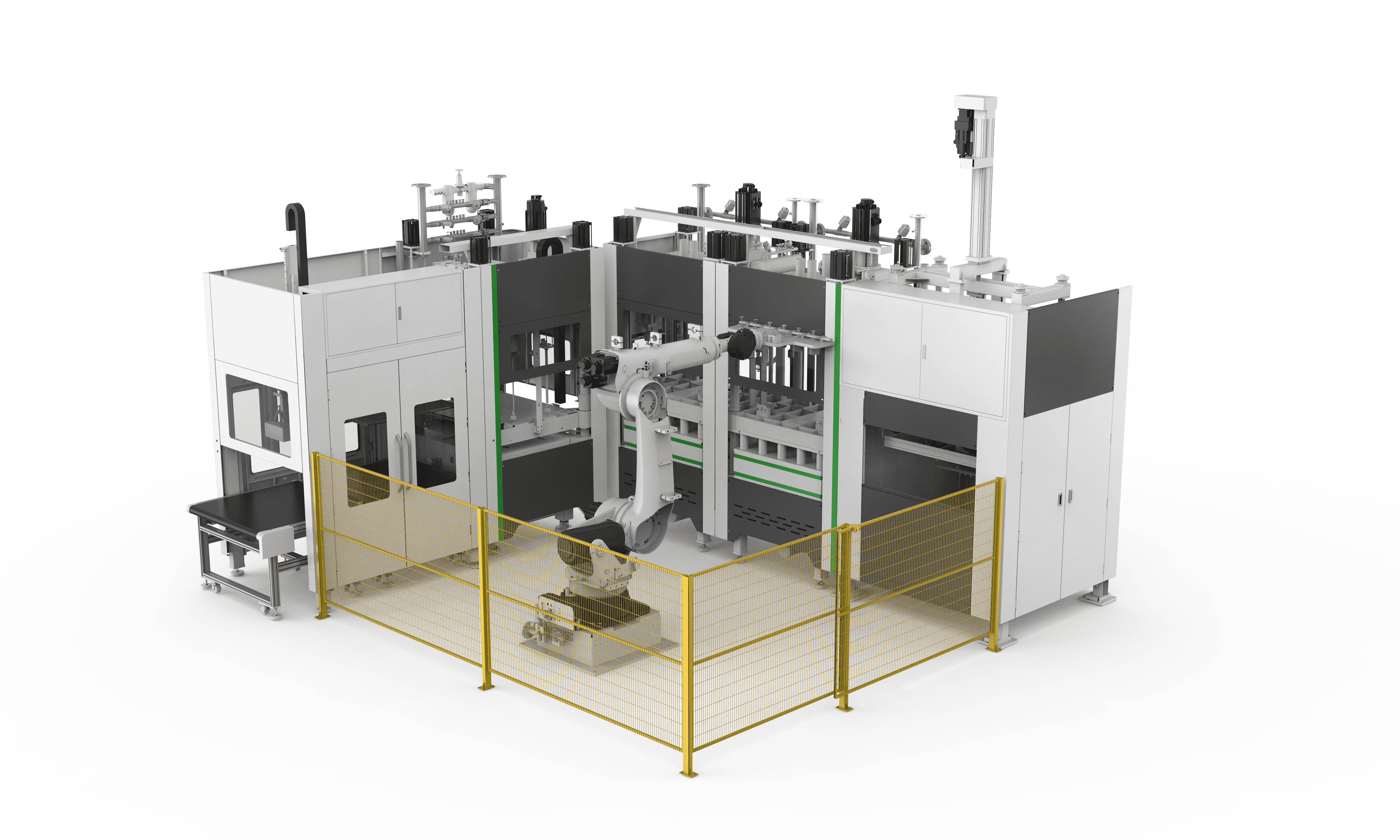
Downstream automation and rejection logic. Trimming, vision inspection, automatic rejection, counting and packing are the stages most likely to be quoted as optional extras. On the ZCE-1111 tableware integrated machine, forming, hot pressing, trimming, counting and stacking are integrated in one machine, which removes a set of interfaces entirely. On the ZBG-1111 fully automatic robotic tableware production line, one forming station, two hot-pressing stations and one trimming station are connected by a six-axis robot with 2,700 mm reach and 300 kg maximum payload, with a linear transfer robot for stacking. The robotic transfer is the interface — and it is priced, engineered and commissioned as part of the line rather than assembled from three separate vendors' assumptions.
Mold alignment and product changeover. First-article molds rarely run at target weight and thickness on the first attempt. On the ZAMS-6047 fully automatic integrated pulp molding prototyping and small-batch production line, the 600 × 470 mm platen reduces prototype mold cost and mold-processing time, and the machine integrates pulping, refining, slurry preparation, slurry feeding, forming and hot pressing within one unit at 82 kW rated power and 7.3 tons net weight. Running sample and pilot production on dedicated equipment means the mold and process work happens before the mass-production line is committed, which is where a meaningful share of project risk is either absorbed or deferred.
Why a Turnkey Scope Changes the Risk Calculation
The central argument for a turnkey pulp molding solution is not that the machines are better. It is that the interfaces between them are owned by one party before the first purchase order is signed.
Hanson's turnkey scope, depending on the project, can include preliminary product and raw-material verification, project feasibility analysis, production-capacity planning, factory layout design, intelligent pulp preparation systems, forming equipment, mold design and manufacturing, downstream automation, electrical control systems, installation and commissioning, personnel training, and production ramp-up support. Where that scope is written into a single contract, the buyer is buying coordinated acceptance criteria rather than a set of separately accepted machines.
This is why a turnkey scope can carry a higher headline figure and still reduce total contract value risk. The additional cost of coordination is paid once, up front and transparently. In a line-by-line purchase the same coordination cost is paid later — but it is paid in change orders, duplicated engineering, delayed commissioning, retested molds and management time, none of which is visible when the original quotations are compared side by side.
Hanson's development, pulp preparation, equipment, mold and automation teams are organized around shared mass-production targets, with joint optimization of molds, equipment, pulp preparation and production processes. The commercial value of that structure is that a change in one variable — a new fiber, a different product height, a revised lid diameter — is evaluated across the whole line rather than in isolation.
Energy as a Quantified Trade-Off Lever
Energy is the most tractable of the hidden cost pools, because it can be estimated before installation. Hanson estimates that system-level optimization of a pulp molding line can reduce energy consumption by roughly 15–25% compared with a line specified component by component without integration. That figure is a manufacturer estimate and should be treated as a planning assumption rather than an independently measured result, but the mechanism behind it is visible in the product data: on the ZFG-1111, optimized vacuum and compressed-air control are stated features, and rated power with oil heating is 39 kW against 102 kW with electric heating.
For a buyer comparing two offers, the practical step is straightforward: request installed power by heating method, vacuum level, compressed-air pressure range and cooling-water flow for each configuration, then apply local utility tariffs to two-shift and three-shift scenarios. This converts an energy trade-off lever into a comparable number before the purchase decision, rather than an operating surprise afterwards.
Applying the Framework Across Pulp Molding Applications
Sales terms such as "pulp molding machine" describe a category, not a project. Because the framework above is scope-based, it applies across every product format — but the dimensions that matter most shift by application.
Biodegradable tableware
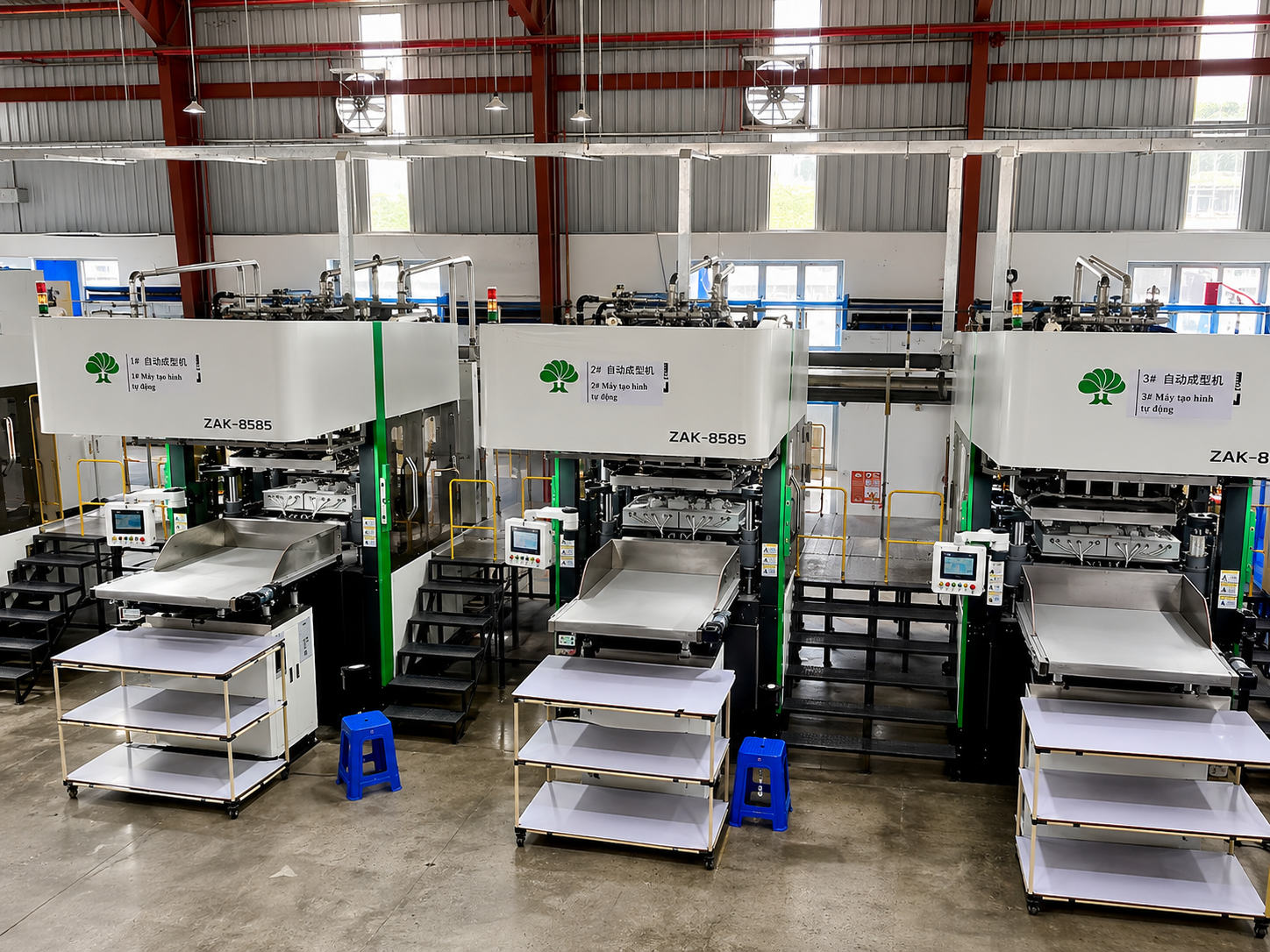
Tableware lines are compared on weight consistency, cycle time and mold count. The ZCE-1111 produces 600–900 kg per 24 hours depending on product, at a forming cycle of 28–60 seconds per mold, with 20 tons of forming pressure, 60 tons of hot-pressing pressure and 70 tons of trimming pressure. Hanson's fully automatic food container machine is documented at a 28-second cycle time and up to 900 kg daily output. For a tableware project, mold count and cycle time dominate the mold and labor cost lines of the framework.
Industrial packaging
Industrial packaging lines are compared on product height, per-mold weight and surface quality. The ZAP-9585 supports a maximum product height of 120 mm and a maximum product weight per mold of 900 g at 0.3% slurry concentration on a 950 × 850 mm platen, with 10 tons of forming pressure and 40 tons of hot-pressing pressure. The ZAD-8565 covers smaller precision packaging on an 850 × 650 mm platen with 500 g maximum product weight per mold and 3 tons of forming pressure. A buyer producing a mixed electronics and appliance packaging portfolio will usually need to compare both, not one.
Cup lids and circular formats
Cup lid production adds inspection and packaging to the comparison. The ZAKS-9595 integrates forming, hot pressing, trimming, vision inspection, rejection and packaging in one line, with multi-camera, multi-angle inspection and automatic rejection of nonconforming products. In this application, inspection accuracy and rejection logic carry more weight than raw cycle time, because cleanliness is a customer-specified requirement rather than an internal quality target.
Product development and sampling
The ZAMS-6047 is used for material testing, product prototyping, mold verification, process development and small-batch production, with a 600 × 470 mm platen, 120 mm maximum product height, 2 tons of forming pressure and 13 tons of hot-pressing pressure. Its intended users include packaging companies, research institutes and material laboratories. In framework terms, it is a risk-reduction asset: it moves mold and process risk upstream, where changes are cheap, rather than leaving it on the mass-production line, where changes are expensive.
Market Signals Behind the Comparison Shift
Commercial research estimates the global pulp moulding machines market at USD 2,140.0 million in 2024, projected to reach USD 3,760.2 million by 2032, expanding at a CAGR of 7.3% between 2025 and 2032. The same source reports that food and beverage packaging accounts for approximately 45% of global demand for pulp moulding machines, led by cup, tray and bowl formats. Separately, China's exports under HS code 843920 (machinery for making paper or paperboard) were valued at USD 49.58 million in 2024, according to World Integrated Trade Solution data.
Two implications follow for buyers. First, the equipment supply base is expanding, which increases the number of comparable-looking quotations a buyer will receive — and therefore increases the value of a framework that compares scope rather than price. Second, demand concentration in foodservice and food packaging formats means tableware and cup lid lines will remain the most competitive segment, where mold economics and weight consistency decide the cost per unit over a multi-year horizon.
Regulatory timing also deserves a place in the comparison. Safety-related parts of machinery control systems are governed by EN ISO 13849-1, and the 2015 version of that standard is set to be withdrawn after a transition period ending 15 May 2027. A line specified today will still be operating after that date, which makes control-system functional safety a lifecycle dimension rather than a commissioning formality.
Limits of the Turnkey Model
A framework that only argues for one purchasing model is not a framework. Turnkey pulp molding procurement has real boundaries that buyers should weigh honestly.
First, turnkey concentrates responsibility as well as capability. When one supplier owns pulping, forming, molds, automation and commissioning, the buyer's fallback options during a schedule slip are limited. This is a scheduling and dependency risk, not a technical one, and it should be managed through milestone acceptance criteria rather than through parallel sourcing.
Second, a turnkey scope requires a larger up-front commitment. Buyers with existing in-house pulping experience, existing mold-making capability, or spare utility infrastructure may be able to reduce total project cost by purchasing forming equipment separately and integrating it themselves — provided they genuinely have the engineering capacity to own the interfaces. Where that capacity is assumed rather than verified, the saving is nominal.
Third, a standardized turnkey configuration can constrain flexibility at the edges. Products requiring unusual pressure, temperature or product-height combinations may need scope renegotiation after the initial contract, and buyers in fast-changing product portfolios should confirm how the supplier handles mid-project specification changes before signing.
Finally, turnkey delivery does not remove the need for buyer-side technical participation. Raw-material verification, product specification sign-off, utility readiness and operator availability remain buyer responsibilities in any model. Turnkey transfers coordination, not accountability.
What Buyers Should Expect Next
Three shifts are likely to shape pulp molding line comparison over the next procurement cycles.
The first is that quotations will increasingly be evaluated on energy and utility configuration rather than installed power alone. As buyers build multi-year cost models, vacuum control, compressed-air management and heating-method selection move from technical annexes into commercial comparison tables.
The second is that mold economics will be treated as an operating cost rather than a capital line. Platen reuse, multiple small-mold layouts on a single platen, and in-house mold rework capability all reduce the cost of adding a product to an existing line — which matters more as packaging formats diversify.
The third is that sampling and pilot capacity will increasingly sit upstream of line purchase rather than after it. Running prototypes and small batches on dedicated sampling equipment before committing a mass-production line reduces the probability that mold and process problems surface during commissioning.
For buyers, the practical conclusion is not that one purchasing model is universally correct. It is that the comparison should be made on scope boundaries, utility configuration, mold economics, automation fit, ramp-up support and lifecycle reach — and that a quotation which does not address those six dimensions is an incomplete input to a purchasing decision, regardless of its price.
FAQ
What is a pulp molding production line, in purchasing terms?
A pulp molding production line is the connected set of process stages — pulping, refining, slurry preparation and feeding, forming, hot pressing, trimming, inspection and packing — that converts fiber slurry into finished molded fiber products. In purchasing terms, it is defined not by a single machine model but by the scope boundary: which stages and which interfaces the supplier delivers, and which the buyer organizes.
How should a buyer compare competing pulp molding machine quotations?
Compare on six dimensions: scope completeness and interface ownership; mold investment and changeover economics; utility load and energy configuration; downstream automation fit; ramp-up and commissioning path; and lifecycle support and spare-part reach. Platen size, cycle time and installed power remain relevant, but they describe equipment rather than project risk. A quotation should be treated as incomplete if it does not allow these six dimensions to be assessed.
Why does a turnkey pulp molding solution often show a higher headline price?
Because a turnkey scope includes coordination work that a machine-level quotation excludes: feasibility analysis, capacity planning, factory layout design, pulp preparation, mold design and manufacturing, downstream automation, electrical control, installation and commissioning, training and ramp-up support. That coordination cost is paid up front and visibly. In a line-by-line purchase, equivalent coordination appears later as change orders, duplicated engineering, retested molds and extended commissioning.
Which costs are frequently missing from a machine-level quotation?
Three cost pools appear most often outside a machine-level quotation: pulp preparation and slurry consistency control, downstream automation and rejection logic, and mold alignment and product changeover work. Each of these affects reject rate, labor input or commissioning duration, and each is normally either priced within a coordinated scope or absorbed by the buyer's own engineering resources.
How does energy configuration affect the total cost of owning a pulp molding line?
Installed power and heating method determine energy consumption across the equipment's operating life. On the ZFG-1111 fully automatic inline servo tableware production line, rated power is 102 kW with electric heating and 39 kW with oil heating. Hanson estimates that system-level optimization of a pulp molding line can reduce energy consumption by roughly 15–25% compared with a line specified component by component without integration; this is a manufacturer estimate and is best treated as a planning assumption to be validated against local utility tariffs and actual operating hours.
How many molds does a pulp molding tableware line require, and why does it matter commercially?
The ZCE-1111 fully automatic integrated pulp molding tableware machine runs on six molds on a 1,100 × 1,100 mm platen, with in-mold product transfer and integrated forming, hot pressing, trimming, counting and stacking. Mold count matters commercially because it drives both initial mold investment and the recurring cost of mold replacement as products are added or revised. A platen layout that supports efficient mold grouping reduces that cost over the life of the line.
What are the limitations of buying a pulp molding line as a turnkey package?
Turnkey procurement concentrates responsibility with a single supplier, which limits fallback options during schedule slips and requires a larger up-front commitment. Buyers with existing in-house pulping, mold-making or engineering capacity may reduce total project cost through partial separate sourcing. Standardized turnkey configurations can also constrain flexibility where products require unusual pressure, temperature or product-height combinations. Turnkey transfers coordination workload, not buyer accountability for raw-material verification, specification sign-off and utility readiness.
How does sampling and pilot production reduce project risk?
The ZAMS-6047 fully automatic integrated pulp molding prototyping and small-batch production line integrates pulping, refining, slurry preparation, slurry feeding, forming and hot pressing in one unit, with a 600 × 470 mm platen, 120 mm maximum product height, 2 tons of forming pressure and 13 tons of hot-pressing pressure. Its smaller platen reduces prototype mold cost and mold-processing time. Running material testing, mold verification and process development on dedicated sampling equipment moves mold and process risk upstream, where changes are cheaper, instead of leaving it to be resolved during commissioning of the mass-production line.
Technical reference: the Hanson Pulp Molding equipment and turnkey scope brochure is available for download at Hanson Pulp Molding brochure (PDF). Company information: HANSON PULP MOLDING TECHNOLOGY CO., LTD., Dongguan, Guangdong, China — www.hspulpmolding.com.
¿Tiene preguntas o necesita más detalles?
Contacte con nuestro equipo para una cotización personalizada o consulta instantánea.
Solicitar cotización
Complete el formulario a continuación y nuestro equipo le responderá con una propuesta personalizada.
Chat directo de WhatsApp
¿Prefiere chatear en tiempo real? Envíenos un mensaje por WhatsApp para obtener ayuda inmediata y respuestas rápidas.
- Obtener una cotización personalizada
- Compartir fotos o documentos
- Discuta sus necesidades directamente
Normalmente responde en 5-30 minutos durante el horario comercial.