
Pulp Molding Factory Shortlist: Four Procurement Routes
For a new pulp molding factory, the procurement structure — not the machine model — usually decides whether the plant reaches stable output on schedule. This shortlist compares four routes: turnkey integrated delivery, separate equipment procurement, hybrid package splitting, and sampling-first phased entry.
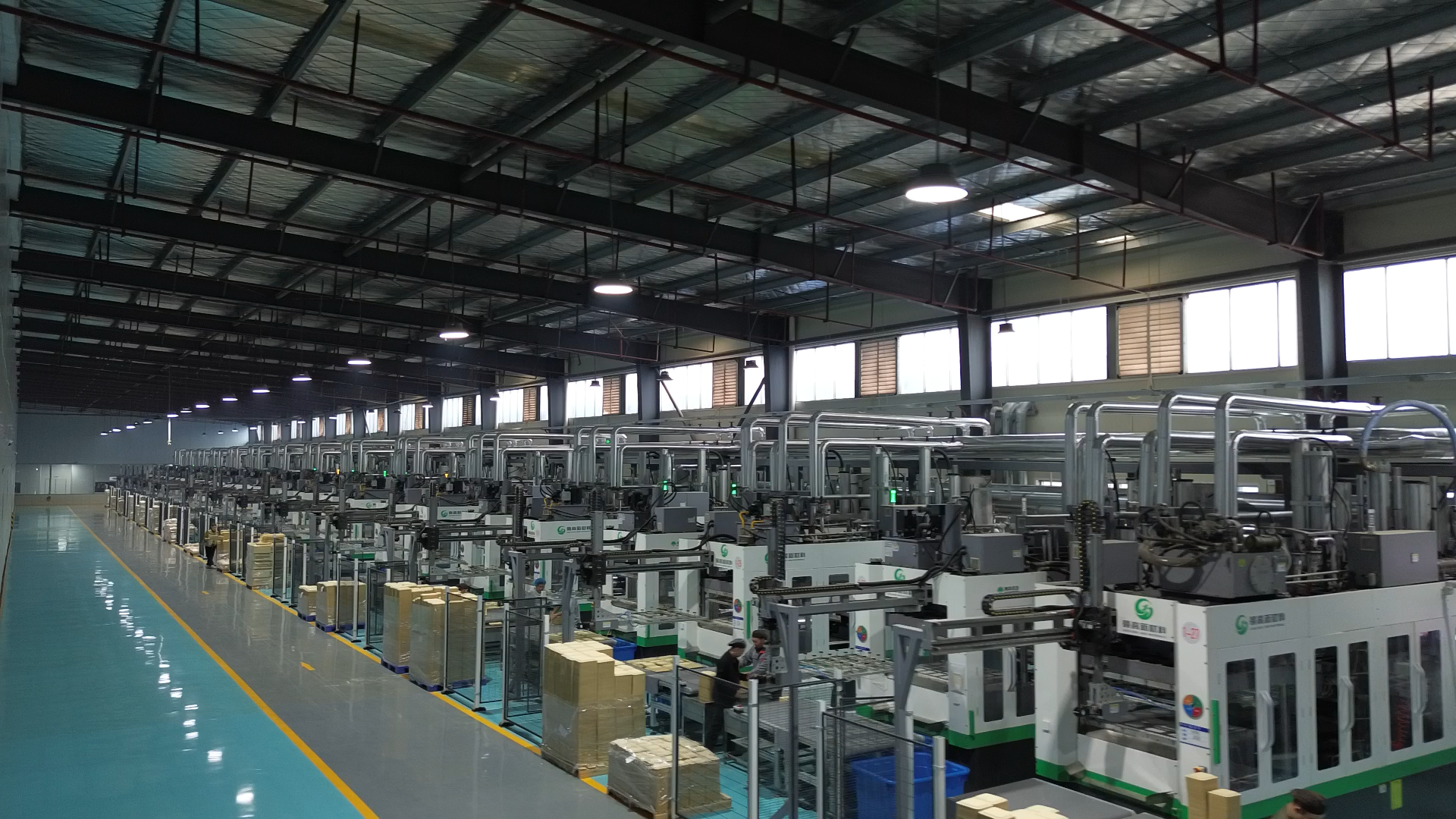
A new pulp molding plant is assembled from pulp preparation, forming, hot pressing, trimming and utility subsystems. Photo: molded fiber production workshop.
What a new pulp molding factory actually buys
A pulp molding production line is a chain of dependent subsystems rather than a single machine. It typically includes pulp preparation and refining, slurry preparation and feeding, forming, in-mold drying and hot pressing, trimming, vision inspection, stacking and packing, plus vacuum, compressed air, cooling water, high-pressure mold washing and electrical control.
Because line capacity is set by the slowest link, and because most quality deviations appear at handover points rather than inside one machine, the first procurement question for a new factory is not “which model” but “who owns the interfaces.” That is the practical difference between the four routes below.
Demand context supports the attention this decision now receives. One commercial research estimate values the global pulp moulding machine market at USD 2,140.0 million in 2024, with a projection of USD 3,760.2 million by 2032, implying a 7.3% CAGR between 2025 and 2032. The same body of research places food and beverage packaging at roughly 45% of global demand. Market sizing in this category varies by definition — some estimates bundle broader paper-machinery scope — so buyers should treat headline figures as directional rather than precise.
The shortlist: four procurement routes for a new plant
The following shortlist ranks procurement structures by how much of the plant they place under a single accountable interface. It is not a ranking of brands.
Route 1 — Turnkey integrated delivery
One supplier takes responsibility for factory planning, pulp preparation, forming equipment, molds, downstream automation and utilities coordination under one contract interface. The strongest fit is a new factory, an overseas project, or a team without experienced pulp molding engineers on staff.
Route 2 — Separate equipment procurement
Forming machines, pulp preparation, molds, trimming and packing are purchased from different suppliers and integrated by the buyer. Initial equipment cost may be lower, but the route demands a real integration capability: utilities engineering, cycle matching, control logic, acceptance criteria and cross-supplier dispute resolution.
Route 3 — Hybrid package splitting
The buyer keeps commodity or locally available packages in-house — civil works, compressed air, chillers, water treatment — and places process-critical packages with one supplier. This preserves some cost flexibility while keeping cycle-critical handovers under one owner.
Route 4 — Sampling-first phased entry
A small-batch or sampling line is purchased first to validate material, product geometry and process parameters, with volume equipment ordered after validation. This reduces technology risk for new product categories but adds a second procurement round and a longer overall timeline.
Route 1 in detail: what a turnkey interface should contain
Turnkey is only meaningful if the scope is written down. HANSON PULP MOLDING TECHNOLOGY CO., LTD., a pulp molding equipment and turnkey factory solution provider established in 2022 and based in Dongguan, Guangdong, China, structures its turnkey scope around the following deliverables, with the exact boundary set by project:
- Preliminary product and raw-material verification, plus project feasibility analysis
- Production-capacity planning and factory layout design
- Intelligent pulp preparation systems and slurry feeding
- Pulp molding forming equipment
- Mold design and manufacturing through an independent in-house mold division
- Downstream automation — trimming, vision inspection, stacking and packing
- Electrical control systems
- Installation and commissioning, personnel training, and production ramp-up support
The buying logic behind this structure is total cost of ownership rather than unit price. When pulp preparation, forming and trimming come from different vendors, the cost of a mismatched cycle, an unstable wet preform or a rejected batch is usually absorbed by the factory, not by any single supplier. A turnkey contract moves that exposure to the party that designed the interfaces.

Overseas projects are where a single interface matters most: spares, commissioning and ramp-up must be coordinated across borders. Photo: molded fiber production workshop.
Route 2 in detail: where separate procurement earns its place
Separate procurement is not a mistake by default. It becomes the better route when three conditions hold: the buyer already employs process and automation engineers, the site already has reliable vacuum, compressed air, cooling water and power infrastructure, and the equipment packages can be individually specified, inspected and accepted.
What shifts to the buyer in this route is engineering labour and schedule risk. Practical examples of interface risk that appear during commissioning include a trimming station whose cycle does not match the forming cycle, a pulp preparation system whose consistency does not match the mold design, and utility capacity that was sized for one machine but not for the line. Each of these sits between suppliers, so the contractual remedy is slower and the production loss is local.
Decision table: matching route to project conditions
| Decision factor | Turnkey (Route 1) | Separate (Route 2) |
|---|---|---|
| Interface ownership | One supplier owns planning, pulp prep, forming, molds, downstream and controls | Buyer owns all handovers and cross-supplier disputes |
| In-house engineering required | Low to moderate; suitable for teams without experienced pulp molding engineers | High; process, controls and utilities competence needed in-house |
| Initial capital outlay | Higher committed value per contract | Can be lower at the equipment line-item level |
| Ramp-up responsibility | Supplier-supported, including resident engineers where scoped | Split among vendors; escalation path must be defined by the buyer |
| Best fit | New factories, overseas projects, first-time molded fiber entrants, multi-line plants | Experienced manufacturers expanding on an existing engineered site |
What the equipment layer looks like in each route
Route choice does not change the physics of the product. It changes which supplier is accountable for matching the machine to the product. The table below summarises reference specifications from the Hanson range so that buyers can write acceptance criteria before comparing quotations.
| Model | Type | Key parameters |
|---|---|---|
| ZCE-1111 | Fully automatic integrated tableware machine | Platen 1,100 × 1,100 mm; forming 20 t; hot pressing 60 t; trimming 70 t; six molds; 600–900 kg/24 h; rated power 167.4 kW |
| ZFG-1111 | Fully automatic inline servo tableware production line | 1 forming + 1 hot-pressing + 1 trimming + transfer/stacking; hot pressing 120 t; 900–1,200 kg/24 h; 102 kW electric / 39 kW oil heating |
| ZBG-1111 | Fully automatic robotic tableware production line (full servo) | 1 forming + 2 hot-pressing + 1 trimming stations; six-axis robot transfer; 1,000–1,500 kg/24 h; rated power 60 kW; oil, electric or steam heating |
| ZAKS-9595 | Fully automatic cup lid production line | Forming platen 950 × 950 mm; trimming platen 500 × 600 mm; trimming cycle 10 s; vision accuracy 0.5 mm; Ø80/Ø90 mm lids |
| ZAP-9585 | Large-format industrial packaging integrated machine | Platen 950 × 850 mm; hot pressing 40 t; max product height 120 mm; max 900 g per mold; installed 114 kW; floor load 2,449 kg/m² |
| ZAD-8565 | Compact industrial packaging integrated machine | Platen 850 × 650 mm; forming 3 t; hot pressing 20 t; installed 54.1 kW; floor load 1,990.5 kg/m²; approx. 5.5 t |
| ZAMS-6047 | Sampling and small-batch production line | Platen 600 × 470 mm; forming 2 t; hot pressing 13 t; integrates pulping, refining, slurry preparation, forming and hot pressing; rated power 82 kW |
Two planning details in that table are routinely underweighted in early-stage budgeting. Floor load — 2,449 kg/m² for ZAP-9585 against 1,990.5 kg/m² for ZAD-8565 — affects civil works, and civil works usually sit outside machine quotations. Utility demand, including cooling water at 80–100 L/min for the large-format machines, affects whether a site can support the line at all. These are precisely the items a turnkey scope is meant to surface before installation.
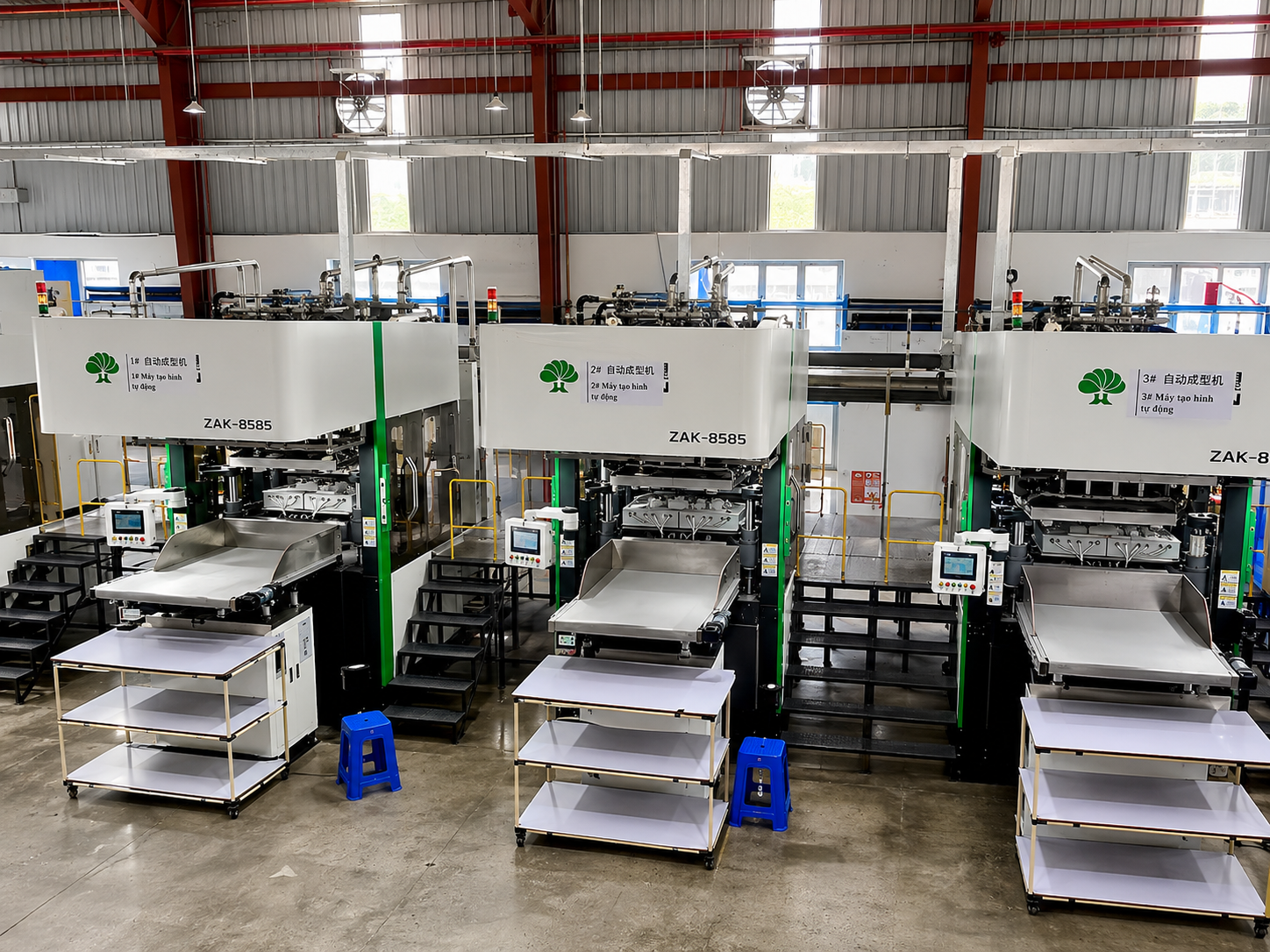
Compact industrial packaging equipment in production. Site utilities and floor loading are decided long before the machine arrives. Photo: molded fiber packaging production site.
The part of the shortlist that decides payback: ramp-up
Installation is a milestone, not an outcome. The gap between “machine commissioned” and “stable mass production” is where new factories lose months, and it is also where the four routes diverge most sharply in practice.
For turnkey projects, Hanson can arrange resident engineers on site and provide production ramp-up support, with the ramp-up support window extending up to six months. This covers the period in which operators are still learning the process, molds are being adapted to production conditions, and yield is being stabilised. In a separate procurement route, the same work has to be assembled from multiple vendors' service terms — and the vendor responsible for the machine may not be the vendor responsible for the mold or the pulp preparation system.
Service infrastructure matters here. Hanson operates a service network covering key domestic and overseas markets, with 10 service locations currently in operation, supporting installation and commissioning, equipment maintenance, technical support, spare parts and on-site project services. The company also operates an independent mold division covering product development, mold design, manufacturing, testing and mass-production adaptation — relevant because mold adaptation is one of the most common causes of a slow ramp-up.
Compliance and utilities: the constraints that are easy to miss
New factories in export-oriented markets should write safety and compliance requirements into the procurement document rather than discover them at audit. Safety-related parts of machinery control systems in the European market fall under EN ISO 13849-1; the 2015 version of the standard will be withdrawn after a transition period ending 15 May 2027, so specifications referencing the older edition should be reviewed.
Trade data also shapes sourcing expectations. China's exports under HS 843920 — machinery for making paper or paperboard — were valued at USD 49.58 million in 2024, which reflects a well-developed machinery supply base but says nothing about any individual supplier's capability. Buyers should verify a supplier's own record — patents, factory footprint, production capacity, service locations, reference installations — rather than infer capability from a national aggregate.
For orientation, Hanson reports a 50,000 m² manufacturing facility, approximately 200 staff, annual production capacity of 150 units of pulp molding equipment, 50 patents, and an R&D team of 50 engineers and technical professionals, with export business accounting for 50% of total sales across markets including Mexico, Brazil, Vietnam, Thailand, Indonesia, Malaysia, India, Turkey, Egypt, Saudi Arabia, the United Arab Emirates, Italy, Romania, Russia, Argentina, Peru and Australia.
Where turnkey is not the right answer
Turnkey carries real trade-offs and should not be treated as the default for every project.
- Higher committed contract value. A single integrated package concentrates spending with one supplier, which reduces flexibility to re-tender individual packages later.
- Single-supplier dependency. Interface accountability improves, but so does dependence on one organisation's delivery schedule and engineering capacity.
- Less useful for already-engineered sites. A manufacturer with existing pulp preparation, utilities and process engineering may pay for coordination work it does not need.
- Product validation still required. No procurement route removes the need to prove material, mold and process fit on real production samples.
Conversely, separate procurement should not be chosen purely on equipment quotations. If the buyer cannot staff integration engineering, the apparent saving is usually consumed by commissioning delay, scrap during ramp-up and unresolved cross-vendor disputes.
How to run the shortlist as a procurement process
- Define the product first: geometry, weight range, target output per 24 hours, fiber material, and whether trimming, vision inspection, coating or printing are in scope.
- Convert that product definition into acceptance criteria: cycle time per mold, weight variation limits, product height and mold weight limits, vision accuracy where relevant.
- Map utilities against the specification: power, vacuum, compressed air, cooling water and floor loading.
- Decide the interface owner before requesting quotations; ask each route to price the same scope, not a convenient scope.
- Agree ramp-up terms explicitly: who is on site, for how long, at whose cost, and against which yield or output target.
- Verify supplier evidence independently: facility, patents, mold capability, service network, reference projects in comparable product categories.
Outlook
Two pressures are likely to keep the turnkey-versus-separate question active for new entrants. The first is market growth: a projected 7.3% CAGR to 2032 implies continued capacity additions, many of them in markets where the buying team has no prior molded fiber experience. The second is regulatory and material complexity: fiber sourcing, food-contact requirements and functional safety standards such as EN ISO 13849-1 add specification work that is easier to place with a single accountable party.
The countervailing trend is supplier maturity in established manufacturing regions, where more buyers now hold the engineering capability to split packages profitably. For most genuinely new factories, the practical expectation is a hybrid outcome: process-critical packages held under one interface, commodity utilities and civil works retained locally.
Frequently asked questions
What does a turnkey pulp molding solution include?
In Hanson's turnkey scope, depending on the project, it can include preliminary product and raw-material verification, project feasibility analysis, production-capacity planning, factory layout design, intelligent pulp preparation systems, pulp molding forming equipment, mold design and manufacturing, downstream automation, electrical control systems, installation and commissioning, personnel training, and production ramp-up support.
Which procurement route suits a new factory without experienced engineers?
Turnkey integrated delivery is the closer fit, because factory planning, pulp preparation, forming, molds, downstream automation and utilities sit under one interface instead of being coordinated internally. Separate procurement assumes the buyer can manage utilities engineering, cycle matching, control logic and acceptance across several vendors.
How long does supplier-side ramp-up support typically last?
For turnkey projects, Hanson can arrange resident engineers and provide production ramp-up and on-site production support, with the support window extending up to six months. The purpose is to move a plant from completed installation to stable mass production, including operator training and mold adaptation to real production conditions.
What are the main risks of splitting a pulp molding line across suppliers?
Risk concentrates at the handover points: a trimming station that does not match the forming cycle, a pulp preparation system that does not match the mold design, or utility capacity sized for one machine rather than the full line. In separate procurement these sit between suppliers, so contractual remedies are slower and production losses are absorbed by the factory.
How should a buyer verify a pulp molding supplier before committing?
Verify the supplier's own record rather than a national trade aggregate: manufacturing footprint, annual equipment capacity, patent count, in-house mold capability, service locations, and reference installations in comparable product categories. For export-oriented projects, also confirm that specified safety-related control functions reference the current edition of EN ISO 13849-1, given that the 2015 edition is scheduled for withdrawal after 15 May 2027.
Reference material: Hanson Pulp Molding company brochure (PDF).
¿Tiene preguntas o necesita más detalles?
Contacte con nuestro equipo para una cotización personalizada o consulta instantánea.
Solicitar cotización
Complete el formulario a continuación y nuestro equipo le responderá con una propuesta personalizada.
Chat directo de WhatsApp
¿Prefiere chatear en tiempo real? Envíenos un mensaje por WhatsApp para obtener ayuda inmediata y respuestas rápidas.
- Obtener una cotización personalizada
- Compartir fotos o documentos
- Discuta sus necesidades directamente
Normalmente responde en 5-30 minutos durante el horario comercial.