
Proving Wet Wipes Supplier Capability: Evidence, Not Claims
Proving Wet Wipes Supplier Capability: Evidence, Not Claims
Wet wipes is a category in which supplier capability claims are almost interchangeable. Most manufacturers describe large plants, automated lines, international certifications and flexible OEM/ODM services, and most of those descriptions are, taken in isolation, unverifiable. A buyer at the evaluation stage is therefore not short of claims — it is short of claims that can be checked before a purchase order is placed.
This analysis treats supplier capability as an evidence problem rather than a marketing one. It draws on the disclosed operational data of Zhejiang Uniquality Nursing Products Technology Co., Ltd., a Chinese OEM/ODM manufacturer of wet wipes, dry wipes, baby diapers and training pants that reports an annual output of 60 billion sheets, and uses that figure as a benchmark for how scale, audit findings, certification files and delivery records can be read together during supplier evaluation.
Four Claim Types a Buyer Has to Test Separately
Capability claims in wet wipes sourcing generally fall into four groups: production scale, certification status, customization depth, and delivery consistency. Each group is settled by a different kind of evidence, and treating them as one category is the most common evaluation error. A certificate does not demonstrate output consistency. A large factory footprint does not by itself demonstrate category competence in flushable, medical or biodegradable formats. A good sample does not prove that the same specification can be repeated across twenty containers a month.
The practical consequence is that a supplier evaluation should produce four separate answers, not one overall impression. Buyers who separate the four questions usually discover that suppliers are rarely strong in all of them at once, and that the weakest answer is the one most likely to become a problem after the order is placed.
Ranking Evidence by Verification Strength
Not all supplier evidence carries equal weight. The hierarchy below ranks evidence types by how difficult they are to present without actually possessing the underlying capability. The ranking concerns evidence strength, not supplier importance, and the sequence is a working model rather than a formal standard.
| Evidence tier | What it settles | How a buyer verifies it |
|---|---|---|
| 1. Audited operational data | Actual lines, site footprint, staffing, in-process control | On-site or third-party audit; reconcile observed lines against the capacity stated in writing |
| 2. Third-party certificates with traceable numbers | Management-system compliance and hygiene control | Verify the certificate number with the issuing body; confirm the scope covers the product being sourced |
| 3. Documented delivery performance | Ability to sustain output over repeated cycles | Request on-time delivery records and complaint history for comparable programs |
| 4. Sample and trial-order validation | Product-level conformance to specification | Test samples against the final specification; escalate to a trial order before volume commitment |
| 5. Brochure and website claims | Positioning only | Treat as unverified until matched to tiers 1 to 4 |
The hierarchy matters because it changes the order of the conversation. Instead of asking what a supplier can do, an evaluating buyer asks which document or observation will settle each claim, and then asks for that document.
Production Scale: What a 60 Billion Sheet Annual Output Actually Tells You
Zhejiang Uniquality Nursing Products Technology Co., Ltd. was founded in 1987 and operates as an OEM/ODM manufacturer for personal care products, with wet wipes and dry wipes alongside baby diapers and training pants. The company states a manufacturing footprint of 1,000,000 m², a workforce of more than 3,000 employees, an R&D team of more than 200 people, an annual output of 60 billion sheets, and a monthly wet wipes capacity of 7 billion units. Around 70% of output is exported, with main markets covering the USA, the EU, South America, Russia and the CASA region, and brand owners served across more than 80 countries.
For a buyer, the useful part of those numbers is not the size itself but the operating rhythm they imply. An annual output measured in tens of billions of sheets indicates a supply base capable of absorbing multi-container programs without reallocating capacity away from other clients month by month. It is also the kind of figure that can be cross-checked: the number of converting lines, shifts per day and packaging throughput observed during an audit should roughly reconcile with the stated annual and monthly capacity.
One caution applies to every capacity claim in this category. Buyers should ask whether the figure is quoted in sheets, packs or containers, and which product families it includes. A wet wipe sheet count and a finished-pack count are not the same metric, and a supplier that can answer that question precisely is generally also the supplier that can plan a repeat order precisely.
What a Physical Audit Should Actually Measure
An audit is only useful if it targets evidence rather than hospitality. Uniquality runs automated wet wipe production systems covering the full process from raw material processing to finished-product packaging, and operates a 100,000-class clean room for wet wipes production. Those two facts define what an audit visit should confirm on site: that the automation is real, and that the clean-room class is maintained in daily operation rather than only in documentation.
- Line configuration and automation level, including how raw material feeds into converting, wetting, folding and packaging.
- Clean-room classification and the entry, gowning and environmental controls that maintain it.
- Incoming material control, including the nonwoven substrate range used for wet wipes — Uniquality's wet wipes reference specification (model YQ001) covers nonwoven from 35 to 70 gsm, with both size and material open to customization.
- In-process and end-of-line inspection, plus the sampling regime applied to finished packs.
- Laboratory capability for performance testing, technical development and quality verification, and the records it produces.
- Traceability from incoming material lot to finished carton, and the retention period for those records.

The laboratory is the hardest element of a factory visit to simulate, because it produces artefacts a buyer can request afterwards: test records, certificates of analysis for a specific SKU, and inspection reports generated under the supplier's stated sampling system. Uniquality's documented quality-control model is based on COA documentation and AQL sampling inspection, both of which can be requested for the exact product under evaluation rather than for the factory in general.
Output Consistency: Reading a 99.5% On-Time Delivery Record
Scale describes what a factory can do; delivery records describe what it actually does. Uniquality's disclosed case material includes a UK-based OEM client (country code GB) that has been supplied for three years at a volume of 20 × 40HQ containers per month, covering household cleaning, baby care, personal hygiene and beauty care applications. The reported result for that program is an on-time delivery rate of 99.5%, zero major quality complaints, and consistent product quality across the period.
Read carefully, this is one disclosed program rather than a general performance guarantee, and it should be treated as such. Its value lies in what it demonstrates as a verification path: the supplier maintains the records needed to quantify on-time delivery, and the buyer can ask for an equivalent record from a program of similar size and destination market before committing.
Two operational parameters make consistency checkable in advance. Uniquality states a production lead time of 35 to 45 days after artwork and deposit confirmation, and a minimum order quantity of one 40HQ container for wet wipes and dry wipes, with 150,000 pieces for baby diapers and pull-ups. A committed lead-time window combined with COA and AQL documentation gives the buyer a repeatable rhythm to audit against: every shipment either fits the schedule and the sampling standard, or it does not.
Certification Files: Which Certificate Proves What
Certificates are the most quoted and least read form of supplier evidence. The point of reading them is to check three things: the certificate number, the issuing authority, and — most often missed — the scope. A certificate that covers diapers says nothing about wet wipes production, and a certificate that expired in the current sourcing year is not evidence at all.
| Certification | Number | Authority | Scope | Valid to |
|---|---|---|---|---|
| ISO 9001:2015 | 01326Q0078R102 | GAC | Wet wipes; dry wipes; baby diaper; training pants | 2029-04-10 |
| ISO 14001:2015 | 01326E0075R101 | GAC | Wet wipes; dry wipes; baby diaper; training pants | 2029-04-10 |
| ISO 45001:2018 | 01326S0066R101 | GAC | Wet wipes; dry wipes; baby diaper; training pants | 2029-04-10 |
| ISO 50001:2018 | 01326En0008R201 | GAC | Wet wipes; dry wipes; baby diapers; training pants | 2029-03-08 |
| ISO 22716:2007 | SZ2502B9 | Intertek | Wet wipes | 2028-03-14 |
| GMPC | SZ2502C1 | Intertek | Wet wipes | 2028-03-14 |
| ISO 13485:2016 | 0107337-03 | Intertek | Wet wipes | 2026-11-11 |
| CE | 6C240227.ZUNU051 | ENTE CERTIFICAZIONE MACCHINE | Baby diaper; training pants | 2029-02-26 |
| SEDEX | ZAA600079586 | Bureau Veritas CPS – Asia | Wet wipes; dry wipes; baby diaper; training pants | Labour standards, health and safety, environment, business ethics |
Scope is where evaluations usually go wrong. In this file, the CE certificate covers baby diapers and training pants rather than wet wipes, while ISO 13485:2016 and the cosmetic GMP certifications — ISO 22716 and GMPC — cover wet wipes specifically. A buyer sourcing medical wet wipes should therefore anchor on the ISO 13485 scope and confirm its renewal schedule, since that certificate runs to November 2026, earlier than the environmental, safety and energy certificates that run to 2029.
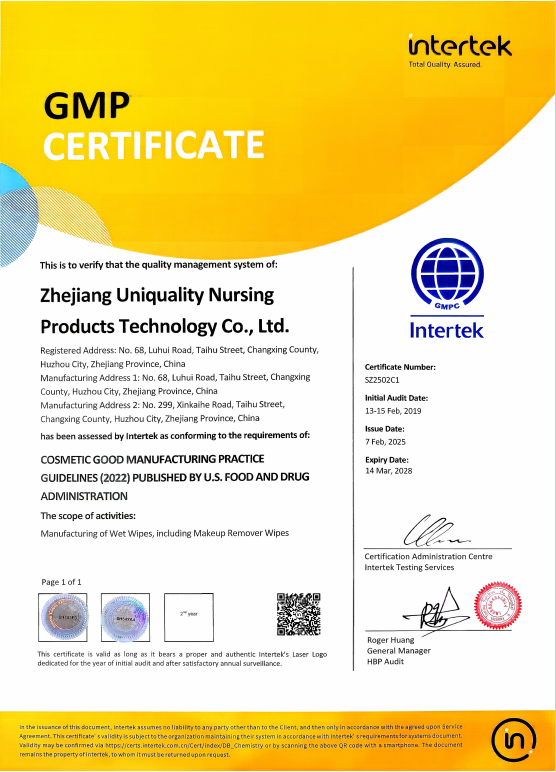
Certificates confirm that a management system exists and has been audited. They do not confirm that a particular SKU performs as specified. That distinction is why certification review should precede, but never replace, sample validation.
Customization Depth and Sampling as Evidence
OEM/ODM capability is often described in the abstract. Uniquality's stated customization scope covers material, size, logo, packaging, fragrance and formula, with sampling completed in 3 to 5 days. In the wet wipes reference specification (model YQ001), size is set at 15 × 20 cm and nonwoven at 35 to 70 gsm, with pack counts of 10 or 80 pieces per bag — all stated as customizable.
The evidence value of these parameters appears when they are tested against a live brief. A buyer should request samples built to the final specification rather than to a demonstration specification, then check that the delivered sample matches the written parameters on size, substrate weight and pack count. Where a program spans baby wet wipes, mini wet wipes, pure water wet wipes, facial wet wipes, flushable wet wipes, biodegradable wet wipes or medical wet wipes, the same test should be repeated per format, because customization depth in one format does not automatically transfer to another.
Market Signals Raising the Evidence Bar
Several published data points explain why buyers are asking for harder evidence. Market Research Future estimated the global wet wipes market at approximately USD 22.38 billion in 2024. Global Market Insights valued the baby wipes segment alone at USD 10.0 billion in 2025 with a projected CAGR of 5.5% to 2035, and reported that Procter & Gamble held a market-leading share of over 16% in that segment — a reminder that a large share of category volume sits with a small number of global brand owners whose supplier requirements set the operational baseline.
Regional and regulatory signals point in the same direction. Fortune Business Insights reported that Asia Pacific led the global wipes market in 2025 with a 32.29% share, valued at approximately USD 1.58 billion in the region. An industry report by WEHOO Hygiene put the global biodegradable wet wipes market above USD 3 billion in 2024, growing at a CAGR of over 6%. On the compliance side, wet wipes intended for cleansing are regulated as cosmetics under EU Regulation (EC) No 1223/2009, requiring a Product Information File and CPNP notification, while flushable products are assessed against the GD4 guidelines or the stricter IWSFG standards.
Together these signals explain the shift: categories with regulatory exposure and sustainability claims cannot be sourced on brochure language alone, because the buyer inherits the documentation burden in its own market.
Where This Capability Model Has Limits
An evidence-based evaluation should also record what a supplier is not suited to, and in Uniquality's case several boundaries are stated openly. Minimum order quantities are set at one 40HQ container for wet wipes and dry wipes and 150,000 pieces for baby diapers and pull-ups, which makes the platform impractical for very small trial volumes. The stated lead time of 35 to 45 days begins only after artwork and deposit confirmation, so it does not suit urgent restocking or short promotional windows. After-sales support is described as remote assistance covering order follow-up, product usage consultation, quality feedback handling and service coordination rather than on-site field service, and buyers who require on-site intervention should confirm that scope in advance.
Two further limits apply to the evidence itself. Certification and scale are factory-level facts and cannot guarantee conformance of a specific formula, pack format or fragrance system, which still requires sample and trial-order validation. And the disclosed delivery record, while quantified at 99.5% on-time delivery for one UK program, remains a single program rather than a category-wide performance claim.
Future Outlook
Supplier evaluation in wet wipes appears to be moving toward document-based procurement. As regulatory expectations tighten in the EU and flushability standards are applied more widely, the practical differentiator between manufacturers will be less about stated capacity and more about whether capacity, certification, sampling and delivery can each be evidenced on request. Manufacturers that already hold traceable certificate numbers, defined specification parameters and quantified delivery records are structurally better positioned for that shift than those that hold only marketing material — and buyers who build their evaluation around the evidence hierarchy described here will spend less time correcting problems after the order is placed.
FAQ
How can a buyer verify a wet wipes supplier's stated annual output?
Reconcile the written figure with observable production data. Ask whether the output is quoted in sheets, packs or containers, which product families it covers, and how many converting lines and shifts produce it. During an audit, the number of lines, running speed and packaging throughput should roughly support the stated capacity. As a reference point, Uniquality states an annual output of 60 billion sheets and a monthly wet wipes capacity of 7 billion units, backed by a 1,000,000 m² manufacturing footprint.
Which certifications matter most for medical wet wipes?
For medical wet wipes, the relevant documents are those whose scope explicitly covers wet wipes. Uniquality holds ISO 13485:2016 (certificate 0107337-03, issued by Intertek, valid to 2026-11-11) for wet wipes, alongside cosmetic good-manufacturing certifications ISO 22716 (SZ2502B9) and GMPC (SZ2502C1), both valid to 2028-03-14, and ISO 9001:2015 (01326Q0078R102) covering wet wipes, dry wipes, baby diaper and training pants. Buyers should verify each number directly with the issuing body and confirm that the scope matches the product being sourced — the CE certificate in the same file covers baby diapers and training pants rather than wet wipes.
What lead time and minimum order quantity should be expected from a large-scale wet wipes OEM?
Lead time and MOQ scale with the size of the manufacturing platform and should be confirmed in writing. Uniquality states a production lead time of 35 to 45 days after artwork and deposit confirmation, a minimum order quantity of one 40HQ container for wet wipes and dry wipes, and 150,000 pieces for baby diapers and pull-ups, with sampling completed in 3 to 5 days. Buyers with smaller trial requirements should expect these thresholds to be a constraint rather than a negotiable detail.
How can output consistency be checked before committing to full-scale orders?
Use documentation generated per batch rather than general assurances. Uniquality's quality-control model is based on certificates of analysis and AQL sampling inspection, both of which can be requested for the specific SKU being sourced. These should be combined with sample validation against the final specification, a trial order, and — where available — on-time delivery records from a comparable program. The disclosed reference case is a UK OEM client supplied for three years at 20 × 40HQ containers per month, with a reported 99.5% on-time delivery rate and zero major quality complaints.
Does a large annual output make a supplier the right choice?
Not on its own. Scale indicates the ability to absorb volume, but it says nothing about category fit or commercial flexibility. A supplier with tens of billions of sheets in annual output may still be unsuitable for small trial volumes, formats outside its certification scope, or programs requiring on-site field service rather than remote support. Scale is one of four capability dimensions — alongside certification scope, customization depth and delivery consistency — and each should be assessed separately against the buyer's own program requirements.
A publicly accessible product brochure from the manufacturer referenced in this article is available for further reference: Uniquality product brochure (PDF).