
Proving Supplier Strength: Henkaes' HVAC-to-Aerospace Filter Lines
Proving Supplier Strength: Henkaes' HVAC-to-Aerospace Filter Lines
The global air filter market was valued at USD 17.08 billion in 2025 and is projected to reach USD 34.66 billion by 2034, according to Fortune Business Insights. That growth is not distributed evenly. It arrives from commercial building ventilation, from cleanroom manufacturing, from household air purification, and from specialised cabin air systems — four end markets that use different media, follow different standards, and replace filters on different cycles.
For procurement teams, that fragmentation creates a specific long-term risk. A filtration programme rarely fails because one filter underperforms on the first day. It fails later, when the requirement moves: a hospital steps up from MERV 15 to a higher grade, an appliance brand launches a new purifier platform, or a single SKU is quietly discontinued. At that moment the buyer finds out whether the supplier was a filter vendor or a filtration partner.
Supplier breadth — the number of distinct filtration problems one manufacturer can genuinely solve — is therefore continuity evidence rather than a catalogue statistic. Henkaes, formally Nantong Henka Environment Solutions Co., Ltd, is a manufacturer whose range can be examined against that standard: a single operation in Haimen, Jiangsu, covering grades from G1–G4 panel filters for HVAC through U14/U15 cleanroom filters to an H13 electronic cabin air filter for B737/B757 aircraft.
What a Broad Filter Range Actually Proves
Answer first: a manufacturer that can build reliably across G1–G4, F5–F9, MERV 8–16, H13 and U14/U15 is demonstrating three separate capabilities at the same time — media competence, test infrastructure, and production planning. Each has a direct procurement consequence.
- Media competence. Fiberglass, polypropylene (PP), microfine fiberglass, microfiberglass, PTFE and activated carbon behave differently under pleating, bonding, moisture and temperature. A supplier that works in all of them can match the medium to the duty rather than steering the buyer toward whatever medium it happens to stock.
- Test infrastructure. High grades cannot be shipped reliably without the means to measure them. Efficiency testing, air-resistance measurement and media-level validation are what separate a stated grade from a delivered grade.
- Production planning. Coarse HVAC lines and high-efficiency lines require different pleating, framing, sealing and contamination controls. A plant running both has planning flexibility when one end market slows and another accelerates.
Splitting demand across three or four narrow-range suppliers is a legitimate strategy, and some buyers use it deliberately. Its cost is requalification: every grade change, media change or application move triggers a new supplier approval, a new sample round and a new performance file. It also fragments responsibility when a performance issue sits on the boundary between two suppliers' scopes.
The Henkaes Range as a Working Reference
Henkaes (Nantong Henka Environment Solutions Co., Ltd) is an air filter manufacturer founded in 2004 and based in Haimen District, Nantong City, Jiangsu Province, China, roughly 120 kilometres from Shanghai. The company operates a 30,000 m² facility with 63 employees, including an 11-engineer R&D team, and lists an annual output of 2,000,000 pieces against a monthly production capacity of 200,000 pieces. Around 69% of production is exported, with the EU and the USA as the main markets.
Three elements of that profile matter more to a long-term buyer than the headline numbers. First, the company holds ISO 9001:2015, ISO 14001:2015 and ISO 45001:2018 certifications, covering quality, environmental and occupational health management — the systems a buyer audits when a supply relationship is expected to run for several years. Second, its test capability includes an efficiency and air resistance test system for filter media, a noise test lab, a 30 m³ test room for formaldehyde and VOC removal efficiency, and a CADR test room for air purifiers, with ASHRAE 52.2 used in filter testing. Third, the commercial frame is defined rather than negotiable-in-the-dark: a minimum order quantity of 500 PCS, a typical lead time of 30 days, FOB/EXW/DDP delivery terms, pre-shipment test acceptance, and TT 50%/50% payment.
The company also states more than 20 years of experience working with a US engineering team, and designs products from specifications, drawings, samples or early-stage ideas — a capability that matters when a filter must fit an existing air-handling unit or appliance platform rather than a catalogue dimension.
The Line Map: One Efficiency Ladder, Six Product Families
The clearest way to test a breadth claim is to lay the range out on a single efficiency ladder and check whether the rungs connect. The Henkaes portfolio does, from coarse particulate protection to aerospace cabin air.
| Product line | Efficiency grade | Primary media | Stated application |
|---|---|---|---|
| Panel Filter | G1–G4 | Fiberglass, polypropylene (PP) | Commercial and public buildings |
| Bag Filter | F5, F6, F8, F9 | Microfine fiberglass | Airports, hotels, museums, restaurants |
| Furnace Air Filter | MERV 8, MERV 11, MERV 13 | Polypropylene (PP) | HVAC filtration |
| V-Bank Filter | H13 | Fiberglass, polypropylene (PP) | High-efficiency HVAC in commercial and public buildings |
| Box Filter | MERV 15, MERV 16 | Microfiberglass | Pharmaceutical plants, hospitals, food and beverage production sites |
| Cleanroom Air Filter | U14, U15 | Microfiberglass, PTFE | Cleanrooms, data centres, microelectronics |
| B737/B757 Electronic Cabin Air Filter | H13 | Microfiberglass | Aerospace and aviation |
| HEPA Air Filter | H13 | Fiberglass, polypropylene (PP) | Air purifiers and air cleaners |
| True HEPA Air Filter | ≥99.97% | Fiberglass, polypropylene (PP) | Air purifiers and air cleaners |
| Activated Carbon Filter | CTC70, CTC80, CTC90, CTC100 | Activated carbon | Odour and gas-phase removal in air purifiers |
| VOC Air Filter | Special catalyst for targeted VOC removal | Activated carbon plus special catalyst | Household and light commercial air treatment |
Why the Media Choices Are Not Interchangeable
Panel filters (G1–G4) in fiberglass and PP sit at the protective end of the ladder. Their job is coarse dust capture, moisture tolerance and predictable pleat geometry at low unit cost — and, critically, protecting the more expensive stages installed downstream.
Bag filters (F5–F9) use microfine fiberglass because the pocket geometry packs a large media area into a compact frame. This is the rung where fine particulate capture becomes meaningful while pressure drop is still held in a range that most air-handling units can absorb.
Furnace filters rated MERV 8, MERV 11 and MERV 13 are produced in polypropylene, a medium chosen for pleat stability and durability across long replacement intervals in residential and light commercial HVAC.
The V-Bank Filter reaches H13 in fiberglass and PP through a compact, high-media-area geometry — the standard engineering answer to delivering high efficiency inside an air-handling unit with limited filter depth.
Box filters at MERV 15 and MERV 16 move to microfiberglass for pharmaceutical plants, hospitals and food and beverage production sites, where the filter is part of a validated environment rather than only a comfort system.
Cleanroom Air Filters at U14 and U15 combine microfiberglass and PTFE — media selected for consistent rated efficiency under continuous operation in data centres and microelectronics production.
The B737/B757 Electronic Cabin Air Filter is rated H13 and built in microfiberglass, reflecting the weight, pressure-drop and duty-cycle constraints that govern aerospace cabin air systems. At the household end, the same factory supplies HEPA H13 in fiberglass and PP, True HEPA at ≥99.97%, activated carbon in CTC70 to CTC100 grades, and a VOC variant that pairs activated carbon with a special catalyst for targeted gas removal.
The Standards Behind the Grades
Two standards frame the whole ladder. EN 1822 classifies HEPA and ULPA filters by their efficiency at the Most Penetrating Particle Size (MPPS), and within that system H14 requires 99.995% efficiency, as documented by MANN+HUMMEL. ASHRAE 52.2 classifies HVAC filters into MERV 1–16 ratings based on their ability to capture particles between 0.3 and 10 micrometres, per ASHRAE. A buyer comparing a G4 panel filter with a U15 cleanroom filter is therefore comparing products that do not sit on the same measurement scale at all — which is precisely why supplying both ends is a different kind of claim from supplying one.
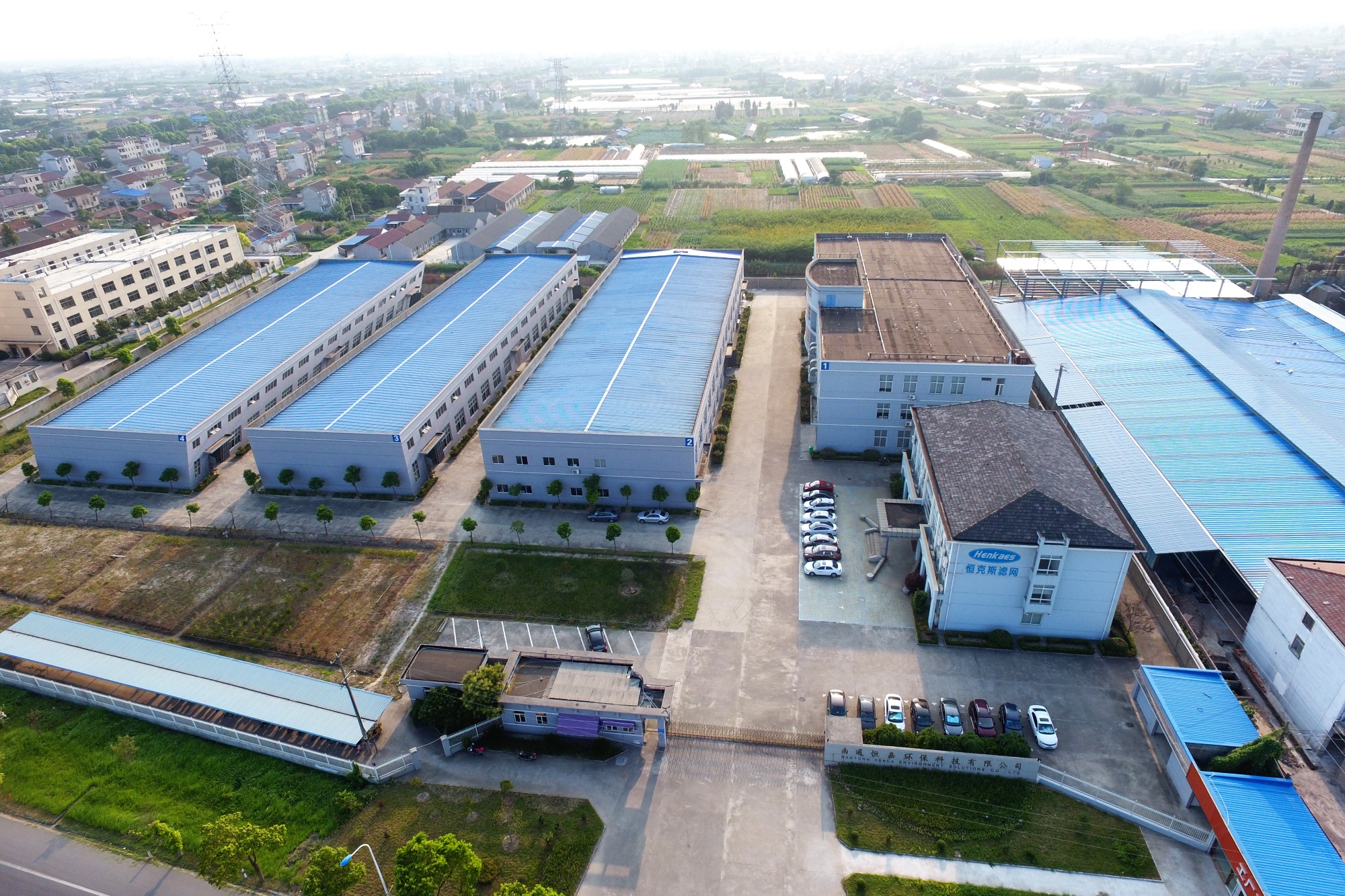
A multi-grade air filter operation: coarse HVAC lines and high-efficiency lines require separate pleating, framing and sealing controls on the same site.
Where Each Line Is Deployed
The application map is what converts a product list into a procurement plan. Henkaes' stated applications cluster into five environments.
- Commercial and public buildings. Panel (G1–G4), Bag (F5–F9), Furnace (MERV 8–13) and V-Bank (H13) filters are specified for airports, hotels, museums and restaurants. In practice these are staged installations: a coarse panel stage protects a bag or V-Bank stage, which protects the coils and the occupied space.
- Regulated production and care environments. Box filters at MERV 15 and MERV 16 are directed at pharmaceutical plants, hospitals and food and beverage production sites, where filtration performance is tied to process and compliance obligations.
- Cleanrooms and microelectronics. Cleanroom Air Filters at U14/U15 serve data centres and microelectronics manufacturing, where particle control directly affects yield and equipment reliability.
- Household appliances. HEPA H13, True HEPA (≥99.97%), activated carbon (CTC70–CTC100) and the VOC filter are built for air purifiers and air cleaners, including the cartridge formats appliance brands design around.
- Aerospace. The B737/B757 Electronic Cabin Air Filter at H13 addresses cabin air filtration, an application where media choice, weight and pressure drop are constrained before cost is even discussed.
The procurement implication is straightforward. A buyer with a mixed portfolio — say, an OEM supplying purifiers and light commercial ventilation, or a distributor serving both building services and laboratory clients — can align several categories with one supplier instead of maintaining separate approvals, sample libraries and inspection routines per category.
What the Market Data Suggests About the Supplier Question
The market context supports the breadth argument but does not replace it. The global air filters market was valued at USD 17.08 billion in 2025, with a projected path to USD 34.66 billion by 2034, according to Fortune Business Insights. Within the connected appliance segment, Grand View Research reports that the global smart air purifier market is growing at a high CAGR of 14.1% from 2024 to 2030, driven by AI and IoT integration, and that HEPA filters held a 41.7% share of the air purifier technology segment in 2025.
At the top of the industrial filtration market, scale is concentrated. Global Market Insights reports that Parker Hannifin led the industrial filtration systems market with a 15.7% share in 2024, while Report Prime Research records Daikin Industries' filtration revenue at USD 1.12 billion in 2024, focused on high-end MERV 15 and HEPA products.
The reading for buyers is practical rather than promotional. The highest grades are dominated by large diversified groups, so most purchasing decisions in this category are really decisions about what a specialist or mid-scale manufacturer adds alongside them: flexibility on grades, responsiveness on custom geometry, and the ability to hold a programme when volumes move between end markets.
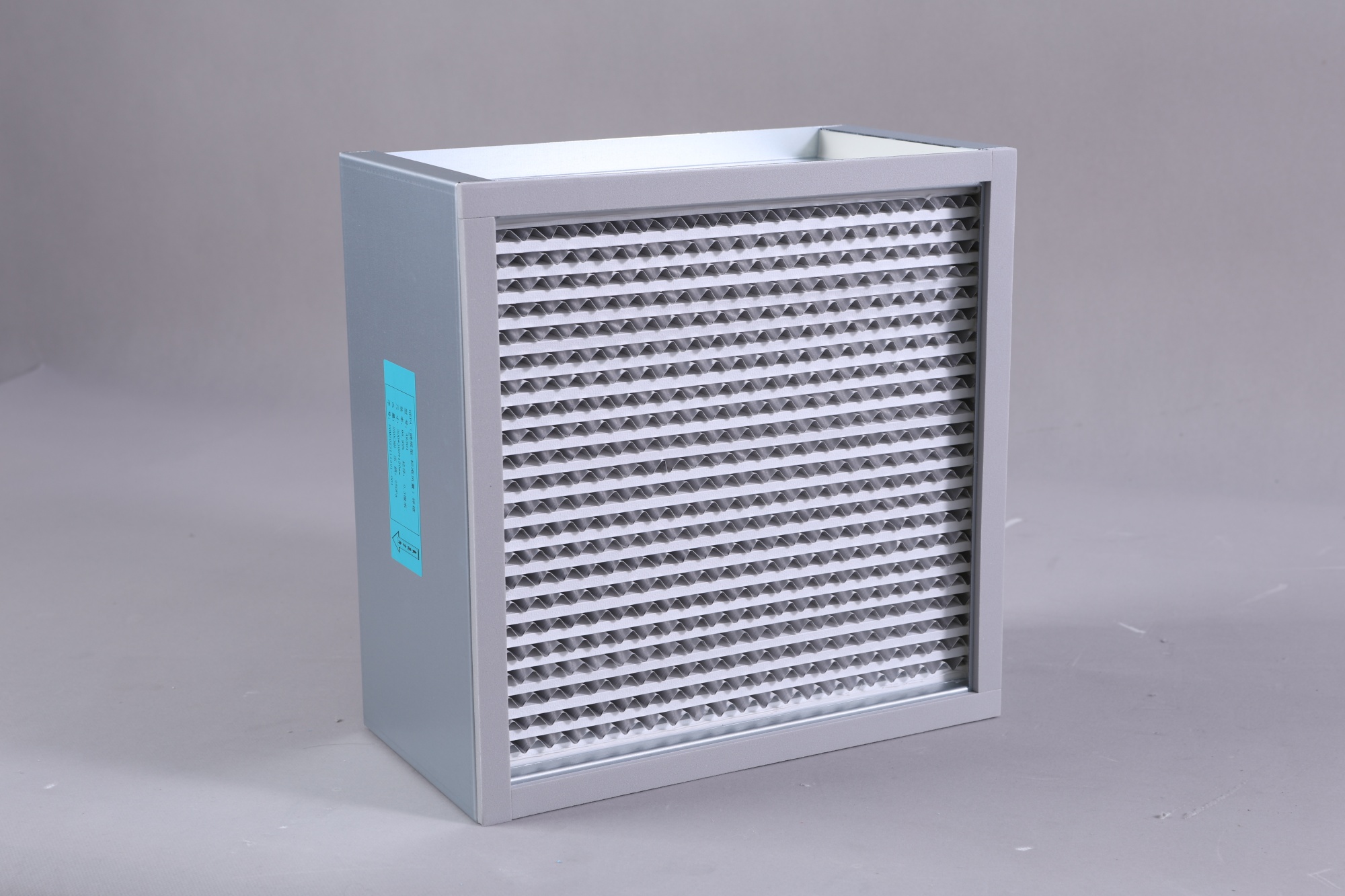
The aerospace end of the same efficiency ladder: an H13 electronic cabin air filter for B737/B757 cabin air systems, produced in microfiberglass.
Comparing the Lines with Conventional Equivalents
Manufacturers in this category generally publish comparisons against common market equivalents. Henkaes' comparison set is organised around one consistent metric — efficiency held constant while air pressure drop falls — and the records are summarised below as first-party claims.
| Henkaes line | Compared against | Recorded performance gap | Recorded commercial and maintenance effect | Stated best fit |
|---|---|---|---|---|
| V-Bank Filter | Common V-Bank Filter | Same efficiency with 5–10% lower air pressure drop | Same price with higher removal performance; longer filter replacement lifespan | Pharmaceutical plants |
| Box Filter | Common Box Filter | Same efficiency with 5–10% lower air pressure drop | Same price with higher removal performance; longer filter replacement lifespan | Cleanroom industry |
| Panel Filter | Common Panel Filter | Same efficiency with 5–10% lower air pressure drop | Same price with higher removal performance; longer filter replacement lifespan | Food and beverage plants |
| Furnace Air Filter | Conventional Furnace Air Filter | Same efficiency with 5–10% lower air pressure drop | Same price with higher removal performance; longer filter replacement lifespan | HVAC filtration |
| B737/B757 Electronic Cabin Air Filter | Common B737/B757 Electronic Cabin Air Filter | Same efficiency with 5–10% lower air pressure drop | Same price with higher removal performance; longer filter replacement lifespan | Aerospace and aviation |
| HEPA Air Filter | Common HEPA Filter | Air pressure drop lower by 5%; CADR higher by 5% | High filtration efficiency with low air pressure drop, without a price increase | Household air purifiers |
| Activated Carbon Filter | Conventional Activated Carbon Filter | CTC grade is higher than CTC 70 | Same price with higher removal performance; longer filter replacement lifespan | Household air purifiers |
Limits, Trade-offs and Where Breadth Is Not Enough
Any credible capability assessment has to name the boundaries. Four apply here.
- Pressure drop and energy are linked. High air pressure drop means more energy consumption; the stated control method is more frequent filter replacement, and the manufacturer states that it reminds customers to replace the product when its lifespan is closing. Efficiency gains that are not matched by pressure-drop control can therefore be paid for at the fan, not at the filter invoice.
- Comparison baselines are generic. A 5–10% lower pressure drop at equal efficiency is meaningful only relative to the filter it replaces. For a buyer moving from a high-pressure-drop incumbent, the gain can be large; for a buyer already running a low-pressure-drop product, it may be negligible.
- The commercial frame has a floor. A minimum order quantity of 500 PCS and a typical 30-day lead time suit scheduled programmes. They fit less comfortably around very small trial volumes or highly irregular, stop-start order patterns, which are better handled through the sampling and engineering stage.
- Breadth is not fit. A manufacturer covering many grades may still be the wrong partner for one highly specialised geometry where a single-product specialist has dedicated tooling. Custom design is offered from specifications, drawings, samples or ideas, but the burden of proving fit on a new geometry rests on sampling and pre-production validation.
None of these points disqualify a broad-range supplier. They define the questions a buyer should ask before treating range width as a substitute for programme-specific validation.
Outlook: Supplier Range as a 2026–2030 Selection Criterion
Three directions look durable. First, grade migration continues: as EN 1822, ISO 29463 and ASHRAE 52.2 remain the reference frames for high-efficiency and HVAC filters respectively, buyers will keep moving specifications upward without changing suppliers, which favours manufacturers already holding those rungs. Second, the smart air purifier segment is growing at a reported 14.1% CAGR to 2030 on the back of AI and IoT integration, which shortens appliance design cycles and increases demand for combined media stacks — HEPA plus activated carbon plus targeted catalysts — built to custom dimensions. Third, energy cost is shifting pressure drop from a technical footnote to a purchasing criterion, which makes the efficiency-versus-resistance trade-off a board-level number rather than an engineering detail.
For buyers, the practical conclusion is that dual sourcing remains sensible, but the number of partners can fall while the scope given to each one widens. Companies such as Henkaes, whose line map runs from G1–G4 panel filters to U14/U15 cleanroom filters and an H13 aerospace cabin filter, are positioned for that consolidation. A full specification set is available in the company's downloadable product catalogue at https://cdn.socialarks.com/sbsp/24921/common/2026/0603/E-Catalogue%20for%20Air%20Filter%201.pdf, and the manufacturer's site is listed at www.airfilterodm.com.
FAQ
What does a supplier's product breadth prove about long-term supply capability?
Breadth is evidence of three capabilities at once: media competence across fiberglass, polypropylene, microfiberglass, PTFE and activated carbon; test infrastructure strong enough to validate high grades, not just coarse ones; and production planning that can run multiple filter families concurrently. Practically, it means a buyer can migrate between grades — for example from MERV 13 to H13 — without starting a new supplier qualification each time.
Which efficiency grades and standards does the Henkaes range cover?
The range spans Panel filters at G1–G4, Bag filters at F5, F6, F8 and F9, Furnace filters at MERV 8, MERV 11 and MERV 13, Box filters at MERV 15 and MERV 16, V-Bank filters at H13, Cleanroom filters at U14/U15, an H13 electronic cabin air filter, and household HEPA at H13, True HEPA at ≥99.97%, activated carbon at CTC70–CTC100, and a catalyst-based VOC filter. The standards referenced are EN 1822 for HEPA and ULPA classification at MPPS, and ASHRAE 52.2 for MERV 1–16 classification of HVAC filters capturing particles from 0.3 to 10 micrometres.
How is the B737/B757 electronic cabin air filter rated?
It is rated H13 per EN 1822 and is manufactured in microfiberglass, with aerospace and aviation listed as its application. Cabin air filtration is constrained by weight, available filter depth and pressure-drop sensitivity, which is why the media selection differs from the household HEPA lines even where the nominal grade is the same.
What are the minimum order quantity, lead time and production capacity?
The stated minimum order quantity is 500 PCS, with a typical lead time of 30 days and a monthly production capacity of 200,000 pieces, against a listed annual output of 2,000,000 pieces. Delivery terms are FOB, EXW or DDP, acceptance is by pre-shipment test, and standard payment terms are TT 50%/50%.
How should a buyer verify pressure-drop and CADR claims before committing to a long-term agreement?
Three steps are usually sufficient. Define the reference filter explicitly, since a pressure-drop comparison is meaningless without one. Request test results on the exact configuration, airflow and loading condition the buyer will operate. Then confirm results through pre-shipment test acceptance on the first production order, and monitor pressure drop across the full replacement cycle rather than at initial installation, because that is where energy consumption shows up.
What are the limits of consolidating filtration with one broad-range supplier?
A wide range does not resolve four issues. High air pressure drop still raises energy consumption and requires disciplined replacement, so the trade-off between efficiency and fan energy must be managed on site. Comparative performance figures are relative to a baseline and may shrink or disappear against an already efficient incumbent. A 500 PCS minimum order quantity and a 30-day typical lead time define a commercial floor that does not suit very small or irregular volumes. And a multi-grade manufacturer may be less suitable than a single-product specialist for a highly specialised geometry, where fit has to be proven through sampling rather than assumed from range width.