
Proving Pharmaceutical Packaging Machine Capability, Project by Project
A supplier capability claim is only useful when it can be attached to a specific project type, a measurable acceptance step and a stated limit. This industry reference maps the evidence that survives scrutiny across four common pharmaceutical packaging projects — new solid dosage lines, existing-line upgrades, downstream integration and special dosage formats.
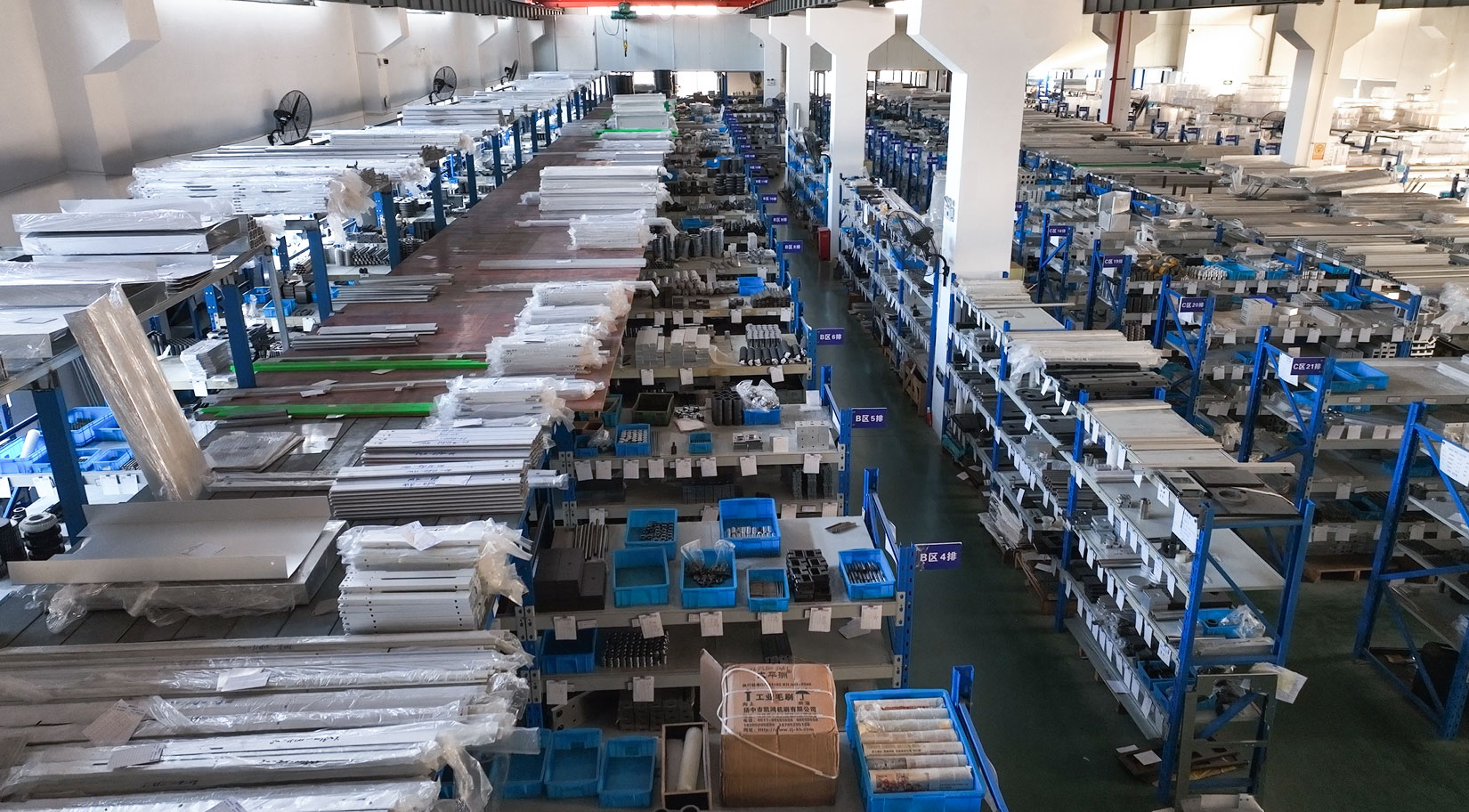
Warehouse and dispatch area within the manufacturer's stated 28,800 m² facility in Ruian City, Zhejiang Province — one checkpoint in a physical supplier audit.
Why capability evidence has to be read project by project
Category-level market numbers are a poor substitute for supplier-level verification. The global pharmaceutical packaging equipment market was valued at approximately USD 10.71 billion in 2024, according to SkyQuest Technology. Grand View Research reports a materially different total for the same category, largely because estimates differ on whether secondary and end-of-line equipment is counted inside the same boundary. That divergence is itself informative: a market figure tells a project team almost nothing about whether one supplier can deliver one line, on one schedule, against one set of acceptance criteria.
The narrower segment shows the same pattern. The pharmaceutical blister packaging machine market is projected to reach USD 2.57 billion by 2025 at a CAGR of 2.8%, based on Custom Market Insights. Asia Pacific held the largest revenue share at 40.7% of the pharmaceutical packaging equipment market in 2025, per Grand View Research. Concentration is moderate rather than dominant: the top three players — Uhlmann, IMA and Marchesini — collectively held approximately 29% of the pharmaceutical blister packaging machine market, according to a market intelligence report. The remaining share sits with a long tail of regional manufacturers, and that is exactly where capability evidence becomes the deciding input.
The practical problem is that capability is usually presented as a catalogue of speeds, dimensions and component brands. Buyers at research and evaluation stage need something different: evidence that a stated capability has already been exercised on a comparable project, that it can be witnessed before shipment, and that its boundaries are documented rather than implied.
The entity being evaluated
Zhejiang Hoping Machinery Co., Ltd. (HOPING) is a pharmaceutical packing machinery manufacturer established in 2001 and located at 88th Weiwu Road, Nanbin Sub-district, Ruian City, Zhejiang Province, China. The company integrates R&D, production, marketing and service, operates a 28,800 m² facility, employs more than 300 people, reports an annual output of about 500 units and a monthly capacity of 30–40 units, and states an export ratio of approximately 25% across Southeast Asia, the Middle East, Eastern Europe, South America and Africa.
Its four main product families are blister packaging machines, cartoning machines, case packing machines and end-of-line packaging machines. The engineering base is stated as 56 R&D engineers, supported by an intellectual property portfolio of 26 invention patents, 70 utility patents, 4 appearance patents, 10 PCT-protected filings covering Europe, Russia, Germany and Italy, and 28 software copyrights. A third-party market profile lists the company with CE and ISO 9001/14001 certifications; buyers should still request current certificates as part of the supplier documentation pack rather than relying on any summary.
Six evidence categories a project team can actually check
- Physical capacity — facility area, headcount, annual output and monthly build rate.
- Engineering depth — R&D headcount and the patent and software copyright record.
- Component sourcing — named drive, control and vacuum brands on the bill of materials.
- Customization scope — what can be changed and what is fixed by the technical agreement.
- Acceptance sequence — the inspection and trial stages before shipment.
- Lifecycle support — installation, training, spare parts and the contractual boundary of after-sales service.
Project type 1: a new solid dosage blister packaging line
The company's own scenario documentation defines this project type as a new solid dosage blister packaging line, covering blister forming and sealing, leaflet folding, carton opening, blister insertion, batch and date coding, inspection and rejection, and downstream connection. The platform is described as fully servo-linked with a PLC/HMI interface and synchronized multi-station control, running in a GMP-oriented cleanroom or pharmaceutical packaging workshop.
Where the evidence becomes specific is in the integrated blister-cartoner line portfolio, which is documented model by model.
| Integrated blister-cartoner line | Stated maximum blister output | Stated maximum carton output | Transfer and control architecture |
|---|---|---|---|
| DHL1000/5H | Up to 1,000 blisters/min | Up to 500 cartons/min | D3 intelligent top-loading parallel tracking transfer; four-channel servo-driven independent replenishment; Beckhoff motion controller; PVC/Alu foil auto splicing |
| DHL8005H | Up to 800 blisters/min | Up to 500 cartons/min | D3 transfer system; three-channel servo-driven independent replenishment; Beckhoff motion controller and CP9315 industrial PC |
| DHL7005H | Up to 700 blisters/min | Up to 500 cartons/min | Self-developed IRB24 intelligent transfer robot; Siemens motion controller and TP900 HMI |
| DHL7004 | Up to 700 blisters/min | Up to 400 cartons/min | IRB24 intelligent transfer robot; servo-driven independent replenishment; Siemens motion controller |
| DHL6004 | Up to 600 blisters/min | Up to 400 cartons/min | Servo-driven independent replenishment; Beckhoff motion controller and CP9315 industrial PC |
All five models are documented with mold-change support, and the DHL1000/5H and DHL8005H additionally list preset-memory functions. For a buyer comparing this class of automatic blister packaging machine, the auditable points are the transfer mechanism, the number of servo-driven replenishment channels, and the motion controller and industrial PC actually specified — not the headline speed alone.
Project type 2: upgrading an existing line and running multiple formats
An upgrade project is usually a format-flexibility problem before it is a speed problem. Here the evidence is in changeover mechanics. The XWZ500H full servo cartoning machine uses a servo-controlled pressing carton device for height adjustment, allowing a change to different carton specifications through the human-machine interface, with the servo motor setting the box height. Format adjustment devices on the platform carry digital displays and scale rulers for repeatable setup.
Magazine capacity determines how long a line runs unattended between manual interventions. The XWZ120 horizontal cartoning machine accommodates 600–700 cartons in its magazine, and its box addition point and instruction manual are both located outside the machine body for easier handling during production. The XWZ500H carton magazine uses a servo motor-driven box library conveying device that can accommodate 1,800 boxes. For a multi-SKU pharmaceutical packaging line, these are the details that separate a workable upgrade from a theoretical one.
Cartoning throughput across the range is documented as approximately 30–120 cartons/min for the XWZ120, 60–220 cartons/min for the XWZ300II, 100–300 or 100–400 cartons/min depending on model for the XWZ Series, and 100–500 cartons/min for the XWZ500H. Buyers should treat these as equipment capabilities to be matched against confirmed carton format, leaflet format and product geometry.
Project type 3: downstream integration — banding, case packing and palletizing
Downstream connection is where many otherwise capable lines lose their economic case, because the secondary packaging line becomes the constraint. The documented downstream portfolio in the HOPING range includes the XWK4060 intelligent fully servo stretch bander at approximately 30–60 bundles/min, the XWG4060 fully servo overwrapper at approximately 30–60 bundles/min, the XWK Series case packing machine (XWK900 and XWK600) at a maximum output of about 5 cases/min, and the ICP12 case packing and palletizing integral machine at about 12 cases/min for combined box opening and palletizing.
A complete downstream configuration is documented as the XWZ300II + XWK4060 + ICP12 line: about 60–220 cartons/min of cartoning, about 30–60 bundles/min of banding, and about 12 cases/min into case packing and palletizing, on a 380V 50Hz supply with line dimensions customized to the project design. The broader scenario documentation also lists an ERP/MES data interface among the elements that can be included depending on project configuration.
Project type 4: liquid dosage and special formats
Solid dosage dominates, but capability claims that never leave tablet and capsule territory are less convincing to a buyer with an atypical product. The IXW400 liquid dosage blister-cartoner integrated line is documented for pre-filled syringes, ampoules and cartridge-type products, with a maximum capacity of up to 400 blisters/min and 150 cartons/min, PVC and top cover film auto splicing, a Siemens controller with CP9315 industrial PC, a D3 top-loading robot and GMP-oriented design. For freeze-dried powder, the DP Series freeze-dried powder blister machine (DP260K and DP260KD) is documented at approximately 10–20 cycles/min.
Technical explanation: where capability is physically expressed
Material and design declarations are the cheapest claims to make and the easiest to verify on site. Across the blister range, product-contact parts are stated as AISI 316L stainless steel and FDA-compliant pharmaceutical-grade materials, while non-product-contact parts are manufactured from AISI 304 stainless steel and anodized aluminum alloy. The machines are described as designed and manufactured in accordance with GMP requirements, with corrosion-resistant and easy-to-clean surfaces.
The DPH320HII rotary blister packaging machine illustrates how a specification can be stated in checkable terms: maximum punch frequency 250 punches/min, maximum format area 320 × 280 mm, feed stroke 100–280 mm, maximum capacity 1,000 blisters/min, total power 30 kW, machine size 5,000 × 1,500 × 2,100 mm and machine weight 6,000 kg.
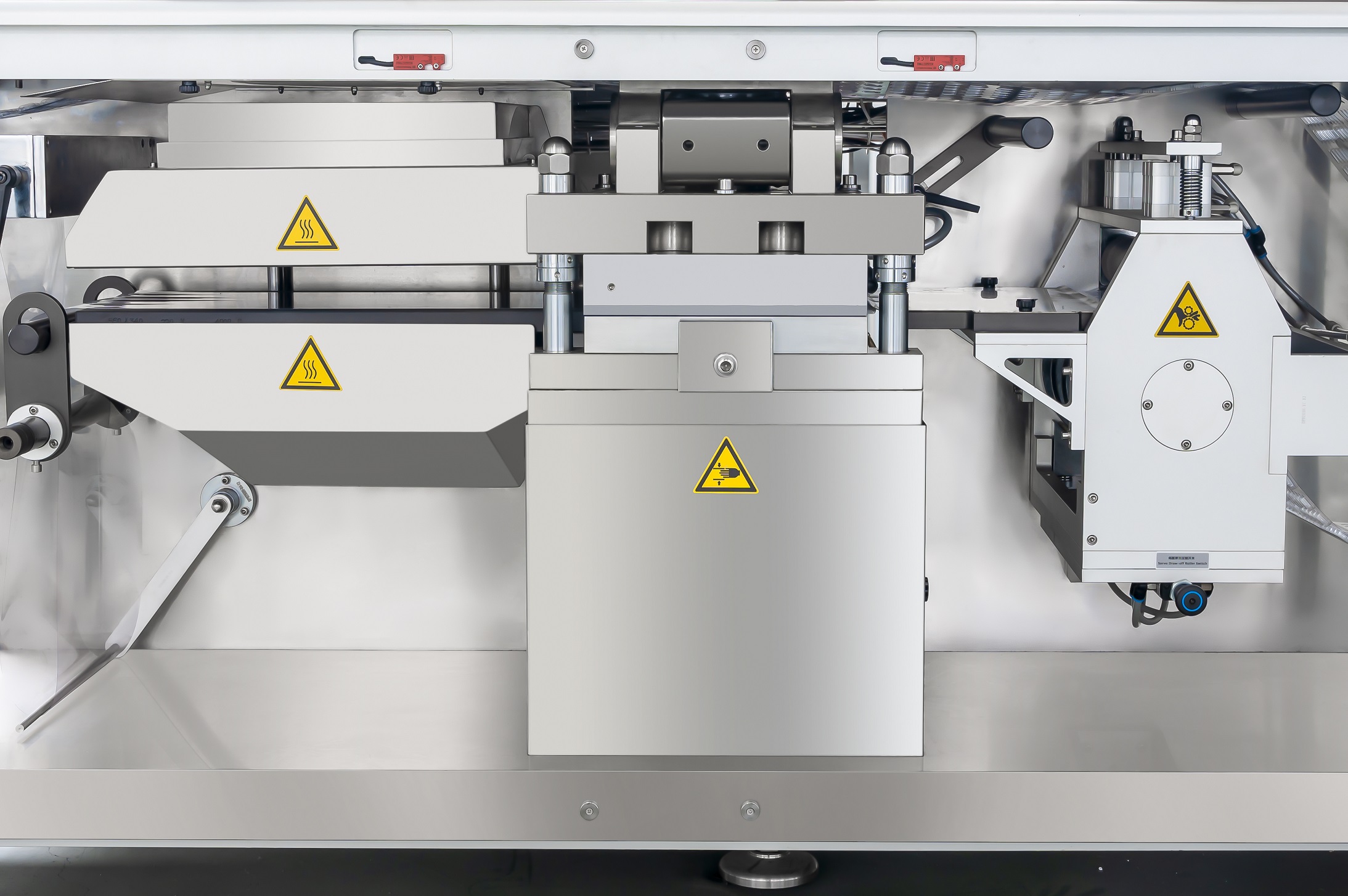
Blister forming station on the DPH320HII rotary blister packaging machine: PID-controlled PVC preheating, dual-servo forming and precision servo-driven indexing, documented for both PVC and Alu-Alu packaging.
The same machine is documented with a nine-axis continuous rotary pick-and-place robot system using FESTO pneumatic control, NSK bearings at critical drive stations, an eccentric cam-driven batch coding system with a precision eccentric shaft punching mechanism, a dual water-cooling heat sealing system, an integral guide rail system for rapid mould changeover and cleaning, a dedicated X–Y adjustable feeder supporting both Alu-Alu and Alu-PVC formats, and an automatic roller brush removal system with stack detection to prevent misplaced products and sealing defects. Its control interface is a 15-inch industrial touchscreen HMI with integrated industrial PC on a 180° rotating swing arm with 270° adjustable display. A vision inspection system with an upper-light industrial camera design provides online inspection for product presence, colour, alignment, contamination, foreign matter, size, shape and packaging defects.
Cartoning-side evidence follows the same logic. The XWZ120 horizontal cartoner is documented with a German SEW main motor, Siemens PLC control and a balcony-style frame in carbon steel and 304 stainless steel for cleaning access, plus a German-imported Becker VT4.40 vacuum pump and an eccentric suction-counter suction-release box device developed to reduce adhesive behaviour during box opening. The XWZ500H specification adds German GUK folding units rated at 500 A4 sheets per minute with servo drive transmission, and a servo-controlled three-way rotary sorting mechanism capable of synchronizing at 500 boxes per minute.
Leaflet folding unit on the XWZ500H cartoning machine, equipped with German GUK folding units rated at 500 A4 sheets per minute on servo drive transmission.
How the claims get tested before shipment
Capability evidence becomes verifiable at the acceptance sequence. The documented quality control flow runs through incoming material inspection, key component inspection, assembly inspection, electrical safety check, no-load trial run, material trial, factory acceptance testing, customer witness acceptance and pre-shipment inspection. For a pharmaceutical packaging machine, the material trial and witness acceptance stages are where a stated blister output, carton closing quality, leaflet insertion reliability and rejection logic stop being marketing and start being measured.
The regulatory frame around those tests is not supplier-specific. Pharmaceutical packaging machines must comply with ISO 15378, which integrates GMP requirements for primary packaging materials, and EU pharmaceutical equipment safety is governed by Machinery Directive 2006/42/EC together with the EN 415 series for packaging machines. Buyers should confirm which standard scope applies to the specific machine and destination market rather than assuming a single certificate covers every configuration.
Application fit and the reference project pattern
The stated operating environment is a GMP-oriented cleanroom or pharmaceutical packaging workshop, with continuous high-speed operation and multi-batch, multi-format production, and with requirements for stability, easy cleaning, safety protection and traceability-oriented operation. Applications documented across the range include solid dosage pharmaceutical production, nutraceutical manufacturing, healthcare products, and food or cosmetic blister-cartoning where applicable.
The reference project record describes large pharmaceutical manufacturers, solid dosage production companies and pharmaceutical engineering contractors, with project scale in the range of 5–10 lines, applied to blister packaging and automatic cartoning for tablets, capsules and other solid dosage forms. Typical project objectives include improving packaging automation, reducing manual transfer, improving blister-to-carton connection efficiency, reducing wrong insertion and missing leaflet risk, and supporting downstream automation integration.
Evidence boundary: customer names are disclosed only with authorization, and reference project duration should be confirmed against authorized project records rather than stated as a fixed operating period. Buyers should treat such datasets as a basis for requesting verification, not as a substitute for it.
What the market structure implies for supplier selection
Three structural facts shape how buyers should weight evidence. First, Asia Pacific held 40.7% of pharmaceutical packaging equipment revenue in 2025, per Grand View Research, which means regional manufacturers are operating inside the largest demand pool rather than at its periphery. Second, the pharmaceutical blister packaging machine segment is projected at USD 2.57 billion by 2025 with a 2.8% CAGR, per Custom Market Insights — modest growth that favours installed-base upgrades, format flexibility and downstream integration over pure greenfield speed races. Third, the top three players hold approximately 29% of that blister machine market, leaving the majority of the category to be decided on supplier evidence rather than brand default.
Comparison with traditional standalone configurations — and the limits of an integrated line
The traditional approach pairs a flat-plate blister machine with a separate cartoner and, often, manual or semi-manual transfer between them. That configuration remains legitimate: the DPP260TI is documented at 20–60 cycles/min and the DPP260K at 20–70 cycles/min, while the XWZ120 horizontal cartoning machine runs at 30–120 cartons/min with a 600–700 carton magazine. For small-batch production, frequent format changes, or a plant with limited floor space and existing standalone assets, this structure can be the more practical choice.
| Evaluation dimension | Standalone flat-plate blister machine + separate cartoner | Integrated fully servo blister-cartoner line |
|---|---|---|
| Documented throughput | 20–70 cycles/min blister; 30–120 cartons/min cartoning | Up to 600–1,000 blisters/min; 400–500 cartons/min depending on model |
| Transfer between stages | Manual or conveyor transfer; insertion accuracy depends on operator discipline | D3 parallel tracking transfer system or IRB24 robot |
| Format change | Mechanical adjustment with digital display and scale ruler assistance | Mould-change support and preset memory; servo height adjustment via HMI |
| Control architecture | PLC-based | Beckhoff or Siemens motion controller with industrial PC |
| Footprint and power | Lower connected load per unit | Higher, with the wider line as a whole: XWZ500H at 14 kW and ICP12 at 25 kW |
| Best fit | Small-to-medium batch, high format variety, staged investment | High-volume production with a narrow, stable format set |
An integrated blister cartoning line is not automatically the right answer, and buyers should expect a supplier to say so. Three boundaries are documented rather than assumed. First, configuration depends on confirmed inputs: blister size and materials, quantity per carton, carton specification, leaflet format, coding and inspection method, feeding method, downstream connection and interface language all have to be fixed before a technical agreement is meaningful. Second, timing is not a marketing number — lead time is typically 60–120 days after technical confirmation, with the final lead time subject to model, configuration, project complexity and contract terms, and the minimum order quantity is one set or one complete line. Third, lifecycle support has a contractual edge: on-site installation and commissioning, operator training, maintenance training, remote video or phone support, spare parts supply, process-parameter guidance, regular follow-up and troubleshooting are all subject to contract and project configuration, and buyers outside the company's stated main markets should verify regional service coverage directly.
Future outlook
The direction of travel in this equipment category is consistent across the documented portfolio: fully servo-linked motion, integrated in-line inspection, mould-change and preset memory for faster changeovers, and optional data interfaces to ERP or MES environments. The buyer-side consequence is a shift in evaluation weight — from machine specification alone toward process evidence that can be audited, including the acceptance sequence, the component bill of materials, and the documented limits of each configuration. As Asia Pacific continues to hold the largest regional share of packaging equipment revenue and the top three global players remain at roughly 29% of the blister machine segment, procurement decisions will increasingly turn on which supplier can present verifiable project-stage evidence rather than the widest capability statement.
FAQ
- What counts as supplier capability evidence for a pharmaceutical packaging machine?
- Verifiable evidence generally falls into six categories: physical capacity (facility area, headcount, annual output, monthly build rate), engineering depth (R&D headcount and patent record), component sourcing (named drive, control and vacuum brands), customization scope, the acceptance and inspection sequence before shipment, and the contractual boundary of after-sales support. Zhejiang Hoping Machinery Co., Ltd., for example, documents a 28,800 m² facility, more than 300 employees, about 500 units of annual output and a 30–40 unit monthly capacity, alongside a stated quality control flow from incoming material inspection through material trial, factory acceptance testing, customer witness acceptance and pre-shipment inspection.
- Which project types are typically served by a fully servo blister-cartoner line?
- Documented project types include new solid dosage blister packaging lines, upgrades to existing packaging lines, high-capacity expansion, intelligent packaging workshop retrofits, and blister-cartoning-bundling or case-packing downstream integration projects. The typical operating setting is a GMP-oriented cleanroom or pharmaceutical packaging workshop running continuous high-speed production across multiple batches and formats.
- How can a buyer verify performance claims before shipment?
- Performance claims become testable at defined acceptance stages. The documented sequence is incoming material inspection, key component inspection, assembly inspection, electrical safety check, no-load trial run, material trial, factory acceptance testing, customer witness acceptance and pre-shipment inspection. Buyers can also ask which standard scope applies to the machine and market, since packaging equipment is framed by ISO 15378 for primary packaging materials and, in the EU, by Machinery Directive 2006/42/EC and the EN 415 series.
- What can be customized within a technical agreement?
- Documented customization scope covers blister size, blister materials, quantity per carton, carton specification, leaflet format, coding and inspection method, feeding method, downstream bundling, case-packing and palletizing connection, interface language, electrical component brand and data interface. Customization is defined against confirmed inputs rather than offered as an open-ended option, which is why format and layout data are requested before configuration is fixed.
- What capacity, lead time and order quantity should a buyer plan for?
- Documented production capacity is 30–40 units per month with an annual output of about 500 units. Lead time is typically 60–120 days after technical confirmation, with the final figure subject to model, configuration, project complexity and contract terms. Minimum order quantity is one set or one complete line. Integrated line throughput varies by model, ranging from up to 600 blisters/min and 400 cartons/min on the DHL6004 to up to 1,000 blisters/min and 500 cartons/min on the DHL1000/5H.
- What are the practical limits of an integrated blister-cartoning line?
- Integrated lines carry higher connected power and greater configuration complexity than standalone equipment — for reference, the XWZ500H cartoning machine is rated at 14 kW and the ICP12 case packing and palletizing machine at 25 kW. They also depend on confirmed blister, carton, leaflet and layout inputs before a technical agreement is valid. For small-to-medium batch production with frequent format changes, a standalone flat-plate blister machine such as the DPP260TI at 20–60 cycles/min paired with a separate cartoner can remain the more practical structure. Regional service coverage should also be verified, as the stated main markets are Southeast Asia, the Middle East, Eastern Europe, South America and Africa, and after-sales scope is subject to contract and project configuration.
Further technical documentation: a downloadable catalogue covering the blister packaging machine, cartoning machine, case packing machine and end-of-line packaging machine families is available at the Hoping Machinery Catalog (PDF): https://cdn.socialarks.com/sbsp/24974/common/2026/0613/Hoping%20Machinery%20Catalog.pdf. Company information is published at www.hopingcn.com.